The Distress Analysis Interview Corpus of human and computer interviews
Jonathan Gratch, Ron Artstein, Gale Lucas, Giota Stratou, Stefan Scherer,
Angela Nazarian, Rachel Wood, Jill Boberg, David DeVault,
Stacy Marsella, David Traum, Skip Rizzo, Louis-Philippe Morency
USC Institute for Creative Technologies, 12015 Waterfront Drive, Playa Vista CA 90094-2536, USA{gratch, artstein, lucas, stratou, scherer, nazarian, rwood, boberg, devault, marsella, traum, rizzo, morency}@ict.usc.edu
Abstract
The Distress Analysis Interview Corpus (DAIC) contains clinical interviews designed to support the diagnosis of psychological distress conditions such as anxiety, depression, and post traumatic stress disorder. The interviews are conducted by humans, human controlled agents and autonomous agents, and the participants include both distressed and non-distressed individuals. Data collected include audio and video recordings and extensive questionnaire responses; parts of the corpus have been transcribed and annotated for a variety of verbal and non-verbal features. The corpus has been used to support the creation of an automated interviewer agent, and for research on the automatic identification of psychological distress.
Keywords:multimodal corpora, virtual humans, dialogue systems, nonverbal behavior
1.
Overview
Untreated mental illness creates enormous social and eco-nomic costs, yet many cases go undiagnosed. Up to half of patients with psychiatric disorders are not recognized as having mental illness by their primary care physicians (Higgins, 1994). Within health-care settings, a first step in identifying mental illness is a semi-structured clinical inter-view, where health-care providers ask a series of questions aimed at identifying clinical symptoms in an open-ended fashion. Recently, there is considerable research interest in developing tools to analyze the verbal and nonverbal con-tent of these interviews as a means for building decision-support tools (Gratch et al., 2013) and computer-assisted self-administered screenings (Bickmore et al., 2005), and for answering fundamental questions about language, non-verbal behavior and mental illness (Scherer et al., 2013b; Yang et al., 2013; Alvarez-Conrad et al., 2001).
The Distress Analysis Interview Corpus (DAIC) is a multi-modal collection of semi-structured clinical interviews. De-signed to simulate standard protocols for identifying people at risk for post-traumatic stress disorder (PTSD) and ma-jor depression, these interviews were collected as part of a larger effort to create a computer agent that interviews peo-ple and identifies verbal and nonverbal indicators of men-tal illness (DeVault et al., 2014). The corpus contains four types of interviews:
Face-to-face interviews between participants and a human interviewer (Figure 1);
Teleconference interviews, conducted by a human inter-viewer over a teleconferencing system;
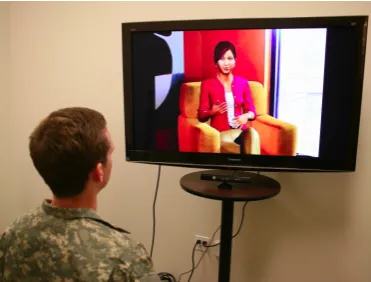
Wizard-of-Oz interviews, conducted by an animated vir-tual interviewer called Ellie (Figure 2), controlled by a human interviewer in another room;
Automated interviews, where participants are interviewed by Ellie operating as an agent in a fully automated mode.
Sample interview excerpts are shown in Figure 3.
Figure 1: Face-to-face interview setup.
Figure 2: Ellie, the virtual interviewer.
Participants are drawn from two distinct populations living in the Greater Los Angeles metropolitan area – veterans of the U.S. armed forces and from the general public – and are coded for depression, PTSD and anxiety based on accepted psychiatric questionnaires.
Condition Total Framing Distress Transcribed Biopac
Human Computer Yes No
Face-to-face 120 — — 49 71 74 20
Teleconference 45 — — 16 29 0 20
Wizard-of-Oz 193 53 140 60 133 193 66
Automated agent 263 47 216 99 164 95 71
Table 1: Interviews collected
3.
Corpus Composition
3.1.
Verbal, Nonverbal and Physiological
Instrumentation
The corpus contains audio, video, and depth sensor (Mi-crosoft Kinect) recordings of all the interactions. For the face-to-face and teleconference interactions, the inter-viewer and participant were recorded by separate cameras, lapel microphones, and Kinects; additionally, face-to-face interviews used an overhead camera to capture the general orientation of the interviewer and participant in the envi-ronment. In the Wizard-of-Oz and automated agent in-terviews, the participant was recorded by a camera, high-quality close-talking microphone, and Kinect, while the agent was recorded through screen-capture software.
A subset of the collections also include physiological data (Biopac).1 We record galvanic skin response (GSR), elec-trocardiogram (ECG), and respiration of participants. Sen-sors were attached following the pre-questionnaires but be-fore the interview. Sensors were connected to the partic-ipants’ trunk and lower-extremities to avoid interference with natural gestures. Additionally, participants were re-quired to sit at rest for three minutes, then presented a se-ries of standardized emotional pictures (Lang et al., 2008) to help calibrate the instrument and provide baseline mea-sures of physiological responsiveness.
3.2.
System logs
The Wizard-of-Oz and automated agent interviews include generated logs of the character’s speech and nonverbal be-havior events. Additionally, the automated agent logs con-tain real-time segmentation, recognition and understanding of the participants’ speech and language, which drive the agent’s actions.
3.3.
Questionnaire data
Participants completed a series of questionnaires prior to the interview, including basic demographic questions, es-tablished measures of psychological distress, and a mea-sure of current mood. The Positive and Negative Affect Scale (PANAS) was used to assess mood (Watson and Clark, 1994). Measures of psychological distress included the PTSD Checklist – Civilian Version (Blanchard et al., 1996), the Patient Health Questionnaire, depression mod-ule (Kroenke and Spitzer, 2002), and the State-Trait
Anxi-1http://www.biopac.com
ety Inventory (Spielberger et al., 1983), all of which were highly correlated, reflecting the typical comorbidity found between these clinical conditions (Gaudiano and Zimmer-man, 2010; Scherer et al., 2013b). After the interac-tion, participants completed the PANAS again, Kang and Gratch’s (2012) Rapport scale, and a measure of social desirability (Li and Bagger, 2007). They also rated their interaction partner on 32 adjectives using a 7-point likert scale with response options ranging from a positive adjec-tive (e.g., polite, kind, warm) to a negaadjec-tive adjecadjec-tive (rude, cruel, cold, respectively).
Before the interview, some participants completed a mea-sure of the five factors of personality (John et al., 1991), and others completed a measure of emotion regulation (Gross and John, 2003). After the interview, participants in the Wizard-of-Oz and automated agent conditions rated their fears of being evaluated negatively during the interview (Leary, 1983) as well as the system’s usability (Brooke, 1996); they also rated success at specific design goals (such as “Ellie was sensitive to my body language” and “Ellie was a good listener”) using a 5-point scale from “strongly dis-agree” to “strongly dis-agree”.
3.4.
Transcription
A portion of the interviews was segmented and transcribed using the ELAN tool from the Max Planck Institute for Psy-cholinguistics (Brugman and Russel, 2004).2 Each tran-scription was reviewed for accuracy by a senior transcriber. Utterances were segmented at boundaries with at least 300 milliseconds of silence. The face-to-face and early Wizard-of-Oz interviews were transcribed from a compos-ite video, combining both participant and interviewer; later Wizard-of-Oz and automated interviews were transcribed from the audio stream of the participant only, while the in-terviewer utterances were recovered from the system logs.
3.5.
Annotation
De-identification All the transcribed interviews were an-notated to remove identifying information. Utterances were tagged for mentions of personal names, specific dates, ad-dresses, schools, places of employment, and locations that can be used to narrow down an event. Utterances were not considered to be personally identifying if they only included large locations (e.g. “I live in Santa Monica”), very large institutions (“I served in the Marines”), or non-specific dates such as age in years. De-identification was
performed independently by two annotators, and differ-ences were reconciled by a senior annotator. Utterances marked as personally identifying will not be shared in ac-cordance with our institution’s ethical guidelines.
Explicit psychological conditions The corpus includes annotations of questions and statements that give an ex-plicit indication of a past or existing condition of psycho-logical distress (e.g. “She diagnosed me with a type of de-pression”). These are useful when developing systems to detect the more subtle distress signals.
Dialogue annotation Parts of the transcribed corpus have been annotated with dialogue-level information to support the development and training of natural language under-standing for the agent. Annotations include: (1) Identifica-tion of clarificaIdentifica-tion quesIdentifica-tions by the participant (e.g. “What was the question?”). (2) Places that are appropriate for the agent to provide a positive or negative empathy re-sponse (e.g. “That’s great” or “I’m sorry”), used to tune the thresholds on the valence classifier for the agent (DeVault et al., 2014); inter-rater agreement (Krippendorff, 2011) was 0.73 for positive empathy and 0.81 for negative em-pathy. (3) Domain-specific dialogue acts in participants’ responses to specific questions, to support follow-up by the agent.
Non-verbal behavior annotation Several non-verbal be-haviors were annotated (Waxer, 1974; Hall et al., 1995): gaze directionality (up, down, left, right, towards inter-viewer), listening smiles (smiles while not speaking), self-adaptors (self-touches in the hand, body, and head), fidget-ing behaviors, and foot-tappfidget-ing or shakfidget-ing behaviors. Each behavior was annotated in a separate tier in ELAN. Four student annotators participated in the annotation; each tier was assigned to a pair of annotators, who first went through a training phase until the inter-rater agreement (Krippen-dorff’s alpha) exceeded 0.7. Following training, each video was annotated by a single annotator; to monitor reliabil-ity, every 10–15 videos each pair was assigned the same video and inter-rater agreement was re-checked. Annota-tors were informed that their reliability was measured but did not know which videos were used for cross-checking (Wildman et al., 1975; Harris and Lahey, 1982).
In addition, automatic annotation of non-verbal features was carried out using a multimodal sensor fusion frame-work called MultiSense, with a multithreading architecture that enables different face- and body-tracking technologies to run in parallel and in realtime. Output from MultiSense was used to estimate the head orientation, the eye-gaze di-rection, smile level, and smile duration. Further, we au-tomatically analyzed voice characteristics including speak-ers’ prosody (e.g. fundamental frequency or voice intensity) and voice quality characteristics, on a breathy to tense di-mension (Scherer et al., 2013a).
4.
Usage
The corpus has been used to support the automated agent’s interactive capabilities by developing custom acoustic and
language models for speech recognition, training classi-fiers for natural language understanding, and informing the creation of dialogue policies; for details, see DeVault et al. (2014). The corpus has also been used to support the agent’s capabilities for distress detection, using multiple types of information including visual signals, voice qual-ity, and dialogue-level features.
Visual signals from the face-to-face data show that sev-eral features can serve as indicators of depression, anxi-ety, and PTSD (Scherer et al., 2013b; Scherer et al., 2014). Specifically, these forms of psychological distress are pre-dicted by a more downward angle of the gaze, less intense smiles and shorter average durations of smile, as well as longer self-touches and fidget on average longer with both hands (e.g. rubbing, stroking) and legs (e.g. tapping, shak-ing). Moreover, the predictive ability of these indicators is moderated by gender (Stratou et al., 2013). A crossover interaction was observed between gender and distress level on emotional displays such as frowning, contempt, and dis-gust. For example, men who scored positively for depres-sion tend to display more frowning than men who did not, whereas women who scored positively for depression tend to display less frowning than those who did not. Other fea-tures such as variability of facial expressions show a main effect of gender – women tend to be more expressive than men, while still other observations, such as head-rotation variation, were entirely gender independent.
Voice qualityfrom the Wizard-of-Oz data, particularly dif-ferences on the breathy to tense dimension, is also a predic-tor of psychological distress (Scherer et al., 2013a; Scherer et al., 2014). Depression and PTSD are both predicted by more tense voice features, such that those with depres-sion and PTSD exhibit more tense voice characteristics than those without depression or PTSD. Tense voice features were, specifically, able to distinguish interviewees with de-pression from those without dede-pression with an accuracy of 75%, and distinguish those with PTSD from those with-out PTSD with an accuracy of 72%.
Overall, the corpus helps with the identification of subtle indicators of psychological distress along multiple behav-ioral dimensions; these indicators will be implemented in the agent, to allow it to identify people who should be re-ferred to further evaluation. In addition, the corpus has been used for research that does not directly support develop-ment of the agent; for example, some research has consid-ered how interviews might differ depending on the method of data collection (face-to-face, Wizard-of-Oz, automated agent interviews). A comparison of face-to-face and wizard dialogues found that participants use twice as many filled pauses when talking to the animated character than when talking to a live interviewer – precisely the opposite of pre-vious results on people talking to task-oriented dialogue systems, where they were less disfluent when talking to the computer (Faust and Artstein, 2013). An investigation of the effects of framing the character as human-controlled or autonomous showed that participants felt lower fear of negative evaluation and engaged in less impression man-agement when the character was framed as autonomous than when it was framed as human-controlled (Gratch et al., 2014b; Gratch et al., 2014a). In fact, actual method of data collection (Wizard-of-Oz versus automated agent interviews) had no impact on fear of negative evaluation or impression management, but who participants believed they were interacting with (human versus computer) ef-fected both fear of negative evaluation and impression man-agement. Moreover, participants also displayed sad emo-tional expressions more intensely when they believed they were interacting with a computer compared to a human. This robust dataset has the potential to help various re-searchers address questions across areas of mental health, human-agent interactions, and verbal and non-verbal be-havior.
5.
Distribution
Currently, the corpus is being shared on a case-by-case ba-sis by request and for research purposes. Longer-term we intend to make significant portions of the data more broadly available to the research community.
Acknowledgments
This work is supported by DARPA under contract W911NF-04-D-0005 and by the U.S. Army RDECOM. Statements and opinions expressed do not necessarily re-flect the position or the policy of the United States Govern-ment, and no official endorsement should be inferred.
6.
References
Alvarez-Conrad, J., Zoellner, L. A., and Foa, E. B. (2001). Linguistic predictors of trauma pathology and physi-cal health. Applied Cognitive Psychology, 15(7):S159– S170.
Bickmore, T., Gruber, A., and Picard, R. (2005). Establish-ing the computer–patient workEstablish-ing alliance in automated health behavior change interventions. Patient Education and Counseling, 59(1):21–30, October.
Blanchard, E. B., Jones-Alexander, J., Buckley, T. C., and Forneris, C. A. (1996). Psychometric properties of the PTSD checklist (PCL). Behaviour Research and Ther-apy, 34(8):669–673, August.
Brooke, J. (1996). SUS: A ‘quick and dirty’ usability scale. In Jordan, P. W., Thomas, B., Weerdmeester, B. A., and McClelland, I. L., editors,Usability Evaluation in Indus-try, chapter 21, pages 189–194. Taylor and Francis, Lon-don.
Brugman, H. and Russel, A. (2004). Annotating multi-media / multi-modal resources with ELAN. In Proceed-ings of the Fourth International Conference on Language Resources and Evaluation (LREC 2004), pages 2065– 2068, Lisbon, Portugal, May.
DeVault, D., Georgila, K., Artstein, R., Morbini, F., Traum, D., Scherer, S., Rizzo, A. S., and Morency, L.-P. (2013). Verbal indicators of psychological distress in interac-tive dialogue with a virtual human. In Proceedings of the SIGDIAL 2013 Conference, pages 193–202, Metz, France, August. Association for Computational Linguis-tics.
DeVault, D., Artstein, R., Benn, G., Dey, T., Fast, E., Gainer, A., Georgila, K., Gratch, J., Hartholt, A., Lhom-met, M., Lucas, G., Marsella, S., Morbini, F., Nazarian, A., Scherer, S., Stratou, G., Suri, A., Traum, D., Wood, R., Xu, Y., Rizzo, A., and Morency, L.-P. (2014). Sim-Sensei kiosk: A virtual human interviewer for health-care decision support. InProceedings of the 13th Inter-national Conference on Autonomous Agents and Multia-gent Systems (AAMAS’14), Paris.
Faust, L. and Artstein, R. (2013). People hesitate more, talk less to virtual interviewers than to human interview-ers. In Fernández, R. and Isard, A., editors, Semdial 2013 DialDam: Proceedings of the 17th Workshop on the Semantics and Pragmatics of Dialogue, pages 35–43, Amsterdam, December.
Gaudiano, B. A. and Zimmerman, M. (2010). Does comor-bid posttraumatic stress disorder affect the severity and course of psychotic major depressive disorder? Journal of Clinical Psychiatry, 71(4):442–450.
Gratch, J., Morency, L.-P., Scherer, S., Stratou, G., Boberg, J., Koenig, S., Adamson, T., and Rizzo, A. (2013). User-state sensing for virtual health agents and telehealth applications. In Westwood, J. D., Westwood, S. W., Felländer-Tsai, L., Haluck, R. S., Robb, R. A., Senger, S., and Vosburgh, K. G., editors,Medicine Meets Virtual Reality 20, volume 184 ofStudies in Health Technology and Informatics, pages 151–157. IOS Press.
Gratch, J., Lucas, G. M., and King, A. (2014a). It’s only a computer: Virtual humans increase willingness to dis-close. Manuscript under review.
Gratch, J., Lucas, G. M., King, A., and Morency, L.-P. (2014b). It’s only a computer: The impact of human-agent interaction in clinical interviews. In Proceedings of the 13th International Conference on Autonomous Agents and Multiagent Systems (AAMAS’14), Paris. Gross, J. J. and John, O. P. (2003). Individual differences
Personal-ity and Social Psychology, 85:348–362.
Hall, J. A., Harrigan, J. A., and Rosenthal, R. (1995). Non-verbal behavior in clinician-patient interaction. Applied and Preventive Psychology, 4(1):21–37.
Harris, F. and Lahey, B. (1982). Recording system bias in direct observational methodology: A review and critical analysis of factors causing inaccurate coding behavior.
Clinical Psychology Review, 2(4):539–556.
Higgins, E. S. (1994). A review of unrecognized men-tal illness in primary care: Prevalence, natural history, and efforts to change the course. Archives of Family Medicine, 3(10):908–917, October.
John, O. P., Donahue, E. M., and Kentle, R. L. (1991). The Big Five Inventory–Versions 4a and 54. University of California, Berkeley, Institute of Personality and Social Research, Berkeley, CA.
Kang, S.-H. and Gratch, J. (2012). Socially anxious peo-ple reveal more personal information with virtual coun-selors that talk about themselves using intimate human back stories. In Wiederhold, B. and Riva, G., editors,
Annual Review of Cybertherapy and Telemedicine 2012, volume 181, pages 202–207. IOS Press, Amsterdam. Krippendorff, K. (2011). Agreement and information in
the reliability of coding. Communication Methods and Measures, 5(2):93–112.
Kroenke, K. and Spitzer, R. L. (2002). The PHQ-9: A new depression diagnostic and severity measure. Psychiatric Annals, 32(9):509–515, September.
Lang, P. J., Bradley, M. M., and Cuthbert, B. N. (2008). International affective picture system (IAPS): Affective ratings of pictures and instruction manual. Technical Re-port A-8, University of Florida, Gainesville, FL. Leary, M. R. (1983). A brief version of the fear of
nega-tive evaluation scale.Personality and Social Psychology Bulletin, 9:371–376.
Li, A. and Bagger, J. (2007). The balanced inventory of desirable responding: A reliability and generaliza-tion study. Educational and Psychological Measure-ment, 40:131–141.
Scherer, S., Stratou, G., Gratch, J., and Morency, L.-P. (2013a). Investigating voice quality as a speaker-independent indicator of depression and PTSD. In Pro-ceedings of Interspeech 2013, Lyon, France, Augist. Scherer, S., Stratou, G., Mahmoud, M., Boberg, J., Gratch,
J., Rizzo, A. S., and Morency, L.-P. (2013b). Automatic behavior descriptors for psychological disorder analy-sis. In10th IEEE International Conference on Automatic Face and Gesture Recognition, Shanghai, China, April. Scherer, S., Stratou, G., Lucas, G. M., Mahmoud, M.,
Boberg, J., Gratch, J., Rizzo, A., and Morency, L.-P. (2014). Automatic audiovisual behavior descriptors for psychological disorder analysis. Manuscript under re-view.
Spielberger, C., Gorssuch, R., Lushene, P., Vagg, P., and Jacobs, G. (1983). Manual for the State-Trait Anxiety Inventory. Consulting Psychologists Press, Inc.
Stratou, G., Scherer, S., Gratch, J., and Morency, L.-P. (2013). Automatic nonverbal behavior indicators of de-pression and PTSD: Exploring gender differences. In
Proceedings of International Conference on Affective Computing and Intelligent Interaction (ACII), Geneva, Switzerland, September.
Watson, D. and Clark, L. A. (1994). The PANAS-X: Man-ual for the positive and negative affect schedule – Ex-panded Form. University of Iowa, Iowa City.
Waxer, P. (1974). Nonverbal cues for depression. Journal of Abnormal Psychology, 83(3):319–322.
Wildman, B., Erickson, M., and Kent, R. (1975). The ef-fect of two training procedures on observer agreement and variability of behavior ratings. Child Development, pages 520–524.
Yang, Y., Fairbairn, C., and Cohn, J. (2013). Detecting depression severity from vocal prosody. Affective Com-puting, IEEE Transactions on, 4(2):142–150.