A Database of Freely Written Texts of German School Students for the Purpose
of Automatic Spelling Error Classification
Kay Berkling
†, Johanna Fay
‡, Masood Ghayoomi
‡, Katrin Hein
‡, R´emi Lavalley
†Ludwig Linhuber
∗, Sebastian St ¨uker
∗†Cooperative State University Baden-W¨urttemberg, Erzbergerstraße 121, 76133 Karlsruhe Germany ‡University of Education, Bismarckstraße 10, 76133 Karlsruhe, Germany
∗Karlsruhe Institute of Technology, Adenauerring 2, 76131 Karlsruhe, Germany
[email protected], [email protected], [email protected], [email protected], [email protected], [email protected], [email protected]
Abstract
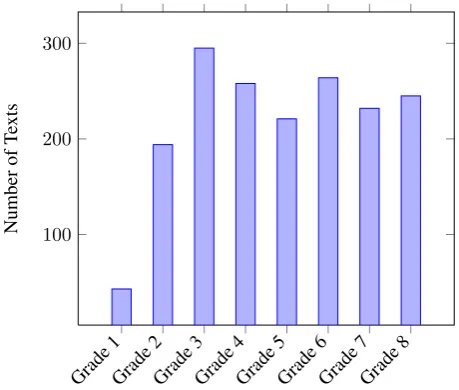
The spelling competence of school students is best measured on freely written texts, instead of pre-determined, dictated texts. Since the analysis of the error categories in these kinds of texts is very labor intensive and costly, we are working on an automatic systems to perform this task. The modules of the systems are derived from techniques from the area of natural language processing, and are learning systems that need large amounts of training data. To obtain the data necessary for training and evaluating the resulting system, we conducted data collection of freely written, German texts by school children. 1,730 students from grade 1 through 8 participated in this data collection. The data was transcribed electronically and annotated with their corrected version. This resulted in a total of 14,563 sentences that can now be used for research regarding spelling diagnostics. Additional meta-data was collected regarding writers’ language biography, teaching methodology, age, gender, and school year. In order to do a detailed manual annotation of the categories of the spelling errors committed by the students we developed a tool specifically tailored to the task.
Keywords:spelling error categories, data collection, e-learning, orthography
1.
Introduction
Reading and writing are core competencies for success in any society. In Germany, the Program for International Student Assessment(PISA) study and theProgress in Inter-national Reading Literacy Study(PIRLS) (Bos, 2004) have shown that around 25% of German school children do not reach the minimal competence level necessary to function effectively in society by the age of 15.
The diagnostic tools that are on the market today of-fer pricey one-time spelling diagnosis on a fixed test set with high-density error-prone and unnatural text and pre-specified word field analysis. In these tools, usually vari-ants of achieved spellings are predicted based on a-priori known reference words. Potential errors are therefore man-ually categorized by experts during test set design. Internet-based or paper-Internet-based diagnostic tests, such as the ’Diagnos-tische Rechtschreibtest’ (DRT) (M¨uller, 2004), ’Deutsche Rechtschreibtest’ (DERET) (Stock and Schneider, 2008), and ’Hamburger Schreibprobe’ (HSP) (May et al., 2007) work in similar ways to categorize errors.
However, according to recent research by Fay (2010), this sort of error analysis deviates, at least in parts, significantly from the error profile derived from a child’s spelling skills based on self-chosen and freely written text. The latter therefore presents a more natural picture of the child’s com-petence level. Gathering diagnostic information requires more sophisticated evaluation tools that lay persons can ap-ply frequently and automatically, in order to track progress and maintain effective spelling tutoring as the child’s pro-file changes.
1.1. A Prototype System for Automatic Spelling Error Classification
Early investigations by the authors have shown that mod-ern language processing technologies offer the capability to automatically diagnose the type of spelling errors com-mitted by individual students (Berkling et al., 2011; Fay et al., 2012; St¨uker et al., 2011).
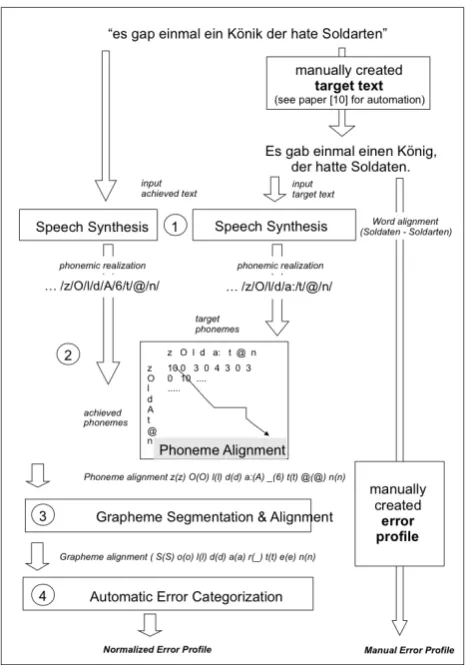
The system that we proposed works in two stages.
Figure 1 shows the complete system. In the first stage the orthographically correct version of a text that was freely written by a child is automatically reconstructed as it was intended by the child. The input is the text that was written by the student containing all the spelling errors. Using tech-niques from natural language processing, the stage searches for the most probable correctly written word sequences that corresponds to the erroneous text. The search thereby re-lies on statistical models to calculate a probability for every possible correct word sequence and to pick the one with the highest probability. The second stage then aligns the stu-dent’s text with the automatically corrected text to perform an actual error classification and diagnostic error profile. Just like the first stage, it also relies on techniques from natural language processing to achieve this task.
Figure 1: Overview of the spelling error classification sys-tem under development
In this paper we report on the collected corpus, relevant statistics on the data and meta-data collected, and how it was annotated. The data is stored in a versatile XML for-matted database in order to allow for flexible research anal-ysis.
2.
Data Collection
The data described in this paper was collected with the help of nine student part timers of the University of Education Karlsruhe during the years 2011–2013. The data collection was conducted at schools in and around Karlsruhe, at ele-mentary schools and two types of secondary schools, Re-alschule and Hauptschule. The random sample is an ”ad hoc random sample, as data was collected in schools that were willing to participate in this study. The data collec-tion was done via elicitacollec-tion, in which the school students had to write as verbose a text as possible. Aspects such as semantics, text structure, coherency and functionality were ignored, since the data will only be analyzed towards its orthographic quality. The requests with which the texts were elicited from the students were formulated as age-appropriate exercises:
Grades 1 to 4 Either the picture book “Der kultivierte Wolf” (Bloom and Biet, 2008) or “Stimmen im Park” (Browne, 1998) was read to the students. Afterwards the students were allowed to choose from a collec-tion of work sheets with motives from the story. They
could also choose blank worksheets. The instruction for the writing exercise was: “Write your own story.” This resulted in a plethora of freely written texts be-cause students were not constrained by arranged pic-tures or key words.
Grades 5 to 8 The instruction to the writing task was sim-ply given as either :“Imagine the world in 20 years. What has changed? How do you envision your life in 20 years? How, where and with whom do you live? Write a text as detailed as possible, so we can under-stand you and your ideas.”; or “A day with ...”
3.
Target Text Annotation
The first step in the annotation of the texts written by the students is to re-construct the correct text that the students intended to write. We call this text thetarget text.
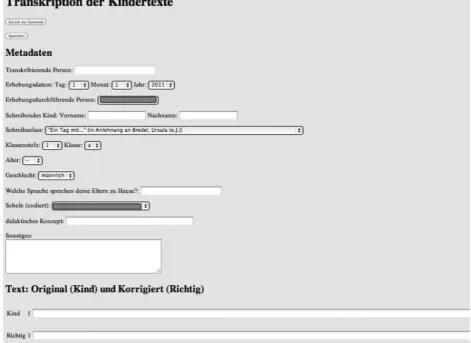
Since the achieved texts had been collected in handwritten form, students of the University of Education, who were specifically trained for the task, converted the hand written texts into digital form. In addition to the electronic version of the achieved texts with all the errors committed by the writers they also created an orthographically correct ver-sion of every sentence. This work was done by entering the text into a web interface that is depicted in Figure 2. The texts written by the school students do not only contain simple spelling errors. Therefore, additional phenomena in the data, such as illegible characters, wrongly separated or joined words were annotated according to the schema depicted in Table 1. The annotation of the erroneous sep-aration or joining of words is especially important in order to be able to compare the achieved and target text word by word, in order to be able to correctly annotate the types of errors committed by the students
3.1. Meta Data
In addition to the texts written by the students and their orthographically correct version, meta data was collected for every text in the database. These data consist of:
• Information about the circumstances under which the text was collected: Identity of the university stu-dent conducting the collection, date of the collection, writing task used to elicit the text
• Background information about the writing school student (as given by himself): grade and class, school, age, gender, languages spoken at home (L1)
• Background information about the methods and concepts of the orthographic lessons (as reported by the teacher): information about the didactic con-cept/material used in the orthographic lessons, for ex-ample “Lollipop Fibel” [Primer], ‘ABC der Tiere” [ABC of animals], etc.
Figure 2: Screenshot of the web interface used to digitize the achieved text and to enter the correct target text
symbol explanation original child archived target
writing text text
* illegible characters; mirror inverted characters except<p, d, q, b> ¥mmel *mmel *mmel
Hunb Hunb Hund
Wort words are written together Under Und er Und er
Word§er words are not written together Spazier gang Spazier§gang Spazier§gang
Word–er word disconnection Hund- Hund–eleine Hunde–leine
the end of the line eleine
Word{2} One word was used more than needed in one sentence. Word count in curly brace. Aber aber aber{2} aber{2}
{F} Writing of foreign words I love I{F}love{F} I{F}love{F}
Football Football{F} Football{F}
{G} Grammatical mistakes (case, tense etc.) Ich w¨unsch mir Ich w¨unsch{G}mir Ich w¨unsch{G}mir
ein Tag mit ... ein{G}Tag mit ... einen{G}Tag mit ...
Table 1: Annotation rules
bilingual abilities). Therefore, in addition to existing stud-ies on the effectiveness of the process of learning to read and write, e.g., (Weinhold, 2009), one can thus start to ana-lyze the relationship between the orthographic competency of students and the didactics of an orthographic lesson.
4.
Annotation of Spelling Error Categories
In a second step we started to annotate the specific cate-gories of the errors committed by the students.
4.1. Error Categories Definition
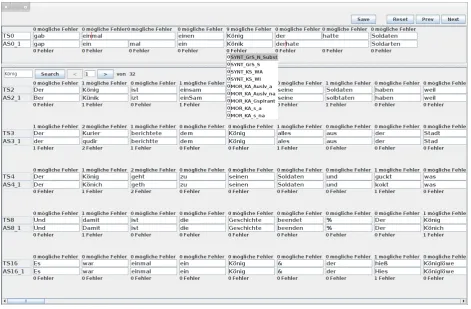
Figure 3: Screenshot of the tool for annotating the error categories
Background Information The participants average age is 11 years. The gender of the writers is relatively equally distributed with 902 male and 828 female students. A vari-ety of languages other than German are spoken at the stu-dents’ homes. The statistics given by the students them-selves shows that German is spoken at home 40.46% of the time, while for 23.06% of the students the language spoken at home is different from German. Moreover, bi- and multi-linguality including German is spoken 63.53% of the time as denoted by the students.
Teaching Materials Methods for teaching children how to read and write have converged over the years and can roughly be categorized into one of two main approaches: The explorative approach, Lesen durch Schreiben ((Re-ichen, 1988)), emphasizes children’s freedom to write while exploring the usage of letters, graphemes and sounds in creating words and texts of their choice. This method usually includes the teacher not correcting a child’s spelling errors. In contrast, the synthetic-analytic approach is more prescribed and often combined with the study of syllables. This is similar to a combination of phonics and whole-word approach used in anglophone countries and is usually sup-ported with a structured textbook. Various supplementary materials exist and are used by teachers. Based on the in-formation extracted from teachers concerning their method-ology and books used in the classroom it can be said that generally there seems to be a tendency to work with the ex-plorative approach during the first year and then move over increasingly to the synthetic-analytical approach, choosing any one of the typical (about 8) textbooks available on the
1-2 Grade 1-4 Grade
100 200 300 400 500 600
Number
of
Students
explorative phonics/whole word/syllable
Figure 5: Methods used for teaching orthographie (cumu-lative)
market. This trend is depicted in Figure 5 for elementary school. It is interesting to note that teachers’ remarks for upper grades reflect a continued need for student support with spelling issues.
6.
Conclusion
errors on such freely written texts is time intensive and thus too expensive in order to be widely performed. We are therefore working on an automated tool that first re-constructs the intended, orthographically correct target text from the students’ achieved text, and then secondly auto-matically classifies the categories of spelling errors com-mitted. As of now, we are doing this for German texts writ-ten by German school students.
The tools that we are developing employ technologies from different areas of natural language processing, such as au-tomatic speech recognition and speech synthesis. These systems are learning systems whose models are trained on large amounts of training data.
In this paper we have described our data collection in or-der to obtain both, the necessary training data for our mod-els, as well as development and evaluation data in order to monitor progress and evaluate the performance of our sys-tems as we develop them. We collected this data in German schools from real students. We further described how we annotated the target text from the collected achieved texts. For manually annotating the categories of the spelling er-rors committed in the collected texts—these categories can be derived by comparing the correct target texts with the students’ achieved texts—we developed an additional tool which allows for an ergonomic and efficient annotation of the spelling errors.
Future work will be directed at making the integrated an-notation of the target text as well as the spelling error cat-egories as efficient as possible, including the use of active learning approaches.
7.
Acknowledgments
The work leading to these results was in part funded by a re-search grant from the German Rere-search Foundation (DFG), grant no. BE 5158/1.
8.
References
Berkling, Kay, Fay, Johanna, and St¨uker, Sebastian. (2011). Speech technology-based framework for quan-titative analysis of german spelling errors in freely com-posed childrens texts. InThe 2011 Workshop of the ISCA Special Interest Group on Speech and Language Tech-nology in Education (SLaTE 2011), Venice, Italy, Au-gust.
Bloom, Becky and Biet, Pascal. (2008). Der kultivierte Wolf. Lappan Verlag, Oldenburg. Andrea Grotelsche, Translator.
Bos, Wilfried. (2004). IGLU: Einige L¨anger der BRD im nationalen und internationalen Vergleich. M¨unster. Browne, Anthony. (1998). Stimmen im Park. Lappan,
Old-enburg. Peter Baumann, Translator.
Fay, Johanna, Berkling, Kay, and St¨uker, Se-bastian. (2012). Automatische Analyse von Rechtschreibf¨ahigkeit auf Basis von Speech-Processing-Technologien. Didaktik Deutsch, Halbjahresschrift f¨ur die Didaktik der deutschen Sprache und Literatur, 19(33).
Fay, Johanna. (2010). Kompetenzfacetten in der Rechtschreibdiagnostik. Rechtschreibleistung im Test
und im freien Text. In Bermerich-Vos, A., editor, Didak-tik Deutsch: Symposium DeutschdidakDidak-tik, volume 29, pages 15–36. Schneider Verlag.
May, Peter, Vieluf, Ulrich, and Malitzky, Volkmar. (2007). Diagnose orthographischer Kompetenz: Hamburger Schreibprobe: Handbuch, Manual. Hamburg.
M¨uller, Rudolf. (2004). Diagnostischer Rechtschreibtest f¨ur 3. Klassen. DRT 3: Manual. G¨ottingen.
Reichen, J¨urgen. (1988).Lesen durch schreiben. sabe. Stock, Claudia and Schneider, Wolfgang. (2008).
Deutscher Rechtschreibtest f¨ur das 1.-4. Schuljahr. G¨ottingen.
St¨uker, Sebastian, Fay, Johanna, and Berkling, Kay. (2011). Towards context-dependent phonetic spelling error correction in childrens freely composed text for diagnostic and pedagogical purposes. In Proceedings of the 12th Annual Conference of the International Speech Communication Association (INTERSPEECH 2011), Florence, Italy, August.