Overview of Todai Robot Project and
Evaluation Framework of its NLP-based Problem Solving
Akira Fujita, Akihiro Kameda, Ai Kawazoe, Yusuke Miyao
National Institute of Informatics, 2-1-2 Hitotsubashi, Chiyoda-ku, Tokyo, Japan E-mail: {a-fujita, kameda, zoeai, yusuke}@nii.ac.jp
Abstract
We introduce the organization of the Todai Robot Project and discuss its achievements. The Todai Robot Project task focuses on benchmarking NLP systems for problem solving. This task encourages NLP-based systems to solve real high-school examinations. We describe the details of the method to manage question resources and their correct answers, answering tools and participation by researchers in the task. We also analyse the answering accuracy of the developed systems by comparing the systems’ answers with answers given by human test-takers.
Keywords: problem solving, document structure annotation, question-type annotation, competition, evaluation framework
1.
Introduction
This paper presents the achievements of the ‘Todai Robot Project’, which focuses on benchmarking NLP systems for problem solving. We report the organization of the Todai Robot Project and the results of its first open evaluation. The Todai Robot Project aims to develop problem-solving systems that can attain high scores in the Japanese National Center Test for University Admissions by 2016 and pass the University of Tokyo’s entrance examination by 2021. For this task, the organizers provide several shared resources for task-takers, which comprise mainly questions in university entrance examinations and textbooks that possess information required to solve problems. Some of the resources were translated into English and are open to all task-takers.
The questions are primarily collected from the Japanese National Center Test for University Admissions (Center Test)1 and its trial examination held by a prep school.
Questions in university entrance examinations are mostly presented in natural language; therefore, it is clear that having a proper understanding of texts is a prerequisite for solving questions. Such questions are carefully designed to empirically quantify the academic skills of high school students. In this regard, these resources are ideal for evaluating end-to-end NLP systems that read natural language text, perform information processing and output answers.
Furthermore, these resources have the following features, which are suitable for solving questions:
Required knowledge is limited
Legitimate solutions always exist
Evaluation of answers by systems is intuitively understandable and can be compared directly with human performance.
These features provide clues regarding the true contributions of current NLP technologies for human-like problem-solving tasks as well as empirical evidence to
1 Center Test is a nationwide standardized test for
university admission in Japan. Nearly all high-school students who aim to enter university take this exam. All
analyse relationships between human intelligence and artificial intelligence.
However, there are barriers that must be addressed by organizers to enable task-takers to isolate specific NLP subtasks for focused research. It is almost impossible for task-takers to develop smart algorithms that can solve all types of questions because entrance examinations span multiple subjects and question types. It is necessary to clearly indicate the question type to task-takers who can adjust the system to solve questions by applying optimized algorithms. Examination data include several components, such as figures and tables. Therefore, the semantic analysis of the components is not trivial and beyond the scope of current NLP research. Their semantic content requires interpretation into natural language in advance. Schemes are also required to evaluate the systems submitted by task-takers and to provide updates regarding the task status. We introduce a method to annotate such resources. We also present a method to manage question resources and their correct answers, answering tools and participation of researchers in the Todai Robot Project. Finally, we present the contribution of this task with the results of an open evaluation in which the developed systems solved a test data set in a trial examination of the Center Test.
2.
Resources
There are eleven subtasks corresponding to each subject in the Center Test: Biology, Chemistry, Ethics, English (foreign language), Japanese (native language), Japanese History, Mathematics, Modern Society, Physics, Politics and Economics and World History. All subjects in the Center Test, excluding Mathematics, consist of multiple choice questions. Mathematics test-takers do not select a choice, but they put numeric characters into a given column in which the number of characters is specified.
All examination texts prepared in these subtasks are obtained from the Center Test and a trial examination held by a prep school. The Center Test examination texts from 1990 to 2011 were used. Each year, a main examination and its supplementary examination, which is open to students who were unable to take the main examination, are available. These examinations are conducted for each subject. In total, there are 571 examinations in the Center Test. Moreover, the trial examination texts from 2012 and 2013 were used. The contents of these examination texts were also translated into English. Textbooks for Biology, Chemistry, Ethics, Japanese History, Mathematics, Modern Society, Physics, Politics and Economics and World History are also provided to task-takers in XML format data. All textbook data are described in Japanese. Datasets of each subtask are divided into three sets: dev (for development), test (for evaluating systems in development progress) and final-test (for final validation of system achievement). The ‘dev’ dataset is provided to tune the systems. To optimize system performance, task-takers repeatedly adjust their system performance using ‘dev’ and conduct open tests. The ‘test’ dataset is provided to prove system performance. The ‘final-test’ dataset analyses how the systems attain scores on a dataset that is not examined by the developers. Consequently, neither the questions nor their correct answers in ‘test’ and ‘final-test’ are shown to
dev final-test
English 48 48
Japanese 35 35
Japanese History 36 36
Mathematics 75 86
Physics 25 24
Politics & Economics 38 36
World History 36 36
Table 2: Total number of questions in each subtask (trial examination).
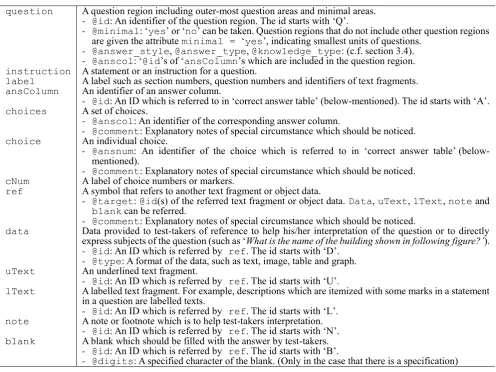
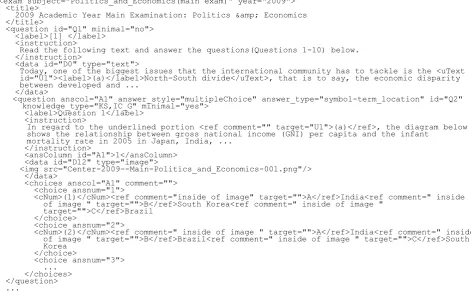
question A question region including outer-most question areas and minimal areas.
- @id: An identifier of the question region. The id starts with ‘Q’.
- @minimal: ‘yes’ or ‘no’ can be taken. Question regions that do not include other question regions are given the attribute minimal = ‘yes’, indicating smallest units of questions.
- @answer_style, @answer_type, @knowledge_type: (c.f. section 3.4).
- @anscol: ‘@id’s of ‘ansColumn’s which are included in the question region.
instruction A statement or an instruction for a question.
label A label such as section numbers, question numbers and identifiers of text fragments.
ansColumn An identifier of an answer column.
- @id: An ID which is referred to in ‘correct answer table’ (below-mentioned). The id starts with ‘A’.
choices A set of choices.
- @anscol: An identifier of the corresponding answer column.
- @comment: Explanatory notes of special circumstance which should be noticed.
choice An individual choice.
- @ansnum: An identifier of the choice which is referred to in ‘correct answer table’ (below-mentioned).
- @comment: Explanatory notes of special circumstance which should be noticed.
cNum A label of choice numbers or markers.
ref A symbol that refers to another text fragment or object data.
- @target: @id(s) of the referred text fragment or object data. Data, uText, lText, note and
blank can be referred.
- @comment: Explanatory notes of special circumstance which should be noticed.
data Data provided to test-takers of reference to help his/her interpretation of the question or to directly
express subjects of the question (such as ‘What is the name of the building shown in following figure?’). - @id: An ID which is referred by ref. The id starts with ‘D’.
- @type: A format of the data, such as text, image, table and graph.
uText An underlined text fragment.
- @id: An ID which is referred by ref. The id starts with ‘U’.
lText A labelled text fragment. For example, descriptions which are itemized with some marks in a statement
in a question are labelled texts.
- @id: An ID which is referred by ref. The id starts with ‘L’.
note A note or footnote which is to help test-takers interpretation.
- @id: An ID which is referred by ref. The id starts with ‘N’.
blank A blank which should be filled with the answer by test-takers.
- @id: An ID which is referred by ref. The id starts with ‘B’.
- @digits: A specified character of the blank. (Only in the case that there is a specification)
Table 3: Tags and their attributes of document structure.
dev test final-test
Biology 601 541 1085
Chemistry 515 688 1009
Ethics 307 266 495
English 520 589 1111
Japanese 296 263 479
Japanese History 531 505 1056
Mathematics 659 659 1254
Modern Society 822 800 1463
Physics 380 417 799
Politics & Economics 536 480 1036
World History 688 700 1340
Mathematics subtask, a participant tries to generate logical formulas from question statements and derive answers by manipulating the formulas (Iwane et al., 2013), while in Physics, a participant uses a physical simulator by providing various parameters from question statements (Yokono and Inamura, 2013). In the social studies subtasks, answers to factoid and true/false questions are addressed by applying textual entailment recognition (Miyao et al., 2012) and question answering (Kanayama et al., 2012). In addition, the selection of resources significantly affects the accuracy of reasoning of truth/falsehood.
Even in a single subtask, questions can contain components that can be regarded as different NLP tasks. For example, it is required to identify the most appropriate solving strategy in Japanese, English and the social studies subtasks. To deal with this situation, we have classified questions by answer style (e.g. multiple-choice), answer types (e.g. terms, sentences, formulas and symbols) and type of knowledge required to solve the question. We have annotated each minimal question with classification information. Knowledge-type information is the most important when selecting strategies to solve questions; therefore, we employ granular classification (90 types in total).
The question-type annotation also provides participants with a function that obtains a subset of examinations in which isolated NLP tasks can be studied. These question classifications are treated as attributes (i.e.
‘@answer_style’, ‘@answer_type’ and
‘@knowledge_type’ of the question tag.
4.
Framework for the competition
This task aims to encourage competition among task-takers and measures real contributions of current NLP studies and technologies when solving questions in each subtask. To this end, we prepared an automatic scoring framework and some baseline systems to define the performance of task-taker systems.
4.1
Automatic Evaluation
Task-takers can submit their answers to questions on our website. The answers must be in XML format (answer XML). The format of the answer XML is the same as the correct answer table. In answer XML, the indispensable tags in each answer that correspond to each minimal question are ‘answer’ and ‘anscolumn_ID’. Logs in a solving process (process log) can be optionally described in the answer XML.
The submitted answer XML is automatically scored by our server. After scoring, four values representing the scoring results are sent to the task-takers and shown on a webpage (result page). The four values are as follows:
- Score (integer ≥ 0)
- Percentage of correctly answered questions (real number ≥ 0 and ≤ 1)
- Number of correctly answered questions
- Number of answered questions in submitted
2 http://21robot.org/task/ranking/
examination data
On this webpage, task-takers can refer to these values and also the correct answers, question statements, knowledge type and process log for each minimal question in the submitted examination data, as is shown in Figure 7. Task-takers can also add comments for each question in the
comment region provided in the answer XML. These comments appear in each question region in the result page so that task-takers can use them for error analysis.
4.2
Baseline system
We prepared three baseline systems to provide a target for comparison with task-taker results. All baseline systems are implementations of random algorithms.
The score submitted by task-takers and the baseline systems are listed in our Ranking Page2 , as is shown in Figure 6. This page is accessible by the public.
4.3
Participation
We accept applications for participation in this task on our web site. Contract forms for the use of resources are available on the website, and task-takers can download resources from the site at the conclusion of the contract. Table 4 shows the status of answer submissions as of March 2014. The number of submissions is shown for each subtask. All task-takers used datasets in Japanese. We also prepared datasets in English.
Subtask Number of submitted answer XML
English 50
Japanese 55
World History 25
Physics 3
Table 4: Number of submitted answers according to task-taker system.
resources, as described in this paper.
7.
Conclusion
In this study, we introduced the achievements of the ‘Todai Robot Project’ task, which focuses on benchmarking NLP systems for problem solving.
We described the details of the method to manage the resources of questions and their correct answers, answering tools and participation by researchers. In the proposed method, we focus on optimizing specifications of annotation for the resources. Consequently, these studies enabled NLP-based systems to solve real examinations that are normally taken by high-school students. Furthermore, we analysed the answering accuracy of the developed systems by comparing the systems’ answers with answers given by human test-takers.
To encourage collaborative and interdisciplinary research, the tasks described in this paper can be viewed on our website. In addition, the resources that are translated into English are available.
8.
Acknowledgements
We would like to express our gratitude to the JC Educational Institute, National Center for University Entrance Examination and Yoyogi Seminar for their support. This research was supported by the Todai Robot Project at the National Institute of Informatics.
9.
References
Angele, J., Moench, E., Oppermann, H., Staab, S., and Wenke, D. (2003). Ontology-based query and answering in chemistry: Ontonova @ project halo. In Proceedings of the Second International Semantic Web Conference, pp. 913–928.
Ferrucci, D. A. (2012). Introduction to “this is Watson”.
IBM Journal of Research and Development, 56(3.4), pp. 1:1–1:15.
Ishioroshi, M., Kano, Y., and Kando, N. (2013). An analysis of the questions of the university entrance examination to answer using the question answering system. The 27th Annual Conference of the Japanese Society for Artificial Intelligence, 2A4-6.
Iwane, H., Matsuzaki, T., Anai, H., and Arai, N. (2013). A symbolic approach to university entrance examination problems in mathematics and issues combining with national language processing. The 27th Annual Conference of the Japanese Society for Artificial Intelligence, 2A4-2.
Kanayama, H., Miyao, Y., and Prager, J. (2012). Answering yes/no questions via question inversion. In Proceedings of COLING 2012, pp. 1377–1392.
Miyao, Y. and Kawazoe, A. (2013). University entrance examinations as a benchmark resource for NLP-based problem solving. In Proceedings of IJCNLP 2013. Miyao, Y., Shima, H., Kanayama, H., and Mitamura, T.
(2012). Evaluating textual entailment recognition for university entrance examinations. ACM Transactions on Asian Language Information Processing, 11(4), p. 13. Schäfer, U. and Weitz, B. (2012). Combining OCR outputs
for logical document structure markup: technical background to the ACL 2012 contributed task. In Proceedings of the ACL2012 Special Workshop on Rediscovering 50 Years of Discoveries, pp. 104–109. World Wide Web Consortium. (2003). Mathematical
markup language (mathml) version 2.0 (second edition), www.w3.org/TR/MathML2.