Proceedings of Recent Advances in Natural Language Processing, pages 839–846,
Using NLP for Enhancing Second Language Acquisition
Leonardo Zilio Rodrigo Wilkens
CENTAL
Universit´e catholique de Louvain
{leonardo.zilio,rodrigo.wilkens,cedrick.fairon}@uclouvain.be
C´edrick Fairon
Abstract
This study presents SMILLE, a system that draws on the Noticing Hypothesis and on input enhancements, addressing the lack of salience of grammatical infor-mation in online documents chosen by a given user. By means of input enhance-ments, the system can draw the user’s at-tention to grammar, which could possi-bly lead to a higher intake per input ratio for metalinguistic information. The sys-tem receives as input an online document and submits it to a combined processing of parser and hand-written rules for detecting its grammatical structures. The input text can be freely chosen by the user, providing a more engaging experience and reflecting the user’s interests. The system can en-hance a total of 107 fine-grained types of grammatical structures that are based on the CEFR. An evaluation of some of those structures resulted in an overall precision of 87%.
1 Introduction
Research on the field of second language acquisi-tion (SLA) has already shown that the mere pre-sentation of input to a language learner is not enough for ensuring that some linguistic informa-tion will be retained (Meurers et al., 2010). This means that the language learner may process the input for its meaning alone, without noticing its linguistic structures, because there is no salient grammatical information. Input is, therefore, un-derstood as “potentially processible language data which are made available, by chance or by design, to the language learner” (Smith, 1993). On the other hand, the intake is the part of the input which is actually internalized by the user and that can
potentially be connected to the long-term memory (Reinders,2012).
As such, an input in its raw form has lower chances of being converted into intake by the learner, and may thus not provide any new linguis-tic information. In the early 90’s,Schmidt(1990) developed the hypothesis that, in order to convert input into intake, a language learner needs to no-tice the relevant information in the input. More recently, Schmidt(2012) stated, in a less contro-versial way, that “people learn about the things that they attend to and do not learn much about the things they do not attend to”. There is much dis-cussion regarding the assumptions of the Noticing Hypothesis, and it has some fierce contesters, such asTruscott(1998). Nevertheless, it seems to be of general agreement that noticing is at least a facili-tator of the language learning process, even though there is differences in the way that authors view the process of noticing, either as a purely con-scious process or as a possibly unconcon-scious pro-cess (Cross,2002).
To solve the lack of salience in raw input,Smith and Truscott (2014) suggested the use of “input enhancements”, so as to give prominence to the relevant linguistic information. This focus-on-form strategy (Doughty, 1991) provides a way to assist language learners, and recent studies on SLA have shown that input enhancements repre-sent a positive step in transforming input into in-take (Plonsky and Ziegler,2016;Simard,2009).
CALL systems that are able to deal with authen-tic texts and uses NLP for rendering a better pre-sentation of linguistic information are called Au-thentic Texts Intelligent Computer-Assisted Lan-guage Learning (ATICALL) Meurers(2012). In this paper, we present the Smart and Intelligent Language Learning Environment (SMILLE), an ATICALL system that enhances authentic Web pages by using available NLP tools. It extracts the
text content of a Web page chosen by the user (i.e., the language learner) and processes it, retrieving linguistic information that can be enhanced ac-cording to the user’s specific language learning needs. To ensure that the highlighted informa-tion is relevant, SMILLE is linked to the users’ language level, as described by the Common Eu-ropean Framework of Reference for Languages (CEFR) (Council of Europe,2011).
SMILLE was developed based on a scenario in which the users are already pursuing a foreign lan-guage course and wish to continue the lanlan-guage learning activity by means of reading Web-based material that corresponds to their interests. In this case, SMILLE can help not only with the text-understanding process, for it has built-in access to dictionaries and meaning-related information, but also with improving the users’ awareness of the grammatical structures that correspond to their language learning level. As such, the system can be seen as a complementary application to a lan-guage course, where the grammatical structures of the user’s level will be in focus (by means of text highlighting), with the bonus of having a plethora of new vocabulary available, since it is designed to process any user-chosen, Web-based text.
Some of the grammatical structures that should be highlighted are complex linguistic structures that are not always recognized by parsers and need hand-written rules to cover this lack of parser in-formation. Since these rules are not trivial to im-plement and require specialized knowledge, in this paper we evaluate the performance of the special-ized rules against a gold standard. In specific, we focus on rules precision, because it is a key point of the pedagogical purpose of our system. In ad-dition, we compare our specialized rules mance against parser dependency tagging perfor-mance.
This paper is organized as follows: we present information on systems that automatically en-hance grammatical structures in Section 2, spe-cially focusing on what type of information and what resources they use for text enhancements; in Section3, we describe SMILLE, some of its fea-tures, and briefly discuss the CEFR and its lan-guage learning levels; we then describe the eval-uation process of some of SMILLE’s features in Section4; lastly, in Section5we present our final remarks.
2 Related Work
CALL systems have recently started to use NLP applications for aiding in reading activities (Azab et al., 2013b), so, in this section, we describe a selection of ATICALL systems that use text en-hancements for SLA: SmartReader (Azab et al.,
2013a,b), WERTi (Meurers et al., 2010), and FLAIR (Chinkina and Meurers, 2016; Chinkina et al.,2016).
The SmartReader provides a reading assistant tool that uses a parser to process texts and high-lights information for the user based on the parser analysis. The system presents definitions for con-tent words, grammatical information for function words, and encyclopedic information for named entities. It also displays the syntactic function (such as subject, object) of selected words in the given sentence and generates simple questions about named entities, provided the answers are in the near context.
The WERTi system allows for text enhance-ments of selected linguistic eleenhance-ments of English, Spanish and German. It also presents exercises corresponding to the selected structure, such as clicking on relevant words, filling the gaps with multiple choice questions or writing the correct word in a gap. The user can choose any URL as in-put, and WERTi will highlight (by means of color coding) the linguistic structure that was selected by the user or modify the text for testing the user’s skills based on the selected activity. It uses pars-ing combined with rules and regular expressions to retrieve text information for seven linguistic struc-tures.
TheFLAIRsystem is described as an online in-formation retrieval system “that uses efficient al-gorithms to retrieve, annotate and rerank Web doc-uments based on the grammatical constructions they contain” (Chinkina et al., 2016). FLAIR searches online documents based on keywords se-lected by the user, parses the first twenty docu-ments retrieved by the search engine and ranks them according to the settings the user selected as most important. It can also recognize 87 differ-ent types of grammatical structures described in the official curriculum for German schools. These structures are annotated in the texts and high-lighted for the user.
high-lighting. This is the case, for instance, of the REAP system (Brown and Eskenazi,2004), which is more focused on text retrieval based on user pro-file and on vocabulary information, and the Co-BRA system (Deville et al., 2013), which has a database of aligned multilingual texts and relies on the teacher to select the relevant information for the language learner. There are also systems that were developed within the field of text sim-plification or readability, but they usually focus on the text properties themselves and on L1 instead of L2.
3 System Description
SMILLE is being developed for English, but there will be an effort to port it to other languages as well. Following the idea of WERTi (Meurers et al., 2010) and the SmartReader (Azab et al.,
2013a,b), SMILLE was designed in a way that the users have independence for choosing online reading materials in the foreign language, so that the freedom of choice should serve as an incentive for further developing the learning process. Using the selected, Web-based text, SMILLE provides a reading assistant module that helps the user to notice linguistic content of the target language by highlighting (i.e., enhancing) language structures in context, while also offering the possibility of looking up meaning and word class.
In the way it presents the text enhancements and the features of the reading assistant module, SMILLE bears some similarities with the sys-tems presented in Section 2. However, it distin-guishes itself in how the enhancements are se-lected. For instance, in WERTi, only a few gram-matical structures are highlighted for the user, and, in SmartReader, only information more relevant to the meaning of the lexical units is presented, and only parser information is shown as part of the grammatical training. And, while FLAIR and SMILLE share a bigger scope in terms of enhance-ments, the types and granularity of grammatical structures are different (for instance, FLAIR does not distinguish between gerund and present par-ticiple, but SMILLE does). In addition, SMILLE links the displayed information to the guidelines of the CEFR and to other language learning re-sources, so that the enhancements are not lim-ited to isolated linguistic structures, but covers the needs for the different language levels. As such, users can read texts that are interesting according
to their own preference, while keeping an eye on important information in terms of linguistic struc-tures that are relevant for their process of acquiring a second language.
For retrieving the relevant content in the chosen Web page, SMILLE crawls over the HTML struc-ture and extracts its text content. This text content is then parsed for part-of-speech (PoS) and syntac-tic dependencies with the Stanford parser ( Man-ning et al.,2014). The parsed text content is then analyzed with hand-written rules for creating new tags for each relevant grammatical structure. After this process, a new Web page is constructed, show-ing the same information extracted from the orig-inal one, but with new HTML code and different JavaScript and CSS scripts that allow for real-time modifications of the text.
Some of the grammatical information that is de-tected by SMILLE requires only that the parser correctly analyzes the word or structure in ques-tion. Such is the case, for instance, of adverbs, ad-jectives and simple verb tenses. Other structures require some rules for retrieving more complex word formations, such as compound verb tenses, phrasal verbs and passive voice, but the infor-mation is mostly retrieved from the dependency and PoS tags. Still other structures though, such as WH-questions and question tags, are retrieved based on rules specifically written for them. As such, SMILLE combines the analysis done by the parser with hand-written rules to extract text in-formation that would not be easily identified, and would not be salient, in a raw input.
3.1 CEFR Levels
The Common European Framework of Reference (CEFR) for Languages (Council of Europe,2011) presents a guide in terms of language levels and content. It provides a description for the commu-nication goals of a language learner.
As a general guide, it leaves various gray ar-eas in which the content of the learning process is not so clear. The information at each level also does not cover the different needs for language learners with different native languages. As such, the specific curricula of different language courses do not need to be necessarily the same regarding the six language mastery levels (Alderson, 2007;
Univer-sit´e catholique de Louvain and Altissia1, so, our
information regarding the grammatical structures and CEFR levels are linked to the language course structure of our enterprise partner.
While developing the system, we had to make a decision regarding the granularity of grammatical structures and the escalation of knowledge associ-ated to each language levels. The CEFR was de-signed for language learning, but Web-based doc-uments normally don’t have this instructive ap-proach by design. In a language course, differ-ent grammatical structures can be learned in pro-gressive steps, so, for instance, today a language learner may study the modal verb “can” and later, during another session, it is possible to learn the modal verb “must”. In an online text, the chances are that different modal verbs will appear at the same time, interwoven in the text. To address this fine-grained differentiation, SMILLE would have to encompass specific rules for each case, some-times for each word in a grammatical category. This would require more processing and an unde-sired increase in the number of rules. So, although the system respects the escalation related to dif-ferent language levels (e.g., difdif-ferent grammatical structures in levels B1 and B2 were separated in specific rules), the progression in the same level was overruled and generalized.
3.2 System Resources
SMILLE is responsible for analyzing a text that was chosen by the user and for outputting an en-hanced text. For example, if the user is currently studying phrasal verbs, the system can highlight phrasal verbs in the chosen text, so that the user’s attention is more easily drawn to the in-context oc-currence of this kind of syntactical construct of the English language. The output of SMILLE is a new Web page that can highlight relevant grammatical structures based on the user’s language level, but it can also help the user to understand the meaning of different vocabulary that is present on the text.
For the grammatical content of the text, there is a sidebar menu showing all the grammatical in-formation available on the text that corresponds to a given language level. The highlighting is done in real-time, so that the user can change the high-lighted structures on the fly. The highhigh-lighted text is modified in terms of color coding (font and background colors) and by changing the format
1Site:http://altissia.com/
to bold. The option for these three modifications are based on the results ofSimard (2009), which have shown that the use of three modifications was among the best ways of enhancing a text structure without saturation.
Our system is designed to be able to show gram-matical information corresponding to levels A1 to C1 of the CEFR2. Depending on the chosen level,
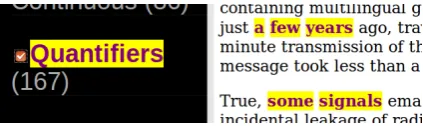
a number of grammatical structures will be dis-played on the sidebar menu. These structures can vary from simple part-of-speech information, such as adjectives, adverbs, nouns, proper nouns, etc. in level A1 to more complex structures such as the use of gerund as object in B1 or the use of passive voice and phrasal verbs in B2. Figure 1
exemplifies structures that can be highlighted by SMILLE’s reading assistant module.
If the user wants to look up the meaning of a word, SMILLE offers two possibilities: if it is not a content word, there is the possibility to look it up online on the Merriam-Webster3; on the
other hand, if it is a content word, then both the Merriam-Webster’s definitions and the WordNet’s (Fellbaum, 1998) glosses can be looked up on-line4. The access to both online resources was
im-plemented by CTRL-clicking on the desired word and selecting the desired resource from a context menu. In addition, by hovering the mouse over a word, the system displays PoS and lemma in-formation. In Figure2, the wordspeculativewas selected and the information from two online re-sources (Merriam-Webster and WordNet) is dis-played; lemma speculative and PoS adjective of the word are also shown in the form of a tooltip.
The CTRL-click menu has yet another function, and it is related to the grammar information. Any word that is part of a grammatical structure that can be highlighted also has a link to a database of grammatical rules. Since the clicked-on word also belongs to a relative clause, by hovering over the relative clause menu, the gerund sub-menu would collapse and a new sub-menu would be displayed with links to information on relative clauses. This provides for further grammatical training when needed by the user.
2Level C2 is focused on reviewing the grammatical knowledge acquired in previous levels.
3Site:www.merriam-webster.com/
Figure 1: Example of highlighting of quantifiers in the text
4 System Evaluation
The system was evaluated to verify its perfor-mance in retrieving grammatical information with rules. Since SMILLE has language learners as tar-get users, and has a pedagogical function as goal, it is important that the information highlighted on the text really corresponds to the grammatical cat-egories selected by the user. If the system has too low precision, than it may impair the user’s capac-ity of understanding the correct use of the different grammatical structures.
For the evaluation process, a gold standard was manually annotated with the required information. The necessity to create a gold standard is due to the fact that, to our knowledge, there exists no corpus annotated with more complex grammatical struc-tures. There do exist many corpora annotated with PoS and dependency information, but those do not present information such as the ones we are work-ing with here. So, in this section, we first describe our gold standard and the annotation process, and later present and discuss the results of the evalua-tion.
4.1 Gold Standard
The gold standard comprises online newspaper ar-ticles and excerpts from literary texts. The news-paper articles were extracted from the sites ofThe New York Times5 (20 articles; 31k tokens), The
Guardian6(20 articles; 18k tokens),The
Washing-ton Post7 (10 articles; 23k tokens), and the USA
Today8 (5 articles; 9k tokens). These were
se-lected for being dedicated to nation wide and in-ternational news, and the articles were collected in a time period that starts at the beginning of March 2017 and ends at the beginning of April 2017. Since newspaper articles generally do not present much dialogue and interaction, and some of the grammatical structures (e.g., short answers,
5Site:www.nytimes.com. 6Site:www.theguardian.com. 7Site:www.washingtonpost.com. 8Site:www.usatoday.com.
WH-questions, question tags) appear more often in dialogues, we further selected seven literary texts from the Project Gutenberg9which contained
longer dialogues: The Yellow Sign (9k tokens),
Varney, the Vampyre(chapters II to V; 20k tokens),
The Great God Pan (chapter V; 11k tokens), and
An Ideal Husband(First Act; 2k tokens).
The corpus was annotated with the following grammatical structures: (1) phrasal verbs, (2) rel-ative clauses, (3) WH-questions, (4) question tags, (5) short answers, (6) gerunds, (7) present partici-ples, (8) infinitives with “to”, and (9) infinitives without the particle “to”. Most of these struc-tures were selected because they are not retriev-able based only on PoS or dependency informa-tion, and, although phrasal verbs are indeed rec-ognized based on dependency information, we de-cided to include this structure for its importance in the learning of English as second language. Each type of grammatical structure was annotated fol-lowing specific criteria, which were laid out in an annotation manual. Since some grammatical structures are rarer than others, the annotation was not done equally in all texts. Structures that are not abundant in most texts (i.e., wh-questions, ques-tion tags, short answers, and phrasal verbs) were annotated in all documents of the corpus, when-ever they appeared. The other ones (i.e., gerunds, present participles, infinitives with and without “to”, and relative clauses) were annotated in only a part of the corpus. Since there is this different distribution along the corpus, Table1presents the number of documents (newspaper articles and lit-erary texts) that contains the structure and the to-ken and sentence count in the gold standard.
Table 1 shows how many structures were an-notated in the gold standard. As can be seen, even though the whole corpus was scrutinized in the search for certain structures, we couldn’t find many instances of question tags and short answers.
4.2 Evaluation
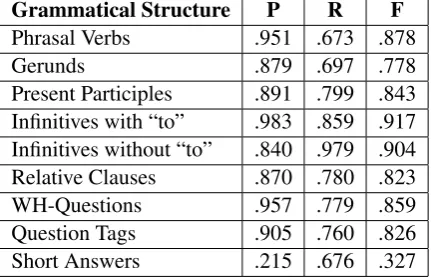
The evaluation was made on a sentence basis. Ta-ble 2 shows precision, recall and F-measure for each of the nine tested grammatical structures.
The overall precision, recall and f-measure of the rule-based annotation10 was, respectively,
85.20%, 82,40% and 83.78%. Since the system
9Site:www.gutenberg.org.
(a) Merriam-Webster’s definitions (b) WordNet’s glosses
Figure 2: SMILLE can show dictionary information for a given word.
Table 1: Gold standard description
Grammatical Structure # Texts # Sentences # Tokens # Structures Annotated
Phrasal Verb 58 6,052 121.1 k 534
Infinitive with “to” 14 1,478 31.9 k 444
Infinitive without “to” 13 1,477 31.8 k 564
Gerund 26 3,920 66.8 k 282
Present Participle 13 2,443 35.0 k 453
Relative Clause 34 2,217 56.7 k 425
WH-Question 20 4,044 66.9 k 176
Question Tag 3 1,992 22.6 k 25
Short Answer 7 3,024 42.3 k 42
Table 2: The SMILLE’s Evaluation: Precision, Recall and F-measure
Grammatical Structure P R F Phrasal Verbs .951 .673 .878
Gerunds .879 .697 .778
Present Participles .891 .799 .843 Infinitives with “to” .983 .859 .917 Infinitives without “to” .840 .979 .904 Relative Clauses .870 .780 .823 WH-Questions .957 .779 .859 Question Tags .905 .760 .826 Short Answers .215 .676 .327
is focused on the learning process, the higher pre-cision score is positive, because showing correct structures is more important than showing a lot of structures that may be incorrect. So, as Meurers et al.(2010) point out, in CALL, the balance tends to be more inclined to the precision side, and less to recall.
The results showed an f-measure that is above the mean (α = 0.05) for generating labeled de-pendency parsing (Cer et al., 2010). We also compared the performance of our rules for
rela-tive clauses with the performance of an annotation solely based on the relative clause annotation that the Stanford parser provides, and the annotation based only on the parser had 59.32% of precision, 94.04% of recall and 72.75% of f-measure, which ranks below the annotation with our rules.
In terms of comparison to state-of-the-art sys-tems, the only other work we know of that presents a similar evaluation is FLAIR (Chinkina and Meurers, 2016), which used 9 newspaper articles as corpus to evaluate 87 different rules used in the FLAIR system for retrieving grammatical in-formation from web-based texts. Unfortunately, the rules and the evaluation process were different than the ones presented here. For instance, Chink-ina and Meurers (2016) did not separate gerunds and present participles, considering both as “-ing verb forms”; thus, they use a rule that is more broad in scope than ours and do not have the prob-lem of distinguishing between the structures. So, although some of the patterns are probably similar, such as the ones for WH-questions and question tags, the different corpora that were used represent a hindrance for a more detailed comparison.
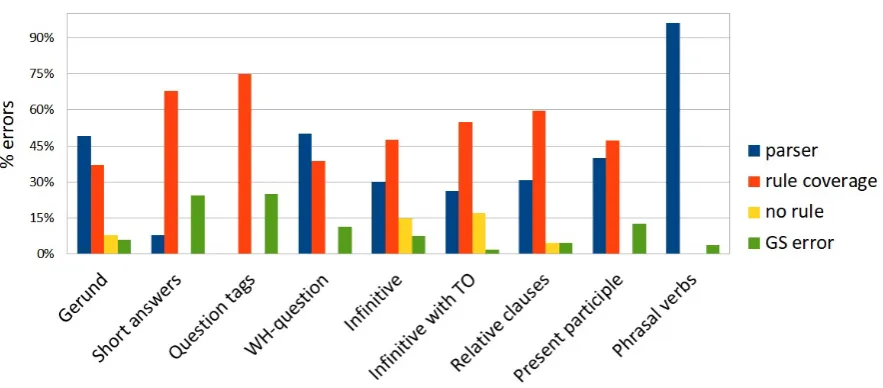
Figure 3: Error analysis
evaluation, we conducted an error analysis. The errors (false positives and false negatives) of the evaluated structures were classified into four cat-egories: parser (parsing error), rule coverage (the rules do not address the specific structure or are too permissive in scope), no rule (there is no rule designed for the structure), GS error (gold stan-dard annotation error), as can be seen in Figure
3. While errors made by the parser annotation (in which some of the rules are based) are responsible for a great part (48%) of the errors, the coverage of our rules (responsible for 38% of the errors) was the main reason for the lack of recall of the system and, especially, for the low precision we got for short answers (in this case, because of a single, too permissive rule). The errors in the gold standard annotation, while not very frequent, prevented, for instance, that our question tag precision reached 100% (which would be the correct precision for this type of structure). This error analysis was a very important step for the future developments of the system, since it allowed us to better pinpoint where there is room for improvement in the rules.
5 Conclusion
This paper presented a system that combines avail-able NLP resources for enhancing language learn-ing. SMILLE extracts raw text from a Web page chosen by the user and enhances its contents by providing the user with tools for a more indepen-dent language learning that can take place any-where with available Internet access. The text is parsed, and a set of rules specific for the different
grammatical structures is then applied. By pro-cessing texts with NLP tools and rules, the system presents a series of linguistic information, aiding the user to notice in-context grammatical struc-tures and providing access to glosses and defini-tions for words, while also offering grammatical explanations for specific types of structures.
SMILLE performed above 85% in terms of pre-cision in most of the evaluated grammatical struc-tures, but lacked a bit in terms of recall. The case of short answers can be considered an out-lier, since it presented a very low precision, and so will require special attention. Future improve-ments will take into account the full error analysis that was carried out and that pinpointed how the flaws in the rules can be addressed.
In terms of the system as a whole, further de-velopments have to be implemented to cover other languages, and to create a database for keep-ing track of user information and user activity concerning language learning (e.g., words that are looked up in dictionaries, grammatical rules consulted, etc.). With these features in place, SMILLE will be able to provide a more customiz-able user experience.
Acknowledgments
References
J Charles Alderson. 2007. The cefr and the need for more research. The Modern Language Journal 91(4):659–663.
Mahmoud Azab, Ahmed Salama, Kemal Oflazer, Hideki Shima, Jun Araki, and Teruko Mitamura. 2013a. An english reading tool as a nlp showcase. In The Companion Volume of the Proceedings of IJCNLP 2013: System Demonstrations. Asian Fed-eration of Natural Language Processing, Nagoya, Japan, pages 5–8. http://www.aclweb.org/anthol-ogy/I13-2002.
Mahmoud Azab, Ahmed Salama, Kemal Oflazer, Hideki Shima, Jun Araki, and Teruko Mitamura. 2013b. An nlp-based reading tool for aiding non-native english readers. Recent Advances in Natural Language Processingpage 41.
Jonathan Brown and Maxine Eskenazi. 2004. Retrieval of authentic documents for reader-specific lexical practice. InInSTIL/ICALL Symposium 2004.
Daniel M Cer, Marie-Catherine De Marneffe, Daniel Jurafsky, and Christopher D Manning. 2010. Pars-ing to stanford dependencies: Trade-offs between speed and accuracy. InLREC. Floriana, Malta.
Maria Chinkina, Madeeswaran Kannan, and Detmar Meurers. 2016. Online information retrieval for lan-guage learning. ACL 2016page 7.
Maria Chinkina and Detmar Meurers. 2016. Linguis-tically aware information retrieval: providing input enrichment for second language learners. In Pro-ceedings of the 11th Workshop on Innovative Use of NLP for Building Educational Applications, San Diego, CA.
Council of Europe. 2011. Common European Frame-work of Reference for Languages: learning, teach-ing, assessment. Cambridge University Press.
Jeremy Cross. 2002. Noticing’in sla: Is it a valid con-cept.TESL-EJ6(3):1–9.
Guy Deville, Laurence Dumortier, Jean-Roch Meurisse, and Marc Miceli. 2013. Ressources lexicales pour laide a lapprentissage des langues. Ressources lexicales: contenu, construction, utilisation, ´evaluation30:291–311.
Catherine Doughty. 1991. Second language instruction does make a difference. Studies in second language acquisition13(04):431–469.
Christiane Fellbaum. 1998. WordNet. Wiley Online Library.
David Little. 2007. The common european framework of reference for languages: Perspectives on the mak-ing of supranational language education policy. The Modern Language Journal91(4):645–655.
Christopher D. Manning, Mihai Surdeanu, John Bauer, Jenny Finkel, Steven J. Bethard, and David Mc-Closky. 2014. The Stanford CoreNLP natural lan-guage processing toolkit. In Association for Com-putational Linguistics (ACL) System Demonstra-tions. pages 55–60. http://www.aclweb.org/anthol-ogy/P/P14/P14-5010.
Detmar Meurers. 2012. Natural language processing and language learning. The Encyclopedia of Applied Linguistics.
Detmar Meurers, Ramon Ziai, Luiz Amaral, Adriane Boyd, Aleksandar Dimitrov, Vanessa Metcalf, and Niels Ott. 2010. Enhancing authentic web pages for language learners. InProceedings of the NAACL HLT 2010 Fifth Workshop on Innovative Use of NLP for Building Educational Applications. Association for Computational Linguistics, pages 10–18. Luke Plonsky and Nicole Ziegler. 2016. The call-sla
interface: Insights from a second-order synthesis . Hayo Reinders. 2012. Towards a definition of intake in
second language acquisition .
Richard Schmidt. 2012. Attention, awareness, and in-dividual differences in language learning. Perspec-tives on individual characteristics and foreign lan-guage education6:27.
Richard W Schmidt. 1990. The role of consciousness in second language learning1. Applied linguistics 11(2):129–158.
Daphn´ee Simard. 2009. Differential effects of tex-tual enhancement formats on intake. System 37(1):124–135.
Michael Sharwood Smith. 1993. Input enhancement in instructed sla. Studies in second language acquisi-tion15(02):165–179.
Mike Sharwood Smith and John Truscott. 2014. Ex-plaining input enhancement: A mogul perspective. International Review of Applied Linguistics in Lan-guage Teaching52(3):253–281.