Proceedings of Recent Advances in Natural Language Processing, pages 407–416,
Improving Discourse Relation Projection to
Build Discourse Annotated Corpora
Majid Laali Leila Kosseim
Department of Computer Science and Software Engineering Concordia University, Montreal, Quebec, Canada {m_laali, kosseim}@encs.concordia.ca
Abstract
The naive approach to annotation pro-jection is not effective to project dis-course annotations from one language to another because implicit discourse rela-tions are often changed to explicit ones and vice-versa in the translation. In this paper, we propose a novel approach based on the intersection between statisti-cal word-alignment models to identify un-supported discourse annotations. This ap-proach identified 65% of the unsupported annotations in the English-French paral-lel sentences from Europarl. By filtering out these unsupported annotations, we in-duced the first PDTB-style discourse an-notated corpus for French from Europarl. We then used this corpus to train a clas-sifier to identify the discourse-usage of French discourse connectives and show a 15% improvement of F1-score compared to the classifier trained on the non-filtered annotations.
1 Introduction
The Penn Discourse Treebank (PDTB) (Prasad et al.,2008) is one of the most successful projects aimed at the development of discourse annotated corpora. Following the predicate-argument ap-proach of the D-LTAG framework (Webber et al., 2003), the PDTB associates discourse relations (DRs) to lexical elements, so-called discourse connectives (DCs). More specifically, DRs be-tween two text spans (so-called discourse argu-ments) are triggered by either lexical elements (or
explicit DCs) such ashowever, becauseor without any lexical element and are inferred by the reader. If a DR is inferred by the reader, annotators of the PDTB inserted an inferred DC which conveys the
same DR between the text spans (orimplicit DCs). As a result of this annotation schema, DCs were heavily used to annotate DRs in the PDTB.
Manually constructing PDTB-style discourse annotated corpora is expensive, both in terms of time and expertise. As a result, such corpora are only available for a limited number of languages.
Annotation projection is an effective approach to quickly build initial discourse treebanks using parallel sentences. The main assumption of anno-tation projection is that because parallel sentences are a translation of each other, semantic annota-tions can be projected from one side onto the other side of parallel sentences. However, this assump-tion does not always hold for the projecassump-tion of dis-course annotations because the realization of DRs can change during the translation. More specifi-cally, although parallel sentences may convey the same DR, implicit DRs are often changed to ex-plicit DRs and vice versa (Zufferey and Cartoni, 2012; Meyer and Webber, 2013; Cartoni et al., 2013;Zufferey and Gygax,2015;Zufferey,2016). In this paper, we focus on the case when an explicit DR is changed to an implicit one, hence explicit DCs are removed during the translation process. Example (1) shows parallel sentences where the French DCmais1has been dropped in the English
translation.
(1) FR: Comme tout le monde dans cette Assemblée, j’aspire à cet espace de liberté, de justice et de sécu-rité,maisje ne veux pas qu’il débouche sur une cen-tralisation à outrance, le chaos et la confusion. EN:Like everybody in this House, I want freedom, jus-tice and security. I do not want to see these degenerate into over-centralisation, chaos and confusion. According to Meyer and Webber (2013), up to 18% of explicit DRs are changed to implicit ones in the English/French portion of the new-stest2010+2012 dataset (Callison-Burch et al.,
1Free translation:but
2010, 2012). Because no counterpart translation exists for the new explicit DCs, it is difficult to re-liably annotate them and any induced annotation would be unsupported.
To address this problem, we propose a novel method based on the intersection be-tween statistical word-alignment models to iden-tify unsupported annotations. We experimented with English-French parallel texts from Europarl (Koehn, 2005) and projected discourse annota-tions from English texts onto French texts. Our approach identified 65% of unsupported discourse annotations. Using our approach, we then induced the first PDTB-style discourse annotated corpus for French2 and used it to train a classifier that
identifies the discourse usage of French DCs. Our results show that filtering unsupported annotations improves the relative F1-score of the classifier by 15%.
2 Related Work
Annotation projection has been widely used in the past to build natural language applications and resources. It has been applied for POS tagging (Yarowsky et al., 2001), word sense disambigua-tion (Bentivogli and Pianta,2005) and dependency parsing (Tiedemann,2015) and more recently, for inducing discourse resources (Versley,2010;Laali and Kosseim,2014;Hidey and McKeown,2016). These works implicitly assume that linguistic an-notations can be projected from one side onto the other side in parallel sentences; however, this may not always be the case. In this work, we pay spe-cial attention to parallel sentences for which this assumption does not hold and therefore, the pro-jected annotations are not supported.
In the context of DR projection, the realiza-tion of DRs may be changed from explicit to im-plicit during the translation, hence exim-plicit DCs are dropped in the translation process (Zufferey and Cartoni,2012;Meyer and Webber,2013; Car-toni et al.,2013;Zufferey and Gygax,2015; Zuf-ferey, 2016). To extract dropped DCs, authors either manually annotate parallel sentences ( Zuf-ferey and Cartoni, 2012; Zufferey and Gygax, 2015; Zufferey, 2016) or use a heuristic based approach using a dictionary (Meyer and Webber, 2013; Cartoni et al., 2013) to verify the transla-tion of DCs proposed by statistical word alignment 2The corpus is available athttps://github.com/
mjlaali/Europarl-ConcoDisco
models such as IBM models (Brown et al.,1993). In contrast to previous works, our approach auto-matically identifies dropped DCs by intersecting statistical word-alignments without using any ad-ditional resources such as a dictionary.
Note that, because DRs are semantic and rhetor-ical in nature, even though explicit DCs may be re-moved during the translation process, we assume that DRs are preserved during the translation pro-cess. Therefore, the DRs should, in principle, be transferred from the source language to the target language. Although this assumption is not directly addressed in previous work, it has been implicitly used by many (e.g. (Hidey and McKeown,2016; Laali and Kosseim, 2014; Cartoni et al., 2013; Popescu-Belis et al.,2012;Meyer,2011;Versley, 2010;Prasad et al.,2010)).
As a by-product of this work, we also gener-ated a PDTB-style discourse annotgener-ated corpus for French. Currently, there exist two publicly avail-able discourse annotated corpora for French: The French Discourse Treebank (FDTB)(Danlos et al., 2015) and ANNODIS (Afantenos et al., 2012). The FDTB corpus contains more than 10,000 in-stances of French discourse connectives annotated asdiscourse-usage. However, to date, French dis-course connectives have not been annotated with DRs. On the other hand, while ANNODIS con-tains DRs, the relations are not associated to DCs. Moreover, the size of the corpus is small and only contains 3355 relations.
3 Methodology 3.1 Corpus Preparation
at running time than Oepen et al. (2016). Note that since the CoNLL 2016 blind test set was ex-tracted from Wikipedia and its domain and genre differ significantly from the PDTB, the 0.90 and 0.76 F1-scores of the CLaC parser can be consid-ered as an estimation of its performance on texts with a different domain such as Europarl.
3.2 Discourse Annotation Projection
Once the English side of Europarl was parsed with the CLaC parser, to project these discourse annota-tions from the English texts onto French texts, we first identified all occurrences of the 371 French DCs listed in LEXCONN (Roze et al.,2012), in the French side of the parallel texts and marked them as French candidate DCs. Then, we looked in the English translation of the French candidate DCs (see Section3.2.1) and we divided the can-didates into two categories with respect to their translation: (1) supported candidates (see Sec-tion 3.2.2), and (2) unsupported candidates (see Section3.2.3).
3.2.1 Identifying the Translations of Candidate DCs
To automatically identify the translation of French candidate DCs, we used statistical world-alignment models. More specifically, we con-catenated all the English words that were aligned with each word of the French candidate DCs and considered this concatenation as their English translation. For example, Figure 1 shows word-alignments for the French DCd’autre partwhere the alignment model found a 1:2 alignment be-tweend’andon thethen three 1:1 alignments. In this case, the English translation of d’autre part
will be considered to beon the other hand.
FR: d’ autre part
EN: on the other hand
Figure 1: Word-alignment for the French DC
d’autre part.
To align English and French words, we used the Moses statistical machine translation system (Koehn et al., 2007). As part of its translation model, Moses can use a variety of statistical word-alignment models. While previous works only ex-perimented with the Grow-diag model (Versley, 2010;Tiedemann, 2015), in this work we
exper-imented with different models to identify their ef-fect on the annotation projection task. For our experiment, we trained an IBM 4 word-alignment model in both directions and generated two word-alignments:
1. Directalignment which includes word-alignments when the source language is set to French and the target language is set to En-glish.
2. Inverse word-alignment which is learned in the reverse direction of Direct word-alignment (i.e. the source language is English and the target language is French).
In addition to these two word-alignments, we also experimented with:
3. Intersection word-alignment which contains alignments that appear in both the Direct
word-alignment and in the Inverse word-alignment. This creates less, but more accu-rate alignments.
4. Grow-diag word-alignment which expands the Intersection word-alignment with the alignments that lie in the union of the Di-rect word-alignment and the Inverse word-alignment and that satisfy the heuristic pro-posed byOch and Ney(2003). This heuristic creates more, but less supported alignments.
3.2.2 Supported French Candidate DCs
If a French candidate DC has been translated into English in the parallel sentence and has been aligned to English texts, we consider it as a sup-ported candidate and label it according to the an-notation of its English translation identified by the word alignments as follows:
1. Discourse-Usage (or DU): If the English translation was part of a PDTB English DC and was marked by the CLaC discourse parser, then we project the English annota-tions and assume that the French candidate DC signals the same relation as the English DC.
2. Non-Discourse-Usage (or NDU): If the glish translation was not part of a PDTB En-glish DC or was not marked by the CLaC parser, then we project the English NDU la-bel and assume that the French candidate DC is not used in a discourse usage and label it as
# French English Projected Annotation (2) Les États membres ontaussileur part de
responsabilité dans ce domaine et ils ne doivent pas l’oublier.
The Member States must also/DU/
CONJUNCTION bear in mind their responsibility.
DU/CONJUNCTION
⇒included in corpus
(3) Et quand je parle d’utilisation optimale, j’évoqueaussibien le niveau national que le niveau régional.
When I speak of optimum utilisation, I am referringboth/NDU to the national and regional levels.
NDU
⇒included in corpus
(4) Pour conclure, je dirai que nous devons faire en sorte que les lignes directrices soient larges, indicatives et souples,afin d’aider nos gestionnaires de programmes et les utilisateurs des crédits et de val-oriser au mieux les potentialités de nos nouveaux domaines de régénération.
The conclusion is that we must make the case for guidelines to be broad, indicative and flexible to assist our programme man-agers and fund-users and to get the maxi-mum potential out of our new fields of re-generation.
None
⇒not included in corpus
(5) Vous me direz que la croissance ou la
pénurie, ce n’est paspourtout le monde. You will tell me that situations of growthor shortage do not affect everyone alike. None⇒not included in corpus Table 1: Examples of discourse connective annotation projection in parallel sentences. French candidate DCs and their correct English translation are in bold face5.
For example, consider Sentences (2) and (3) in Table1. In Sentence (2),aussiis translated toalso
which the CLaC parser tagged as a DC signaling a CONJUNCTIONrelation. By projecting this anno-tation, we induce thataussishould also be used in discourse usage and signals aCONJUNCTION rela-tion. On the other hand, in Sentence (3),aussiis translated tobothwhich is not recognized as a DC, therefore, this French candidate DC is assumed to be used in a NDU.
3.2.3 Unsupported French Candidate DCs
If the word-alignment model identified no align-ments for a French candidate DC or aligned the candidate to punctuations, then we assume that the candidate has no translation and there is no anno-tation to be projected. We refer to such French candidate DCs as unsupported candidates and fil-ter them before the annotation projection. Sen-tences (4) and (5) in Table 1 illustrate two cases of unsupported French candidate DCs. In Sen-tence (4), the explicit French DCafin d’3signals a REASON relation, however it has been dropped in the English translation and replaced by the use of
to + infinitive(to assist) to implicitly convey the REASON relation. This example shows how the realization of DRs may be changed from explicit to implicit during the translation process. In Sen-tence (5), the French candidate DCpour4does not
signal a DR but again, it has no English transla-tion. In both examples, since there is no English translation of the French candidate DCs, they will
3Free translation:in order to 4Free translation:for
be filtered because there is no annotation that can be reliably projected onto them.
Our approach is different from previous work as we identify unsupported French candidate DCs before the projection and filter them out. For ex-ample, Versley (2010) assumed that French can-didate DCs are used in either a DU or a NDU. Anytime there is not enough evidence to label a French candidate DC as a DU (e.g. its translation is not part of an English DC), the candidate is as-sumed to be a NDU. This means that in Sentences (3), (4) and (5), all French candidate DCs would be tagged as NDU in Versley(2010)’s approach. On the other hand, our approach only labels the French candidate DC in Sentence (3) as NDU and filters out the French candidate DCs in Sentences (4) and (5) as they cannot be reliably annotated.
3.3 Building the ConcoDisco Corpora
Automatically aligning French candidate DCs to their English counterparts allowed us to automat-ically project discourse annotations from English onto French for each of the four word-alignment models. As a result, we created four different cor-pora from Europarl where French candidate DCs are labeled with either DU and the DR that they signal or NDU. We called these corpora: the Con-coDisco corpora6. For comparative purposes, we
also extracted a corpus without filtering unsup-ported candidates, which we refer to as Naive-Grow-diag. Table 2 shows statistics of the
cor-5All examples are extracted from the Europarl corpus. 6Available at https://github.com/mjlaali/
pora generated from Europarl. As the table shows, all corpora contain about 1 million French candi-date DCs that are labelled as true French DC and for which a PDTB DR is assigned, and around 5 million candidates in non-discourse-usage. Com-pared to the FDTB, these corpora are approxi-mately 100 times larger and French DCs are as-sociated with PDTB relations.
Corpus # DU # NDU Total
ConcoDisco-Intersection 988K 3,926K 4,914K ConcoDisco-Grow-diag 1,074K 5,191K 6,265K ConcoDisco-Direct 1,045K 4,279K 5,324K ConcoDisco-Inverse 1,090K 5,579K 6,668K Naive-Grow-diag 1,090K 5,191K 6,265K
Table 2: Statistics of the ConcoDisco and Naive-Grow-diag corpora.
As Table2shows, the ConcoDisco corpora con-tain significantly different numbers of NDUs. For example, theInverse word-alignment model gen-erates 1,653 thousands more NDU labels than the
Intersection word-alignment model (5,579K ver-sus 3,926K). Section 4.1.2 discusses this differ-ence and its relation to unsupported French can-didate DCs.
4 Evaluation
To evaluate our approach to filtering unsupported annotations, we proceeded with two methods: 1) an intrinsic evaluation of both DU/NDU labels and the PDTB relations assigned to the French DCs in the ConcoDisco corpora (see Section4.1) and 2) an extrinsic evaluation of DU/NDU labels using the task of disambiguation of French DC usage (see Section4.2).
4.1 Intrinsic Evaluation
To intrinsically evaluate the approach, we first built a gold-standard dataset using crowdsourcing (see Section 4.1.1), and then compared the Con-coDisco corpora against the gold-standard dataset (see Section4.1.2).
4.1.1 Building a Gold-Standard Dataset
To evaluate if French candidate DCs have the same discourse annotations as their translation, we de-signed a linguistic test, the Translatabletest, in-spired by theSubstitutability TestofKnott(1996, p. 71). To investigate if two DCs signal the same relation,Knott(1996) compared a set of sentences where the only difference was the DCs used. If
two sentences convey the same meaning then he assumed that the two DCs signal the same rela-tion in that context. For example, the first two sentences in Example(6)(marked with aX) vey the same meaning, and therefore we can con-clude thatsoandtherebysignal the same relation in these two sentences. However, the third sen-tence (marked with a×) does not convey the same meaning and therefore, it does not support thatin shortcan signal the same relation as the other two connectives7.
(6) X She left the country before the year was up;so she lost her right to permanent residence.
X She left the country before the year was up; she therebylost her right to permanent residence.
× She left the country before the year was up; in shortshe lost her right to permanent residence. The Substitutability Testhas been also used by Roze et al.(2012) as one of their linguistic tests to associate DRs to French DCs.
Inspired by theSubstitutability Testtest, we de-signed the Translatable test. Since parallel sen-tences are a translation of each other, we can as-sume that they convey the same meaning and we therefore only need to verify if there is an En-glish expression that is a good substitution for the French DC candidate. If this is the case, then we conclude that the French DC candidate should have the same discourse annotation (dis-course usage and relation) as their English substi-tution. Otherwise, we conclude that the French DC candidate cannot be reliably annotated.
To build a gold-standard dataset, we first ran-domly selected parallel sentences from a random Europarl file8 containing French candidate DCs.
For each French candidate DC, we selected at most 10 parallel sentences to keep the number of the sentence pairs tractable and to avoid any bias towards frequent French candidate DCs. This ap-proach generated 696 pairs of parallel sentences similar to the examples in Table 1. Then, we used the CrowdFlower platform9to run the Trans-latable test on the dataset. To do so, we high-lighted the French candidate DCs in each pair of parallel sentences (as shown in the column
Frenchin Table 1) and asked annotators to iden-tify (i.e. copy and paste) the English expression that is the best translation of the French candidate DC or to indicate if the French candidate DC has
7All sentences are taken from (Knott,1996) 8ep-00-01-17.txt
no translation. To ensure more accurate results, we limited the annotators to bilingual English-French speakers. Moreover, we manually aligned 80 test questions using three bilingual English-French speakers with a background in discourse analysis and filtered annotators whose accuracy was below 0.80 against these test questions. Out of 211 initial annotators, only 33 passed our test questions and proceeded with the actual annota-tion task. We used the webservice10 provided by Freelon(2010) to calculate the Krippendorff’s Al-pha agreement (Krippendorff, 2004) between the 33 annotators. The agreement between annotators was 0.787 which shows a strong agreement.
The CrowdFlower annotations allowed us to create a corpus of 696 pairs of sentences which we refer to it as the CrowdFlower gold-standarddataset. Table3 shows statistics of this dataset. According to the crowdsourced annota-tors, 31.61% of French candidate DCs can be sub-stituted by an English DC which was marked by the CLaC parser and therefore are used in a DU (as in Sentence (2) of Table1); while 53.74% can be substituted by an English expression which does not signal any DR according to the CLaC parser (as in Sentence (3) of Table 1) and is therefore used in a NDU. Finally, 14.66% of the French can-didate DCs have no English translation (as in Sen-tences (4) or (5) of Table1), hence they cannot be reliably annotated. Recall that as opposed to pre-vious work such as (Versley,2010), our approach specifically addresses this significant proportion of explicit relations translated as implicit ones.
French Candidate DCs
Total DU NDU Dropped
696 (100%) 220 (31.61%) 374 (53.74%) 102 (14.66%)
Table 3: Statistics of the CrowdFlower gold-standard dataset.
4.1.2 Evaluation of the ConcoDisco Corpora
To evaluate the performance of the four word-alignment models in the identification of the En-glish translation of French candidate DCs, we compared the corpora generated by the models against the CrowdFlower gold-standard dataset. Note that this evaluation shows the performance of the word-alignment models for the Translat-able Test, and therefore can be also considered 10http://dfreelon.org/utils/recalfront/
recal3/
as an intrinsic evaluation of the DRs assigned to the French candidate DCs11. Table 4 shows
pre-cision (P) and recall (R) for both DU and NDU labels, as well as the overall annotations (OA) of the four ConcoDisco corpora. As Table4 shows, the ConcoDisco-Intersection achieves the highest precision for both DU labels (0.934) and NDU la-bels (0.902), at the expense of recall. For exam-ple, while the ConcoDisco-Intersection achieves a higher overall precision than the Naive-Grow-diag (0.914 versus 0.815), its recall is lower (0.845 ver-sus 0.955).
Because the Intersection model suffers from sparsity issues (many words are aligned to null), the Grow-diag model is typically used for an-notation projection (Tiedemann, 2015; Versley, 2010). However, Table4shows that the Intersec-tionmodel is more suitable for discourse annota-tion projecannota-tion due to its precision. Because the ConcoDisco corpora are much larger than existing discourse corpora (with around 5 million annota-tions), a higher precision is preferable in our case. A further error analysis shows that the main ad-vantage of theIntersectionmodel is when French candidate DCs are dropped during the translation (i.e. explicit relations that are changed to implicit ones – see the columnDropped in Table3). For example in Sentence 1, mais has been dropped in the English translation. This causes both the
Grow-diag and the Inverse models to incorrectly alignmaistoand. Hence, when we project the DR for either of these two models,maiswill be incor-rectly marked asNDUbecauseandis not an En-glish DC. However,maissignals aCONTRAST re-lation. Therefore, a false-negative instance is gen-erated formais.
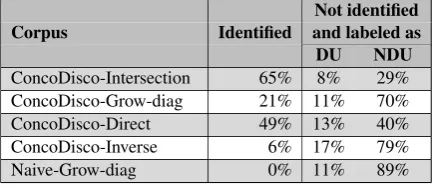
Table 5 shows the performance of each align-ment model for the identification of dropped French candidate DCs against the CrowdFlower gold-standard dataset. While the Intersection
model identifies the most dropped DCs (65% out of the 102 dropped candidates), theInverse word alignment is the worst model as it identifies only 6% of the dropped candidates and the naive Grow-diag approach clearly identifies none. Note that the alignment models tend to label dropped French candidates DCs as NDU more often than as DU 11Because we do not have gold discourse annotations for
DU NDU OA
Corpus P R P R P R
ConcoDisco-Intersection 0.934 0.895 0.902 0.816 0.914 0.845 ConcoDisco-Grow-diag 0.906 0.923 0.814 0.904 0.847 0.911 ConcoDisco-Direct 0.902 0.918 0.883 0.866 0.890 0.886 ConcoDisco-Inverse 0.891 0.927 0.801 0.928 0.832 0.928 Naive-Grow-diag 0.906 0.923 0.771 0.973 0.815 0.955
Table 4: Precision (P) and recall (R) of the four ConcoDisco and the Naive-Grow-diag corpora against the CrowdFlower gold-standard dataset for DU/NDU labels and overall (OA).
when they cannot identify candidates that were dropped during the translation; therefore, dropped French candidate DCs may artificially increase the number of NDU labels. This also explains why the number of NDU labels for theIntersection word-alignment is the lowest among the word-word-alignment models (see Table2).
Not identified and labeled as
Corpus Identified
DU NDU
ConcoDisco-Intersection 65% 8% 29% ConcoDisco-Grow-diag 21% 11% 70%
ConcoDisco-Direct 49% 13% 40%
ConcoDisco-Inverse 6% 17% 79%
Naive-Grow-diag 0% 11% 89%
Table 5: Accuracy of the four ConcoDisco and the Naive-Grow-diag corpora in the identification of dropped candidate DCs (unsupported candidates) against the CrowdFlower gold-standard dataset.
4.2 Extrinsic Evaluation
To extrinsically evaluate the effect of unsupported annotations on the quality of the ConcoDisco cor-pora models, we used the corcor-pora to train a binary classifier in order to detect the discourse usage of French DCs. Since the classifiers only differ by the training set used, by comparing the results of the classifiers, we indirectly assessed the quality of the corpora.
For our experiment, we used the French Dis-course Treebank (FDTB) (Danlos et al., 2015). The FDTB marks French DCs in two syntactically annotated corpora: the Sequoia Treebank (Candito and Seddah,2012) and the French Treebank (FTB) (Abeillé et al., 2000). We assigned DU labels to the French DCs marked in the FDTB and NDU la-bels for all other non-discourse occurrences of the French DCs in the FDTB. Table6shows statistics of the FDTB.
In our experiments, we used the same classifier
Corpus # Word # DU # NDU
FTB 557,149 10,437 40,669
Sequoia 33,205 544 2,255
Total 579,243 10,735 42,924
Table 6: Statistics of the FDTB.
used in the CLaC discourse parser (Laali et al., 2016) for disambiguating the usage of English DCs and trained it on the ConcoDisco corpora, the Naive-Grow-diag corpus and the FTB section of the FDTB. We reserved the Sequoia section of the FDTB for the evaluation of the trained classi-fiers. The text of the Sequoia section of the FDTB is extracted from Wikipedia and the ANNODIS corpus (Afantenos et al., 2012). This allowed us to compare the classifiers on datasets of different domains/genres than the training datasets, there-fore, introducing no bias toward any of the training datasets.
Table 7 shows the precision, recall and the F1-score of the classifiers. While the preci-sion of classifiers trained on the ConcoDisco cor-pora is high (0.831~0.857) and actually higher than the one trained on the manually annotated FTB, their recall is much lower (0.309~0.406). We also observed that the classifiers trained on Naive-Grow-diag and on ConcoDisco-Grow-diag have the same performance. This is because the Grow-diag models created many false-negative in-stances for a set of French DCs. Hence, the clas-sifiers trained on this model labeled all occur-rence of these French DCs as NDU. In addition, Naive-Grow-diag also added more false-negative instances to the same set of French DCs so the classifier labeled all those French DCs as NDU.
Among the classifiers trained on the Con-coDisco corpora, the one based on theIntersection
In-tersectionmodel makes it the most appropriate for discourse annotation projection.
The low recall of the classifiers trained on the ConcoDisco corpora is an indication of a large number of false-negative instances. As discussed in Section 4.1.2, an important source of false-negative instances is due to French candidate DCs that are dropped in the translation. Table7shows this by illustrating the same behaviour as in Ta-ble 5. As these two tables show, the more accu-rate a word alignment model is at pruning dropped French candidate DCs, the higher recall the clas-sifier will achieve using the dataset extracted from this word alignment model. In our case, the In-tersection model is the most accurate model in the identification of dropped candidate DCs with an accuracy of 65% (see Table 5), and the clas-sifier trained on the ConcoDisco-Intersection also achieves the highest recall (i.e. 0.406). This classifier achieves a 15% relative improvement in F1-score compare to the one that was trained on Naive-Grow-diag. This shows the adverse effect of unsupported annotations on the classifiers.
To investigate further the low recall of the clas-sifiers, we manually analyzed the results of three French DCs with a low recall and a high frequency in the CrowdFlower gold-standard dataset: enfin,
afin deandainsi12. We observed that while 96% of
the French candidate DCs for these English DCs were properly aligned to their translation, 59% of them were incorrectly labeled as NDU because their English translation were not properly anno-tated. This happened for three main reasons:
1. The English translation is an English DC, but because it is either infrequent in the PDTB (e.g. finally) or its NDU usage dominates its DU usage (e.g. for), the English DC cannot be reliably annotated.
2. The English translation is an English DC, but it is not listed in the PDTB (e.g.in order to). 3. The English translation is not an English DC, but it signals a DRs (e.g. this would ensure that or in this way). Such expressions are calledAltLex in the PDTB. We excluded Al-tLex from our analysis because to our knowl-edge, no English discourse parser can cur-rently annotate them reliably.
12Free translation: enfin =finally, afin de=in order to, ainsi=so.
Training Corpus P R F1
FTB 0.777 0.756 0.766
ConcoDisco-Intersection 0.831 0.406 0.546 ConcoDisco-Grow-diag 0.837 0.331 0.474 ConcoDisco-Direct 0.834 0.397 0.538 ConcoDisco-Inverse 0.857 0.309 0.454 Naive-Grow-diag 0.837 0.331 0.474
Table 7: Performance of the classifiers trained on different corpora against the Sequoia test set.
5 Conclusion and Future Work
In this paper, we addressed the main assumption of annotation projection and showed that discourse annotations may not always be reliably projected in parallel sentences when DRs are changed from explicit to implicit ones during the translation. We proposed a novel approach based on the intersec-tion between statistical word-alignment models to identify unsupported annotations. This approach was able to identify 65% of the unsupported anno-tations, hence allowing the automatic induction of more precise corpora. As a by-product of our ap-proach, we automatically induced the ConcoDisco corpora: the first PDTB style discourse corpora for French. We showed that our approach to filtering unsupported annotations improves the F1-score of a classifier that labels the DU and the NDU of French DCs by 15% compared to when the unsup-ported annotations are not filtered.
There are several ways that this work can be ex-tended. First, our method to induce a classifier to label French DCs with DU/NDU labels lends it-self well to a bootstrapping approach. As we used English DCs to label the usage of French DCs, we could also use French DCs to label the us-age of English DCs. Second, our approach can be used to automatically identify and annotate im-plicit DRs within English texts without parsing the English texts by identifying French DCs that are dropped during the translation (see Example (1) or Example (4)). In addition, since our approach only needs the availability of a parallel corpus with English, it can be easy used for other languages. Finally, the results of our work can be used to improve the development of French discourse re-sources such as LEXCONN and the FDTB.
Acknowledgement
Cianflone, Alexis Grondin, Andrés Lou and Félix-Herve Bachand for their help on the CrowdFlower task. This work was financially supported by an NSERC grant.
References
Anne Abeillé, Lionel Clément, and François Toussenel. 2000. Building a treebank for French. In Proceed-ings of 2nd International Conference on Language Resources and Evaluation (LREC 2000). Athens, Greece, page 165–187.
Stergos D. Afantenos, Nicholas Asher, Farah Bena-mara, Myriam Bras, Cécile Fabre, Mai Ho-Dac, Anne Le Draoulec, Philippe Muller, Marie-Paule Péry-Woodley, and Laurent Prévot. 2012. An empir-ical resource for discovering cognitive principles of discourse organisation: The ANNODIS corpus. In
Proceedings of the 8th International Conference on Language Resources and Evaluation (LREC 2012). Istanbul, Turkey, page 2727–2734.
Luisa Bentivogli and Emanuele Pianta. 2005. Ex-ploiting parallel texts in the creation of multilin-gual semantically annotated resources: The Mul-tiSemCor Corpus. Natural Language Engineering
11(3):247–261.
Peter F. Brown, Vincent J. Della Pietra, Stephen A. Della Pietra, and Robert L. Mercer. 1993. The mathematics of statistical machine translation: Pa-rameter estimation. Computational Linguistics
19(2):263–311.
Chris Callison-Burch, Philipp Koehn, Christof Monz, Kay Peterson, Mark Przybocki, and Omar F. Zaidan. 2010. Findings of the 2010 joint workshop on sta-tistical machine translation and metrics for machine translation. InProceedings of the Joint Fifth Work-shop on Statistical Machine Translation and Metric-sMATR. Uppsala, Sweden, page 17–53.
Chris Callison-Burch, Philipp Koehn, Christof Monz, Matt Post, Radu Soricut, and Lucia Specia. 2012. Findings of the 2012 Workshop on Statistical Ma-chine Translation. In Proceedings of the Seventh Workshop on Statistical Machine Translation. Mon-tréal, Canada, page 10–51.
Marie Candito and Djamé Seddah. 2012. Effectively long-distance dependencies in French: annotation and parsing evaluation. In The 11th International Workshop on Treebanks and Linguistic Theories (TLT 11). Lisbon, Portugal, pages 61–72.
Bruno Cartoni, Sandrine Zufferey, and Thomas Meyer. 2013. Annotating the meaning of discourse con-nectives by looking at their translation: The translation-spotting technique. Dialogue & Dis-course4(2):65–86.
L. Danlos, M. Colinet, and J. Steinlin. 2015. FDTB1: Repérage des connecteurs de discours en corpus.
In Actes de la 22e conférence sur le Traitement Automatique des Langues Naturelles (TALN 2015). Caen, France, pages 350–356.
Deen G. Freelon. 2010. ReCal: Intercoder reliability calculation as a web service. International Journal of Internet Science5(1):20–33.
Christopher Hidey and Kathleen McKeown. 2016. Identifying Causal Relations Using Parallel Wikipedia Articles. InProceedings of the 54th An-nual Meeting of the Association for Computational Linguistics (ACL 2016). Berlin, Germany, pages 1424–1433.
Alistair Knott. 1996. A data-driven methodology for motivating a set of coherence relations. PhD disser-tation, University of Edinburgh, Computer Science Department.
Philipp Koehn. 2005. Europarl: A parallel corpus for statistical machine translation. In Proceedings of the 10th Machine Translation Summit. Phuket, Thai-land, volume 5, pages 79–86.
Philipp Koehn, Hieu Hoang, Alexandra Birch, Chris Callison-Burch, Marcello Federico, Nicola Bertoldi, Brooke Cowan, Wade Shen, Christine Moran, Richard Zens, Chris Dyer, Ondrej Bojar, Alexandra Constantin, and Evan Herbst. 2007. Moses: Open source toolkit for statistical machine translation. In
Proceedings of the 45th Annual Meeting of the ACL on Interactive Poster and Demonstration Sessions (ACL 2007). Prague, pages 177–180.
Klaus Krippendorff. 2004. Content analysis: An intro-duction to its methodology. Sage.
Majid Laali, Andre Cianflone, and Leila Kosseim. 2016. The CLaC Discourse Parser at CoNLL-2016. InProceedings of the 20th Conference on Computa-tional Natural Language Learning (CoNLL 2016). Berlin, Germany, pages 92–99.
Majid Laali and Leila Kosseim. 2014. Inducing dis-course connectives from parallel texts. In Proceed-ings of the 25th International Conference on Com-putational Linguistics: Technical Papers (COLING 2014). Dublin, Ireland, pages 610–619.
Thomas Meyer. 2011. Disambiguating Tempo-ral–Contrastive Discourse Connectives for Machine Translation. In Proceedings of the 49th Annual Meeting of the Association for Computational Lin-guistics: Human Language Technologies (ACL-HLT 2011). Portland, OR, USA, pages 46–51.
Thomas Meyer and Bonnie Webber. 2013. Implicita-tion of discourse connectives in (machine) transla-tion. InProceedings of the 1st DiscoMT Workshop at the 51st Annual Meeting of the Association for Computational Linguistics (ACL 2013). Sofia, Bul-garia, pages 19–26.
Stephan Oepen, Jonathon Read, Tatjana Schef-fler, Uladzimir Sidarenka, Manfed Stede, Erik Velldal, and Lilja Ovrelid. 2016. OPT: Oslo—Potsdam—Teesside Pipelining Rules, Rankers, and Classifier Ensembles for Shallow Discourse Parsing. In Proceedings of the 20th Conference on Computational Natural Language Learning (CoNLL 2016). Berlin, Germany, pages 20–26.
Andrei Popescu-Belis, Thomas Meyer, Jeevanthi Liyanapathirana, Bruno Cartoni, and Sandrine Zuf-ferey. 2012. Discourse-level Annotation over Eu-roparl for Machine Translation: Connectives and Pronouns. InProceedings of the 8th International Conference on Language Resources and Evaluation (LREC 2012). Istanbul, Turkey, pages 23–25. Rashmi Prasad, Nikhil Dinesh, Alan Lee, Eleni
Milt-sakaki, Livio Robaldo, Aravind K. Joshi, and Bon-nie L. Webber. 2008. The Penn Discourse Tree-Bank 2.0. InProceedings of the Sixth International Conference on Language Resources and Evaluation (LREC 2008). Marrakech, Morocco, pages 28–30. Rashmi Prasad, Aravind Joshi, and Bonnie Webber.
2010. Realization of discourse relations by other means: alternative lexicalizations. InProceedings of the 23rd International Conference on Computa-tional Linguistics: Posters (COLING 2010). Beijing, China, page 1023–1031.
Charlotte Roze, Laurence Danlos, and Philippe Muller. 2012. LEXCONN: A French lexicon of dis-course connectives. Discours [En ligne] 10. https://doi.org/10.4000/discours.8645.
Jörg Tiedemann. 2015. Improving the Cross-Lingual Projection of Syntactic Dependencies. In Pro-ceedings of the 20th Nordic Conference of Com-putational Linguistics (NODALIDA 2015). Vilnius, Lithuania, pages 191–199.
Yannick Versley. 2010. Discovery of ambiguous and unambiguous discourse connectives via annotation projection. In Proceedings of the Workshop on Annotation and Exploitation of Parallel Corpora (AEPC 2010). Tartu, Estonia, pages 83–82.
Bonnie Webber, Matthew Stone, Aravind Joshi, and Alistair Knott. 2003. Anaphora and discourse struc-ture. Computational Linguistics29(4):545–587. Nianwen Xue, Hwee Tou Ng, Attapol Rutherford,
Bon-nie Webber, Chuan Wang, and Hongmin Wang. 2016. CoNLL 2016 Shared Task on Multilingual Shallow Discourse Parsing. In Proceedings of the 20th Conference on Computational Natural Lan-guage Learning (CoNLL 2016). Berlin, Germany, pages 1–19.
David Yarowsky, Grace Ngai, and Richard Wicen-towski. 2001. Inducing multilingual text analysis tools via robust projection across aligned corpora. In
Proceedings of the first international conference on
human language technology research (HLT 2001). San Diego, California, page 1–8.
Sandrine Zufferey. 2016. Discourse connectives across languages: factors influencing their explicit or im-plicit translation.Languages in Contrast16(2):264– 279.
Sandrine Zufferey and Bruno Cartoni. 2012. English and French causal connectives in contrast. Lan-guages in contrast12(2):232–250.