ISSN (Print) : 2320 – 3765 ISSN (Online): 2278 – 8875
I
nternational
J
ournal of
A
dvanced
R
esearch in
E
lectrical,
E
lectronics and
I
nstrumentation
E
ngineering
(An ISO 3297: 2007 Certified Organization)
Vol. 5, Issue 12, December 2016
Design and Implementation of A Smart Street
Lighting System
Deepraj S Deshmukh1, Dr.M.B.Ramamurti2
Research Scholar, Rayalaseema University, Kurnool, AP, India. 1
Professor CMRCET, Department of ECE, Kondlakoya (v) Medchal Road, Hyderabad, (TS), India. 2
ABSTRACT: - This work aims to develop a smart LED lighting system, which is remotely controlled by Android apps
via handheld devices, e.g., Smartphone’s, tablets, and so forth. The status of energy use is reflected by readings displayed on a handheld device, and it is treated as a criterion in the lighting mode design of a system. A multimeter, a wireless light dimmer, an IR learning remote module, etc. are connected to a server by means of RS 232/485 and a human computer interface on a touch screen. The wireless data communication is designed to operate in compliance with the ZigBee standard, and signal processing on sensed data is made through a self adaptive weighted data fusion algorithm. A low variation in data fusion together with a high stability is experimentally demonstrated in this work. The wireless light dimmer as well as the IR learning remote module can be instructed directly by command given on the human computer interface, and the reading on a multimeter can be displayed thereon via the server. This proposed smart LED lighting system can be remotely controlled and self learning mode can be enabled by a single handheld device via WiFi transmission. Hence, this proposal is validated as an approach to power monitoring for home appliances, and is demonstrated as a digital home network in consideration of energy efficiency.
KEYWORDS: - intelligent LED; lighting system; self-adaptive weighted; data fusion; ZigBee; IR
I. INTRODUCTION
As an increasingly popular issue, the field of digital home services appeals to plenty of high tech companies. The way humans go through their daily lives in today’s Hollywood films could be realized in the very near future, one of which is the digital home network aimed at facilitating human’s daily lives. Currently, digital home network technology is being developed with focus on six aspects, namely, central control systems, security monitoring, heath care, residence monitoring, information appliances, and energy saving. The field of central control covers system control, management authority, etc. security monitoring covers environment monitoring, building access control, etc. health care covers patient location tracking, bed management in hospitals, etc. residence monitoring covers lighting control, etc. information appliances cover home automation control, and energy saving covers efficiency improvement, power management, etc. Currently, many companies have put a great effort into the development of central control and information appliances, while they do not pay as much attention to the field of health care. This study is devoted to the applications of residence monitoring and information appliances.
There exists a wide diversity of home electronics with incompatible remote controls. The motivation of this work is hence to develop a platform, either on a smart phone or a tablet, for interoperability among these incompatible remote controls, such that the real time monitoring on home energy use can be achieved, and the brightness as well as the lighting modes of a smart LED lighting system can be switched. Smart control refers to a succession of control strategies, involving experience learning, logic operation, adaptivity, organization, debug, and so on, and is widely applied to highly uncertain, nonlinear, or complicated systems, which cannot be well controlled by conventional approaches.
ISSN (Print) : 2320 – 3765 ISSN (Online): 2278 – 8875
I
nternational
J
ournal of
A
dvanced
R
esearch in
E
lectrical,
E
lectronics and
I
nstrumentation
E
ngineering
(An ISO 3297: 2007 Certified Organization)
Vol. 5, Issue 12, December 2016
preloaded into the lighting system, either wired or wireless, to meet the user’s specific needs. Besides, conventionally, a heavily loaded lighting system necessitates a high-capacity switch, and requires a large volume of cables to drive a distant load. In contrast, a load is directly powered by an output driver, meaning that there is no need to increase the power capacity of a switch when the system is heavily loaded, and it merely requires a long signal line to drive a distant load. Furthermore, a smart lighting system can be made dimmable and controllable by timer means. As illustrated in Figure 1, a smart LED lighting system comprises a rectifier followed by a power factor corrector and then by a DC/DC converter [1].
Figure 1. Flow chart of a smart LED lighting system.
As a rule, there are two approaches to energy efficient lighting, namely, the use of high efficiency light sources, and the development of smart lighting techniques. An illustration of the latter is the thermal infrared sensing technique, by use of which indoor lights can be switched on/off automatically when there is somebody/nobody present. On top of that, a lighting system can be made adaptive, such that the indoor brightness can be maintained at a constant level taking into account the contribution of outdoor sunshine. As indicated by statistics, lighting, air conditioning and the rest account for 33%, 50% and 17% of energy consumption, respectively. Since the late 1960s and early 1970s, developed countries started to develop green lighting technologies for ecological concerns.
A great challenge to be faced is the electrical wiring problem when try to build an energy efficient lighting system in an old building. Is there a way to get the job done, but not to rewire the whole house? The answer is affirmative. A solution to this problem is the use of short range wireless communication techniques, namely, Bluetooth, IEEE 802.11 WiFi and infrared. For instance, the residence lighting can be controlled by an IR remote control. There are multiple remote controls in most residences, and a universal remote control is a must such that any of the home appliances can be controlled by such single piece [2].
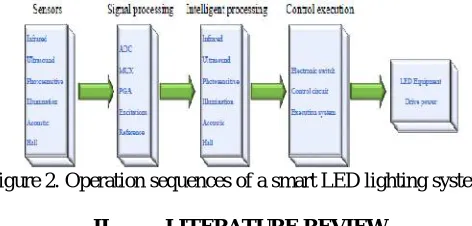
A wide variety of sensors, including IR, ultrasonic, light, illumination, voice, and Hall sensors, can be integrated into an MCU-based LED lighting system. In this manner, various types of detected signals can be processed in such a way that an LED lighting system can be operated in a smart way. Due to the very weak sensed signals, the front end electronics and signal processing is seen as required and involves an ADC(s), an MUX, a PGA, a voltage reference, an excitation source, embedded micro processor (MCU, ASIC), memory (RAM, E2PROM), etc. Smart signal processing can be automatically performed on the collected data by either an MCU or an ASIC inside commercial products. As illustrated in Figure 2, a number of wireless communication modules, including ZigBee, WLAN, TCP/IP, WiFi, etc. can be integrated into a remote control smart LED lighting system.
Figure 2. Operation sequences of a smart LED lighting system.
II. LITERATURE REVIEW
ISSN (Print) : 2320 – 3765 ISSN (Online): 2278 – 8875
I
nternational
J
ournal of
A
dvanced
R
esearch in
E
lectrical,
E
lectronics and
I
nstrumentation
E
ngineering
(An ISO 3297: 2007 Certified Organization)
Vol. 5, Issue 12, December 2016
audio and image data. As suggested in [4], a novel security monitoring system is operated in such a way that a residence owner can be warned by a text alert automatically, and a motion activated security camera(s) is operated only when there is something wrong therein for energy saving purposes.
Health care technology is applied to smart beds, electric adjustable beds, smart toilets, smart sofas, smart first aid kits, etc. residence monitoring technology is applied to smart closets, smart lamps, electric curtain control, automated temperature monitoring, etc. information appliance control is applied to smart kitchens, digital TVs, image phones, etc. and energy saving technology is applied to energy saving microwave ovens, electric ovens, energy efficient wastewater treatment, energy saving heaters, thermal bathtubs, etc. As indicated in [5], facial feature extraction is performed before family members return home, and the images of unidentified visitors can be displayed on monitors or smart phones for security concerns. Besides, the region of interest within an image can be skillfully specified in an attempt to reduce the incidences of false alarms. This technology can be further applied as an auxiliary tool for parents to keep an eye on infants and children. As stated in [6,7], optical fiber technology has been demonstrated as a very effective approach to the integration of smart TVs and many other services. For instance, at a minimum transmission rate of 100 Mbps for home use, high speed network services, including high definition TV (HDTV), video on demand (VOD), and the like, can be realized. Any type of optical fiber wireless products is not available yet in market due to a lack of transmission protocol stipulated. Other than the high spending, it requires a great effort to implement fiber to the home projects. Currently, there have been a wide variety of technologies, including LED, CCD and CMOS sensor technology, solar energy technology, available for digital home services.
There are a great number of problems waiting to be solved when integrating a wide diversity of digital home services. As suggested in [8,9], a great challenge encountered is the platforms and interoperability among various technologies, such as Ethernet, phone lines, power lines, IEEE 1394, USB2.0, Bluetooth, infrared, 802.11a/b/g, and so forth. Another big challenge is to provide the required network flexibility such that any extra sensors or devices can be effortlessly introduced into an existing smart home service network. As pointed out in [9], another challenge is to find effective ways to make new technologies accessible for seniors.
In this work, the addition of extra IR remote control home appliances into a digital home network merely requires more IR output channels in the aspect of hardware, while additional control interfaces must be developed in the aspect of software instead. As indicated in [1], an MCU-based LED lighting system is operated in such a way that the aim of cost reductions and an energy saving plan can be implemented. In an effort to extend LED lifetime, an LED light source is dimmed or even switched off once the sensed operating temperature goes beyond a threshold, and is lit in a dark place. Furthermore, a greater number of street lights can be lit automatically in rush hour traffic due to safety concern, and adaptive brightness is enabled according to the number of people indoor. A smart LED lighting system is proposed based on [1] toward the energy consumption reduction target.
If the LED heat has no way to exit the LED would be continuously enveloped in high temperatures. After a period of time the heat will cause the LED to become unstable with a decrease in brightness. Until now most LED lights were used with cooling aluminum housing material. There are three types of aluminum heat sinks, die-cast aluminum, extruded aluminum and fin-style aluminum. They have different degrees of cooling capacity, of course, the cost is different and so the LED lamp is priced differently. Therefore, when you choose LED lights you should try to understand its thermal material, as even with a low voltage LED chip heat will be released. LED heat radiating is not good in that it reduces the LED lights life-time to only 8,000–15,000 h or less. This is the most important factor causing increased costs.
III. DESIGN OF AN LED LIGHTING SYSTEM
All the constraints must be taken into account, e.g., the operating conditions, limitations on electrical and optical components, cost, LED driver current, and expected system lifetime, when an LED lighting system is designed so as to meet the user’s specific needs, e.g., temperature ratings, expected brightness.
ISSN (Print) : 2320 – 3765 ISSN (Online): 2278 – 8875
I
nternational
J
ournal of
A
dvanced
R
esearch in
E
lectrical,
E
lectronics and
I
nstrumentation
E
ngineering
(An ISO 3297: 2007 Certified Organization)
Vol. 5, Issue 12, December 2016
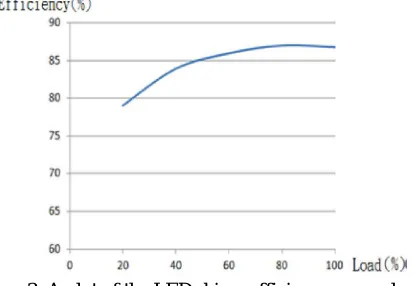
efficiency of 87% is highly recommended, while a lower one is recommended for outdoor use or for an extended lifetime.
Figure 3. A plot of the LED driver efficiency versus load.
The power loss leads to a drop in the lamp efficiency, and the number of LED lamps is determined so as to meet the total luminous flux requirement, expressed as:
where Bs and BM represent the actual luminous flux and the target value, respectively, G and R the optical and the thermal efficiencies, respectively.
LED operating current plays a critical role in the lighting efficiency and the lifetime thereof. A rise in the operating current brings about an enhanced output power and requires a smaller number of LEDs, but the price paid is a degraded efficiency, a larger sized LED driver and a shorter life cycle, since there is a high temperature drop across LED heat channels. The minimum, rather than typical, luminous flux requirement, as specified in an LED application note, must be met in the determination of the number of LED lamps. Accordingly, the number of LEDs, SLED, is given as:
where BS denotes the actual luminous flux, and BD the minimum flux emanating from each LED. Since each LED is an independent light source, an LED lamp provides a much longer life cycle than a conventional light source, and can be integrated with novel light sources into an existing lighting system.
Although LED is an energy efficient light source, a large amount of heat consumption is generated in an LED lighting system when a great number of high power LEDs operate concurrently. The efficiency of an LED is found to decrease with the operating current, namely, the operating temperature. In an effort to operate an LED at a high efficiency, the operating temperature must be kept low for sure. A significant heat dissipation improvement has been made using a heat sink to which a high power LED is mounted. In contrast, the outward transfer heat generated by an LED lamp cannot be made as efficient as in the preceding case, due to the thermally non conductive material used in a lamp case. In this context, a steep temperature rise brings about a degraded performance and a shortened lifetime. There is a great challenge when dealing with a theoretical thermal analysis on an LED lamp due to the thermal convection with complicated boundary conditions and the thermal conduction across multiple interfaces. As a matter of fact, there is no need to analyze the heat distribution in a non-equilibrium state, since merely an equilibrium state is the issue of interest. It is an extremely difficult task to evaluate the heat distribution in the interior of a lamp case across multiple interfaces, and what really matters in practical application is whether the temperature falls below the rating. A solution to this problem is the use of thermal resistance theory, an advantage over streamline thermal analysis in this case.
ISSN (Print) : 2320 – 3765 ISSN (Online): 2278 – 8875
I
nternational
J
ournal of
A
dvanced
R
esearch in
E
lectrical,
E
lectronics and
I
nstrumentation
E
ngineering
(An ISO 3297: 2007 Certified Organization)
Vol. 5, Issue 12, December 2016
which a way must be found to elevate the driver’s efficiency. In most cases, there are two ways to tune LED intensity, one of which is achieved by the change of DC driving current, and the other is made by pulse width modulation (PWM). The light intensity varies linearly with the driving current, until a threshold is reached. Light efficiency degradation is seen together with a large amount of heat at high driving currents. The light intensity is tuned according to the Talbot-Plateau law in a PWM scheme. Commercial LEDs are available with recommended driver circuits meeting EMI and other safety requirements, leading to a short design phase. Yet, there exists a problem that the drivers recommended are measured as a rule to demonstrate an efficiency of approximately 80%, and driver’s performance variation, affecting the life cycle together with the operating temperature of an LED, appears among those provided by LED manufacturers [10,11].
IV. SYSTEM FRAME
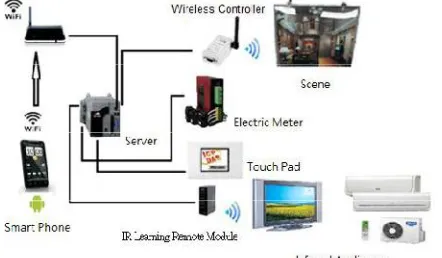
As a server, XP-8000 takes charge of data access, and gets connected to a Touch Pad, a multimeter, an IR learning remote module, a wireless lighting controller, and many more through an RS-232 or an RS-485 interface such that a digit home is constructed. As illustrated in Figure 4, an IR learning remote module is wired to the server, an XP-8000, through an RS-232 interface, while the voltage/current readings on a multimeter is transmitted to the server by means of an RS-485 interface. A light module is instructed via a wireless controller connected to and by the server through the RS-232 interface, and the server is operated according to the command issued by a Touch Pad through WiFi connection.
Figure 4. Devices controlled by the server in a smart lighting system.
In the system server, a particular block of memory, referred to as the Shared Memory hereafter is reserved for the current status storage of various electrical devices. For instance, instructions are issued indirectly from a mobile device, e.g., a smart phone or a tablet, using WiFi technique by way of the Shared Memory. In contrast, devices are instructed directly by a human computer interface on a touch screen, subsequent to which the status information stored in the Shared Memory is updated. Accordingly, the readings displayed on a multimeter can be presented on a smart phone, a tablet or a human computer interface on a touch screen by means of the Shared Memory.
V. CONCLUSIONS AND FUTURE WORK
Remote control for home appliances can be operated by a handheld device, such as a smart phone, a tablet, etc. The performance superiority of an LED lighting system over its conventional counterparts is demonstrated in the proposal in many aspects. Further cost savings are realized by the proposed color-changing and fully dimmable smart LED lighting controller relative to a conventional one.
ISSN (Print) : 2320 – 3765 ISSN (Online): 2278 – 8875
I
nternational
J
ournal of
A
dvanced
R
esearch in
E
lectrical,
E
lectronics and
I
nstrumentation
E
ngineering
(An ISO 3297: 2007 Certified Organization)
Vol. 5, Issue 12, December 2016
to prevent LED damage from the voltage over and undershoot, that is, the lifetime of an LED light source is hence extended.
A program starts technique is adopted in a smart light dimmer such that a specified level of brightness is reached over time for an extended lifetime of an LED. Likewise, a program close technique is employed as well. It is found that a 10% drop in brightness can double the lifespan of an LED light source, while a 50% drop can extended the lifespan by up to 20-fold. Preset lighting modes are stored in the memory of a micro controller unit for easy maintenance as well as replacement. A number of automated services are expected to be provided to meet specific needs and for energy saving purposes. In short, a tremendous amount of advancing progress has been made in the field of smart lighting techniques, as the consequence of network and automatic control technique improvement.
REFERENCES
1. Tan, Y.K.; Huynh, T.P.; Wang, Z.Z. Smart personal sensor network control for energy saving in DC grid powered LED lighting system. IEEE Trans. Smart Grid 2013, 4, 669–676.
2. Park, Y.J.; Lee, M.H. Cost Effective Smart Remote Controller Based on Invisible IR-LED Using Image Processing. In Proceedings of the 2013 IEEE International Conference on Consumer Electronics (ICCE), Las Vegas, NV, USA, 11–14 January 2013; pp. 434–435.
3. Hwang, Z.; Uhm, Y.; Kim, Y.; Kim, G.; Park, S. Development of LED smart switch with light-weight middleware for location-aware services in smart home. IEEE Trans. Consum. Electron. 2010, 56, 1395–1402.
4. Zanjani, P.N.; Ghods, V.; Bahadori, M. Monitoring and Remote Sensing of the Street Lighting System Using Computer Vision and Image Processing Techniques for the Purpose of Mechanized Blackouts. In Proceedings of the 2012 19th International Conference on Mechatronics and Machine Vision in Practice (M2VIP), Auckland, New Zealand, 28–30 November 2012; pp. 5–10.
5. Ding, Y.S.; Jin, Y.L.; Ren, L.H.; Hao, K.R. An intelligent self-organization scheme for the internet of things. IEEE Comput. Intell. Mag. 2013, 8, 41–53.
6. Lee, C.K.; Li, S.N.; Hui, S.Y. A design methodology for smart LED lighting systems powered by weakly regulated renewable power grids. IEEE Trans. Smart Grid 2011, 2, 548–554.
7. Bhardwaj, S.; Syed, A.A.; Ozcelebi, T.; Lukkien, J. Power-managed smart lighting using a semantic interoperability architecture. IEEE Trans. Consum. Electron. 2011, 57, 420–427.
8. Keränen, K.; Mäkinen, J.; Korhonen, P.; Juntunen, E.; Heikkinen, V.; Mäkelä, J. Infrared temperature sensor system for mobile devices. Sens. Actuators A Phys. 2010, 158, 161–167.
9. Choi, S.J.; Kim, T.H. Symmetric current-balancing circuit for LED backlight with dimming. IEEE Trans. Ind. Electron. 2012, 59, 1698–1707. 10. Park, W.-K.; Han, I.; Park, K.-R. ZigBee based dynamic control scheme for multiple legacy IR controllable digital consumer devices. IEEE Trans. Consum. Electron. 2007, 53, 172–177.
11. Erol-Kantarci, M.; Kantarci, B.; Mouftah, H.T. Reliable overlay topology design for the smart microgrid network. IEEE Netw. 2011, 25, 38–43. 12. Thomas, C.; Balakrishnan, N. Improvement in intrusion detection with advances in sensor fusion. IEEE Trans. Inf. Forensics Sec. 2009, 4, 542– 551.
13. Cevikalp, H.; Polikar, R. Local classifier weighting by quadratic programming. IEEE Trans. Neur. Netw. 2008, 19, 1832–1838.
14. Zaveri, M.A.; Merchant, S.N.; Desai, U.B. Robust neural-network-based data association and multiple model-based tracking of multiple point targets. IEEE Trans. Syst. Man Cybernet. Part C: Appl. Rev. 2007, 37, 337–351.
15. Park, D.-C.; Woo, Y.-J. Weighted centroid neural network for edge preserving image compression. IEEE Trans. Neur. Netw. 2001, 12, 1134– 1146.
16. Sung, W.-T.; Hsiao, C.-L. IHPG algorithm for efficient information fusion in multi-sensor network via smoothing parameter optimization. Informatica 2013, 24, 219–230.
17. Liu, T.H.; Yi, S.C.; Wang, X.W. A fault management protocol for low-energy and efficient wireless sensor networks. J. Inf. Hid. Multimedia Signal Process. 2013, 4, 34–45.
18. Chen, Y.H.; Huang, H.C. The copyright protection system for android platform. Recent Adv. Inf. Hid. Appl. 2013, 40, 19–32.