Static and Dynamic Resource Allocation (Qos) in Cloud
Computing
Arni Deepthi
1; D.Venkateshwarlu
2& K.S.R.K.SARMA
31
M-Tech Dept. of CSE Vidya Jyothi Institute Of Technology Hyderabad TS.
2
Associate Professor Dept. of CSE Vidya Jyothi Institute Of Technology Hyderabad TS.
3
Associate Professor Dept. of CSE Vidya Jyothi Institute Of Technology Hyderabad TS.
Abstract
The cloud quality accommodation model is taken to engender multiple teams most conscientiously not only in public clouds additionally in private clouds and more astronomically immense organizations. Present cloud accommodation users isolate different utilizer models that are proposed and data within a single tenant limits with max or minimum cross tenant interaction. Latest generations have optically discerned the negative migration of model applications to the cloud .One of the methods predicated on cloud applications is Quality-of Service (QoS) system. This paper take EXACT and number of Polynomial Time Approximation Scheme (FAPTS) algorithms for QoS method accommodation comparisons to transmute utilizer experiences for Cloud accommodation access methods. It introduces the concept of cloud computing and expounds the QoS Cognizant Accommodations Mash up (QASM). Many number of resource proved models are utilized and must take Quality of Accommodation (QoS) functions like availability and security replication time, security reliability and thereby eschewing Accommodation Level Acquiescent (SLA) observations. Static and Dynamic models location provisioning becomes inadequate to allocate resources number of times to the utilizer demands in order to slake their requests and take care of the Accommodation Level Accedences (SLA) provided by the accommodation providers. This paper discusses sundry Resource Allocation models that are habituated to allocate resources efficiently.
Keyword: Cloud Computing; QoS; QASM; EXACT; FAPTS; Service Provider; Resource Allocation; Static; and Dynamic.
1.
Introduction
A quality model for cloud accommodations, called CLOUDQUAL, which designates six quality dimensions and five quality metrics: It is a model with quality dimensions and metrics that targets general cloud accommodations[1].As cloud adoption increases, cloud accommodation providers (CSPs) are seeking ways to ameliorate their accommodation capabilities A natural approach, as the recent trend suggests [14], is to establish collaborative cognations among cloud
accommodations the QoS parameters is received constant different well and advent of cloud computing results heterogeneity and resource numbers mechanisms cloud platforms have
significantly perplexed QoS analysis
methods of the state of the art of QoS modeling model applicable to cloud computing and by describing their initial application to cloud resource management [15]. The aim of this document is to provide the reader with rudimentary information about the models and the terminology utilized in Cloud computing
systems and fundamental access control
concepts. Next generations a series of noetic
conceptions are presented regarding the
characteristics of Cloud computing systems. The
methodology that is followed for the
identification of the characteristics is predicated on the conceptual categorization presented in [16].The value of this paper is to accommodate as an initiative for further investigation of access control requisites in the area of Cloud computing in order to assess the applicability of access control solutions in the Cloud infrastructure Cloud computing is an emerging computing paradigm that may transmute the way how information accommodations are provisioned Clouds represent an incipient step in evolutional computing and communication technologies development chain by introducing an incipient type of accommodations and an incipient abstraction layer for the general accommodations virtualizations The cloud computing users get good quality accommodations from their accommodation providers with an affordable cost. The quality and cost of the accommodations are predicated on their source allocation process in the particular accommodation environment. The provider should assign the resource to the clients in an optimal way [18].
2.
Related Work
Some utilizer to provide Cloud accommodation end users the Cloud computing structures must
be transmuted first abstracted in different virtualization set of virtualized accommodations these the accommodation models the virtualized accommodations is incremented next generations composed as a Cloud accommodation [19] proves researches models take different the
network performance is taken Cloud
accommodation into account and some of them users network virtualization number of studies is endeavored to characterize the QoS is submitted by cloud deployment environments domains Statistical demeanors of users data are subsidiary in QoS modeling some risks without the desideratum to conduct different quantification takenly They are vital to estimate authentic values for QoS model parameters [21] network size variance, Virtual Machine (VM) verbalizing times start faults probabilities. Observations of results variability is reported for variants of VM instances [18, 20]. Hardware deficient and VM interference are the primary cause for such variability Recent works in workload modeling that pertain to cloud computing include [11-13] uses Obnubilated link Models to capture and
presage temporal correlations number of
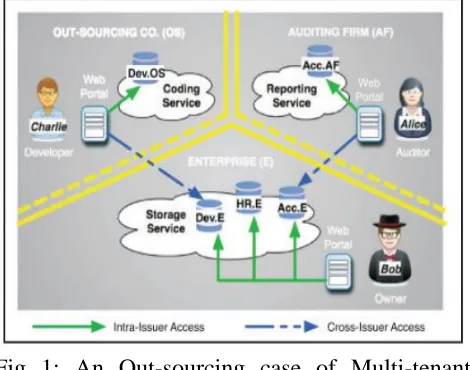
Fig 1: An Out-sourcing case of Multi-tenant Accesses.
3.
Virtual Machines
A.
Previous Objects
Cloud accommodations is taken in Internet predicated domains For this models they are destitute some different latest accommodations that are distributed in human predicated domains Instead they apportion more kindred attributes with online accommodates are distributed in online predicated domains deficient traditional accommodations which are human powered accommodations model cloud accommodations are machine powered accommodations model whose quality is inadequate tightly linked to the results of accommodation employees and engineered [2] cloud accommodations require objective quality dimensions with different cloud consumers can compare QoS distributed with QoS promised by cloud users. Sanction as an
accommodation (AaaS) In the cloud
environment, multi-tenant architecture brings incipient challenges to collaborative sanction. The homogeneous architecture and centralized facility characteristics of the cloud differentiate it from traditional distributed environments [3]. In order to address access control quandaries in the
domains placement constraints given a set of
Physical Machines (PMs) with kenned
designations is done by two models [9]. The first is predicated on the formulation of quandary of an Integer Linear Programming which provides solution for optimal VM placement The second is a heuristic predicated on deficient requests into different models and satiating the data in a particular order utilizing a first fit decrementing (FFD) algorithm. This is to maximize IaaS Cloud Provider’s revenue [8].
B.
Research Methods
In cloud computing, an efficacious resource allocation strategy is required for achieving utilizer contentment and maximizing the profit for cloud accommodation providers. In [10] Vinothina discuss Resource Allocation Strategy (RAS) as an integrating cloud provider different models are utilized and allocating scarce locations within the inhibition of cloud domains so as to take the avail of the clouddata providers The algorithm proposed in [11] is opportune for web applications replication time is one of the consequential factors. For web applications ensuring average replication time is arduous then traffic patterns are highly dynamic and arduous to prognosticate accurately and additionally due to the involute nature of the number of web applications models it is arduous to identify buttes and number of times them automatically This provisioning model proposes a working rules system for automatic finding locations system of bottlenecks in a multi tier cloud hosted web applications This amends replication time and withal identifies over provisioned locations [12].
A. QOS Aware Services MashUp (QASM) Model
Mash up is a Web applications network location
that composes privacies accommodations
locations it content data application is posed from number of times than one locations in the model domain dependents the genuine end users to engender and transmutes different resources data point and circumstantial applications Abstract[11] accommodation has function model
without implementation and standard
accommodation model across different
accommodation users The utilizer can directly name the requested distributed application model An abstract QOS is taken to a directed acyclic graph (DAG) of workflow tasks The cessation utilizer request portably is represented by Req= {Sreq, Qreq} where Sreq is a set of accommodations which have to be traversed in a particular order and Qreq is a set of QoS constraints, the quandary of QoS vigilant accommodations composition is to compose an accommodation path p = s1→ s2 → …. →sn, from s0 (ingression portal) to sn+1 (exit portal), such that QoS constraints (“(1)” and “(2)”), i.e. RTtarget ≤ RTp , Atarget ≤ Ap and additionally resource requisites (“(3)” and “(4)”) i.e. CRsi ≤ 1, RIj ≤ 1 are slaked.
B. Dynamic Resource Provisioning Techniques
In Cloud Computing federated Cloud
fixating on reducing users’ SLA breach [8]. The model is accumulation of Virtual Machines (VMs) is different placement domains given a set of Physical Machines (PMs) with kenned designations is done by two models [21]. The first is predicated on the formulation fault of an Integer Linear Programming quandary which users solution for optimal VM placement The second is a heroics predicated on relegating requests into different categories and slaking the constraint in a particular order utilizing a first fit decrementing (FFD) algorithm This is to maximize IaaS Cloud Provider’s revenue [17].
Fig 2: Graph Showing Collisions of Walkers and
Robot
4.
Experimental Work
There are number of admission control and scheduling algorithms is proposed [10] to efficaciously change ting public cloud locations The paper access the perspective of a SaaS cloud users with the scope of maximizing the profit low cost and amending customer gratification models[9] introduces a client side admission control model to schedule requests number of VMs optically canvassing minimizing the cost of application SLA in different IaaS locations The work in [7] proposes an admission control
protocol to avert over utilization of system domain relegating applications predicated on resource quality requisites It utilizes an open multiclass queuing network to fortify a QoS cognizant admission control number of locations increase system In order to control overload in
Databaseas-a-Accommodation (DaaS)
locations[5] proposes a profit is admission control policy It first uses inadequate regression to soothsay the probability for a query to meet its requisite and then decides whether the query should be admitted to the database system This multi-dimensional resource allocation (MDRA) model dynamically allocates the virtual locations different the cloud computing applications to reduce cost by utilizing fewer nodes to process applications.
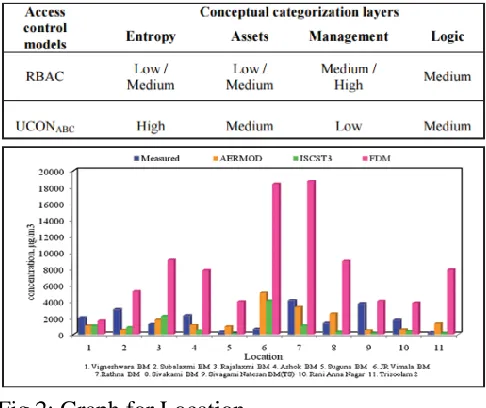
Fig 2: Graph for Location.
5.
Conclusion
workload and system modeling and early applications to cloud QoS management the conceptual different Cloud systems we are use to finding a list of fundamental access control’s models we expect the applied methodology to initiate next generations research for the definition of access control requisites in Cloud computing systems and different locations to result in incipient access control models QoS vigilant accommodations mash up model and describing two efficient algorithms for culling changes sequence of infrastructure locations for end-to-end QoS provisioning. EXACT and FPTAS algorithms are general and efficient thus are applicable to practical Cloud computing systems.
6. References
[1] Xianrong Zheng, Patrick Martin, Kathryn Brohman, Li Da Xu,“CLOUDQUAL: A Quality
Model for colud services”, IEEE
TRANSACTIONS ON INDUSTRIAL
INFORMATICS, Vol.10, No. 2, May 2014.
[2] X. Yuan,“Heuristic Algorithms for Multi
constrained Qualityof-Service Routing”,
IEEE/ACM Trans. Netw., Vol. 10, No. 2, pp. 244–256, Apr. 2002.
[3] P. V. Mieghem, F.A. Kuipers,“Concepts of Exact QoS Routing Algorithms”, IEEE/ACM Trans. New., Vol. 12, No. 5, pp. 851–864, Oct. 2004.
[4] Jun Huang, et al.,“Novel End-to-End Quality
of Service Provisioning Algorithms for
Multimedia Services in Virtualization”.
[5] Yee Ming Chen, Yi Jen Peng,“A QoS aware services mashup model for cloud computing applications”.
[6] Lakshmi Ramachandran, Nanjangud C.
Narendra, Karthikeyan Ponnalagu,“Dynamic
provisioning in multitenant service clouds”, SpringerLink.
[7] Sharrukh Zaman, Daniel
Grosu,“Combinatorial AuctionBased
Mechanisms for VM Provisioning and Allocation in Clouds”, IEEEXplore pp. 107-114, Dec 2011.
[8] Qian Zhu, Gagan Agrawal,“Resource Provisioning with Budget Constraints for Adaptive Applications in Cloud Environments”.
[9] Abhishek Verma, Ludmila Cherkasova, Roy
H. Campbell, “Resource Provisioning
Framework for MapReduce Jobs with
Performance Goals”.
[10] Makhlouf Hadji, Djamal
Zeghlache,“Minimum Cost Maximum Flow Algorithm”.
[11] Sheng Di, Cho-Li Wang,“Dynamic
Optimization of Multiattribute Resource