THD Analysis of Induction Motor Using Solid
State Switching Devices
Umar Farooq Siddiqui1, Pallavi Bondriya2
PG Student [PE], Dept. of EX, TIT, Bhopal, Madhya Pradesh, India1 Assistant Professor, Dept. of EX, TIT, Bhopal, Madhya Pradesh, India2
ABSTRACT: In this paper soft starting of asynchronous motor via two different power electronics devices is obtained as well as this paper give comparative performance of asynchronous motor for same firing angle applying on two different power electronics devices first one is thyristor and second one is insulated gate bipolar transistor. This paper employ the topology in order to minimizing the adverse effects of high inrush currents in induction motors starting torque transients with the help of electronically controlled soft-starting voltages utilizing silicon-controlled rectifiers (SCRs). In this paper fundamental frequency and THD is calculated in both for R-L load and asynchronous motor by various firing angles, and influence of load variations in terms of firing angle has been investigated for Thyristor and IGBT (Insulated Gate Bipolar Transistor).
KEYWORDS: Variable speed induction motor, Soft Starter, Thyristor, IGBT, Fundamental Frequency, THD. I.INTRODUCTION
Harmonics are cause of voltage changing and increasing fluctuating torque, surge as well as creating losses in supply line which occur great problems in the starting of large asynchronous motor. Harmonic is component of a sine wave that is an integer multiple of the fundamental wave. In case of increase harmonics cause losses and depreciation in the transmission and distribution equipment and power consumers, so to control harmonic it is necessary to use some technique to reduce harmonics and increasing quality of power as well as make it healthier for devices. Because of harmonics supply voltage fluctuates, resulting in the failure of motor starting
.
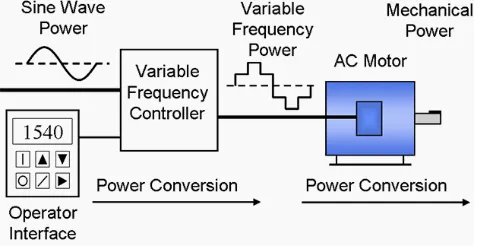
In this paper we have discussed about solution of all above types of problems and remove this by using soft starter technique. There are a lot of methods adapting to controlled harmonics in these one method is to insert filter between the supply and asynchronous motor. If the supply output voltage contains high frequency harmonics, these can be reducing by low-size filter. Soft Starting gives jerk free and smooth start to the induction motor. Subsequent to this, high frequency component from this voltage can easily be attenuated by using a semiconductor based control circuit model. This controlled circuit not only reduces harmonics as well as reduce problem of direct online starting and give smooth and jerk free stating to the machine. AC voltage controllers or voltage regulator or control circuit unit can use highly speed power electronics switches such as thyristors, Insulated gate bipolar transistor, Bipolar Junction Transistor etc. Now present day’s thyristor and IGBT more commonly employed in soft starting of induction motor.THD is elevated. When the load is vacuous the soft starter method is dexterous. The feasibility of this thesis is that continuous Alternating current side input current in contrast to the conventional AC regulator where the input current is irregular. The major improvement with this scheme is the input current happens to be discontinuous continuous ac side within input current in contrast to the conventional ac regulator where. This in turn improves the transient response. This method mends the execution of the motor by dislodging the supply frequency torque pulsation. Block diagram of split phase induction motor with soft starter is shown in fig.
Fig. 1 Block Diagram of Soft-Starter Controlled a Synchronous motor drive
II.VERIABLE SPEED DRIVE
Variable speed ac drives are used in ever-increasing numbers because of their well-known benefits for energy efficiency and for flexible control of processes and machinery using low-cost readily available maintenance free ac motors. Advances in solid state power conversion devices have opened up new field of application for ac machines to variable speed drive applications where formally only dc motors where practicalWith the recent advances in power electronics (bipolar transistor, inverter grade thyristor, GTO thyristor, IGBT etc.) and miniaturization/mass production of control electronics (development of VLSI technology and microprocessor based digital control systems), variable frequency and variable voltage (V.V.V.F) a.c motors drives have come into increased use in various industrial applications.
III.AC VOLTAGE CONTROLLER
AC voltage controllers (ac line voltage controllers) are employed to vary the RMS value of the alternating voltage applied to a load circuit by introducing Thyristors between the load and a constant voltage ac source. The RMS value of alternating voltage applied to a load circuit is controlled by controlling the triggering angle of the Thyristors in the ac voltage controller circuits. In phase control the Thyristors are used as switches to connect the load circuit to the input ac supply, for a part of every input cycle. That is the ac supply voltage is chopped using Thyristors during a part of each input cycle. The thyristor switch is turned on for a part of every half cycle, so that input supply voltage appears across the load and then turned off during the remaining part of input half cycle to disconnect the ac supply from the load. By
controlling the phase angle or the trigger angle ‘α’ (delay angle), the output RMS voltage across the load can be
controlled. The trigger delay angle ‘α’ is defined as the phase angle (the value of ωt) at which the thyristor turns on and
the load current begins to flow.
Fig 3 AC Voltage Controller
IV.DEVELOPMENT OF MATLAB/SIMULINK MODEL
Simulink is a software package which potentially viable you to model, simulate, and analyze systems whose outputs change over time. There are many many stages for the creation of any simulink model. Firstly , a block diagram is created by user, with the help of Simulink model user edited, that graphically depicts time-dependent mathematical relationships among the system's inputs, states, and then gated its outputs. The sample time of a block is a parameter that indicates when, during simulation, the block produces outputs and if appropriate, updates its internal state. Sample times can also be discrete, continuous, fixed in minor step, inherited, constant, variable, triggered, or asynchronous. A classic block diagram model of a dynamic system graphically consists of blocks and lines -
Fig 4 Schematic Simulation model
V. THEORETICAL ANALYSIS
Harmonic is a multiple integral multiple of fundamental frequency which disturb pure sinusoidal waveforms. Total Harmonic Distortion is the illustration of harmonic distorted current concerned with fundamental current. Harmonic distortion can be determined by following equations:-
THD = ………… In case of voltage –
THD =
⋯………..
The voltage at each harmonic is given by –
Vn(rms) =
2+ 2
Where –
an = [
2
(1+ ) { cos(1+n) α-1 } ( ) { cos(1- n) α-1 }]
bn = [
2
(1+ ) { sin(1+n) α-1 } + ( ) { sin(1- n) α-1 }]
Where n = 1
a1 = [
2
(1+1) { cos (1+1) α-1 } + ( ) { cos (1- 1) α-1 }]
a1 = { cos2α-1 }
Like above equations –
b1 = { sin2α+2(π-α) }
Input power can obtain by –
Pinput = VRMS IRMS
Output Power can be obtain by –
Pout = VRMS(out) IRMS(out)
Pout = ( )R =
( )
η =
Where –
Vout(rms) = Vz =
[(
−
) +
Iout(rms) =
√
1
−
+
These current equation conclude that by controlling firing angle can controlled the output current.
VI.SIMULINK MODEL OF SPLIT PHASE ASYNCHRONOUS MOTOR
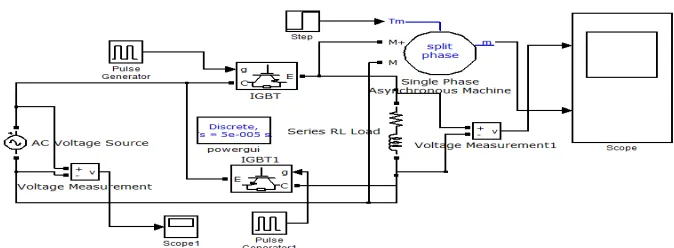
This is the diagram of single-phase soft starter of single phase induction motor using Thyristors With R-L load. There is a ac voltage regulator connected with single phase ac supply. The regulator is equipped with thyristor. There are two triggering circuits connected with individual anti parallel thyristor pair. Now the next section is controlling unit which will controlled output of regulator circuit with respect to time. This stable output fed into the input of single phase induction motor and R-L load. For different values of firing angle there are their individual appropriate results and we can analyse the result on scope.
Fig.5 Single-Phase Soft Starter Using Thyristors With R-L Load
This is the table of THD and fundamental frequency for various firing angle for thyristor based soft starter technique . Different firing angles have different THD as well as fundamental frequency for both R-L load and split phase induction motor. Following table will show the above fulfilment of soft starter techniques.
Sr. No. Firing Angle
(degree) THD in % Fundamental Frequency(Hz) R-L Load THD in % Induction Motor Fundamental Frequency(Hz)
1
PG-I – 12 PG-II – 192
3.45 98.93 12.3 13.28
2 PG-I -15 PG-II -195
4.51 98.84 12.18 13.26
3 PG-I -18 PG-II -198
5.63 98.72 12.10 13.24
4 PG-I -30 PG-II -210
11.60 97.56 12.77 13.04
5 PG-I -45 PG-II -225
24.01 92.58 16.92 12.27
TABLE 1- THD for various firing angle for thyristor based soft starter
VII. SIMULINK MODEL OF SPLIT PHASE ASYNCHRONOUS MOTOR USING IGBT
This is the table of THD and fundamental frequency for various firing angle for insulated gate bipolar transistor based soft starter technique. Different firing angles have different THD as well as fundamental frequency for both R-L load and split phase induction motor. Following table will show the above fulfilment of soft starter techniques.
Sr. No. Firing Angle
(degree) THD in % R-L Load Fundamental Frequency(Hz) THD in % Induction Motor Fundamental Frequency(Hz)
1 PG-I - 12
PG-II – 192
7.35 98.24 14.76 13.45
2 PG-I -15
PG-II -195
7.35 98.24 14.76 13.45
3 PG-I -18
PG-II -198
7.35 98.24 14.76 13.45
4 PG-I -30
PG-II -210
37.94 91.95 21.76 12.43
5 PG-I -45
PG-II -225
39.72 90.49 23.15 12.24
TABLE 2- THD for various firing angle for IGBT based soft starter
VII. RESULT
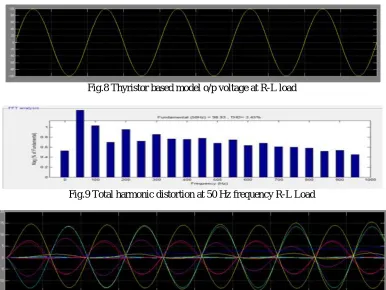
Following are the results through simulation software for the respective firing angles which shows outputs of R-L load and split phase induction by waveforms between amplitude versus time. These results shows variations in outputs by changing firing angles with respect to time.
RESULT FOR FIRING ANGLE 12 0 and 192o -
Fig.8 Thyristor based model o/p voltage at R-L load
Fig.9 Total harmonic distortion at 50 Hz frequency R-L Load
Fig.11 Total harmonic distortion at 50 Hz frequency at Asynchronous motor
Fig.12 O/P Voltage waveform Of IGBT based model at R-L Load
Fig.13 Total harmonic distortion at 50 Hz frequency R-L Load
Fig.14 IGBT based model o/p voltage at Asynchronous motor
RESULT FOR FIRING ANGLE 18 0 and 198o –
Fig.16 Thyristor based model o/p voltage at R-L load
Fig.17 Total harmonic distortion at 50 Hz frequency R-L Load
Fig.18 Thyristor based model o/p voltage at Asynchronous motor
Fig.19 Total harmonic distortion at 50 Hz frequency at Asynchronous motor
Fig.20 O/P Voltage waveform Of IGBT based model at R-L Load
Fig.22 IGBT based model o/p voltage at Asynchronous motor
Fig.23 Total harmonic distortion at 50 Hz frequency at Asynchronous motor RESULT FOR FIRING ANGLE 45 0 and 225o -
Fig.32 Thyristor based model o/p voltage at R-L load
Fig.33 Total harmonic distortion at 50 Hz frequency R-L Load
Fig.36 IGBT based model o/p voltage at R-L
Fig.37 Total harmonic distortion at 50 Hz frequency R-L Load
Fig.38 IGBT based model o/p voltage at Asynchronous motor
Fig.39 Total harmonic distortion at 50 Hz frequency at Asynchronous motor
VIII.CONCLUSION
The paper analyze the performance of induction motor drive supplied from a variable voltage soft starter individually for thyristor and IGBT. This analysis conclude that when the firing angle gradually increases fundamental frequency decreases and THD increases. It is also concluded that with increasing firing angle, motor fails in critical cases. For same firing angle R-L load’s THD and fundamental frequency have higher value as compare to asynchronous motor THD and fundamental frequency. It is also concluded for same firing angle thyristor based soft starting gives low THD and high fundamental frequency as compare to IGBT based soft starting. As IGBTs requires filters to be used as power switch, large amount of distortion cab be observed in the input voltage which results in drive system instability, we set firing angle is set at its minimum value for reducing fluctuation and THD.
REFERENCES
1. Singh B., Al-Haddad K., Chandra A., “A review of active filters for power quality improvement,” IEEE Transactions on Industrial Electronics, vol. 46, no. 5, pp. 960–971, 1999.
2. Hamed S., Chalmers B., ‘Analysis of variable-voltage thyristor controlled induction motors’, IEE Proc., Vol. 137, No. 3, Pt. B, pp. 184-193,1990.
3. Gajare Atul M., Bhasme Nitin R., ‘A Review On Speed Control Techniques Of Single Phase Induction Motors’,International Journal Of Computer technology And Electronics Engineering,Volume 2, Issue 5,October 2012.