Performance Evaluation of PAPR Reduction
Techniques in Filter Bank Based Multicarrier
Systems in AWGN and Fading Channels
Neenu Raju
1, Sakuntala S. Pillai
2PG Student [TCE], Dept. of ECE, Mar Baselios College of Engineering and Technology, Trivandrum, Kerala, India1 Professor & Dean (R&D), Dept. of ECE, Mar Baselios College of Engineering and Technology, Trivandrum, Kerala,
India2
ABSTRACT: Orthogonal Frequency division Multiplexing (OFDM) is a multicarrier modulation technique which supports high data rate transmission and are widely used in digital audio/ video broadcasting, WiFi and WiMax. It has the ability to cope up with several channel conditions and the insertion of a guard band called cyclic prefix eliminates inter-symbol interference. But this guard band reduces spectral efficiency which can be overcome by using an alternative technique known as Filter bank based multicarrier (FBMC) systems .This system provides better spectral shaping of the sub-bands by using synthesis and analysis filters. One of the problems associated with FBMC system is high Peak to Average Power Ratio (PAPR). The performance of the system is evaluated using Non Linear Companding techniques like A- law and μ- law and they are found to be better compared to other techniques. Performance is evaluated using CCDF plot and BER for different channels like AWGN, Rayleigh and Rician channel.
KEYWORDS: Companding, Cosine Modulated Filter bank, Filter Bank based Multicarrier (FBMC) Systems, PAPR.
I.INTRODUCTION
Orthogonal Frequency Division Multiplexing (OFDM) is a digital multicarrier modulation scheme, which is widely used in audio or video broadcasting, Wi-Fi etc. It consists of multiple subcarriers and these subcarriers are orthogonally spaced to avoid inter-carrier interference. The advantages of OFDM are the ability to cope with several channel conditions, robust against narrow band channel interference, robust against fading caused by multipath channels etc. It also uses a guard band called cyclic prefix to eliminate inter-symbol interference. But this guard band reduces the bandwidth efficiency and power efficiency, which is the main drawback of OFDM [1]. The individual subcarriers can be completely separated and demodulated by FFT at the receiver when there is no inter- symbol interference.
Filter bank based multicarrier (FBMC) system is an alternative technique to overcome the limitations in OFDM. The main characteristics of FBMC system is that it provides better spectral shaping of the sub bands which in turn simplifies the equalization of inter- carrier and inter-symbol interference when no cyclic prefix is used. This system is developed from the multirate filter banks in transmultiplexer configuration [2]. The IFFT and FFT block in OFDM systems are replaced by synthesis and analysis filters of filter bank theory in FBMC system. Cosine Modulated Filter banks (CMFB) uses filters of larger length and provides smaller side lobes and better stop band attenuation than Discrete Fourier transform (DFT) based systems [3]. The analysis and synthesis filters are cosine modulated versions of low pass prototype filter and therefore the design of entire filter bank reduces to the design of a single prototype filter. Here the prototype filter for CMFB is designed using window method with Kaiser Window as the window function. Kaiser window offers a simple means of designing low pass FIR filters and can have a direct control over the stop-band attenuation of the prototype filter [4].
transmitted signal and requires the use of amplifiers and ADC/DAC with large dynamic range. The power efficiency of the amplifier depends on its linear dynamic range and efficiency decreases with increase in dynamic range. Therefore it is necessary for the communication system employing FBMC to reduce the PAPR [5].
A large number of techniques have been reported for reducing the PAPR value and they have many limitations. In this paper, Non Linear Companding techniques like A- law and μ- law Companding techniques used for reducing PAPR value. In this technique, the Companding transform is applied at the transmitter side to attenuate large peaks and expand smaller amplitudes of FBMC signal, thereby reducing the PAPR [6]. At the receiver decompanding is performed by using inverse companding function to recover the orginal FBMC signal. It is found to be a very effective technique to reduce the PAPR of FBMC signal and also the complexity is very low [7].
The rest of the paper is organized as follows: Section II gives an overview of the FBMC system. Section III and IV describes the design of Prototype filter and Cosine Modulated Filter bank. Section V and VI describes about PAPR and its reduction techniques. Section VII focuses on the simulation scenario. The simulation results are described in Section VIII. Section IX concludes the paper.
II.OVERVIEW OF FBMC SYSTEM
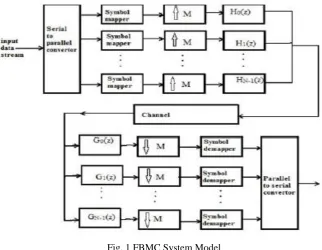
A general overview of FBMC system model is shown in Fig. 1. The filter banks are employed in transmultiplexer configuration. It consists of symbol mapper and an upsampler followed by synthesis filters at the transmitter end. The synthesis filter performs the frequency division multiplexing of complex data symbols into parallel subcarriers. The analysis filter at the receiver end separates’ the data from each carrier. The synthesis and analysis filters are cosine modulated versions of low pass prototype filter. The prototype filter is designed using Kaiser Window with cut off frequency pi/8 and enough stop band attenuation.
Fig. 1 FBMC System Model
redundancy. The upsampled data is then passed through the synthesis filter and the composite signal is transmitted over a common channel. Here the performance is evaluated in AWGN, Rayleigh and Rician channel.
At the receiver, inverse operation takes place. The composite signal gets separated into N channels using analysis filters. The analysis filter is followed by a downsampler to obtain the original sampling rate. They are ten demapped and converted back to serial form.
III.DESIGN OF PROTYPE FILTER
The prototype filter for CMFB is a symmetric linear phase low pass filter, designed using window method with Kaiser Window as the window function. Prototype filter can be designed such that the FBMC system guarantees perfect reconstruction property. The bandwidth of the filter is π/2M, where M is the number of channels. Let
h
(
n
)
be the impulse response of the filter defines as:)
(
)
(
)
(
n
h
n
v
n
h
i
(1)where
v
(
n
)
be the window function which is zero for2
N
n
andh
i(
n
)
be the ideal impulse response with cut off frequencyw
c given by:
n
n
w
n
w
w
n
h
c c c i,
)
(
sin
)
(
(2)The Kaiser Window is given by:
2
2
,
)
(
/
5
.
0
/
1
)
(
0 2 0N
n
N
I
N
n
I
n
v
(3)Where
I
0(
x
)
represents the modified zeroth order Bessel function of the first kind which can be computed using the expression:
1 2 0!
5
.
0
1
)
(
k kk
x
x
I
(4)The parameter
can be adjusted to obtain the desired stop band attenuation and is given by:
21
50
21
,
0
,
21
07886
.
0
21
5842
.
0
50
,
7
.
8
1102
.
0
4 . 0
s s s s s sA
if A
A
A
if A
A
(5)The order N is adjusted to satisfy the requirement on
f
and is given by:IV.DESIGN OF COSINE MODULATED FILTER BANK
Cosine Modulated Filter banks (CMFB) are real coefficient filter banks derived from a single prototype filter using cosine modulation. The impulse response of synthesis filter
f
k(
n
)
and the impulse response of the analysis filter)
(
n
h
k can be expressed as:k p k
N
n
M
k
n
h
n
f
2
2
)
1
2
cos(
)
(
2
)
(
(7)k p k
N
n
M
k
n
h
n
h
2
2
)
1
2
cos(
)
(
2
)
(
(8)Where,
h
p(
n
)
denotes the impulse response of symmetric linear phase prototype filter. To be free from phase distortion, analysis filters are chosen such that
1
0
1
0
)
1
(
)
(
N
n
M
k
n
N
f
n
h
k k (9)k
must be chosen such that
,
0
,
1
,
2
...
1
4
1
nk
M
k
,M
is the number of channels andN
is the length of the prototype filter. Thus a nearly perfect reconstruction filter bank can be obtained by satisfying the above conditions.V.PEAK TO AVERAGE POWER RATIO
Peak to Average Power Ratio is one of the main drawbacks of every multicarrier system. Similar to OFDM, FBMC system also suffers from the problem of high PAPR. It is defined as the ratio of maximum signal power to the average signal power. For a continuous time signal PAPR is evaluated by the equation:
NT NT tdt
t
x
NT
t
x
PAPR
0 2 2 0)
(
1
)
(
max
(10)Where,
x
(
t
)
denotes the amplitude of the FBMC signal. With high PAPR, high power amplifiers are required in the transmitter side to obtain sufficient transmission power, which is expensive. Also it demands the use of DAC with large dynamic range inorder to accommodate large peaks of the multicarrier modulation signal. Therefore the best solution is to reduce PAPR before the signals are transmitted through highpower amplifiers and DAC. The primary goal of PAPR reduction technique is to reduce the factormax
x
(
t
)
. The PAPR of a system can be studied using Complementary Cumulative Distribution Function (CCDF). It is the probability that PAPR exceeds a particular threshold value and is given by:)
(
Pr
obability
PAPR
P
0CCDF
(11)Where,
P
0is the threshold.VI.NON LINEAR COMPANDING TRANSFORM
companded signal at the transmitter can be correctly recovered at the receiver using an inverse transform function. There are two types of Non linear Companding: A-law Companding and μ- law Companding.
6.1 A- Law Companding
A- law encoding at the transmitter for a given input
x
is given as:
x
A
A
x
A
A
x
x
x
A
x
x
F
1
,
)
ln(
1
)
ln(
1
1
,
ln
1
)
sgn(
)
(
(12)Where,
A
denotes the compression parameter. The value ofA
is chosen to be 50. At the receiver,A
law expansion is given as:
1
ln
1
1
,
1
ln
1
exp
ln
1
1
,
))
ln(
1
(
)
sgn(
)
(
1y
A
A
A
y
A
y
A
A
y
y
y
F
(13)6.2
- Law Companding
- law companding is simple and an effective technique to reduce PAPR compared toA
- law Companding. It also provides a slightly larger dynamic range without any distortion for small signals. The signal after companding for a given inputx
is
,
1
1
1
ln
1
ln
)
sgn(
)
(
x
x
x
x
F
(14) The inverse operation is carried out at the receiver after analysis analysis filter bank.
- law expansion at the receiver is given as:
sgn
1
1
1
,
1
1
1
y
y
y
F
y
(15)where
y
denotes the received signal and the range of the function is from -1 to 1.Although bothA
- law and
- law Companders are simple, the performance of two companders for different values of compressing factors are evaluated and their performance are shown in simulation results.VII.SIMULATION SCENARIO
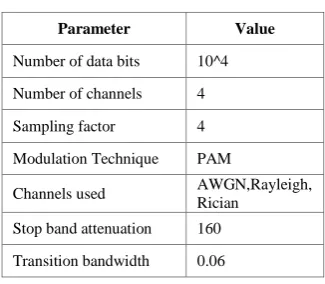
Table 1. Simulation Parameters
Parameter Value
Number of data bits 10^4
Number of channels 4
Sampling factor 4
Modulation Technique PAM
Channels used AWGN,Rayleigh,
Rician
Stop band attenuation 160
Transition bandwidth 0.06
VIII. RESULT AND DISCUSSION
An FBMC system is designed using the simulation parameters as given in Table 1. Initially the bits are mapped into symbols using PAM modulation and modulated signals are fed to synthesis filter bank. The resulting filter bank based multicarrier signal is transmitted over an AWGN, Rayleigh or Rician channel. It is then followed by an analysis filter bank and symbol de-mapping at the receiver side. PAPR Performance is evaluated using CCDF plot for the following reduction techniques, A- law companding, μ- law companding, and Raised Cosine Pulse shaping technique.
The filter banks are derived from a single Prototype filter. The Prototype filter is designed such that the system satisfies perfect reconstruction or near perfect reconstruction property. Fig. 2 shows the magnitude response of Prototype filter with stop band attenuation of 160dB.
Fig. 2 Magnitude Response of Prototype Filter
Fig. 3 Cosine Modulated Filter Bank
The main drawback of FBMC system is high PAPR. The PAPR of a system can be studied using Complementary Cumulative Distribution function. Fig. 4 shows the CCDF plot obtained for different values of
A
inA
- law Companding.A
can have the values of 20, 50 or 80.When compression factorA
=20 , PAPR value obtained is around 15.133 dB and forA
= 80, it is 14.73 dB. It can be observed that when the value ofA
becomes 50, better reduction in PAPR of about 13.53 dB is obtained compared to other two values.Fig. 4 CCDF Plot showing variation of PAPR for different values of
A
.Also FBMC system with
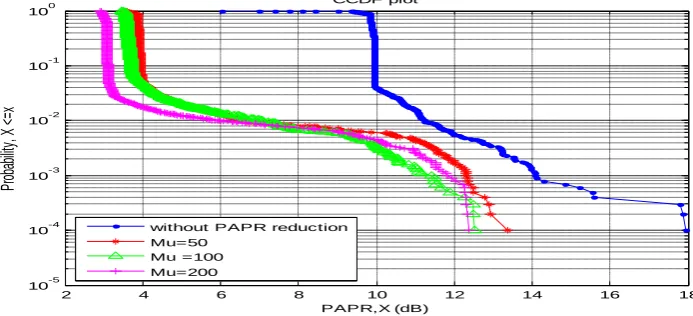
- law companding for different values of
parameter is simulated. It is observed that the value of PAPR varies for different values of
, such as
=50,100, or 200. As the value of
increases, the value of PAPR decreases. When
=50, the value of PAPR obtained is 13.46 dB and for
=100, it is 12.69dB. The better2 4 6 8 10 12 14 16 18
10-5 10-4 10-3 10-2 10-1 100
CCDF plot
PAPR,X (dB)
P
ro
ba
bi
lit
y,
X
<
=
x
without PAPR reduction A=20
reduced value of PAPR is obtained when
=200 and is found to be 12.39 dB. This variation can be easily demonstrated by the CCDF plot as shown in Fig. 5.Fig. 5 CCDF Plot showing variation of PAPR for different values of
Fig. 6 shows the CCDF plot showing variation of PAPR for FBMC system with without reduction techniques. It is clear from the plot that
law companding provides better PAPR reduction capability thanA
law companding.Fig. 6 CCDF Plot showing PAPR distribution
The numerical values obtained for FBMC system with and without reduction techniques have been summarized in Table 2.
Table 2. Numerical values of PAPR
PAPR of FBMC signal= 17.14 dB
Reduction Technique Measured PAPR (dB)
A
Companding14.84
Companding 11.652 4 6 8 10 12 14 16 18 10-5
10-4 10-3 10-2 10-1 100
CCDF plot
PAPR,X (dB)
Pr
ob
ab
ilit
y,
X
<
=x
without PAPR reduction Mu=50
Mu =100 Mu=200
2 4 6 8 10 12 14 16 18 10-5
10-4 10-3 10-2 10-1 100
CCDF plot
PAPR,X (dB)
Pr
ob
ab
ilit
y,
X
<
=x
without PAPR reduction A companding
The effectiveness of PAPR reduction technique also depends on BER performance. Here the performance of FBMC system with and without PAPR reduction techniques is evaluated in AWGN, Rayleigh or Riccian channel. Fig. 7 shows the BER performance of FBMC system with and without PAPR reduction technique under AWGN channel.
Figure 7.BER Performance under AWGN channel.
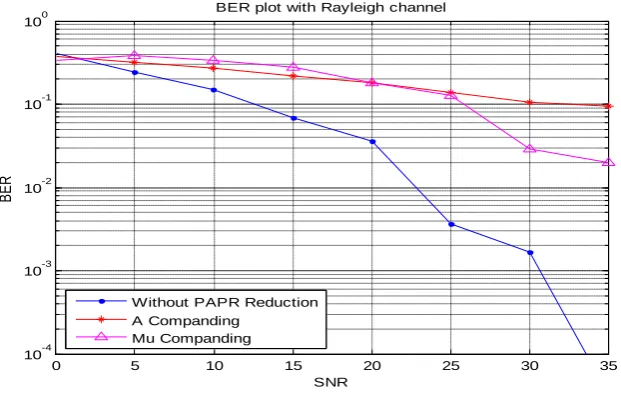
Also the BER performance of FBMC system is evaluated under Rayleigh channel and can be observed in Fig. 8. On comparing with AWGN channel, Rayleigh channels offers only less performance.
Fig. 8 BER Performance under Rayleigh channel
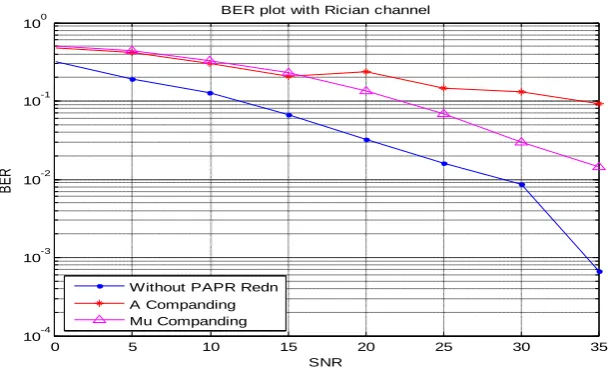
The BER performance of the FBMC system with and without PAPR reduction technique under Rician channel is also evaluated here and is given in Fig. 9.
0 5 10 15 20 25 30 35
10-4 10-3 10-2 10-1 100
SNR
BER
BER plot with AWGN channel
Without PAPR Reduction A Companding
Mu Companding
0 5 10 15 20 25 30 35
10-4 10-3 10-2 10-1 100
SNR
BER
BER plot with Rayleigh channel
Without PAPR Reduction A Companding
Fig. 9 BER Performance under Rician channel
Of all the BER graphs shown above, as the value of SNR increases, the BER values under AWGN or Rayleigh or Riccian channel gets decreased. Also it is clear that AWGN channel provides better performance than Rayleigh and Riccian channel. Under the evaluation in all the channels, the BER Performance is better for
law Companding compared to A- law Companding.IX.CONCLUSION
In this paper, an FBMC system is designed using cosine modulated filter banks. The Prototype filter for the filter banks are designed using low pass Kaiser Window method. All analysis and synthesis filters are derived from this single Prototype filter. The issue of PAPR is reduced using the techniques like A- law and μ- law Companding techniques. These techniques are implemented in a Filter bank based system using Cosine modulated filter banks under different channels like AWGN, Rayleigh and Riccian and their BER performance is evaluated. It is found that μ- law Companding is a better technique in terms of better BER performance and PAPR reduction capability than A-law Companding.
REFERENCES
[1] Krishna Arya, Dr. C. Vijaykumar, “Elimination of cyclic prefixof OFDM systems using filter bank based multicarrier systems,” IEEE
Conference on TENCON, 2008.
[2] M.Vitterli, “Theory of multirate filter banks,” IEEE Transactions on Accoustics, Speech and Signal Processing, Vol. ASSP 35, No. 3, March
1987.
[3] A. D Rizos,J.G Proakis, and T. Q. Nguyen, “Comparison of DFT and Cosine Modulated Filter banks in Multicarrier Modulation,” Global
Telecommunications Conference, pp. 687-691, Vol. 2, Dec 2006.
[4] Yuan- Pei Lin and P. P. Vaidyanathan, “A Kaiser Window Approach for the Design of Prototype Filters of Cosine Modulated Filter banks,”
IEEE Signal Processing Letters, Vol. 5, No. 6, 1998.
[5] V. M. Kulkarni, Dr. A. S. Bhalchandra, “An Overview of various techniques to reduce Peak to Average Power Ratio in Multicarrier Systems
,” IEEE International Conference Computational Intelligence and Computing Research, 2012.
[6] Tao Jiang,Weidong Xiang, Paul C. Richardson,DaimingQu, and Guangxi Zhu, “On the Nonlinear Companding Transform for Reduction in
PAPR of MCM Signals,” IEEE Transactions on Wireless Communications, Vol. 6, No.6,June 2007.
[7] Mishmy T. S., Sheeba V. S., “Peak to Average Power Reduction in Filter bank based Multicarrier systems,” IEEE International Conference on
Advancec in Communication and Computing, 2013.
0 5 10 15 20 25 30 35
10-4 10-3 10-2 10-1 100
SNR
BER
BER plot with Rician channel