Available online: https://edupediapublications.org/journals/index.php/IJR/ P a g e | 1 6 4 6
Making Facebook More Secure
P.Srinivas Rao Dr.Jayadev Gyani Dr.G.Narsimha Associate Professor Professor Associate Professor
Department of CSE,JITS Department of CSE,JITS Department of CSE,JNTUHCEJ
[email protected] [email protected] [email protected]
Abstract: With 20 million installs a day, third-party apps are a primary motive for the popularity and addictiveness of facebook. Unluckily, hackers have realized the skills of utilizing apps for spreading malware and spam. The crisis is already big, as we discover that at the least 13% of apps in our dataset are malicious. So far, the study group has enthusiastic about detecting malicious posts and campaigns. In this paper, we're going to find that applications are malicious or not. We use expertise collected through observing the posting behavior of common facebook apps which can be going for walks on it. So, first we try to find out the points of malicious apps and different traits of malicious apps which are unsafe to users. In this task, we came up with a framework with which automated detection of false profiles is feasible and is effective. Extra framework makes use of classification methods like support Vector machine, Naive Bayes and selection trees to classify the profiles into fake or actual ones. As, that is an automated detection process, it may be applied without difficulty by means of online social networks which has millions of profiles whose profiles cannot be examined manually.
Key Words: Facebook Apps, Malicious Apps, Profiling Apps, Online Social Networks.
1. INTRODUCTION
In recent days, the social life of everyone has come to be associated with the on-line social networks. These sites have made a radical change in the way in which we pursue our social life. Adding new friends and get in touch with them and their updates have become easier. The
online social networks have influence on the science, education, grassroots organizing,
employment, trade, and many others. Researchers have been studying these online social networks to see the impact they make on the individuals. Academics can attain the students effortlessly by way of this making a friendly environment for the students to be taught, lecturers now-a-days lecturers are becoming themselves acquainted to these sites bringing online classroom pages, giving homework, making discussions, and so forth. This improves education a lot. The employers can use these social networking sites to hire the individuals who are proficient and in the work, their heritage examine can be carried out quite simply making use of this. Many of the on-line social Networks (OSN) are free however some charge the membership fee and makes use of this for industry purposes and the leisure of them lift money by way of utilizing the promoting. This can be utilized by the government to get the opinions of the public quickly.
Nasza-Available online: https://edupediapublications.org/journals/index.php/IJR/ P a g e | 1 6 4 7
Klasa in Poland, Cyworld traditionally used in Asia, and so on are one of the most widespread social networking websites.
A social network is a social constitution made from a suite of social actors (similar to individuals or corporations) and a collection of the dynamic ties between these actors. The social network perspective presents a suite of methods for analyzing the structure of whole social entities as well as a style of theories explaining the patterns based in these constructions. The study of those structures uses social network evaluation to identify regional and international patterns, locate influential entities, and evaluate network dynamics.
The social network is a theoretical assemble valuable in the social sciences to be trained relationships between members, companies, business, or even complete societies. The term is used to describe a social structure decided by means of such interactions. The ties by way of which any given social unit connects characterize the convergence of the various social contacts of that unit. This theoretical approach is necessarily, relational. An axiom of the social network strategy to working out social interplay is that social phenomena[3] should be certainly conceived and investigated by way of the residences of family members between and within units, rather of the residences of these items themselves. For this reason, one long-established criticism of social network idea is that person company is traditionally unnoticed despite the fact that this is probably not the case in observe. Exactly considering that many types of relations, singular or in mixture type. These network configurations, network analytics are priceless to a broad variety of study businesses. A number of points of on-line social networks are formed to each and every of the more than300 social networking websites presently in existence. Probably the most characteristic is the capability to create and share a private profile. This profile web page in general entails a photo, some general private information (name, age,
sex, and place) and additional space for listing your favorite bands, books, TV shows, movies, hobbies and websites. Most social networks on the internet additionally let you post photos, music, movies and individual blogs to our profile webpage. But the essential purpose of on-line social networks is the capability to seek out and make acquaintance with different website participants. These friends additionally show up as links for our profile page. So visitors can comfortably browse our on-line friend network. Each on-line social network has dissimilar ideas and ways for searching out and contacting potential friends.
Problem statement
Available online: https://edupediapublications.org/journals/index.php/IJR/ P a g e | 1 6 4 8
while installing as a result no security available on Facebook.
II.RELATED WORK
1) Detecting and Characterizing Social Spam Campaigns Authors:Hongyu Gao,Jun Hu,Christo Wilson,Zhichun Li,Yan Chen,Ben Y.Zhao.
Description:
In this paper, authors presented an initial study to quantify and characterize spam campaigns launched using accounts on online social networks.
They studied a large anonymized dataset of asynchronous wall messages between Facebook users. We analyze all wall messages received by roughly 3.5 million Facebook users(more than 187 million messages in all),and use a set of automated techniques to detect and characterize coordinated spam campaigns. System detected roughly 200,000 malicious wall posts with embedded URLs, originating from more than 57,000 user accounts. Authors found that more than 70% of all malicious wall posts advertise phishing sites.
They study the characteristics of malicious accounts, and see that more than 97% are compromised accounts, rather than fake accounts created solely for the purpose of spamming. Finally, when adjusted to the local time of the sender, spamming[5] dominates actual wall post activity in the early morning hours, when normal users are asleep.
2) Is the App Safe? A large Sale Study on Application Permissions and Risk Signals Authors:Pern Hui Chia,Yusuke Yamamoto,N.Asokan
Description:
Third-party applications (apps) drive the attractiveness of web and mobile application platforms. Many of these platforms adopt a decentralized control strategy, relying on
explicit user consent for granting permissions that the apps request. Users have to rely primarily on community ratings as the signals to identify the potentially harmful and inappropriate apps even though community ratings typically reflect opinions about perceived functionality of performance rather than about risks.With the arrival ofHTML5 web apps,such user-consent permission systems will become more widespread.We study the effectiveness or user-consent permission systems through a large scale data collection of Facebook apps,Chrome extensions and Adroid apps[7].The analysis conforms that the current forms of community ratings used in app markets today are not reliable indicators of priay risks of an app.We find some evidence indicating attempts to mislead or entice users into granting permissions:free applications and applications with mature content request more permissions than is typical:--lookalike applications which have names similar to popular applications also request more permissions than is typical.Authors[4] find that across all three platforms popular applications request more permissions than average.
3) LIBSVM: A Library for Support Vector Machines. Authors: Chih-Chung Chang and Chih-Jen Lin
Description:
Available online: https://edupediapublications.org/journals/index.php/IJR/ P a g e | 1 6 4 9
machine learning method for classification, regression, and other learning tasks. LIBSVM is currently one of the most widely used SVM software.
4) Social Applications: Exploring A More Secure Framework Authors: Andrew Besmer, Heather Richter Lipford, Mohamed Shehab, Gorrell Cheek
Description:
Online social network sites, such as MySpace, Facebook and others have grown rapidly, with hundreds of millions of active users. A new feature on many sites is social applications and services written by third party developers that provide additional functionality linked to a user’s profile. However, current application platforms put users at risk by permitting the disclosure of large amounts of personal information to these applications and their developers. This paper formally abstracts and defines the current access control model applied to these applications, and builds on it to create a more secure framework. We do so in the interest of preserving as much of the current architecture as possible, while seeking to provide a practical balance between security and privacy needs of the users, and the needs of the applications to access users’ information. We present a user study of our interface design for setting a user-to application policy. The results indicate that the model and interface work for users who are more concerned with their privacy, but we still need to explore alternate means of creating policies for those who are less concerned
BACKGROUND
In this section, we discuss how applications work on Facebook, provide an overview of My
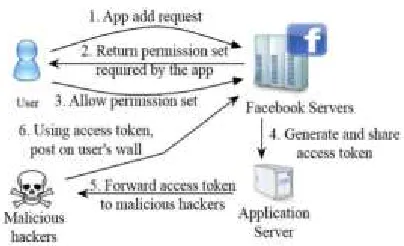
Page Keeper[8] (our primary data source), and summary the datasets that we use in this paper FACEBOOK APPS : Facebook enables third-party developers to offer services to its users by means of Facebook applications. Unlike typical desktop and smart phone applications, connection of a Facebook application by a user does not involve the user downloading and executing an application binary. Instead, when a worker adds a Facebook application to her profile, the user grants the application server: (a) authorization to access a subset of the information listed on the user’s Facebook profile (e.g. the user’s email address), and (b) permission to perform certain actions on behalf of the user (e.g., the ability to post on the user’s wall). Facebook grants these permissions to any application by handing an O Auth 2.0 [4] token to the application server for each user who installs the application. Thereafter, the application can access the data and perform the explicitly-permitted actions on behalf of the user. Fig.1 depicts the steps involved in the installation and process of a Facebook application.
Available online: https://edupediapublications.org/journals/index.php/IJR/ P a g e | 1 6 5 0
Operation of malicious applications: Malicious Facebook applications typically operate as follows.
• Step 1: Hackers prove users to install the app, usually with some fake promise (e.g., free iPads).
• Step 2: Once a user installs the app, it redirects the user to a web page where the user is requested to achieve tasks, such as completing a survey, again with the lure of fake rewards. • Step 3: The app thereafter accesses personal information (e.g., birth date) from the user’s profile, which the hackers can hypothetically use to profit.
• Step 4: The app makes malicious posts on behalf of the user to lure the user’s friends to install the same app .
This way the cycle continues with the app or colluding apps reaching more and more users. Private information or surveys can be “sold" to third parties to eventually profit the hackers. Mathematical model
Let S is the Whole System Consists: S = {U, P, Req, A, APP}.
1. U is the set of number of user on the facebook.
U={u1,u2,………..un}.
2. P is the set of number of permission set for user .
P={p1,p2,………pn}.
3. Req is set of number of add app request from user to server.
Req={a1,a2,………an}.
4. A is the set of number of set of access tokens of user.
5. APP is the set of number of facebook benign application available on facebooks application server.
APP = {ap1,ap2,………apn}
Step 1: At first user sends request to facebook server for adding an application to his profile like some game app etc.
Step 2: When a request comes to facebook server from client it returns the one set which contains the permissions required to app which he want to install on his profile , permissions like, Application wants to access user information from profile like name, date of birth etc. and this token are send to application server. Step 3: In this step user allow the access the information from his profile to that particular app, Here user doesn’t aware that whether that app is benign or malicious so, here our FRAppE comes in picture. FRAppE checks whether that app is malicious or benign by applying some classifications such as FRAppE Lite and FRAppE.
Available online: https://edupediapublications.org/journals/index.php/IJR/ P a g e | 1 6 5 1
Output: Detecting malicious apps and providing access to only benign apps to user.
III.PROPOSED METHOD
The proposed framework in the fig.2 shows the sequence of actions that need to be followed for continues detection of fake profiles with active leaning from the feedback given by the classification algorithm. This framework can easily be implemented by the social networking sites.
1. The detection process begins with the selection of the profile that needs to be tested.
2. Once the profile is selected,then the required attributes are selected on which the classification algorithm is applied.
3. The extracted attributes are passed to the trained classifier. The classifier gets trained on regular basis as new training data is feed into the classifier.
4. The classifier determines whether the profile is fake or legitimate.
5. The classifier may not be accurate in classifying the profile. So the feedback of the result is given back to the classifier.If the profile is identified as fake, SNS can send notification to the profile to submit identification. If the valid identification is given, feedback is sent to the classifier indicating that the profile was not fake.
6. This process is repeated and as the time proceeds, the no. of training data increases the classifier becomes more and more accurate in predicting the fake profiles.
Fig.2 : Framework for detection of fake profiles and learning
Classification is the process of learning a target function f that maps each records, x consisting of set of attributes to one of the predefined class labels, y. A classification technique is a approach of building classification models from an input data
Available online: https://edupediapublications.org/journals/index.php/IJR/ P a g e | 1 6 5 2
Fig.3: An approach for building a classification model
The classifiers that we have implemented for classifying the profiles are:
• Naive Bayes Classification • Decision Tree Classification • Support Vector Machine
IV.RESULTS AND DISCUSSION Required Datasets:
We need dataset with a mixture of real and fake profiles labeled accordingly. The algorithms need to be trained using the training dataset and should be evaluated using the testing dataset. But there are no such datasets available because of privacy issues.
As there is no standard dataset present, we need to prepare the dataset by scrapping the profiles from facebook. To scrap the data from the profiles, we need to be friends with the profiles which are being scrapped.
A. Data scrapping
Scripts written in python language were used which logs into facebook automatically and scraps required data. Facebook Graph API is also used along with python to extract some required data. Anti scrap detection techniques were implemented to prevent facebook immune system from detecting profiles were scrapped out of which some profiles were hiding data from friends also which were removed from the dataset which left real profiles in the dataset. Barracuda labs is presently working on facebook spam detection making applications for them. They detected and scrapped fake profiles and analyzed the data. We collected the data from them, filtered the profiles in which data is hidden.
B.Attributes Considered • No. of friends
• Education and work • Gender
• No. of columns filled in about me • Relationship status
• No. of photos of the person tagged * • No. of wall posts posted by the person * • No. of photos uploaded by the person * Evaluation parameters
•Efficiency = No. of correct predictions/ Total No. of Predictions
• False Positive rate = No. of real profiles detected as fake/ Total No. of fake profiles to be detected
• False Negative rate = No. of fake profiles detected as real/Total No. of real profiles
Available online: https://edupediapublications.org/journals/index.php/IJR/ P a g e | 1 6 5 3
which dont change much when the training dataset increases. As the no. of attributes increases for the training dataset the efficiency of all the algorithms increases. The false positive rate of the SVM is least that means if a profile is detected fake then
the chance of being fake is very high in SVM whereas Naive Bayes shows high false positive rate.
The false negative rate on the other hand is very low for Naive Bayes and the SVM has average false negative rate is the algorithm is well trained.
So, from the results we find that SVM is well suited for classification of the fake profiles in the social networks.
Figure.1: Efficiency vs No. of profiles in training dataset
Figure.2: Efficiency vs No. of attributes considered in a profile
Available online: https://edupediapublications.org/journals/index.php/IJR/ P a g e | 1 6 5 4
Figure.4: False Negative vs No. of profiles in training dataset
V.CONCLUSION REMARKS
We have proposed a framework using which we can detect fake profiles in any online work networks with a very high efficiency. But our frame work does not address all the characteristics of a profile. Fake profile identification process can be improved by combining Machine learning and NLP techniques .As part of the future work we try to implement this approach.
REFERENCES
[1] T. Stein, E. Chen, and K. Mangla. Facebook immune system. In Proceedings of the 4th
Workshop on Social Network Systems, SNS, volume 11, page 8, 2011.
[2] Y. Boshmaf, I. Muslukhov, K. Beznosov, and M. Ripeanu. The socialbot network: when bots socialize for fame and money. In Proceedings of the 27th Annual Computer Security Applications Conference, pages 93{102. ACM, 2011.
[3] C. Wagner, S. Mitter, C. K¨orner, and M. Strohmaier. When social bots attack: Modeling susceptibility of users in online social networks. In Proceedings of the WWW, volume 12, 2012. [4] G. Kontaxis, I. Polakis, S. Ioannidis, and E.P. Markatos. Detecting social network profile cloning. In Pervasive Computing and Communications Workshops (PERCOM
Workshops), 2011 IEEE International Conference on, pages 295{300. IEEE, 2011. [5] A. Wang. Detecting spam bots in online social networking sites: a machine learning approach. Data and Applications Security and Privacy XXIV, pages 335{342, 2010.
[6] H. Gao, J. Hu, C. Wilson, Z. Li, Y. Chen, and B.Y. Zhao. Detecting and characterizing social spam campaigns. In Proceedings of the 10th annual conference on Internet measurement, pages 35{47. ACM, 2010.
[7] Z. Chu, S. Gianvecchio, H. Wang, and S. Jajodia. Who is tweeting on twitter: human, bot, or
cyborg? In Proceedings of the 26th Annual Computer Security Applications Conference, pages 21{30. ACM, 2010.
[8] S. Krasser, Y. Tang, J. Gould, D. Alperovitch, and P. Judge. Identifying image spam based on header and file properties using c4. 5 decision trees and support vector machine learning. In Information Assurance and Security Workshop, 2007. IAW’07. IEEE SMC, pages 255{261. IEEE, 2007.