Title: Evolution of cognitive function via redeployment of brain areas Running head: Evolution of cognitive function
Michael L. Anderson
Institute for Advanced Computer Studies
Program in Neuroscience and Cognitive Science
University of Maryland College Park, MD 20742 USA. [email protected]
o: 301-405-1746 f: 301-314-1353 h: 410-323-4787
Word count (incl. abstract, references and captions): 3981
Keywords: Adaptation, Physiological; Brain; Cortex; Cognition; Evolution
Abstract
The creative re-use of existing cognitive capacities may have played a significant role in the evolutionary development of the brain. There are obvious evolutionary advantages to such redeployment, and the data presented here confirm three important empirical predictions of this account of the development of cognition: (1) a typical brain area will be utilized by many cognitive functions in diverse task categories, (2) evolutionarily older brain areas will be deployed in more cognitive functions and (3) more recent cognitive functions will utilize more, and more widely scattered brain areas. These findings have implications not just for our understanding of the evolutionary origins of cognitive function, but also for the practice of both clinical and experimental
Evolution and redeployment
Part of understanding the functional organization of the brain is understanding how it evolved. The current study suggests that while the brain may have originally emerged as an organ with functionally dedicated regions, the creative re-use of these regions has played a significant role in its evolutionary development. This would parallel the
evolution of other capabilities wherein existing structures, evolved for other purposes, are re-used and built upon in the course of continuing evolutionary development
(“exaptation”: Gould and Vrba, 1982).There is psychological support for exaptation in cognition (Cosmides, 1989; Cruse, 2003; Glenberg and Kashak, 2002; Gould, 1991; Lakoff and Nuñez, 2000; Riegler, 2001; Wilson, 2001), and neuroanatomic evidence that the brain evolved by preserving, extending, and combining existing network components, rather than by generating complex structures de novo (Sporns and Kötter, 2004).
However, there has been little evidence that integrates these two perspectives, bringing such an account of the evolution of cognitive function into the realm of cognitive neuroscience (although see, e.g., Barsalou 1999).
One recent hypothesis along these lines—that combines a story about the evolution of the brain based on the re-use and extension of existing elements with an exaptive account of cognitive functions—is the massive redeployment hypothesis (Anderson, 2006;
capacities, without disrupting their participation in existing programs. If cognitive functions evolved in this way, then we should be able to make some specific empirical predictions regarding the resulting functional topography of the brain; here I discuss three.
First and most generally, we should expect a typical brain region to support numerous cognitive functions in diverse task categories. If this were not the case, if a typical brain region in fact served a very limited set of cognitive functions, then this would suggest instead that the brain evolved by generating new, dedicated regions for each new purpose.
Second, there should be a correlation between the phylogenetic age of a brain area and the frequency with which it is deployed in various cognitive functions. The longer an area has been around the more likely it will have proved useful to some evolving cognitive capacity, and be incorporated into the functional network of brain regions supporting the new task. Naturally this will not be true for every brain region, since a given area may have evolved to serve a very particular purpose of little use in later developments. But it should be generally the case that the older an area is, the more cognitive functions it supports.
functions. Again, the reasoning is simple: the more brain areas there are when a given cognitive capacity is evolving, the more likely that one of them will already serve some purpose useful for the emerging capacity, and there is little reason to suppose that the most useful areas will be grouped together (and less reason to suppose this as
evolutionary time passes, making available more functions supported by more areas).
Approach and methods
To evaluate the predictions made by the redeployment hypothesis, I performed some statistical analyses of 135 brain-imaging experiments, collected by Cabeza and Nyberg (2000). They survey 275 fMRI and PET experiments, in ten task categories. Here I focus on only four categories: attention, perception, imagery, and language. The 39 attention tasks included things like tone detection and Stroop tasks (naming colored words); the 42 perception tasks included such things as object identification and facial recognition; the 18 imagery tasks include mental rotation and landmark visualization; and the 36 language tasks included reading out loud and silently, lexical decision tasks (discriminating words from non-words), and the like.
For each task, Cabeza and Nyberg catalog the brain areas reported to be activated by that task from a list including 26 numbered Brodmann areas, plus the insula and MT, and three subcortical areas—basal ganglia, thalamus and cerebellum—for each hemisphere. Each area was divided into a lateral and medial segment, for a total of 124 brain regions. Note that the reported activations do not represent the full network of brain areas
activated by a given cognitive task, but those remaining after the relevant
studies are understood to be those specifically responsible for the cognitive function under investigation.
In order to evaluate the three predictions, several values need to be calculated for this data set. First, we need to know how many brain areas are activated by a typical
cognitive task, and whether this varies by task category. Second, we need to know how many cognitive tasks a typical brain area supports, and how these tasks are distributed across the four categories. Third, we need to measure the “scatter” of the areas
participating in each task, and the variance of this value by task category. Finally, we need to correlate these values with phylogenetic age.
to BL activations, and I matched RL activations in an area to other RL activations of that area, as well as to BL activations. I followed the same procedure for medial activations. I did not match bilateral activations to each other.
To calculate the diversity of activations across task categories I employed a standard measure of population diversity, Diversity Variability (DV). DV is calculated using the
following equation, a version of standard deviation, where Cati is the proportion of
activations in category i; mean is the mean proportion of activations in each category
(always 0.25 for 4 categories), and k is the number of categories:
(
)
k mean Cat
DV
k
i i
∑
=
−
= 1
2
The category diversity of a given area is just (1-DV). With four categories, category diversity ranges from 0.57 (all items in one category) to 1 (equal numbers in each category). Note that for the purpose of calculating category diversity, the activation counts in each category were normalized to n=42.
Graph theory (Diestel, 2005) is a branch of mathematics that allows one to explore the topological properties of graphs. Graph-theoretic analyses have been used in
neuroscience for such purposes as investigating neural connectivity patterns (Sporns, 2002), correcting brain images (Han, et al. 2001), and analyzing the patterns of neural activations in epilepsy (Suharitdamrong, Chaovalitwongse and Pardalos, 2006).
One of the simplest concepts in graph theory is minimum graph distance, which is just
the fewest number of edges one must traverse to get from one node to another. Nodes that are adjacent in a graph have a graph distance of 1, nodes not adjacent to each other, but both adjacent to a third have a graph distance of 2, and so on. The minimum graph distance between every pair of nodes in the graph of the cortex was calculated using Dijkstra’s algorithm (Dijkstra, 1959).
A simple extension of minimum graph distance is average minimum graph distance,
AMGD = 1 AMGD = 1.5 AMGD = 2.0
Figure 1: Illustrations of the average minimum graph distance (AMGD). The figure shows the average minimum graph distances between nodes in some simple graphs. Lines between nodes indicate
adjacency.
Results
On average, each of the 135 tasks activated 5.97 regions (SD 4.80). Perceptual tasks activated 4.88 (n = 42, SD 3.55), attention 5.26 (n = 39, SD 4.23), imagery 6.39 (n = 18, SD 3.29) and language 7.81 (n = 36, SD 6.56). More importantly, the 86 brain regions that were activated by at least one task supported, on average, 9.36 different tasks (SD 8.62). Ignoring the division into medial and lateral regions gives an average of 13.00 tasks per area (SD 8.44), nearly one in ten of the tasks surveyed.
(SD 21.5) of activations are in categories other than the category with the highest number of activations.
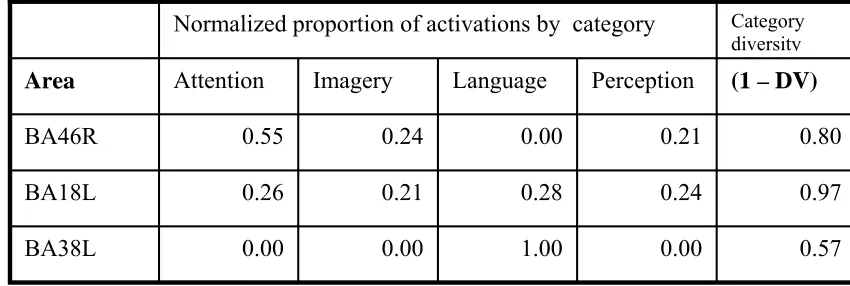
Using the measure of population diversity among categories discussed above shows that the 86 brain regions have a mean category diversity of 0.76 (SD 0.11); ignoring the medial/lateral division gives 0.81 (SD 0.09). As shown in Table 1, an average category diversity of 0.81 suggests a fairly high degree of redeployment throughout the brain.
Table 1: Illustrations of the category diversity of some Brodmann areas. The table shows some examples of the diversity of activations across categories for three Brodmann areas.
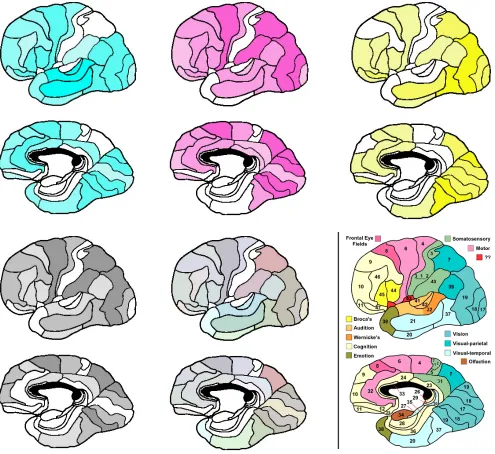
These results are perhaps even more striking when put in graphical form. Figure 2 represents activations of Brodmann areas in the left hemisphere, in each of the four task domains, by both color and intensity. The color represents the task domain, and the intensity indicates the number of tasks in the category that activate the area. I use the colors cyan (language), magenta (attention), yellow (perception) and black (imagery) so that these colors can be mixed using standard CMYK 4-color printing methods.
0.57 0.00 1.00 0.00 0.00 BA38L 0.97 0.24 0.28 0.21 0.26 BA18L 0.80 0.21 0.00 0.24 0.55 BA46R
(1 – DV)
Perception Language Imagery Attention Area Category diversity
Figure 2: Color-coded activations of left cortex. The figure illustrates the activations of Brodmann areas in the left hemisphere according to color and intensity, where color represents the cognitive domain and
intensity the number of tasks in the domain activating the area. In this figure, cyan represents language,
magenta represents attention, yellow represents perception and black represents imagery. Overlaying the
single-color images gives the 4-color image in the bottom center. This image contrasts sharply with the
standard picture of localization by domain as shown in the bottom right panel.
more complex and subtle structure, where activity in many (most) brain areas supports multiple tasks in multiple cognitive domains. The difference between the standard picture and the functional organization suggested by the redeployment hypothesis is perhaps best illustrated by contrasting the lower middle panel with the lower right panel. Rather than large areas of mono-chromatic cortex, what we see instead is a large array of unique colors, indicating the relative contributions of each Brodmann area to supporting tasks in a given cognitive domain.
However, this does not mean that the cortex is in any way randomly or holistically
organized; far from it. In fact, as is illustrated below, we can make (and support) some specific predictions about the relations between cognitive functions and brain areas based on the phylogenetic age of the function and the brain area.
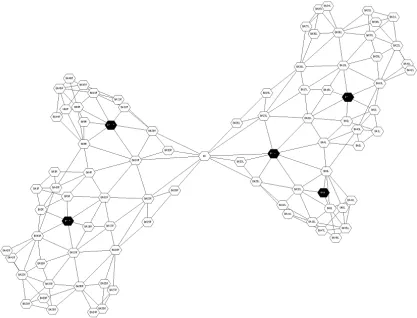
Figure 3: The cortex represented as an adjacency graph, showing the Brodmann areas as nodes, with lines between adjacent areas. The darkened nodes are those activated by an attention task reported by Corbetta
(1993). That task activated left Brodmann areas 7, 8 and 24, and right Brodmann areas 7 and 32; average
minimum graph distance is 4.0, close to the average for all tasks.
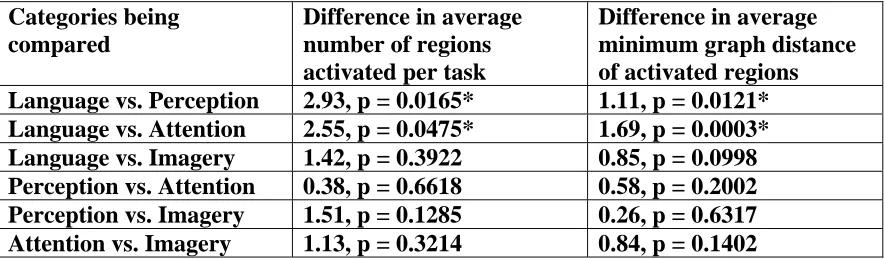
0.0475). For average minimum graph distance, language is greater than perception by 1.11 (p = 0.0121) and greater than attention by 1.69 (p = 0.0003). Differences between other categories are not significant (Table 2).
Categories being compared
Difference in average number of regions activated per task
Difference in average minimum graph distance of activated regions Language vs. Perception 2.93, p = 0.0165* 1.11, p = 0.0121*
Language vs. Attention 2.55, p = 0.0475* 1.69, p = 0.0003*
Language vs. Imagery 1.42, p = 0.3922 0.85, p = 0.0998
Perception vs. Attention 0.38, p = 0.6618 0.58, p = 0.2002
Perception vs. Imagery 1.51, p = 0.1285 0.26, p = 0.6317
Attention vs. Imagery 1.13, p = 0.3214 0.84, p = 0.1402
Table 2: Results for all category comparisons on average number of brain regions activated per task and average minimum graph distance between the activated regions. Note that only the differences between
language and perception and language and attention are significant.
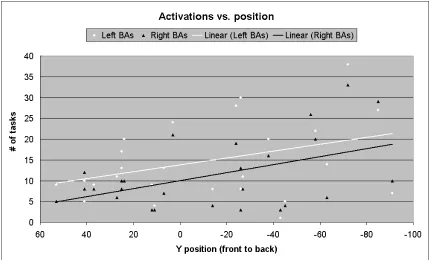
The last important prediction of the redeployment hypothesis to be discussed here is that evolutionarily older brain areas should be deployed in more cognitive functions. Figure 2 gives the results of plotting the number of tasks that activate a given Brodmann area versus the Y-coordinate of the area, based on the simplifying assumption that areas in the rear of the cerebral cortex (occipital lobe) are evolutionarily older than those in the front (pre-frontal cortex), ceterus paribus. Although the data are highly variable, as expected,
Figure 2: A plot of the number of tasks (out of 135) that activated each Brodmann area vs. the Y coordinate of the area (calculated in Talairach (Talairach and Tornaux, 1988) space using the Brede
(Nielsen, 2003) database). The data shows a linear correlation, R = -0.4121, p <= 0.00244 (t = -3.198, DF =
50).
Discussion
Together, these data suggest a picture of the evolution of cognition where redeployment plays a significant role. As predicted, we see correlations between phylogenetic age of brain areas and the frequency of their participation in cognitive function, and between the age of cognitive functions and their degree of localization. We also saw that the typical brain area is a diverse instrument, supporting cognitive tasks in multiple task categories. The massive redeployment hypothesis thus appears to be both empirically supported, and consistent with the evidence for evolution by exaptation in both psychology and
Before concluding, I would like to say a few words about the more theoretical attractions and implications of the massive redeployment hypothesis. First of all, the hypothesis offers the potential for explaining both localization of function (cognitive functions only use limited and specific parts of the brain), and diversity of purpose (a typical brain area is activated by highly diverse cognitive tasks). This may help dissolve the debate between localization and holism (Uttal, 2001), which in its typical form offers a false choice between equipotentiality (a given brain area can do many different things when it is activated) and strict localization (each brain area does one and only one thing).
According to the massive redeployment hypothesis, the fact that a brain area is dedicated to some highly specific low-level task is perfectly compatible with its being used to support many different cognitive functions (Anderson, 2006; in press). In fact, if brain areas were multi- or equi-potential, and so could easily be recruited to compute
substantially different functions, then it is hard to understand why older brain areas are more often recruited than younger ones, and why newer cognitive functions recruit more widely scattered brain areas. It would seem that such a pattern of redeployment would only arise if the low-level (computational) functions of brain areas were relatively fixed, such that developing a new cognitive function requires either developing new capacities
de novo, or finding areas already performing some required role. If brain areas could
instead be easily encouraged to compute many different functions, then considerations of information-processing efficiency would favor recruitment of nearer areas over areas
Second, redeployment may offer a clearer way of organizing the search for the neurological bases of cognitive function. In particular, it suggests that in order to determine the functional role of a given brain region it is necessary to consider its participation across multiple task categories, and not just focus on one, as has been the typical practice. Making this claim a bit more specific, when modeling a given cognitive function, and attempting to map that model onto brain areas, it will be necessary to consider not just the model of the function under primary consideration, but also the models of other functions recruiting the same brain areas, such that the sub-functional elements of each model attribute the same role to the brain areas where they overlap. Finding the functional role of a given brain area will be something like finding the right letter to go into a box on a (multidimensional) crossword puzzle, determined not just by the answer to a single clue, but by all the clues whose answers cross that box. This makes the task both harder, because it is multiply constrained, but also easier, because it offers the possibility of leveraging information from several sources to make the
attribution.
Finally, looking at brain organization in this way can offer a different a method to assess the relative evolutionary age of cognitive functions, and of brain areas, opening another window on our evolutionary past.
References
Anderson, M. L. 2006. Evidence for massive redeployment of brain areas in cognitive function. Proc. Cog. Sci. Soc. 28.
Anderson, M.L. In press. The massive redeployment hypothesis and the functional topography of the brain. Phil. Psych.
Barsalou, L.W. 1999. Perceptual Symbol Systems. Behav. Brain Sci. 22, 577–660.
Brodmann, K. 1907. Beiträge zur histologischen Lokalisation der Großhirnrinde J. Psychol. Neurol. 10, 231–4.
Cabeza, R. and Nyberg, L. 2000. Imaging cognition II: An empirical review of 275 PET and fMRI studies. Journal of Cognitive Neuroscience 12, 1–47.
Corbetta, M., Miezin, F. M., Shulman, G. L., and Petersen, S. E. 1993. A PET study of visuospatial attention. J. Neuroscience 13, 1202–26.
Cosmides, L. 1989. The logic of social exchange: Has natural selection shaped how humans reason? Studies with the Wason selection task. Cognition 31, 187–276.
Cruse, H. 2003. The evolution of cognition—a hypothesis. Cognitive Science 27, 135–
155.
Diestel, R. 2005. Graph Theory, 3ed. Heidelberg, Springer-Verlag.
Dijkstra, E. W. 1959. A note on two problems in connexion with graphs. Numerische Mathematik 1, 269–71.
Dubin, M. 2005. Brodmann areas in the human brain with an emphasis on vision and language http://spot.colorado.edu/~dubin/talks/brodmann/brodmann.html
Gould, S. J. 1991. Exaptation: A crucial tool for an evolutionary psychology. Journal of
Social Issues, 3, 43–65.
Gould, S. J. and Vrba, E. 1982. Exaptation: A missing term in the science of form.
Paleobiology 8, 4–15.
Han, X., Xu, C., Braga-Neto, U., and Prince, J. L. 2001. Graph-based topology correction for brain cortex segmentation. Proc. XVIIth Int. Conf. Information Processing in Medical Imaging.
Heineman, G.T. and Councill, W.T. 2001. Component-Based Software Engineering: Putting The Pieces Together. (Addison-Wesley, New York).
Lakoff, G. and Núñez, R. 2000. Where Mathematics Comes From. Basic Books, New
York.
Muller R.A., Rothermel R.D., Behen M.E., Muzik O., Mangner T.J., and Chugani H.T. (1997). Receptive and expressive language activations for sentences: a PET study.
Neuroreport, 8(17): 3767-70.
Nielsen, F.Ǻ. 2003. The Brede database: a small database for functional neuroimaging.
NeuroImage 19.
Riegler, A. 2001. The cognitive ratchet: The ratchet effect as a fundamental principle in evolution and cognition. Cybernetics & Systems 32, 411–27.
Sporns, O. 2002. Graph theory methods for the analysis of neural connectivity patterns. Kötter, R. (ed.) Neuroscience Databases: A Practical Guide. Klüwer.
Sporns O. and Kötter, R. 2004. Motifs in brain networks. PLoS Biol 2(11): e369.
Suharitdamrong, W. Chaovalitwongse, A. and Pardalos, P. M. 2006. Graph theory-based data mining techniques to study similarity of epileptic brain network. Proc. DIMACS Workshop on Data Mining, Systems Analysis, and Optimization in Neuroscience.
Talairach J. and Tournaux P. 1988. Co-planar stereotaxic atlas of the human brain.
Thieme, New York.
Uttal, W. R. (2001) The New Phrenology: The Limits of Localizing Cognitive Processes in the Brain. Cambridge: MIT Press.
Wilson, M. 2001. The case for sensorimotor coding in working memory. Psychonomic Bulletin and Review 8, 44–57.