IJEDR1501005
International Journal of Engineering Development and Research (www.ijedr.org)20
Evaluating the Mechanical Properties of Copper Red
Mud Composites
1U.Hari Babu, 2N.Vijaya Sai 1Professor, 2Professor 1
Mechanical Engineering,
1 QIS College of Engineering & Technology, Ongole, A.P., India
________________________________________________________________________________________________________
Abstract - Copper and its alloys have found wide application in electronic materials, wear-resistance , heat-resistance materials, torch nozzle materials, manufacture of bushes, bearings and high conductivity electrical contractors etc. Red mud emerges as the solid waste material during production of alumina from bauxite by the Bayer’s process. It consists of iron oxide, titanium, aluminum and silica along with some other minor constituents. Its disposal remains a worldwide problem in terms of environmental concerns. It is generally agreed that to improve hardness and wear resistance of MMCs by using hard intermetallic compound as reinforcement into the copper matrix. The reinforcing materials are generally SiC, Al2O3 etc are costly. The red mud alone contains all these reinforcement elements. The main objective of
this paper is to explore the use of red mud as a reinforcing material as a low cost. The present investigation is aimed at producing copper red mud composite using copper as matrix and red mud as reinforcement. Copper red mud mixtures with different volume percentages were prepared. Copper red mud composites improve strength, stiffness and wear resistance. The density and coefficient of thermal expansion of composite decrease, and their hardness and wear resistance increases as their red mud content increases. The major drawbacks of these copper based composites are reduced conductivity and poor machinability. These two factors are strongly influence the popularity of the developed copper based composites in several technological fields of applications. To overcome this soft phase graphite is used as a additional reinforcement to the copper red mud composite. Graphite being a solid lubricant can improve the machinability of the composite. Furthermore, graphite possess excellent thermal and electrical conductivity thereby, can improve the conducting capability of copper composites.
Index Terms - Copper, Red mud, MMC, reinforcement, composite
________________________________________________________________________________________________________
I. INTRODUCTION
Composite material is a material consisting of two or more distinct phases (matrix phase and reinforcing phase) and having bulk properties significantly different from those of any of the constituents. The properties of composites materials are high stiffness and high strength, low density, high temperature stability, high electrical and thermal conductivity, corrosion resistance, improved wear resistance etc. In recent years, copper based composites are gaining wide spread importance because of the high electrical and thermal conductivity, good corrosion resistance and high melting point. Copper is one of the most important materials in thermal and electronic applications. However, its extensive applications are limited by the low mechanical property and poor wear resistance. Ceramic particulate reinforcements can improve high-temperature mechanical properties and wear property without severe deterioration of electrical and thermal conductivities of the matrix . Pure copper is having F.C.C structure, ductile, excellent conductor, malleable and easy to cast into desired shapes. But this copper has to be alloyed with many other elements to effect minor changes in terms of the properties such as improving the tensile strength, hardness, machinability etc .
Red mud is the solid waste residue of the absorption of bauxite ores with caustic soda for alumina (Al2O3) production. Approximately 35–40% of the processed bauxite ore goes into the waste as alkaline red mud slurry which consists of 15–40% solids and 0.8–1.5 tons of red mud is generated per ton of alumina produced [1]. It is estimated that annually 70 million tons of red mud is produced all over the world, with 0.7 million tons in Greece [2], 2 million tons in India [3], 30 million tons in Australia [4] and nearly 30 million tons in China. It is estimated that for each tone of alumina produced, up to two tones of red mud are generated.. Under normal conditions, when one ton of alumina is produced nearly a ton of red mud is generated as a waste. In terms of metal production the ratio of aluminium to red mud is 1:2. This waste material has been accumulating at an increasing rate throughout the world. The disposal/utilization of red mud have been an acute problem and a clearcut solution is not available till date. The use of red mud is restricted only for recovery of some metal values like Titanium, Vanadium and Zinc; making of ceramics etc. It has also been used for making cement, bricks, pigments and glazed sewer pipes, plastics, glass etc.
II. RED MUD
IJEDR1501005
International Journal of Engineering Development and Research (www.ijedr.org)21
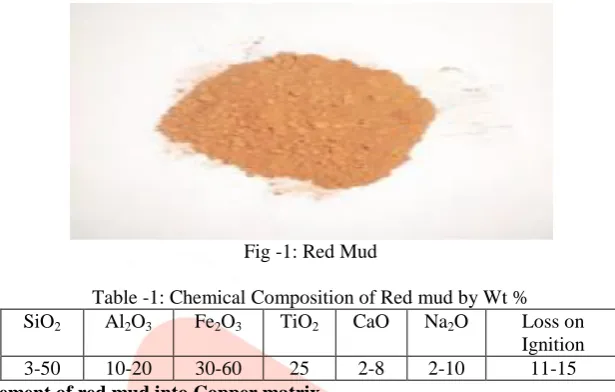
industrial development. Therefore, we need to promote the industrialization of precious metal recovery processes, optimize complex processes and develop new ones. Although the added value is relatively low, the resources utilization of red mud is the most widely used way and the most effective way to resolve the red mud stockpiling problem. Red mud can also be used to produce other construction materials. A mature, relevant technology would greatly promote the consumption of red mud. Applying red mud as an environmental remediation material is a new hot point in terms of utilization. Due to the simple process, low cost, it is worth promoting its application in the field of environmental protection. However, there is a risk of introducing new contamination, and a difficulty of recycling it after the application.Fig -1: Red Mud
Table -1: Chemical Composition of Red mud by Wt % SiO2 Al2O3 Fe2O3 TiO2 CaO Na2O Loss on
Ignition
3-50 10-20 30-60 25 2-8 2-10 11-15
2.1 Need for the reinforcement of red mud into Copper matrix
Optimum performance of composite is obtained by selecting the shape and size of the reinforcement material to fit for the particular application. The demand increasing day by day for low cost reinforcement stimulated the interest towards production and utilization of red mud , which contains major elements like Al2O3, Fe2O3, TiO2, and Na2O for preparation of a metal matrix composite to improve hardness and wear resistant applications.
2.2 Reinforcement
Reinforcement increases the strength, hardness and the temperature resistance and also lowers the density of MMC. In order to achieve these properties the selection of reinforcement, method of production and chemical compatibility with the matrix are very important aspects. The reinforcement used in copper matrix is Red mud. The density of red Mud is 3.05 gm/cm3 [5].
2.3 Effect of reinforcement Volume fraction
For low volume fraction of reinforcement, the composite strength was observed to be governed by the residual matrix strength, which decreases with increasing reinforcing volume fraction.
2.3.1 Effect of particle size
The deformation and fracture behaviour of the composite revealed the importance of particle size [6]. A reduction in particle size is observed [7] to increase the proportional limit, yield stress and the ultimate tensile stress. It is well established that large particles are detrimental to fracture toughness due to their tendency towards fracture.
2.3.2 Effect of reinforcement distribution
Apart from the reinforcement level, the reinforcement distribution also influences the ductility and fracture toughness of the MMC and hence indirectly the strength [8]. A uniform reinforcement distribution is essential for effective utilization of the load carrying capacity of the reinforcement.
2.4 Fracture
The fracture behaviour of MMCs has been identified not only for extending their applications but also for improving mechanical properties, especially strength and ductility. A better understanding of the underlying mechanisms affecting composite properties are essential if the properties of the composite material are to be improved.
2.5 Microstructure
The most important aspects of the microstructure is the distribution of the reinforcing particles, and this depends on the processing and fabrication routes involved. The oxides of reinforcing particles used in the composites have a varying density. Density of the particles is one of the important factors determining the distribution of the particles in molten metal. Particles having higher density than molten metal can settle at the bottom of the bath slowly and particles of lower density can segregate at the top. The properties of composites are finally dependent on the distribution of the particles. Hence the study of the distribution of the particles in the composite is of great significance.
IJEDR1501005
International Journal of Engineering Development and Research (www.ijedr.org)22
If the composite is to be used in a structural application, the modulus, strength, and density of the composite will be important, which requires a high modulus, low density reinforcement. If the composite is to be used in thermal applications, the coefficient of thermal expansion and thermal conductivity are important. If the composite is to be used in wear resistant applications, hardness is important.III. STIR CASTING
Stir casting is a liquid state method of composite material fabrication, in which a dispersed phase is mixed with a molten metal matrix by means of a mechanical stirring. It is the simplest and the most cost effective method of liquid state fabrication is Stir Casting.
Stir casting is characterized by the following features :
Content of dispersed phase is limited ( usually not more than 30% Vol.)
Distribution of dispersed phase throughout the matrix is not perfectly homogeneous. Distribution of dispersed phase may be improved if the matrix is in semi solid condition. High viscosity of semi solid matrix material enables better mixing of the dispersed phase.
Fig -2: Stir Casting
The melting of metal was carried out in electrical resistance furnace by using a graphite crucible & stirrer. The furnace temperature was first raised above the liquids temperature to melt the copper scraps completely (12500C) and was then cooled down just below the liquids to keep the slurry in a semi solid state. Red mud particles were preheated at 4000C for 3 to 4 hours and graphite powders also preheated to 4500C for 1 to 2 hours. Addition of 1% titanium to increase the wettability of copper. During pouring of preheated red mud and graphite particles into the crucible the stirrer is rotated continuously. After sufficient mixing was done, the composite slurry was reheated to a fully liquid state and then stirring is carried out for about 15 to 20 minutes at a normal stirring rate of 600 rpm. Pouring of the composite slurry has been carried out in the preheated cast iron moulds (2000C to 3000C ) of required sizes.
IV. EXPERIMENTAL DETAILS
Among discontinuous metal matrix composites, stir casting is generally accepted as a promising route, currently practiced commercially. Its advantages lie in its simplicity, flexibility and applicability to large quantity production. It is also attractive because conventional metal processing route to be used, and hence minimizes the final cost of the product. Pure copper was melted using electrical furnace and preheated red mud powders of 10%, 15%, 25% by volume were added to the molten metal. The composite melts were poured into preheated cast iron moulds of required size. The composite is tested in Universal testing machine for finding the tensile strength and hardness is find out by using Vickers Hardness testing machine. The microstructure of the specimen also observed.
V. RESULTS & DISCUSSION
IJEDR1501005
International Journal of Engineering Development and Research (www.ijedr.org)23
Figure-3: Microstructure of copper red mud compositesFrom the figure.3 it reveals that a homogeneous distribution of the red mud particles in the copper matrix , and this dispersion is increasing with increasing the amount of red mud. The red mud is a highly complex material that differs due to the different bauxites used and the different process parameters [9]. Therefore red mud should be regarded as a group of materials, having particular characteristics, such as
produced during bauxite refining Highly alkaline
Mainly composed of iron oxides having a variety of elements and mineralogical phases Relatively high specific surface
Fine particle size distribution
5.2 Mechanical properties of copper Red mud Composites 5.2.1 Hardness Studies
The hardness of the material is a physical parameter indicating the ability of resisting local plastic deformation. As the amount red mud increases the hardness of the composite also increases. This increase was observed from 270 VHN to 340 VHN.
5.2.2 Tensile Strength properties studies
The composite show higher loads than the unreinforced alloy, and this increase is more for higher the amount of red mud. This indicates that the red mud addition leads to improvement in the strength of the composite. The strength of the composite varies from 250 to 300 Mpa.
VI. CONCLUSIONS
Cu based MMCs have better wear resistance . The increase in wear resistance is because of the homogenous dispersion of Red
mud particles in the copper matrix.
2.Graphite is used as a additional reinforcement to the copper Red mud composite can improve the Conductivity and machinability.
3.The results shows that with an increase in composition of red mud, an increase in hardness, strength.
REFERENCES
[1]. Liu X, Zhang N. Waste Management & Research. 2011;(29):1053-1063.
[2]. Vangelatos I, Angelopoulos GN, Boufounos D. Utilization of ferroalumina as raw material in the production of Ordinary Portland Cement. Journal of Hazardous Materials. 2009;(168):473–478.
[3]. Agrawal A, Sahu KK, Pandy BD. Solid waste management in non-ferrous industries in India. Resources, Conservation and Recycling. 2004;(42):99–120.
[4]. Wang S, Ang HM, Tade MO. Novel application of red mud as coagulant, adsorbent and catalyst for environmentally benign processes. Chemosphere. 2008;(72):1621– 1635.
[5]. Vladimir Cablik, “ Characterization and applications of Red mud from Bauxite processing” 2007, PP:27-38.
[6]. C.M. Friend, “The effect of Matrix Properties on Reinforcement is Short Al2O3 Fibre-Al MMCs”, J.Mat. Sci., Vol. 22, 1987, pp 3005-3010.
[7]. J.J. Lewandowski, D.S.Liu and C.Liu, “Observations on the Effects of Particulate size and Superposed Pressure on Deformation of MMCs”, Scr. Metall. Vol. 25, 1991, pp 21-26.
[8]. J.J. Lewandowski and C.Liu, “Effects of Matrix Microstructure and Particle Distribution on fracture of an Al Metal Matrix Composite”, Mat. Sci. Engg., Vol. 107A, 1989, pp 241-255.
IJEDR1501005
International Journal of Engineering Development and Research (www.ijedr.org)24
[10]. G. Celebi Efe, I. Altinsoy, M. Ipek, S. Zeytin and C. Bindal, “Effects of SiC Particle Size on Properties of Cu–SiC Metal Matrix Composites”, Proceedings of the International Congress on Advances in Applied Physics and Materials Science, Antalya 2011, Volume 121 (2012).[11]. G. Celebi Efe, I. Altinsoy, M. Ipek, I. Ozbek, S. Zeytin, C. Bindal, “Improving properties of copper by SiC particles”, ECCM15 – 15th European conference on composites Materials, Venice, Italy, 24-28 June 2012.
[12]. M. A. MIŚKIEWICZ, H. MATYSIAK, K. J. KURZYDŁOWSKI , “ Finite element method modelling of the properties of a Cu–SiC composite under cyclic loading conditions” Materials Science-Poland, Vol. 25, No. 3, 2007
[13]. K.G. Budinski and M.K. Budinski, Engineering Materials ; properties and selection, 6th edition Prentice – Hall, 1999, P 532. [14]. Ping Wang , and Dong-Yan Liu, “Physical and Chemical Properties of Sintering Red Mud and Bayer Red Mud and the Implications for Beneficial Utilization”, Materials, Volume 5, Oct 2012.
[15]. Harekrushna Sutar, Subash Chandra Mishra, Santosh Kumar Sahoo, Ananta Prasad chakraverty and Himanshu Sekhar Maharana, “Progress of Red Mud Utilization: An Overview”, American Chemical Science Journal 4(3): 255-279, 2014