M E T H O D O L O G Y
Meta-Analyses Proved Inconsistent in How
Missing Data Were Handled Across Their
Included Primary Trials: A Methodological Survey
This article was published in the following Dove Press journal:
Clinical Epidemiology
Lara A Kahale, 1
Assem M Khamis, 2Batoul Diab,1 Yaping Chang, 3
Luciane Cruz Lopes, 4 Arnav Agarwal, 3,5Ling Li, 6 Reem A Mustafa,3,7
Serge Koujanian,8Reem Waziry,9 Jason W Busse, 3,10–12
Abeer Dakik,1Lotty Hooft,13 Gordon H Guyatt,3,14
Rob JPM Scholten,13Elie A Akl 1,3 1
Clinical Research Institute, American University of Beirut, Beirut, Lebanon;2
Wolfson Palliative Care Research Centre, Hull York Medical School, University of Hull, Hull, UK;3
Department of Health Research Methods, Evidence, and Impact, McMaster University, Hamilton, Canada; 4
Pharmaceutical Sciences Post Graduate Course, University of Sorocaba, UNISO, Sorocaba, Sao Paulo, Brazil;5
Department of Medicine, University of Toronto, Toronto, Ontario, Canada;6
Chinese Evidence-Based Medicine Center, West China Hospital, Sichuan University, Chengdu, People’s Republic of China;7Departments of Medicine and Biomedical & Health Informatics, University of Missouri-Kansas City, Kansas City, MO, USA; 8
Department of Evaluative Clinical Sciences, Sunnybrook Health Sciences Centre, Toronto, Ontario, Canada;9
Department of Epidemiology, Harvard T.H. Chan School of Public Health, Boston, MA, USA;10
Department of Anesthesia, McMaster University, Hamilton, Canada;11The Michael G. DeGroote National Pain Centre, McMaster University, Hamilton, Canada; 12
Chronic Pain Centre of Excellence for Canadian Veterans, Hamilton, Canada;13Julius Center for Health Sciences and Primary Care, University Medical Center Utrecht, Utrecht University, Utrecht, the Netherlands;14
Department of Medicine, McMaster University, Hamilton, Canada
Background:How systematic review authors address missing data among eligible primary studies remains uncertain.
Objective: To assess whether systematic review authors are consistent in the way they handle missing data, both across trials included in the same meta-analysis, and with their reported methods.
Methods: We first identified 100 eligible systematic reviews that included a statistically significant meta-analysis of a patient-important dichotomous efficacy outcome. Then, we successfully retrieved 638 of the 653 trials included in these systematic reviews’ meta-analyses. From each trial report, we extracted statistical data used in the analysis of the outcome of interest to compare with the data used in the meta-analysis. First, we used these comparisons to classify the“analytical method actually used”for handling missing data by the systematic review authors for each included trial. Second, we assessed whether systema-tic reviews explicitly reported their analysystema-tical method of handling missing data. Third, we calculated the proportion of systematic reviews that were consistent in their “analytical method actually used” across trials included in the same meta-analysis. Fourth, among systematic reviews that were consistent in the“analytical method actually used”across trials and explicitly reported on a method for handling missing data, we assessed whether the
“analytical method actually used”and the reported methods were consistent.
Results: We were unable to determine the“analytical method reviews actually used”for handling missing outcome data among 397 trials. Among the remaining 241, systematic review authors most commonly conducted “complete case analysis” (n=128, 53%) or assumed “none of the participants with missing data had the event of interest” (n=58, 24%). Only eight of 100 systematic reviews were consistent in their approach to handling missing data across included trials, but none of these reported methods for handling missing data. Among seven reviews that did explicitly report their analytical method of handling missing data, only one was consistent in their approach across included trials (using complete case analysis), and their approach was inconsistent with their reported methods (assumed all participants with missing data had the event).
Conclusion: The majority of systematic review authors were inconsistent in their approach towards reporting and handling missing outcome data across eligible primary trials, and most did not explicitly report their methods to handle missing data. Systematic review authors should clearly identify missing outcome data among their eligible trials, specify an approach for handling missing data in their analyses, and apply their approach consistently across all primary trials.
Keywords:missing data, assumption, randomized controlled trial, systematic review, meta-analysis
Correspondence: Elie A Akl Department of Internal Medicine, American University of Beirut Medical Center, P.O. Box: 11-0236; Riad-El-Solh,
Beirut 1107–2020, Lebanon
Tel +961 1 374374 Email [email protected]
Clinical Epidemiology
Dove
press
open access to scientific and medical research
Open Access Full Text Article
Clinical Epidemiology downloaded from https://www.dovepress.com/ by 118.70.13.36 on 24-Aug-2020
Key Message
● Systematic review authors were inconsistent in their
methods of handling missing data across included trials.
● Most systematic review authors did not explicitly
report their methods to handle missing data.
● Systematic review authors may simply use what
tri-alists have reported, without consciously planning a method to handle missing data.
● Systematic review authors should clearly describe an
approach for handling missing data outcomes and apply this approach consistently among eligible trials for their review.
Background
Reporting of missing outcome data in randomized
con-trolled trials (RCTs) is often suboptimal.1 Randomized
controlled trials typically report the overall prevalence of
study participants that failed to complete the study;2
how-ever, not all outcome measures may be similarly affected. Some trial participants may have experienced one or more outcomes (and have them documented) prior to disconti-nuing the study prematurely. Also, it is not always clear whether RCT authors followed all participants, such as those who withdrew consent to participate (i.e., whether
they have missing data or not).1 Moreover, RCT authors
often fail to clearly describe how they handled missing outcome data in their analyses.1,2
The poor reporting of missing outcome data in RCTs necessitates that systematic review authors develop plans to
address this issue.3–16 However, a recent methodological
survey found that only 25% of systematic review authors reported strategies to address whether certain categories of participants (e.g., withdrew consent, non-compliant) might have missing outcome data, and only 19% of systematic reviews reported a method for handling missing data (e.g.,
complete case analysis, making assumptions).17
Even when systematic review authors decide to handle missing outcome data in their analysis, they may do so inconsistently across trials included in the same meta-analysis. As an illustrative scenario, for a systematic review that plans to include only participants with available out-come data in their meta-analysis (i.e., use complete case
analysis),18one would expect the denominators of all trials
included in that meta-analysis to be restricted to only parti-cipants with available outcome data. However, for one
trial,19reviewer authors used the total number randomized
for the denominator (despite having participants with
missing data), and in another trial,20they excluded
partici-pants with missing data from the denominator. In such a scenario, we observe two main potential problems: (1) the analytical method review authors actually used for handling missing data is inconsistent across trials included in the same meta-analysis; and (2) the analytical method review authors actually used for handling missing data is, for some trials, inconsistent with their methods. These issues may complicate the reproducibility of systematic reviews and bias results. The extent of these problems remains, however, unclear.
Objective
The overall objective of this study was to assess whether the systematic review authors are consistent in the way they handle missing data, both across trials included in the same meta-analysis, and with their reported methods.
More specifically, we aimed to: (1) classify the methods
systematic review authors actually used for handling miss-ing data for each included trial; (2) assess whether sys-tematic reviews authors explicitly reported on the method of handling missing data; (3) assess the extent to which systematic review authors were consistent in their methods actually used across trials included in the same meta-analysis; and (4) when consistent, assess whether the methods the systematic review authors actually used were consistent with their reported methods (if reported).
Methods
Study Design and De
fi
nitions
This methodological study is part of a larger project exam-ining methodological issues related to missing outcome
data in systematic reviews and RCTs.21 Our published
protocol includes detailed information on the definitions,
eligibility criteria, search strategy, selection process, data
extraction and data analysis.21 A patient-important
out-come is defined as an outcome for which a patient would
answer with“yes”to the following question:
If the patient knew that this outcome was the only thing to change with treatment, would the patient consider receiving this treatment if associated with burden, side effects, or cost?21
We defined missing data as outcome data for trial
partici-pants that are not available to systematic review authors from the published RCT reports or personal contact with
RCT authors. We used our recently published guidance22
Clinical Epidemiology downloaded from https://www.dovepress.com/ by 118.70.13.36 on 24-Aug-2020
to identify categories of trial participants who might have missing outcome data.
Sample Selection
Our random sample included 50 Cochrane and 50 non-Cochrane systematic reviews published in 2012 that reported
a statistically significant, group-level meta-analysis, of
a patient-important dichotomous efficacy outcome.17 We
retrieved all 653 RCTs included in the 100 meta-analyses
of interest.1 Eleven pairs of reviewers extracted data, in
duplicate and independently, from the systematic reviews and RCTs and resolved disagreements with the help of a third reviewer. We conducted calibration exercises and used standardized and pilot-tested forms with detailed writ-ten instructions to improve reliability of data extraction.
Classifying the
“
Analytical Method
Reviews Actually Used
”
for Handling
Missing Data
Authors of reviews may fail to clearly report their approach to handling missing data. Alternatively, the approach they report in their methods may not correspond with the method they actually used. Therefore, we
estab-lished the “analytical method reviews actually used” for
handling missing data using the following steps:
1. From each RCT report, we extracted (per study arm) the number of participants randomized, the numerator (i.e. the number of events) used in the analysis of interest, and the number of participants with missing data. 2. From the meta-analysis (forest plot plus text) and
for each arm of all contributing RCTs, we extracted the denominator and the numerator used in the meta-analysis of interest.
3. We compared the statistical data from the RCT report with data from the meta-analysis.
4. Based on this comparison, we classified the“
analy-tical method reviews actually used” for handling
missing data as:
● Unclear, cannot be verified (provided numbers
that could not be explained or did not add up to match any of the suggested analytical method actually used).
● Complete case analysis.
● Making assumptions (e.g., best case scenario, all
participants had the event).
● Different methods (from the above bullet points)
for different categories of participants with miss-ing data.
● Not applicable, no missing data.
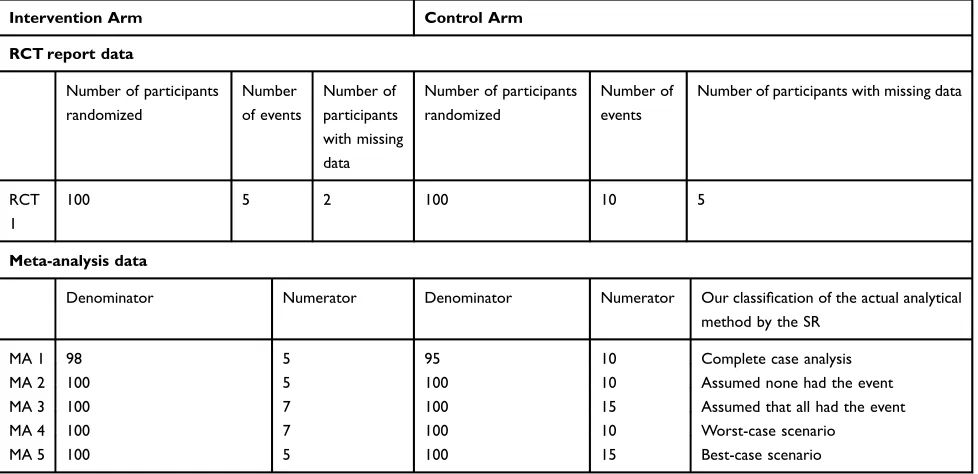
Table 1lists commonly used methods of handling missing outcome data of trial participants. The hypothetical
exam-ples in Table 2 illustrate how different meta-analyses
addressing the same study question (i.e. same patients, interventions, comparators and outcomes) may handle missing data from a single eligible RCT, and how we
classified the “analytical method reviews actually used”
in each case. We also assessed the confidence of data
extractors in classifying the analytical method actually used, i.e., whether based on explicit reporting (higher
confidence) or best guess (lower confidence).
Also, for systematic reviews that reported on having participants with missing outcome data, we assessed whether systematic review authors used the same denomi-nator and/or numerator as the one(s) reported in the RCTs that contributed to their meta-analysis.
Consistency Between Analytical Methods
Reported, and Used, for Handling Missing
Outcome Data
After classifying the “analytical method reviews actually
used” for handling missing data (aim 1), we assessed
whether the authors explicitly reported on the analytical method of handling missing data which, if present, we
designated as the “reported analytical method” (aim 2).
Second, for each meta-analysis, we assessed whether the
“analytical method reviews actually used” for handling
missing data was consistent across trials within this
meta-analysis (aim 3). If so, we explored whether the“analytical
method reviews actually used” was consistent with the
“reported analytical method” (aim 4). We displayed the
results of the“reported”and“actual”analytical methods in
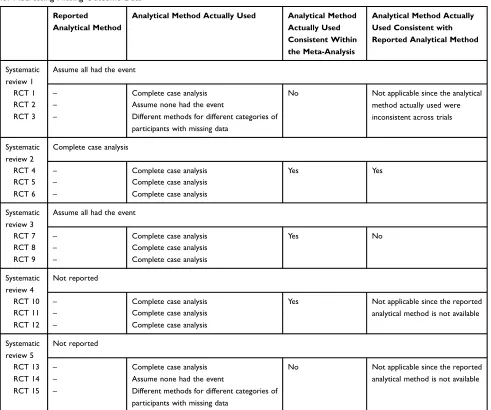
a matrix (seeTable 3).
Statistical Analysis
Using SPSS statistical software, version 21.0,23 we
con-ducted a descriptive analysis (frequencies and percentages) of all collected variables. We also planned to conduct
regression analyses to study the association between“
con-sistency between actual and reported method” and
char-acteristics of included systematic reviews.
Clinical Epidemiology downloaded from https://www.dovepress.com/ by 118.70.13.36 on 24-Aug-2020
Results
Our sample of 100 systematic reviews with significant
pooled effect estimates included 653 RCTs that
informed the meta-analyses of interest, of which we acquired the full-text reports for 638. We have pre-viously reported on the details of these systematic
reviews17 and the included RCTs.1Briefly, four hundred
RCTs (63%) reported on at least one category of
participants that were either explicitly not followed-up or with unclear follow-up status. Among these 400 RCTs, the median percentage of participants that were either explicitly not followed-up or with unclear
follow-up status was 11.7% (IQR 5.6–23.7%).1 Among trials
with missing outcome data, the meta-analyses they con-tributed to most often used the denominator (81%) and
numerator (80%) reported by the RCT (Table 4).
Table 1Commonly Used Methods of Handling Missing Outcome Data Among Trial Participants
Method of Handling Missing Data Implications for Participants with Missing Data in the Numerator and Denominator
Intervention Arm Control Arm
Numerator Denominator Numerator Denominator
Complete case analysis Excluded Excluded Excluded Excluded
Best case scenario Assumed that all had
a favorable outcome
Included Assumed that all had an
unfavorable outcome
Included
None of the participants with missing data had the outcome
Assumed that none had the outcome
Included Assumed that none had the
outcome
Included
All participants with missing data had the outcome
Assumed that all had the outcome
Included Assumed that all had the
outcome
Included
Worst case scenario Assumed that all had an
unfavorable outcome
Included Assumed that all had
a favorable outcome
Included
Table 2Examples Illustrating How Meta-Analyses Addressing the Same Study Question Might Handle Missing Outcome Data for an Unfavorable Dichotomous Outcome from an RCT Report and Thus Informed Classification of the “Analytical Method Reviews Actually Used”
Intervention Arm Control Arm
RCT report data
Number of participants randomized
Number of events
Number of participants with missing data
Number of participants randomized
Number of events
Number of participants with missing data
RCT 1
100 5 2 100 10 5
Meta-analysis data
Denominator Numerator Denominator Numerator Our classification of the actual analytical
method by the SR
MA 1 98 5 95 10 Complete case analysis
MA 2 100 5 100 10 Assumed none had the event
MA 3 100 7 100 15 Assumed that all had the event
MA 4 100 7 100 10 Worst-case scenario
MA 5 100 5 100 15 Best-case scenario
Abbreviations:MA, meta-analysis; RCT, randomized controlled trial; SR, systematic review.
Clinical Epidemiology downloaded from https://www.dovepress.com/ by 118.70.13.36 on 24-Aug-2020
Classifying the
“
Analytical Method
Reviews Actually Used
”
for Handling
Missing Data
We were able to classify the “analytical method reviews
actually used”for 241 (38%) of the included RCTs; 67%
were classified with lower confidence (best guess) and
33% with higher confidence (based on explicit reporting)
(Table 4). For the remaining RCTs, 207 (32%) included no participants with missing data (complete follow-up), 161 (25%) provided numbers that could not be explained (did not add up to match any of the suggested analytical method actually used), 5 (1%) had extracted the wrong data (e.g., used data from the wrong outcome), and 24
(4%) provided insufficient information for even a best
guess at the method used to handle missing data.
Among the 241 included RCTs for which we were able to
classify the“analytical method reviews actually used”,
sys-tematic review authors conducted“complete case analysis”
in 128 (53%), assumed“none of the participants with missing
data had the event of interest”in 58 (24%), and used different methods for different categories of participants with missing data in 51 (21%) trials. In four RCTs (2%) assumptions other
than thefive we explored (Table 1) were used.
Only seven of the 100 systematic reviews we assessed explicitly reported on methods to handle missing data in their meta-analysis. Two planned a complete case analysis, two proposed assuming all participants with missing data had the event of interest, and three reported their intention to assume that none of the participants with missing data had the event of interest.
Table 3Hypothetical Scenarios Illustrating the Process for Judging Consistency Between“Reported”and“Actual”Analytical Methods for Addressing Missing Outcome Data
Reported Analytical Method
Analytical Method Actually Used Analytical Method
Actually Used Consistent Within the Meta-Analysis
Analytical Method Actually Used Consistent with Reported Analytical Method
Systematic review 1
Assume all had the event
RCT 1 – Complete case analysis No Not applicable since the analytical
method actually used were inconsistent across trials
RCT 2 – Assume none had the event
RCT 3 – Different methods for different categories of
participants with missing data
Systematic review 2
Complete case analysis
RCT 4 – Complete case analysis Yes Yes
RCT 5 – Complete case analysis
RCT 6 – Complete case analysis
Systematic review 3
Assume all had the event
RCT 7 – Complete case analysis Yes No
RCT 8 – Complete case analysis
RCT 9 – Complete case analysis
Systematic review 4
Not reported
RCT 10 – Complete case analysis Yes Not applicable since the reported
analytical method is not available
RCT 11 – Complete case analysis
RCT 12 – Complete case analysis
Systematic review 5
Not reported
RCT 13 – Complete case analysis No Not applicable since the reported
analytical method is not available
RCT 14 – Assume none had the event
RCT 15 – Different methods for different categories of
participants with missing data
Clinical Epidemiology downloaded from https://www.dovepress.com/ by 118.70.13.36 on 24-Aug-2020
Consistency in Analytical Methods
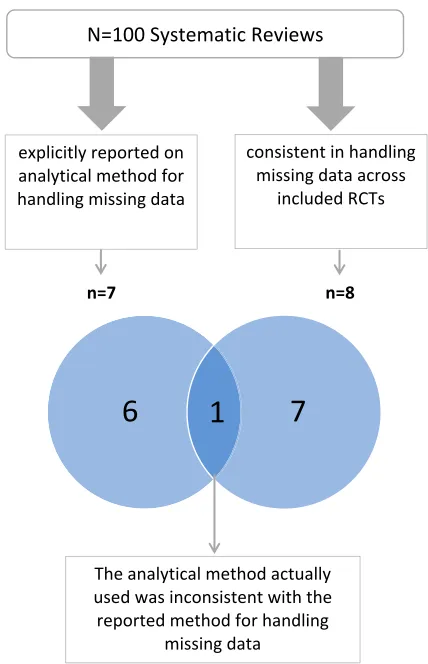
Of the seven systematic reviews that explicitly reported on the analytical method for handling missing data, only one was consistent in handling missing data across all
included trials (using complete case analysis) (Figure 1).
However, the analytical method actually used was not
consistent with their “reported analytical methods” (“if
missing data were unable to be obtained, a result was assumed to have a particular value, such as poor
outcome”).24 Of the 93 systematic reviews that did not
explicitly report their analytical method of handling missing data, seven were consistent in their actual ana-lytical method for handling missing data across all included trials.
Due to the low number of reviews that were consistent within the same meta-analysis, we were not able to conduct any regression analysis to study the association between
“consistency between actual and reported method”and
char-acteristics of included systematic reviews.
Discussion
Summary of Findings
In this systematic survey of Cochrane and non-Cochrane systematic reviews, we found that missing data of trial participants was inconsistently handled by almost all reviews. Most reviews did not specify an approach for handling missing data, and of the few that did, none applied their approach consistently across eligible trials.
Strengths and Limitations
The main strength of our study is the systematic and trans-parent methods used, including screening independently and in duplicate, conducting calibration exercises and use of
Table 4“Analytical Method Reviews Actually Used”to Handle Missing Data Across RCTs Included in Meta-Analysis
Variable n (%)
Ability to classify the analytical method reviews actually used (n=638)
Able to classify 241 (37.8)
Not applicable (no missing data) 207 (32.4) Could not be explained (numbers do not add up) 161 (25.2)
Wrong data extraction 5 (0.8)
No data available from RCT or SR 24 (3.8)
Classification of the analytical method reviews actually used (n= 241+)
Complete case analysis 128 (53.1)
None of the participants with missing data had the event of interest
58 (24.1)
All the participants with missing data had the event of interest 2 (0.8)
Worst-case scenario 1 (0.4)
Best-case scenario 0
Same event rate as those followed up 0
Other 1 (0.4)
Different methods for different categories of participants with missing data
51 (21.2)
The SR authors used in the meta-analysis a denominator used by the RCT (n=431*)
Definitely yes 348 (80.7)
Definitely no 65 (15.1)
Unclear 18 (4.2)
The SR authors used in the meta-analysis a numerator used by the RCT (n=431*)
Definitely yes 345 (80.0)
Definitely no 53 (12.3)
Unclear 33 (7.7)
Notes:+
n=241 RCTs for which we could classify an“analytical method reviews actually used”. *n= 431 RCTs excluding those with no missing data (638–207 RCTs that had no missing data).
Abbreviations:ITT, intention-to-treat; LTFU, lost to follow-up; RCT, randomized controlled trials; SR, systematic reviews.
N=100 Systematic Reviews
6
1
7
explicitly reported on analytical method for handling missing data
consistent in handling missing data across
included RCTs
n=7 n=8
The analytical method actually used was inconsistent with the reported method for handling
missing data
Figure 1Consistency in analytical methods within the same meta-analysis and versus the reported analytical method.
Abbreviations:RCTs: randomized controlled trials; SR: systematic review.
Clinical Epidemiology downloaded from https://www.dovepress.com/ by 118.70.13.36 on 24-Aug-2020
pilot-tested forms for data extraction to increase reliability and applying a systematic strategy for making the numerous
classification judgments involved in the study. To our
knowl-edge, this is the first methodological survey exploring how
systematic review authors actually dealt with trial missing
outcome data in their meta-analysis. Also, this is the first
study to assess whether the methods used for handling miss-ing outcome data in the meta-analysis are consistent with the
“reported analytical methods”. A limitation of our study is
that we considered only dichotomous outcome data. The methods for handling missing continuous data are different
and our findings may not be generalizable to continuous
outcomes.25,26 Another limitation was our reliance on
reviewers’ judgments at different stages of the process
(e.g., judgment regarding the actual analytical method used to handle missing data). Our development and application of a logically coherent strategy for making the numerous
clas-sification judgments involved in the study may mitigate this
concern. Further, our sample included systematic reviews
that were published in 2012, and may not reflect more current
reviews; however, recent surveys suggest that the reporting, handling, and assessment of risk of bias in relation to missing data have not improved since we acquired the reviews used in our study.16,27-29
Interpretation of Findings
Both the challenge we faced in classifying the “analytical
method reviews actually used” (25% of RCTs provided
numbers that could not be explained) and the observed inconsistency in handling missing data within the same
meta-analysis reflect the failure of reviewers to adopt
standardized approaches to reporting and dealing with
missing data.22,30,31 This inconsistency may bias the
results and could produce disparatefindings among
differ-ent meta-analyses addressing the same research question,
even when considering the same trials.32
We uncovered three limitations in how systematic reviews authors handle missing data in their meta-analysis:
1. Ninety-three percent did not explicitly report on their methods for handling missing data.
2. Ninety-two percent were inconsistent in the meth-ods used to handle missing data across RCTs within the same meta-analysis.
3. In the few meta-analyses that did explicitly report a method for handling missing data, none actually applied that method.
We also found that for more than 80% of RCTs with missing outcome data contributing to the meta-analyses of interest, the systematic review authors used the same denominator and numerator as those reported by the trialists. So, systema-tic review authors may simply use what trialists have reported, without consciously planning a method to handle missing data. As trialists use different approaches to handling missing outcome data of trial participants, this practice might explain why systematic review authors are not consistent with their approach in handling missing data across trials included in the same meta-analysis. In other cases, systematic review authors and trial authors, intending to apply the
“intention to treat” principle, include the total number of
participants randomized in the denominator while using whatever the trial authors have used in the numerator.
Subsequently, they would be implicitly applying “none of
the participants with missing data had the event”. Given that
this assumption is highly implausible in a real-world context, the confidence in thefindings would be lower.33,34
Recommendations for Practice
In order to ensure consistency in handling missing data across trials included in the same meta-analysis, authors should:
1. Develop a transparent and detailed strategy for handling missing data (e.g., using complete case
analysis, applying assumptions);35–38
2. Refer to available guidance on how to identify
participants with missing data from RCT reports;22
3. Apply their strategy for handling missing data con-sistently across all trials included in the meta-analysis.
4. Report clearly on the above.
Conclusion
The large majority of systematic reviews considered in our study did not report a method for handling missing data in their meta-analyses. For the few that did, the actual method used for handling missing outcome data was often inconsistent with their reported methods. As such inconsistency might threaten the validity of the results of systematic reviews, methodologic rigor requires improved adherence to guidance on identifying, reporting, and hand-ling participants with missing outcome data.
Abbreviations
MA, meta-analysis; RCT, randomized controlled trial; SR, systematic review.
Clinical Epidemiology downloaded from https://www.dovepress.com/ by 118.70.13.36 on 24-Aug-2020
Author Contributions
All authors contributed to data analysis, drafting or revising the article, gavefinal approval of the version to be published, and agree to be accountable for all aspects of the work.
Disclosure
The authors report no conflicts of interest in this work.
References
1. Kahale LA, Diab B, Khamis AM, et al. Potentially missing data was considerably more frequent than definitely missing data in rando-mized controlled trials: a methodological survey.J Clin Epidemiol.
2018;106:18–31.
2. Akl EA, Kahale LA, Ebrahim S, et al. Three challenges described for identifying participants with missing data in trials reports, and poten-tial solutions suggested to systematic reviewers.J Clin Epidemiol.
2016;76:147–154. doi:10.1016/j.jclinepi.2016.02.022
3. Hussain JA, White IR, Langan D, et al. Missing data in randomised controlled trials evaluating palliative interventions: a systematic review and meta-analysis. Lancet. 2016;387:S53. doi:10.1016/ s0140-6736(16)00440-2
4. Adewuyi TE, MacLennan G, Cook JA. Non-compliance with rando-mised allocation and missing outcome data in randorando-mised controlled trials evaluating surgical interventions: a systematic review.BMC Res Notes.2015;8:403. doi:10.1186/s13104-015-1364-9
5. Akl EA, Shawwa K, Kahale LA, et al. Reporting missing participant data in randomised trials: systematic survey of the methodological literature and a proposed guide. BMJ Open. 2015;5(12):e008431. doi:10.1136/bmjopen-2015-008431
6. Bell ML, Fiero M, Horton NJ, et al. Handling missing data in RCTs; a review of the top medical journals. BMC Med Res Methodol.
2014;14(1):118. doi:10.1186/1471-2288-14-118
7. Fielding S, Maclennan G, Cook JA, et al. A review of RCTs in four medical journals to assess the use of imputation to overcome missing data in quality of life outcomes.Trials.2008;9(1):51. doi:10.1186/ 1745-6215-9-51
8. Fielding S, Ogbuagu A, Sivasubramaniam S, et al. Reporting and dealing with missing quality of life data in RCTs: has the picture changed in the last decade?Qual Life Res.2016;25(12):2977–2983. doi:10.1007/s11136-016-1411-6
9. Fiero MH, Huang S, Oren E, et al. Statistical analysis and handling of missing data in cluster randomized trials: a systematic review.Trials.
2016;17(1):72. doi:10.1186/s13063-016-1201-z
10. Gewandter JS, McDermott MP, McKeown A, et al. Reporting of missing data and methods used to accommodate them in recent analge-sic clinical trials: ACTTION systematic review and recommendations.
Pain.2014;155(9):1871–1877. doi:10.1016/j.pain.2014.06.018 11. Karlson CW, Rapoff MA. Attrition in randomized controlled trials for
pediatric chronic conditions.J Pediatr Psychol.2009;34(7):782–793. doi:10.1093/jpepsy/jsn122
12. Masconi KL, Matsha TE, Echouffo-Tcheugui JB, et al. Reporting and handling of missing data in predictive research for prevalent undiag-nosed type 2 diabetes mellitus: a systematic review.EPMA J.2015;6 (1):7. doi:10.1186/s13167-015-0028-0
13. Spineli LM. Missing binary data extraction challenges from cochrane reviews in mental health and Campbell reviews with implications for empirical research.Res Synth Methods.2017;8(4):514–525. doi:10.1002/ jrsm.1268
14. Wahlbeck K, Tuunainen A, Ahokas A, et al. Dropout rates in rando-mised antipsychotic drug trials. Psychopharmacology. 2001;155 (3):230–233. doi:10.1007/s002130100711
15. Wood AM, White IR, Thompson SG. Are missing outcome data adequately handled? A review of published randomized controlled trials in major medical journals. Clin Trials. 2004;1(4):368–376. doi:10.1191/1740774504cn032oa
16. Ibrahim F, Tom BDM, Scott DL, et al. A systematic review of randomised controlled trials in rheumatoid arthritis: the reporting and handling of missing data in composite outcomes. Trials.
2016;17(1):272. doi:10.1186/s13063-016-1402-5
17. Kahale LADB, Brignardello-Petersen R, Agarwal A, et al. Systematic reviews do not adequately report, or address missing outcome data in their analyses: a methodological survey. J Clin Epidemiol. 2018. doi:10.1016/j.jclinepi.2018.02.016
18. Lafuente-Lafuente C, Valembois L, Bergmann JF, et al. Antiarrhythmics for maintaining sinus rhythm after cardioversion of atrialfibrillation.Cochrane Database Syst Rev.2011;3.
19. Singh S, Saini RK, DiMarco J, et al. Efficacy and safety of sotalol in digitalized patients with chronic atrial fibrillation. Am J Cardiol.
1991;68(11):1227–1230. doi:10.1016/0002-9149(91)90200-5 20. Singh BN, Singh SN, Reda DJ, et al. Amiodarone versus sotalol for
atrial fibrillation. N Engl J Med. 2005;352(18):1861–1872. doi:10.1056/NEJMoa041705
21. Akl EA, Kahale LA, Agarwal A, et al. Impact of missing participant data for dichotomous outcomes on pooled effect estimates in sys-tematic reviews: a protocol for a methodological study. Syst Rev.
2014;3:137. doi:10.1186/2046-4053-3-137
22. Kahale LA, Guyatt GH, Agoritsas T, et al. A guidance was developed to identify participants with missing outcome data in randomized controlled trials. J Clin Epidemiol. 2019;115:55–63. doi:10.1016/j. jclinepi.2019.07.003
23. IBM Corp. Released 2013. IBM SPSS Statistics for Windows, Version 22.0. Armonk, NY: IBM Corp.
24. Tang H, Hunter T, Hu Y, et al. Cabergoline for preventing ovarian hyperstimulation syndrome.Cochrane Database Syst Rev.2012;2. 25. Ebrahim S, Akl EA, Mustafa RA, et al. Addressing continuous data
for participants excluded from trial analysis: a guide for systematic reviewers.J Clin Epidemiol.2013;66(9):1014–21 e1. doi:10.1016/j. jclinepi.2013.03.014
26. Ebrahim S, Johnston BC, Akl EA, et al. Addressing continuous data measured with different instruments for participants excluded from trial analysis: a guide for systematic reviewers. J Clin Epidemiol.
2014;67(5):560–570. doi:10.1016/j.jclinepi.2013.11.014
27. Sullivan TR, Yelland LN, Lee KJ, et al. Treatment of missing data in follow-up studies of randomised controlled trials: a systematic review of the literature. Clin Trials. 2017;14(4):387–395. doi:10.1177/ 1740774517703319
28. Babic A, Tokalic R, Cunha JAS, et al. Assessments of attrition bias in cochrane systematic reviews are highly inconsistent and thus hinder-ing trial comparability. BMC Med Res Methodol. 2019;19(1):76. doi:10.1186/s12874-019-0717-9
29. Shivasabesan G, Mitra B, O’Reilly GM. Missing data in trauma registries: a systematic review. Injury. 2018;49(9):1641–1647. doi:10.1016/j.injury.2018.03.035
30. Akl EA, Carrasco-Labra A, Brignardello-Petersen R, et al. Reporting, handling and assessing the risk of bias associated with missing participant data in systematic reviews: a methodological survey.BMJ Open.2015;5(9):e009368. doi:10.1136/bmjopen-2015-009368
31. Akl EA, Kahale LA, Agoritsas T, et al. Handling trial participants with missing outcome data when conducting a meta-analysis: a systematic survey of proposed approaches.Syst Rev.2015;4:98. doi:10.1186/s13643-015-0083-6
32. Khamis AM, El Moheb M, Nicolas J, et al. Several reasons explained the variation in the results of 22 meta-analyses addressing the same question.
J Clin Epidemiol.2019;113:147–158. doi:10.1016/j.jclinepi.2019.05.023
Clinical Epidemiology downloaded from https://www.dovepress.com/ by 118.70.13.36 on 24-Aug-2020
33. Guyatt GH, Oxman AD, Vist G, et al. GRADE guidelines: 4. Rating the quality of evidence—study limitations (risk of bias). J Clin Epidemiol.2011;64(4):407–415. doi:10.1016/j.jclinepi.2010.07.017 34. Guyatt GH, Ebrahim S, Alonso-Coello P, et al. GRADE guidelines 17:
assessing the risk of bias associated with missing participant outcome data in a body of evidence. J Clin Epidemiol. 2017;87:14–22. doi:10.1016/j.jclinepi.2017.05.005
35. Akl EA, Johnston BC, Alonso-Coello P, et al. Addressing dichoto-mous data for participants excluded from trial analysis: a guide for systematic reviewers. PLoS One. 2013;8(2):e57132. doi:10.1371/ journal.pone.0057132
36. White IR, Carpenter J, Horton NJ. Including all individuals is not enough: lessons for intention-to-treat analysis. Clin Trials. 2012;9 (4):396–407. doi:10.1177/1740774512450098
37. White IR, Higgins JP. Meta-analysis with missing data. Stata J.
2009;9(1):57–69. doi:10.1177/1536867X0900900104
38. White IR, Horton NJ, Carpenter J, et al. Strategy for intention to treat analysis in randomised trials with missing outcome data. BMJ.
2011;342(feb07 1):d40. doi:10.1136/bmj.d40
Clinical Epidemiology
Dove
press
Publish your work in this journal
Clinical Epidemiology is an international, peer-reviewed, open access, online journal focusing on disease and drug epidemiology, identifi ca-tion of risk factors and screening procedures to develop optimal pre-ventative initiatives and programs. Specific topics include: diagnosis, prognosis, treatment, screening, prevention, risk factor modification,
systematic reviews, risk & safety of medical interventions, epidemiol-ogy & biostatistical methods, and evaluation of guidelines, translational medicine, health policies & economic evaluations. The manuscript management system is completely online and includes a very quick and fair peer-review system, which is all easy to use.
Submit your manuscript here:https://www.dovepress.com/clinical-epidemiology-journal
Clinical Epidemiology downloaded from https://www.dovepress.com/ by 118.70.13.36 on 24-Aug-2020