IJEDR1401125
International Journal of Engineering Development and Research (www.ijedr.org)688
Indecisive Condition Classification Using SVM
1Jyoti Pathak,
2Sachin Patel
1Student,
2Assistant Professor
Information Technology, PCST, Indore, India1[email protected], 2[email protected],
___________________________________________________________________________________________________________________
Abstract—In this research, we exploit the regularize framework and proposed an associative classification algorithm for uncertain data. The major recompense of SVM(support vector machine) are: recurrent item sets capture every dominant associations between items in a dataset. These classifiers naturally handle missing values and outliers as they only deal with statistically significant associations which build the classification to be vigorous. We proposed a novel indecisive SVM Based clustering algorithm which considers large databases as the major application. The SVM Based clustering algorithm will cluster a specified set of data and exploit the matching which proposes other works.
Index Terms—: support vector machine, indecisive data, associative classification, fuzzy clustering.
I. INTRODUCTION
In current years, outstanding to the extensive relevance of uncertain data, In uncertain databases, the support of an item sets is a random variable instead of a unchanging event counting of this data. Data uncertainty arises obviously in much application appropriate to a variety of reasons. For example, data got from size by physical procedure are often imprecise due to measurement errors. One more source of error is quantization errors introduce by the digitization process. In several applications, such as crime suspect identification and medical diseases data values are continually changing recorded information is frequently stale. Indecisive may moreover come from repeated dimensions. In this paper, we initially aim to clarify the relationship between the two dissimilar definitions. Through extensive experiment, we verify that the two definitions have a tight connection and can be unified together when the size of data is large enough. Secondly, we provide baseline implementations of existing representative algorithms and test their performances with uniform measures fairly. Finally, according to the fair tests over many different benchmark data sets, we clarify several existing inconsistent conclusions and discuss some new findings. The digital insurrection has completed achievable that the data incarcerate be effortless and its storage have an almost null cost. As a substance of this, huge amount of extremely dimensional data are stored in databases incessantly. Due to this, semi-automatic technique for classification from databases is necessary. Support vector machine (SVM) is a dominant method for classification and regression. Training an SVM is frequently posed as a quadratic programming (QP) problem to discover a partition hyper-plane which associates a matrix of density nun, where the n is the quantity of points in the data set.
This requirements huge quantity of computational time and memory for large data sets, so the training Complexity of SVM is highly dependent on the size of a data set [1][5] a lot of efforts have been made on the classification for huge data sets. Sequential Minimal Optimization [12] convert the large QP difficulty into a series of diminutive QP problems, every one engage merely two variables [4][6]. [8] Converse large scale estimate for Bayesian inference for LS-SVM. The results of [7] demonstrate that a fair computational improvement can be acquire by means of a recursive strategy for large data sets, such as individuals concerned in data mining and text classification relevance. In this paper we propose a new approach for classification of large data sets, named SVM classification. In dividing wall, the quantity of clusters is pre-defined to keep away from computational cost for formative the optimal number of clusters. We merely segment the training data set and to eliminate the set of clusters with minor probability for support vectors. Based on the obtain clusters, which are distinct as mixed category and consistent category, we mine support vectors by SVM and form into concentrated clusters. Then we be appropriate de-clustering for the concentrated clusters, and acquire subsets from the innovative sets. In conclusion, we use SVM again and conclude the classification. An experiment is certain to demonstrate the efficiency of the new approach.
II. RELENTEDWORKS
Fabrizio Angiulli in at al[1] In this work the uncertain nearest neighbor rule, representing the generalization of the certain nearest neighbor rule to the uncertain scenario, has been introduced. Moreover, an algorithm to perform uncertain nearest neighbor classification of a generic (un)certain test object has been presented, together with some properties precisely designed to significantly reduce the temporal cost associated with nearest neighbor class probability computation.
Fabrizio Angiu in at al[2]introduce the Uncertain Nearest Neighbor (UNN) rule, which represents the generalization of the deterministic nearest neighbor rule to the case in which uncertain objects are available. The UNN rule relies on the concept of nearest neighbor class, rather than on that of nearest neighbor object. The nearest neighbor class of a test object is the class that maximizes the probability of providing its nearest neighbor.
Sangkyum Kim in at al[3] In this paper, they have proposed a new syntactic feature set of k-ee subtrees to classify documents based on their authorship. To mine k-ee subtrees, we developed a direct discriminative k-ee subtree mining algorithm via a branch-and-bound approach. algorithm could perform a discriminative score based feature selection procedure to mine discriminative patterns in one step, not iteratively. To directly mine discriminative patterns, they have theoretically derived an upper bound of binned information gain score of the numeric feature values.
IJEDR1401125
International Journal of Engineering Development and Research (www.ijedr.org)689
objects or illustration are referred cooperatively as training dataset. Before construction the replica, this training set should be classified to add a class label to every object or instance. This replica can be put up using different classification method which comprise, Decision trees, Associative classifiers, Bayesian methods, Support vector machines (SVM), etc.
Secord Testing: In this stage, the replica construct in the earlier step is used for categorization. Initial, the predictive accuracy of the classifier is anticipated. A test set which is complete up of test tuples and their connected class labels, is used to determine it. These tuples are arbitrarily chosen from the universal data set and are not implicated while construction the classification replica previous. Classification method was developed as a significant constituent of machine learning algorithms in organize to mine rules and patterns from data that could be used for prediction. Dissimilar technique from machine learning, statistics, information retrieval and data mining are used for classification. They comprise Bayesian technique, Bayesian belief networks, Decision trees, neural networks, Associative classifiers, Emerging patterns, and SVM. A high-quality analysis of this technique SVM Based Amongst these associative classification has expanded a lot of attractiveness because of it’s the numerous reward given below Association rules incarcerate all the prevailing relationships between items in a dataset Low-frequency patterns are reduce at an premature stage before construction the classifier Classification replica is robust because of the statistical implication of associations between the ite. Standardize Data creation: The standardize creation of data is described and our present the same briefly in the circumstance of classification. Given the positive class training dataset ARtr, the primary step in our algorithm is to extract dissimilar separate vectors. K-means clustering algorithm is used to cluster all the generated separate vectors Stotal for the training dataset. It produce a clustering C which has k quantity of dissimilar clusters – c1,c2,c3,ck After clustering, each AR
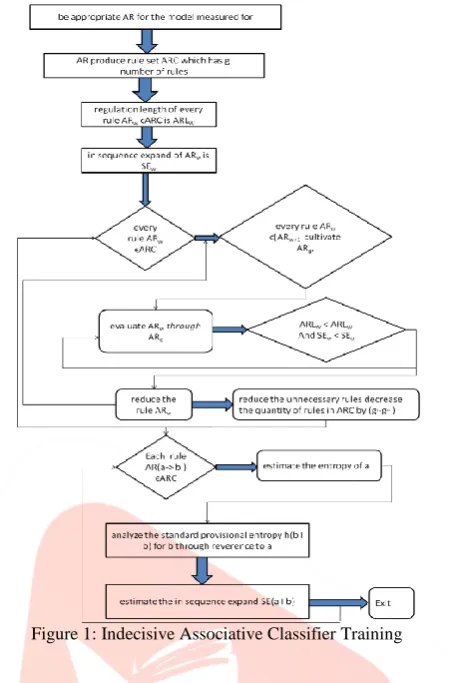
tr . AR is characterize in the customized form of where every expression representthe cluster associated with a fraction value. choose the quantity of clusters while collect is also an important step. since, lesser the quantity of clusters, extra is the loss of information concerning indecisive data which is also the same in case of higher number of clusters. Hence, decide the most favorable number of clusters is significant. In our algorithm while testing we have used the number of clusters based on the dataset measured. Indecisive Associative Classifier Training: the majority of the algorithms instruct their particular classifier with positive class and negative class datasets. But in Indecisive Associative Classifier Training, only a positive-class dataset is used for training the classifier. The primary step in training is to produce association rules for the indecisive replica. For produce the indecisive association rules, we contain used an indecisive algorithm which relies on the separation approach. The main reason for building an uncertain associative classifier instead of a traditional associative classifier is to handle the fraction value associated with the cluster identification in the customized model. After the creation of association rules, entropy and in sequence expand are intended for each rule produce. Given a rule aІb, a is an itemset collected of unreliable numeral of attributes and a is the class label of the rule which is discover from the dataset. The probability of a is consider to be the maximum probability of all the attributes in each rule. The SE(aw,b) of a specified quality a with respect to the class attribute b is the decrease in indecision concerning the value of b when we recognize the value of b.
IJEDR1401125
International Journal of Engineering Development and Research (www.ijedr.org)690
Figure 1: Indecisive Associative Classifier Training
IV. CLASSIFICATION
Classification is completes with a set of indecisive classification rules derivative. We increase this importance with the information gain SE(ARo) linked with the rule ARoas shown in figure 1 and consider this acquire consequence as the indecisive in sequence expand ARo. We compute the indecisive in sequence expand obtain while be appropriate every rule in the rule set ARC and append the ideals as shown figure1. This is the entirety indecisive in sequence expand which is established with a threshold –. If the value indecisive in sequence expand issuperior than or equivalent to –, then it belongs to the positive class or else it belong to the negative class.
V. CREATIONOFINDECISIVENUMEROUSITEMSETTRANSACTION
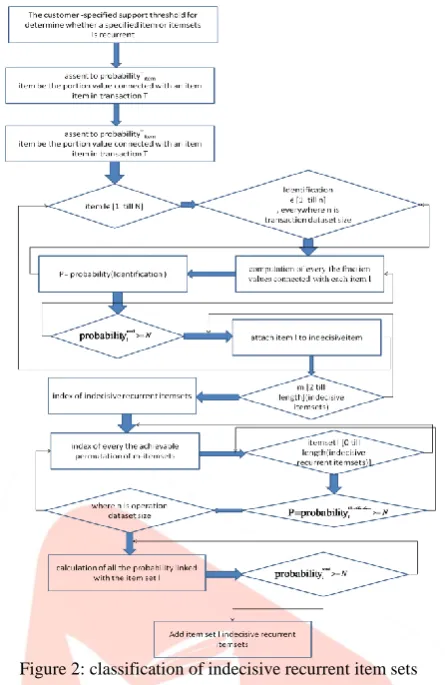
Dataset A set of indecisive recurrent item sets (iri) is identified in figure 2. As the subsequent step, each itemset in iri is measured as a innovative transaction. Using all these indecisive recurrent item sets, a new transaction dataset is produce. Every recurrent itemset is one of the cluster-ids used in replica R. recognize all the dataset which enclose all the recurrent itemsets when characterize them as in replica R. Each of these dataset associated with a probability importance that is considered from the personage probabilities associated with every of the cluster ids. Statistical illustration of manipulative the probability value can be seen in every of the indecisive recurrent itemset(iri) is transformed. The entire procedure of generate recurrent itemset transaction dataset is give details figure 2. Clustering of datasets. Generate dataset indecisive recurrent itemsets is used for the concluding clustering where similar datasets are grouped into a same cluster. illustration of iri can be seen in Figure 2 which is transformed to a expedient replica as exposed in that acts as an input for clustering algorithm.
VI. CLASSIFICATIONOFINDECISIVERECURRENTITEMSETS
IJEDR1401125
International Journal of Engineering Development and Research (www.ijedr.org)691
Figure 2: classification of indecisive recurrent item sets
Data clustering on indecisive data using the traditional techniques might change the nature of clusters because of the occurrence of indecision. For clustering, there are numerous resemblance metrics which are used to assembly an item with other items. In case of indecisive data, if the distance function is used as a resemblance metric, its computation will be exaggerated by indecision.
IJEDR1401125
International Journal of Engineering Development and Research (www.ijedr.org)692
a number of technique that are extensive from the clustering method for confident data are developed These developed techniques modify the significant metrics which deal with the similarity of data and transform them in such a way that they can handle indecision
Table Name
CRIME
SL No Field Name Data Type Size Constraint Explanation
1 type varchar 32 2 sector int
Table Name
WITNESS
SL No Field Name Data Type Size Constraint Explanation
1 name varchar 32 2 sector int
Table Name
PERSON
SL No Field Name Data Type Size Constraint Explanation
1 name varchar 32 2 hair varchar 32 3 clothes varchar 32
Table Name
SAWPERSON
SL No Field Name Data Type Size Constraint Explanation
1 witness varchar 32 2 hair varchar 32 3 clothes varchar 32
Table Name
SUSPECT_S
SL No Field Name Data Type Size Constraint Explanation
1 suspect varchar 32 2 crime varchar 32
Table Name
SUSPECT_D
SL No Field Name Data Type Size Constraint Explanation
1 suspect varchar 32 2 crime varchar 32 3 Conf numeric
Table Name
DRIVES
SL No Field Name Data Type Size Constraint Explanation
1 person varchar 32 2 car varchar 32 3 Conf numeric
Table Name
SAWCAR
SL No Field Name Data Type Size Constraint Explanation
1 witness varchar 32 2 car varchar 32 3 Conf numeric
Table Name
ACCOMPLICES
SL No Field Name Data Type Size Constraint Explanation
1 name1 varchar 32 2 name2 varchar 32 3 crime varchar 32 4 Conf numeric
Table Name
HIGH_SUSPECT
SL No Field Name Data Type Size Constraint Explanation
1 suspect varchar 32 2 crime varchar 32
Table Description
Table Design for: -DataMiningCrime
IJEDR1401125
International Journal of Engineering Development and Research (www.ijedr.org)693
ACKNOWLEDGMENT
We would like to express our gratitude to all those who gave us the possibility to complete this paper. We want to thank the Information Technology of the Patel College of Science and Technology for giving me permission to commence this paper in the first instance, to do the necessary research work and to use departmental data. We are deeply indebted to our Master of Engineering supervisor Mr. Sachin Patel from the IT Department PCST whose help, stimulating suggestions and encouragement.
REFERENCES
[1] Fabrizio Angiulli, Fabio Fassetti DEIS, Universit`a della Calabria,‖ Uncertain Nearest Neighbor Classification‖ Journal Name, Vol. V, No. N, 8 2011.
[2] Fabrizio Angiulli ,Fabio Fassetti DIMES, University of Calabria, Italy ACM Transactions on Knowledge Discovery from Data (TKDD) TKDD Homepage archive Volume 7 Issue 1, March 2013 Article No. 1.
[3] Sangkyum Kim, Hyungsul Kim, Tim Weninger, Jiawei Han, Hyun Duk Kim,‖ Authorship Classification: A Discriminative Syntactic Tree Mining Approach‖ SIGIR ’11 July 24-28 2011, Beijing, China.
[4] Yongxin Tong Lei Chen Yurong Cheng , Philip S. Yu ,‖ Mining Frequent Itemsets over Uncertain Databases‖ August 27th 31st 2012, Istanbul, Turkey. Proceedings of the VLDB Endowment, Vol. 5, No. 11.
[5] Olalekan Kadri , C.I. Ezeife ,‖ Mining Uncertain Web Log Sequences with Access History Probabilities‖ SAC’11 March 21-25, 2011, TaiChung, Taiwan.
[6] Metanat HooshSadat and R. Osmar Zaiane. An associative classifier for uncertain datasets. In Proceedings of the 16th Pacific-Asia Conference on Knowledge Discovery and Data Mining, PAKDD’12, 2012.
[7] Michael Chau, Reynold Cheng, and Ben Kao. Uncertain data mining: A new research direction. In Proceedings of the Workshop on the Sciences of the Artificial, 2005.
[8] Charu C. Aggarwal, Yan Li, JianyongWang, and JingWang. Frequent pattern mining with uncertain data. In Proceedings of the 15th ACM SIGKDD international conference on Knowledge discovery and data mining, KDD ’09, pages 29–38, 2009. [9] Jiye Liang,‖ Feature selection for large-scale data sets in GrC‖ IEEE International Conference on Granular Computing-2012. [10] Ashfaqur Rahman, Daniel V. Smith, Greg Timms,‖ Multiple Classifier System for Automated Quality Assessment of Marine
Sensor Data‖ IEEE ISSNIP 2013.
[11] Xiaojing Shen, Yunmin Zhu Yingting Luo, Jiazhou He,‖ Minimized Euclidean Error Data Association for Multi-Target and Multisensor Uncertain Dynamic Systems‖
[12] X. Shen, Y. Zhu, E. Song, and Y. Luo, ―Minimizing Euclidian state estimation error for linear uncertain dynamic systems based on multisensory and multi-algorithm fusion,‖ IEEE Transactions on Information Theory, vol. 57, pp. 7131–7146, October 2011.
[13] Gao Huang, Student Member, IEEE, Shiji Song, Cheng Wu, and Keyou You,Robust Support Vector Regression for Uncertain Input and Output Data, IEEE TRANSACTIONS ON NEURAL NETWORKS AND LEARNING SYSTEMS, VOL. 23, NO. 11, NOVEMBER 2012.
[14] Y. Miche, A. Sorjamaa, P. Bas, O. Simula, C. Jutten, and A. Lendasse, ―OP-ELM: Optimally pruned extreme learning machine,‖ IEEE Trans. Neural Netw., vol. 21, no. 1, pp. 158–162, Jan. 2010.
[15] E. J. Bayro-Corrochano and N. Arana-Daniel, ―Clifford support vector machines for classification, regression, and recurrence,‖ IEEE Trans. Neural Netw., vol. 21, no. 11, pp. 1731–1746, Nov. 2010.