A STUDY OF THE APPRAISAL OF MATHEMATICS
TEACHERS IN GHANA
Jonathan Arko Fletcher
Thesis submitted to the University of London
For the Degree of Ph.D.1997
Boston Spa, Wetherby West Yorkshire, LS23 7BQ www.bl.uk
BEST COpy AVAILABLE.
ABSTRACT
Teacher appraisal may provide opportunities for teachers to improve the quality of their teaching, thereby increasing the quality of pupil learning. Literature on teacher appraisal in Ghana indicates that the appraisal system is designed to serve both formative and summative purposes. The ability of the appraisal system to provide opportunities for mathematics teachers to develop professionally is the subject of this study.
The study aims to:
a) identify the nature and purposes of Teacher Appraisal in Ghana (TAG); b) examine the validity of existing methods of TAG specifically by:
i ... examining the potential of the appraisal system to help mathematics teachers improve their teaching of mathematics;
11 ... finding which variables are significantly related to Ghanaian secondary
mathematics teachers' views of teacher appraisal in Ghana and its ability to help them improve their teaching of mathematics
c) identify the implications of any changes in the existing teacher appraisal systems for Ghana's educational policies.
441 secondary mathematics teachers participated. 193 of these teach the subject at the junior secondary level and 248 teach it at the senior secondary level. In addition, 44 Ghana Education Service officials (and 6 heads of secondary schools) who appraise mathematics teachers were sampled. Questionnaires and interviews were used to collect teachers' and appraisers' perceptions of the appraisal system. Additionally, some appraisers were observed while at work. The results of the study showed that many education officials in Ghana who appraise mathematics teachers, and who are required to 'help' mathematics teachers improve their work, have little or no training in secondary school mathematics teaching or its appraisal.
than their junior secondary counterparts.
Putting the results at the junior secondary and senior secondary levels together, the study found professional status to be the single most important determinant of teachers' attitude to teacher appraisal in Ghana as a formative process. The above differences between junior secondary and senior secondary respondents thus reflected the differences in the two groups of teachers' academic and professional qualifications in mathematics.
ACKNOWLEDGEMENTS
I am very grateful to my supervisors Professors Alison Wolf and Richard Noss for the interest they showed in my work and the invaluable help, advice and encouragement they gave me throughout the course.
I acknowledge the co-operation of all those who assisted me in this study, particularly the Directors of Education, the headmasters/mistresses and the mathematics teachers who took part in the study.
CONTENTS
ABSTRACT ... 2
ACKNOWLEDGEMENTS ... 4
LIST OF APPENDICES ... 9
LIST OF FIGURES ... 10
LIST OF TABLES ... " 11 CHAPTER 1: AN OVERVIEW OF THE STUDy ... 13
1.1 Introduction ... " 13 1.2 The Problem ... " 13 1.3 Aims of the Study ... 15
1.4 Dependent Variable ... 17
1.5 Issues informing the hypotheses ... 19
1.6 Independent Variables ... 20
1.7 The layout of the thesis ... 21
CHAPTER 2: DEVELOPMENT OF EDUCATION IN GHANA ... 23
2.1 Introduction ... 23
2.2 The Educational Reform Programme ( ERP) ... 26
2.2.1 Pre-school, Nursery and Kindergarten Education ... 27
2.2.2 First Cycle (Basic) Education ... 27
2.2.3 Second Cycle Education ... 27
2.2.4 Tertiary Education ... 28
2.3 The Development of Teacher Education in Ghana ... '" ... '" ... 30
2.4 Teacher Appraisal and Unionism - An Historical Review ... 33
2.5 The Ghana Education Service (GES) ... 37
2.6 Conclusion ... 41
CHAPTER 3: TEACHER APPRAISAL METHODS: A REVIEW OF THE LITERATURE ... 43
3.1 Introduction ... 43
3.2 Appraisal Studies in the UK and the USA ... .43
3.3 Self - Appraisal ... 47
3.4 Peer Appraisal ... 52
3.5 Managerial Appraisal ... 56
CHAPTER 4: THE VALIDITY OF TEACHER APPRAISAL: A THEORETICAL
FRAMEWORK ... 62
4.1 Introduction ... 62
4.2 The Concept of Validity ... 63
4.3 Evaluating the Validity of Assessment Systems ... 65
4.3.1 Criterion-Related Validity ... 66
4.3.2 Content Validity ... 68
4.3.3 Construct Validity ... 69
4.4 Recent Development in the Theory of Validity ... " 70 4.5 Observation of Teaching ... 72
Observation for summative appraisal ... 74
4.6 Promotion interviews ... '" ... 75
4.7 Conclusion ... , ... 78
CHAPTER 5: HYPOTHESES FOR IDENTIFYING THE VARIABLES RELATED TO PERCEIVED SUPPORT ... 83
5.1 Introduction ... " ... 83
5.2 Hypothesis 1 ... 86
5.3 Hypothesis 2 ... 90
5.4 Hypothesis 3 ... 92
5.5 Hypothesis 4 ... '" ... 95
5. 6 Hypothesis 5 ... 99
5.6.1 Promotion in the GES ... 99
5.7 Hypothesis 6 .. '" ... , ... 101
5.8 Hypothesis 7 ... '" ... '" ... 104
CHAPTER 6: METHODOLOGy ... 111
6.1 Introduction ... 111
6.2 Preparation ... 112
6.3 The Pilot Study ... 113
6.3.1 Findings of the Pilot Study ... 117
6.4 The Main Study ... '" ... , ... 118
6.4.1 Population ... 118
6.4.2 Sample ... 119
6.4.3 Method of Selecting Sample Schools ... 120
6.4.4 Sample Sizes ... 120
6.4.5 Method of Selecting Appraisers ... 121
Teacher Questionnaire ... 121
Appraiser Questionnaire ... 124
6.4.7 Method of Administering Questionnaires ... 125
Junior secondary schools ... 125
senior secondary schools . ... " 125 Appraisers . ... " 126 6.4.8 Interviews ... 126
6.4.9 Work Inspection and Observation ... '" ... 128
Promotion interviews ... 129
6.4.10 Other Information ... 129
6.4.11 Analysis ... 130
CHAPTER 7: MATHEMATICS TEACHERS' PERCEIVED VALIDITY OF TEACHER APPRAISAL IN GHANA. ... 132
7.1 Introduction ... 132
7.2 Test (s) of Significance ... 132
7.3 Levels of Significance ... 133
7.4 Terminology ... 133
7.5 The Main Dependent Variable ... 134
7.6 Appraisal Experience ... 137
7.7 Respondents' Last Appraiser ... '" ... 140
7.8 Training ... 142
7.9 Mathematics Teaching Experience ... '" ... 146
7.10 Rank ... , ... , .... '" ... 150
7.11 Gender ... 152
7.12 Professional Status ... 153
7.13 Relationships Between the Variables of the Study ... 158
7.13.1 Rank as a Dependent Variable ... " 163 7.13.2 Mathematics Teaching Experience as a Dependent Variable ... 164
7.14 Discriminant Analysis ... 167
7.15 Conclusion ... 169
CHAPTER 8: THE VALIDITY OF TEACHER APPRAISAL IN GHANA ... 171
8.1 Introduction ... 171
8.2 Criteria for Evaluating the Validity of Formative Appraisal ... 172
8.3 Relevance of the Validity Criteria to the Present Study ... 173
8.3.2 Relating appraisal criteria to the underlying construct
being measured ... 182
Appraisers' perception of mathematics teaching . ... " 183 8.3.3 Conducting appraisals in a friendly atmosphere ... 187
8.3.4 Post-observation conference ... 190
Teachers' views about feedback after an observed lesson ... 191
Appraisers' perceptions about feedback after classroom observation . ... " 192 8.3.5 Summary of the validity of TAG as a formative process ... 194
8.4 Criteria for Evaluating the Validity of Summative Appraisal ... 195
8.5 Relevance of the Validity Criteria to the Present Study ... " 196 8.5.1 Credibility ... 196
8.5.2 Sampling of teacher's relevant work ... 200
8.5.3 Transparency of criteria for summative purposes ... 200
8.5.4 Multiple sampling in summative appraisal ... 215
8.6 Conclusion ... 218
CHAPTER 9: CONCLUSIONS ... 220
9.1 Introduction ... 220
9.2 The Literature Review ... 221
Studies relating to perceived organisational support . ... 221
Relevant studies in mathematics education ... 222
MAIN FINDINGS AND DISCUSSION ... 223
9.3 Nature and Purposes of TAG ... 223
9.3.1 Methods of appraisal ... 224
9.3.2 Instruments ... 225
Classroom observation ... 225
Promotion Interview ... 225
9.4 Potential of TAG ... 226
9.4.1 TAG as a formative process ... 226
9.4.2 TAG as a Summative System ... 227
9.5 Variables related to perceived support ... 228
9.6 Implications of changes in TAG ... 232
9.7 Limitations of the Study ... 237
9.8 Contribution of the Study and Further Research ... 239
9.9 Conclusion ... '" ... 241
BIBLIOGRAPHy ... 243
LIST OF APPENDICES
Appendix Al
(Mathematics) Teacher Appraisal Questionnaire ... 263 AppendixA2
Appraiser Questionnaire ... 272
Appendix Bl
Map of Ghana ... 278 Appendix B2
New Structure of Education in Ghana ... 279 Appendix B3
Institutional Relationship between the Ministry of Education and the GES ... 280 AppendixB4
Letter of Assurance from the Akuapem North District (GES) ... 281 AppendixB5
Time Table for Questionnaire Administration in the Akuapem North District
(GES) ... 282 AppendixB6
Letter of Introduction ... 283 AppendixB7
Inspection Report (O'Reilly Secondary School- Accra) ... 284 AppendixB8
PromotionlPrescribed Courses Sample Tests ... 288 AppendixB9
Inspection/Confidential Report Form ... 306 Appendix B 10
Promotion Application Forms ... 308 Appendix B 11
School Teacher Appraisal in the London Borough of Southwark ... 312 Appendix B 12
The Minister of Education's Speech on the State of Science Education in
Ghana ... 317
Appendix Cl
Relationship Between Mathematics Teaching Experience and the other
Variables used in the Hypotheses ... 326 Appendix C2
LIST OF FIGURES
Figure 1.1
Model describing the factors influencing the validity of TAG. . . 16 Figure 2.1
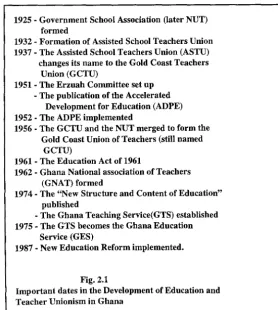
Important dates in the development of Education and Teacher Unionism in
Ghana ... 41 Figure 3.1
A pre-service teacher's concept map on ration and proportion ... 50 Figure 6.1
Items used to collect teachers' views about teacher appraisal ... 113 Figure 6.2
Objectives for selected items of the appraisers questionnaire ... 125 Figure 7.1
Causal model showing proposed relationships between the variables used in
the study ... 159 Figure 7.2
Causal model showing relationships between the variables used in the study
at the junior level. ... 165 Figure 7.3
Causal model showing relationships between the variables used in the study
for the senior level. ... 166 Figure 7.4
Causal model showing relationships between the variables used in the study
LIST OF TABLES
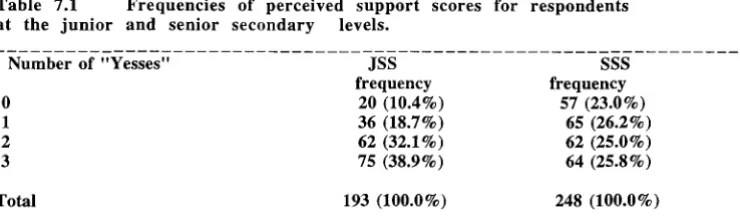
7.1 Frequencies of perceived support scores for respondents ... 135 7.2 Examining the relationship between teacher characteristics and
perceived (professional) support at the junior secondary level ... 136 7.3 Examining the relationship between teacher characteristics and
perceived (professional) support at the senior secondary level ... 137 7.4 Contingency tables showing the relationship between last
appraisal experience and perceived support, for junior and senior
secondary respondents ... 138 7.5 Sources of appraisal feedback at respondents' last appraisal
session ... 141 7.6 Contingency tables showing the relationship between last
appraisal feedback source and perceived support, controlled for
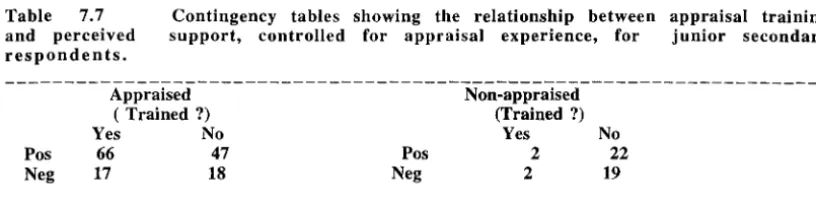
appraisal experience, for junior and senior secondary respondents ... 141 7.7 Contingency tables showing the relationship between appraisal
training and perceived support, controlled for appraisal
experience, for junior secondary respondents ... 144 7.8 Contingency tables showing the relationship between appraisal
training and perceived support, controlled for appraisal
experience, for senior secondary respondents ... 145 7.9 Contingency tables showing the relationship between experience
and perceived support controlled for appraisal experience, for
junior secondary respondents ... 147 7.10 Contingency tables showing the relationship between experience
and perceived support controlled for appraisal experience, for
senior secondary respondents ... 147 7.11 Contingency tables showing the relationship between rank and
perceived support, controlled for appraisal experience, for junior
secondary respondents ... 151 7.12 Contingency tables showing the relationship between rank and
perceived support, controlled for appraisal experience, for senior
secondary respondents ... 151 7.13 Contingency tables showing the relationship between professional
status and perceived support, controlled for appraisal experience,
for junior secondary respondents ... 154 7.13 Contingency tables showing the relationship between professional
status and perceived support, controlled for appraisal experience,
7.15 Summary statistics for the main variables used in the study ... 160
7.16 Intercorrelations between the main variables used in the study for junior and senior secondary levels ... 160
7.17 Intercorrelations between the main variables used in the study for the combined data ... 160
7.18 Total variance of the dependent variable "explained" by the seven independent variables ... 161
7.19 Incremental variance for each of the seven independent variables ... 162
7.20 Discriminant power of the main independent variables ... 168
7.21 Percentage of grouped cases correctly classified ... 169
8.1 Subject specialist areas of appraisers ... 175
8.2 Teachers' opinion of the mathematics teaching expertise of appraisers ... 176
8.3 Appraised teachers' opinion of the mathematics teaching expertise of appraisers ... 177
8.4 Teachers' opinion of appraisers' level of training in the appraisal of mathematics teaching ... 177
8.5 Appraised teachers' opinion of appraisers' level of training in the appraisal of mathematics teaching ... 178
8.6 Percentage of appraisers' work related to promotion and their frequencies ... 179
8.7 Purposes accounting for 50 percent or more of appraisers' work and their frequencies ... 180
8.8 Things appraisers look for in a mathematics lesson ... 183
8.9 Comparison between JSS and SSS appraisers' perceptions of mathematics teaching ... 184
8.10 Appraisers'description of a good mathematics lesson ... 185
8.11 Teachers' views about post-observation conferences ... 191
8.12 Appraised teachers' views about post-observation conferences ... 192
8.13 Appraisers' rankings of the factors considered by the GES for the promotion of teachers ... 211
8.14 Appraisers' choice scores (CS) ... 212
8.15 Appraisers' promotion perception scores ... 213
8.16 Teachers' Promotion Perception Scores (TPPS) ... 213
CHAPTER 1
AN OVERVIEW OF THE STUDY
1.1 Introduction
Ghana, once known as the Gold Coast, is a former British Colony on the West Coast of Africa. Located on the Gulf of Guinea, Ghana is bordered by three Francophone countries: Cote d'IVoire (Ivory Coast) and Burkina Faso (Upper Volta) on the west, Burkina Faso (Upper Volta) on the north, and Togo on the east. The country occupies an area of about 240,000 square kilometres (which is slightly smaller than the UK) and has a population of about 15 million. Like all the other countries who were once under British rule, Ghana inherited, at the time she gained independence from British rule in 1957, an education system built on the British model of education. Since then, several steps have been taken, without much success, to make education more functional to serve Ghanaian development aspirations. Indeed, various Ghanaian governments have tacitly supported educational practices which are in close conformity with educational developments in the United Kingdom. However, there is one area where the Ghanaian system appears to differ conspicuously from the British system. This is the area of teacher appraisal, which is the subject of the present study.
Teacher appraisal, may be defined as the attempt by self and/or others to analyse and assess a range of professional knowledge, skills, and attitudes which are relevant to the performance of a teacher's role within an institution or agency (Andreson , Powel & Smith, 1987). Teacher appraisal can be both retrospective and prospective, looking back at what has or has not been achieved, taking stock of the present and then planning some pathways which will help the individual teacher's professional development as well as (her/his) professional 'accountability'. Used in the above context, teacher appraisal becomes synonymous with teacher evaluation, which also involves stock-taking and recommendations for improvements. Throughout this thesis the two words (i.e. appraisal and evaluation) are used interchangeably and they mean almost the same thing. In this chapter, I will present an overview of the study.
1.2 The Problem
teachers in it. It follows that the main way of improving the quality of learning that takes place in any educational system is to improve the quality of teaching in that system. One way of improving the quality of teaching is by providing teachers with the opportunity to develop professionally through the process of appraisal. Yet the literature on TAG suggests that the appraisal process rarely does improve teaching quality. In the light of the 'reduction' in education in Ghana, this observation has serious implications for the implementation of the innovation in the Ghanaian education system.
Ghana is currently implementing a new system of education which aims to make the latter both cost-effective and accessible to all Ghanaian children of school going age. The programme took off in 1987. Although the period of university education has been extended from three to four years, pre-university education has been shortened from 17 to 13 years: six years primary schooling; three of junior secondary; and four years of senior secondary: the 6-3-4 system. Thus in an attempt to improve the access to basic education in Ghana, the Ghanaian government has reduced the 'quantity' of pre university education and increased that of university education. Considering that only 25 percent of pupils who go through the 6-3-4 system will gain admission to either the universities or any of the other tertiary institutions such as the polytechnics and teacher training colleges (National Report, 1990), for the majority of Ghanaian children, the formal education they are to receive for 13 years or less - only 50 percent of pupils from the junior secondary school will gain admission to senior secondary schools (National Report, op. cit.) - should be of a quality that will adequately prepare them for adult life.
The study concentrates on the appraisal of teachers of mathematics in Ghanaian secondary schools where mathematics is found most difficult both to teach and to learn (Boakye & Oxenham, 1982) and where very little research has been done by others, albeit a review of the literature shows some studies on the supervision of school teachers in Ghana as well as in other countries. It seeks to examine the validity of the teacher appraisal system in Ghana and to identify some of the factors that are relevant to Ghanaian secondary mathematics teachers' perceptions of the validity of TAG as a formative process.
1.3 Aims of the Study
The study aims to:
a) identify the nature and purposes of Teacher Appraisal in Ghana (TAG); b) examine the validity of existing methods of TAG specifically by:
i ... examining the potential of the appraisal system to help mathematics teachers improve their teaching of mathematics;
ii... finding which variables are significantly related to Ghanaian secondary mathematics teachers' views of teacher appraisal in Ghana and its ability to help them improve their teaching of mathematics
c) identify the implications of any changes in the existing teacher appraisal system for Ghana's educational policies.
Bailey (1981) has argued that what an institution requires from its staff will generally depend on the goals of that institution and that appraisal can be a powerful tool for establishing the institution's vision and encouraging stafftowards its achievement. He argues further that if institutional aims are to be followed, then the appraisal scheme should establish the degree to which these aims need to be followed. Relating this to the present study, it is important to establish the nature and purposes of the teacher appraisal system(s) in Ghana before one can comment on the procedures that are employed in pursuance of those purposes. Having identified the purposes of the appraisal system, one can then go on to look at the instrument and procedures used in pursuance of the goals of the system to see how valid they are.
perceptions of all the parties involved in the appraisal process.
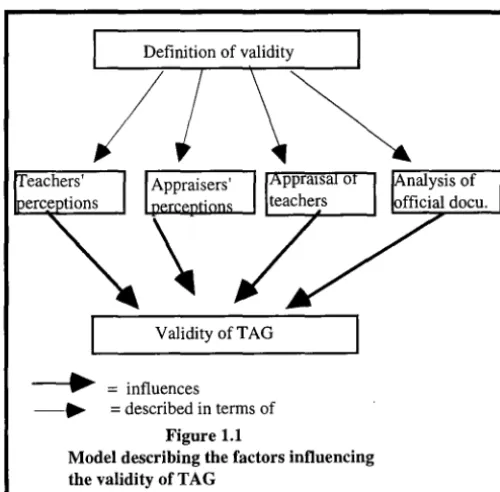
As the present study is about the potential of the teacher appraisal process to help mathematics teachers improve their teaching of mathematics, it included in the validity judgement, the perceptions of both mathematics teachers and their appraisers of the appraisal system's potential to help the former improve their work. Additionally, validity was measured in terms of the degree of match or mismatch between what valid appraisal of mathematics teachers might include and how Ghanaian secondary mathematics teachers are actually appraised. Other relevant evidence such as the analysis of official documents on teacher appraisal also informed the final conclusions about the validity of the teacher appraisal system in Ghana. The factors taken into account in arriving at the conclusions about the system's validity are presented in model (Figure 1.1) below.
Validity of TAG
--.~
=
influences- . = described in terms of Figure 1.1
Model describing the factors influencing the validity of TAG
is therefore important, in a study like the present one, to ascertain and compare the views, about the appraisal scheme, of teachers and their appraisers in order to see if the above relationship can be explained in terms of the similarities and/or differences in their perceptions. The present study therefore compares appraisers' perceptions of one of the outcomes of appraisal - promotion - with those of appraisees and examines the degree of match or mismatch between the two sets of perceptions and how this can affect mathematics teachers' perceptions of the appraisal system's potential to help them improve their work.
In addition to examining the validity of the appraisal system from mathematics teachers' and their appraisers' points of view, the study also identifies a number of variables which are significantly related to mathematics teachers' views of the appraisal system and its potential to help them improve their work. Using teachers' perceptions of the system's potential to help them improve their work (i.e. their perceived support from the organisation which appraises them - the Ghana Education Service) as the main dependent variable (see below), a number of hypotheses were formulated and tested using certain teacher characteristics and other variables as the independent variables. The hypotheses were thus used to examine the validity of the teacher appraisal process from the point of view of different categories of mathematics teachers at the two different levels of education considered in the present study namely, junior secondary and senior secondary levels.
A major advantage of using the hypotheses is that they helped to identify which groups of teachers see the appraisal system in a positive light and which groups see it in a negative light. Thus, to the extent that teachers' perceived validity of the appraisal system influences ways of finding a 'solution' to the problem of helping teachers to improve their teaching of mathematics, the hypotheses might help identify and indicate what sort of changes would be most productive at different levels of the system. Consequently, the hypotheses form a major part of the present study.
1.4 Dependent Variable
The main dependent variable used in the formulation of the hypotheses was perceived organisational or professional support, which I describe below. I also describe below why this variable was chosen for the present study.
cited primary purposes of personnel appraisal, namely accountability and professional growth. These two purposes are discussed in detail in chapter 3 and it suffices to say that the accountability ( or summative) dimension reflects the need to determine whether a professional is competent in order to ensure that services delivered are safe and effective (e.g. Stiggins & Duke, 1988) whereas the professional growth ( or formative) dimension reflects the need for development of the individual (e.g. Latham & Wexley, 1982).
Writers like Nuttall (1986) have argued that summative and formative purposes of appraisal can co-exist within the same scheme. Fullan (1991) has also noted that "combining individual and institutional development has its tensions, but the message .... should be abundantly clear. You cannot have one without the other" (p.349).
Yet McGreal (1988) argued that multiple purposes of evaluation can be successfully met with a single evaluation system only when the system is viewed as one component of a larger mission: that of furthering the goals of the organisation. If the dynamic relationship between the individual and the organisation is healthy, then what is good for the organisation must also be good for the individual, and vice versa. Indeed, Getzel and Guba (1957), in their classical model of social behaviour and the administrative process, described this dynamic relationship as one that fuses the prevailing interests of the institution with those of the individual:
Since the goals of the social system must be carried out, it is obviously necessary to make explicit the
roles and expectations required to achieve the goals. And, since the roles and expectations will be
implemented by flesh - and - blood people with needs to be met, the personalities and dispositions of
these people must be taken into account (Getzel and Guba ,op cit., pp 437-438, my emphasis)
Such an orientation enhances the ability of both the individual and the institution to achieve desired goals and consequently encourages a satisfying state of affairs within the organisation and among its respective employees (Little, 1993; March & Simons
1993).
in terms of their need to 'manage' staff whatever the purpose of the appraisal is, whilst junior staff in their hierarchies may see it more in terms of their own personal development. These differences may be exacerbated when a single system is used for the dual purposes (of appraisal) as the literature suggests is the case in Ghana.
In such circumstances, and in view of the limited resources available to the Ghana Education Service, it is important to identify which teacher characteristics ( and other variables) are significantly related to teachers' perceptions of the appraisal process. Hence the importance of considering teachers' perceived validity of the teacher appraisal system in Ghana.
The question then is, to what extent is the present teacher appraisal system in Ghana achieving the dual purpose of helping teachers to improve their work and at the same time making judgements on their work for summative purposes? The present study assessed how well the dual role is being performed by the system.
1.5 Issues informing the hypotheses
To gain clear insights into the appraisal of mathematics teachers in Ghana as well as find out which teacher variables are significantly related to mathematics teachers' perceived support, a number of working hypotheses were formulated. These hypotheses were based on some of the issues which teacher appraisal ought to address. In other words, they were based on some of the gaps in the literature on teacher appraisal which need filling. The hypotheses are discussed in detail in chapter 5 and will only be listed here:
)nly when the system has been (reasonably) accurately described that one can infer whether or not it can actually help mathematics teachers improve their work.
Another issue which is of great importance in performance appraisal is the relationship between the appraiser and appraisee. This relationship can influence the perceptions of both appraisers and appraisees of the appraisal process. The differences in the perceptions of the appraisal process of both appraisers and appraisees can in turn influence the latter's perceived impact of the appraisal process. It is thus suggested that one's perceived impact of an appraisal system may not only depend on whether or not one has gone through the experience of being appraised, but on the relationship between one and one's appraiser. With regard to the present study, it is reasonable to suggest that a teacher's perceived impact of the appraisal system could be influenced by who appraises the teacher generally, and who last appraised her or him in particular. Here too, any relationship between teachers' perceptions (ofthe appraisal process) and their last appraisal experience can help describe the teacher appraisal system in Ghana.
A third issue, which relates more to summative appraisal than to formative appraisal is that of the level of training appraisers receive to enable them meet the required 'standards' in summative appraisals. It is suggested, as far as the present study is concerned, that the level of training teachers receive for the above purpose can also influence their perception of the appraisal process. As in the case of the above issues, the differences between the perceptions of teachers who have received training to enable them meet summative appraisal criteria and those of their 'non-trained' counterparts can throw some light on summative appraisals in the Ghana Education Service. It follows that the relationship between teachers' rank in the GES and their perceptions of the appraisal system can also throw some light on (summative) teacher appraisals in Ghana, since the training teachers receive might help them clear the promotion bar.
Some other important issues which the literature on teacher appraisal in particular has been rather silent on include the influence of teachers' experience (both in quantitative and qualitative terms) on their perceptions of teacher appraisal systems. This is in spite of the fact that a good number of studies have looked at the relationship between
Finally, the issue of gender differences in mathematics education has attracted much interest both within and outside the mathematics education community . Yet it appears that very little attention has been paid to the relationship between gender and perceptions of appraisal in teacher appraisal studies. The present study therefore attempted to fill this important gap. This is because such a relationship might help explain some of the differences that researchers have found between the sexes in various aspects of mathematics teaching and learning.
1.6 Independent Variables
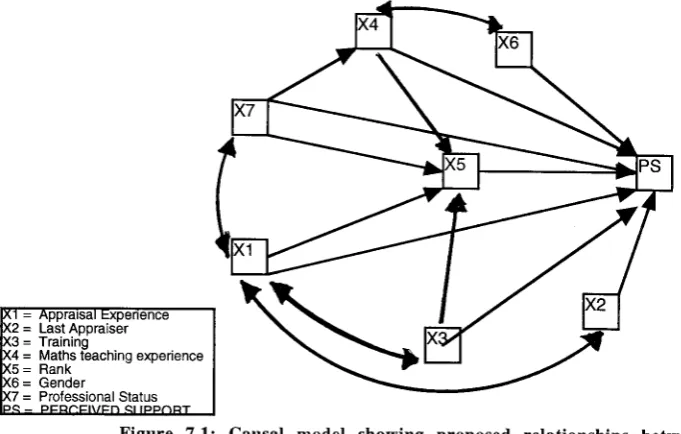
Following the above hypotheses, the seven main independent variables which were used in the empirical analyses were:
1. Experience with appraisal 2. Respondent's last appraiser 3. Training in appraisal
4. Experience in maths teaching 5. Rank of respondent
6. Gender
7. Professional status of respondent
The relevant data about teachers' perceptions were collected through a questionnaire (distributed to secondary mathematics teachers) and interviews. The perceptions of appraisers were also collected through a questionnaire and interviews. Additionally, the work of appraisers was observed. Thus, as mentioned above, conclusions about the validity of the appraisal system were based on the perceptions of both teachers appraisers, how the latter do their work and any other relevant evidence.
1.7 The layout of the thesis
The thesis consists of nine chapters which have been arranged as follows:
Chapter one presents an overview of the study.
significance to the present study.
Chapters three discusses the strengths and weaknesses (and consequently) the validity of teacher appraisal methods. It also touches on the review of the literature on performance appraisal and seeks to establish the rationale for the study.
Chapter four seeks to establish the theoretical framework for evaluating the validity of teacher appraisal in Ghana.
Chapter five looks at the main hypotheses for the study. It discusses certain teacher characteristics and other variables that are relevant to the study.
Chapter six discusses the method employed in the study as well as the pilot study leading to the present study and its implications.
Chapter seven tests the hypotheses formulated in chapter five. It thus examines the relationship between the independent variables of interest and the main dependent variable. It seeks to establish which variables are relevant to Ghanaian mathematics teachers' views of teacher appraisal and its ability to help them improve their teaching of mathematics. In other words, it attempts to identify which factors affect mathematics teachers' perceived validity of the appraisal system.
Chapter eight looks at the validity of the teacher appraisal system in Ghana by drawing on both appraisees' and appraisers' perception of TAG as well as what actually goes on by way of appraisal of mathematics teachers.
CHAPTER 2
DEVELOPMENT OF EDUCATION IN GHANA
2.1 Introduction
Education is a word which does not seem to have a universal definition. However, one can argue that, in general, education is a function of any society whether simple or complex, traditional or modern and that any society evolves its own system of education purposely to produce people to play adult roles as useful members of their environment. So, for example, before western schooling was introduced into Ghana, Ghanaians had an indigenous, largely informal and practical form of education by which they trained their youth to fit and function in their society. Yet, the word "education" is increasingly being used in a rather restricted sense to mean formal instruction in European-type schools. The 'educated' in this sense are those who have received or are receiving such instruction. The present review therefore concentrates on formal education in Ghana.
The first recorded European-type school in Ghana (then Gold Coast) was the Portuguese school established in 1529. This was the real first attempt to help the children to learn how to read and write in Portuguese (McWilliam, 1959). The Portuguese school did not take root and long before the middle of the 16th century, there was no school in the Gold Coast. The 'much awaited' revival came in 1572 when four Catholic Augustinian missionaries arrived at Elmina, on the coast. They at once began work with children, but a few years later were murdered, following an attempt, which had at first seemed successful, to open mission schools along the coast. However, education continued in the Elmina Castle itself, where the Portuguese Vicar ran a school for mulatto children, but even this came to an end in the seizure of the castle by the Protestant Dutch in 1637.
There is no gainsaying that since the introduction of formal education into Ghana, various governments - (both colonial and post-colonial) have maintained a pattern of education built on the systems of education existing in the countries of the European missionaries who worked in the country. As Antwi (1992) points out, just before the assumption of power by African nationalist governments, the pattern of education in Ghana was similar to that of England. It is hardly surprising therefore that the evolution of education in Ghana shows a stress on English as a language for study in schools as well as a basis for instruction in school subjects at almost every level of education in the country. This is in spite of the fact that at least 80 per cent of Ghanaians can speak one of six selected local languages (Akan, Dagbani, Ewe, Ga, Kasem and Nzima) which are written and have literature (Antwi, op. cit.).
As Sackeyfio (1992) argues, the Ghanaian child is continually exposed, albeit, by second-hand means ( such as through the use of audio-visual aids) to the aspects of native English environments that will enable him or her to understand words, concepts, and allusions that he or she is bound to encounter in his or her studies. Hence the pervasiveness of school or formal education in the Ghanaian culture. Indeed, in Ghana, to be 'well educated' is to be scholarly! This perhaps explains why many attempts to change the system of education in Ghana have failed.
Indeed, the development of education in Ghana has been characterised by conservatism and resistant to change. The root of this educational conservatism can be traced to the pattern of education developed in the early 19th century which entrenched the academic type of education. As Foster (1965) observed, this type of education had all the social prestige and provided access to the fast growing elite class of clerks, administrators and lawyers who enjoyed substantial incomes. He observed further that by the year 1850, the education system had become obviously dysfunctional, not only because the type of education was not suited to the needs of the country, but the supply of educated Africans in Southern Ghana was outstripping demand for their services.
For over a hundred years, all attempts to change the system had been unsuccessfuL Therefore, the system of education inherited by the African government in 1951 - the year which marks the effective end to the colonial period in Ghana - was not any different from the academic type of education that had existed since the beginning of the 19th century. According to Foster:
... all schools at whatever level, had proved remarkably resistant to change and innovation (Foster, op.
It is not surprising that in 1951, when the country had become internally self-governing, the formal education embarked upon by the first nationalist government through the implementation of the Accelerated Development Plan for Education
(discussed below) was still academic in nature. However, despite its academic nature the extension of primary education to many Ghanaian children under the Plan, makes the latter an important milestone in the development of education in Ghana (Antwi, op. cit). As McWilliam (1959) points out, one of the most remarkable achievements of the 'joint venture' between the Government and the Missions to carry out the development and expansion of education throughout the country, in the 19th and 20th centuries, was the acceleration in the process of extending primary education to all Ghanaian children of school-going age. The Accelerated Development Plan for Education therefore deserves a little more space here.
In 1943, the then Governor of the Gold Coast, Governor Burns gave an estimate that there were 470,000 children of school-going age, of whom only 90,000 (less than 20%) were attending school. It was then the government policy that progress towards increasing the above percentage should depend on the supply of trained teachers, which in turn depended on money. As McWilliam and Kwamena-Poh (1975) point out, it was hinted in the official Report on the Gold Coast in 1947 that to provide a six-year course of primary education for all children might take twenty-five years. Nevertheless, the new African Government of 1951 determined to accelerate the process and this led to the birth of the Accelerated Development Plan for Education in 1951, which was implemented the following year. The rapid expansion of primary education was thus the most striking feature of the Plan. The Plan established free and compulsory primary and basic education for all children of school-going age and since then, various Ghanaian governments have attempted with varying success, to provide facilities and opportunities for education of children in Ghana.
lacked literacy skills (Fobih, 1995).
A significant number of trained teachers had left the country for Nigeria as a result of Ghana's economic decline and the harsh repressive revolutionary zeal of the military regime. By 1986, the Ghanaian education system had reached a crisis point with drop-out rates, especially at the basic education level in the rural areas, rising at an alarming speed. The then Minister of Education, Dr Abdalla had this to say:
Over the past decade, there has been a sharp deterioration in the quality of education at all levels. There
has been a virtual collapse of physical infrastructure, in the provision of buildings, equipment,
materials, teaching aids, etc ... The PNDC [Provisional National Defence Council] has [therefore]
decided to embark upon a comprehensive programme of educational reforms (Abdalla, 1986, quoted in
Asante, 1988).
Thus to arrest the situation, a comprehensive educational reform programme was drawn up for basic, secondary and tertiary levels of the educational system and with financial help from the International Monetary Fund (IMP) and the World Bank, this new system was implemented in 1987.
2.2 The Educational Reform Programme ( ERP)
It is perhaps fair to say that, the aims, objectives and content of the new system of education in Ghana (National Report, 1990) are all rooted in one basic principle of relevance. As Rawlings (1989) points out, the overall objective of the new educational reform is to train manpower with the right attitudes and ensure the relevance of national educational programmes to national needs. The system takes cognisance of the present and the future needs of the child and those of the society at large. The new system provides or appears to provide for the expansion of the basic education curriculum to cater for academic, cultural, technical, vocational and commercial subjects. Emphasis is being laid on the study of indigenous languages, science and mathematics to make the students competent in the current world of 'hi-tech' consumer products and services. However, it remains to be seen whether the new educational system can be successfully implemented.
2.2.1 Pre-school, Nursery and Kindergarten Education
This level of education covers the ages between 3 and 5 years. It is made up of 18 to 24 months of Pre-school education. Education at this level is not compulsory or free. Some of the nurseries are part of the schools in the public sector but the bulk of them are run by private individuals and organisations under the supervision of the Ghana Education Service .
2.2.2 First Cycle (Basic) Education
The national policy on Basic Education stipulates that all children from the age of 6 should receive 6 years primary education and 3 years Junior Secondary Education. The basic education is free and compulsory for all children. As might be expected, mathematics is a compulsory subject in the Junior Secondary School (JSS) curriculum.
2.2.3 Second Cycle Education
Pupils from the Junior Secondary Courses are selected according to their academic capabilities (and their parents' or guardians' financial capabilities) into five terminal courses. These courses which although terminal yet provide access to the tertiary system are:
(1) General (Arts and Science) Courses;
(2)
Technical courses;(3) Commercial courses;
(4)
Agricultural courses; and(5)
Vocational courses.2.2.4 Tertiary Education.
The tertiary system of Education consists of the existing universities, the polytechnics, diploma awarding institutions, teacher training colleges and other professional institutions. Of particular importance as far as the present study is concerned is teacher education. Indeed, teachers form the key factor in the implementation process throughout the new system of education and the success of the reforms will depend largely on their competence and commitment. Consequently reforms have also been introduced into teacher education. As discussed below, the teacher training programme has been restructured and the academic level for the intake into teacher training colleges has been raised. Initial training college is of post-secondary level with credits in at least four subjects ( including in mathematics and English) and at least a pass in one other subject at the Senior Secondary Certificate Examination or at GCE '0' level as the basic entry qualification. The course structure is such that each trainee is to offer a number of core subjects of which mathematics is one. There is also a mathematics/science bias course for students with 'good' passes in mathematics and the 'sciences'.
The status of mathematics in the Ghanaian school curriculum has made pupil achievement in mathematics an important issue in the Ghanaian education system. This is because every pupil's academic and arguably social 'destination' appears to be determined by their achievement in mathematics. It is important to emphasise at the outset that the issue of whether or not mathematics should be taught to every Ghanaian pupil is not the subject of the present study, but it is equally important to mention that by making a GCE "0" level credit (or its equivalent) in mathematics a prerequisite for admission to tertiary institutions in Ghana, the present Ghanaian government, like their counterparts in other countries, have encouraged its learning. Yet examination results in school mathematics are not very encouraging. For example, in 1987, only 8349 (31.5%) candidates out of a total of 26,503 passed the GCE '0' level examination in mathematics with credit (W AEC, 1988).
politicians and educationists alike to highlight the 'mystification' of the subject in Ghanaian schools.
Surely, if every Ghanaian child is to be given the opportunity to participate 'fully' in mathematics education in order to gain a fair chance of participating in further education (which is apparently the only key to gaining 'secure' employment in Ghana), then it is imperative that the teaching of the subject is improved. Of course, the fundamental assumption here is that there is reasonably adequate room for improvement - an assumption which underlies all continuous professional development schemes. In fact, considering that the current reforms have cut the period of pre-university education from 17 years to 13, it is almost a necessity that the teaching of the subject be improved. Furthermore, the problem of ensuring that all Ghanaian pupils are given the opportunity to participate fully in education generally and mathematics education in particular, has been made more difficult by the 'rush' which characterised the implementation of the new educational reform in Ghana, which is described in detail in a later section.
Indeed, the swiftness with which this national assignment of great significance was undertaken without adherence to conventional procedures for an educational transformation of such magnitude has been an issue of controversy. An example of the Government's lack of regard for adequate preparation for the implementation is the odd way in which teachers for the new system were selected. The selection and preparation of teachers for the new system are not the subject of this study. However, it is worth mentioning that the selection of teachers for the junior secondary courses was based solely on teachers' GCE "0" Level grades in the various subjects. For example, those who had 'good' passes in mathematics were selected to teach mathematics, irrespective of the subject(s) they were teaching prior to the reforms (Konadu, 1994).
that the Government could support. It would have also ensured an establishment of field study attachment apprenticeship training programmes for both terminal and the continuing students at both the junior and senior secondary levels. Nevertheless, whether by social commitment for change or political and economic expediency, an extremely difficult task has been accomplished. It is now left to Government and other stakeholders in education to ensure that the quality of education in general and of mathematics education in particular is improved well beyond the standard it was just before the reform was introduced. One way of ensuring such improvement is by concentrating reasonable amounts of effort and resources on the process by which teachers, particularly teachers of mathematics receive professional support. This is the process of teacher appraisal, which is the subject of the present study. There is no gainsaying that the discussion of teacher appraisal cannot be divorced from that of teacher education and development. The next section therefore looks briefly at the historical development of teacher education in Ghana. This will be followed by a discussion of the historical review of teacher appraisal in Ghana.
2.3 The Development of Teacher Education in Ghana
The general growth of elementary education was inevitably accompanied by a need for teachers. The need was first met by the Monitorial system - in which one 'trained' teacher was in charge of a school and a number of monitors were appointed from among the pupils in the top of a school to help him by being in charge of the "mechanical" teaching work and rote learning in the various classes. This system was later abandoned and the Missions and the Government established training institutions to train teachers for the schools.
The first training college (in Ghana) was established by the Basel Mission in 1848 at Akropong in the Eastern Region. The Basel Mission also established a second teachers' college at Abetifi a few years later. These and the Roman Catholic teachers' college at Bla were the only institutions for teacher education in Ghana until 1909.
was not the first time teachers' salaries had been related to their performance, as shown below, it marked an important phase in the performance related pay era, which took a different form in 1956 - a year before Ghana attained independence.
The trends in Ghana's teacher education seem to follow the same pattern as the various reviews in the education system. For example , with the implementation of the Accelerated Development Plan for Education (ADPE) in 1952, a 2-year Post Middle Certificate B course for teachers was established. As the name suggests, entry requirements for the course were the possession of the Middle School Leaving Certificate and the passing of the entrance examination. Also following the 1961 Education Act and the subsequent increase in school enrolment, teacher education was stepped up. The 2-year course was abolished in that year (i.e. 1961) and was replaced by a 4-year Certificate A course which had been temporarily suspended in 1951. The abolishing of the 2-year Certificate B course meant that the last of the Certificate B courses ended at the end of the 1962-63 school year.
Alongside the 4-year course was a 2-year Certificate A (Post B) course. The former was designed for pupils with the Middle School Leaving Certificate and who passed the entrance examination. The latter course was for Certificate B teachers who were being upgraded to Certificate A status. After the 1966 military take-over, the military government decided to discontinue the Certificate A (Post B) course because it did not consider it financially sound to allow such teachers to do the 2-year Post B course on study leave terms (Minstry of Education, 1967). Certificate B teachers were therefore upgraded through prescribed in-service courses. Meanwhile more training colleges were established and more Middle schoolleavers were recruited for the 4-year course. For example, the Initial Teacher Training Colleges (ITTC) which numbered 30 in 1957 increased to 83 in 1967 and enrolment rose from 3873 to 15 547 respectively (Kwakwa, 1968).
As mentioned above, the 4-year course has been proscribed. This means that the ITTC's are now all offering 3-year post secondary courses. Of particular importance as far as this study is concerned is the training of mathematics teachers. Ghana has three main programmes of teacher education for mathematics teachers. These are:
primary schools is done by teachers who may not have any specialist education in mathematics or its teaching.
b) 3-year diploma course in advanced mathematics ( an upgrade of the phased out two-year mathematics specialist course) at the University College of Education, Winneba. Products of this course, which is mainly for practising mathematics teachers, teach in senior secondary schools and initial teacher training colleges.
c) Graduate mathematics teachers are trained at the University of Cape Coast (UCC). The duration of the BSc (MathslEducation) course and the BEd(Maths) course is four years and the products also teach at the SSS and ITTCs. As part of the new education reforms, a two-year post diploma course has been introduced at Winneba to upgrade diplomates to the position of graduate teachers. These and UCC graduates as well as those non-professional mathematics graduates from the other Universities who successfully complete the post-graduate certificate in education (PGCE) run by the University of Cape Coast enjoy the same status and conditions of service in the GES. The above categories of mathematics teachers who are teaching the subject at the specified level(s) of education are referred to in this study as "professional mathematics teachers" or simply "professionals".
In addition to these qualified teachers, non-professional graduates (mainly from the two universities - University of Ghana, Legon and University of Science and Technology, Kumasi) with degrees and diplomas in mathematics or courses with substantial mathematical content are employed by the GES on temporary basis to teach mathematics at the SSS level. There are also some untrained General Certificate of Education (GCE) "A" holders with passes in "A" level mathematics and/or the 'sciences' as well as those with 'good' passes in GCE "0" level Mathematics who are also hired on temporary basis to teach mathematics at the SSS and basic levels respectively. Among this last group are National Service Personnel who are deployed, by law, to teach (the subject among others), particularly at the basic education level.
-one year immediately after leaving school and another year after completing their courses at any of the universities. These and other professional teachers with fields of specialisation different from mathematics but who nevertheless were teaching the subject at either the JSS or SSS level (or both) at the time of the study are referred to in the latter as "non-professional mathematics teachers" or "non-professionals" for short.
It is important to point out that because of the compulsory status of mathematics in the Ghanaian school curriculum as well as the subject's 'gate-keeper' role in the Ghanaian education system, many non-professional mathematics teachers are teaching the subject especially at the basic education (i.e. primary and junior secondary) level. This 'problem' has been mentioned a number of times in this thesis because it is one of the main issues which decided me to undertake the present study. It seems reasonable to say that these non-professional teachers as well as their professional counterparts would need help to enable them to contribute fully to the new system of education with emphasis on different ways of teaching mathematics. Surely different groups of mathematics teachers (or even different individual teachers) would have different professional development needs as far the teaching of mathematics is concerned. It is therefore imperative that the teacher appraisal system in any education system recognise and identify each individual mathematics teacher's professional needs before any meaningful 'solution' to the above problem can be considered. Hence the importance of teacher appraisal systems in the development of teacher education. The next section looks at the historical review of teacher appraisal in Ghana.
2.4 Teacher Appraisal and Unionism . An Historical Review
It must be admitted from the outset that literature on teacher performance and appraisal in Ghana before and during the colonial era, seems rather sketchy. However, McWilliam and Kwamena-Poh (1975) give a vivid description, of how teachers in Ghana fared in the past, as recorded by a British official, one J.S. Laurie (sent by the British Parliament in 1868 to report on the state of education in the West African settlements) whom they quote at length:
... the teachers are self-possessed and straight forward, and at the same time their inborn softness of
manner lends a particular grace to their whole bearing ... Notwithstanding that their earnings are
sometimes as low as one pound per month, they always contrived to dress well, and surrounded
themselves with higher than average luxuries ... At the top of the primary schools, the best pupils
compared favourably with pupils in rural schools in England, but lower down the school, things were
The point here is not so much one of emphasising the use of pupil-performance as an indicator of teacher performance as emphasising the contentment of teachers in spite of the fact that their earnings during that period were low. This picture of teachers' apparent contentment with themselves and their profession tallies with reports of the Directors of Education in the nineteen twenties. An example of such reports is one by Oman (1928) which indicated teachers' keenness with their work and enthusiasm as well as confidence in themselves, despite their relatively low earnings. Now, if the teachers in the past were apparently content with themselves and their profession, how did they react to teacher appraisal?
Here, it seems the picture does not look that rosy. One particular criterion of
appraisal which teachers found very difficult to accept (and which many teachers in the UK cannot imagine) was that of pupil-performance under the system of "payment by results". As McWilliam and Kwamena-Poh (op. cit.) report, in 1902 the Board of Education introduced into Ghana this system which had been abandoned in England in
1895. The tension and friction between teachers and inspectors in the schools generally resulting from the system can however be imagined. Under the system, one of the principal aims of an inspector's visit to a school would be to find out by means of an examination whether or not the teachers had been able to make their pupils absorb some facts irrespective of the method used. This was done to enable the inspector allocate grants to the school. The teachers, knowing that their pay depended on an examination of this kind, resented it and, of course, developed resentment for the inspectors as well. The system of "payment by results" therefore "made the teachers and their inspectors enemies instead of workers in the same field" (McWilliam & Kwamena-Poh, op. cit., 1975, p.33).
Similarly, the relationship between teachers and managers, who were and still are usually representatives of the various churches, did not seem to have been any better. One source of the tension between teachers and the churches was the rigid discipline to which the churches subjected the teacher. Up until the middle of the 1970s, they subjected the teacher to very rigid code of conduct based on the code of ethics of the religious denominations.
The Erzuah Committee recommended that the teaching service should be unified and that teachers in both government and non-government schools be put on the same salary and pension scales and that the Government should cease to employ a category of teachers as "government teachers". This recommendation was implemented in 1956. The committee went further to make far-reaching proposals on teachers' salaries. Three principles guided the Committee's proposals.
The first of them was that, teachers should command a salary scale higher than that of other persons with similar qualifications and experience in other occupations. While admitting that they were aware that such high recognition as they proposed was not accorded to teachers in most other countries, the Committee believed that the move was necessary "if the country was to develop rapidly and achieve its place among nations" (McWilliam & Kwamena-Poh, op. cit., 1975, p.91). Secondly, it emphasised that the country could only afford the new increases if the general standard of the teachers' work in the schools was "raised considerably" (ibid). Thirdly, the Committee was aware that the successful implementation of the Accelerated Development Plan (mentioned above) depended largely on teachers.
Of particular importance and relevance to the present study is the second principle, namely, that of raising standards so that they commensurate with teachers' salaries. How was this principle achieved or considered to have been achieved, given the fact that the committee's recommendations led to (appreciable?) increases in the starting salaries of the various grades of teachers? It appears nothing new was done with regard to appraisal of teaching to ensure that 'standards' were raised. It was perhaps assumed that having improved the lot of teachers, the latter would respond by working harder, thereby improving standards. Or perhaps the lack of new directives on appraisal was as a result of the chain-reaction which ensued after the implementation of the Committee's recommendations. As Bame (1972) points out, workers in other occupations and professions in Ghana demanded similar improvement in their working conditions which they were also given. Thus, the few years that followed the implementation of the Committee's proposals saw similar salary increases for employees in other occupations. As a matter of fact, in some cases other occupations offered better working conditions and between 1956 and 1960 approximately 3,000 teachers had left the teaching service for alternative jobs outside teaching, resulting in an annual wastage of 8.7 percent.
Government School Teachers Union formed in 1925 (and later named the National Union of Teachers - NUT) and the Assisted School Teachers Union (ASTU) formed in 1937 by non-Government (mainly missionary) school teachers to protect the interest of its members. The GCTU later became the Ghana National Association of Teachers (GNAT) in 1962 and has remained the single teachers' union catering for the interests of all teachers in pre-university institutions in Ghana (see GNAT, 1981 for detailed discussion of the development of teacher unionism in Ghana).
Admittedly, thousands of teachers, mostly elderly folk, who could not pass the prescribed examinations for promotion to the new grades kept on 'marking time', nevertheless there was hope for teachers who could burn the candle at both ends. That is not to say however, that there were no anomalies in the teaching service at the time. For example, many of the teachers who passed the Senior Teacher and Principal Teacher examinations were drafted into various offices in the Ministry of Education and classified as civil servants with better conditions of service. The office was for the supervisors and the classroom for the supervised. In addition to teachers who were transferred to the office, there were non-teachers employed by the Ministry of Education to supervise teachers' work. Most of these were young university graduates who had no teaching experience.
The dichotomy between classroom teachers and the 'officers' hurt the former. Smarting under this dichotomy many teachers took it into their heads to fight for a teaching service in which teachers would direct the affairs of the teaching profession. This move was clearly a protest against the attitude of the officers and in the end it paid off. The discontent among teachers led to the birth of the Ghana Teaching Service in 1974 which later became the Ghana Education Service (GES) the following year. The most significant change (in the teaching service) as far as the establishment of the GES is concerned is what has happened to the ordinary teacher since 1974 by way of grade and salary, particularly grade.
2.5 The Ghana Education Service (GES)
It is worth emphasising that the GES is not completely autonomous. Not only are the head of the Service and her/his deputies appointed by the Government on the recommendation of the Minister of Education, the final responsibility of formulating policies and the exercise of control over funding at the pre-university level ultimately rests with the Minster of Education (ibid). Appendix B.3 shows the institutional relationship between the Ministry of Education (MOE) and the GES as well as the directorates in the latter.
The GES is however the body solely responsible for employing and training all teachers at the pre-university levels in Ghana. The hierarchy in the Service from top to bottom is as follows:
1. Director General
2. Deputy Director General 3. Director
4. Assistant Director 5. Principal Superintendent 6. Senior Superintendent 7. Superintendent
8. Assistant Superintendent 9. Certificate 'A' Teacher.
The GES is headed by the Director General (DG) who is the chief professional adviser to the Ministry of Education on professional matters. The DG is assisted by two Deputy Director Generals and other high level personnel who administer and manage education at the national, regional, district and institutional levels.
institutions in Ghana.
Assistant Directors are heads and assistant heads of senior secondary schools and initial teacher training colleges and, where appropriate, also heads of departments in the above institutions. A few of them are charged with the inspection and supervision of primary and secondary schools as well as the management of (denominational) Education Units. Assistant Directors are former Principal Superintendents who gave a minimum of three years' 'satisfactory' service in the latter grade and who have been successful at a promotion interview at the end of the satisfactory service.
Principal Superintendents are heads and assistant heads of basic education schools (i.e. primary and junior secondary schools). A good number of them teach in senior secondary schools and initial teacher training colleges with added pastoral duties. Some of them inspect and supervise primary and secondary schools while a small minority of them perform administrative duties at both regional and district levels. Principal Superintendents are former Senior Superintendents who have passed a promotion interview at the end of a minimum of three years' satisfactory service in the latter grade.
Senior Superintendents also teach in basic education, senior secondary and initial teacher training institutions depending on their academic qualifications. Like principal superintendents, some them inspect and supervise first and second cycle institutions. A few of them are Regional subject organisers who visit and give demonstration lessons in first and second cycle institutions (i.e. basic education and senior secondary schools). Promotion to the grade of senior superintendent is more or less automatic, which means that all superintendents who complete three years of satisfactory service are eligible for promotion to this grade.