IJSRR, 8(3) July. – Sep., 2019 Page 607
Research article Available online www.ijsrr.org
ISSN: 2279–0543
International Journal of Scientific Research and Reviews
Evaluation of the Functioning of Mid-Day Meal Programme in
Selected Rural Areas of Uttarakhand
1
*Chhavi Arya and
2Kavita Bisht
1
Assistant Professor,Department of Home Science,DSB Campus, Kumaun University Nainital,Uttarakhand, India, Pin -263001Email- [email protected]
Mobile Number -7456045722
2Research scholar, Department of Home Science,DSB Campus, Kumaun University,
Nainital,Uttarakhand, India, Pin -263001 Email- [email protected]
Mobile Number-8477005905
ABSTRACT
Present study was undertaken to evaluate the functioning ofMid Day Meal (MDM) Programme in selected villages of Ramghar block, district Nainital, in the sub Himalayan hilly state Uttarakhand, India. The response and opinion of 200adolescent children, 11 BhojanMatas and 6 teachersincharge of MDM was collected through Questionnaire cum interview method. Results of the study showed that MDM was regularly cooked and served hot in selected schools and majority of the selected adolescent respondents liked it. Thirty five per cent of the adolescent respondents opined that the served MDM lacked variety. Majority of the adolescent respondents reported that MDM was not served according to the schools Pre-decided menu. Maximum adolescent respondents washed their hands before eating.Wood was used as fuel for cooking and LPG was not being used for cooking even in a single school. Hygiene and sanitation parameters were lower with respect to serving MDM andfood storage. Only two locally available foods could find place in the MDM.Irregular and scanty water supply was a problem reported by majority of the BhojanMatas. Insufficient monitoring of MDM Programme by concerned officials is reported. Majority of the teachers reported lack of resources and that the programme adversely affected teaching. Lack of variety, insufficient water supply, lack of proper cooking utensils, lack of hygiene in food storage and serving, non availability of LPG as fuel, and poor monitoring are some of the problems which need immediate attention for effective functioning of the programme in the region.
KEY WORDS
- Mid Day Meal, adolescent respondents, Bhojan Matas, Hygiene, monitoring*Corresponding Author
Dr Chhavi Arya
Assistant Professor, Department of Home Science, DSB Campus, Kumaun University
Nainital,Uttarakhand, INDIA, Pin -263001 Email- [email protected]
IJSRR, 8(3) July. – Sep., 2019 Page 608
INTRODUCTION
The Mid Day Meal Scheme of government of India is a unique free of cost school feeding program. After Independence in 1962 the scheme was initiated in primary schools inthe Indian state of Tamil Nadu. The National Programme of Nutritional Support to Primary Education (NP-NSPE) was launched as a centrally sponsored scheme on 15th August 1995. Today it is popularly known as the Mid Day Meal Programme In 2001 it was directed under the scheme that cooked Mid Day Meal be served to children at government and government aided primary school. The major objectives of the scheme are enhancing enrollment retention and attendance in schools and simultaneously improving the nutritional status of the beneficiaries, that is of the school children. The scheme addresses the issue of food security, lack of nutrition and access to education on a pan nation scale1. Improved socialization among children belonging to all caste was also one of the objectives of the MDM scheme. This ambitious scheme of the government of India with its wide coverage functions on a massive scale and provides freshly cooked hot meal to the children.
The Mid Day Meal scheme has under gone several revisions and changes over time. Under this scheme cooking cost, transportation subsidy and nutritional norms have been revised in the past. Central assistance was also provided under the scheme to each unit (school) for the establishment of a kitchen. As per the present nutritional norms under this scheme 450 calorie and 12g of protein is to be provided per day to primary school children and 700 calorie and 20g of protein are to be provided to children belonging to upper primary classes, that is to the adolescent children2.
IJSRR, 8(3) July. – Sep., 2019 Page 609
important phase for bone development in terms of mineralization of bones which would be in function for a lifetime and therefore calcium requirements are highest during this period.As it is crucial to meet the nutrient needs in adolescence, malnutrition during this phase can have detrimental effect with serious permanent damage to health of an adolescent. The health consequences of prolonged state of malnutrition among children and adolescents include delayed physical growth and impaired motor and cognitive development, diminished cognitive performance, lower intellectual quotient (IQ), poor social skills, greater behavioral problems and vulnerability to contracting diseases6,7.
From October 2007 the scheme was extended to cover children of upper primary classes (i.e. class 6 to 8) in 3479 educationally backward blocks and was later extended in April 2008 to cover the entire country2 (MHRD, 2018). The visionary Mid Day Meal scheme of the Indian governmentis an initiative towards improving the nutritional as well as educational level of its children and adolescents. Despite governmental will, efforts and existing programmes many children and adolescents in India continue to suffer from malnutrition. Further there is also the need to study the functioning of Mid Day Meal Scheme at grass root level to gain an insight of the problem and conditions existing at school level where the programme is actually implemented. The effectiveness in the implementation of the Mid Day Meal Scheme needs to be evaluated on regional basis. Few studies were available which attempted to evaluate the functioning of Mid day meal Programme in the Sub Himalayan hilly Indian state of Uttarakhand. Studies pertaining to research problem in the undertaken study region could not be sighted. It is important to bring out the problems confronted by the stakeholders and care providers belonging to this region in order to make corrective changes and revisions for the betterment of theMid Day Mealprogramme. This is of particular concern since this study region has its own unique geographical conditions not shared by other parts of the country, which have a direct impact on the lives and problems faced by the inhabitants of this region.Therefore the present study was undertaken to evaluate the functioning of Mid Day Meal programme in the selected government schools located in rural areas of Ramghar block of Nainital District,Uttarakhand and to understand the problems and constrains in the functioning of the programme in the study region and also to observe and seek the opinions of the beneficiaries care providers and the teachers.
MATERIAL AND METHODS
IJSRR, 8(3) July. – Sep., 2019 Page 610 Simayal, Mukteshwar and lweshal) were randomly selected.To evaluate the functioning of Mid day Meal programme six Government schools existing in the selected villages were surveyed.
In order to get a clear picture of the persisting situation 200 adolescent children,11
Bhojanmatas and 6 teachers in charge of Mid day Meal programme in the selected schools were included in the study. The interviewed 200 adolescent children included 100 boys and 100 girls in the age group of 13 to 15 years. Bhojanmata is a female attendant in the government schools who is responsible for preparing and serving food as well as making other required arrangements. The number of Bhojanmatas working in a school depends on the number of children to be catered in the school. There were two Bhojanmataseach working in thevillage governmentschools of Gahena, Pokhri and Semayal. Three Bhojanmatas worked at the government school in Lweshalsince the more number of children were attending this school. One Bhojanmata worked in each school of the two schools of village Mukteshwar. Therefore total eleven Bhojanmatas were included in the study. Apart from this the opinion of six teachers who wereincharge of the functioning of the Mid Day Meal Programme in the schools was also collected.
Questionnaire cum interview method was used for data collection, Separate survey schedules were formulated to get the opinion of the care providers i.e. the Bhojanmatas, the teachersincharge for the functioning of the programme and the beneficiaries i.e. the adolescent children.
RESULTS AND DISCUSSION
IJSRR, 8(3) July. – Sep., 2019 Page 611
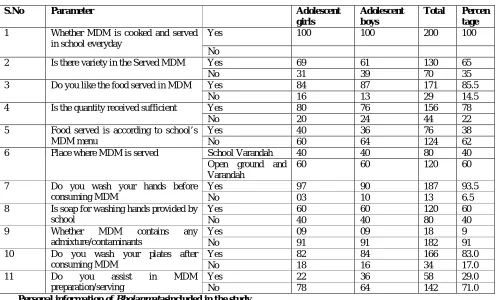
day meal was insufficient. In the present study majority (62%) ofthe respondents reported that served MDM varied from the school’s pre-decided MDM menu however, 38 per cent of the respondents agreed that MDM was served according to pre-decided menu.
During the study it was also observed that almost all children brought their own plates from home for consuming the served MDM. the adolescent respondents cleaned their plates themselves with plain water after consuming MDM. Forty per cent of the adolescent respondents reported that they sat on the school verandah floor for consuming the served MDM and 60 per cent reported that they consumed MDM sitting either in school verandah or in open ground. Thus in the present study it was observed that hygiene aspect was lacking in the serving of MDM.In one of the studies conducted in Bihar in maximum schools plates were not available in sufficient number 8. Majority (93.5%) per cent of the adolescent respondents washed their hands in school before consuming MDM and 6.50 per cent adolescent respondents reported that they did not wash their hands before consuming MDM. Sixty per cent of the adolescent respondents reported that soap for washing hand was provided by school however, 40 per cent reported that soap for washing hand was not provided by school and therefore many respondents washed hands only with plain water.In one study conducted in Raipur, Chhasttighar all children in the surveyed schools wash their hands before and after meals only with water9 (Kumar et al, 2014). Though majority (91%) of the adolescent respondents reported that the served MDM did not contain any kind of admixture or contaminant 9.0 per cent of the adolescent respondents reported that served MDM did contain some admixture or contaminant like small stones, small brick pieces and pieces of straw. After consuming MDM majority (83.0%0 of the children washed their plates themselves. In the study 29.0 per cent of the adolescent respondents reported that they did helped in the preparation or serving of MDM. They assisted in cleaning the serving area, carrying the ration to school, making arrangements for cooking water and in arranging the seating mats.
Information on the functioning of the Mid Day Meal programme was also collected from the
Bhojanmatas. Total eleven Bhojanmatas were included in the study.Questionnare cum interview method was used for collection information on the functioning of MDM (Table 2). The Bhojanmatas
IJSRR, 8(3) July. – Sep., 2019 Page 612
also noted that the children of most (63.63%) of the Bhojanmatasdid not study in the same school in which she worked.
Table 1 Information provided by selected adolescent boys and girls on quality, quantity and hygiene
aspects of MDM
S.No Parameter Adolescent
girls
Adolescent boys
Total Percen tage
1 Whether MDM is cooked and served
in school everyday
Yes 100 100 200 100
No
2 Is there variety in the Served MDM Yes 69 61 130 65
No 31 39 70 35
3 Do you like the food served in MDM Yes 84 87 171 85.5
No 16 13 29 14.5
4 Is the quantity received sufficient Yes 80 76 156 78
No 20 24 44 22
5 Food served is according to school’s
MDM menu
Yes 40 36 76 38
No 60 64 124 62
6 Place where MDM is served School Varandah 40 40 80 40
Open ground and Varandah
60 60 120 60
7 Do you wash your hands before
consuming MDM
Yes 97 90 187 93.5
No 03 10 13 6.5
8 Is soap for washing hands provided by
school
Yes 60 60 120 60
No 40 40 80 40
9 Whether MDM contains any
admixture/contaminants
Yes 09 09 18 9
No 91 91 182 91
10 Do you wash your plates after
consuming MDM
Yes 82 84 166 83.0
No 18 16 34 17.0
11 Do you assist in MDM
preparation/serving
Yes 22 36 58 29.0
No 78 64 142 71.0
Personal information of Bhojanmatasincluded in the study
Table 2- Personal information of Bhojanmatasincluded in the study
S no Parameter Number Percentage
1 Educational level of
Bhojanmatas
Illiterate 3 27.27
Primary 6 54.54
Middle School 2 18.18
2 Years of work experience 4-6 years 6 54.54
6-10 years 5 45.45
3 Do your children study in same
school
Yes 4 36.36
No 7 63.63
.
Information obtained from Bhojanmatason arrangements and functioning of MDM
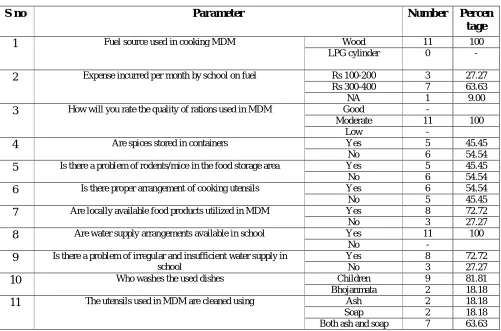
Information was obtained from Bhojanmatas regarding the arrangements and functioning of MDM (Table 3). In the study it was found that in all the selected village schools of Ramghar block wood was used as fuel for cooking the MDM. The Bhojanmatas themselves made arrangements for fuel wood from the forest. It was reported by the Bhojanmatas that she was paid by the school for arranging the fuel wood. Majority (63.63%) received 300 to 400 rupees and 27.27 per cent
IJSRR, 8(3) July. – Sep., 2019 Page 613 Bhojanmatas was not responsible for making arrangement of fuel wood. Mostly the fuel wood was collected from the village local forest. The Bhojanmatas reported that it was a labourious and time consuming task. Most Bhojanmatas participating in the study rated the quality of ration used in MDM as moderate.
In the present study it was also observed that each school selected in the study had an additional store room adjoining the kitchen for the storage of ration and other supplies, however store room in all the schools included in the study was not used. The reason for this practice was that since the kitchen and store were separately located not adjoining the main school building therefore for safety reasons the ration was stored in a room within the main school building.A study conducted in Raipur, Chhattisgharalso reported that food grains were stored in separate room within the school premises9. It was also found that in majority (54.54%) of the schools the spices were not stored in proper containers and they remained open in the same package in which they were purchased. In 45.45 per cent school kitchen’s the spices were stored in separate containers. The problem of rodents and mice was found in 45.45 per cent school kitchen and store rooms. Majority (54.54%) of theBhojanmatas participating in the study did not report any problem of any problem of mice in school kitchen or store room. Thus in the present study it was found that proper hygiene parameters in storage of rations and other edibles was not being maintained in almost 45 per cent of the schools. With reference to cooking utensils used in MDM it was found that in majority (54.54%) of the schools there was proper arrangement of cooking utensils. However in 45.45 per cent schools either the utensils were too big in relation to the number of children enrolled or too small. In majority of the schools locally available food products were used in MDM. However, in 27.27 per cent schools locally available food products were not used in MDM. The commonly used locally available food products were black soyabean(Bhatt) and potatoes
In all the schools selected in the study there was the arrangement of tap water supply through pipelines. However the problem of insufficient and irregular water supply was reported in 72.72 percent schools. Therefore on many occasions there was no water available for cooking the MDM. In such instances the Bhojanmatas had to fetch water from elsewhere such as local natural sources, community hand pumps and from nearby houses. In 18.18 per cent of the schools ash was being used by the BhojanMatas to clean utensils. Further in the study it was found that some quantity of food remained as left over in majority (63.63%) of the schools. On such instances the leftover food was served to children of senior classes and also by the Bhojanmatas. Majority (81.81%) of the
IJSRR, 8(3) July. – Sep., 2019 Page 614 Table 3- Information obtained from Bhojanmatason arrangements and functioning of MDM
S no Parameter Number Percen
tage
1 Fuel source used in cooking MDM Wood 11 100
LPG cylinder 0 -
2 Expense incurred per month by school on fuel Rs 100-200 3 27.27
Rs 300-400 7 63.63
NA 1 9.00
3 How will you rate the quality of rations used in MDM Good -
Moderate 11 100
Low -
4 Are spices stored in containers Yes 5 45.45
No 6 54.54
5 Is there a problem of rodents/mice in the food storage area Yes 5 45.45
No 6 54.54
6 Is there proper arrangement of cooking utensils Yes 6 54.54
No 5 45.45
7 Are locally available food products utilized in MDM Yes 8 72.72
No 3 27.27
8 Are water supply arrangements available in school Yes 11 100
No -
9 Is there a problem of irregular and insufficient water supply in school
Yes 8 72.72
No 3 27.27
10 Who washes the used dishes Children 9 81.81
Bhojanmata 2 18.18
11 The utensils used in MDM are cleaned using Ash 2 18.18
Soap 2 18.18
Both ash and soap 7 63.63
In the present study information was also collected from the Bhojanmatas regarding the monitoring of the functioning of MDM programme (Table 4). Majority (63.63%) of the Bhojanmatas
reported that the teacher incharge was not present when MDM was served. However, 36.36 per cent
Bhojanmatas reported that the teacher incharge remained present during MDM service. Majority (81.81%) of the Bhojanmatas reported that the teacher inchargewere satisfied with their working. In the present study 63.63 per cent of the Bhojanmatas reported that their schools were not physically inspected by concerned higher officials with regarding the functioning of MDM and 36.36 per cent
IJSRR, 8(3) July. – Sep., 2019 Page 615 Table 4- Opinion of Bhojanmatas on the monitoring of MDM
S no Parameter Number Percentage
1 Teacher incharge is present when
MDM is served
Yes 4 36.36
No 7 63.63
2 Strict observation of MDM is
kept by the incharge teacher
Yes 6 54.54
No 5 45.45
3 Is the teacher incharge satisfied
with your working
Yes 9 81.81
No 2 18.18
4 Is the school inspected for MDM
functioning by concerned
officers
Yes 4 36.36
No 7 63.63
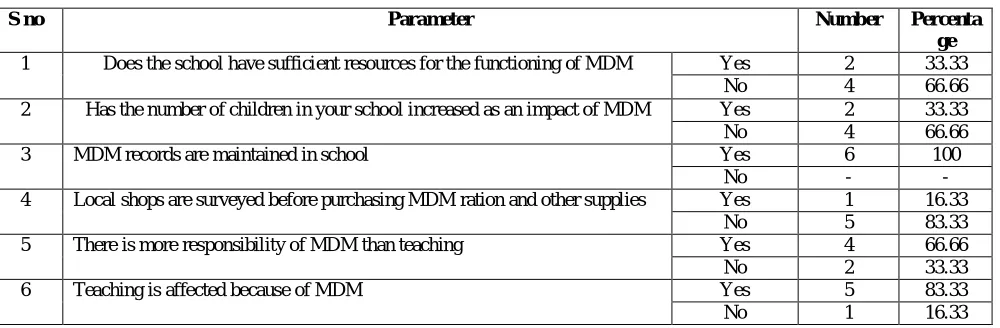
In the present study the opinion six teachers incharge of MDM programme from the selected village schools was also collected with respect to the various aspects of the programme (Table 5). Majority (66.66%) of the teachers reported that their school did not have sufficient resources for the functioning of MDM programme, 33.33 per cent teachers reported that they had sufficient resources. In the opinion of majority (66.66%) of the teachers thenumber of children in their school did not increased as an impact of MDM. In one of the studies across schools of Chandighar and Panchkula it was reported that the scheme did improve the attendance of students in school but it still could not make up increased enrollment and retention of students 10. MDM Programme records are maintained in all the schools surveyed. A large majority (83.33%) of the teachers also reported that local shops were not surveyed before purchasing MDM ration or other supplies. In one of the studies conducted in rural Vadodara results revealed that the MDMP in ≤50 of the schools adhered to NSPE 2006
IJSRR, 8(3) July. – Sep., 2019 Page 616 Table 5 Opinion of Incharge Teachers on the functioning of MDM
S no Parameter Number Percenta
ge
1 Does the school have sufficient resources for the functioning of MDM Yes 2 33.33
No 4 66.66
2 Has the number of children in your school increased as an impact of MDM Yes 2 33.33
No 4 66.66
3 MDM records are maintained in school Yes 6 100
No - -
4 Local shops are surveyed before purchasing MDM ration and other supplies Yes 1 16.33
No 5 83.33
5 There is more responsibility of MDM than teaching Yes 4 66.66
No 2 33.33
6 Teaching is affected because of MDM Yes 5 83.33
No 1 16.33
CONCLUSION
In the present study the responses and opinion of 200 adolescent children, eleven
BhojanMatas and six teachers (incharge of MDM) was collected. Results of the study showed that MDM was regularly cooked and served hot in the selected rural schools of Ramghar block. Majority (85.5%) of the selected adolescent respondents liked the food served in MDM and most (78%) of them were also satisfied with its quantity. Thirty five per cent of the adolescent respondents were of the opinion that the served MDM lacked variety. According to majority (62%) of the adolescent respondents MDM was not served according to the schools Pre-decided menu. It is also note worthy that majority of the adolescent respondents consumed MDM sitting on school verandah floors or in open grounds in all the selected schools and brought their own plates for consuming MDM.
As a good hygiene practice 93.5 per cent of theadolescent respondents washed their hands before eating the served MDM and sixty per cent of the adolescent respondents reported that soap for washing hands was provided by school. However 40 per cent of the adolescent respondents washed their hands with plain water as soap was not available in school. As reported by majority of theadolescent respondents the served MDM did not contain any admixture. Another 29 per cent of the adolescent respondents reported that they assisted in various chores related to the preparation of MDM.
With regard to the functioning and arrangements of MDM it was reported by all the
IJSRR, 8(3) July. – Sep., 2019 Page 617
seen in the study that the only two locally available foods could find place in the MDM. However, since the region has rich vegetation and a variety of vegetables and fruits grow in the region, it is suggested vegetables (especially seasonal green leafy vegetables) and fruits be included in the MDM. This would also help enhance variety in MDM. A problem of irregular and scanty water supply was reported by majority of the BhojanMatas. On the monitoring of MDM majority of the BhojanMatas
reported that the teacher incharge was not present when MDM was served. However, in the opinion of 54.54 per cent BhojanMatas strict observation of MDM was kept by 54.54 per cent of the incharge teachers. Majority ((63.63%) of the BhojanMatas reported that since their school was distantly located it was not inspected for the functioning of MDM by higher concerned officers. Most of the teachers included in the study reported that their school did not have sufficient resources for the functioning of MDM programme and in their opinion the programme had no impact in increasing the number of children in school. Majority of the teachers included considered MDM as a bigger responsibility than teaching and also that it adversely affected teaching.The study concludes that in most of the schools included in the study there was regularity in the served MDM and it did not contain any admixture. Records were well maintained. Lack of variety, insufficient water supply, lack of proper cooking utensils, lack of hygiene in food storage, non availability of LPG as fuel, and poor monitoring are some of the problems which need immediate attention. The study suggests a lot more effort is needed to improve the functioning of the programme in the region.
REFERENCES
1. Garg M, Mandal K S, Mid- Day Meal for the poor, Privatised Education for the Non poor, Economic and Political Weekly, 2013;48 (30): 155
2. Mhrd.govt.in, School education, Mid day meal scheme 2018
3. www.unicef.org, (2005), The State of the World’s Children, Childhood under threat. Available from https://www.unicef.org/ publication /index-24432html
4. Pal A, Pari AK, Sinha A and Dhara PC, Prevalence of undernutrition and associated factors: A cross-sectional study among rural adolescents in West Bengal, India, 2017
5. Sardesai M V, 2nd edition, Introduction to clinical nutrition, , Marcel Dekker Inc, New York, 2003.
6. Mengistu K, Alemu K, Destw B, Prevalence of malnutrition and associated factors among children aged 6-59 months at HidabuAbotedistric, North Shewa, Oramia region state, Journal of NutrDisordTher, 2013 T1:001
IJSRR, 8(3) July. – Sep., 2019 Page 618
8. ACVIDA nidan (2014), Assessment of Mid- Day Meal Scheme in PLAN intervention districts of Bihar, Alliance to Covert Vision in Developmental Action nidan.in/wp-content/uploads 2014/07
9. Kumar R, Atray R, Rudra N Study of the Impact of Mid- Day Meal Programme on school enrolment and retention, Final Report SCERT, Raipur Chattisghar, Mott MacDonald 2014 10.Rana S S, An Evaluative study of Mid- Day Meal programme in Chandigarh and Panchkula,
Scholarly research Journal for Interdisciplinary studies, 2014; II(XII): 1508-1512