939 IJSTR©2019
www.ijstr.org
Thermal Image Segmentation Based On
Differential Evolution
Sanjeev Kumar Tomar, Santar Pal Singh, Akhtar Husain, Charul Rajpal, Krishna Tomar
Abstract—Image segmentation is an important study in pattern recognition. The objective of segmentation techniques is to split the image into segments which are easier to understand and analyze. There are various methods available for the image segmentation among them thresholding is simplest method. Thresholding function is used to covert a gray-scale image into its equivalent binary image. In this paper, Thermal images are taken for processing. Thermal Imaging is a technique used for viewing the objects in dark, foggy and smoky environment. Otsu method is used for thresholding which is automatic clustering-based method. Pixels are divided into two classes such that inter-class variance is maximum and intra-class variance is minimum. Histogram of grayscale image is generated and then attempt to find thresholds at which the image could optimally be segregated into pixels belonging to the foreground of the image vs pixels belonging to the background of the image. The differential evolution keeps generating threshold values within the range of 1 to 256 and evaluating the fitness of the threshold using Otsu criteria for the image. Using mutations and crossovers, more optimal thresholds are selected generation after generation. The segmented image is shown along with the histogram and the location of the thresholds.
Index Terms—Differential Evolution, Image Segmentation, Thresholding, Otsu method, Patter Recognition, Clustering, Pixels
—————————— ——————————
1 INTRODUCTION
Thermal Imaging is a technique of viewing an object in gloomy surroundings. Thermal Imaging use objects’ infrared radiation to detect the object and forming an image based on available information. Thermal Imaging works well even in foggy, smoky and hazy environment. The infrared power emitted by the object is called heat signature. A thermal camera must have a heat sensor which detects the differences in the temperature of radiation emitted by objects. More radiations emitted by the object means hotter it is. Radiation sensed by the heat sensor helps in generating the image based on gathered information. [1]. Image Segmentation main aim is to mark certain labels to each pixel and group pixels which are having same label. Pixel having same labels have some similarity in characteristics such as color, intensity or texture [2]. Thresholding is simple and effective method to isolate image from the background. It converts the image into binary image by specifying a black pixel for the pixel have intensity greater than a fixed constant value and white pixel for the remaining pixels having intensity than that fixed value [3]. Bi-level thresholding is used when we just need to classify object from the background but it cannot be used to specify different objects. To specify different object clearly we need multi-level thresholding. Sometimes multi-band thresholding are also used, in this specific different threshold for each of the RGB components of the image is used and then combine them with certain operations [4].
Otsu method is based on automatic clustering where number of classes and other characteristics such as mean, variance and etc. are not known in starting. Mean and variance changes according to the input given. The variance should be minimum inside the class and inter-class variance should be maximum. Otsu method is used to calculate fitness function over generations which are developed in Differential Evolution Algorithm. It is also used to plot the number of pixels present at particular intensity of grey scale image [5, 6]. Differential Evolution is used to generate generations of threshold values. Using mutation and crossover operator, more optimal threshold value is generated after each generations. The main difference between different evolutionary techniques, like genetic algorithm, is that genetic algorithm rely on the crossover function only. Differential Evolution rely on the mutation function also. Differential Evolution is popular for its capability to proficiently and flexible look at huge search space and it has two major advantages: Differential Evolution have a small number of parameters to adjust and have exposed a more rapid convergence rate compared to other evolutionary algorithms [5].
2
RELATED
WORK
In the paper [7], thermal images are taken for the detection of breast cancer. An automated approach is developed to detect the breast region in the given approach. Canny edge detector algorithm is used to detect the breast boundary and Hough transform is used to detect the region that is not the part of the body and then density of extra region is detected that is not the part of the body. In the paper [8], Zhang Jin-Yu and Chen Yan has proposed a new algorithm for image segmentation based on chaos- genetic algorithm for thermal images. They discussed the drawbacks of two dimensional classes square error approach and overcome these drawback such as computational cost and area into consideration using their proposed algorithm which is more effective and efficient. ————————————————
Sanjeev Kumar Tomar, Assistant Professor, Dept. of Comp. Sc.& Engg., ASET, Amity University Noida ( India)
Santar Pal Singh, Associate Professor, School of Comp. Sc.& Engg., Galgotias University Greater Noida (India) E-mail: [email protected]
Akhtar Husain, Associate Professor, Dept. of Comp. Sc.& IT,FET, MJP Rohilkhand University Bareilly( India)
Charul Rajpal, PG Student, Dept. of Comp. Sc.& Engg., ASET, Amity University Noida ( India)
Krishna Tomar, Lecturer, Dept. of Electronics Engineering, MMIT Hathras ( India)
Here [9], thermal images are used to detect cancer tissues as it emits different radiation than healthy ones. Two techniques are modeled fuzzy c-mean and k-mean for segmentation and the results of both techniques are compared. Out of these two techniques, fuzzy c-mean gives better results on Infrared image. In last it also explain the sensitivity of camera effects the number of cluster formation in both the techniques. In the paper [10], Author detects the Rheumatoid arthritis disease using Thermal Images as there is difference in heat radiation in abnormal and normal region. He used skin temperature measurement and heat distribution for the analysis of disease. Ones the abnormal region is detected then it is segmented using the Expectation Maximization and fuzzy c-mean algorithm. Results of both the algorithm are being compared and result goes in Fuzzy c-mean favour as it gives better result. Erik Cuevas and Daniel Zaldívar [11] represent an image segmentation method using Differential Evolution. First the image was segmented using multi-level Thresholding, one-dimensional histogram is formed form the image using Gaussian Functions. For determining the parameters of Gaussian Function, Differential Evolution Algorithm is being used. Experiment also shows that algorithm chose threshold value automatically. In the paper [12], Mutli-level Thresholding is represented using 2-D histogram. Mutli-level Thresholding is used so that each object is specified clearly. Maximum Tsallis entropy is used to represent information of 2-D histogram. For improving computational efficiency differential evolution algorithm is being used. The results of Differential Evolution is compared with particle swam optimization, genetic algorithm and artificial bee-colony. Soham Sarkar and GyanaRanjan Patra[13] uses Image Entropy to define multi-level thresholding. Here differential evolution is used for optimizing computational cost and results are being compared with particle swam-optimization and genetic algorithm. Further Universal Image Quality Index and Structural Similarity Index Measurements are used performance evaluation. In this Paper [14], author proposed a fresh algorithm for image thresholding using Differential Evolution technique. Here image is segmented into multiple parts and each part is thresholded using different threshold values. Differential Evolution is applied on all the threshold values to obtain the optimum threshold value and then threshold the image using that optimum value. Result of proposed approach is compared with Kittler Algorithm. Sushil Kumar [15] has embedded differential evolution algorithm with otsu method to find the threshold of the image optimally. In this paper, he uses the difference in class variance property of otsu method which for used for automatic clustering the pixels of similar intensity and differential evolution for generating optimal threshold value in each generation. He has taken digital images for the experiment. Here in [16] author discussed the drawback of otsu method which works well when signal to noise ratio is high. This method don’t provide ideal result under low signal to noise ratio so to improve that preprocessing is done with differential evolution algorithm which shows great result in noisy environment as well. So a comparative study has been shown here in cluster variance otsu method with the differential evolution
3 DIFFERENTIAL
EVOLUTION
ALGORITHM
The Differential Evolution is population based algorithm which is simple and direct searching algorithm for obtaining global optimization for multi-modal functions. It uses crossover and mutation operators for selecting best candidate in the given population. First randomly three members are chosen from the given population. Calculate the weighted difference of the two chosen member and add it to the third chosen member place. This step is known as mutation. Then in crossover step chose crossover probability value and check the crossover value of the generated member. If the generated member have greater fitness value as compare to the previously chosen population then new member is added into population and replace the old value else old value is returned to the population. Let the population size is of S Candidate. Consider Ai as parent candidate at index i (range from 0 to S) . Each Candidate present in population have D parameters and Ai(j) represents jth parameter of Ai candidate. Ax, Ay, Az are three parent candidates chosen randomly. Difference Vector is (Ay– Az). W is a weight that multiple to the difference of two chosen population place. Ideal values: [0.5, 1.0]. CR is the probability of crossover taking place. Range: [0, 1]. Az` is a mutant vector obtained through adding third chosen candidate place to the above calculated weighted difference. Trial vector At is the child of the Ai and Az`.
1. Perform following steps for each candidate in the population.
for (int i = 0; i<S; ++i)
2. Choose three parents at random Ax, Ay and Az.(they must differ from each other and i)
do {
x = random.nextInt(S); } while (x == i) do
{
y = random.nextInt(S); } while (y == i || y == x); do
{
z = random.nextInt(S);
} while (z == i || z == y || z == x);
3. Mutation :
Az` = Az + W * (Ay - Ax)
4. Crossover : Uniform crossover is applied for D
parameters
int R = random.nextInt(D); for (int j=0; j < D; ++j) {
float probability = random.nextFloat(); if (probability < CR || j == R)
At[j] = Az`[j] else
941 IJSTR©2019
generated member At and the initially present member Ai. Member with higher fitness function value is added to the new population and other one is rejected.
3.1 Choice of Threshold Value based on Differential Evolution and OTSU Method
For a regular image, conventional OTSU presents suitable image division. Threshold value selection is the major concern in thresholding image segmentation. The key proposal of OTSU methodology is to facilitate the image pixels into two groups 1C and 0C with respect to the threshold value t . 0C is category which contain pixels having value whose range is from 0 to t. 1C is category which contain pixels having value whose range is from t+1 to N-1(where Nis the number of level in gray scale image). The OTSU class variance value between 1C and 0C is calculated by
( 2 ) 2
0 1 0 1
( )t p ( )t p ( ) (t v ( )t v ( ) )t
Where p0(t)and p1(t)are probabilities of class 0 C and 1 C that are separated by threshold value t ; v0(t)and v1(t) represent the mean values of the pixels that exists in classes 0C and 1C .Threshold t can take values from 0 to N-1. The basis of the OTSU technique is to find out the value of variance. Let T is the most favorable threshold value, b0 and b1 are the values of the background and target pixels of a image. The output of the image thresholding technique is
The conventional OTSU method is not able to give perfect segmentation outcome if an image have low signal-to-noise ratio. Due to this drawback, this paper represents the latest technique that obtain ideal image segmentation in low signal-to-noise ration as well. Since the threshold selection using OTSU method is used for quick optimization and using Differential Evolution to enhance efficiency.
3.1.1 Image Pre-processing
Here, we are using gray scale image consist of 256 levels along with Gaussian noise. Even though the gray thresh function of the Matlab gives the finest value of threshold, the display of segmentation was not clear. Due to the intrusion of noise in an image, the noise shows as target in the outcome of segmentation. Characteristic of noise are taken into consideration, the pixel f(x, y) is treated upon following conditions:(1)In case, the mean value of the neighboring pixels was lesser than the pixel value f(x, y), then pixel f(x, y) would be considered as noisy point, in this case background value of the pixel will be assigned to noisy point;(2),Else perform nothing. As value of background is much lesser than the value of noise in the image in this testing, the value of pixel f(x, y) is being estimated with respect to the outcome of the summation value of all its vicinity pixels and their size.
3.1.2 Calculation of fitness function
The threshold of an image can take values from 0to 255 as it is of 256 level. Since the image have been pre-processed reducing the noise as possible and then Differential Evolution is applied, the choice of vectors value from population is in between the interval [0, 1].There are two classes 0 C and 1 C which are contains the pixel of image and the background .The fitness function is
2
0 1 0 1
( ) ( ) ( ) ( ( ( ) ( ) )
c o s i t p t p t v t v t
here t is the value of vector which are chosen in between the interval [0,1];Where p0(t)and p1(t)are probabilities of class 0 C and 1 C that are separated by threshold value t ; v0(t)and v1(t) are the mean valuesof pixels that belong to classes 0C and 1C .
3.1.3 The selection of differential evolution operators Differential Evolution uses crossover and mutation operators for selecting best candidate in the given population. First randomly three members are chosen from the given population. Calculate the weighted difference of the two chosen member and add it to the third chosen member place. This step is known as mutation. Then in crossover step chose crossover probability value and check the crossover value of the generated member. If the generated member have greater fitness value as compare to the previously chosen population then new member is added into population and replace the old value else old value is returned to the population.
4 SIMULATION
AND
RESULT
ANALYSIS
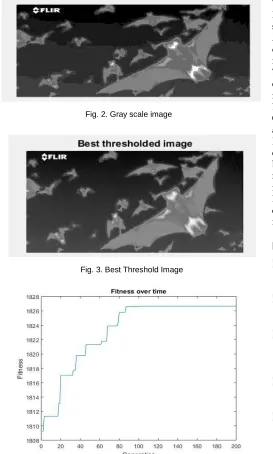
An execution of the popular Differential Evolution Computational Intelligence algorithm expressed by Storn and Price. This algorithm uses the Otsu criterion as the fitness function and can be used to threshold grayscale images using multiple thresholds. The solution you get is near-optimal, just as every computational intelligence algorithm is meant to work. More detailed explanation: The program is designed to generate a 0 to 255 level histogram of any grayscale image and then attempt to find thresholds at which the image could optimally be segregated into pixels belonging to the foreground of the image vs pixels belonging to the background of the image. This evaluation of the best threshold is done using the Otsu criterion, and the Otsu fitness of the threshold is returned as a "between class variance". The higher the value, the better the fitness. The differential evolution keeps generating threshold values within the range of 1 to 256 and evaluating the fitness of the threshold for the image. Using mutations and crossovers, more optimal thresholds are selected generation after generation. The user can choose to run multiple trials and the best thresholds among those trials are selected and the segmented image is shown along with the histogram and the location of the thresholds. Here figure 1 has undergone segmentation process and we obtain figure 3 as best thresholded image with fitness function value equals to 1826.6 with thresholds 26, 44, 63, 82, 107, 130, 164 and 210.
2
0 1 0 1
0 ,
,
1, ( ) ( ) ( ( ) ( ) ) ,
b f x y T
f x y
b p t p t v t v t f x y T
Figure 2 is gray scale image equivalent of image of figure 1. The fitness values in different generations are shown in figure 4. The figure 5 represents the number of pixels at particular intensity.
5
CONCLUSION
In this paper, Differential Evolution has been used for image segmentation and to obtain the best suited thresholds value.. As image segmentation problems can be converted in optimization problems, Differential Evolution is being used in resolution of complex concerns and provides desirable results. The use of two steps i.e.pre-processing along with differential evolution algorithm in the research gives further contented results of segmentation. Choice of fitness function in Differential Evolution is a major task and for that purpose Otsu’s method has been used. Variance between the class 0 C and 1 C should be maximum and within the class is minimum. In the future, work would be combination of differential evolution algorithm and the 2-Dimenstional maximum between cluster variance technique that can be applied to the noisy images. The grouping of the Two Dimenstional maximum between cluster variance method and Differential Evolution Algorithm provides faster convergence rate and could achieve huge progress in the quality and speed of image segmentation technique.
R
EFERENCES[1] WhatIs.com. What is thermal imaging? - Definition from WhatIs.com.[online]Availableat:https://whatis.techtarget. com/definition/thermal-imaging [Accessed 13 Feb. 2019]. [2] En.wikipedia.org. Image segmentation. [online] Available at: https://en.wikipedia.org/wiki/Image_segmentation [Accessed 15 Feb. 2019].
[3] En.wikipedia.org. Thresholding (image processing).
[online] Available at:
https://en.wikipedia.org/wiki/Thresholding_(image_pr ocessing) [Accessed 17 Feb. 2019].
[4] Anon, [online] Available at:
http://shodhganga.inflibnet.ac.in/bitstream/10603/1883 24/14/14_chapter4.pdf [Accessed 15 Feb. 2019].
[5] D. Karaboga and B. Basturk, ―Image segmentation based on differential evolution algorithm,‖ Proc. IEEE 13th Signal Processing and Communications Applications Conference, Turkey, 2005..
Fig. 1. Thermal image
Fig. 2. Gray scale image
Fig. 3. Best Threshold Image
943 IJSTR©2019
[6] En.wikipedia.org. Otsu's method. [online] Available at: https://en.wikipedia.org/wiki/Otsu%27s_method [Accessed 18 Feb. 2019].
[7] N. Scales, C. Kerry, and M. Prize, ― Automated image segmentation for breast analysis using infrared images,‖ Proc. 26th Annual International Conference of the IEEE in Engineering in Medicine and Biology Society,IEMBS'04.,vol. 1, pp. 1737-1740, 2004.
[8] Z.Jin-Yu, C. Yan, and H. Xian-Xiang, ―IR thermal image segmentation based on enhanced genetic algorithms and two-dimensional classes square error,‖ Proc. Second International Conference on Information and Computing Science, ICIC'09, vol. 2, pp. 309-31, 2009.
[9] M. Etehad Tavakol, S. Sadri, S., and E. Y. K. Ng, ―Application of K-and fuzzy c-means for color segmentation of thermal infrared breast images,‖ Journal of medical systems, vol. 34, no.1, pp.35-42, 2010.
[10]U. Snekhalatha, M. Anburajan, T. Teena, B. Venkatraman, M., Menaka, and B. Raj, ―Thermal image analysis and segmentation of hand in evaluation of rheumatoid arthritis,‖ Proc. International Conference on Computer Communication and Informatics (ICCCI), pp. 1-6,2012. [11]E, Cuevas, D. Zaldívar, and M. Perez-Cisneros, ―Image
segmentation based on differential evolution optimization,‖ Applications of evolutionary computation in image processing and pattern recognition, pp. 9-22, 2016.
[12]S. Sarkar, S. Das, ―Multilevel image thresholding based on 2D histogram and maximum Tsallis entropy—a differential evolution approach,‖ IEEE Transactions on Image Processing, vol 22, no.12, pp.4788-4797, 2013. [13]S. Sarkar, G. R. Patra, G. R., and S. Das, ― A differential
evolution based approach for multilevel image segmentation using minimum cross entropy thresholding,‖ Proc. International Conference on Swarm, Evolutionary, and Memetic Computing ,pp. 51-58,2011. [14]S. Rahnamayan, H.R. Tizhoosh, and N.M. Salama,
―Image Thresholding Using Differential Evolution,‖ Proc. International Conference on Image Processing, Computer Vision, & Pattern Recognition.IPCV06, pp. 244-249, 2006.
[15]S. Kumar, M. Pant, and A.K. Ray, ―Differential evolution embedded Otsu's method for optimized image thresholding,‖ Proc. World Congress on Information and Communication Technologies, pp. 325-329, 2011.