Fingerprint Image Segmentation Using
Hierarchical Technique
Wan Aezwani Wan Abu
Bakar,
Ghazali Sulong Department of Graphics& Multimedia Faculty of Computer Science&
Information SystemUniversiti Teknologi Malaysia 81310 UTM Skudai
Johor.
[email protected], [email protected]
Keywords: Fingerprint. image segmentation. hierarchical, region growing. region ofinterest. recognition. biometric
ABSTRACT
Fingerprints are the ridge and furrow patterns on the tip or the finger and its verification is an important biometric technique (or personal identification. The quality or the fingerprint image is the most significant (actor in a reliable matching process. Thus, any pre-processing algorithm should aim to enhance the quality of the existing features without creating false features [I). This scenario brings the idea or the research. The research rocus on the segmentation approach. The purpose of the study is to identify a segmentation approach of fingerprint image by considering several approaches namely Hierarchical technique and Region growing by pixel aggregation technique. The process isvital when to apply next pre-processing stages i.e. thinning, identifying between true and false minutiae and minutiae extraction process. The research is supported by 50 samples or data that is collected through an available fingerprint device.
1.0 INTRODUCTION
The beginning of the fingerprint is not known. But for certain, there are defmite periods in its history. The ftrst period started when human beings become aware of ftngerprint that such fmgerprint is used as a mean of individual
signature. The second period then started with the development of fingerprint coding and filing system and technique of searching for latent prints[I].
Starting on I960s, Federal Bureau of Investigation (FBI) and Paris Police Oeparnnent had made a big investment to support the
development of Automated Fingerprint
Identification System (AFlS) which is the system to identify the fingerprint matching. Their effort were so successful that a large number of AFIS's are currently installed and in operation at law-enforcement agencies world-wide. These systems have greatly improved the operational productivity of these agencies and reduced the cost of hiring and training human fmgerprint experts for manual fmgerprint identification. Automatic fmgerprint identification rapidly grew
beyond law enforcement into civilian
Query FP Image
...
Pre-processing
•
Feature Extraction•
Matching
r
FP database(registered
..
Manual verification
Figure1.1 :Scbematic Block Diagram olan AFIS
Currently, there are nine biometric technology [3] include fingerprint, face, h~d
geometry, hand vein, retinal pattern, I~S,
signature, voice print and also facIal
thermograms. Of the nine technology,
nevertheless not many of them are acceptable as indisputable evidence of identity i.e. ex~ensive
studies have been conducted on automatic face recognition and number of face recognition system available, yet it has not been.pro~ed ~at
face can be used reliably to estabhsh IdentIty. Moreover, although signatures also are legally acceptable biometric, they rank a ~istant seco?d to fingerprints due to the issues mvolved WIth accuracy, forgery and behavioural variability.
1.1 Biometric Overview
Any human physiological or behavioural characteristic can be used to make a personal identification as long as it satisfies following requirements [3] : Universality meanstha~ e~ery
person should have the charactensatlon; Uniqueness indicates that no two persons~o~ld
be the same in terms of charactenstlcs; Permanence means that characteristics should be invariant with time; Collectability indicates that
the characteristics can be measured
quantitatively.
Biometrics is a rapidly evolving technology that has been widely used in forensics such as criminal ide'ltification and person security and
D-12
has the potential to be widely adopted in a very broad range of civilian applications as in banking security such as electronic fund transfers, ATM security, check cashing, and credit card transaction; Physical access control such as airport access control; Information system security such as access to databases via login privileges; Government benefits distribution such as welfare disbursement programs.
1.2 Statement of the problem
Fingerprint recognition remains as one of the most prominent biometric identification methods. The quality of the fmgerprint image is the most significant factor in a reliable matching process. Any pre-processing algorithm should aim to enhance the quality of the existing features without creating false features. The main objectives of this research proposal are :
• To identify techniques involved in segmentation process that is to be applied in fingerprint images.
• To evaluate and analyse the robust segmentation techniques which is to be used in fingerprint recognition methodology.
I
(Vx(i,}J
+V,v(i,}J)
wxw V.(i,j)
CL(i,j)=
w ..
1+-
J+-whereV.(i,j)=
t
I
(G~(u,v)+G:(u,v))
w w
U=I-2~;::J-2
2.1.1 Hierarchical Technique
According to [2], using the hierarchical technique is best suited for the image orientation, thus ease of segmentation process. By dividing the two blocks i.e. 8x8 and 16x 16, the first block 8x8 is to view the micro-ridges of image whereby the second block 16x16 is to indicate the much clearer to view the macro-ridges of image. The orientation field of a fingerprint image represents the intrinsic nature of the fmgerprint image. It plays a very important role in fmgerprint image analysis. A new hierarchical algorithm, genuinely proposed by [3], a fairly smooth orientation field estimate can be obtained. After the orientation filed of an input fingerprint image is estimated, a segmentation algorithm, which is based on local certainty level of the orientation field., is used to locate the region of interest within the input fmgerprint image. The Certainty Level (CL) of the orientation field at pixel (ij) is defined as follows:
Segmentation
I
AcquisitionI
~
I
Pr...
p.~~.~e
singSea es Enhancement, Quality
Control, Orientation
..=r=
,
~
Figure 1.2 : Schematie Block diagram of fingerprint image processing
2.0 LITERATURE REVIEW
where W is the size of a local neighbourhood. For each pixel, if its certainty level of the orientation field is below a certain threshold., T, then the pixel is marked as background pixel.
2.1 Fingerprint Methodology
Image Segmentation
2.1.2 Region growingbyPixel Aggregation
Segmentation is the process to split between the background (set to 0) and the foreground (set to I) in a binary version. The process is done to indicate a clear features i.e. ridge and valley of a fingerprint image. The goal of segmentation is to pre-process the noisy fmgerprint to be enhanced by removing the noise. It extr;icts the binary version out of the enhanced fingerprint image. There are several possible methods, which have been reviewed by the author during the literature, The methods are given as follows:
Let R represent the entire image region. Segmentation is viewed as a process that partitions R into n subregion Rio R2,oo
"R..
suchthat:
i. U R;=R( ..
R"
ii. ~is connected region, i
=
1,2, ... ,niii. ~11 Rj= 0 for all i andj, i:;t:j iv. P(~)=TRUE for i= 1,2...0
peR;) is a logical predicate over the points in set R; and
0
is the null set. Condition (i) indicates that the segmentation must be completed i.e. every pixel must be in region. Condition (ii) requires that points inregion must be connected. Condition (iv) indicates that the region must be satisfied by the pixels in a segmented region for e.g. peR;) = TRUE if all pixels in R; have the same intensity. Finally condition (v) indicates that regionsR;and Rjaredifferent in the sense of predicate P.
According to [I], region growing is a procedure that pixels or subregions are grouping into larger regions. The simplest of these approaches is pixel aggregation. which start with a set of 'seed' points and from these grows regions by appending to each seed point those neighbouring pixels that have similar properties (such as gray-level, texture, colour). To illustrate, let consider in Figure 2.1 (a) where the number inside the cells represent gray-level values (0 - 255). Let the points with coordinates (3,2) be used as seeds. Using 2 starting points result in segmentation consist of at most 2 regions:
• R, associated with seed (3,2) • R2associated with seed (3.4)
The property P to be used to include a pixel in either region is that the absolute difference between level of that pixel and the gray-level of the seed be less than threshold, T. Any pixel that satisfies this property simultaneously for both seed is arbitrarily assigned to region R I. Figure 2.1 (b) shows the result obtained using T=3. [n this case, the segmentation consist of 2 regions where the points in :
• R1denotes A's
• Rz denotes B's
0 0 5 6 7
I I 5 8 7
0 I 6 7 7
2 0 7 6 6
0 I 5 6 5
Figure 2.1(I) :original
0-14
A A B B B
A A B B B
A A B B B
A A B B B
A A B B B
Figure 2.1 (b) : segmentation result usinlln absolute difference of less tblnJ between intensity le'llels
3.0 RESEARCH DESIGN
The research procedures are subjected to the follOWing methodology. At first fmgerprint image is live-scanned through a Biometric Scanner-Veridicom Passprint device and manual scanned through HP Deskscan
n.
The number of images are restricted to 50 images in TIFF (Tagged Image File Format). Secondly the noise on image is removed through Median Filtering technique 3x3 and image is then enhanced through HighBoostI and HighPassI technique. Then the gray-level histogram is plotted and quality control process is done. After that image orientation is estimated. Then the image segmentation process is undertaken. Algorithm is coded using Delphi 3.0 andrun the successfully compiled program on the domain images. The result of segmentation techniques is analysed and validated to be ease of use in the forwarding image processing stages.4.0 RESULT AND DISCUSSION
4.1 Result of Segmentation Process
By contrast, based on region growing by pixel aggregation technique, each image has to be processed through noise removal by median filtering 3x3, enhanced by HighPass1 filtering. Next QC check and segmentation processes are done, discarding the orientation process because it shows the wrong effect if the orientation process is undertaken. In this technique, the image is segmented by 3 randomly chosen threshold values Le. 59, 63,and71.The effect of segmentation process can be seen when the image is enhanced by HighPassI filtering versus HighBoostI filtering.
Block 4X4
8X8
16X 16
32X32
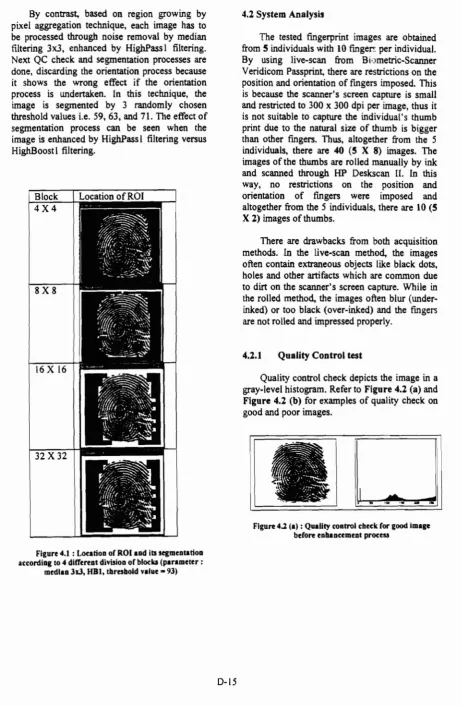
Figure 4.1 : LoeadoD of ROIaad ill segmeDtatioD accordillg to 4 differeDt divisioD of blocks (parameter:
mediaD 313, UBI, tbresbold value - 93)
4.2 System Analysis
The tested fingerprint images are obtained from5 individuals with 10 finger.: per individual. By using live-scan from Bi'Jmetric-Scanner Veridicom Passprint, there are restrictions on the position and orientation of fmgers imposed. This is because the scanner's screen capture is small and restricted to300x300 dpi per image, thus it is not suitable to capture the individual's thumb print due to the natural size of thumb is bigger than other fingers. Thus, altogether from the 5
individuals, there are 40 (5 X 8) images. The images of the thumbs are rolled manually by ink and scanned through HP Deskscan II. In this way, no restrictions on the position and orientation of fmgers were imposed and altogether from the5 individuals, there are 10 (5 X 2)images of thumbs.
There are drawbacks from both acquisition methods. In the live-scan method, the images often contain extraneous objects like black dots, holes and other artifacts which are common due to dirt on the scanner's screen capture. While in
the rolled method, the images often blur (under-inked) or too black (over-(under-inked) and the fingers are not rolled and impressed properly.
4.2.1 Quality Control test
Quality control check depicts the image in a gray-level histogram. Refer to Figure 4.2 (a) and Figure 4.2 (b) for examples of quality check on good and poor images.
Figure 4.2 (b) : QUllity control cbeck for poor imlge before enblRCemen( proem
I
I.
I
II
I
!I
When the 50 images are passed through quality control check, 84% (42 images) of fmgerprint images in the database are of reasonable quality (accepted). These 42 images are accepted mainly because the images are impressed properly which resulted in the average percentage of black and white pixel areas though there's still dirt on the scanner's screen capture. While only 16% (S images) of them are not of good quality (rejected). This is mainly due to large creases and smudges in ridges, dryness, over-inked or under-inked of the impressed fmgers. Refer to Table 4.1 to see the percentage of False Acceptance Ratio (FAR) and False Rejection Ratio (FRR).
Tlble 4.1 : FAR Ind FRR orimlges Ifter QC
Sample
I
Quality Control FAR FRRI
(%)
(%)
Accept I Reject
50 42
Is
S4 164.2.2 Orientation test
Figure 4.3 : OrieDtatioD test result
4.2.3 Segmentation test
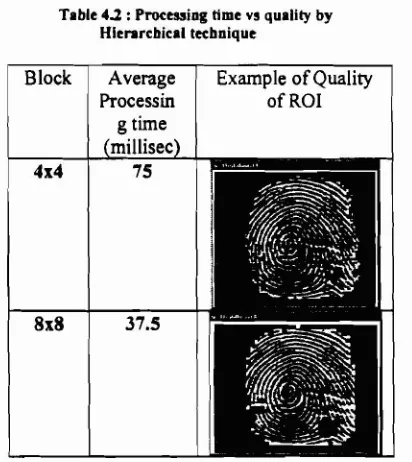
Segmentation test is covered regarding to two techniques, which have been discussed earlier. By using hierarchical technique, the region of interest is located differently based on 4 corresponding blocks as shown in Figure4.1. The result can be measured by concerning the quality verSus processing time as shown in Table 4.2. The table shows that the region of interest (ROI) segmented by blocks 4x4 and SxS are better in quality but more time is taken with 75 milliseconds for block 4x4 and 37.5 milliseconds for block 8x8. But the ROI for images by blocks 16xl6 and 32x32 are lower in quality but better in processing time with 18.75 milliseconds for block 16xl6 and 9.375 milliseconds for block 32x32. Thus, the average measure for locating ROI by this technique can be chosen on image with block 16x 16 with average in quality and processing time taken.
Tlble 4.2 : Processing time vs qUility by HlerarcbiCiI tecbnique
It is proved that only image orientation on block S X 8 is suitable for a good image such that the orientation can be displayed in a fine-grained level, while image orientation on block 16 X 16 is suitable for image with bold ridges such that the orientation can be displayed in a coarse-grained level (refer to Figure 4.3)
D-16
Block
4x4
8x8
32xJ2 9.375
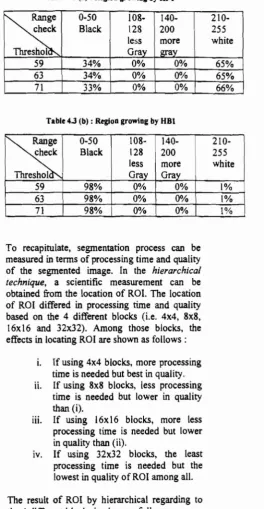
• 0-50indicates the black pixel area,
• 108-128 indicates the less gray pixel area,
• 140-200indicates more gray pixel area, • 210-255indicates white pixel area. On the other hand, by using region growing by pixel aggregation technique, the result of segmentation differed based on 3 different threshold values i.e. 59, 63 and 71. In this technique, segmentation process is tested based on 2 cases which are RG by HPI as shown in Table 4.3 (a) and RG by HB 1 as shown in Table 4.3 (b). The 4 range checks are considered as follows:
• By using block 32x32 it is most
acceptable in terms of lowest processing time and it is still acceptable in terms of quality by visuaJ representation but not in the machine processing.
• By using block 4x4, it is still acceptable in terms of processing time and it is most acceptable in terms of quality by visual representation since it displays
Table 4.3 (b) : Region growlnK by HBI
i. If using 4x4 blocks, more processing time is needed but best in quality. ii. If using 8x8 blocks, less processing
time is needed but lower in quality than(i).
iii. If using 16x 16 blocks, more less processing time is needed but lower in quaJity than (ii).
iv. If using 32x32 blocks, the least processing time is needed but the lowest in quality of ROI among all.
Table 4.3 (a) : Region growing by lIPl
The result of ROI by hierarchical regarding to the 4 different blocks is given as follows: To recapitulate, segmentation process can be measuredinterms of processing time and quality of the segmented image. In the hierarchical
technique, a scientific measurement can be obtained from the location of ROI. The location of ROI differed in processing time and quality based on the 4 different blocks (i.e. 4x4, 8x8. 16xl6 and 32x32). Among those blocks, the effectsinlocating ROI are shown as follows:
~
0-50 108- 140-210-check Black 128 200 255
less more white
Threshol Grav Gray
59 98% 0% 0% 1%
63 98% 0% 0010 1%
71 98% 0% 0% 1%
~
0-50 108- 140-210-check Black 128 200 255
less more white
Threshol Grav w:av
59 34% 0% 0% 65%
63 34% 0% 0% 65%
71 33% 0% 0% 66%
18.75
16d6
Inthe second case (i.e. RG by HB 1), Table4.3 (b) depicts that the percentage of black pixel area is 98% with I% of white pixel area if the threshold is 59. The percentage of black and white pixel areas is also the same if the threshold value is 63 and 71. This means that the segmented images are rejected because the bJack and white pixel areas are very distinct in percentage.
the most discrete ROI. But the problem is the quality if it is by machine processing such that the ROI which it displays maybe is not merely true, it is because the ridges is disjointed.
• By using block 16x16 it is more
acceptable in terms of processing time and it is still acceptable in terms of quality by visual representation as well as machine processing.
• By usingblock 8x8, it is still acceptable in terms of processing time and it is more acceptable in terms of quality by visual representation as well as machine processing.
Thus, as a conclusion for the hierarchical technique, the result of best ROI can be displayed is by using block 16x 16 and block 8x8. This is because the block 16x16 gives an average measurement in processing time while block 8x8 gives an average measurement in quality.
improve the performance in segmentation process.
Regarding segmentation by hierarchical techniques, the image has to be processed through noise removal, enhancement by HBl, orientation and then segmentation is undertaken. During the orientation, image is best be viewed by 8x8 and l6xl6 block region because the orientation line is mapped in a fine-grained way. But during the segmentation process, as opposed to the orientation stage, the region of interest of each image is best viewed by block 8x8, if the quality is going to be concerned. While the region of interest of each image is best be viewed by block 16x 16 if the processing time is going to be concerned. This segmentation technique can efficiently be applied to the next process Le. extract minutiae and thinning process of fmgerprint images.
REFERENCES
Meanwhile, in the region growing by pixel aggregation technique, the measurement of segmented image can only be obtained by predicting a threshold value on every image. This means that the threshold values will determine the quality of how good the segmented images are. Thus by predicting the threshold value, the segmented images can still be obtained but not in an efficient way. The processing time for segmentation process by this technique is not significantly different from hierarchical technique. Thus, as a conclusion, the segmentation process by region growing by pixel aggregation is unpredictable since it can be measured in a theoretically but not in scientifically. Based on experimental results, the hierarchical technique by blocks 16x 16 and 8x8 is suitable than region growing by pixel aggregation technique for fingerprint image segmentation.
5.0 CONCLUSION
Detecting bad quality images, treating the finger with proper remedies (e.g. application of moisturizer), applying the screen capture with appropriate toner and subsequent recapturing of the fmgerprint images are some of the useful strategies to improve the system performance. The result of good image acquisition will
0-18 [I]
[2]
[3]
[4]
Alobaidi, B. M. K. (1998) "Fingerprint Image Enhancement." Faculty of Computer Science & Information System. University Of Technology Malaysia (VTM) : Thesis MSc.
Azmi, Kamis. (2000) "Pengecaman Cap Jari : Peningkatan Kualiti Imej" Faculty of Computer Science & Information System, University Of Technology Malaysia (VTM) : Thesis BSc.
Jain, A. K., Hong, L., Pankanti, S., and Bolle, R. 1997. "An Identity
-Authentication System Using
Fingerprint." Proceedings of the IEEE. Vol. 85, No.9, pp. 1365 - 1388.
Kasaei, S., Deriche, M., and Boashash, B. 1997. "Fingerprint Feature Extraction Using Block-Direction On