75:2 (2013) 63–69 | www.jurnalteknologi.utm.my | eISSN 2180–3722 | ISSN 0127–9696
Jurnal
Teknologi
Full Paper
S
OFT
S
HADOWS
U
SING
S
P
-L
INE
A
PPROXIMATION
Hoshang Kolivand
*, Mohd Shahrizal Sunar
MaGIC-X Universiti Teknologi Malaysia, 81310 UTM Johor Bahru,
Johor, Malaysia
Article history
Received
31 January 2014
Received in revised form
15 August 2014
Accepted
17 September 2014
*Corresponding author
[email protected]
Graphical abstract
Abstract
Realistic soft shadows are an important factor to enhance the realism of Augmented Reality systems. Without shadows, virtual objects would look floating over the scene resulting unrealistic rendering of AR environment. Little attention has been directed towards balanced trade-off between shadow quality and computational cost. In this study, a new approach is proposed; Quadratic Sp-line Interpolation (QSI) to soften the outline of the shadow. QSI estimates the border of hard shadow samples. In more details, a reflective hemisphere is used to capture real light then to create an environment map. Implementation of the Median Cut algorithm is performed to locate the direction of real light sources on the environment map. Subsequently, the original hard shadows are retrieved and a sample of multilayer hard shadows is produced. The proposed technique is tested by using three samples of multilayer hard shadows with a varied number of light sources that are generated from the Median Cut algorithm. The experimental results show that the proposed technique has successfully produced realistic soft shadows with low computational costs.
Keywords: Component, augmented reality, shadows, soft shadows, reflective sphere
© 2015 Penerbit UTM Press. All rights reserved
1.0 INTRODUCTION
AR technology is used in various fields such as medicine, education, manufacturing, advertising, gaming and tourism. AR technology is applied in certain important areas including learning, training, entertainment, information resources and exploration. It is also used in planning strategies and solving problems in which precision is required, and high cost and risks are inevitable. In this era of globalization, AR technology plays a significant role in the development of information technology both in the present time and in future.
To achieve photorealism in AR system, integration between virtual objects with real environments must be corrected. According to Sato et al. [4], three principal aspects are identified to achieve AR system of high quality including consistency in terms of geometry, illumination and time. Being consistent in
real objects have shadows. Generally, virtual objects appear like floating things in AR environments. However, some shadow generation techniques produce soft shadows although at a high computational cost. This is due to the high usage of hardware resources at that time. Our Sp-line technique enhances the realism of soft shadows. The approach is based on a Quadratic Spline Interpolation (QSI) to soften the outline of the shadows.
2.0 LITERATURE
Research on shadows in AR environment was initiated near two decades ago. A group of researchers have conducted research on shadows in AR environment including Naemura et al. [5], Sugano
et al. [3], Gibson et al. [6], Haller et al. [7], Madsen et al. [2], Kanbara and Yokoya [8], Konttinen et al. [9], Jacobs et al. [1], Madsen and Laursen [10] , Jensen
et al. [11], [20] and Kolivand et al [17]. Considering the problems and deficiencies found in current researches, it is necessary to continue studies on creation of shadows in AR environment, with which the problems can be reduced, and the quality of shadow can be improved.
Naemura et al. [5] proposed the concept of virtual light and virtual shadows. The concept of virtual shadows in this method is divided into four types including real to virtual shadows for rigid objects, real to virtual shadow for non-rigid objects, image-based virtual to virtual shadows, and virtual to real shadows. These methods project shadows of real objects onto virtual world and vice versa. A natural merge between real and virtual worlds will be obtained, in which shading and shadows correspond between these two worlds. Sugano et al. [3] and Madsen et al. [2] have also highlighted the importance of consistent shadows in AR environment.
With regard to shadow performance, some researchers conducted in [12], [6], [10], in which the proposed approaches are designed to run in graphics hardware offering an approach to balance the performance without sacrificing the visual quality of shadows. Besides that, generating shadows using shadow maps [3], [10], [18], [25] or shadow volumes [7], [19] can be developed at low costs. Meanwhile, Haller et al. [7] proposed the use of shadow volumes which is focused more on the shadow problems in AR systems. The reality of AR world is improved with real shadows projected onto virtual objects and vice versa.
The credibility of shadow creation can also be achieved through estimation of light source position. Research related to light source position can be found in [11], [13], [8], [26]. All the studies have the same objective which is to propose a method capable of creating lighting for virtual objects in AR environments as realistically as possible like in the real world. This research is based on principles and lessons from these research undertakings, which has
produced soft shadows with regard to real light source direction.
The current work is constructed based on projection shadows. Some improvements are employed to enhance the quality of soft shadows. Regarding projection shadows, the rendering time compared to current related works is needed. Many researchers have attempted to improve the soft shadow quality in AR but not much attention has been given to rendering time. Nakano et al. [21] introduced a technique to find the resolution of the light sources maps to create perceptually-correct shadows. Yeoh
et al. [22] proposed a technique for realistic shadows in AR using a shadow segmentation approach which recovered geometrical information on multiple faded shadows.
3.0 METHODS AND MATERIALS
The detailed process of generating realistic shadows is explained in this section. A framework is created where the development process of shadows and the method of soft shadow creation are demonstrated.
3.1 Full Hardware Setup
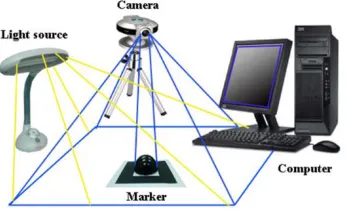
The framework used in this research is shown in Figure 1. The problems of consistency of geometric and photometric registration as described in [14] are highlighted in the implementation processes. These problems need to be resolved especially when dealing with unrealistic fake shadow generation. Then, shadows will be rendered based on estimation of light source position in the real scene and correct-perception of users’ viewpoint will be obtained. To enhance the softness of shadow samples, QSI is employed.
The main contribution of this research is to apply QSI to enhance the realism and to employ DML to reduce the rendering time for AR systems. QSI tries to convert the sharp outline of samples to a smooth outline, while DML optimizes the number of layers, resulting in a reduction of rendering time.
3.2 Implementation
light from all possible directions at some reference point using the median cut algorithm.
Figure 1 Haller’s method [7] for casting virtual shadows on real objects
Figure 2 System set-up
This algorithm produces a set of light sources [15] and estimates the light source position in the real scene from the environment map. The light sources are used to generate realistic shadows. The soft shadows using QSI is applied to obtain smooth-edge outlines of shadows so that the shadows look realistic. Finally, the 3D virtual object with the correct attached shadow is rendered in the real scene.
3.3 Light Source Tracking
Reflective sphere is a spherical object with glossy surface applied to capture light from surrounding environment. In this paper, the reflective sphere is frequently used to obtain the position of the real light source. The purpose is to generate a virtual shadow with the same direction as the shadows in the real environment. The area of the reflective sphere which appears on camera view needs to be segmented into the image for the calculation purposes. Next, the
image is segmented to the pixel coordinates (Figure 2) [8].
The reflection of light from the reflective sphere falls on the surface of the ball and bounces the light back into the surrounding environment and the camera. This means that each pixel in the segmentation of the circle represents the light reflected from the surface of the reflective sphere. In this research, both the spherical coordinates and Cartesian coordinates are used in mapping the reflective sphere. The image of the circle segment is implemented using the forward mapping method. Forward mapping is implemented through each pixel in the circle segmentation of the reflective sphere where every appropriate pixel value is mapped to the environment map [15], [11].
The Median Cut algorithm which is used in this research aims to locate the source of light in the light probe image. This algorithm converts the light probe images to a group of light sources. The median cut algorithm splits the environment map image into 2n regions based on latitude and longitude format [15]. The regions which are already split have an equal light energy stemming from a light source. The process is shown in the introduced flowchart which is illustrated in Figure 3.
Figure 3 Process of splitting
The advantages of using this algorithm include its being efficient, fast and easy to put into practice. The algorithm is immensely practical to be applied in merging the virtual object into the real scene.
3.4 Soft Shadows Generation
The soft shadow method in this research is based on the concept of Heckbert and Herf [16] optimized with a new
procedure of reconstructing samples, the silhouette of samples is approximated by QSI. This approximation progressively renders the samples smoother. The number of samples influences the quality of soft shadows. In fact, the higher the number of samples used, the higher the quality of soft shadows generated and vice versa. The shadow boundary with the constant x:
y
y
(1)Where, ε represents the error for the original y which is computed by normal distribution.
ε = N(0,1) (2)
In this technique, the center of shadow is recognized with respect to the light source. Then, the silhouette of shadow is assessed using a projection shadow technique. By spreading away many pixels around the shadow silhouette with respect to the center of the shadow and applying QSI, a new approximation of shadow is constructed. The technique is repeated for each sample to achieve high quality shadows. The technique has balanced the trade-off between quality and rendering time.
Figure 4 illustrates how approximating could omit some of the sharp pointed parts of shadows with different degree of spline interpolations. The QSI is selected due to its capability of balancing the trade-off, otherwise most of the time high degrees would be better to be used in finding the enhancement quality.
Having approximated all the new pixels with quadratic spline and extracted the shadow borders to the new approximation, a new smooth border is obtained under the following assumption:
(
)
2,
[
,
1]
i i i i ii
x
a
x
b
x
c
x
x
x
S
(3)Then,
i i i i i i i i i ii
x
x
d
x
x
y
x
x
d
d
x
S
(
)
(
)
)
(
2
)
(
1 2 11 1 (4) Where,
0
d
,
d
x
x
y
y
d
i1 0i 1 i i 1 i
i
(5)
For each (x, y) which in the shadow outline S(x) is the approximation of y to make the outline smooth, as can be seen in Figure 4. QSI changes the outline of shadow samples to become softer. The QSI is more effective when the objects are complicated. As can be seen from Figure 5, the sharp outline of shadow samples is changed to a soft outline. This technique enhances the quality of soft shadows.
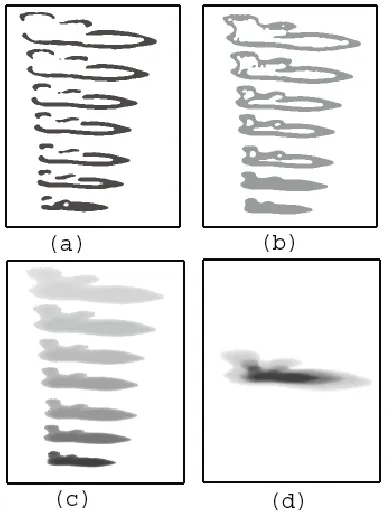
Having produced the few hard-shadow samples, the samples are blended together in different dark colors and sizes. This process is performed by stacking on each other starting from the lighter dark color and
ending with the original color of the shadow. Figure 6 shows the overlapping process of samples of hard shadows to achieve the soft enough shadows.
In producing soft shadows, this technique takes advantage of two parameters called the length and gap factors. The length factor determines the lengths of soft shadows from the original hard shadows, while the gap factor determines the distance between hard shadows in the samples. Figure 6((c) and (d)) illustrates the concept of soft shadow creation using the length and gap factors.
Figure 4 Different approximation using different degrees of interpolation
Figure 5 The QSI approximation for a part shadow boundary
In summary, the light source position is recognized by Median Cut algorithm, which can be eliminated if the light source is controlled manually. Many hard samples are constructed based on changing the location of light source. QSI covers the quality of the object to generate shadows especially during the movement of objects.
4.0 RESULTS
quality of virtual shadows with the quality of shadows of the real objects. In addition, the virtual shadow generated in this research is based on the directions of real light sources. Therefore, virtual soft shadows produced in this research have the same directions as those of the real objects.
Figure 6 The process of QSI approximation to achieve the soft shadow with a few samples
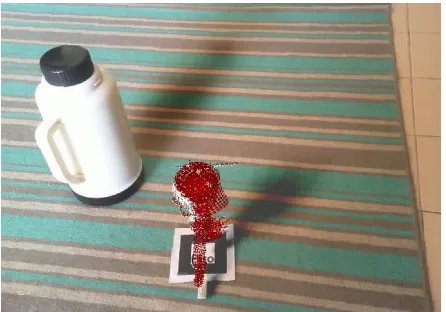
Figure 7, 8, 9 and 10 are generated using QSI technique. The result is acceptable compared to the real results. The virtual shadows produced by a virtual object are directly comparable with those of real objects.
This technique enhances the shadow quality. Nevertheless, the main shortcoming with our approach is self shadowing and casting shadows on other objects due to using projection shadows which can be solved by replacing the projection shadows with shadow maps or any other improvements on shadow maps such as Cascaded Shadow Maps [23] and Hybrid Shadow Maps [24].
5.0 CONCLUSION AND FUTURE WORK
This research has implemented soft shadows in AR environments. Compared to hard shadows, the purpose of soft shadows is to add realistic features on shadows in AR environments. This is because of the fact that hard shadows still have drawbacks such as having sharp and hard-edged outlines, which are considered to be deficient in the appearance of shadows. The creation of soft shadows is based on the real light source in which the direction of virtual
shadows is similar to the direction of real shadows in the real environments. To improve the implementation process of soft shadows, QSI technique is applied to enhance the quality.
In conclusion, this research has resulted in the creation of realistic soft shadows based on real light source direction. In future works, the techniques to generate soft shadows can be improved based on system requirements. AR in outdoor rendering environments based on real light source from the sun could be more beneficial for mixed reality environments. In addition, virtual shadows produced in AR environments correspond to those of real objects and vice versa. To be more realistic in the context of AR environments, virtual objects in this environment must be illuminated with real lighting so as to appear as real objects.
Figure 7 Soft shadows for a statue with 1762 triangles using QSI
Figure 9 Soft shadows for a tree with 256364 triangles using QSI
Figure 10 Soft shadows for a Boboboy with 373544 triangles using QSI
References
[1] Jacobs, K., C. Angus and C. Loscos. 2005. Automatic Generation of Consistent Shadows for Augmented Reality. In Proceedings Graphics Interface Conference 2005. Victoria, British Columbia, Canada. May 9-11, 2005. 113-120.
[2] Madsen, C. B., M. K. D. Sorensen and M. Vittrup. 2003. The Importance of Shadows in Augmented Reality. In Proceedings of the 6th Annual International Workshop on Presence, Presence 2003. Aalborg, Denmark. October 6-8, 2003. 21.
[3] Sugano, N., H. Kato and K. Tachibana. 2003. The Effects of Shadow Representation of Virtual Objects in Augmented Reality. In Proceedings of 2nd IEEE/ACM International Symposium on Mixed and Augmented Reality (ISMAR 2003). October 7-10, 2003. 76-83.
[4] Sato, I., Y. Sato and K. Ikeuchi. 1999. Acquiring a Radiance Distribution to Superimpose Virtual Objects onto a Real Scene. IEEE Transactions on Visualization and Computer
Graphics. 5(1): 1-12.
[5] Naemura, T., T. Nitta, A. Mimura, and H.Harashima. 2002. Virtual Shadows in Mixed Reality Environment using Flashlight-Like Devices. Trans. Virtual Reality Society of
Japan. 7(2): 227-237.
[6] Gibson, S., J. Cook, T. Howard, and R. Hubbold. 2003. Rapid Shadow Generation in Real-World Lighting
Environments. In Proceedings of Eurographics Symposium on Rendering (EGRW 2003). Belgium. June 25-26, 2003. 219-229.
[7] Haller, M., S. Drab and W. Hartmann. 2003. A Real-Time Shadow Approach for an Augmented Reality Application Using Shadow Volumes. In Proceedings of the ACM Symposium on Virtual Reality Software and Technology (VRST 2003).Osaka, Japan. October 1-3, 2003. 56-65. [8] Kanbara, M. and N. Yokoya. 2004. Real-Time Estimation of
Light Source Environment for Photorealistic Augmented Reality. In Proceedings of the 17th International Conference on Pattern Recognition. Cambridge,United Kingdom. August 23-26, 2004. 911-914.
[9] Hughes, C. E., J. Konttinen, and S. N. Pattanaik. 2004. The Future of Mixed Reality: Issues in Illumination and Shadows. In The Interservice/Industry Training, Simulation and Education Conference (I/ITSEC). 2004(1). National Training Systems Association.
[10] Madsen, C. B. and R. Laursen. 2007. A Scalable GPU-Based Approach to Shading and Shadowing for Photo-Realistic Real-Time Augmented Reality. Braz J., P-P Vasquez, J. Pereira (Eds.). In Proceedings of International Conference on Graphics Theory and Applications (GRAPP 2007). Barcelona, Spain. 252-261. Institute for Systems and Technologies of Information, Control and Communication. [11] Jensen, B. F., J. S. Laursen, J.B. Madsen, and T.W. Pedersen. 2009. Simplifying Real Time Light Source Tracking and Credible Shadow Generation for Augmented Reality. Institute for Media Technology, Aalborg University.
[12] Gibson, S. and A. Murta. 2000. Interactive Rendering with Real World Illumination, In Proceedings of 11th Eurographics Workshop on Rendering. 365-376.
[13] Yan, F. 2008. Estimation of Light Source Environment For Illumination Consistency of Augmented Reality, In Congress on Image and Signal Processing (CISP 2008). Sanya, China. May 27-30, 2008. 771-775.
[14] Kanbara, M. and N. Yokoya. 2002. Geometric and Photometric Registration for Real-Time Augmented Reality. In International Symposium on Mixed and Augmented Reality (ISMAR 2002). October 1, 2002. 279-280.
[15] Debevec, P. 2005. A Median Cut Algorithm for Light Probe Sampling. In Proceedings of International Conference and Exhibition on Computer Graphics and Interactive Techniques (SIGGRAPH 2005). Los Angeles, California. July 31-August 4, 2005.
[16] Herf, M. and P. S. Heckbert. 1996. Fast Soft Shadows. In Visual Proceedings of International Conference and Exhibition on Computer Graphics and Interactive Techniques (SIGGRAPH 1996). New Orleans, Louisiana USA. August 4-9, 1996. 145.
[17] Kolivand, H. and S. M. Sunar. 2012. Covering Photometric Properties of Outdoor Components with the Effects of Sky Color in Mixed Reality. Multimedia Tools and Applications, Under revision.
[18] Kolivand, H. and S. M. Sunar. 2013. A Survey on Volume Shadows in Computer Graphics. IETE Technical Review. 30(1): 38-46.
[19] Kolivand, H. and S .M. Sunar. 2012. An Overview on Based Real-Time Shadow Techniques in Virtual Environment.
TELKOMNIKA Indonesian Journal of Electrical Engineering.
10(1): 171-178.
[20] Carmigniani, J. et al. 2011. Augmented reality Technologies, Systems and Applications. Journal of
Multimedia Tools and Applications. 51(1): 341-377.
[21] Nakano, G., I. Kitahara and Y. Ohta. 2008. Generating Perceptually-correct Shadows for Mixed Reality. In Proceedings of the 7th IEEE/ACM International Symposium on Mixed and Augmented Reality (ISMAR 2008). Cambridge, UK. September 15018, 2008. 173-174.
Mixed and Augmented Reality (ISMAR 2009). Orlando, USA. 223-224.
[23] Dimitrov, R. 2007. Cascaded Shadow Maps, Developer Documentation, NVIDIA Corp.
[24] Kolivand H. and S. M. Sunar. 2012. Real-Time Outdoor Rendering using Hybrid Shadow Maps. In International Journal of Innovative Computing, Information and Control
(IJICIC). 8(10): 7169-7184.
[25] Ismail I. S. M. Sunar and C. S. Yusof. 2012. Exploring Dynamic Character Motion Techniques for Games Development. The International Journal of Virtual
Research. 11(1): 51-57.
[26] Alhajahmad H., F. A. A. Hashish, H. Kolivand, and S. M. Sunar. 2013. An Overview: Image Segmentation Techniques for Geometry and Color Detection in Augmented Reality Environments. Oriental Journal Of