Development and validation of a Database
Forensic Metamodel (DBFM)
Arafat Al-dhaqm1,2
*, Shukor Razak1, Siti Hajar Othman1, Asri Ngadi1, Mohammed Nazir Ahmed1, Abdulalem Ali Mohammed1
1 Department of Computer Science, Faculty of Computing, Universiti Teknologi Malaysia, Skudai, Johor,
Malaysia, 2 Department of Computer Science, Aden Community College, Aden, Yemen *[email protected]
Abstract
Database Forensics (DBF) is a widespread area of knowledge. It has many complex fea-tures and is well known amongst database investigators and practitioners. Several models and frameworks have been created specifically to allow knowledge-sharing and effective DBF activities. However, these are often narrow in focus and address specified database incident types. We have analysed 60 such models in an attempt to uncover how numerous DBF activities are really public even when the actions vary. We then generate a unified abstract view of DBF in the form of a metamodel. We identified, extracted, and proposed a common concept and reconciled concept definitions to propose a metamodel. We have applied a metamodelling process to guarantee that this metamodel is comprehensive and consistent.
Introduction
Database Forensics (DBF) is a field of digital forensic investigation that addresses database contents and their metadata [1]. It is considered a significant field by which to identify, detect, acquire, analyse, and reconstruct database incidents and reveal intruders’ activities. DBF has suffered from several issues, which has resulted in it becoming a heterogeneous, confusing and unstructured domain. Examples of these issues include a variety of database system infrastruc-tures; the multidimensional nature of database systems; and domain knowledge effectively being scattered in all directions [2,3]. A variety of database system infrastructures with multidi-mensional natures has enabled the DBF domain to address specific incidents. Therefore, each database management system (DBMS) has a specific forensic investigation model/approach. Consequently, the issues of different concepts and terminologies in terms of the forensic inves-tigation process and the scattering of domain knowledge in all directions have produced other challenges for DBF investigators and practitioners. This knowledge (such as models, processes, techniques, tools, frameworks, methods, activities, approaches, and algorithms) is neither organized nor structured. Furthermore, it is universally dispersed, such as in the Internet, books, journals, conferences, online databases, book chapters, dissertations, reports, and orga-nizations. Consequently, there is a lack of generic/standardized models by which to unify con-cepts and terminologies that may be used to reduce confusion and assist in organizing and
a1111111111 a1111111111 a1111111111 a1111111111 a1111111111 OPEN ACCESS
Citation: Al-dhaqm A, Razak S, Othman SH, Ngadi
A, Ahmed MN, Ali Mohammed A (2017) Development and validation of a Database Forensic Metamodel (DBFM). PLoS ONE 12(2): e0170793. doi:10.1371/journal.pone.0170793
Editor: Kim-Kwang Raymond Choo, University of
Texas at San Antonio, UNITED STATES
Received: August 12, 2016
Accepted: December 18, 2016
Published: February 1, 2017
Copyright:©2017 Al-dhaqm et al. This is an open access article distributed under the terms of the
Creative Commons Attribution License, which permits unrestricted use, distribution, and reproduction in any medium, provided the original author and source are credited.
Data Availability Statement: All relevant data are
within the paper and its Supporting Information files.
Funding: We acknowledge Universiti Teknologi
Malaysia and MOHE through FRGS grant no. R. J130000.7813.4F193 for support related to the proofreading service for this paper.
Competing Interests: The authors have declared
structuring domain knowledge. This study discusses the DBF domain from several perspec-tives to highlight, extract, compare, merge and derive common concepts of the domain as well as to harmonize and reconcile concepts and definitions, such as i) the Database Dimensions perspective; ii) Database Forensic Technology perspective; and iii) Database Forensic Investi-gation process perspective.
This study applies a metamodelling approach to unify existing attempts to represent DBF knowledge in a reusable form and provide a unified viewpoint of access. Metamodelling has been achieved by way of the Object Management Group (OMG) [4]. We explain our unifica-tion method by offering common concepts and reconciled definiunifica-tions that generalize most of the concepts used in existing DBF practices as described in existing models. This paper is structured as follows: In Section 2, we present some works related to this research. Section 3 provides the actual development process of our DBF metamodel based on a metamodelling approach. Section 4 presents the validation of the proposed DBF Metamodel. Section 5 pres-ents the limitations of the DBF Metamodel. Finally, we conclude this paper in Section 6 with recommendations for possible future work related to this paper.
2.0 Backgrounds and related work
Several types of modelling languages have been offered for various disciplines, including busi-ness process modelling [5]; systems engineering; and software engineering [6,7]. These lan-guages are naturally used to identify systems that can provide a better understanding for stockholders. This study targets the emergence of a modelling language to define the domain of DBF. In addition, it draws on research from the field of metamodelling [8,9] to develop a process by which to create such a language. Generally, a metamodelling process aims to gener-ate a group ofclassesto represent domain entities and define domain concepts, actions or states [10]. This concept group is called themetamodel. The language that we look for is sup-ported by themetamodel. It has the ability to generalize the domain by gathering all field/ domain concepts and dividing the field/domain issues into sub-domain issues. A more diffi-cult mission in the development of a domain description is to determine how the end user will form his/her own model with the concepts and notation from a domainlanguage. In the field of software engineering, a metamodel targets the generation of portable software actions and components. Further, it is interoperable and reusable. A metamodel also contains the descrip-tion of the particular modelling environment for a firm domain and describes the syntax and semantics of the domain. It can be viewed from the following three different perspectives: i) as a set of structuring blocks and rules used to construct and control new models; ii) as the model of a domain of interest; and iii) as an instance of another model. In our situation, a metamodel is an essential structuring block that creates statements about the possible structure of DBF models [11].
Several metamodelling frameworks have been defined by many information systems researchers, e.g., [17–24]. In this study, we follow a metamodelling framework based on the Meta Object Facility (MOF) [12] presented by OMG. Our DBF metamodel (DBFM) will com-prise a set of concepts of the DBF Language and their relationships matching with the Meta-model layer of MOF. Through the use of DBFM, it will be easier to manage multiple
product of an iterative process. Its evolution will be interleaved with the validation process of the metamodel. Any improvements resulting from the validation process (e.g., concept improvement/deletion/addition) will directly feed into the iterative process. In [15], they iden-tified a number of techniques that use external sources to validate the concepts in the metamo-del (e.g., other existing mometamo-dels or DBF descriptions). Specifically, we illustrated the
‘Comparison against other models’[16,17] using one external source to validate a part of the preliminary version of the metamodel. For the purpose of the validation in this study, we refine 18 DBF models in detail by using our metamodel and applying multiple validation techniques.
The quality of the metamodel is measured based on how well it can achieve the purpose of its development [18,19], specifically by addressing the needs of domain practitioners; increas-ing the transparency of the knowledge encoded within the domain applications; and beincreas-ing amenable to validation by experts in the domain area. Ourend users (domain practitioners)
include a database administrator, a DBF investigator and/or response managers for various public and private database organizations seeking to create a DBF model to manage expected database incidents. Database Forensics (DBF) includes all features of preparation and response to all processes of database forensic investigation, includingidentification,collection and preser-vation,analysis,and presentationactivities.
This study targets a reduction of interoperability challenges and facilitates the process of knowledge-sharing similar to [20], but in DBF. It is common that no two database incidents are precisely the same and that every database incident needs its own managing process. How-ever, the ways in which database incidents affect database integrity and business continuity are similar, and responses are often transferrable between database incidents. For example, a col-lection of volatile datais a DBF action that is applicable in various DBF situations [1]. We use a variety of models and frameworks that have been developed by many domain experts, investi-gators, or companies on the subject of DBF studies. Existing DBF models can be categorized as
requirements modelsbecause of abstract representations of an existing or a desired model in the real world (e.g., detection tampering [21], preparation and verification [22], technology tools [23], decision-making [24], response and identification [25], collection and analysis [26], and reconstruction evidence [27]). The meaning and definition of specific concept terminolo-gies and their relationships may differ from one observer to another [28]. Domain concepts can have multiple descriptions. Some concepts are observed to represent similar DBF activities that are expressed differently. For example, in a System and Method for Investigating a Data Operation Performed on a Database [23], the terminology ‘Reconstructing Database’is used to reconstruct the database events from logs and memory caches. The same activity, however, is represented using ‘Rebuilding’in the Database Application Schema Forensics Model [29]. A specific domain modelling language expressed as a metamodel can offer an alternative and bet-ter approach towards resolving this type of problem. Our approach unifies the various bet- termi-nologies used. The DBF Metamodel (DBFM) developed in this study describes all the DBF model concepts and the way they are arranged/organized, linked and constrained. It also pro-vides a flexible structure by which to facilitate the storage and retrieval of DBF knowledge. This work is extended to our works published between 2014 and 2016 [30–32].
contained or other data files may have been modified, deleted or copied from their original locations into other places. These databases may or may no longer be operational depending on the extent of the damage done. Most of the research in database forensics falls into this cate-gory.Damaged database: We refer to a modified database as a database which has not been compromised or damaged but has undergone changes due to normal business processes since the event of interest occurred. This category of databases is often of interest when a database is not directly involved in the crime being investigated but is used to store information that may assist in solving other crimes.
On the other perspective (forensic technology perspective), we were discovering from the literature review that most of the models are focusing on the technical side (specific tools, algo-rithms, methods). For example [23] have been offered specific forensic technology and foren-sic mechanisms to reveal Oracle database activities such as Log Miner, Flashback, Recycle Bin, and System Change Number (SCN), Undo log and Redo log. Also, [33] offered a forensic tool called “Log Miner” to analyse Oracle database activities. Additionally, Litchfield offered series of technical models [25,34–39] to deal with several specific incidents, cases and scenarios of Oracle database. Furthermore, several studies such as [1–3,22,24,26,27,29,40–66], discussed Database Forensic from technology perspectives. For example, methods to detect database tampering, detect covert database server, discovering who is criminal, when crime happen, what and where crime happen, protect evidence methods, acquisition methods, analysis meth-ods, forensic analysis algorithms, etc. have been offered to deal with Database Forensic. Conse-quently, no of the offered models has been covered whole Database Forensic domain. Some models deal with Oracle database forensic, and some deal with MSSQL Server forensic, where others deal with MySQL database forensic, DB2 forensic and SQLite forensic. However, they are sharing in some investigation concepts and terminologies. According to [64] research in digital forensics has led to the development of various techniques and process models. How-ever, many of these techniques are not completely transferable to database forensics due to cer-tain characteristics of databases which require them to be adapted for handling database forensics.
Finally, the Database Forensic has been discussed from investigation process perspective. Therefore, Investigation process model for Oracle database was offered by [23] to reveal mali-cious database activities. It consists of, four investigation process:Suspend database operation,
collecting data,reconstructing database,and restoring database integrity. Another model was developed by [33] to discover and analyse intruder activities in MSSQL server database. It con-sists of five investigation process namelyVerification, Evidence Collection,Timeline Creation,
Media Analysis, andData Recovery. Also, two investigation processes were extracted from the model [25], namelyIdentification,and Collection processto identify and collect the volatile and non-volatile data. Additionally, four investigation processes have been extracted from the model [22] to identify, verify, collect and analyse MSSQL server database incidents. The extracted investigation processes areInvestigation preparation,Incident verification,Artefact collection,and Artefact analysis. Also, two investigation processes extracted from the model:
Database Connection Environment and Extraction datato detect and extract malicious rela-tions amongst tables. Other three investigation process:Data Acquisition,Beginning of Investi-gation,and Financial and Business Data Analysiswere offered by [44] to detect fraud
tamper detection. Thus two investigation processes have been highlighted in this modelSetup evidence collection server and Collect Oracle file.
The framework proposed by [3] to deal with MySQL server database. Generally, it consists of three main investigation processes:Identification,Artefact collection,and Artefact analysis. Another framework has been offered by [68] to analyze database incidents. It consists of six investigation processes:Incident reporting,Examination preparation, Physical & digital exami-nation,Documentation & Presentation,Post examination,Post examination analysis. Also, seven investigation processes have been suggested by [27] to investigate database incidents namely:Determine database dimension,determining acquisition method,a collection of volatile artefacts,Collection of non-volatile artefacts,preservation and authentication of collected data,
analysis of collected data,reconstruction of the database.
Recently, several works have been offered in digital forensic. However, they are mostly focusing on cloud forensic and smartphone forensic [69–86]. They mentioned Database Forensic in an indirect way.
3.0 Metamodelling database forensics
To construct DBFM, a group of common and repeatedly used DBF concepts is first deter-mined. The concepts and their definitions of DBF are listed in the existing DBF literature. A survey of the DBF field/domain is first conducted by studying the huge amount of existing DBF models, frameworks, methods, approaches and techniques from three perspectives (60 in total). This gives us a broad knowledge of DBF actions, activities, and operations. The relation-ships are used with related common concepts. The metamodel construction development is iterative with nonstop modification of new concepts. To create the DBFM, we used the 8steps Metamodelling Creation Processadapted from [87,88], which is described below.
3.1 Preparing knowledge sources
This step involves gathering together the knowledge sources to be used. We have undertaken a meta-study to learn how to distinguish between them. This also enhances our domain aware-ness as recommended in [89] as an initial step for any metamodelling process. In total, we col-lected 60 DBF models from a variety of the following sources: journals; conference papers; organization and investigation agencies’ organization reports; online investigation-related websites; books; etc. Collecting these models was performed as follows: we focused on discov-ering categories of DBF models and ascertained that there are sufficient DBF models in the lit-erature to enable metamodelling to be a feasible path. We used the following academic collections of journals: Scopus; Web of Science; IEEE; Springer; Engineering Village and Goo-gle Scholar. For this purpose, we used the following search keywords: ‘database forensic’; ‘detect covert database’; ‘detect database tampering’; ‘analysis database forensic’; ‘database forensic artefacts’; ‘database forensic investigation’; ‘database forensic process’; and ‘database tampering’. This effort led to the discovery of 60 models, frameworks, activities, approaches, mechanisms, and case studies. With this number, we became more confident that the literature on DBF modelling is sufficiently mature to apply a metamodelling process. We categorized these 60 models according to the following three different primary perspectives: i) Database Forensic Dimensions-based (e.g., destroyed, compromised, and changed); ii) Database Foren-sic Technology-based (e.g., tools, algorithms, and methods); and iii) Database ForenForen-sic Investi-gation Process-based (e.g., Identification, Artefact collection, Artefact analysis,
Documentation and Presentation).
metamodelling process, and this includes 18 models that cover three perspectives of DBF. Another set, Set II, is used to undertake validation of the DBFM (Step 8 in the process). The sets are formed according to how broadly they cover the three perspectives of DBF. Some models cover all three perspectives, some cover 2 perspectives, while others focus on only one perspective. Some models focus on a specific DBF perspective and do not pay too much atten-tion to the boundaries of the DBF perspectives (e.g., reconstrucatten-tion events (technology-based)). If a model does not cover any DBF perspective, we exclude it from any further investi-gation. The models included in each set are shown in (Table A inS1 Appendix I).
For Set I, we require wide coverage across the concepts as our aim is to create a DBFM that can be widely applicable. Using the coverage measure alone, we quickly gain an indication of how widely applicable the sourced model is. The model is said to have a high coverage value if it can cover the entire perspective of DBF (general model), whereas a model has a lower cover-age value if it only describes a specific DBF perspective, such as forensic techniques (specific model). As supported by Kellyet al. in their discussion regarding practices for the development of domain-specific modelling, “Finding the proper generic-specific balance is a key-success factor in domain-specific modelling development. . .” ([89]pp.25). For example, the ‘SQL Server Forensic Analysis Methodology’ [22] could cover most of the DBF aspect in the model, whereas ‘Reconstruction in Database Forensic’ [64] covers only a small portion of the DBF domain. In the selection of models for Set I, we ensured that selected models can cover three (3) perspectives in DBF (Database Forensic Dimensions, Database Forensic Technology, and Database Forensic Investigation Process). The initial metamodel development requires the combination of all generic concepts existing in the domain. The combination of concepts that come from all DBF perspectives will provide generic concepts for our DBFM.
3.2 Recognize and extract general concepts
Extraction of concepts from a textual model must comply with tight conditions to avoid any missing or unrelated concepts that may cause doubt or confusion later. Therefore, the concepts should be extracted from the main body of the textual model; this means excluding the title, abstract, introduction, related works, and conclusion. The main body of the textual model explains the perspective of researchers, developers, or experts as to the main clue of this model. For example, Lee’s model “A Workflow to Support Forensic Database Analysis” [24] is a work-flow model for Database Forensics that offers six (6) processes; hence, the authors focus on the related concepts of these processes. Additionally, Fowler’s model, “SQL Server Forensic Analy-sis Methodology” [22], offered forensic methodologies that covered the Microsoft SQL Server Database and proposed four processes, namelyInvestigation preparedness; Verification inci-dent; Artefact collection; and Artefact analysis.
Therefore, authors recognize the concepts contained under these processes. With regard to the other criteria, recognized concepts must be nouns or (adjective + noun). For example,
and heuristics suitable to the selection of appropriate concepts. Finally, the last recognized cri-terion is the exclusion of specific concepts related to particular fields, such as Oracle Flashback Transaction; Oracle LogMiner; Oracle tools; SQLedit; MySQL utilities; and so on.
Therefore, in accordance with the findings of previous studies [91–93], and [88], the authors manually extracted concepts from each model (containing 18 models in total). This is a laborious process whereby every model is used to identify potential concepts that are required in this study. The mechanism that was followed to extract concepts is as follows: “read a main textual model word by word to first understand the purpose of the model and then the meaning of each paragraph”. Therefore, the concepts related to the Database Forensic domain should be highlighted and extracted. According to [90], “It is important, to begin with a very exhaustive list of concepts and gradually eliminate concepts that are irrelevant”.
Wong’s model [23] covered the Oracle database server forensic concepts to reveal malicious activities in a database. However, it is limited in scope to the discovery of the SQL injection attack. A total of 17 concepts have been extracted, namelyCapture evidence,Intruder activity,
Database server,Collected data,Database contents,Reconstructing database,Redo log,Undo log,
Audit trail,Alert log,Hashing,Examination,Backup,Transaction, Investigation Team,
Resources, and finally,Damage Database.
Fowler’s model [94] covered MSSQL Server forensic concepts which were used during the investigation process. A total of 17 concepts were extracted from Flower’s model, and these includedData acquisition,Database server,Capture,Acquired data,Transaction logs,Evidence integrity,Suspicious transaction,Evidence,Volatile data,Non-volatile data,Event,Output file,
Log file,Database files,Incident response,Trusted forensic workstation,and Timeline.
Additionally, some 16 further concepts have been identified from Leitchfield’s model [25], includingRedo log,Gathering evidence,Hashing,Examination,Forensic examiner,Suspicious activity,Volatile evidence,Non-volatile evidence,Incident,Database Server,Output file, Organi-zation,Court,Live response,Collection server, andDecision. Furthermore, 10 concepts were extracted from Olivier’s model [1]:Database contents,Examination,Backup,Investigation Team,Source,Evidence,Incident,DBMS,Court, andCapture. (Table B inS2 Appendix I) dis-plays the extracted concepts. Hence, the output of this step is 246 general concepts.
3.3 Nominate and propose common concepts
In this step, we nominate common concepts from among 246 extracted concepts based on similarity in meaning or function. Thus, authors nominate the concepts in clusters. Each clus-ter has similar concepts in meaning and function. The outcome of this process resulted in 44 clusters, as shown in (Table C inS3 Appendix I).
For example, the following are concepts that are clustered based on similar meaning: “Reconstructing database”in model [23]; “Reconstruction” in models [22], [3], [27], [95,96]; “Reconstruction event” in model [60]; and “Reconstructing” concept in model [66]. To provide another example, the “Capture” concept has been mentioned in three models [94], [97], [24], together with its synonym “Seizure” mentioned in the model [44]. These have all been grouped in a cluster. Additionally, the “Transaction” concept mentioned in four models [23], [3], [26], [95], [66] has been grouped into one cluster. Therefore, the concepts that have a similar mean-ing or function have been grouped together in clusters.
as well as covering the entire DBF domain. Additionally,“DataAcquisition” has been proposed as a common concept in Cluster 2, along with“InvestigationTeam” in Cluster 13. (Table C in
S3 Appendix I) displays the proposed common concepts.
3.4 Short-listing of candidate definitions
For every concept, we short-list several definitions to use towards deriving a common defini-tion. When two or more concepts share the same definition, a process to reconcile and fit the definition is required. A greater weight is given to sources with clearer definitions (as opposed to those considered implicit definitions that can be subject to interpretation). However, the concepts that have multiple definitions comply with the reconciliation process [87,88], [98]. For example, from the Ideal Log Setting for Database Forensics Reconstruction [96], we short-list only the following concept definitions:
• Reconstruction: ‘its application in database forensics also involves the reconstruction of data that might have existed on a database at an earlier time prior to some modifications or deletion’.
• Transaction logs: ‘transaction logs are useful for recovery from failed transactions and retrieval of a consistent version of the database in the event that the system crashes’.
• Log file: ‘the log files keep a record of the events that occur in the database’.
• Timeline: ‘creating a timeline of events can assist an investigator to gain an insight into the events that occurred as well as the people involved. It also assists in identifying patterns and anomalies that may reveal other sources of evidence in a system’.
This step requires specifying a list of candidate definitions for all short-listed concepts (the definitions will be reconciled in Step 3.5). These are as follows: a Live acquisition is defined as ‘a live data acquisition occurring when the system being analysed is still running while the analy-sis is being performed’; a Collected Artefact is defined as ‘The collected artefacts or information sources can hold malicious transactions to uncover any active unauthorized database access’;and a Volatile artefact is defined as ‘Volatile artefacts are collections of s related volatile database server and operating system artefacts (such as memories artefacts) which hold volatile data’.
3.5 Reconciliation of definitions
Explicit definitions are important in science, as they improve communication and understand-ing. Precise definitions help to ensure that we are talking about the same phenomena. Further, they also assist in avoiding circular thinking where what appears as a thesis is only a redundant restatement of basic assumptions [99]. Differences between definitions are reconciled in this step. In choosing or synthesizing the common concept definition to be used, definitions short-listed in Step 3.4 are considered.
Khanuja’s is too specific to be able to use one of the database forensic investigation processes (analysis). However, Fru¨hwirt’s and Adedayo’s definitions have somewhat the same meaning and purpose. Therefore, and to give a coherent and comprehensive definition, we choose Fru¨hwirt’s and Adebayo’s definition as the basis of our generalized definition within our pro-posed concepts. In addition, we have added the keywords of other definitions to provide com-pleteness of meaning. As a result, the Data File concept in our study is defined as “The data files are used to store database objects and contents such as tables and procedures.Data files can also be attached to a trusted forensic machine and used to support activity reconstruction artefact analysis”(See Table D inS4 Appendix II).
3.6 Designation of proposed common concepts into database forensic
processes
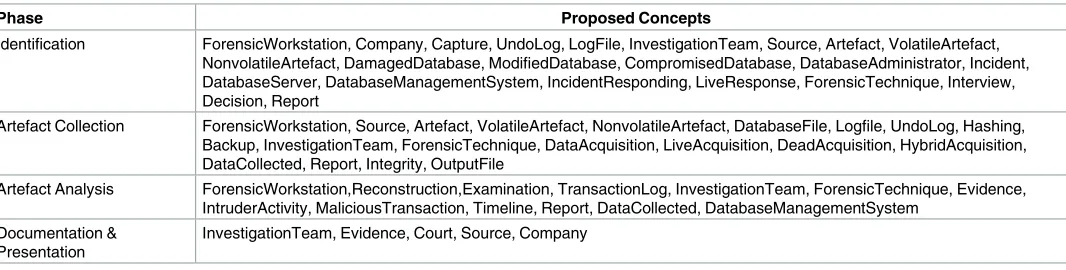
Proposed concepts are designated into Database Forensic processes, specificallyIdentification,
Artefact Collection,Artefact Analysis,and Documentation & Presentation[32].Identificationis a process in which Database Forensics identifies entire resources that may be used for investi-gative purposes. In addition, it identifies and detects database incidents.Artefact Collectionis the process that collects and preserves data. It provides forensic technologies and artefacts by which to collect the evidence to effectively address database incidents. TheArtefact Analysis
process analyses collected evidence and reveal the causes of incidents; it also tracks the inci-dents and attacker. Lastly,Documentation&presentationwill document the investigation pro-cesses and submit the report to the court. Designation into the propro-cesses is shown inTable 1.
3.7 Identifying relationships between concepts and the resultant DBFM
We now determine the relationships between our Database Forensic Metamodel concepts. As shown in Figs1–4, we use the ( ), ( ) and ( ) symbols to denoteAssociation,
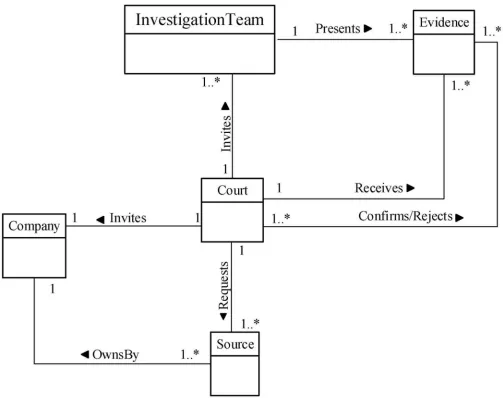
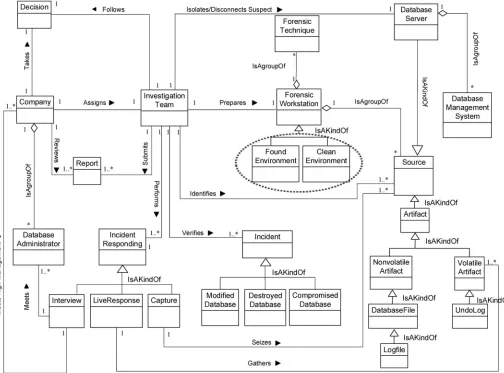
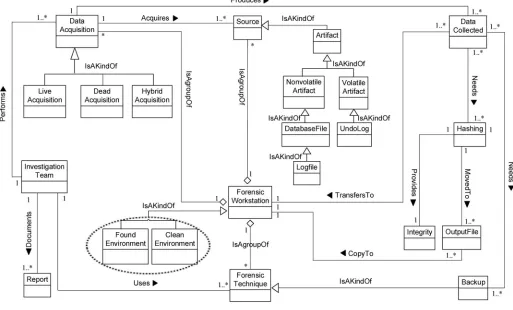
SpecializationandAggregationrelationships, respectively. As an association example, ‘Verifies’ betweenInvestigationTeam andIncidentconcepts indicates that an incident that could affect a company may need to be verified, revealed or detected. As specialization relationships, Volati-leArtefactandNonvolatileArtefactspecialize theArtefactconcept. To use an aggregation exam-ple,ForensicTechnique, andSourceare connected by the relation ‘a grouping of” during the identification, and artefact collection process. In almost all DBF models observed, we found the existence ofInvestigationTeam during most of the Database Forensic models. More exam-ple of binary relationship is shown inTable 2. For each pair of a related concept, semantic of the relationship are identified and depicted with a specific symbol.
Table 1. Concepts from step 3.7 designated into four DBF investigation processes.
Phase Proposed Concepts
Identification ForensicWorkstation, Company, Capture, UndoLog, LogFile, InvestigationTeam, Source, Artefact, VolatileArtefact, NonvolatileArtefact, DamagedDatabase, ModifiedDatabase, CompromisedDatabase, DatabaseAdministrator, Incident, DatabaseServer, DatabaseManagementSystem, IncidentResponding, LiveResponse, ForensicTechnique, Interview, Decision, Report
Artefact Collection ForensicWorkstation, Source, Artefact, VolatileArtefact, NonvolatileArtefact, DatabaseFile, Logfile, UndoLog, Hashing, Backup, InvestigationTeam, ForensicTechnique, DataAcquisition, LiveAcquisition, DeadAcquisition, HybridAcquisition, DataCollected, Report, Integrity, OutputFile
Artefact Analysis ForensicWorkstation,Reconstruction,Examination, TransactionLog, InvestigationTeam, ForensicTechnique, Evidence, IntruderActivity, MaliciousTransaction, Timeline, Report, DataCollected, DatabaseManagementSystem
Documentation & Presentation
InvestigationTeam, Evidence, Court, Source, Company
DBF is a continuous process with activities linking processes at different points. Corre-spondingly, in our DBFM, relationships between concepts are identified not only between concepts within the same process but also between concepts from different processes. Con-cepts from classes in different processes can be linked, and the continuous process in DBF can be formed. For example,Investigator(in the Identification process) is a concept designating an actor to formulate an investigation to meet future DBF needs based on extrapolations from the present needs. Investigation begins with the currentstatusandchartsout apathto a projected status, includingshort-termplans for achievinginterim goals. Linkages across processes are established either through relationships between concepts from different processes or through common concepts between processes.
Linkages across processes are also established through common concepts between pro-cesses. The use of the conceptIncidentRespondingshows that the investigation task should start from the identification stage in any Database Forensic investigation process. Conversely, the use of the conceptForensicTechnique shows that the three processes require overlapping sets ofForensicTechnique for their process activities. Database Forensic Metamodel clearly presents classes of concepts in the four Database Forensic Metamodels as follows:
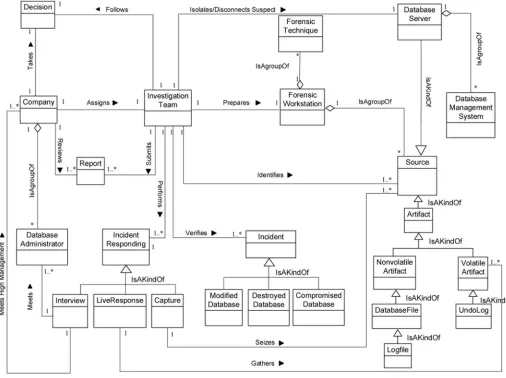
Fig 1. DBFM 1.0 identification-process class of concepts.
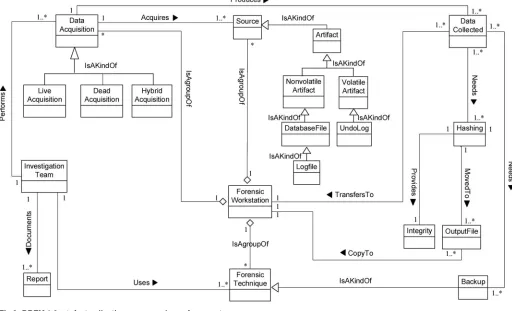
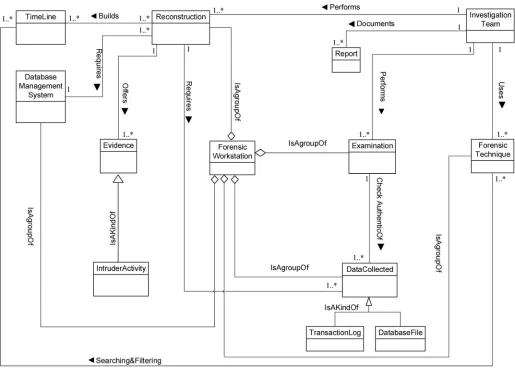
Identification-process (Fig 1);Artefact Collection-process (Fig 2);Artefact Analysis-process (Fig 3); andDocumentation and Presentation-process (Fig 4). The metamodel may also be used as a tool to determine the completeness of a given DBF solution.
3.8 Validation of Database Forensic Metamodel (DBFM)
The first version of DBFM will be validated and improved to make it complete and coherent. Thus, two common validation techniques will be used in this study, namelyComparison against other modelsandFrequency-based selection. Section 4.0 explains the process of DBFM validation in detail.
4.0 DBFM validation
We validate our DBFM for purposes of generality, expressiveness, and completeness. Validate generality ensures that the DBFM may cover whole DBF domain models, whereas validating the expressiveness ensures the degree to which it can directly model any particular real-world concept. This determines: that the theories and assumptions underlying the concepts in the metamodel are correct; and that the representation of the metamodel of the problem entity, the structure of the metamodel, and the logic and causal relationships are suitable for the intended purpose of the metamodel [17]. We apply two commonly used validation techniques as follows:
1. Comparison against other models—Derived concepts of the developed metamodel are
vali-dated and compared to concepts from other similar (valid) existing domain models or
Fig 2. DBFM 1.0 artefact collection-process class of concepts.
metamodels [17,100,101]. For this purpose, we use a set of 10 Database Forensics models in a validation set (as listed in Table A inS1 Appendix I, and Table E inS5 Appendix III). We thoroughly ensured that every concept in each of the models can be appropriately derived from a concept within DBFM. Where required, we modified the DBFM to ensure that it can represent all models in the validation sets. This validation is described in sub-section 4.1, where we also list the changes we made to the first version of DBFM, yielding DBFM 1.1.
2. Frequency-based selection—The importance of the individual concepts included in DBFM
is evaluated as advocated in [102,103]. The second set of nine (9) models in Set V2 is used (see Table A inS1 Appendix I, and Table F inS6 Appendix III). This validation is described in sub-section 4.2, where we also list the changes we have made to DBFM 1.1, yielding DBFM 1.2.
4.1 DBFM validation 1—comparison against other models
The first validation ensures that DBF can represent each of the models in the validation set V1 (as listed in Table A inS1 Appendix I, and Table E inS5 Appendix III). Where applicable, DBFM was modified to ensure that every model can be represented. DBFM was revised by
Fig 3. DBFM 1.0 artefact analysis process class of concepts.
adding 5 new concepts (listed inTable 3). Not all processes were changed to the same extent, e.g., Identification-process, Artefact Collection process and Artefact Analysis process of DBFM gained theCleanEnvironmentandFoundEnvironmentconcepts as shown in Figs5–7, whereas Documentation & Presentation-process added and changed relations among concepts (seeFig 8). The validation also confirmed the use of all relationships between all concepts (also shown inTable 4). None of the existing relationships were deleted.
4.2 DBFM validation 2—frequency-based selection
In this second validation, we perform aFrequency-Based Selection(FBS) technique using 9 models (Set V2 in Table A inS1 Appendix I, and Table F inS6 Appendix III). This is aFeature Selectiontechnique that evaluates the importance of individual concepts in the model devel-oped in [103]. It is based on the idea that the best model is formed using the most common features [104], and it is commonly used in data mining [105], software analysis [102], and
Fig 4. DBFM 1.0 documentation & presentation-process class of concepts.
medical retrieval systems [106]. By performing FBS, we removefeatures(concepts) that donot have correlations to (or a need for)the classification from DBFM.
We first gather concepts from the models in the validation Set V2, and in doing so, we also ensure that they can all be refined using DBFM 1.1 (see Table F inS6 Appendix III). As
Table 2. Relationships among concepts in DBFM.
Concept 1 Relationship Concept 2 Process/in Figure
InvestigationTeam Association—‘Prepares’ ForensicWorkstation Identification/1 InvestigationTeam Association—‘Performs’ IncidentResponding Identification/1 Interview Association—‘Meets’ DatabaseAdministrator Identification/1 Source Aggregation—‘isAGroupOf’ ForensicWorkstation Identification/1 DatabaseServer Aggregation—‘isAGroupOf’ Source Identification/1 VolatileArtefact Specialization—‘IsAKindOf’ Artefact Identification/1 TransactionLog Specialization—‘IsAKindOf’ DataCollected Artefact Analysis /3 DataAcquisition Aggregation—‘isAGroupOf’ ForensicWorkstation Artefact Collection/2 Source Aggregation—‘isAGroupOf’ ForensicWorkstation Artefact Collection /2 DataCollected Association—‘Needs’ Hashing Artefact Collection/2 DataCollected Association—‘Needs’ Backup Artefact Collection/2 Examination Aggregation—‘isAGroupOf’ ForensicWorkstation Artefact Analysis/3 VolatileArtefact Specialization—‘IsAKindOf’ ArtefactAnalysis Artefact Analysis/3 InvestigationTeam Association—‘Performs’ Reconstruction Artefact Analysis/3 Reconstruction Association—‘Requires’ DataCollceted Artefact Analysis/3 DatabaseFile Specialization—‘IsAKindOf’ DataCollceted Artefact Analysis/3
Court Association—‘Invites’ Company Documentation& Presentation/4 Court Association—‘Receives’ Evidence Documentation& Presentation/4
VolatileArtefact Specialization—‘IsAKindOf’ Artefact Identification and Artefact Collection (Inter processes) / 1 and 2 Source Aggregation—‘isAGroupOf’ ForensicWorkstation Identification to Artefact Collection (Inter phases) / 1 and 2
doi:10.1371/journal.pone.0170793.t002
Table 3. Five new added concepts based on validation over comparison to 10 models of set V1.
Concepts Set V1 DBFM Phase Concept Definition
ReconstructionAlgorithm (5) Analysis Database reconstruction algorithm enables forensic investigators to determine whether data of interest was present in a database at an earlier time despite the fact that several database modifications may have been performed since that time.
Searching (5) Analysis Searching each of the possible reconstructed relations before inserting it in the set relation. CleanEnvironment (5,7,9) Identification,
Collection, and Analysis
A clean environment is a setting where we have ensured that the data model will not alter the output of the DBMS. It is important to understand that a clean state differs from a post-mortem state
characteristic of traditional digital forensics. A clean state is not merely a copy of the evidence that needs to be analyzed but rather a copy of the evidence program that runs like the original copy and from which we can query output. This means that the clean environment is set up to run like the original DBMS, but we are sure that the data model is not corrupting the output that we receive from the DBMS.
FoundEnvironment (5,7,9) Identification, Collection, and Analysis
A found environment refers to a state of the data model where the data model was in use in the DBMS when an event of forensic interest occurred. The found environment may also refer to an environment where the same machine that the DBMS was originally installed on is not used, but the data model was mirrored onto another machine. It is vital to understand that the found environment is not exactly the same here as the traditional meaning of a live digital forensic environment because the
environment may fully or partially exist on the live machine or another machine.
CopyingFile (9) Analysis Copy the data files from the suspect installation of the DBMS to a new installation of the DBMS, where a clean copy of the DBMS has been installed. The logic here is that a new installation of the DBMS on another machine will provide a clean data model. The data files of the new installation will be replaced with the data files of the suspect installation.
expected, most concepts, in six of the nine models, were easily derived, and only the following six concepts were added to DBFM:HashedValue, Rehashing,AirtightBag,PresentInformation,
Documentation, andPolicy(see Figs9–12). The second task in our FBS validation was to score each concept according to its frequency. Concepts that have a low score are revisited and are liable for deletion. The frequency results obtained for all DBFM concepts are shown in (Table G inS7 Appendix III, and Table H inS8 Appendix III).
Table 5shows the result of this calculation for every DBFM concept. We have defined the following five categories of concepts based on their DoC values:
1. Very Strong (DoC result: 100–70%),
2. Strong (69–50%),
3. Moderate (49–30%),
4. Mild (29–11%), and
5. Very Mild (10–0%).
Fig 5. DBFM 1.1 a validated version of identification-process class of concepts.
Very Strong refers to the concept that appears many times in Set V2 models; whereas Very Mild is located at the other end of the scale. For example, the DBFM conceptSourcehas a strong concept DoC value of 100% as follows:
DocðSourceÞ ¼ 8
9X100% ¼ 88
Aiming for absolute theoretical completeness is cited as a common bad practice in metamo-del development [89]. As discussed in [89pp. 23], similar to the development of domain-spe-cific modelling, metamodel development is not about achieving perfection. We concur with these views, and if a DBFM concept has a ‘zero’ DoC score, it is deleted only after due consid-eration. Concepts with zero values are instead revisited and liable for deletion. DoC classifica-tion for all DBFM concepts is shown inTable 5and described as follows: 12 concepts in DBFM 1.1 are categorized as ‘Very Strong’; 9 are “Strong’; 12 are ‘Moderate’; 13 are ‘Mild’; and 3 concepts are ‘Very Mild’ (Table 5).
The three very mild concepts areUndoLog,OutputFile, andHybridAcquisition, and they are reassessed in DBFM. We deletedOutputFileandHybridAcquisitionas they only appeared rarely among domain models. However, we opted to keepUndoLogas they are common across varying DBF domains.
As a result of FBS, Figs9–12show the new validated version of Identification concepts, Col-lection concepts, Analysis concepts and Presentation concepts, respectively.
Fig 6. DBFM 1.1 a validated version of artefact collection-process class of concepts.
As a result of ensuring that DBFM represents each of the models in V2, we also added six concepts to the Identification process, Artefact Collection process, Artefact Analysis process and Documentation & Presentation process (encircled in (Figs9–12)) as follows:
• HashedValue—“Values returned by hash functions”.
• AirtightBag—“where the evidence of CDROM should be kept in an environmentally neutral state”.
• PresentInformation—“Pictorial and graphical representation of statistics would help increase the understanding of people who needed to interface with the results”.
• Policy—“a set ofideasor aplanof what to do in particular situations that have beenagreed
toofficiallyby a group ofpeople, abusiness organization, agovernment, or apolitical party”.
• Rehash—“Matching is performed between old hash values with rehash tuple. If the hash value is the same, there is no problem”.
• Documentation—“clear details of names and roles of each person handling the bag of which there should not be many. The airtight evidence bag label should be impossible to get off the bag without breaking the seal which is unique to that bag”.
As a result of the refinements described in Sections 4.1 and 4.2, the DBFM classes of con-cepts are shown in (Figs9–12). These figures have been annotated to clarify the impact of the FSB validation.
Fig 7. DBFM 1.1 a validated version of artefact analysis-process class of concepts.
Practically, a real scenario has been utilized to assess the effectiveness and applicability of DBFM. This scenario was offered by [35]. “A DBA believes that one of his development servers has been compromised.No auditing was enabled.Is there any evidence to support a compromise occurred”. In this scenario where the company has no auditing services, we are going to dem-onstrate the capabilities of DBFM:
1. DBFM identification class. The DBA of a company whose believes that one of his
development servers has been compromised should notify the company management. The company looks at the nature, risk, type, and status of the incident. Then, if the incident is criti-cal, the company should assign investigation team to identify, collect, preserve, analyze, recon-struct and document the evidence. Theinvestigation Team should get authorization / search
warrant to start their mission. Also, the access rights to reach the suspect database server should be there. Moreover, identifySources which may use during the whole investigation task
such asArtefact, Volatile Artefact, Non-volatile Artefact, and Database server. Artefact is a Fig 8. DBFM 1.1 a validated version of documentation & presentation-process class of concepts.
Table 4. List of relationships modifications between concepts in DBFM.
Concept 1 Concept 2 Modification
Process: Identification
1 CleanEnvironment ForensicWorkstation Add (Specialization)—isAKindOf
2 FoundEnvironment ForensicWorkstation Add (Specialization)—isAKindOf
Process: Artefact Collection
1 CleanEnvironment ForensicWorkstation Add (Specialization)—isAKindOf
2 FoundEnvironment ForensicWorkstation Add (Specialization)—isAKindOf
Process: Artefact Analysis
1 CleanEnvironment ForensicWorkstation Add (Specialization)—isAKindOf
2 FoundEnvironment ForensicWorkstation Add (Specialization)—isAKindOf
3 Searching ForensicTechnique Add (Specialization)—isAKindOf
5 CopyingFile ForensicTechnique Add (Specialization)—isAKindOf
6 ReconstructionAlgorithm ForensicTechnique Add (Specialization)—isAKindOf
doi:10.1371/journal.pone.0170793.t004
Fig 9. DBFM 1.2 A validated version of Identification-process class of concepts.
kind of sources which hold the evidence of incidents. Artefact has the volatile and non-volatile artefact. Volatile artefact includes database files, log files, database files, history files, trace files, alert files, transaction log, and so on. The non-volatile artefact includes the artefact which hold the volatile data such as undo log, SQL cash, log buffers, and whole memories structures.
Theinvestigation Team should partially or completely isolate or disconnect the suspect the Database Server to get enough time to capture data. Additionally, the investigation Team
should performIncident Responding to check and verify the database incident. Incident Responding classified into three steps: Capture to seize and protect the sources, Live Response
to gather the volatile artefact, and conduct an interview to get information.
Investigation team should capture/seize the sources to protect it from tampering. Also, the
most important step that must do by investigation team is a live response to gathering the live data from memory structure before missing.
Furthermore, investigation team should conduct an interview with IT staff such as DBA and also with the CEO of the company. The purpose of the interview with DBA is to get the information accounts, basic information about database, incident reports, network topology, database server activities, security procedures, and policies and so on. However, the purpose of the interview with CEO is to get information about the kind of privacy of the data of the com-pany, and the importance of business continuous of the company and so on. Consequently, theinvestigation teamshould verify and check the type of incident and prepare and submit a primary investigation report to the company management. The company management takes the decision to stop or continues the investigation.
Fig 10. DBFM 1.2 a validated version of artefact collection-process class of concepts.
Finally, theInvestigationTeam should prepare the ForensicWorkstation to achieve whole
investigation task such collect, preserve analysis and document the evidence. The Forensi-cWorkstation is a clean and trust machine to do the investigation. It includes trust forensic
techniques, trust and clean Database Management Systems (DBMS) to ensure the clean and correct results.Forensic Techniques is a collection of trusted forensic tools, methods, and
algo-rithms that use by investigators to do an investigation.Fig 13displays the identification meta-model class.
2. DBFM artefact collection class. Investigation Team has been already checked and
identified the database incident, captured and seized the sources, identified and prepared the forensic workstation and forensic techniques in identification phase. Thus, in this phase, the volatile and non-volatile data should be acquired.Investigation Team performs Data Acquisi-tion which acquires the different kinds of sources. Data AcquisiAcquisi-tion is a process which
classi-fied into the dead acquisition and lives acquisition.Dead Acquisition used to acquire the data
from artefact when the database server is off, whereas thelive acquisition is used to acquire the
data from artefact when the database server is on. Furthermore, the investigation team should use specialforensic techniques to acquire the data such as tools, algorithms, methods and so
on. Consequently, the data collected will produce from data acquisition process.Data collected
includes the volatile and non-volatile data. The data collected needs hashing algorithms and imaging to preserve the evidence from tampering. Hashing algorithms provide integrity of original data. The data collected and hashed value should keep and send to theforensic work-station. Finally, investigation team should document all the collection and preservation steps
in severalreports.Fig 14displays Artefact collection metamodel class.
Fig 11. DBFM 1.2 a validated version of artefact analysis-process class of concepts.
Fig 12. DBFM 1.2 a validated version of documentation & presentation-process class of concepts.
doi:10.1371/journal.pone.0170793.g012
Table 5. Degree of confidence for DBFM concepts after FBS.
Percentage Degree (Degree of Confidence)
100–70% (12 Very Strong) 69–50% (9 Strong) 49–30% (12 Moderate) 29–11% (13 Mild) 10–0% (3 Very Mild)
ForensicTechnique ForensicWorkstation Company VolatileArtefact UndoLog (p)
Source InvestigationTeam CleanEnvironment DamagedDatabase OutputFile (x)
Artefact LogFile FoundEnvironment ModifiedDatabase HybridAcquisition(x)
NonvolatileArtefact TransactionLog DatabaseFile Interview
Transaction DatabaseServer RedoLog LiveResponse
Incident DataCollected CompromisedDatabase Capture
DatabaseManagementSystem CopyingFile Report Decision
IncidentResponding Examination DataAcquisition LiveAcquisition
Integrity DatabaseAdministrator Hashing DeadAcquisition
Evidence Backup CollectedArtefact
MaliciousTransaction Reconstruction TimeLine
IntruderActivity Court Searching
ReconstructionAlgorithm
3. DBFM artefact analysis class. Whole volatile and non-volatile data has been collected,
preserved and moved to the forensic workstation in artefact collection phase. Thus, in this phase, thecollected data should be examining, analyzing and reconstructing to reveal any
evi-dence to support a compromise occurred and also determine who is tampering? When did
tampering happen? Where did tampering happen?.
Fig 13. DBFM identification class of concepts.
First of all thecollected data and hashed values that moved to forensic workstation should
be examined to check theintegrity of data. Investigation team performs examination process
to check the authentic of collected data during moving / transforming to the forensic worksta-tion. It includesrehashing of hashed value to ensure that the collected data has not tampered
with. Furthermore, the investigation team documents the examination process in separate reports to introduce it in the court. However, if the results of examination process show that thecollected data has been tampering with, then the investigation team needs doing collecting
data again.Fig 15displays examination process to check authentic of collected data.
Secondly,artefact analysis should perform by investigation team if the collocated data is
cleaned and has not been tampering with.Artefact analysis includes reconstruction process.
Thereconstruction process is the cornerstone of the artefact analysis. It includes constructing
thetimeline of events before or after the intruder actions. The timeline events will be searching Fig 14. DBFM artefact collection class of concepts.
and filtering usingforensic techniques to produce evidence. Basically, the investigation team
will achievereconstruction process to bring the evidence and detect whole tracks of the
inci-dent.Reconstruction process requires a collected data such as backup set, database files, and transaction log to build the timeline events. Also, it required a clean/exit database manage-ment systems (DBMS). The timeline events include whole events that done by intruder such as
failure or success login/logoff, DML transactions, or DDL transactions etc. The investigator will use the specialforensic techniques such as RGB/RGBY algorithms[57],Tile bitmap algo-rithm[46], or Log Miner [33], to search and filter the timeline events and detect who is tamper-ing? When and where did tampering happen? Theevidence that got by this process will
organize, structure and preserve in airtight bag/seal to keep the evidence from temperature, humidity, and human tampering. Theairtight bag should submit to the company and then the Fig 15. DBFM artefact analysis-process class of concepts.
court of law. However, all the artefact analysis process steps should be documented in several reports.Fig 16displays artefact analysis class.
Obviously, DBFM provides clear steps to guide a user’s, newcomers or practitioners to identify, collect, preserve, reconstruct and analyze database incidents. Therefore, users have the ability to instantiate a customized model to solve the problem in hand. For example, (Fig 16) depicts an examination model that derive from DBFM artefact analysis class.
5. Contribution
In this study, aframework of a DBF languageunderlined by a DBF metamodel (DBFM) is cre-ated. This demonstrates the emergence of a DBF semantic modeling standard through the
Fig 16. Documentation & presentation-process class of concepts.
metamodel that allows the description of various DBF data models. For the purpose of devel-oping the DBFM,general conceptsused in DBF are identified and new ones synthesized as required. This process involves analyzing the domain models, management processes, domain phases, activities, roles, goals and all other elements in DBF. The successful creation of the metamodel generalizes metamodelling to solve problems in DBF. The study generalizes the metamodelling approach. It creates a synthesis and validation processes that are discipline agnostic. In other words, the metamodelling process used in this study will not demand domain expertise as is usually the case in software engineering. Rather, the adapted process will provide new guidelines on sourcing the knowledge required to drive and validate the metamodelling process.
This study contributes to the facilitation of sharing of DBF knowledge. It presents a new a metamodeling based approach to guide DBF practitioners to structure, organize and reuse DBF-based on a Database Forensic Metamodel (DBFM). This is a specific artefact to describe a DBF language. The approach formulated does not mandate-consistent semantic relation-ships between the various stored models as it not fully formalized. Rather it is semi-formal and provides semantic links between the various models stored. The interpretation of the links is partly derived by the system users. This offers flexibility that enables easy storage of DBF knowledge by users and easy reuse by different users. From the metamodel, DBFM, semantic links between all models as well as new DBF models can be derived. DBFM is presented in four sets of concept classes: theIdentification,Artefact collection,Artefact analysis, and Presen-tation & documenPresen-tation class of concepts. Each set represents a corresponding DBF phase. This clearly describes the DBF domain to its users.
To the metamodeling community, the study contributes by facilitating the metamodeling process itself to not (knowledge) domain experts and prescribing a precise validation process that combines both domain and domain independent considerations. It first introduces new heuristics to a process adapted from [107] to enable preparing and selecting knowledge sources to drive the metamodeling process. This allows the domain metamodellers to be familiarized with common elements and various viewpoints of a domain without demanding deep DBF expertise. Improving the effectiveness of knowledge sources thus includes improv-ing its usage and access. In addition, the study prescribes a precise validation usimprov-ing two types of metamodel validation techniques:Comparison against other models,and Frequency-based Selection. Each validation technique is tailored for a specific quality goal. The aim of the first validation, theComparison against other modelsis to identify any missing concepts in the ini-tial version of the DBFM and to also ensure its broad coverage. For theFrequency-based Selection, it aims to evaluate the importance of the individual concepts included in DBFM. As a result, a high degree of completeness, concepts significance and logical consistency of the metamodel are ensured.
Also, the study contributes to knowledge by also introducing a successful DBFM able to support different metadata types to define various DBF information models. It successfully describes the structure and functional description of any DBF information model as demanded from such a metamodel [108]. As the ability to offer modelling guideline to many domain users, DBFM helps various users to find rapid decision solution from semantic models earlier created. It successfully facilitates three meta-levels metamodeling abstraction in the MOF framework: the M2-level for a Metamodel, the M1-level for a Model, and the M0-level for a User Model.
DBFM through its four sets of classes (Identification,Artefact collection,Artefact analysis
subsequent phases (solution models and the way they are arrived at from DBFM clearly vary according to the intention of the user for their new model. Finally, where coordination is lack-ing due to interoperability problems in a heterogeneous environment (e.g. different data for-mats or the absence of a common language), DBFM can also facilitate a general and global framework for coordinating people and data sources involved.
6. Limitations of the Model
Our Database Forensic metamodel (DBFM) has been developed based on a careful analysis of the existing literature and domain-specific database forensic models. It has been validated through a couple of iterations and applied to a specific case. While the DBFM is generic and domain-independent and can be instantiated for specific DBF scenarios, it has some limita-tions that need to be addressed, especially as the DBFM evolves.
The following are some of the limitations that will be taken into account in the next itera-tion of DBFM refinement.
• In developing our DBFM, we have considered only the models presented in English that could lead to a cultural bias. In the next stage of our model refinement, we will consider a more diverse set of models from different geographic regions, which will improve the com-pleteness and applicability of the model.
• While we searched for input from practitioners and experts during the DBFM development, we validated the model against two sets of models from the literature and applied it to a spe-cific DBF case. There was no formal evaluation of the model performed by the experts in Database Forensics. As part of a future work, the DBFM and the results will be validated by a group of DBF experts or digital forensic experts.
• In the second part of the DBFM validation process (Section 4.2), we used a frequency-based selection technique. In this process, we were interested in knowing whether a particular con-cept appeared in a model or not and did not focus on how many times it appeared. In the field of information retrieval, this frequency is used to indicate the importance of a concept. In the next iteration of DBFM development, we will consider this fact and refine the model accordingly.
• In developing the DBFM, our goal was to create a model that is general and complete. Hence, we tried to include all the concepts that occurred in all or most of the models. While this resulted in a broad model that represents common practice, it might not be the “best practice” model. Our DBFM might be read as a model that is useful for training novices but may not be useful in helping organizations develop a state-of-the-art or best-practice model. While specialized (best-practice) models can be instantiated from the general DBFM, in our future work, we will take a synthesis approach and incorporate most important concepts from the various models to produce a class of best-practice models.
7. Conclusion
This study has discussed the development of the Database Forensic Metamodel (DBFM). The metamodel presented is intended to become an effective platform for sharing and integrating DBF knowledge from varying sources. Existing database forensic models are not based on any metamodels or standards but rather constitute proprietary solutions that are mainly focused on frameworks and other model aspects. This is the first work that develops a DBF metamodel across the four established phases of the database forensic domains. Our DBFM can unify these works as a navigation metamodel. More importantly, the DBFM is the first step to allow interoperability of DBF solutions and effective transfer of knowledge across database bound-aries. It may also be used as a tool to determine the completeness of any DBF solutions.
We presented the metamodel in a familiar format, UML, to increase its ease of use and broaden its appeal. In synthesizing our metamodel, we used 18 models for the development of DBFM. The future work of this study will concentrate on development of a database forensic repository to demonstrate the effectiveness of DBFM.
Supporting information
S1 Appendix I. Table A. The 38 DBF models for development (Set I) and validation (Set II). The perspectives they cover are denoted by ‘p’.
(DOCX)
S2 Appendix I. Table B. Extracted database forensic concepts.
(DOCX)
S3 Appendix I. Table C. Candidate and Proposed common concepts for the DBF domain.
(DOCX)
S4 Appendix II. Table D. List of proposed DBF concepts and definition.
(DOCX)
S5 Appendix III. Table E. Validation summary against model set V1.
(DOCX)
S6 Appendix III. Table F. Validation summary against model set V2.
(DOCX)
S7 Appendix III. Table G. Frequency results of identification and artefact collection-pro-cess concepts.
(DOCX)
S8 Appendix III. Table H. Frequency result of artefact analysis and documentation & pre-sentation-process concepts.
(DOCX)
Acknowledgments
We acknowledge the expert Mr. Daniele Giomo for his assistance and evaluation of this work. We also acknowledge Universiti Teknologi Malaysia and MOHE through FRGS Grant No. R. J130000.7813.4F193 for support related to the proofreading service for this paper.
Author Contributions
Data curation: AA.
Formal analysis: AA.
Funding acquisition: SR.
Investigation: AA SR SHO AN MNA AAM.
Methodology: AA SR SHO AN.
Project administration: AA SR SHO.
Resources: AA.
Software: AA.
Supervision: SR SHO AN.
Validation: AA.
Visualization: AA SR SHO AN MNA AAM.
Writing – original draft: AA.
Writing – review & editing: AA SR SHO.
References
1. Olivier MS (2009) On metadata context in database forensics. Digital Investigation 5: 115–123.
2. Fru¨hwirt P, Kieseberg P, Schrittwieser S, Huber M, Weippl E. InnoDB database forensics: reconstruct-ing data manipulation queries from redo logs; 2012. IEEE. pp. 625–633.
3. Khanuja HK, Adane D (2012) A framework for database forensic analysis. Computer Science & Engi-neering: An International Journal (CSEIJ) 2: 27–41.
4. OMG (2003) Model Driven Architecture (MDA) Guide.
5. Weilkiens T (2011) Systems engineering with SysML/UML: modeling, analysis, design: Morgan Kaufmann.
6. OMG (2001) Unified Modelling Language Specification, version 1.4. Object Management Group.
7. Beate L, Birgit K (2006) An evaluation of conceptual business process modelling languages. Proceed-ings of the 2006 ACM symposium on Applied computing. Dijon, France: ACM.
8. Nordstrom G, Sztipanovits J, Karsai G, Ledeczi A (1999) Metamodeling: Rapid Design and Evolution of Domain-Specific Modeling Environments: Vanderbilt University. 156 p.
9. Tran QNN, Low GC, Beydoun G (2006) A Methodological Framework for Ontology Centric Agent Ori-ented Software Engineering. International Journal of Computer Systems Science and Engineering 21: 117–132.
10. Sowa JF (1984) Conceptual Structures: Information Processing In Mind and Machine: Addison-Wes-ley Longman Publishing Co., Inc. 481 p.
11. Stahl T, Voelter M, Czarnecki K (2005) Model-Driven Software Engineering, Technology, Engineering, Management: John-Wiley & Sons Ltd. 85–88 p.
12. OMG (2002) Meta Object Facility (MOF) Specification. 1.4 ed: Object Management Group.
13. Nissen HW, Jeusfeld MA, Jarke M, Zemanek GV, Huber H (1996) Managing Multiple Requirements Perspectives With Metamodels. Software, IEEE 13: 37–48.
14. Sadraei E, Aurum A, Beydoun G, Paech B (2007) A field study of the requirements engineering prac-tice in Australian software industry. Requir Eng 12: 145–162.
15. Othman SH, Beydoun G (2010) Metamodelling Approach To Support Disaster Management Knowl-edge Sharing. Australasian Conference on Information Systems (ACIS’2010) Proceeding, Paper 97. Brisbane, Australia.
16. Jin R, Chen W, Simpson TW (2001) Comparative studies of metamodelling techniques under multiple modelling criteria. Structural and Multidisciplinary Optimization 23: 1–13.