Procedia - Social and Behavioral Sciences 56 ( 2012 ) 673 – 678
1877-0428 © 2012 Published by Elsevier Ltd. Selection and/or peer-review under responsibility of Centre of Engineering Education, Universiti Teknologi Malaysia
doi: 10.1016/j.sbspro.2012.09.702
International Conference on Teaching and Learning in Higher Education (ICTLHE 2012) in
conjunction with RCEE & RHED 2012
Andragogy and Pedagogy Learning Model Preference among
Undergraduate Students
Norah Md Noor
a,*, Jamalludin Harun
b, and Baharuddin Aris
aaCentre for Teaching and Learning, Universiti Teknologi Malaysia, UTM Skudai, 81310, Johor, Malaysia bFaculty of Education, Universiti Teknologi Malaysia, UTM Skudai, 81310, Johor, Malaysia
Abstract
This paper reports on a research project that investigated the pedagogical and/or andragogical orientation preferred by undergraduate student in one of the Higher Institution in Malaysia. To gather the data, questionnaires were distributed among 323 undergraduate students who took the Introduction to Programming Language course and descriptive analyses have been conducted. In order to validate the data, a qualitative data from interview were gathered to be triangulated. These findings have implications for educators involved in designing online learning applications and will be used to develop a prototype of individualized online learning environment based on the pedagogy and andragogy as its foundational model.
© 2012 N. Md Noor, J. Harun & B. Aris.The Authors. Published by Elsevier Ltd.
Selection and/or peer-review under responsibility of the Centre of Engineering Education, Universiti Teknologi Malaysia
Keywords: Type your keywords here, separated by semicolons ;
1. Introduction
Individualized Online Learning Environment has been shown to have a positive effect on student learning. A number of studies have demonstrated that students can benefit in their learning process using individualized learning system (Ong & Ramachandran, 2000; Kinshuk, 2002). Many of the earlier system consider the student background in term of their performance level or cognitive state to decide the next difficulty level and depth of the topic should be offered (Ong & Ramachandran, 2000; Freedman, 2000).
* Corresponding author. Tel.: +6-075-53-7880. E-mail address: [email protected]
© 2012 Published by Elsevier Ltd. Selection and/or peer-review under responsibility of Centre of Engineering Education, Universiti Teknologi MalaysiaOpen access under CC BY-NC-ND license.
Complexity associated with understanding how people learn remains a difficult problem in term of individualized learning platform (Cheung et al. 2003). According to Fidishun (2000), learning theory should become the focus in the design of instructional technology so that they can construct lessons that are not only technology-effective but that are significant from the learner’s perspective. Giving this into hand, an appropriate learning model such as Pedagogy or Andragogy should be considered when developing an Individualized learning environment.
2.Theoretical Background
Pedagogy and Andragogy model is actually crucial assumptions about the characteristics of learners that consider the whole-person perspective in term of diagnosis of needs, learning climate, and role of their experience (Delahaye et al. (1994).
Andragogy describes the instructional approach based on self-directed learning theory while Pedagogy describes the traditional instructional approach based on teacher-directed learning theory (Knowles, 1980).
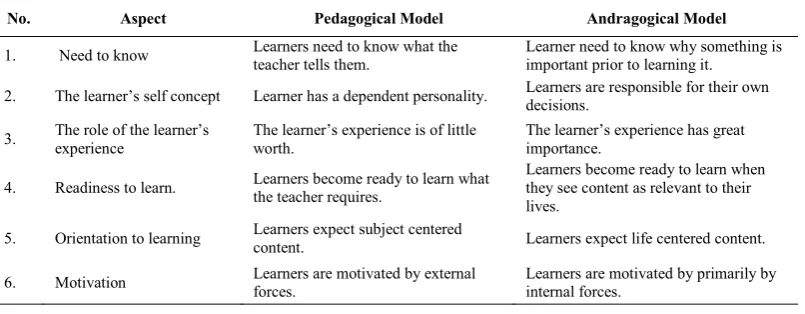
The pedagogical model and andragogical model differ in six assumptions about learners which are the learner’s need to know, self-concept, experience, readiness to learn, orientation to learning, and motivation (Knowles et al. 1998). Table 1 summarizes the differences between the pedagogical and andragogical models:
Table 1. Pedagogical and Andragogical Assumption about Learners
No. Aspect Pedagogical Model Andragogical Model
1. Need to know Learners need to know what the teacher tells them. Learner need to know why something is important prior to learning it.
2. The learner’s self concept Learner has a dependent personality. Learners are responsible for their own decisions.
3. The role of the learner’s experience The learner’s experience is of little worth. The learner’s experience has great importance.
4. Readiness to learn. Learners become ready to learn what the teacher requires.
Learners become ready to learn when they see content as relevant to their lives.
5. Orientation to learning Learners expect subject centered content. Learners expect life centered content.
6. Motivation Learners are motivated by external forces. Learners are motivated by primarily by internal forces.
Source: Knowles et al. 1998
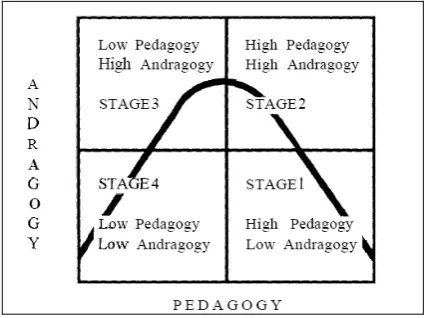
However, research conducted by Delahaye, Limerick, and Hearn (1994) found that learners could be two dimensional, utilizing both pedagogical and andragogical principles at the same time. They form model of four stages of learning as shown in Figure 1.
Fig. 1. Four stages of learning (Source: Delahaye et al., 1994)
Therefore, this research will try to investigate the pedagogical and/or andragogical orientation preferred by undergraduate student who took an introductory to programming language course in one of the Higher Institution in Malaysia. They were chosen as nowadays, Introduction to Programming has become one of the compulsory subject offered to those non-major science computer students. We try to identify with how actually their preferable learning orientation based on the pedagogy and andragogy as its foundational model.
3.Research Methods
To gather the data, a survey instrument regarding learning preference based on pedagogy and andragogy assumptions among students in higher education had been developed and distributed among 323 out of 589 local higher institution students in semester 2 of academic year 2009-2010. These students were selected randomly based on those who take an Introduction of Programming Language in non major computer science faculty in UTM. The Quantitative data were collected and analyzed using quantitative data analysis software.
The instrument used in this survey study was developed based on extensive literature review of pedagogy and andragogy learners’ assumption. The reliability of instrument was tested through internal consistency which is the Cronbach’s coefficient alpha. The Cronbach’s alpha value for this instrument is0.940thus demonstrate that the scales are consistent and reliable.
The instrument consists of 40 items (20 regarding andragogy assumption another 20 regarding pedagogical assumption) using a 5 point scale (1= Strongly disagree, 2 = Disagree, 3= Medium Agreement, 4 = Agree, 5 = Strongly Agree). Refer Table 2 and 3 for the sample of items in the survey instrument
Table 2. Some of the items under andragogical orientation
Item Number
II – 6 I can plan my own course of action to accomplish the assignment given efficiently.
Table 3. Some of the items under the pedagogical orientation
Item Number
IV – 4 I prefer to be notified by the instructor on my weaknesses in the subject
V – 6 I prefer the instructor to give various example during the teaching and learning process
In order to understand the students learning preference in much details, a qualitative data were gathered. Two lecturers which have been involved with teaching introductory to Programming Language courses had been interviewed based on several question regarding andragogical learners assumption.
4.Finding
The samples for this research consist of about 54.2% female and 45.8% male student within the range of age 20 to 22 years old. They were attending an Introductory to Programming language class from multiple non major computer science faculty such as Faculty of Education, Faculty of Built Environment, Faculty of Civil engineering and Faculty of Geoinformation and Real Estate.
Table 4. Sample distribution
Frequency Percent %
Male 175 54.2
Female 148 45.8
Total 323 100.0
In order to classify four stages of their learning development based on Delahaye, Limerick and Hearn (1994), student’s preferences for each pedagogy and andragogy assumption were determined according to the Table 5 below:
Table 5. Categorization of undergraduate students preference level according to mean score
Total Score Pre-Services Teacher Preference Level
1.00 – 2.99 Low
3.00 – 5.00 High
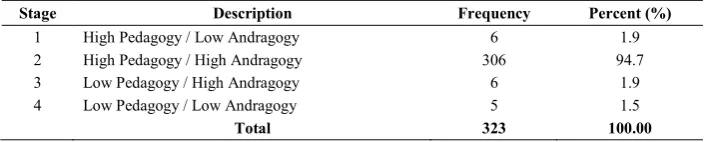
The findings shows that majority of the students were in Stage 2 (94.7%) based on the model of four stages of learning development by Delahaye, Limerick, and Hearn (1994). This shows that majority of the undergraduate students in this study had left Stage 1 and entered Stage 2.
Table 6. Descriptive statistics – four stages of learning development among pre-services teacher
Stage Description Frequency Percent (%)
1 High Pedagogy / Low Andragogy 6 1.9
2 High Pedagogy / High Andragogy 306 94.7
3 Low Pedagogy / High Andragogy 6 1.9
4 Low Pedagogy / Low Andragogy 5 1.5
Two lecturers which have been involved with teaching Introduction to Programming course among undergraduate students for more than 6 years and also experts in web-based learning research were also been interviewed based on several question regarding andragogical learners assumption. They responded to the question with either Yes, No or In-between answer, followed by comment and example from their own experience. Each of their comments was recorded carefully.
In brief, some of the answers from the structured interview were shown in Table 6.
Table 7. Result from the structured interview from expert
No. Questions P1 P2
1 Adakah pelajar pra-siswazah menunjukkan keenam-enam aspek andragogi untuk pembelajaran dalam kelas?
In-Between
“Kebanyakan pelajar masih lagi bergantung pada pensyarah….”
In-Between
“Tidak semua pelajar mempunyai keseluruhan aspek andragogi – antara aspek Andragogi yang kuat dapat dilihat seperti motivasi kendiri….” 2 Adakah terdapat pelajar yang
sangat terarah kendiri dalam pembelajaran?
In Between
“… ada juga pelajar yang agak self -dependent, usually they quite talkative, rajin bertanya, jawapan bagi soalan yang diberi oleh pensyarah adalah relevan dan ada reason on the selection answer… they confident dan perform dalam tugasan personal dan final exam.
Unfortunately, ada juga pelajar yang ada pengalaman mengajar, they’re just the same (not self dependent).”
No
“… pelajar masih lagi memerlukan bimbingan daripda pensyarah”
Interviews were done to acknowledge whether Andragogy or Pedagogy aspects (Learners need to know, Learner’s Self Concept, Role of learners' experience, Readiness to learn, Learning Orientation and Motivation to learn) were applied among their undergraduate students. It seems that that both of them believe that their undergraduate students taking Introduction to Programming subject demonstrates both andragogy and pedagogy learners aspect alongside. They still need guidance from their lecturer to pursue most of their learning activities but willing to take in charge on some of the self learning to pursue their understanding.
5.Conclusıon
As a conclusion, andragogical and pedagogical assumptions should be utilized in moderation based on the student preference. Some student preferred learning based on the pedagogical principals orientation while the others do not. Majority of the undergraduate students as found in this research preferred a combination of pedagogical and andragogical orientation on their learning process. This is similar to few other research that shows higher institutional students within the age of 18 to 24 that can be called as youth learners preferred a learning approach that utilized both pedagogy and andragogy principles (Choy & Delahaye, 2002; Choy & Delahaye, 2003, Zaidatun et al. 2008).
still need guidance from their lecturers. They also not yet prepared to accept the full responsibility of planning their own learning process. Therefore the integration of both learning orientation preferences should be considered in classroom learning as well as designing and developing an online learning application among undergraduate learners.
Acknowledgements
The authors are deeply indebted and would like to express our gratitude to the Universiti Teknologi Malaysia for supporting this study under the Research University Grant (RUG) Vote 00J91.
References
Delahaye, B.L., Limerick, D.C. & Hearn, G. (1994). “The relationship between andragogical and pedagogical orientations and the implications for adult learning”. Adult Education Quarterly, 44(4), 187 – 200
Fidishun, Dolores (2000). Andragogy and technology: integrating adult learning theory as we teach with technology, 5th annual Instructional Technology Conference, April 9-11, 2000, Middle Tennessee State University. Available at
http://www.mtsu.edu/~itconf/proceed00/fidishun.htm
Freedman. R (2000), What is an Intelligent Tutoring System? The International Journal of Artificial Intelligence in Education 11(3): 15-16 (Fall 2000)
Handelsman, M M. Briggs, W L. Sullivan, N, & Towler, A. (2005). A Measure of College Student Course Engagement, Journal of Educational Research, v98 n3 p184 Jan-Feb 2005
Kinshuk (2002). Does Intelligent Tutoring have future! In Kinshuk et al. (Eds.) Proceedings of the International Conference on Computers in Education, Los Alamitos, CA:IEEE Computer Society, 1524-1525 (ISBN 0-7695-1509-6)
Knowles, Malcolm S., Elwood F. Holton III, & Richard A. Swanson. (1998). The Adult Learner. Houston: Gulf Publishing. Ong J. & Ramachandran S (2000), Intelligent Tutoring Systems : The What and the How
http://www.learningcircuits.org/2000/feb2000/ong.htm