18th International Conference on Structural Mechanics in Reactor Technology (SMiRT 18) Beijing, China, August 7-12, 2005 SMiRT18-K02-4
CHARACTERIZATION OF DESIGN GROUND MOTION FOR THE
CENTRAL AND EASTERN UNITED STATES:
LICENSING IMPLICATIONS
Joe Litehiser*
Bechtel Corporation
PO Box 193965, San Francisco, CA, USA
Phone: 415 768-7145, Fax: 415 768-4955
E-mail: [email protected]
Peter Carrato
Bechtel Power Corporation
5275 Westview Drive, Frederick, MD, USA
Phone: 301 228-7611, Fax: 301 682-6785
E-mail: [email protected]
ABSTRACT
For the first time in decades several US utilities are exploring the possibility of building new Nuclear Power Plant (NPP) generating capacity in the Central and Eastern United States (CEUS). Among the many topics that must be considered to license a nuclear plant (NPP) is appropriate design to mitigate the potential effects of vibratory ground motion from earthquakes.
Agreement on seismic design ground motion was not always easy during licensing of the last generation of NPPs. Therefore, over the last few decades both industry and the United States Nuclear Regulatory Commission (USNRC) have worked to find ground motion criteria that recognize and overcome earlier licensing difficulties. Such criteria should be stable and easily implemented. Important and complementary programs under the direction of the Lawrence Livermore National Laboratory (LLNL) and the Electric Power Research Institute (EPRI) were part of this effort, and these studies resulted in probabilistic seismic hazard assessments (PSHAs) for a number of CEUS NPP sites. These results and the concepts underlying them are now incorporated into both USNRC regulation and regulatory guidance.
Nevertheless, as the utilities and the NRC begin a renewed licensing dialog, issues of regulatory interpretation of earthquake ground motion design criteria have emerged. These issues are as fundamental as the shape and amplitude of ground motion design response spectra and as significant as the impact of these spectra on structural design. Successful and timely resolution of these issues will significantly impact the future of nuclear power in the US. The purpose of this paper is to briefly describe some of these issues and the approaches that have been proposed for their resolution.
Keywords: Central and Eastern United States, probabilistic seismic hazard, ground motion criteria
1. INTRODUCTION
In the past few years, and for the first time in many years, several utilities in the Central and Eastern United States (CEUS) have begun to explore the possibility of building new Nuclear Power Plant (NPP) generating capacity. During the hiatus between this renewed interest in nuclear power and the licensing of the last CEUS NPP decades ago, significant changes have taken place in both US Federal regulations governing, and United States Nuclear Regulatory Commission (USNRC) guidance implementing, development of earthquake ground motions for NPP design. Therefore, the recent attempts of CEUS utilities to license new NPPs represent the first opportunities for the industry and the USNRC to discover and resolve issues of regulatory interpretation.
Earthquake ground motion design response spectra for current United States NPPs are based largely on relatively limited earthquake data collected from events on the west coast of North America. A composite of these empirical data provided the foundation for the spectral shape contained in Regulatory Guide 1.60 (RG 1.60) published by the USNRC. The shape of RG 1.60 design response spectra has strongly influenced the thinking of a number of vendors in designing and licensing standardized key systems and components of NPPs. The peak
3005 Copyright © 2005 by SMiRT18
ground accelerations used to scale this spectral shape were established using a deterministic process as outline in Appendix A of the Code of Federal Regulations, 10 CFR Part 100.
During the last twenty years a number of studies have focused on the characteristics of earthquake ground motion for both historic and potential future earthquakes in the CEUS. These studies recognize that there is significant uncertainty in defining the amplitude and spectral shape of earthquake ground motions. To formally incorporate these uncertainties, the USNRC issued new licensing rules effective January 1997. These new rules are given in 10 CFR 50 Appendix S and 10 CFR100.23. Guidance for the implementation of these rules is given in RG 1.165. The methodology for developing ground motion given in these documents emphasizes the use of a probabilistic seismic hazard analysis (PSHA). The formulation of mathematical models used to describe the frequency-dependent attenuation of strong ground motion with distance significantly affects estimates of design ground motion throughout the CEUS.
RG 1.165 attempts to ease the paradigm shift from deterministic to probabilistic seismic design criteria, and from a general to a site-specific design response spectral shape. This is accomplished by adopting the PSHA results of two important studies of CEUS earthquake hazard that took place in the 1980s – studies performed by Lawrence Livermore National Laboratories (LLNL) on behalf of the USNRC and by the Electric Power Research Institute (EPRI) on behalf of the NRC and US utilities, respectively. Key among the regulatory decisions on how, specifically, to use the results of these studies are: 1) adoption of a relative measure of design adequacy based on the median of the median probabilities of exceedance of the existing seismic design response spectral amplitudes for twenty-nine licensed NPPs in the CEUS (equivalent, in practice, to design for a ground motion with a reference probability of one-in-one-hundred-thousand chance per year of being exceeded at half of the twenty-nine reference NPPs), 2) emphasis on two specific frequency ranges of 1-2.5 Hz and 5-10 Hz, and 3) provision for revision of the relative measure of design adequacy in the event of significant new information that might affect the original LLNL or EPRI results.
Attempts to implement RG 1.165 provisions have shown that 1) new estimates of strong ground motion attenuation in the CEUS are likely to lead to higher PSHA results for a given return period because estimates of attenuation aleatory uncertainty adopted in the earlier LLNL and EPRI studies were lower, 2) for many CEUS locations, the design response spectra developed under RG 1.165 will have response spectral amplitudes that, for frequencies greater than 10-25 Hz, are significantly above currently considered standard design spectra, and 3) although these effects of using updated strong motion attenuation relations should be ameliorated by revising the reference probability, as is explicitly encouraged within RG 1.165 when new information is found significantly affecting PSHA results for a number of sites, in practice this is difficult for a single license application focusing on a single site.
To resolve these issues a number of complementary or alternative approaches are being explored by utilities currently considering new NPP units. Among these approaches are: 1) re-evaluating the reference probability for CEUS sites using both preliminary arguments and, perhaps, more formal and time-consuming collaborative studies, 2) movement toward regulatory acceptance of performance-based seismic design criteria, like those used by the US Department of Energy (USDOE) for its many nuclear material handling facilities or like those proposed by the American Society of Civil Engineers (ASCE) for all types of nuclear facilities, and 3) re-examination and refinement of arguments and analyses showing that the very high-frequency motions arising formally from implementation of RG 1.165 do not propagate through the foundation to affect key systems and components.
2. LICENSING BACKGROUND
Regulations for developing seismic design ground motions for existing US NPPs evolved over the early years of the industry, ultimately resulting in Appendix A of the Code of Federal Regulations (2002). This regulation directs that the design of each NPP take into account the potential effects from shaking caused by the most severe earthquake associated with tectonic structures or tectonic provinces in the site region and to use this motion to define the Safe Shutdown Earthquake (SSE).
3006 Copyright © 2005 by SMiRT18
100 of 10 CFR) recognizes that uncertainties are inherent in such estimates and directs that they must be addressed through an appropriate analysis such as a probabilistic seismic hazard analysis (PSHA) or suitable sensitivity analyses. Acceptable PSHA analysis is specified by reference to the two extensive efforts undertaken by LLNL (see Sobel, 1994) (on behalf of the USNRC) and EPRI (1989) (on behalf of the utilities). Critical elements in these studies were where, how large and how often do earthquakes in a site region occur, how quickly does shaking from these earthquakes decrease with distance, and what is the uncertainty in these elements? Suitable sensitivity analyses demonstrate that the elements incorporated into the LLNL and/or EPRI PSHAs are still representative of current knowledge.
This alternative “probabilistic” approach also has advantages and disadvantages. Its advantages are that it can incorporate a wide range of information and judgment, it can handle uncertainty formally and explicitly, and its conclusions are not as easily upset by new data or hypotheses. Its disadvantages are that its highly integrative nature can obscure those model elements that drive the result, that its highly quantitative nature can lead to a false impression of precision, and that its open embrace of uncertainty and complexity can make decision making difficult.
Regulatory Guide 1.165 (RG 1.165) was developed in part to provide general guidance on procedures acceptable to the USNRC staff for conducting probabilistic seismic hazard analyses and determining the safe shutdown earthquake (SSE) for satisfying the requirements of 10 CFR 100.23 (USNRC, 1997). Details of guidance for PSHA and SSE development are contained in Appendices E and F of RG 1.165. In very general terms, the PSHAs developed by LLNL and/or EPRI to characterize the seismic hazard for nuclear power plants in the CEUS are acceptable under RG 1.165 both as to their methodologies and their seismic source models. SSE response spectra are developed by scaling a site-specific spectral shape, determined for the controlling earthquakes, to envelope the average of the ground motion levels for 5 and 10 Hz (SA,5-10), and 1 and 2.5 Hz
(SA,1-2.5). These frequencies are “frequencies of interest” under the regulatory guidance for the design of NPPs
against the effects of strong ground motions. The magnitudes and distances of “controlling earthquakes” are defined using an annual probability (median 10-5) of exceeding the average of the 5 and 10 Hz SSE response spectrum ordinates associated with twenty-nine reference NPPs in the CEUS that use Regulatory Guide 1.60 spectra as their design bases.
Several important features of RG 1.165 guidance are: dependence on a specific relative annual probability of exceedance, definition in terms of specific frequencies of interest (with emphasis on the 5-to-10 Hz range), definition of the reference probability in terms of median values of design exceedance probabilities for NPPs with RG 1.60 or RG 1.60-like SSE spectra, and reliance on the model assumptions of the LLNL and/or EPRI studies including the strong ground motion attenuation relations adopted for those studies.
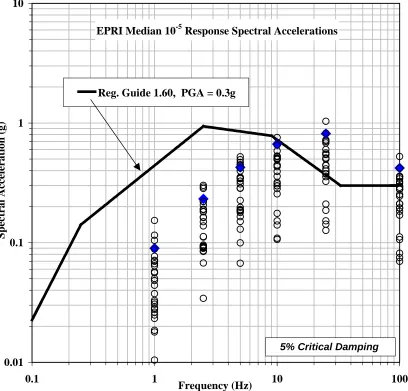
One important implication of RG 1.165 is shown in Fig. 1. In this figure, 10-5 median spectral accelerations for response frequencies of 1, 2.5, 5, 10, 25, and peak ground acceleration (PGA) are shown for twenty-eight of the twenty-nine NPP sites used by RG 1.165 to define the reference probability. The PSHA model used for the spectral accelerations of this figure is the EPRI model and the results are the EPRI results. No EPRI results were published for the twenty-ninth RG 1.165 NPP site in Callaway County, Missouri. LLNL results show a similar overall picture. For any given frequency the 10-5 median spectral accelerations vary by about a factor of ten over these twenty-eight representative NPP sites but the ratios of spectral accelerations between any two frequencies are very consistent for all sites. What is most clear from Fig. 1 is that the shapes of the 10-5 median spectra (spectra with the same probability of exceedance for all frequencies considered) are similar throughout the CEUS yet much different from the shape of the RG 1.60 spectrum.
EPRI Median 10-5 Response Spectral Accelerations
0.01 0.1 1 10
0.1 1 10 100
Frequency (Hz)
Spectral Acceleration (g)
Reg. Guide 1.60, PGA = 0.3g
5% Critical Damping
Fig. 1 - 10
-5median spectral accelerations for twenty-eight of the twenty-nine NPP sites
used by RG 1.165 to define the reference probability. The example site values are emphasized.
3. RESULTS OF IMPLEMENTING RG 1.165 – AN EXAMPLE
Consider a typical CEUS site in the Piedmont Mountains of eastern USA. A probabilistic seismic hazard analysis (PSHA) was conducted for this site during the 1989 EPRI study. The 10-5 median spectral accelerations for the site from the EPRI study are highlighted as blue filled diamonds in Fig. 1.
As recommended in RG 1.165, the following general steps were undertaken to develop seismic design ground motions for an updated evaluation for the site SSE:
• Review and update EPRI seismic source models • Review and update EPRI ground motion models
• Perform sensitivity studies or updated probabilistic seismic hazard analyses to determine whether any new seismic source or ground motion models significantly increase the published EPRI results • Derive SSE ground motions from the original or updated seismic hazard results
3.1 Seismic Source Model – Review, Update, Sensitivity Studies
In the 1989 EPRI project, six independent Earth Science Teams (ESTs) evaluated geologic, geophysical, and seismological data to develop seismic sources in the CEUS. These sources were used to model the occurrence of future earthquakes and evaluate earthquake hazards at NPP sites across the CEUS. For the 1989 EPRI seismic hazard calculations, a screening criterion was implemented so that all sources whose combined hazard was less than 1 percent of the total hazard were excluded from the analysis. Under this criterion, a total of thirty-nine
3008 Copyright © 2005 by SMiRT18
seismic sources identified by the six teams of earth science specialists controlled PSHA results over the annual probability of exceedance range of interest. (Many of these sources were effectively alternative models of a similar source.) An additional ninety-one seismic sources were considered by the specialists in the “less than 1 percent” category. For the development of an updated PSHA for the site any new geologic, geophysical, and/or seismological data found was considered and evaluated to determine if contributions from any of these or any other seismic source would have significantly changed the seismic hazard.
Review of the updated geological, seismological and geophysical database relative to the 1989 EPRI seismic source model generally showed that there are no significant changes to the EPRI source model with three exceptions:
• Identification of a recently postulated East Coast Fault System (ECFS) along the Atlantic seaboard • Revision to the recurrence interval and source geometry of the Charleston seismic source, currently
believed to be 550 years based on paleoliquefaction data, rather than several thousand years based on seismicity used in the EPRI seismic source model, and the Charleston source geometry modified to include the possibility that the 1886 Charleston earthquake occurred on the southern segment of the ECFS.
• Revision to the recurrence interval of the New Madrid seismic source currently believed to be 500 years based on paleoliquefaction data, rather than several thousand years based on seismicity used in the EPRI seismic source model.
Sensitivity analyses were performed for the ECFS and the revised Charleston seismic source to evaluate the significance of these sources to hazard at the site. The New Madrid seismic source is located over 600 miles west of the site. The results of revising the recurrence parameters of the Charleston seismic source approximately 300 miles south of the example site were used to evaluate whether the revised recurrence parameters for the New Madrid seismic source would significantly increase hazard at the site. The sensitivity analyses showed that the combined effect of new seismic source/seismicity information was small, leading to an increase of only several percent in the longer period (1 Hz) 10-5 median seismic hazard at the example site and no significant increase in the higher-frequency (10 Hz) motion.
3.2 Ground Motion Attenuation Model – Review, Update, Sensitivity Studies
Ground motion models developed by EPRI (2004) were used to examine the effects on seismic hazard of current estimates of seismic shaking as a function of earthquake magnitude and distance. For general area sources, nine estimates of median ground motion are combined with four estimates of aleatory uncertainty, giving 36 combinations. For fault sources in rifted regions, which applies to the ECFS fault segments, 12 estimates of median ground motion are combined with four estimates of aleatory uncertainty, giving 48 combinations. When both area sources and faults are active, a specific correlation of area source models and fault source models is used to represent ground motion models that might apply together. These families of models (36 for area sources, 48 for fault sources) represent the epistemic uncertainty in ground motion, and contribute to the epistemic uncertainty in seismic hazard.
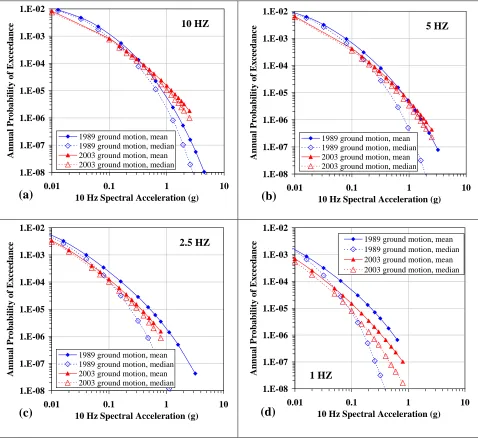
The effect of the 2004 EPRI ground motion models was determined by calculating seismic hazard using these models and the 1989 EPRI seismic sources, and comparing hazard to that using the 1989 EPRI ground motion. Examples of changes in median and mean hazard at the site caused by using the 2004 EPRI attenuation models instead of the 1989 models, and for frequencies in the 1-to10Hz range of interest for application of RG 1.165 are shown in Fig. 2.
10 HZ 1.E-08 1.E-07 1.E-06 1.E-05 1.E-04 1.E-03 1.E-02
0.01 0.1 1 10
10 Hz Spectral Acceleration (g)
Annual Probability of Exceedance
1989 ground motion, mean 1989 ground motion, median 2003 ground motion, mean 2003 ground motion, median
(a)
5 HZ 1.E-08 1.E-07 1.E-06 1.E-05 1.E-04 1.E-03 1.E-020.01 0.1 1 10
10 Hz Spectral Acceleration (g)
Annual Probability of Exceedance
1989 ground motion, mean 1989 ground motion, median 2003 ground motion, mean 2003 ground motion, median
(b)
2.5 HZ 1.E-08 1.E-07 1.E-06 1.E-05 1.E-04 1.E-03 1.E-020.01 0.1 1 10
10 Hz Spectral Acceleration (g)
Annual Probability of Exceedance
1989 ground motion, mean 1989 ground motion, median 2003 ground motion, mean 2003 ground motion, median
(c)
1 HZ 1.E-08 1.E-07 1.E-06 1.E-05 1.E-04 1.E-03 1.E-020.01 0.1 1 10
10 Hz Spectral Acceleration (g)
Annual Probability of Exceedance
1989 ground motion, mean 1989 ground motion, median 2003 ground motion, mean 2003 ground motion, median
(d)
Fig. 2 - Sensitivity of seismic hazard to ground motion model. Changes in median and
mean hazard caused by using the 2004 EPRI attenuation models instead of the 1989 models.
A major difference between the 1989 and 2004 ground motion models is that the estimates of aleatory uncertainty1 are larger in the 2004 study. In 1989, a standard deviation of natural log (ground motion) of 0.5 was used for all frequencies, whereas in 2004, values of 0.6 and 0.7 are common (they vary depending on magnitude, distance, and frequency). At annual frequencies of 10-5, which are sensitive to the tails of the ground motion aleatory distribution, this difference in standard deviation increases seismic hazard. This would likely be true for any CEUS location. A compensating factor at low frequencies (1 and 2.5 Hz) is the use of ground motion models act to reduce low frequency ground motion estimates from those used in 1989. Thus the median 1 Hz seismic hazard is about the same for both models. The mean amplitudes using the 2004 ground motion models are closer to the median amplitudes than is the case for the 1989 models, reflecting convergence on scientific consensus on what are reasonable models to use for ground motion estimation in the eastern US. In 1989, the ground motion models were quite diverse, with one model developed by estimating peak ground acceleration and velocity, then
3009 Copyright © 2005 by SMiRT18
1
3010 Copyright © 2005 by SMiRT18
using spectral amplification factors to estimate spectral amplitudes. In 2004, the available models estimate spectral amplitudes directly.
In summary, the effect of the new EPRI ground motion models is complex, depending on interplay between details of both the median ground motion relations and their aleatory uncertainties. The impact varies for different ground motion spectral frequencies and specified seismic hazard levels. At the highest-frequency (10 Hz) ground motion and seismic hazard level (10-5 median seismic hazard) specified under RG 1.165 guidance, increased aleatory uncertainty in the new EPRI ground motion models results in spectral accelerations over 55 percent higher than the previous EPRI model. Therefore, the change in ground motion models would likely result in significant changes in hazard predictions for the selected plant sites used to estimate the reference probability as shown in RG 1.165, Table B.1.
If general revisions to PSHA methods or data bases result in significant changes in hazard predictions for the selected plant sites in Table B.1 of RG 1.165, Appendix B, the RG provides the methodology that should be used to determine a revised reference probability. The procedure specified in RG 1.165, Appendix B, to establish a reference probability requires a three-step calculation of the seismic hazard results for the twenty-nine sites of Table B.1. First, the seismic hazard must be determined at each site for spectral responses at 5 and 10 Hz. Second, the composite annual probability of exceeding each site’s licensing-basis SSE must be determined for spectral responses at 5 and 10 Hz using median hazard estimates. Finally, a reference probability must be determined by finding the median of the distribution of annual exceedance probabilities for the 29 plants in Table B.1. Any revised calculation of the reference probability, therefore, would require a new seismic analysis for the remaining twenty-eight sites of Table B.1.
3.2 RG 1.165 Design Ground Motion
The goal in selecting an SSE ground motion spectrum is to achieve a seismic design that provides adequate protection of the public health and safety. RG 1.165, Appendix B, outlines a means of achieving this goal by establishing a reference probability (RP) for the SSE ground motion that is equivalent to the safest 50 percent of existing nuclear plants. This approach ensures that the seismic design of a new plant will be equivalent, in terms of annual probability of exceedance, to existing plants. This relative measure relies on scientific and regulatory precedent set during the licensing of the twenty-nine NPPs of RG 1.165, Appendix B, Table B1.
RG 1.165, Appendix B, Section B.3 recognizes, however, that there are situations in which it is appropriate to establish a new RP on which design-basis ground motions should be calculated, including, “…if general revisions to PSHA methods or data bases result in significant changes in hazard predictions for the selected plant sites in Table B.1.” As discussed in the following paragraphs, the PSHA and related analyses performed for the site being considered indicate that a new RP is appropriate. Further, it appears that this conclusion may be reached at many locations in the CEUS as additional sites are evaluated.
Three factors contributing to a change in the reference probability recommended in RG 1.165 were identified:
• The revised CEUS ground motion attenuation models of the EPRI (2003) study.
• Use of mean rather than median hazard estimates.
• The shorter recurrence interval estimates for major earthquakes in the Charleston and New Madrid areas.
The revised EPRI ground motion models, as discussed above, indicate generally higher ground motions and aleatory uncertainties at high frequency amplitudes of interest than previous models, resulting in greater hazard estimates for a given return period (see Fig 2). Conclusions with respect to lower frequencies are more complex, but not as critical in the present USNRC regulatory environment because of the considerable margin between PSHA and standard design response spectrum format spectral acceleration values at these lower frequencies (see Fig. 1).
As Fig. 2 also shows, use of the mean hazard instead of the median hazard will imply a higher reference probability for a fixed ground motion level, since the mean hazard curve lies above the median hazard curve. The mean is computationally an easier statistic to use than the median and the mean ground motion hazard value is the one specified for the performance-based method discussed below. The median statistic was specified in RG 1.165 at least in part because its value in the LLNL and EPRI studies was, by happenstance, in better agreement than the mean values in these two studies. The better agreement between mean and median in the EPRI 2003 study (see Fig. 2) and advances in rigorous methods of incorporation of scientific uncertainty in an expert elicitation process (see USNRC, 1997) argue that this disparity would not likely be as significant an issue today.
3011 Copyright © 2005 by SMiRT18
intervals increase the seismic hazard at sites affected by large earthquakes in these regions. Therefore, the sites listed in RG 1.165, Table B.1 that are relatively close to New Madrid or Charleston would potentially have a greater seismic hazard today than was used in deriving the RP in RG 1.165.
In the absence of detailed PSHA analysis of all twenty-nine RG 1.165 NPPs, the effects of these and other factors (such as the discovery of any new potential earthquake sources in the CEUS) on the current 10-5 median reference probability (or an alternative mean probability) can only be estimated. The combined effect of these three factors could increase the reference probability by a factor of 5 or more. That is, the reference probability for the mean hazard may be 5×10⁻⁵ or higher. Thus, for a site in the CEUS, an SSE ground motion level consistent with a mean hazard of 5×10⁻⁵ is appropriate. The higher reference probability still satisfies the fundamental safety goal that the SSE ground motion is equivalent to the safest 50 percent of existing nuclear plants.
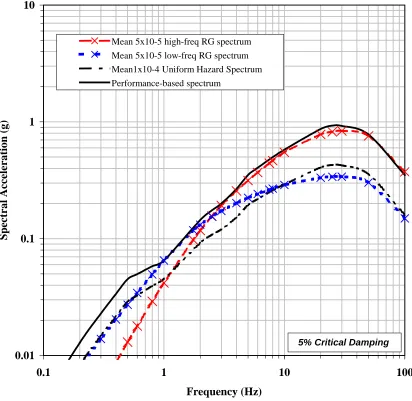
Mean PSHA results were found for the 1, 2.5, 5, and 10 Hz frequencies of interest, and the 1 to 2.5 Hz and 5 to 10 Hz controlling earthquakes were computed, under the RG 1.165 methodology at a reference probability of 5×10⁻⁵. High frequency and low frequency spectra scaled to these average 1 to 2.5 Hz and 5 to 10 Hz amplitudes and with spectral shapes based on the recommendation of Risk Engineering, Inc. (2001) are shown in Fig. 3.
0.01 0.1 1 10
0.1 1 10 100
Frequency (Hz)
Spectral Acceleration (g)
Mean 5x10⁻⁵ high-freq RG spectrum Mean 5x10⁻⁵ low-freq RG spectrum Mean1x10-4 Uniform Hazard Spectrum Performance-based spectrum
5% Critical Damping
Fig. 3 - Comparison of Reference Probability and Performance-Based Spectra.
3.3 A “Performance-based” Approach
3012 Copyright © 2005 by SMiRT18
NUREG/CR-6728 (Risk Engineering Inc., 2001). This approach develops a “performance-based-spectrum” that has a mean annual frequency of 10-5 of unacceptable performance of nuclear structures, systems, and components as a result of seismically initiated events. The performance-based spectrum is achieved by starting from a ground motion spectrum with a selected mean annual frequency of exceedance, and modifying this spectrum by a scale factor that is based on the slope of the mean seismic hazard curve between 10-4 and 10-5. Although based on a different statistic (mean rather than median ground motion of RG 1.165), the same source and ground motion models can be used in both cases. And as proposed above the procedure of RG 1.165 can yield SSE estimates is terms of mean as well as median hazard curves.
The performance-based spectrum is derived so that the mean frequency of onset of significant inelastic deformation (FOSID) for structures, systems, and components (SSCs) is 10-5 per year. The FOSID is a conservative estimate of the frequency of unacceptable performance for an individual SSC, and the frequency of unacceptable performance of an individual SSC is a conservative estimate of the frequency of seismically induced core damage (or the SCDF, the seismic core damage frequency). Thus, the goal of achieving a mean SCDF of 10-5 is achieved in a conservative fashion by designating a design spectrum based on a mean FOSID of 10-5.
The basis for choosing a mean annual risk of 10-5 for unacceptable performance is similar to the basis for choosing a median annual hazard of 10-5 for unanticipated ground motion: these are the median values for existing NPPs. An analysis of mean SCDFs for twenty-five NPPs where these frequencies have been quantified through seismic probabilistic risk assessments (SPRAs) using the EPRI (1989) seismic hazard curves shows that the 10-5 criterion for mean FOSID falls at about the 40 percent point of the existing plant cumulative distribution, meaning that about 60 percent of the twenty-five plants have an SCDF higher than this value. Again, the analogy with Figure B1 of RG 1.165 is clear.
One important advantage of the performance-based criterion is that it is based on a relative measure of robustness in design for the NPPs whose SPRAs were developed. In order to maintain an expectation of acceptable plant performance if new geologic, seismologic, or geophysical evidence is proposed that would increase the shaking hazard at the plant site, enhancements may be made to the design of an individual plant’s SSCs without regard to how this new geoscience information might affect the hazard at other sites. When, as it is under RG 1.165, the criterion is relative ground motion hazard at twenty-nine widely distributed sites, the effect of this new information at any particular site can only be determined after evaluation of its effect on ground motion at all twenty-nine sites.
The performance-based spectrum is achieved by starting from a ground motion spectrum with a mean 10-4 annual frequency of exceedance, and modifying this spectrum by a scale factor that is based on the slope of the mean seismic hazard curve between 10-4 and 10-5 for a suite of response spectrum frequencies. For the site being examined here the scale factor was found to increase the mean 10-4 ground motions by a factor of 1.40 to 1.64 across the frequency range 0.5 Hz to 100 Hz.
Both the mean 10-4 ground motions uniform hazard spectrum and the scaled performance-based design response spectrum are shown in Fig. 3.
Comparing the envelope of the mean 5 x 10⁻⁵ per year high and low frequency RG 1.165 design spectra and the performance-based design spectrum in Fig. 3 with each other and with the EPRI (1989) 10-5 median spectral amplitudes for the example site in Fig. 1, it is clear that each approach can yield similar results, under reasonable assumptions, leading to consistently conservative design for new and existing NPPS. The acceptability of these several approaches within the regulatory licensing arena is currently being worked through.
4. SOME ADDITIONAL ENGINEERING CONSIDERATIONS
What is also clear from a comparison of the any of the design spectra of Fig. 3 with the conventional RG 1.60 design response spectrum of Fig. 1 is that the CEUS spectra all have a fundamentally different shape than the RG 1.60 spectrum. All evaluations of CEUS design spectra beginning with the LLNL and EPRI studies predict much greater high frequency spectral amplitudes and much smaller low frequency spectral amplitudes, each relative to the conventional measure of peak acceleration, than does RG 1.60. RG 1.165 accommodates these differences fairly well in the 1-to10 Hz range of the “frequencies of interest,” but leaves unaddressed any regulatory stance on the importance of design spectral amplitudes outside this frequency range. As shown in Fig. 1, although almost every one of the twenty-nine NPP sites used in developing the reference probability of RG 1.165 would be adequately enveloped within the 1-to-10 Hz frequency range by a RG 1.60 spectrum scaled to a peak ground acceleration (PGA) of 0.30g, only about one-fourth of these same plants would pass this test at a spectral frequency of 25 Hz and about one-third would fail at the very high frequencies of the PGA. Since the twenty-nine NPPs of RG 1.165 were chosen because they represented relatively recently designs that explicitly used RG 1.60, should the industry infer that these higher frequency exceedances are not of regulatory concern?
3013 Copyright © 2005 by SMiRT18
From a structural engineering perspective, the spectra shown in Fig. 3 represent the maximum elastic responses of a number of 5 percent critically damped, single-frequency oscillators mounted on small, light pads on the free ground surface. Such small oscillators would not have sufficient mass to cause the modification of the input motion and would probably experience the high accelerations predicted by the response spectra shown.
However, large structures modify the ground motion so that the shaking experienced by these structures is different than predicted by the Fig. 3 spectra. Comparison of spectra obtained from the recorded motions on the base mat of large structures with input motions having high-frequency energy shows substantial differences (Chang et al., 1986). The accelerations calculated from the recorded motions are far less than those of the input motion, particularly for frequencies above 10 Hz.
In order to obtain a realistic design spectrum, factors must be considered that affect the shape of the spectrum experienced by structures with large base mats, such as those typical of nuclear power plants. Factors that affect the motion of the base mat include:
• Horizontal spatial variation and incoherence of the ground motion,
• Vertical spatial variation of the ground motion, scattering effects, and soil-structure interaction.
The first factor is more prominent for structures with large plan dimensions and would reduce the input into the structure at high frequencies. This effect is more pronounced at rock sites. The vertical spatial variation is more prominent at soil sites and again would reduce the amplitude of high frequency motions (Jack R. Benjamin and Assoc., Inc and RPK Structural Mechanic Consulting, 1993). Incoherence has been recognized in the national standard for seismic analysis of safety-related structures and significant reductions in the SDS have been recommended (ASCE, 2000).
In addition to the spatial variations of the ground motions, observations after strong earthquakes indicate that high-frequency accelerations are less damaging to well-engineered structures (Jack R. Benjamin and Assoc., Inc and RPK Structural Mechanic Consulting, 1993). This is though to be because high frequency motions are associated with small displacements and well-engineered structures have ample capacity to dissipate the corresponding limited energy without significant damage. Structures suffer severe damage only when the story drifts are relatively large, as observed during earthquake damage inspections. Large story drifts occur when the energy content of the input motion is high between about 1 and 10 Hz. Above 10 Hz, the energy content is low and the story drifts are small, resulting in essentially elastic response and no visible damage. Modification of this nature to the UHS would be based on the principle of equal risk across the entire frequency range and would be a refinement to the performance-based approach.
The reduction in spectral accelerations in the high frequency range is also justified considering the responses of the sub-systems. Structural response is unlikely to be significantly influenced by the high frequency content of the ground motion because of the filtering due to the presence of low natural frequency modes with high participation factors, which is typical for nuclear plant structures. And these high spectral accelerations are accompanied by small displacements. Most sub-systems have adequate energy dissipation capability to accommodate such small displacements without failure. Nonlinear time history analyses demonstrate that these high-frequency motions are less damaging compared to low-frequency motions. Based on these studies, a methodology for the reduction of spectral accelerations in the high frequency range has been developed (Jack R. Benjamin and Assoc., Inc and RPK Structural Mechanic Consulting, 1993).
Finally, use of spectra like those of Fig. 3 without modification will make it difficult to obtain realistic structural responses. From simply the point of view of our ability to analyze in-structure response, it may be difficult to capture these high frequency effects as the motions propagate through the structure. The analytical methods would have to consider smaller dimensions and time steps requiring, even if computationally practical, more detailed information about the spatial distribution of physical properties of structural elements than it may be practical to obtain. Therefore, a method that will maintain a sufficient degree of accuracy in the predicted seismic responses while obviating the need for such refined modeling is needed.
5. CONCLUSIONS
RG 1.165 uses criteria that focus on the relative seismic hazard at representative existing NPPs within the frequency range 1-to-10Hz (with emphasis on the 5-to-10Hz range) but defines seismic design response spectra for future NPPs over a broader frequency range. For frequencies greater than 10Hz this imposes relatively higher design levels than implied by the design requirements for existing plants.
3014 Copyright © 2005 by SMiRT18
revisions to the LLNL and EPRI database are to be undertaken periodically (about every 10 years), this has not happened nor is it planned.
Incorporation into the PSHA analysis of updated estimates of the frequency of occurrence of major, potentially damaging earthquakes in the Charleston, South Carolina, and New Madrid, Missouri, areas of the CEUS has only a small effect for sites that are distant from both sources. This effect would be expected to be greater for sites closer to Charleston or New Madrid.
The effect of updated strong ground motion attenuation models is significant, especially for higher-frequency spectral accelerations. This effect is expected to be general for any PSHA update throughout the CEUS because it is due in part to in increase in the random (aleatory) uncertainty in the revised attenuation models and because the principal contributors to these high-frequency motions are likely to be moderate, nearby earthquakes that are widely distributed throughout the CEUS.
Use of the mean (a more widely and easily used statistic than the median), the revised CEUS attenuation models, and new estimates for the average repeat times for major earthquakes in Charleston, SC, and New Madrid, MO, increased the reference probability of RG 1.165 to a value of about 5×10⁻⁵ per year. This value may well be representative of many CEUS sites, but a complete recalculation of this reference probability is unlikely to be undertaken by any single utility and appears beyond the immediate reach of the power industry.
The performance-based approach appears to offer an alternative way to develop SSE ground motions. Under reasonable assumptions this approach yield similar ground motion design values. A principal advantage of this approach is its reliance on acceptable risk, which is defined by an appropriate scale factor increasing ground motions with a specified probability of exceedance at a particular plant.
All approaches considered clearly imply a different design response spectrum shape for CEUS sites than the general RG 1.60 shape that has been deeply embedded in NPP licensing thinking and regulation. Efforts to formally recognize and overcome this issue, begun but essentially abandoned years ago as the licensing of new NPPs in the US stopped, are new being renewed.
Successful and timely resolution of these issues will significantly impact the future of nuclear power in the US.
REFERENCES
American Society of Civil Engineers (2000). “Seismic Analysis of Safety-Related Nuclear Structures and Commentary,” ASCE 4-98.
American Society of Civil Engineers (2003). “Seismic Design Criteria for Structures, Systems, and Components in Nuclear Facilities and Commentary,” ASCE draft standard, July 25, 2003.
Chang, C. Y., et al. (1986). “Engineering Characterization of Ground Motion – Task II: Observational Data on Spatial Variations of Earthquake Ground Motion,” NUREG/CR-3805, Vol. 3, Prepared for the Nuclear Regulatory Commission, February 1986.
Code of Federal Regulations, (2002). “Title 10 – Energy, Chapter I – Nuclear Regulatory Commission, Part 100 – Reactor Site Criteria, Appendix A”, [10CFR100] revised (on line) January 1, 2002
[ http://www.access.gpo.gov/nara/cfr/waisidx_03/10cfr100_03.html ].
Electric Power Research Institute [EPRI] (1989). "Probabilistic Seismic Hazard Evaluations at Nuclear Power Plant Sites in the Central and Eastern United States: Resolution of the Charleston Earthquake Issue," EPRI Report NP-6395-D, Project P101-53, Special Report, April 1989.
Electric Power Research Institute [EPRI] (2004). “CEUS Ground Motion Project Final Report,” EPRI, Palo Alto, CA, Dominion Energy, Glen Allen, VA, Entergy Nuclear, Jackson, MS, and Exelon Generation Company, Kennet Square, PA: 2004. 1009684.
Jack R. Benjamin and Associates, Inc. and RPK Structural Mechanics Consulting. (1993). “Analysis of High-Frequency Seismic Effects,” Report EPRI TR-102470, prepared for EPRI, October 1993.
Risk Engineering, Inc. (2001). “Technical Basis for Revision of Regulatory Guidance on Design Ground Motions: Hazard- and Risk-consistent Ground Motion Spectra Guidelines,” USNRC, Report NUREG/CR-6728, October 2001.
Sobel, P. (1994). “Revised Livermore seismic hazard estimates for sixty-nine nuclear power plant sites east of the Rocky Mountains,” USNRC, Report. NUREG-1488, April 1994.
U. S. Department of Energy (2002)..”Natural phenomena hazards design and evaluation criteria for Department of Energy Facilities, U.S. Department of Energy, Washington, D.C., Rept. DOE-STD-1020-2002,
January 2002.
3015 Copyright © 2005 by SMiRT18
U. S. Nuclear Regulatory Commission (1997). “Regulatory Guide 1.165 - Identification and Characterization of Seismic Sources and Determination of Safe Shutdown Earthquake Ground Motion.”