
Charge and the dry-strength performance of polyampholytes. Part 2. Colloidal effects
28
0
0
Full text
(2) The motivation for the present work was to help explain the superior performance of polyampholytes, polymers that bear both positive and negative ionizable groups, for the enhancement of bonding in paper. It has been shown that addition of solutions of polyampholytes to slurries of papermaking fibers can result in paper strength increases that exceed what can be achieved with simple polyelectrolyte dry-strength additives [1-4]. In particular we wanted to find out whether the superior performance of polyampholytes was related to some unique colloidal characteristics of this class of polymers. The word “colloidal” is used in this article in two senses. First, the field of colloid science has been deeply concerned with issues of suspension stability, deposition, and inter-particle forces governing suspended matter. Second, the root of the word colloid comes from the Greek kolla eides, meaning a “glue-form” material. The word seems doubly apt when describing water-dispersed materials having high capability to serve as bonding agents. Early evidence of polyampholytes’ unique colloidal characteristics was obtained by Alfrey and coworkers [5], who were the first to synthesize research materials of this type. They showed that polyampholytes tended to come out of solution within an intermediate range of pH, at which ionic charges of both sign were present on the molecular chain. Subsequent work showed that the viscosity of the polyampholyte solutions was at a minimum in the isoelectric pH region [4,6-9]. Turbidimetric and “optical density” measurements also have been used to elucidate changes, due to variation in pH or electrolyte conditions, in the solutions properties of polyampholytes [8]. The same type of approach also has been employed in studying the regions of destabilization when varying the relative amounts of cationic and anionic polyelectrolytes in the formation of polyelectrolyte complexes [10-11]..
(3) Another colloidal technique that has been shown to be a very sensitive way to probe weak colloidal interactions between solids suspended in liquid is the determination of sediment volumes [12-14]. An inverse relationship is often found between colloidal stability and the volume resulting from sedimentation of the particulate matter [15]. The usual explanation for such phenomena is that attractive interactive forces cause sticking collisions among particulates or fibers in a colloidally unstable suspension, upon their initial contact, resulting in a relatively voluminous aggregated structure. By contrast, particles experiencing a net repulsion, upon their approach to each other, would be expected to slide past each other, allowing for the formation of relatively dense sediment. In terms of the present study the sediment volume method provides a way to sense phenomena having importance at the limit of low interactive forces, in essentially stagnant solution. Gruber et al. [14] were apparently the first to employ the sediment volume method to evaluate effects of polyelectrolyte treatments on cellulosic fibers of the type used in paper manufacture. They observed that the sediment volume of a refined kraft pulp increased by about a factor of two following treatment with a high-charge, intermediate-mass polymer. Alince and Robertson [13] studied the increases in sediment volume of microcrystalline cellulose resulting from their treatment with highly cationic polyelectrolytes. In cases where the treated suspension was settled, agitated, then allowed to settle for a second time, these authors observed maximum sediment volume corresponding to charge neutralization by the polyelectrolyte. Neyret et al. [16] applied related methods in the case of polystyrene latex suspensions treated with polyampholytes or polyelectrolytes. Maximum sediment volume was associated with intermediate levels.
(4) of polymer treatment, consistent with charge neutralization and charged patch mechanisms of colloidal destabilization [17-18]. Though the results corresponding to the polyampholyte treatments were generally similar to those for the polyelectrolytes, the authors found evidence for charge-biased molecular rearrangements of the polyampholyte conformations, tending to result in more restabilization, with the passage of time, of the treated systems. Since papermaking operations can involve a wide range of hydrodynamic shear conditions [19], it is also important also to assess the colloidal stability of polyampholytetreated fibers in the presence of flow. Hubbe [20], as well as Burgess et al. [21] have reported a modified version of the photometric dispersion analyzer test [22], making the method suitable for evaluation of fiber suspensions. The device works by detecting and evaluating fluctuations in the intensity of light transmitted through a transparent tube, through which the suspension is pumped. The tubing in the original device had an internal diameter in the range 1-3 mm, which was ideal for the study of latex suspensions, in which the particles were of colloidal size. The test was later modified [20] by the use of much larger transparent tubing (internal diameter 6.35 mm), as well as a modification in the signal electronics, in order to accommodate cellulosic fibers.. 2. Experimental 2.1. Materials Experiments were conducted in deionized water prepared with an ion-exchange system from Pureflow, Inc. Inorganic chemicals all were of reagent grade..
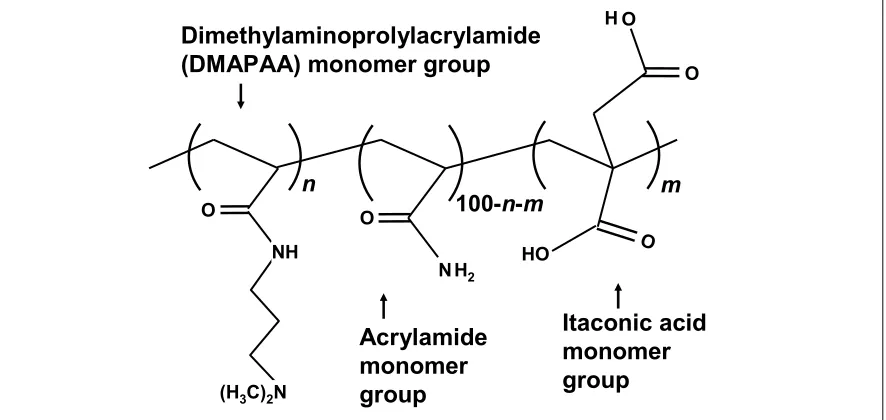
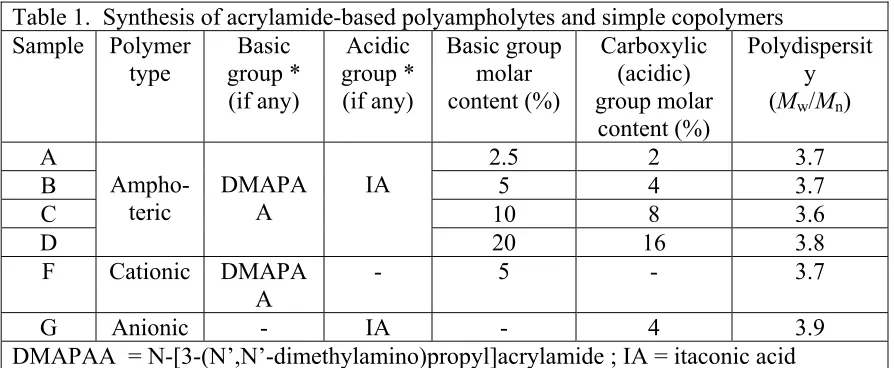
(5) Polyampholyte and polyelectrolyte samples were prepared as described earlier [4] by free-radical polymerization, following the recipes of charged monomers indicated in Table 1. The general composition of these random terpolymers and copolymers is as shown in Fig. 1. The cationic monomer was N-[3-(N’,N’dimethylamino)propyl]acrylamide (DMAPAA), a tertiary amine. The anionic monomer was a dicarboxylic acid (IA), itaconic acid. In each case a sufficient amount of neutral acrylamide monomer was added to comprise 100% on a molar basis. The compositions of the prepared materials are shown in Table 1. The results of 1H and 13C nuclear magnetic resonance (NMR) tests showed close agreement with the synthesis recipes. The molecular mass of all polymer samples ca. 3 x 10⁶ Daltons. The polydispersity values (Mw/Mn) in the range 3.6-3.9 are typical for polyacrylamide-based dry-strength additives.. Dimethylaminoprolylacrylamide (DMAPAA) monomer group. n O. O NH. (H3C)2N. HO O. m. 100-n-m N H2. Acrylamide monomer group. HO. O. Itaconic acid monomer group. Fig. 1. Molecular composition of model polyampholytes prepared by random, freeradical polymerization.
(6) Table 1. Synthesis of acrylamide-based polyampholytes and simple copolymers Sample Polymer Basic Acidic Basic group Carboxylic Polydispersit type group * group * molar (acidic) y (if any) (if any) content (%) group molar (Mw/Mn) content (%) A 2.5 2 3.7 Ampho- DMAPA IA B 5 4 3.7 teric A C 10 8 3.6 D 20 16 3.8 F Cationic DMAPA 5 3.7 A G Anionic IA 4 3.9 DMAPAA = N-[3-(N’,N’-dimethylamino)propyl]acrylamide ; IA = itaconic acid 2.2 Fiber Slurry Preparation Bleached hardwood kraft fibers were refined for 5 minutes and 40 seconds with a laboratory Hollander refiner (Valley Machinery Co., Appleton, WI) to a Canadian Standard Freeness value (TAPPI Test T227) of 440 ml. The refined fibers were then placed in the final chamber of a Bauer-McNett classifier apparatus (see TAPPI Method T233) fitted with a 200-mesh screen. The classifier was run for 15 minutes, per batch, to substantially remove fiber fines from the refined fibers. The decrilling procedure was carried out to simplify interpretation of results to be obtained later, since any polymer becoming adsorbed onto fibers would be sure to be retained in the paper. Because fines are expected to play a significant role in the development of paper properties, it will be understood that the present study is designed to predict relative, rather than absolute effects on paper strength. The decrilled suspension had a freeness of approximately 600 ml. 2.3 Paper Strength Evaluation.
(7) For preparation of laboratory test sheets (“handsheets”) the fibers were resuspended as a 0.5% slurry in 10-4 M sodium bicarbonate solution, to which sufficient sodium sulfate had been added to reach an electrical conductivity of 1000 µS/cm at 23 oC. The electrical conductivity was selected in order to ensure that the results were relevant to the aqueous conditions encountered during the manufacture of paper. Polyampholyte solutions were added with constant stirring at selected levels to the 0.5% solids suspension. Handsheets were prepared with a British sheet mold, following TAPPI Method T205. In order to maintain the same salt concentration during formation of the paper, 50 ml sodium sulfate was added to the handsheet mold just before fiber slurry was added to make a sheet. 2.4 Evaluation of Polymer Aqueous Mixtures Experiments were carried out by adding 0.25 ml of 0.1 N HCl to 45 ml of deionized water, followed by 5.0 ml of a 1.0% solids solution of the polymer of interest. The mixture was stirred gently at a pre-selected speed with a magnetic stirrer for at least 30 seconds prior to testing. Turbidity measurements were carried out with a DRT-15CE Turbidimeter. Four replicate measurements were made of each mixture. Incremental addition of 0.1 N NaOH were used to adjust the pH within the range 3<pH<11, with at least 30 seconds of stirring before each turbidity value was recorded. 2.5 Adsorption onto Cellulosic Fibers To determine the amounts of polymer adsorbed from solution onto cellulosic surfaces, 10 ml of 0.1% polymer solution was added to 200 ml of 0.5% solids decrilled hardwood kraft fiber suspension, having a supporting electrolyte of 10-4 M sodium.
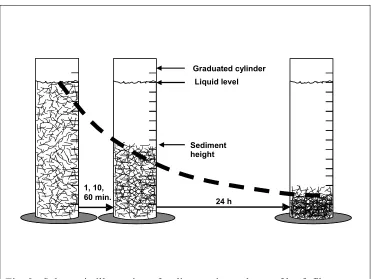
(8) bicarbonate, to which sufficient sodium sulfate had been added to reach an electrical conductivity of 1000 µS/cm at 23 oC. The suspension was stirred for 5 minutes, then filtered through a 400-mesh stainless steel screen. The filtrate was adjusted to pH=3 with HCl addition, and the conductivity was raised to 2000 µS/cm. An aliquot of the filtrate was then titrated with 0.0001N polyvinylsulfate potassium salt (PVSK) to a streaming current endpoint of 0.0, as determined by a Mütek PCD-05pH device from BTG. 2.6 Sediment Volume Tests Each individual measurement was initiated by taking 2000 ml from a master batch of 0.5% consistency stock, optional addition of polyampholyte (except for the blank), mixing, and separation into four equal portions for a flocculation test (see next) and three replicate sediment volume tests. As in the handsheet tests described earlier, the supporting electrolyte included 10-4M sodium bicarbonate and sufficient sodium sulfate to raise the electrical conductivity at 23 oC to 1000 µS/cm. The pH was close to neutral in each case. After addition of the selected type of ionic polymer at 0.05, 0.2, and 2.0 % levels, based on oven-dry fiber mass, samples were mixed thoroughly for 30 seconds and then left to stand in 500 ml graduated cylinders. The level of sediment was recorded after 60, 600, 3600 seconds and after 24 hours. Results were interpreted as illustrated in Fig. 2. The height of sediment was recorded after 1, 10, 60 minutes, and after 24 hours of sedimentation. The data to be reported were obtained after 24 hours in each case, based on the observation that those results tended to show a greater differentiation among the treatment conditions..
(9) Graduated cylinder Liquid level. Sediment height. 1, 10, 60 min.. 24 h. Fig. 2. Schematic illustration of sedimentation volume of kraft fiber suspensions treated with ionic polymers 2.7 Flocculation Tests Immediately after recording the “one minute” observation of the sediment volume test, as just described, the remaining 500 ml of the sub-batch was placed into a 1000 ml plastic beaker with a stir-bar. A modified Photometric Dispersion Analyzer (PDA) having a low gain modification and 6.35 mm internal diameter tubing was used, as previously described [20]. The two gain constants were set to “1.0,” and the “RMS” and “Filter” buttons were depressed. A peristaltic pump was used to supply a flow of approximately 530 ml/min. After running the PDA for 30 seconds, data were collected each second for ten measurements. The process was repeated with incrementally higher dosages of polymer to detect any effects on flocculation. 2.8 Zeta Potential of Derivatized MCC Probe Particles.
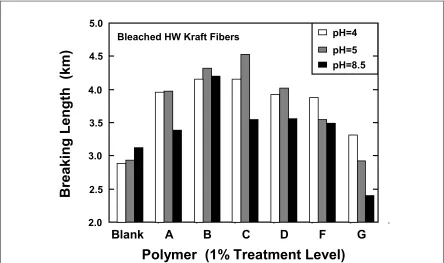
(10) Effects of the charged polymers on zeta potential were evaluated by the use of surface-derivatized microcrystalline cellulose (MCC) particles having either a strong positive or a strong negative zeta potential. The preparation is described elsewhere [23]. Briefly stated, 20 µm microcrystalline cellulose powder was reacted with either 3-chloro2-hydroxy-1-propanesulfonic acid, sodium salt hydrate, or with (3-chloro-2hydroxypropyl) trimethyl-ammonium chloride. After extensive rinsing and resuspension in 1000 µS/cm sodium sulfate solution, the zeta potential of the cationic particles was nearly constant at about +18 mV within the range 3<pH<8. The zeta potential of the anionic particles was about in the range -20 to -30 mV for pH values of 3 or more. Dilute suspensions of the prepared MCC particles were prepared in 1000 µS/cm sodium sulfate solution, which also contained 10-4 molar sodium bicarbonate to stabilize the pH near to the neutral point. Zeta potentials were evaluated by microelectrophoresis with a LazerZee device after addition of charged polymer at the addition levels (dry on dry basis) to be indicated in the text. 3. Results and Discussion 3.1 Tensile Strength due to Polyampholyte Treatments Figure 3 shows results of tensile strength evaluation of paper sheets formed under standard conditions from bleached hardwood kraft fibers, some of which had been treated with different polymers at the 1% level, based on dry mass. Tests were carried out at 1000 µS/cm, and the pH had been pre-adjusted to the values shown before addition of the ionic polymers. The relative standard deviation of replicate data, for these tests, was generally about 5%. Thus, differences smaller than about 0.2 km of breaking length can be neglected. As shown, treatment with the polyampholytes, labeled as polymers A.
(11) through D in the figure, all increased the tensile strength of the paper, consistent with a strengthening of inter-fiber bonding. Some of the results with polyampholyte treatments gave superior strength gains compared to treatment with the polyelectrolyte samples F and G, which had similar molecular mass and the same proportions of either acidic or basic monomeric groups as polymer B.. 5.0. pH=4. Breaking Length (km). Bleached HW Kraft Fibers. pH=5. 4.5. pH=8.5. 4.0 3.5 3.0 2.5 2.0. Blank. A. B. C. D. F. G. Polymer (1% Treatment Level) Fig. 3. Effect of macromolecular composition and pH on the tensile strength of polymertreated bleached kraft fibers at 1000 µS/cm conductivity Results corresponding to the simple polyelectrolytes, samples F and G, can be explained in terms of charge interactions. Polymer F, which contains tertiary amine groups, giving it a positive ionic character, yielded results that were clearly superior to treatment with the polyelectrolyte G, which contains anionic carboxylate groups. Separate evaluations of the electrokinetic properties of bleached hardwood kraft fibers revealed a negative zeta potential at pH values higher than about 2.5 [24-26], so it is not.
(12) surprising that the positively charged polyelectrolyte should function more effectively as a bonding agent. Though the negative ionic charge of a bleached kraft fiber is known to increase moderately with pH in the range between 4 and 9.5, the effects of pH in Fig. 3 are perhaps best explained with reference to the net charge of the synthetic polymers. The degrees of dissociation of both carboxylic acid groups on the itaconic acid monomer group, as well as the tertiary amine functions on polyampholyte samples A through D are expected to be functions of pH [8,27]. The net ionic charge of the polyampholytes goes from being positive at low pH to a negative at high pH. Separate evaluation by means of streaming current titrations [28] showed that the isoelectric points of polyampholyte samples A through D all were at pH≈7.5. It follows that at pH=8.5 the polyampholytes all were net negative in charge. These results are generally in agreement with the work of Yoshizawa et al. [29], who showed in the case of amphoteric starches that electrostatic interactions between the negatively charged groups on the fiber surface with the positive groups on the polyampholyte were of dominant importance for efficient adsorption. Concentrating next on results of tests carried out at acidic pH values (Fig. 3), maximum strength gains were observed corresponding to the polyampholytes having intermediate charge density, i.e. samples B and C. Sample B contained 5 mole percent tertiary amine groups and 4 mole percent carboxyl groups, whereas sample C contained twice these molar levels of ionizable monomeric groups. One possible way to rationalize the maximum strengthening effect when using a polyampholyte of intermediate charge density is to assume that the interactions are governed by the net charge of the additive. Based on this assumption, polymer interaction with the negative fiber surfaces would be.
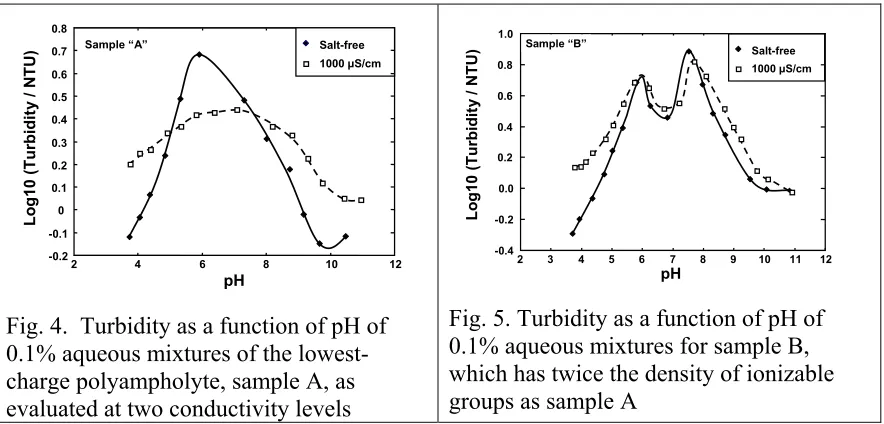
(13) expected initially to increase with increasing positive charge of the polymers. Then, beyond a certain point of increasing charge density, it can be expected that the surfaces would tend to become over-charged with net-cationic polymer, decreasing the amount adsorbed, as well as the effectiveness of the treatment in terms of bond enhancement. 3.2 Effects of pH and Charge Density on Colloidal Stability Various colloid-chemical tests were carried out in an effort to account for the strength results shown in Fig. 3. Tests involving aqueous mixtures and solutions with only the polymers and supporting electrolyte will be considered first. Turbidity tests, supplemented by visual examination, were used as an initial indication of the relative stability of the model polyampholytes and polyelectrolytes examined in this study (see Experimental). Parallel tests were carried out in the absence of salt and with sufficient sodium sulfate present to give an electrical conductivity of 1000 µS/cm at 23 oC. Figure 4 shows results obtained with the polyampholyte sample having the lowest density of ionizable groups, 2.5 mole % of tertiary amine functions and 2 mole % of carboxyl functions. Either of the two curves shown in Fig. 4 can be qualitatively explained based on an increased ability of positive and negative ionic groups within the polyampholyte to interact with each other as the pH approaches the range within which the densities of polymer-bound, dissociated ionic groups are approximately equal. A tendency for pairing of oppositely charged ions within the macromolecule favors the release of the counter-ions toward the bulk of solution, leaving the polyampholyte in a partially neutralized and collapsed state [8, 30-31]. Results generally were consistent with the observed polymer solution viscosity results reported earlier [4]..
(14) When comparing the two sets of results for salt-containing and salt-free solutions, it might be said that Fig. 4 provides a textbook demonstration of the so-called “antipolyelectrolyte” effect. In other words, in the vicinity of the isoelectric pH of polyampholyte solutions it is sometimes observed that an increased salt concentration tends to make the polymer more expanded in solution and less ready to precipitate [6,8,31-32]. The effect is at least partly due to a screening effect of the monomeric ions, reducing the strength of complexation interactions among oppositely charged groups within the same or adjacent macromolecule(s). By contrast, at pH values farther removed from the isoelectric pH it can be expected that either positive or negative ionic charges will dominate to such an extent that the polymer behaves more like a simple polyelectrolyte, becoming less stable in solution with increasing salt. If Fig. 4 can represent a textbook example of the “anti-polyelectrolyte effect,” then Fig. 5, obtained with polyampholyte having a higher charge density, might be considered to be the perfect counter-example. The ratio of ionizable groups was kept the same as in Fig. 1, but the molar density of each was increased by a factor of two. Except at pH values below about 6, the turbidity results obtained in the presence and absence of added sodium sulfate almost overlapped each other. Though the general explanation for the higher turbidity values in the pH range between about 5.5 and 9 are identical to those cited in the case of Fig. 4, it is necessary to explain a local minimum occurring at neutral pH. Based on visual observations it was apparent that phase separation of the polyampholyte from solution occurred to such an extent at near-neutral pH, producing large, isolated flocs that were no longer efficient for the scattering of light..
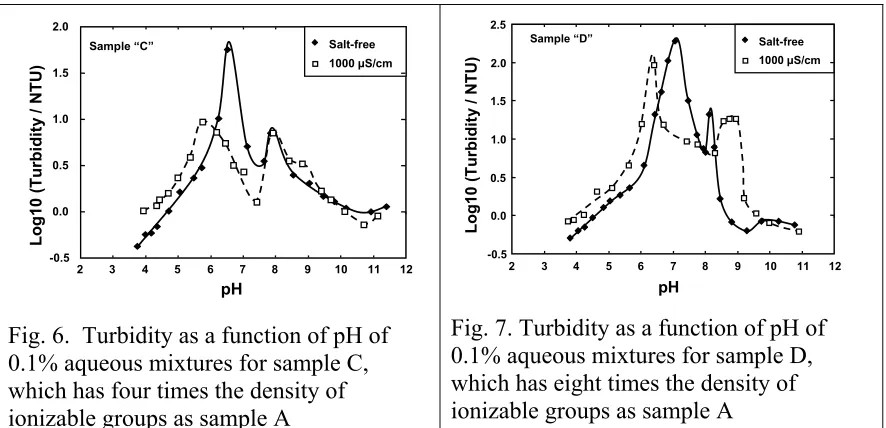
(15) Though further study would be required to confirm the mechanism, it is worth noting that an increased charge density can be expected to increase the ability of the macromolecules to maintain binding interactions at higher salt levels. Such effects have been well demonstrated, for instance, in the case of simple polyelectrolytes interacting with polyelectrolytes of opposite charge [33-35].. Sample “A”. 0.7. 1.0. Salt-free. Log10 (Turbidity / NTU). Log10 (Turbidity / NTU). 0.8 1000 µS/cm. 0.6 0.5 0.4 0.3 0.2 0.1 0. Sample “B”. Salt-free. 0.8. 1000 µS/cm. 0.6 0.4 0.2 0.0 -0.2. -0.1 -0.2. -0.4. 2. 4. 6. 8. 10. pH. Fig. 4. Turbidity as a function of pH of 0.1% aqueous mixtures of the lowestcharge polyampholyte, sample A, as evaluated at two conductivity levels. 12. 2. 3. 4. 5. 6. 7. pH. 8. 9. 10. 11. 12. Fig. 5. Turbidity as a function of pH of 0.1% aqueous mixtures for sample B, which has twice the density of ionizable groups as sample A. Figure 6 shows corresponding results for a polyampholyte sample that contained ionizable group concentrations that were twice as high as in the previous figure, and Fig. 7 shows results for polyampholytes with yet another doubling of charge densities, while holding the ratio of ionizable groups constant. While the general effects remain similar to those in Fig. 5, there is trend towards higher turbidity values at pH values roughly midway between the pKa and pKb values of the acidic and basic groups, respectively. Simultaneously, the transitions from relatively turbid to relatively clear solutions with increasing distance from isoelectric pH values tended to occur within narrower ranges of pH with increasing charge density of the polyampholytes. This effect is consistent with a greater ability of the more highly charged polyampholytes to become charge-stabilized.
(16) and eventually dissolved in solution as macromolecular ionic groups of one sign begin to dominate over groups having the opposite sign.. 2.5. 2.0 1000 µS/cm. 1.5. Log10 (Turbidity / NTU). Log10 (Turbidity / NTU). Sample “D”. Salt-free. Sample “C”. 1.0. 0.5. 0.0. -0.5. 3. 4. 5. 6. 7. 8. 9. 10. 11. 12. pH. Fig. 6. Turbidity as a function of pH of 0.1% aqueous mixtures for sample C, which has four times the density of ionizable groups as sample A. 1000 µS/cm. 1.5 1.0 0.5 0.0 -0.5. 2. Salt-free. 2.0. 2. 3. 4. 5. 6. 7. 8. 9. 10. 11. 12. pH. Fig. 7. Turbidity as a function of pH of 0.1% aqueous mixtures for sample D, which has eight times the density of ionizable groups as sample A. 3.3 Fiber-Polymer Interactions: Adsorption Results of the adsorption tests on bleached kraft fibers are summarized in Table 2. The data were interpolated to show effects corresponding to the pH values given in Fig. 3. Table 2. Polymer Adsorption onto Bleached Kraft Fibers with Different Polymer Monomeric Composition and Solution pH at 1000 µS/cm Conductivity (grams polymer per 100 grams of fiber solids) pH: 4.0 5.0 8.5 Polymer A 0.6 0.7 0.5 Polymer B 0.7 0.8 0.8 Polymer C 0.6 0.9 0.9 Polymer D 0.5 0.7 1.0 Polymer F 0.5 0.6 0.8 Polymer G 0.0 0.0 0.0 Though a comparison between Table 2 and Fig. 3 does not show a perfect agreement in trends, there is general support for the working hypothesis that high adsorbed amounts ought to result in corresponding increases in strength. For example, if.
(17) one considers only the adsorption results corresponding to pH=5, then it can be seen that polyampholyte sample C achieved the highest breaking length, consistent with the highest adsorbed amount of polymer. The remaining results for pH=5 followed the same basic order, as did the results of tests corresponding to pH=4. It is interesting that the very efficient adsorption observed at pH=8.5 in the case of polymer D, the highest-charge polyampholyte, did not correspond to a higher tensile strength in the resulting paper samples. This counter-example suggests that there are additional factors of importance to strength, besides just how much of the bonding agent can be adsorbed under the conditions of interest. Some factors to consider in future work include (a) the conformation of the adsorbed molecules, (b) possible contributions of ionic interactions to adhesion and fiber joint strength, and (c) effects due to differences in the uniformity of the fiber network in the resulting paper. 3.4 Sediment Volumes By measuring the volume of sediment formed by the gradual settling of polymertreated cellulosic fibers it is possible to get very sensitive information about frictional forces acting between the adjacent fibers [36]. As shown in Fig. 8, addition of 0.05% of polyampholyte based on bleached hardwood kraft fiber solids resulted in a moderate increase in sediment volume in all of the cases considered. It is reasonable, at relatively low levels of addition, for adsorbed macromolecules to act like charged patches, which then can become attracted to uncovered areas on adjacent fibers in the suspension. The fact that sediment volumes continued to increase as a function of polyampholyte dosage, in most cases, can be taken as contributing evidence that the adsorbed polyampholyte molecules have a tendency to self-associate with similar molecules adsorbed onto.
(18) adjacent surfaces. Such a mechanism would explain evidence of a relatively high friction coefficient between fibers in the presence of a sufficient concentration of polyampholyte so that more or less complete coverage of the surfaces is expected. In the case of sample A, the lowest charge polyampholyte, increases in dosage yielded a drop down to baseline values of sedimentation volume. Such behavior is evidence that sample A molecules did not increase attractive interactions between the surfaces when added at the higher levels. Instead, it is reasonable to expect that a low-charge, hydrophilic polymer can induce repulsion between surfaces, by means of a steric stabilization mechanism. To provide context for the effects of the polyampholyte molecules on sediment volumes, Fig. 9 shows rather similar results in the case of two polyelectrolytes having the same density of either positive or negative ionizable groups as the polyampholyte sample B (see Table 1). Note that the “blank” results (two tests) are shown at the left of the figure. The effect of the cationic polyelectrolyte, sample F, is consistent with the formation of polyelectrolyte bridges [37-39] or patch-like electrostatic interactions [1718] between the adjacent surfaces. Such interactions are expected to impede the tendency of the sediment elements to slide past each other, resulting in densification of the sediment. Remarkably, such an effect even was seen even in the case of sample G, an anionic polymer that would not be expected to interact strongly with the predominantly negative surfaces of the fibers. Results are not expected to be greatly influenced by the rate of initial formation of flocs, due to the fact that after settling all fibers have to come into contact with each other. Hydrodynamic shear is intentionally kept very low during sediment volume tests to avoid disrupting weak attachments between the solid surfaces..
(19) 125. Blank "A" "B" "C" "D". 120 115 110. Sediment Volume (cm3/g). Sediment Volume (cm3/g). 125. 105 100 95 90 85 80. 0. 0.05. 0.1. 0.2. 0. 5. 1.0. 2.0. Dosage (%). Fig. 8. Volume of sediment formed per unit mass of bleached hardwood kraft fibers at different polyampholyte additions at neutral pH and 1000 µS/cm conductivity. 120 115 110 105 100 95. Blank “F" “G". 90 85 80. 0. 0.05. 0.1. 0.2. 0. 5. 1.0. 2.0. Dosage (%). Fig. 9. Volume of sediment formed per unit mass of bleached hardwood kraft fibers at different polyelectrolyte additions at neutral pH and 1000 µS/cm conductivity. The fact that treatments with the moderately to more highly charged polyampholyte samples generally increased the sedimentation volumes can be taken as evidence for an increased frictional effect between adjacent solid surfaces in the sediment. Such friction is likely to play an important role during the final laying down of the wet web during paper formation, since a bulky, porous structure of the initial paper web can be expected to promote more rapid dewatering [40]. Indeed, various authors have stated that more rapid release of water is one of the advantages contributed by polyampholyte additives, such as amphoteric starches [41-42] and acrylamide terpolymers [43]. 3.5 Flocculation Tests of fiber flocculation under conditions of flow were used as a second means of evaluating effects of forces acting between fibers. Previous work has shown that conditions associated with polymer bridging between fibers tend to yield increases in fiber flocculation [20]. By contrast, mere neutralization of surface charges was found to have relatively little effect on the tendency of fibers to form flocs in the presence of flow. As shown in Fig. 10, there was no significant effect of the polyampholytes on.
(20) flocculation until the addition level exceeded 1% on a dry basis, which can be considered as a huge dosage. It is considered important that the polyampholyte treatments did not cause flocculation, since flocculation tends to result in a significant decrease in paper strength [44]. Notably, the highest level of flocculation shown in Fig. 10 was associated with very high addition of sample “D,” which has the highest charge density of the polyampholytes tested. Interestingly, at the 3% level of treatment the polyelectrolyte samples “F” and “G” showed the lowest levels of fiber flocculation. It is worth noting the contrast between the flocculation test results in Fig. 10, showing little effect of polyampholytes on flocculation, versus the significant effects of the same treatments on sedimentation volumes (Fig. 8). This combination of observations implies that the attractive forces induced by polyampholyte adsorption can be expected to be too weak to result in significant increases in fiber flocculation, in the presence of flow. Contrasting results were obtained when similar tests were carried out with the same type of fiber suspensions, following their treatment with commercial acrylamide retention aid polymers. In two of the cases the fibers were first treated at the 0.1% level with poly-diallyldimethylammonium chloride (poly-DADMAC - low mass, SigmaAldrich Cat. No. 40,901-4) before addition of either cationic or anionic acrylamide copolymer at the 0.005, 0.01, 0.03, 0.1, 0.3, 1.0, and 3.0 % cumulative level of treatment. As shown in Fig. 11, up to about 0.1% level of treatment, on a solids basis either increased the level of flocculation, or there was no significant effect. The greatest flocculating effects were observed in the cases of treatment with the cationic copolymer and with a sequence of highly cationic poly-DADMAC followed by the anionic copolymer flocculant..
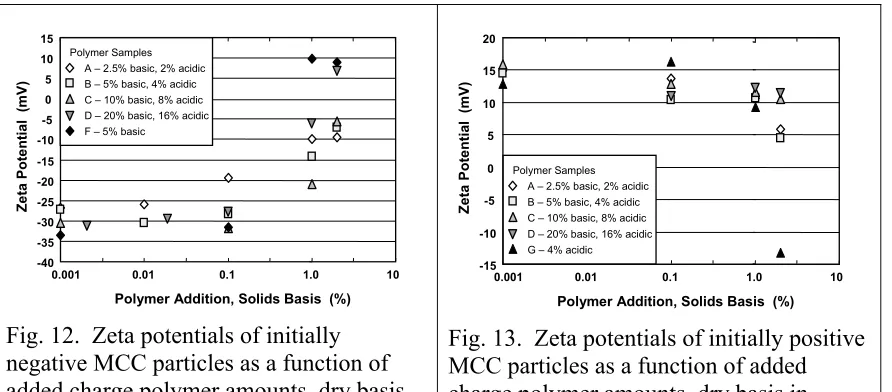
(21) Addition of higher amounts of polymer produced dispersing effects in all cases, reducing the level of observed flocculation way below the level of the untreated fibers as the concentration of high-mass polyelectrolytes was increased above about 0.1% to 0.2% on a solids basis. These results are consistent with a lubricating effect as described by others [36,45-46]. In other words, fibers appear to be able to slide past each other, rather than adhering to each other upon contact, which is a precondition for the formation of fiber flocs. Repulsion between the fibers, to account for the lubricating effect, can be attributed to steric stabilization due to adsorbed layers of water-loving, extended polymer coils on adjacent surfaces within the fiber slurry.. 1.4. 1.2 1 0.8 0.6 "A". 0.4. "B" "C". 0.2. "D" "F" "G". 0 0.001. 0.01. 0.1. 1.0. 10. Dosage (%). Fig. 10. Flocculation, as determined by fluctuations in transmitted light through a tube, through which polymer-treated hardwood fiber suspension is flowing. Flocculation (PDA Units). Flocculation (PDA Units). 1.4. 1.2 1 0.8 0.6 Cationic PAM. 0.4. Anionic PAM DADMAC / cPAM. 0.2. DADMAC / aPAM. 1000 µS/cm (Na2SO4) Poly-DADMAC dose = 0.1%. 0 0.001. 0.01. 0.1. 1.0. 10. Dosage (%). Fig. 11. Results of flocculation tests in the case of fiber suspensions treated at different levels of very-high-mass acrylamide-type copolymers. 3.6. Zeta Potential of Probe Particles Figures 12 and 13 show what happened when increasing amounts of the charged polymer samples were added to suspensions of either negative or positive MCC probe particle, respectively. Treatment levels of 0.1% (solids basis) or less had relatively little effect on zeta potential, as might be expected for low-to-moderately charged polymers adsorbing onto high-charge probe particles [23]. The ability of the lowest-charge.
(22) polyampholyte, sample A, to decrease the absolute magnitude of zeta potential already at 0.1% treatment level is tentatively attributed to a more extended conformation in the adsorbed state, as would be expected for a more weakly charged polymer. At high levels of treatment, 1-3% on a solids basis, most of the polyampholytes caused the probe particles of either charge to have a relatively low, positive charge, consistent with the polymers’ fixed ratio of 5 basic to 4 acidic groups that are expected to be almost fully charged at pH=7. The highest-charge polyampholyte, sample D, consistently yielded the highest positive zeta potentials at high treatment levels, though still not nearly as high as the initial positive zeta potential of the cationic probe particles represented in Fig. 12. What is remarkable about the results in Figs. 11-12 is that zeta potentials tended to become “moderated” with increasing addition levels of the polyampholyte treatments, especially in cases were the charge density of the polymer was low to moderate. Thus, the initial zeta potential values of about -30 mV (Fig. 12) and +15 mV (Fig. 13) of the probe particles became closer to neutral charge with increasing addition of lower-charge samples of polyampholyte. The results provide further demonstration that polyampholytes are capable of adsorbing onto substrates of either sign of charge, but that, depending on their charge density, the sign of charge of the substrate is not necessarily reversed. Phenomena of this nature will be considered in more detail in Part 3 of this article series..
(23) 15. 20 Polymer Samples. 5 0 -5 -10. A – 2.5% basic, 2% acidic B – 5% basic, 4% acidic. 15. Zeta Potential (mV). Zeta Potential (mV). 10. C – 10% basic, 8% acidic D – 20% basic, 16% acidic F – 5% basic. -15 -20 -25 -30 -35 -40 0.001. 0.01. 0.1. 1.0. 10. Polymer Addition, Solids Basis (%). Fig. 12. Zeta potentials of initially negative MCC particles as a function of added charge polymer amounts, dry basis, in neutral, 1000 µS/cm solution. 10 5 0. Polymer Samples A – 2.5% basic, 2% acidic. -5. B – 5% basic, 4% acidic C – 10% basic, 8% acidic. -10. D – 20% basic, 16% acidic G – 4% acidic. -15 0.001. 0.01. 0.1. 1.0. 10. Polymer Addition, Solids Basis (%). Fig. 13. Zeta potentials of initially positive MCC particles as a function of added charge polymer amounts, dry basis in neutral, 1000 µS/cm solution. 4. Conclusions 1. The colloidal behavior of polyampholytes, as evaluated from the bulk aqueous solutions properties, colloidal stability, and fiber suspension behavior, gives insight into the superior bonding contribution of these materials during the manufacture of paper. A general agreement was found, in many respects, between conditions favoring strength development and conditions favoring maximum turbidity of aqueous polyampholyte mixtures and maximum adsorption. 2. From a technical standpoint there appears to be an optimum charge density of polyampholytes to provide strength gains in paper made from treated fiber suspensions. Thus, the highest strength results were obtained with samples containing cationic monomer groups in the range of 5-10% and anionic monomer groups in the range of 4-8% (note that there were two anionic groups per anionic monomer in the samples considered). Though the reasons for the fall-off in drystrength performance with further increase in charge density was not obvious from.
(24) the colloid-chemical tests carried out in this study, it is worth noting that increasing charge density of the polyampholytes tended to narrow the window of pH within which relatively high turbidity could be observed. 3. Treatment by polyampholytes increased the sediment volume of treated bleached kraft fiber suspensions, consistent with an increase in the effective friction coefficient between fibers in the sediment. Such behavior is consistent with the formation of a porous paper mat that can be dewatered more quickly with less energy. 4. In contrast to polyelectrolyte treatments, the polyampholytes showed little tendency to increase or decrease the flocculation of fibers in a flowing suspension. The lack of flocculation tendency is another factor that can help explain the superior strength gains that can be achieved with polyampholyte addition. Acknowledgments The authors wish to acknowledge the support of the National Research Initiative of the USDA Cooperative State Research, Education and Extension Service, grant number 2004-35504-14655. In-kind support provided by Harima Chemical Co., Inc. is also gratefully acknowledged for preparation of the polyampholytes. References [1] Y. Fukunaga, New application method of dry strength agents by effective utilization of amphoteric polyacrylamide and aluminum sulfate, Proc. Japan TAPPI Ann. Mtg., 1999, pp. 349- 357. [2] Y. Yoshimoto, Y. Iwasa, and T. Fujiwara, Study on the mechanism of PAMs as dry strength agents, Proc. 2004(71st) Pulp Paper Res. Conf., 2004, pp. 126-129. [3] A. Sato, M. Ogawa, T. Oguni, and M. Fujii, Amphoteric PAMs as dry strength resins, Proc. TAPPI 2005 Practical Papermakers Conf., digital document, TAPPI Press, Atlanta, 2005. [4] J. Song, Y. Wang, M.A. Hubbe, O.J. Rojas, N. Sulić, T. Sezaki, Charge and the drystrength performance of polyampholytes. Part 1. Handsheets properties and polymer solution viscosity, J. Pulp Paper Res. J. 32 (2006), in print. [5] T. Alfrey, Jr., H. Morawetz, E.B. Fitzgerald, and R.M. Fuoss, Synthetic electrical analog of proteins, J. Amer. Chem. Soc. 72 (1950) 1864..
(25) [6] T. Alfrey, Jr. and H. Morawetz, Amphoteric polyelectrolytes. I. 2-vinylpyridinemethacrylic acid copolymers, J. Amer. Chem. Soc. 74 (1952) 436-441. [7] F. Ascoli, and C. Botré, Amphoteric behavior of a copolymer: N,Ndiethylallylamine-acrylic acid, J. Polymer Sci. 62 (174) (1962) S56-S59. [8] E.A. Bekturov, S.E. Kudaibergenov, and S.R. Rafikov, Synthetic polymeric ampholytes in solution, Rev. Macromol. Chem. Phys. C30 (1990) 233-303. [9] E.E. Kathmann and C.L. McCormick, Water-soluble polymers. 71. pH responsive behavior of terpolymers of sodium acrylate, acrylamide, and the zwitterionic monomer 4(2-acrylamide-2-methylpropanedimethylammonio) butanoate, J. Polymer Sci. A35 (1997) 231-242. [10] V.A. Kabanov, A.B. Zezin, V.A. Izumrudov, and T.K. Bronich, Cooperative polyelectrolyte reactions, Makromol. Chem., Suppl. 13 (1985) 137-155. [11] J. Chen, J.A. Heitmann, and M.A. Hubbe, Dependency of polyelectrolyte complex stoichiometry on the order of addition. 1. Effect of salt concentration during streaming current titrations with strong poly-acid and poly-base, Colloids Surf. 223 (2003) 215-230. [12] J.E. Kline, The application of the Verwey-Overbeek theory to the relative sediment volume of kaolin-water dispersions, Tappi 50 (12) (1967) 590-596. [13] B. Alince, and A.A. Robertson, Aggregation of microcrystalline cellulose with polyethyleneimine, Colloid Poly. Sci. 252 (1974) 920-927. [14] E. Gruber, M. Gelbrich, and W. Schempp, Morphological and chemical factors affecting dewatering, Wochenbl. Papierfabr. 125 (2) (1997) 66-72. [15] R.J. Hunter, Introduction to Modern Colloid Science, Oxford Univ. Press, Oxford, UK, 1993. [16] S. Neyret, L. Ouali, F. Candau, and E. Pefferkorn, Adsorption of polyampholytes on polystyrene latex: Effect on colloid stability, J. Colloid Interface Sci. 176 (1995) 86-94. [17] D.R. Kasper, Theoretical and experimental investigations of the flocculation of charged particles in aqueous solutions by polyelectrolytes of opposite charge, PhD Thesis, California Inst. Technol., Pasadena, CA, 1971. [18] J. Gregory, The effect of cationic polymers on the colloidal stability of latex particles, J. Colloid Interface Sci. 55 (1976) 35-44. [19] P.A. Tam Doo, R.J. Kerekes, R.H. Pelton, Estimates of maximum hydrodynamic shear stresses on fiber surfaces in papermaking, J. Pulp Paper Sci. 10 (1984) J80-J88. [20] M.A. Hubbe, Reversibility of polymer-induced fiber flocculation by shear. 1. experimental methods, Nordic Pulp Paper Res. J. 15 (2000) 545-553. [21] M.S. Burgess, J.E. Curley, N. Wiseman, and H. Xiao, On-line optical determination of floc size. Part 1: Principles and techniques, J. Pulp Paper Sci. 28 (2002) 63-65. [22] J. Gregory, Turbidity fluctuations in flowing suspensions, J. Colloid Interface Sci. 105 (1985) 357-371. [23] M.A. Hubbe, O.J. Rojas, L.A. Lucia, T.M. Jung, Consequences of the nanoporosity of cellulosic fibers on their streaming potential and their interactions with cationic polyelectrolytes, Cellulose, in print. [24] T.M. Herrington, J.C. Petzold, An investigation into the nature of charge on the surface of papermaking woodpulps. I. Charge/pH isotherms, Colloids Surf. 64 (1992) 97108. [25] G. Bygrave and P. Englezos, P., Fiber charge from potentiometric titration of kraft pulp and Donnan equilibrium theory, Nordic Pulp Paper Res. J. 13 (1998) 220-224..
(26) [26] F. Wang and M.A. Hubbe, Charge properties of fibers in the paper mill environment. Part 1. Effect of electrical conductivity, J. Pulp Paper Sci. 28 (2002) 347-353. [27] J. Mazur, A. Silberberg, and A. Katchalsky, Potentiometric behavior of polyampholytes, J. Poly. Sci. 35 (128) (1959) 43-70. [28] Y. Wang, M.A. Hubbe, T. Sezaki, X. Wang, O.J. Rojas, and D.S. Argyropoulos, The role of polyampholyte charge density on its interactions with cellulose, Nordic Pulp Paper Res. J., in print. [29] J. Yoshizawa, A. Isogai, and F. Onabe, Analysis and retention behaviour of cationic and amphoteric starches on handsheets, J. Pulp Paper Sci. 24 (1998) 213-218. [30] P.G. Higgs, and J.-F. Joanny, Theory of polyampholyte solutions, J. Chem. Phys. 94 (1991) 1543-1554. [31] R. Everaers, A. Johner, and J.-F. Joanny, Polyampholytes: From single chains to solutions, Macromolecules 30 (1997) 8478-8498. [32] X. Peng and J. Shen, Studies on salting effects of DMC-AM-AA terpolymers in aqueous solution, Acta Polymerica Sinica (1999) 736-740. [33] H. Dautzenberg and N. Karibyants, Polyelectrolyte complex formation in highly aggregating systems. Effect of salt: Response to subsequent addition of NaCl, Macromol. Chem. Phys. 200 (1999) 118-125. [34] D.V. Pergushov, H.-M. Buchhammer, and K. Lunkwitz, Effect of low-molecularweight salt on dispersions of interpolyelectrolyte complexes, Colloid Polymer Sci. 277 (1999) 101-107. [35] S. Dragan, and M. Cristea, Influence of low-molecular-weight salts on the formation of polyelectrolyte complexes based on polycations with quaternary ammonium salt groups in the main chain and poly(sodium acrylate), Eur. Poly. J. 37 (2001) 15711575. [36] S. Zauscher and D. Klingenberg, Surface and friction forces between cellulose surfaces measured with colloidal probe microscopy, Nordic Pulp Paper Res. J. 15 (2000) 459-468. [37] V.K. La Mer and T.W. Healy, Adsorption-flocculation reactions of macromolecules at the solid-liquid interface, Rev. Pure Appl. Chem. 13 (Sept.) (1963) 112-133. [38] E. Dickinson and L. Eriksson, Particle flocculation by adsorbing polymers, Adv. Colloid Interface Sci. 34 (1991) 1-29. [39] J. Gregory, Rates of flocculation of latex particles by cationic polymers, J. Colloid Interface Sci. 42 (1973) 448-456. [40] T. Lindström, Some fundamental chemical aspects on paper forming, in C.F. Baker and V.W. Punton (Eds.), Fundamentals of Papermaking, Mechan. Eng. Pub., London, 1989. [41] R.T. McQueary, Wet end waxy amphoteric starch impacts drainage, retention and strength, Proc. TAPPI 1990 Papermakers Conf., TAPPI Press, Atlanta, 1990, 137-142. [42] P.C. Dalidowicz, Drainage aids containing bound phosphorous, Proc. TAPPI 2000 Papermakers Conf., TAPPI Press, Atlanta, 2000, pp. 119-123. [43] X.-C. Ye, H. Tanaka, and M. Sumimoto, Effects of network-type polyacrylamides on the drainage and retention of wheat straw pulp, Mokuzai Gakkaishi 36 (1) (1990) 6468..
(27) [44] F. Linhart, D. Horn, J. Eisenlauer, and R. Hemel, Monitoring and control of formation by means of a fiber optic flocculation sensor, Wochenbl. Papeirfabr. 115 (1987) 331-338. [45] P.F.W. Lee and T. Lindström, Effects of high molecular mass anionic polymers on paper sheet formation, Nordic Pulp Paper Res. J. 4 (1989) 61-70. [46] M. Giri, J. Simonsen, and W.E. Rochefort, Dispersion of pulp slurries using carboxymethylcellulose, Tappi J. 83 (10) (2000) 58. [digital document] FIGURE CAPTIONS Fig. 1. Molecular composition of model polyampholytes prepared by random, freeradical polymerization Fig. 2. Schematic illustration of sedimentation volume of kraft fiber suspensions treated with ionic polymers Fig. 3. Effect of macromolecular composition and pH on the tensile strength of polymertreated bleached kraft fibers at 1000 µS/cm conductivity Fig. 4. Turbidity as a function of pH of 0.1% aqueous mixtures of the lowest-charge polyampholyte, sample A, as evaluated at two conductivity levels Fig. 5. Turbidity as a function of pH of 0.1% aqueous mixtures for sample B, which has twice the density of ionizable groups as sample A Fig. 6. Turbidity as a function of pH of 0.1% aqueous mixtures for sample C, which has four times the density of ionizable groups as sample A Fig. 7. Turbidity as a function of pH of 0.1% aqueous mixtures for sample D, which has eight times the density of ionizable groups as sample A Fig. 8. Volume of sediment formed per unit mass of bleached hardwood kraft fibers at different polyampholyte additions at neutral pH and 1000 µS/cm conductivity Fig. 9. Volume of sediment formed per unit mass of bleached hardwood kraft fibers at different polyelectrolyte additions at neutral pH and 1000 µS/cm conductivity Fig. 10. Flocculation, as determined by fluctuations in transmitted light through a tube, through which polymer-treated hardwood fiber suspension is flowing Fig. 11. Results of flocculation tests in the case of fiber suspensions treated at different levels of very-high-mass acrylamide-type copolymers Fig. 12. Zeta potentials of initially negative MCC particles as a function of added charge polymer amounts, dry basis, in neutral, 1000 µS/cm solution.
(28) Fig. 13. Zeta potentials of initially positive MCC particles as a function of added charge polymer amounts, dry basis in neutral, 1000 µS/cm solution.
(29)
Figure
+5

Related documents