ASSESSING THE STRUCTURAL RESPONSE OF EQUIPMENT
SUBJECTED TO DYNAMIC HIGH FREQUENCY LOADING
Eddie M. Guerra, P.E.1 and Enrique Bazan-Zurita, Ph.D.2
1
Senior Project Engineer, Rizzo Associates, USA 2
Principal, Rizzo Associates, USA
ABSTRACT
Seismic fragility evaluations are generally based on static-equivalent approaches to calculate anchorage reaction forces of equipment in nuclear plants. This conservative method has proved sufficient for early Seismic PRAs in CEUS nuclear plants where the seismic hazard estimates were considerably lower than those currently controlling the results of Seismic PRAs. Because static-equivalent seismic demands could lead to considerably unrealistic controlling failure modes of equipment some analysis refinement is warranted. This paper presents a simplified procedure to calculate the seismic demand on equipment anchorage via modal analysis with consideration of wave propagation and energy concepts. Recent research on the dynamic behaviour of electrical cabinets and the advent of accessible computer capability allow more realistic estimates for the seismic demand on equipment anchorage. Practical examples are presented for Motor Control Centers (MCCs) illustrating the effect of base flexibility, effective mass participation and high frequency content in the anchorage seismic demand calculation. Despite its simplicity, the proposed procedure allows appreciably more accurate estimates of the seismic demand avoiding the need of more elaborated Finite Element Models. We also examine the application and potential benefits when evaluating relays subjected to high frequency motion.
INTRODUCTION
In recent years, nuclear plants in Central Eastern United States (CEUS) have undergone Seismic Probabilistic Risk Assessments (SPRA) to fulfill both regulatory (NRC 50.54(f) Letter) and plant risk-management requirements, primarily in response to new seismic hazard findings as presented in GI-199 Report. Throughout the development of seismic fragilities in support of SPRAs, analysts will refer to current industry-accepted conservatively biased methods to deal with an increased seismic demand that extends beyond the plant design basis in the high frequency spectral region. This reality can be visualized when calculating the equivalent seismic force from floor response spectra to estimate the seismic demand for the fragility of equipment anchorage. The adherence to a conservative static-equivalent approach to tackle higher seismic demands at higher frequencies will not only lead to unrealistic anchorage fragilities but could also affect the reliability of the PRA model for making risk-informed decisions.
This paper aims to provide fragility analysts with an alternate approach to estimate the seismic demand for the evaluation of equipment anchorage. The approach is founded on the idea that the maximum response of an electrical cabinet under high frequency motion is dominated by a wave propagation response rather than a modal response. Iwan (1997) conducted pioneering work on developing drift response spectra based on wave propagation concepts. Zhang (2011) and Ebrahimian and Todorovska (2014) proposed enhanced modeling techniques based on Timoshenko beams and development of generalized impulse response functions. Chopra and Chintanapakdee (2001) demonstrate that modal analysis including sufficient number of modes would accurately capture wave propagation effects on structures. Further, Cheng et. al (2015) explain how pulse durations will affect the duration of the wave propagation phase relative to the free vibration phase. Therefore, by considering the advantage of modal analysis to predict wave propagation effects and the influence of pulse duration on the dynamic response of a structure, a time history analysis using modal superposition for an idealized structural model could provide a better estimate of seismic demand for cabinet anchorage in comparison to the traditional static-equivalent method.
The methodology presented in this paper is organized in the following manner: First, a brief background is provided on recent research regarding the dynamic behavior of typical electrical cabinets and panels used in US nuclear plants. Then, a discussion on how base flexibility affects the modal response of electrical cabinets is presented. A description of wave propagation concepts applied to pulse excitations follows with special emphasis on high frequency effects and its comparison with traditional static-equivalent methods. Finally, a practical application of the proposed approach is provided along with discussions on results and potential future applications.
DYNAMIC BEHAVIOR OF ELECTRICAL CABINETS AND PANELS
The dynamic behavior of electrical cabinets and panels is composed of three predominant modes of response: (1) local panel deformation, (2) overall cantilever motion and (3) rigid rocking motion.
(a)
(b) (c)
Figure 1: Principal modes of vibration of electrical cabinets: (a) local panel deformation, (b) overall cantilever motion and (c) rigid rocking motion.
Overall bending of the cabinet framing structure constitutes a relatively higher frequency mode given the stiffening effect of sheet metal housing plates and its diaphragm effect on lateral motion. Higher modes of vibration will respond in the form of local panel deformation (Gupta (2004) and Jieun (2012)).
Based on the above discussion, it is reasonable to distinguish the dynamic behavior of the cabinet in two main modes: fundamental mode and panel vibration. Although panel vibration is of high significance for the assessment of mounted relays, it could be argued that it will pose an insignificant contribution to the overturning moment. From a modal response perspective, the deformation is concentrated in a particular area of the cabinet and dissipated through damping of the panel and its connecting points. Further, the kinetic energy associated to the low mass participating in higher modes will not contribute to an overall deformation or overturning of the cabinet. Detailed finite element models (Jieun (2012)) have shown how modes other than the fundamental mode will appear in the form of local panel deformations at higher frequencies. Although local panel deformations can not be easily represented by a simplified cantilever beam analogy, the evidence from both testing and FE models leads to the conclusion that overturning is mainly induced by a fundamental mode of vibration rather than higher modes.
EFFECT OF CABINET BASE FLEXIBILITY
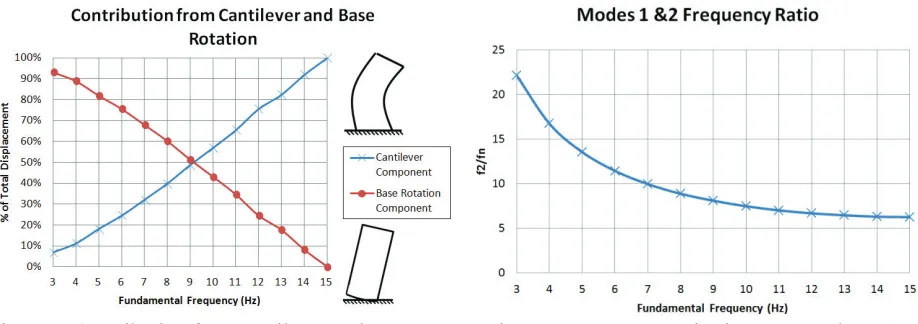
Special emphasis should be placed on the contribution of base rocking to the fundamental mode of response versus overall bending. The results shown in Figure 2 from a static linear-elastic analysis of a fixed-free Euler-Bernoulli beam illustrate the contribution from both cantilever and base rotation as a function of equipment fundamental frequency. A starting point is set for a cantilever beam with a fixed base and a fundamental mode of 15 Hz under the asssumption that the change in fundamental mode is highly sensitive to base flexibility rather than framing non-linearities. It is assumed that most electrical cabinets are well constructed, with internal framing and housing panels to prevent significant deformation of the structural housing before considerable deformation at the base takes place. Hence, for a cabinet with fn= 15Hz, the anchorage is assumed as infinitely stiff and the change in fundamental frequency is a
function of base flexibility only. If the beam cross sectional properties remain constant and the base stiffness represented by a rotational spring is varied reducing the fn from 15Hz to 3Hz, one will arrive to
the relationship as shown in Figure 2.
Figure 2: Contribution from cantilever and Figure 3: Frequency ratios between modes 1 & 2. base rotation.
closer as the cabinet fundamental frequency increases. This relationship is expected since the higher the contribution from a rocking mode the more the system will resemble a SDOF behavior.
Figure 3 illustrates the importance of incorporating base flexibility into the analysis in order to arrive at acurate estimates of higher modes of vibrations. This will in turn assist in estimating the effect from higher modes of vibration relative to the high frequency input. The effects of higher modes of vibration in the response of the cabinet relative to the high fequency content can be better examined via wave propagation concepts.
APPLICATION OF WAVE PROPAGATION IN CABINET DYNAMIC RESPONSE
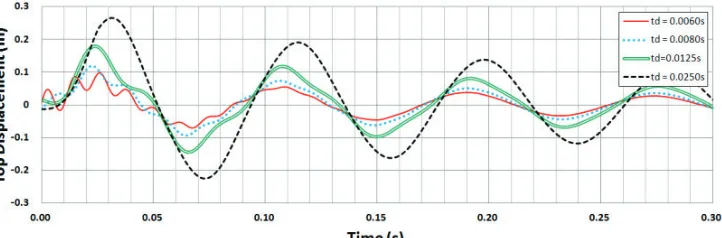
Wave propagation is a transient dynamic phenomena resulting from short duration excitation as is the case in high frequency motion. Wave propagation concepts have been used to accurately represent the initial response of structures subjected to pulse type ground input (Iwan (1997), Chopra (2001) and Cheng (2015)). Iwan (1997) and Cheng (2015) show how the response to impulse loading can be observed as a summation of propagating waves transitioning to a modal response with respect to time. Chopra (2001) shows how modal analysis with sufficient number of modes will converge to the wave propagation concept hence capturing with good accuracy the initial response of the structure under high frequency motion. By idealizing a time history input as a series of short-duration pulses and considering that the maxima due to each pulse will happen before the first cycle of response, wave propagation may be more suitable to capture that response compared with traditional SDOF static equivalent methods. Figures 5 through 7 illustrate how the pulse duration will affect the maxima and modal participation of a distributed-parameter cantilever beam.
Figure 5: Dynamic response of a distributed-parameter cantilever beam with Tn = 0.083s subjected to
varying pulse load duration td.
Figures 5 through 7 illustrate the following points: (1) the shorter the pulse duration, the more the influence of higher modes and the longer the duration of the transient phase, (2) for td/Tn values below 0.25 dynamic amplification becomes negligible compared with the static deformation po/k, and (3) the maximum response will occur during the transient phase where the response is dominated by higher modes rather than the fundamental mode of vibration. These observations, as corroborated by Cheng (2015) and Zhang (2011), indicate that wave propagation methods may be more suitable to capture the maximum response of electrical cabinets and panels under high frequency motion.
In the traditional static-equivalent method, the ISRS is contructed by plotting the maximum response for a series of SDOF oscillating frequencies. The numerical process to obtain an ISRS is based on either a modal analysis or direct integration given a time history input (Computers and Structures, Inc. (2009)). Both methods rely on the Convolution Integral where the response per time step is superimposed to obtain maximum responses for a series of frequency values.
A time history input motion contains pulses so short that the maximum response atributed to each pulse will result mostly from higher modes of vibration. Chopra (2006) shows that response history analysis using existing modal combination rules will converge to the wave propagation solution proposed by Iwan (1997). Modal analyses with sufficient modes accurately capture the response of the cabinet to high frequency motion where the maxima occurs during a transient phase and where higher modes are still dominating the response. This approach can be used to accurately capture the contribution from higher modes versus fundamental modes of vibration during the early phase of response to each pulse load. A distributed parameter Euler-Bernoulli beam model can better represent the ability of the cabinet to physically exhibit normal modes something that is not well captured by the traditional static-equivalent method.
PROPOSED APPROACH AND APPLICATION TO MOTOR CONTROL CENTERS
The following section incorporates the aforementioned concepts on dynamic behavior of cabinets, effects of base flexibility and the application of wave propagation on structures to devise an approach to estimate the seismic demand that will lead directly to overturning of the cabinet. Several scenarios are presented as practical examples applied to Motor Control Centers (MCC).
Input Parameters: The input parameters correspond to the (1) MCC natural frequency often given by manufacturers, test data or estimated based on engineering judgement, (2) floor displacement and velocity time histories obtained from building seismic analysis, (3) anchorage design details (i.e. number of bolts, anchor type, concrete compressive strength, embedment length, etc.)
Simplified Analytical Model: A simplified model is created in a computer program (Matlab, SAP2000, STAAD) as a fixed-free Euler-Bernoulli cantilever beam represented by several lumped masses to represent the “distributed-parameter” criterion. An Euler-Bernoulli idealized beam is considered appropiate since shear deformations may not be significant due to the cabinets large height-width ratio (H/B > 4) and internal column-beam flexibility (ΣIbeams > ΣIcolumns). The beam element has been divided into 10 small lumped masses in order to capture any high frequency effect Chopra (2006). A fixed beam is first created with constant EI(x) and m(x) across its length. Subsequently, a rotational spring is incorporated and tunned to the targeted fundamental mode of vibration.
to the peak response. The peak response is obtained from the contribution of all modes given by Equation 1 below:
ݑሶሺݔǡ ݐሻ ൌ ݑሶሺݔǡ ݐሻ
ஶ
ୀଵ
ൌ ߮ሺݔሻݍሶሺݐሻ
ஶ
ୀଵ
ሺͳሻ
From the total ݑሶሺݔǡ ݐሻ , only the contribution from the first mode when the peak velocity occurs is of interest and is calculated from ߮ଵሺݔሻݍሶଵሺݐሻ. The modal mass participation Γm of the first mode is also
obtained from a modal analysis.
Equivalent Seismic Force Calculation from Kinetic Energy Input: The kinetic energy Ek is given by
Equation 2 below and is defined as a modal sum for the cabinet at any given time instance t
ܧ ൌ ܧǡ
ஶ
ୀଵ
ǡ ܧǡൌͳʹ ݉ݍሶଶሺݐሻ න ߮ଶሺݔሻ݀ݔ
ሺʹሻ
Thus by equating the kinetic energy imparted to the system by the first mode to its associated strain energy ܧ௦ǡ ൌଵଶܨ௦௦ݑሺݔǡ ݐሻ, an equivalent seismic force can be obtained using Equation 3 below:
ܨ௦௦ൌ݉ݍሶ
ଶሺݐሻ ߮
ଶሺݔሻ݀ݔ
ݑሺݔǡ ݐሻ ሺ͵ሻ
This equivalent seismic force is subsequently used to determine the corresponding base shear and overturning moment to be resisted by the cabinet anchorage. For purposes of this calculation, the energy dissipated through damping is neglected thus the kinetic input energy imparted to the system is transformed into strain energy due to deformation of the system.
APPLICATION TO MOTOR CONTROL CENTERS UNDER HIGH FREQUENCY MOTION
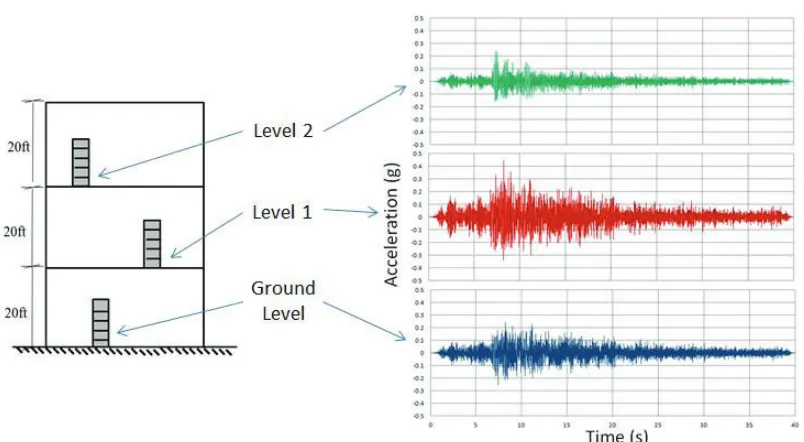
The following section provides several practical applications to Motor Control Centers (MCCs) located at different heights in a building with the intent to examine the effect of varying high-frequency content. In addition to the effect of high frequency content, the base flexibility for each of the MCCs is varied between 3, 8 and 15 Hz. These two parameters are known to dictate the seismic demand to be resisted by the cabinet anchorage.
Figure 8: Schematic for MCC location in Figure 9: Resultant acceelration time histories building response analysis. for each building level.
Figure 10: Acceleration response spectra for each building level.
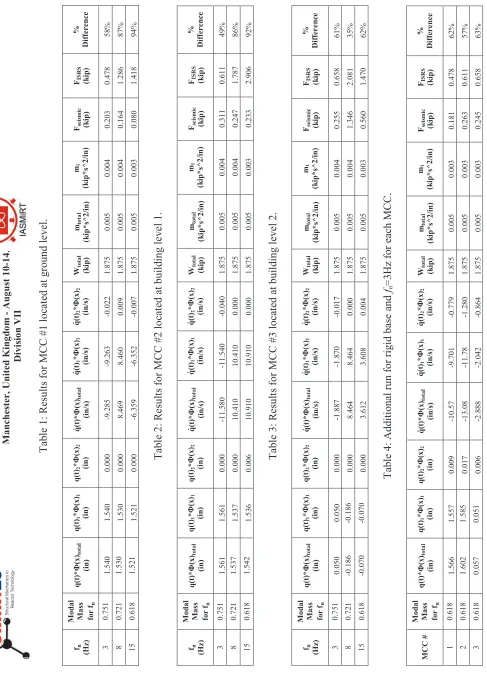
Tables 1 through 3 present the results for the three MCCs evaluated with varying natural frequencies. For discussion purposes, each table includes the resulting seismic force obtained via traditional static-equivalent method (FISRS) and those obtained by using the propose approach (Fseismic). It is noted that FISRS
DISCUSSION OF RESULTS
Results summarized in tables 1, 2 and 3 show that the equivalent seismic demand for anchorage evaluation based on dynamic analysis is significantly reduced when compared to results from the traditional static-equivalent method. No significant contribution is seen from higher modes indicating negligible effect from the high frequency content in the applied time histories. However, results for MCC#1 located at ground level will experience larger contribution from higher modes compared with MCCs located at higher elevations in the building. This is expected since there is considerably higher frequency content at ground level. MCCs with higher natural frequencies exhibit higher seismic demand reductions when comparing the proposed approach with the traditional static-equivalent method. The reductions are mainly due to the lower mass participation for the first mode of MCCs with higher natural frequency. A stiffer base will lead to an overall higher natural frequency and a cantilever-type mode controlling over a rotational mode. A rotational type mode will resemble more a SDOF behavior thus leading to a higher mass participation factor for the first mode. In addition, a more flexible base will lead to modes being more separated thus concentrating most of the vibration energy in the first mode of response.
Table 4 shows results for all three MCCs with an infinitely rigid base and varying cross sectional properties tuned to a fundamental frequency of 3Hz. This run illustrates that the less the contribution from a rotational mode, the more the contribution from higher modes.
In summary, our results show that contribution from higher modes will greatly depend on the base flexibility rather than the high-frequency content or location in the building. A more flexible base will lead to a triangular type shape mode with a higher mass participation and higher spatial distribution from higher modes. Although the softer the base the more similar to a SDOF problem, still considerable reductions are reached due to the effect of a lower mass participation and high frequency content in relation to MCC flexibility.
CONCLUSIONS AND FUTURE RESEARCH NEEDS
Higher modes of vibrations of cabinets respond as local panel vibration rather than a fundamental mode of response. Wave propagation concepts help in capturing these responses from higher frequencies as well as show that maximum responses will occur during a transient phase thus demonstrating to be a more accurate method rather than the traditional ISRS approach based on a SDOF single oscillator.
Base flexibility demonstrated to be the main driver for modal mass participation since it will dictate how vibration modes will distance from each other thus leading to a difference in contribution from higher modes of vibration. The softer the base, the more the cabient will resemble a SDOF thus leading to lesser effects from higher modes presented through local panel deformation.
Current computer power and availability of commercial programs allows for the effective use of modal sythesis in time history analysis. No significant time is spent on computer runs therefore it is practical to apply methods as the one presented.
Energy principles coupled with wave propagation concepts could also be more suitable for relay chatter evaluation. Kinetic energy content from higher modes of vibration can be better captured through wave propagation methods thus providing a better estimate of the seismic effect on relays. For example, certain types of relays may be sensitive to higher frequencies in the range of 20 to 30 Hz. This paper has shown that under such a high frequency content, the problem is dynamic rather than static. Of course the degree of higher mode contribution, as previously shown, is a function of the pulse duration relative to the cabinet fundamental period of vibration. Therefore, the application of static amplification factors may be questionable under high frequency input. It is recommended that energy content from higher modes of vibration be used through a wave propagation approach to evaluate the potential of essential relays to chatter under seismic motion.
REFERENCES
Cheng et. al (2015). “Prediction of Wave Propagation in Buildings Using Data from a Single
Seismometer”, Bulleting of the Seismological Society of America, Vol. 105, No. 1, pp. 107-119. Chopra and Chintanapakdee (2001). “Drift Spectrum vs. Modal Analysis of Structural Response to Near- Fault Ground Motions”, Earthquake Spectra, Vol. 17, No. 2, pp. 221-234.
Computers and Structures, Inc. (2009). “Detailed Derivation of Analytical Equations used for Response Spectrum Generation”, CSI Knowledge Base.
Ebrahimian and Todorovska (2014). “Wave Propagation in a Timoshenko Beam Building Model”,
Journal of Engineering Mechanics, Vol. 140, No. 5.
EPRI NP 6041 (1991). “A Methodology for Assessment of Nuclear Power Plant Seismic Margin, Rev 1”. EPRI 5228 (1991). “Seismic Verification of Nuclear Plant Equipment Anchorage, Rev 1”.
EPRI TR-102180 (1993). “Guidelines for Estimation or Verification of Equipment Natural Frequency.” Iwan (1997). “Drift Spectrum: Measure of Demand for Earthquake Ground Motions”, Journal of
Structural Engineering, Vol. 123, No. 4, pp. 397-404.
Jieun (2012). “Seismic Performance Evaluation of Switchboard Cabinets Using Nonlinear Numerical Models”, Doctoral Dissertation, Georgia Institute of Technology.
Rustogi and Gupta (2004). “Modeling of Dynamic Behavior of Electrical Cabinets and Control Panels: Experimental and Analytical Results”, Journal of Structural Engineering, Vol. 130, No. 3, pp. 511-519.