IGCESH2014
Universiti Teknologi Malaysia, Johor Bahru, Malaysia 19-21 August 2014
SCHOOL-BASED ASSESSMENT : A STUDY ON TEACHER’S KNOWLEDGE AND PRACTICES
Rohaya Talib1, Hamimah Abu Naim2, Nor Sahidah Mohamad Ali3 and Mohd
Aisamuddin Mat Hassan4
1, 2
Faculty of Education, Universiti Teknologi Malaysia, MALAYSIA.
(E-mail: [email protected], [email protected])
3, 4
Faculty of Education, Universiti Teknologi Malaysia, MALAYSIA.
(E-mail: [email protected], [email protected])
ABSTRACT
School-Based Assessment is a new policy venture in the highly centralized education system of Malaysia. The traditional system of assessment no longer satisfies the educational and social needs of the third millennium. In the past few decades, many countries have made profound reforms in their assessment systems. Since then, there have been only a few studies that looked into the implementation of SBA in Malaysia. Therefore, this study is conducted to investigate the knowledge and practices of Malaysian primary school teachers who directly involved in the SBA implementation. This study is deemed timely and crucial as it could provide a relevant picture for scholars, practitioners and policy makers in relation to testing and assessment. Descriptive research design was employed to examine the level of knowledge and practices of 400 school teachers in Johor Bahru that has been selected randomly using the Teacher Assessment Knowledge and Practice Inventory (TAKPI). The data were validated using Rasch Measurement Model and analyzed through descriptive and inferential statistics. Result showed that 68% from the total respondent scored was in moderate level in SBA knowledge while 75.5% of the teachers seldom applied Assessment for Learning (AfL) practices in SBA context. In regard to the result, teachers still have insufficient knowledge in implementing SBA and inconsistent on applying AfL practices. Implications on the teachers’ competency and further recommendations for future research will be discussed.
KEYWORDS: School-Based Assessment; Assessment knowledge; Assessment for
Learning;
INTRODUCTION
the Primary School Standards Curriculum (KSSR) could help education system reform to improve students’ performance as stated in the core strategies of the plan.
Under this system, teachers are given greater responsibility to design quality assessments that align with the learning outcomes as they are the most suitable people to assess their students and they have a better understanding of the context of the subject area. This system also provides opportunities for teachers to continuously monitor their students and to give constructive feedback to improve students’ learning abilities (Brown, 2001; AACU, 2011). The change in the summative evaluation focuses on tests and exams for formative assessment recommended by SBA drew numerous complaints from teachers. There seems to be a sense of insecurity among teachers to conduct a formative evaluation during the process of teaching and learning. The application of formative assessment is still low, as teachers are less qualified, especially in integrating formative assessment techniques in the process of T&L (Black & Wiliam, 1998; Hall & Burke, 2003; Brookhart, 2007). In the early implementation of Integrated Curriculum for Primary Schools (KBSR), teachers do not fully understand the concept of evaluation of SBA, and they lack expertise in evaluating their students (Adi Badiozaman, 2006). Adi Badiozaman Tuah (2006) also stated that it is a fact that to carry out the SBA is not an easy task. He pointed out that there were three contributing factors of unsuccessful assessment which are, i) The schools unable to interpret and understand broader assessment in operational terms that bring improvement in the learning and teaching of the school, ii) Schools will abandon short term instructive responsibilities, such as SBA, to accomplish the interest of the public in the accomplishment of good results in public exams and iii) There is the human factor where teachers are not preparing or equipping themselves with the knowledge and skills that make SBA as an integral part of the School-Based Curriculum development process.
Investigations into the practices of teacher evaluation revealed that the teachers were not well prepared to meet the demand for evaluation in class due to insufficient training (Hills, 1991 and O’Sullivan & Chalnick, 1991). In terms of standardized tests, teachers frequently reported involved in teaching test items, an increase in test time, giving clues, and change student responses (Hall & Kleine, 1992; Nolen, Haladyna, & Haas, 1992). Teachers also struggled to interpret the results of standardized tests (Hills, 1991; Impara, Divine, Bruce, Liverman & Gay, 1991) and the results of tests (Plake, 1993). Many teachers incorporated non-achievement factors such as effort, attitude and motivation grades (Griswold, 1993) and they often do not have applicable weight in the ranking to reflect the importance of the different gap (Stiggins et al., 1989).
Due to the recent problem arrise in this new assessment system, the main focus in this study is to evaluate teachers’ knowledge based on five dimensions of SBA knowledge constructs and identify the level of teachers’ Assessment for Learning (AfL) practices after 3 years of implementing the SBA system at school.
MAIN RESULTS
Analysis of SBA Knowledge
Analysis of the teachers SBA knowledge as shown in Table 1 is based on the findings of the data collected according to the test items which are true or false question and multiple choice questions. This study revealed that teachers knowledge in SBA is still in a moderate level. Apart from this, teachers are still inadequate implementing the SBA. It indeniable that the assessment of students without any contribution from the classroom teacher who directs the learning activities are incomplete Airasian (1994). This result of teachers SBA result in this study is parallel with Chan (2011) study who also indicated that teachers possessed limited knowledge in a number of aspects such as interpreting test scores, conducting item analysis and forming a test bank. The findings in this study also reveals that the teachers had limited knowledge in analyzing the score and conducting item analysis. This can be seem clearly by the result of summarizing SBA result and grading construct where the 25% teachers score 0 to 39 marks. The score reflected that they are not familiar in calculating the mean, standard deviation, z-score and t-score. Furthermore, they most probably did not have practice in interpreting the score. This result were supported by Chan et al. (2009).
Table 1. Level of Teachers’ SBA Knowledge Based on SBA Knowledge Construct
Analysis of AfL Practices
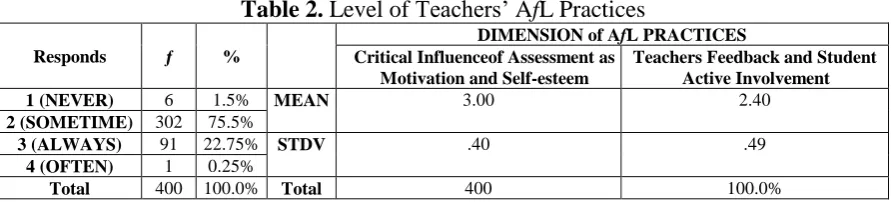
Analysis of research question three was based on answer given by a total of 400 respondents through 14 items related to their AfL practices in SBA context is shown in Table 2. This study reveals that teachers rarely used AfL practice in SBA with 2.75 mean value. This finding is relevent with Brookhart’s (2002) finding which indicate the teachers have limited skills at gathering and using classroom assessment information for improving student learning. This study also indicate findings that teachers always apply the critical influence of assessment as motivation and self-esteem practices. However, rarely use the teachers’ feedback and studentw involvement AfL practices in their lesson. This finding is supported by Hattie and Timperley (2007) that found teachers tend to focus on the correctional rather than instructional aspects of feedback. Studies of the impact of feedback on student learning achievement indicate that the feedback has the potential to have a significant effect on student learning achievement (Hattie and Timperley, 2007). Hattie and Timperley (2007) also note that feedback is more effective when it addresses achievable goals and when it does not carry high threats to self-esteem. At this point, once a task has been assessed, proper feedback needs to be given so that both teaching and
DIMENSION OF SBA KNOWLEDGE
SCORES
CONCEPT ASSESSMENT
PLANNING
ASSESSMENT METHOD SELECTION AND INSTRUMENTATION
DEVELOPMENT
CONDUCTING SBA
SUMMARIZING RESULT AND
GRADING
TOTAL SCORE
ƒ % ƒ % ƒ % ƒ % ƒ % ƒ %
0-39 93 23.25% 70 17.50% 94 23.50% 63 24.50% 100 25.00% 52 13%
40-60 242 60.50% 252 63.00% 247 61.75% 239 59.75% 130 32.50% 272 68%
61-100 65 16.25% 78 19.50% 59 14.75% 98 15.75% 70 17.50% 76 19%
hours on assessments if less than half of the respondents manage to give proper feedback while the majority said that they only manage to give feedback occasionally. Teachers also should use group discussion technique to help enhance the students’ communication and interpersonal and intrapersonal skills (Hamm and Adams, 2009).
Table 2. Level of Teachers’ AfL Practices
Responds ƒ %
DIMENSION of AfL PRACTICES Critical Influenceof Assessment as
Motivation and Self-esteem
Teachers Feedback and Student Active Involvement
1 (NEVER) 6 1.5% MEAN 3.00 2.40
2 (SOMETIME) 302 75.5%
3 (ALWAYS) 91 22.75% STDV .40 .49
4 (OFTEN) 1 0.25%
Total 400 100.0% Total 400 100.0%
Analysis of Teachers’ SBA Knowledge and AfL Practices
Table 3. Level of Teachers’ SBA Knowledge and AfL Practices Based on Teaching
Experience and Training
SBA KNOWLEDGE AfL PRACTICES TOTAL
TEACHING EXPERIENCE
0 - 5 YEARS 50.27 2.72 119 (29.8%) 6 -10 YEARS 50.25 2.71 154 (38.5%) 11 - 15 YEARS 48.28 2.75 73 (18.2%)
MORE THAN
15 YEARS 51.01 2.85 54 (13.5%)
TRAINING YES 49.94 2.77 281 (70.3%)
NO 50.14 2.69 119 (29.7%)
CONCLUSIONS
The findings on the study have indicated that teachers still have insufficient SBA knowledge and lack of AfL practices. Here are some recommendations which could help in the implementation of more effective than SBA. Any form of training in the SBA would be welcome. One has to understand the fact that any change in the policy would require intensive training available to all interested parties. For the effective implementation of the SBA, training should be continued in the form of briefings, sessions or workshops. Respondents in this study who had gone for training in SBA lamented on the fact that the course and exposure offered at school level was insufficient as the Ministry used the Cascade Model for training which trained the trainer to ensure that knowledge is transferred from experts and specialists to the teachers themselves (Dichaba and Mokhele, 2012). Cascade approach failed to prepare either officials or school-based teachers for the complexity involved in implementing the new national curriculum. Ono and Ferreira (2010) documented how teachers frequently complained that even the district trainers themselves did not always understand the curriculum. The result was the misinterpretation of crucial information (Fiske and Ladd, 2004). Those who went for training at the national level were exposed to a week long training stint whereas at state level training was held for three days and at school level, training ranged from 1-day to 1 hour. It is recommended that the training held in appropriate gap of time to delivered the information and do practical on conducting SBA. Here, it is a crucial need of Continuous Professional Development (CPD) for Malaysian teachers as it can improve the educational vitality of our institutions through attention to the competencies needed by individual teachers and to the institutional policies required to promote academic excellence (Wilkenson, 1998).
implementation by looking at conceptions, beliefs and assessment anxiety that can be considered as a new variable.
REFERENCES
[1] AACU. (2011). The Leap Vision for Learning Outcomes, Practices, Impact, and Employers’ Views.
Retrieved on 30 October 2013, From,
Http://Www.Aacu.Org/Leap/Documents/Leapvision_Summary.Pdf
[2] Adi Badiozaman Tuah. Improving The Quality of Primary Education in Malaysia Through Curriculum Innovation: Some Current Issues on Assessment of Students’ Performance and Achievement.
Proceedings 3rd International Conference on Measurement qnd Evaluation in Education (ICMEE), Penang: University Science Of Malaysia (2006), 16-26.
[3] Airasian, P. W. Classroom Assessment. New York: Mcgraw-Hill, 1994.
[4] Black, P. & Wiliam, D. Inside The Black Box: Raising Standards through Classroom Assessment. London: School Of Education, King College, 1998.
[5] Black, P., Harrison, C., Lee, C., Marshall, B. & Wiliam, D. (2003). Assessment for Learning: Putting It Into Practice. New York: Open University Press.
[6] Brookhart, S. M. Expending Views about Formative Classroom Assessment: A Review of the Literature. In. Mcmillan J. H. (Eds.). Formative Classroom Assessment: Theory into Practice, 43-62. New York: Teachers College Press, 2007.
[7] Brookhart, S. M. The Standards and Classroom Assessment Research. Paper Presented At The Annual Meeting of The American Association Of Colleges For Teacher Education, Dallas, TX, 2002.
[8] Brown, G.T.L. School-Based Assessment Methods: Development and Implementation. Journal of Assessment Paradigms 1(1) (2001), 30-32.
[9] Chan Yuen Fook, Gurnam Kaur Sidhu & Md. Rizal Md. Yunus. School-Based Assessment: Enhancing Knowledge and Best Practices. Shah Alam: UPENA, UITM, 2009.
[10] Chan, A.Y.W. Bilingualized or Monolingual Dictionaries? Preferences and Practices of Advanced ESL Learners in Hong Kong. Language. Culture and Curriculum, 24(1) (2011), 1-21.
[11] Dischaba, M.M. & Mokhele, M.L. Does the Cascade Model Work for Teacher Training? Analysis of Teachers’ Experiences. Int J Edu Sci, 4(3) (2012): 249-254.
[12] Fiske, E. B. & Ladd, H. F. Elusive Equity: Education Reform in Post-Apartheid South Africa. Washington: DC: Brookings Institute, 2004.
[13] Griswold, P. A. Beliefs and Inferences About Grading Elicited From Student Performance Sketches.
Educational Assessment, 1(4) (1993), 311–328.
[14] Hall, J. L., & Kleine, P. F. Educators’perceptions of NRT Misuse. Educational Measurement: Issues and Practices, 11(2) (1992), 18–22.
[15] Hall, K. & Burke W. M. Making Formative Assessment Work: Effective Practice in the Primary Classroom. Maidenhead: Open University Press, 2003.
[16] Hamm, M & Adams, D. Activating assessment for all atudents: Inovative activities, lesson plans, and informative assessment. United Kingdom: Rowman & Littlefield Education, 2009.
[17] Hargreaves, A. Teaching In A Knowledge Society — Education In The Age Of Insecurity. London: Teachers College Press, 2003.
[18] Hattie, J. And Timperley.H. The Power of Feedback. Review of Educational Research, 77 (2007), 81-112.
[19] Hills, J. R. Apathy Concerning Grading and Testing. Phi Delta Kappa, 72(7) (1991), 540–545.
[20] Housner, L. D., & Griffey, D. C. Teacher Cognition: Differences in Planning and Interactive Decision Making Between Experienced and Inexperienced Teachers. Research Quarterly for Exercise & Sport, 56(1) (1985), 45–53.
[22] Mitchell, R. Testing For Learning: How New Approaches To Evaluation Can Improve American Schools. New York: The Free Press MOE, 1992.
[23] Nolen, S. B., Haladyna, T. M., & Haas, N. S. Uses and Abuses of Achievement Test Scores.
Educational Measurement: Issues and Practice, 11(2) (1992), 9–15.
[24] O’sullivan, R. G., & Chalnick, M. K. Measurement-Related Course Work Requirements for Teacher Certification and Recertification. Educational Measurement: Issues and Practices, 10(1) (1991), 17–19. [25] Ono, Y. & Ferreira, J. A Case Study of Continuing Teacher Professional Development through Lesson
Study in South Africa. South African Journal of Education, 30 (2010): 59-74.
[26] Organisation for Economic Co-operation and Development (OECD). Formative Assessment — Improving Learning In Secondary Classrooms. Paris: OECD publishing, 2005.
[27] Plake, B. S. Teacher Assessment Literacy: Teachers’ Competencies in The Educational Assessment of Students. Mid-Western Educational Researcher, 6(1) (1993), 21–27.
[28] Reyneke, M. & Meyer, L. & Nel. C. School-Based Assessment: The Leash Needed To Keep The Poetic ‘Unruly Pack of Hounds’ Effectively in The Hunt for Learning Outcome. South African Journal of Education, 30 (2010), 277-292.
[29] Shue A. L. & Anusiem A. U. School-Based Assessment as An Innovation in Nigerian Educational System: The Implementation Challenges. Knowledge Review, 25(1) (2012).
[30] Stiggins, R. J., Frisbie, R. J., & Griswold, P. A. Inside High School Grading Practices: Building A Research Agenda. Educational Measurement: Issues and Practice, 8(2) (1989), 5–14.