International Journal of Asian Social Science, 2014, 4(2): 160-169
† Corresponding author
MEASURING THE EFFECTIVENESS OF TEACHING AND LEARNING
PROGRAMMING THROUGH EMBEDDED SYSTEMS
Surizal Nazeri
College of Information Technology, Universiti Tenaga Nasional(UNITEN, Malaysia)
Azizah Suliman
College of Information Technology, Universiti Tenaga Nasional(UNITEN, Malaysia)
Salman Yussof
†College of Information Technology, Universiti Tenaga Nasional(UNITEN, Malaysia)
Nur Shakirah Md Salleh
College of Information Technology, Universiti Tenaga Nasional(UNITEN, Malaysia)
ABSTRACT
An earlier study has shown fewer students are interested in learning programming subjects. Many
tertiary educational institutions are faced with a high failure rate in programming courses. In
Malaysia the shortage of skilled programmers to meet the job market has caused companies to
invite programmers from the foreign countries like Indonesia, India and Vietnam. In generating
interest towards programming, a new teaching module has been developed. In this module,
students will use electronic devices on an embedded kit to run their programs. This paper discusses
the results of an analysis of the experiments carried to test the concept of teaching and learning C
programming through embedded systems. Based on the analysis done, the students proved to be
more interested in learning programming. Most of the students agreed that the use of electronic
tools help them to be more creative as well as increase their interest in programming. It also
created opportunities for teamwork when they start doing and discussing the programs
development with their friends.
© 2014 AESS Publications. All Rights Reserved.
Keywords:
Teaching and learning, Programming, embedded systems, Teaching and learning tools, Programming in Malaysian schools, Measuring effectiveness, Interest in programmingInternational Journal of Asian Social Science
ISSN(e): 2224-4441/ISSN(p): 2226-5139
Special Issue: International Conference on Teaching and Learning in Education, 2013
© 2014 AESS Publications. All Rights Reserved.
1.
INTRODUCTION
Programming is one of the most sought after skills in the field of information technology.
Currently, electronic devices like smart phones, televisions, music players and many others are the basic equipment’s in our daily life and all of these equipments require programs to enable it to operate in accordance to its purpose. As reported by local newspapers, the shortage of skilled
programmers is evident worldwide. In Malaysia, government and private companies are forced to
import programmers from foreign countries such as India, Indonesia and Vietnam(Hassan, 2009).
Realizing the importance to increase the number of skilled programmers, Malaysian government
introduced computer programming courses at vocational schools(KPM, 2000). The government
also introduced the subject of Information, Communication and Technology as an elective subject
for non-vocational schools to allow the students who are not in the vocational stream to learn basic
concepts of information technology. Since its implementation in 2003, it has not yet reached its
goal in producing a sufficient number of programmers in the country. Research showed that most
students who majored in information technology and computer science do not necessarily choose
programming as a career because they feel that programming is a difficult and boring
subject(Hassan, 2009).
Currently, countries such as Japan, Korea, India and the United States of America (USA) have
been producing a lot of skilled programmers. These countries use different approaches of teaching
programming other than lecturing. In some parts of USA, programming is taught by using
electronic and robotic components in an effort to attract students to programming(Ogasawara and
Dodds, 1992). Presumably this method is effective as these countries export their skilled workers to
countries that require skilled programmers like Malaysia.
Diversity of teaching methods can help attract students to a topic. Various methods have been
introduced by the teachers and researchers in finding the best method to teach programming to
students. According to(Matthíasdóttir, 2006), the teaching methods like focusing on lab sessions,
recorded lectures, online tests and one-to-one teachings are the suitable methods in teaching. Based
on their study, students agreed that the best way to learn programming was to work by themselves
on programming coursework, in practical sessions (in the computer room) and on their own with
the learning materials. This is consistent with (Bellaby et al., 2003) who states that “…lectures are not a useful way of teaching programming”. Both of them suggested the new way to teach programming must be introduced in order to gain students’ interest.
In addition, the robot kit is also used in many developed countries to give students early
exposure to science-related programming. Since (Papert, 1993) introduced a method of teaching
through robotic, awareness of the importance of its use has been increasing year after year. Starting
from that, various studies have been conducted to find the best method to incorporate robotic
education. The use of robots in education can help teachers to attract students to a topic in the
classroom. According to (Goh and Aris, 2008 ), robots have great potential for pedagogic reasons
within education at all levels. In addition, the robotic elements also provide particular opportunities
for making accessible, for a wide range of disabled students, practical elements of the
curriculum(Mataric, 2004). However, (Cliburn, 2006)reported that only one out of five courses that
he taught using robots could be considered successful. He did point out, that part of the reason for
© 2014 AESS Publications. All Rights Reserved.
indicates the use of robots can attract students to learn programming, but it is not practical because
students need to handle easily damaged components. In addition, the cost to buy a robot is too high.
According to the (McNally, 2006) cost of a robot could reach $300 and it was too high to provide
every student with a robot. Since the robots are operated on batteries and are not a precise device,
they are also prone to errors and variations in behavior over time. For example, a right turn may be
93 degrees when the batteries are fully charged but only 87 degrees once they are half dead.
In this project we developed a teaching module with an embedded system training kit to teach
programming to school children in Malaysia. Embedded Systems Programming (ESP) module is a
module which was developed by adapting teaching methods that are based on embedded systems
and robotic as it was implemented in other countries. The syllabus of this module followed the
Fundamentals of Programming (C Programming) subject and maintains the topics in the syllabus as
set by the Ministry of Education (MOE), Malaysia. The difference between this module and the
existing module currently used in Malaysian schools is the use of the electronic components such
as LED, LCD, 7-segment display and keypad as input and output devices for the programs. The
electronic components are supposedly to be the enticing elements of programming in this module.
ESP consists of 8 topics where Chapter 1 to Chapter 5 are topics related to the basic of C
Programming while Chapters 6 to Chapter 8 are additional chapters for students to learn the basic
of Embedded System Programming. This module includes a manual on how the students can use
the kit to run their programs.
This paper is organized into four sections. While Section 1 introduces the background of this
research, Section 2 will briefly describes the methodology of how the research and experiments are
carried out. Section 3 which are actually the main emphasis of this paper, details the results of the
testing and assessments of the module and shows the major findings of it. Section 4 ends with a
discussion of the findings and concludes with an establishment of a few statements.
2.
METHODOLOGY
The major steps that can be clearly distinguished in this research project are module
development and module testing and assessment. In this section, we briefly described the first
phase of the methodology. For details of this phase please refer to(Suliman and Nazeri, 2012),
(Nazeri et al., 2013) and (Suliman and Nazeri, 2013). The testing and assessment methods are
described so as to give an understanding of how the results are collected for the analysis.
2.1. Module Development
As mentioned before the modules are developed based on the syllabus of Fundamentals of
Programming Language (C Language) but with an introduction to Embedded Systems
Programming so the students may be able to use the accompaning training kit to do the partical part
of running their progams. Table 1 shows a brief outline of the topics covered in the ESP teaching
module. Following the syllabus taxonomy of many programming courses, chapter 1 and 2 starts
with the basic theory of programming and problem solving methods. As the basic programming
curriculum in Malaysian schools cover structured programming issues until the topics of
conditional statements, iterative statements and basic functions, the ESP module content was also
© 2014 AESS Publications. All Rights Reserved.
solving the problems as related to the embedded devices on the training kit, the programs are
executed on the training kits. Problems such as simulating the sequence of traffic light lightings on
LEDs on the kits can easily incorporate the structured programming concepts of conditional
statements and loops. Through visualization of the problem solution, problem solving becomes
more exiciting for the students.
Table-1. A Brief Table of Content for the ESP Teaching Module
Chapter Topics
1 Introduction to Programming
2 Basic Problem Analysis and Design
3 Fundamentals of C programming
4 Selection Statements
5 Looping Statements
6 Introduction to Embedded System
7 PIC16 Background
8 Embedded Programming
2.2. Module Testing
The teaching modules are tested on students selected from two types of schools, which are the
daily (non-boarding and non-vocational) schools and vocational (boarding) schools. Group 1 is a
group of 35 students from vocational schools who have been taught basic programming for eight
months. Students from this group consist of students from Sekolah Vokasional Balik Pulau and
Sekolah Vokasional Shah Alam. Group 2 consists of students from daily schools with a total of 36
students have yet to be exposed to any formal basic programming in schools. Students from this
group came from the Sekolah Kebangsaan Derma, Perlis and Sekolah Kebangsaan Bandar Baru
Salak Tinggi.
The total teaching time depends on the approval given by the school. Lesson plans are broken
down into two teaching options, which are two days or three days of teaching session. For schools
that provides two days of teaching session, teaching begins at 8 am and end at 5 pm and the total
amount of time for teaching session is 15 hours and for the school that provides three days,
teaching session begins at 8 am and ends at 2 pm. Total number of hours for three days is 16 hours.
During the teaching process, students will be divided into groups with each group consist of
two to four persons. Each group is provided with one ESP module, one embedded kit and one set of
answer booklet to enable students to write answers to each exercise session.
2.3. Assessment Methods
Assessments process is the stage where the students’ programming performance will be tested
and assessed. In this process, students will be evaluated via three assessment methods to determine
their level of understanding. The three methods of assessment are survey, exercises and project.
2.3.1. Survey
Survey contains a number of questions to gauge their interests, understanding and
© 2014 AESS Publications. All Rights Reserved.
after the completion of the teaching and learning process. Each student is given one set of survey
questions where they are required to answer and hand back to the instructor.
2.3.2. Exercises
The exercises contain questions to be answered by students based on the topic and it needsto
be answered in a group. After each topic covered from the teaching module, related exercises need
to be done and answers to the exercise questions need to be recorded in the answer booklet
provided. At the end of the course, the group need to return the answer booklet to the instructor for
grading.
2.3.3. Project
Project is to identify whether the students can apply what they have been taught so far, to
produce a program using the Embedded Kit. Each group was given time of three to four hours to
write a program using the embedded kit that utilizes the input and output devices. Scoring does not
necessarily depend on the students in producing exciting programs but awarding marks are
dependent on the amount of subtopic that can be included in the program and the complexity of the
program. The more subtopics and variations of control structure included in a program, the more
marks can be obtained. Each group is required to present their project.
3.
RESULTS AND ANALYSIS
To facilitate understanding, the results are described in three parts, namely the result of the
surveys, the result of the class exercises and the result of the class project. The results will be analyzed and discussed to gain an insight into the students’ performance and their interest inthis new approach in teaching programming.
3.1. Survey
This survey is intended to obtain the students’ opinion on the developed modules in terms of the module layout and the topics covered so that improvements can be made in the future. Apart
from that, it is also aimed to find out whether or not the students are interested in programming
after the use of this module. The survey was carried out after all the related topics have been taught
to the students. Students involved in the survey can be categorized into two groups, students who
had not had a formal training in programming, Group 2 and students who have had a formal
training in programming, Group 1.
As can be seen from Figure 1, 51% of the students (36 out of 71 students) have never learned
basic programming before. By referring to Figure 2, students who have not learned programming,
83.6% or 31 students agree that this module is easy to understand and help them understand the
programming topics. 91.9% or 34 students felt that the use of electronic components helps to
generate their interest in learning programming because they can manipulate the components to
© 2014 AESS Publications. All Rights Reserved.
Figure-1. Student experience in programming
Figure-2. Group 2 - Student understanding and opinions
Figure-3. a) Student interest b) Student opinion
(a) (b)
As shown in Figure 3, the ability of the module to get students to be interested to learn
programming is proven when 86.5% of the students confirmed this to be the case. Apart from that,
94.6% have expressed their interest to learn more about programming in the future.
51% 49%
Programming Basic
Yes No
0 1 2 3 4 5
Easy to understand Electronic component
helps in understandings
N
o
o
f
st
u
d
en
ts
Question
Agree
Disagree
86% 14%
This module makes me interested in programming
Agree Disagree
Agree 95% Disagree
5%
© 2014 AESS Publications. All Rights Reserved.
Figure-4. Students’ Passion in Programming
The passion and interest of the students shown in Figure 4 also revealed when 91.9% of the
students actively modifying their program throughout the lab session, while 70.3% of them
admitted that they could answer questions correctly.
Figure- 5. Student opinion
Among the students surveyed, 49% of them (35 out of 71 students) have learned basic
programming before. Based on Figure 5, 76.5% or 26 of students in this group think that this
module is easy to understand and all of them agreed that the use of electronic components is able to
help them to understand the programming topics taught. A total of 97.1% or 33 of the students
agreed that this module is able to attract them to learn programming and all of them are interested
to learn more in the future. All students also admit they are interested in modifying the program to
produce various different outputs and 67.6% or 23 students admitted that they can answer the
exercise questions correctly.
3.2. Class Exercises
Exercise is a tool for assessing the level of student understanding on the topics taught to them.
An exercise is given to each group after the end of each chapter.
0 5 10 15 20 25 30 35 40
I always try to modify my program I can answer the exercise question
correctly
N
o
o
f
st
u
d
en
ts
© 2014 AESS Publications. All Rights Reserved.
Figure-6. Students’ Grades – Group 1
Based on the Figure 6, 50% or 18 of the students who have learned basic programming before
acquired A- and above for the overall score. Only 16.7% or 3 students in this category obtained the
grade C and below. The other else get the grade between B+ and C+.
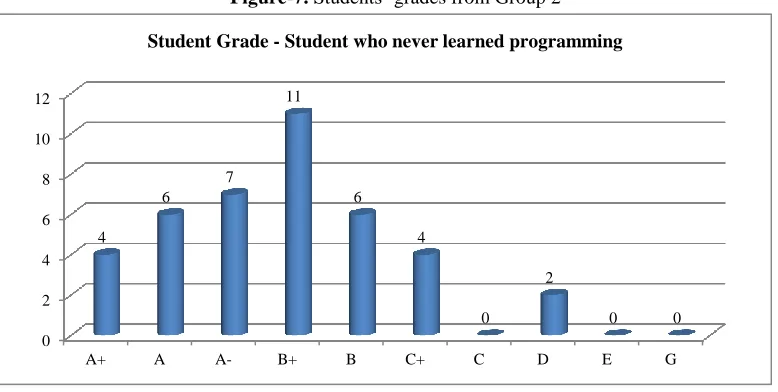
Figure-7. Students’ grades from Group 2
For students who have not learned basic programming before, the student grade is shown in
Figure 7. There are 42.5% or 17 students managed to obtain A- and above. However, there are 2 or
5% of the students who obtained a D grade for the exercise. The majority of students only manage
to achieve moderate achievement where 52.5% or 21 students obtained the grades between B+ and
C
3.3. Class Project
Each group was given four hours to develop their group project. Marks for project are not
dependent on the creativity of the students, but focuses on students' understanding of topics that
have been taught before.
3 6
9
6 6
3 3
0 0 0
A+ A A- B+ B+ C+ C D E G
Student Grade - Student who has learned programming
Student Grade
0 2 4 6 8 10 12
A+ A A- B+ B C+ C D E G
4 6
7
11
6
4
0 2
0 0
© 2014 AESS Publications. All Rights Reserved.
Figure-8. Percentage of topic applied in student’s project
Based on Figure 8, students who have learned basic programming before show good
performance. In total there are 10 sub-topics, and there are four groups that managed to apply 80%
of the programming techniques taught to them in their program. Another seven groups managed to
apply 70% of the programming techniques taught, while the other one group managed to apply
60% of the programming techniques taught in their program. Achievement of students who do not
have a previous training in programming is also very encouraging. There is one group that
managed to apply all the programming techniques taught to them. Another three groups managed
to apply 90% of the programming techniques taught, six groups managed to apply 80% of the
programming techniques taught and the other two groups managed to apply 70% of the
programming techniques taught.
4.
DISCUSSION AND CONCLUSION
The results obtained from these three assessments have shown positive results. In general, the
results showed that the students are able to learn programming quite effectively using embedded
systems. The use of embedded system to teach programming has also increased their interest in
programming to the extent that they would like to learn more. This is proven by their active attitude
observed during the process of developing a program in which they are always seen, trying to
modify their program if the output does not satisfy them. The interest and enthusiasm of the
students are consistent with their performance in class exercises. Overall, student achievement in
class exercises have shown encouraging results in which none of them fail (grade F). Almost half
of the class managed to get the grade A- and above. This is believe to have proved the effectiveness
of this module in increasing student interest and achievement in programming. This statement is
further strengthened by the students’ achievement in class project which was developed by the
students in groups. All groups are able to apply at least 60% of the programming techniques taught
to them in their project. This means that they can understand what has been taught to them and
apply them in the program that they are developing. Overall, the use of embedded systems in
teaching and learning programming is proven to attract student interest in learning programming as
well as increase their understanding and achievements. This method provides an alternative to
teach programming that can be applied by schools as well as higher learning institutions.
In conclusion, the approach of teaching programming using embedded system as has been
practiced by a number of other countries is also suitable to be implemented in Malaysia. Interest in
0 1 2 3 4 5 6 7
60% 70% 80% 90% 100%
N
o
o
f
st
u
d
en
ts
Total topic applied in class project
Group 1 : Basic Programming Experience
© 2014 AESS Publications. All Rights Reserved.
programming grew because the students are able to see physical outputs of their program offered in
the embedded kit. This method has been proven to be effective in attracting student interest in
learning programming as well as able to enhance students' understanding and performance
compared to the traditional method in teaching programming.
REFERENCES
Bellaby, G., C. McDonald and A.Patterson, 2003. Why lecturer? 4th Annual LTSN - ICS Conference.
Galway, Ireland. pp. 228-231.
Cliburn, D. C. 2006. Experiences with the LEGO mindstorms through the undergraduate computer science
curriculum. The 36th ASEE/IEEE Frontiers in Education Conference.California: pp. 1-6.
Goh, H. and B. Aris, 2008 . Using robotics in education : Lessons learned and learning experiences. smart
teaching & learning: Re-engineering ID, Utilization and Innovation of Technology. Johor Bahru. pp:
2.
Hassan, S. F. 2009. Kerjaya bidang IT lumayan. Kuala Lumpur: Harian Metro.
KPM, K. P. 2000. Pusat perkembangan kurikulum. Putrajaya: Kementerian Pelajaran Malaysia KPM.
Mataric, M. J. 2004. Robotics education for all ages. AAI Spring Symposiumon Accessible, Hands-on AI and
Robotics Education. Palo Alto: The AAAI Press. pp: 14
Matthíasdóttir, Á. 2006. How to teach programming languages to novice students? International Conference
on Computer Systems and Technologies (CompSysTech'06). Bulgaria.
McNally, G. M.-M. 2006. Do LEGO mindstorms robots have a future in CS education? SIGCSE Bull. pp:
61-62.
Nazeri, S., A. Suliman and N.Salleh, 2013. Measuring the effectiveness of teaching and learning programming
through embedded system. International Conference on Teaching and Learning Education (ICTLE).
Melaka.
Ogasawara, T. and G. Dodds, 1992. Robotics in Japan: from east to west and outer space to inner space.
Computing & Control Engineering Journal, 3(3): 142-148.
Papert, S. 1993. The children's machine: Rethinking school in the age of the computer. New York: Basic
Books.
Suliman, A. and S. Nazeri, 2012. The effectiveness of teaching and learning programming using embedded
system. 8th International Conference on Information Science and Digital Content Technology
(ICIDT). Jeju Island, Korea. pp: 32-36
Suliman, A. and S. Nazeri, 2013. Methods for evaluating the ffectiveness of A C programming teaching tool.
International Conference on Computing and Informatics ICOCI. Sarawak. pp: 127-132