Drug Design, Development and Therapy 2016:10 3725–3736
Drug Design, Development and Therapy
Dove
press
submit your manuscript | www.dovepress.com 3725
R e v i e w open access to scientific and medical research
Open Access Full Text Article
Systematic review and meta-analysis of
randomized controlled trials on wenxin keli
Xiaoyi wang Ying wang Xiaoyuan Feng Ying Lu
Yu Zhang wenwen wang wentao Zhu
School of Management, Beijing University of Chinese Medicine, Beijing, People’s Republic of China
Objective: The aim of the study was to evaluate the effectiveness, safety, and cost associated with Wenxin keli in the treatment of cardiovascular diseases based on meta-analysis.
Methods: The terms “Wenxin keli” and “Wenxin” were used as the search terms in the PubMed, ProQuest, Springer, the Cochrane Library, CNKI (China National Knowledge Infrastructure), VIP (Chinese Scientific Journals Database), and Wan fang electronic databases (from January 2000 to October 2015). Relevant print journals and conference papers were also searched. Studies on randomized controlled trials (RCTs) of Wenxin keli used in the treatment of cardiovascular diseases were screened, and its indications were classified. Meta-analysis of these studies was conducted using the RevMan 5.2 software.
Results: A total of 49 RCTs (n=4,610) were included, 29 of which focused on arrhythmia, seven on angina, seven on heart failure, two on viral myocarditis, and four on menopausal syndrome. Analysis of the therapeutic indications of Wenxin keli showed that it was comparatively more curative and effective than other available treatments for cardiovascular diseases.
Conclusion: Wenxin keli showed better clinical efficacy in the treatment of arrhythmia, angina, and heart failure; however, more high-quality evidence is needed to support its use in the clinical setting.
Keywords: Wenxin keli, cardiovascular disease, meta-analysis, systematic review
Introduction
The number of patients affected by cardiovascular disease is steadily increasing because of socioeconomic development and modern lifestyles.1 A report from the World Health
Organization reveals that chronic noncommunicable diseases have now become the leading cause of death worldwide. In 2008, 36 million individuals died of chronic noncommunicable diseases (63% of total deaths), of which 48% died of cardiovascular diseases.2 In recent years, there has been a shift in the medical paradigm, and
cardio-vascular and cerebrocardio-vascular diseases have now become a serious threat to public health.3 According to a report on Cardiovascular Diseases in China (2013), presented
at the China Heart Congress, about one-fifth of all Chinese adults are currently affected with cardiovascular and cerebrovascular diseases.4 Furthermore, during the past five
years, mortality due to cardiovascular diseases ranks first among all causes of death.4
Social and economic development has led to dramatic changes in lifestyles, including an increase in energy intake, less manual labor, accelerated pace of life, competitive pressures, and exposure to other risk factors associated with cardiovascular and other chronic noncommunicable diseases, which are causes for concern.5
Wenxin keli consists of several kinds of Chinese herbs including Huang Jing,
Codonopsis, amber, Panax, and nard. Wenxin keli has been used clinically in the
treat-ment of qi and yin deficiency, systolic blood stasis due to restless heart palpitations, Correspondence: wentao Zhu
School of Management, Beijing University of Chinese Medicine, No 11, Beijing North Third Ring Road, Chaoyang, Beijing, People’s Republic of China Tel +86 10 6428 6475
Fax +86 10 6428 6475 email [email protected]
Journal name: Drug Design, Development and Therapy Article Designation: Review
Year: 2016 Volume: 10
Running head verso: Wang et al
Running head recto: Meta-analysis of the effects of Wenxin keli DOI: http://dx.doi.org/10.2147/DDDT.S112333
Drug Design, Development and Therapy downloaded from https://www.dovepress.com/ by 118.70.13.36 on 21-Aug-2020
For personal use only.
Number of times this article has been viewed
This article was published in the following Dove Press journal: Drug Design, Development and Therapy
Dovepress
wang et al
shortness of breath, chest pain, premature ventricular con-tractions (PVC), and atrial premature beats. It is one of the main forms of treatment for cardiovascular disease in Chinese medicine. In recent years, many researchers have evaluated the use of Wenxin keli in the treatment of cardiovascular disease; however, further evaluation is necessary. Therefore, the present study aimed to conduct a comprehensive evalua-tion of the efficacy and safety of Wenxin keli, and provide the basis for its use as a medication for cardiovascular disease.
Materials and methods
Literature search
We performed systematic searches for randomized con-trolled trials (RCTs) designed to evaluate the clinical effi-cacy of Wenxin keli in CNKI (China National Knowledge Infrastructure), Wan fang, VIP (Chinese Scientific Journals Database), PubMed, the Cochrane Library, Springer, and ProQuest from January 1, 2000 to September 7, 2015 using “Wenxin keli” and “Wenxin” as the search terms.
inclusion and exclusion criteria
Based on the Cochrane Collaboration Handbook standards, the following inclusion criteria were formulated for the selected literature: all published domestic and international RCTs on Wenxin keli; comparable baseline test data; interventions with individual drugs and Wenxin keli doses of 9 g, three times/day; any particular course of treatment; publications in Chinese and English. Diagnostic criteria used in the present study were based on authoritative Chinese and other countries diagnostic criteria. The exclusion criteria were as follows: duplicate pub-lications, reports of combination therapy effects on treatment, descriptive studies, studies involving animal testing, conflicting before and after data (such as, the sum of the data not matching the total), and reports without statistical indicators.
Quality assessment
Study quality was evaluated with an improved version of the Jadad questionnaire, considering mainly four aspects: 1) random sequence generation (2 points); 2) randomized hiding (2 points); 3) blinding (2 points); 4) a withdrawal period (1 point). Two reviewers independently completed the assessment, and the mean score of the two reviewers was used as the final quality score of the selected studies. In the assessment of RCTs, 1–3 points were considered as low quality, and 4–7 points indicated high quality.
A unified data extraction sheet was derived, based on blind-ing characteristics in previously published medical literature, for use by the two reviewers. The information thereby extracted was then cross-checked. The extracted data included:
1) document specifications: first author, publication year, and title;
2) subjects: disease, diagnostic criteria, inclusion and exclu-sion criteria, sample size, etc;
3) interventions: medication, dosage, route of administra-tion, duration of treatment, etc;
4) results: efficacy indicators.
Statistical analysis
The RevMan 5.2 software, provided by the Cochrane Collaboration, was used to conduct the meta-analysis. Count data were used to determine the odds ratio (OR) and 95% confidence interval (CI) for the efficacy analysis of effect size, whereas measurement data were used to determine the standardized mean difference. Heterogeneity of the included studies was expressed in terms of P and I2. If P.0.1 and
I2,50%, the result of the test for heterogeneity was
con-sidered not statistically significant, and the fixed effects model was used for meta-analysis. For contrast, the random effects model was also applied to the data when P#0.1 and
I2$50%.
Results
Retrieval results and quality assessment
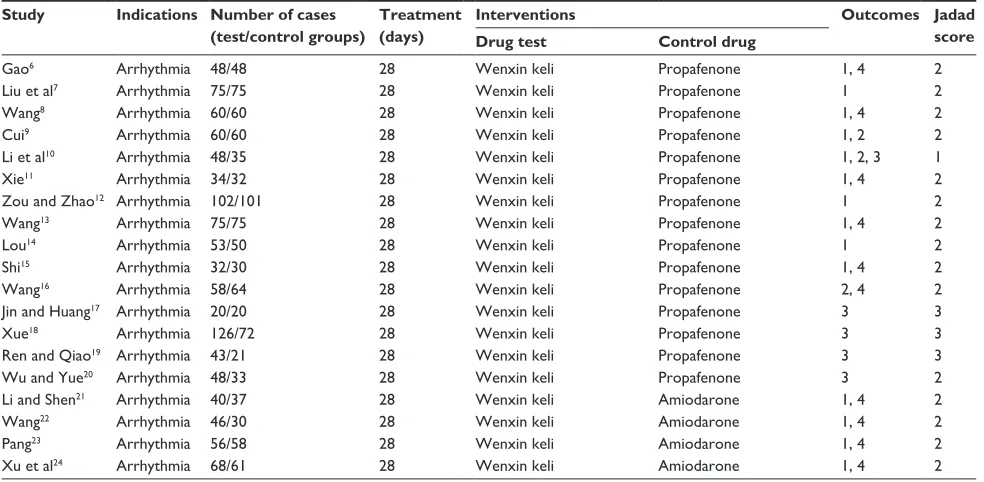
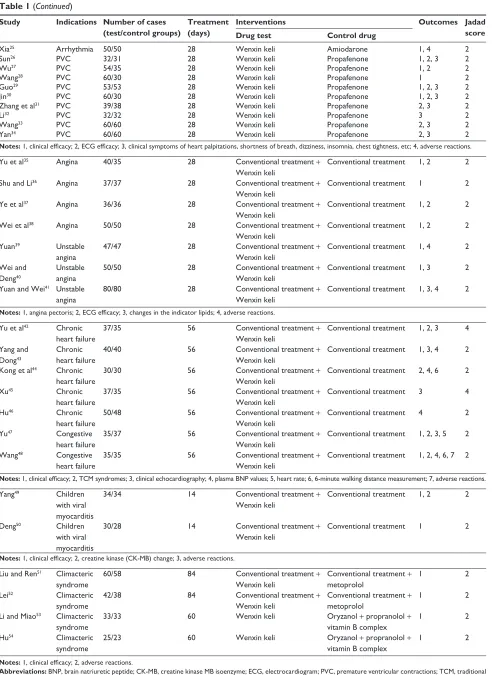
We searched 2,970 potentially relevant articles in CNKI, 3,488 in Wan fang, 2,393 in VIP, and two each in PubMed, Springer, the Cochrane Library, and ProQuest. We retrieved 2,274 reports after reading the abstracts, and reports involv-ing animal studies, pharmacological studies, and systems analyses were excluded. After screening the full texts of 663 documents that were selected following applica-tion of the inclusion and exclusion criteria, 29 studies on arrhythmia were included,6–34 of which nine were on PVC,
seven on angina,35–41 seven on heart failure,42–48 two on viral
disorders,49,50 and four on climacteric syndrome,51–54 as shown
in Figure 1 and Table 1.
The quality assessment of the studies was performed by two independent reviewers. Of the 49 studies included (Figure 1 and Table 1), only two studies were found to be of high quality (4 points).6–54 The results of specific assessment
are presented in Table 1.
Results of meta-analysis
Meta-analysis of wenxin keli in the treatment of arrhythmia
Clinical efficacy
There were 29 reports on the use of Wenxin keli in the treatment of arrhythmia, including nine on PVC. The results showed that Wenxin keli exhibited better clinical efficacy in
Drug Design, Development and Therapy downloaded from https://www.dovepress.com/ by 118.70.13.36 on 21-Aug-2020
Dovepress Meta-analysis of the effects of wenxin keli
³:HQ[LQNHOL´DQG³:HQ[LQ´XVHGDVNH\ZRUGV LQVHDUFKDEOHGDWDEDVHV
/LWHUDWXUHUHYLHZIRU PHWDDQDO\VLVQ
)LOWHUGRFXPHQW QXPEHUQ
&OLPDFWHULF V\QGURPHQ 9LUDOP\RFDUGLWLV
Q +HDUWIDLOXUH
Q $QJLQD
Q $UUK\WKPLD
Q
3XE0HG3UR4XHVW 6SULQJHU&RFKUDQH
Q :)
Q 9,3
Q &1.,
Q
6\QGURPHFODVVLILFDWLRQ
6FUHHQLQJEDVHGRQWLWOHDQGDEVWUDFWDQGWKH IROORZLQJH[FOXVLRQFULWHULDDQLPDOWHVWLQJ QRQUDQGRPL]HGFRQWUROOHGWULDOVDQG V\VWHPDWLFUHYLHZV
)XUWKHUPXOWLSOH[VFUHHQLQJH[FOXGLQJGXSOLFDWH SXEOLFDWLRQVWKRVHWKDWGLGQRWPHHWVSHFLILF VWDQGDUGVDQGWKRVHWKDWVDWLVILHGWKHFULWHULD ZLWKRXWWKHUHTXLUHGLQGH[WH[W
Figure 1 Study selection steps.
Abbreviations: CNKI, China National Knowledge Infrastructure; VIP, Chinese Scientific Journals Database; WF, Wan fang.
Table 1 Basic characteristics of included studies
Study Indications Number of cases
(test/control groups)
Treatment (days)
Interventions Outcomes Jadad
score
Drug test Control drug
Gao6 Arrhythmia 48/48 28 wenxin keli Propafenone 1, 4 2
Liu et al7 Arrhythmia 75/75 28 wenxin keli Propafenone 1 2
wang8 Arrhythmia 60/60 28 wenxin keli Propafenone 1, 4 2
Cui9 Arrhythmia 60/60 28 wenxin keli Propafenone 1, 2 2
Li et al10 Arrhythmia 48/35 28 wenxin keli Propafenone 1, 2, 3 1
Xie11 Arrhythmia 34/32 28 wenxin keli Propafenone 1, 4 2
Zou and Zhao12 Arrhythmia 102/101 28 wenxin keli Propafenone 1 2
wang13 Arrhythmia 75/75 28 wenxin keli Propafenone 1, 4 2
Lou14 Arrhythmia 53/50 28 wenxin keli Propafenone 1 2
Shi15 Arrhythmia 32/30 28 wenxin keli Propafenone 1, 4 2
wang16 Arrhythmia 58/64 28 wenxin keli Propafenone 2, 4 2
Jin and Huang17 Arrhythmia 20/20 28 wenxin keli Propafenone 3 3
Xue18 Arrhythmia 126/72 28 wenxin keli Propafenone 3 3
Ren and Qiao19 Arrhythmia 43/21 28 wenxin keli Propafenone 3 3
wu and Yue20 Arrhythmia 48/33 28 wenxin keli Propafenone 3 2
Li and Shen21 Arrhythmia 40/37 28 wenxin keli Amiodarone 1, 4 2
wang22 Arrhythmia 46/30 28 wenxin keli Amiodarone 1, 4 2
Pang23 Arrhythmia 56/58 28 wenxin keli Amiodarone 1, 4 2
Xu et al24 Arrhythmia 68/61 28 wenxin keli Amiodarone 1, 4 2
(Continued)
Drug Design, Development and Therapy downloaded from https://www.dovepress.com/ by 118.70.13.36 on 21-Aug-2020
Dovepress
wang et al
Table 1 (Continued)
Study Indications Number of cases
(test/control groups)
Treatment (days)
Interventions Outcomes Jadad
score
Drug test Control drug
Xia25 Arrhythmia 50/50 28 wenxin keli Amiodarone 1, 4 2
Sun26 PvC 32/31 28 wenxin keli Propafenone 1, 2, 3 2
wu27 PvC 54/35 28 wenxin keli Propafenone 1, 2 2
wang28 PvC 60/30 28 wenxin keli Propafenone 1 2
Guo29 PvC 53/53 28 wenxin keli Propafenone 1, 2, 3 2
Jin30 PvC 60/30 28 wenxin keli Propafenone 1, 2, 3 2
Zhang et al31 PvC 39/38 28 wenxin keli Propafenone 2, 3 2
Li32 PvC 32/32 28 wenxin keli Propafenone 3 2
wang33 PvC 60/60 28 wenxin keli Propafenone 2, 3 2
Yan34 PvC 60/60 28 wenxin keli Propafenone 2, 3 2
Notes: 1, clinical efficacy; 2, ECG efficacy; 3, clinical symptoms of heart palpitations, shortness of breath, dizziness, insomnia, chest tightness, etc; 4, adverse reactions.
Yu et al35 Angina 40/35 28 Conventional treatment +
wenxin keli
Conventional treatment 1, 2 2
Shu and Li36 Angina 37/37 28 Conventional treatment +
wenxin keli
Conventional treatment 1 2
Ye et al37 Angina 36/36 28 Conventional treatment +
wenxin keli
Conventional treatment 1, 2 2
wei et al38 Angina 50/50 28 Conventional treatment +
wenxin keli
Conventional treatment 1, 2 2
Yuan39 Unstable
angina
47/47 28 Conventional treatment +
wenxin keli
Conventional treatment 1, 4 2
wei and Deng40
Unstable angina
50/50 28 Conventional treatment +
wenxin keli
Conventional treatment 1, 3 2
Yuan and wei41 Unstable
angina
80/80 28 Conventional treatment +
wenxin keli
Conventional treatment 1, 3, 4 2
Notes: 1, angina pectoris; 2, ECG efficacy; 3, changes in the indicator lipids; 4, adverse reactions. Yu et al42 Chronic
heart failure
37/35 56 Conventional treatment +
wenxin keli
Conventional treatment 1, 2, 3 4
Yang and Dong43
Chronic heart failure
40/40 56 Conventional treatment +
wenxin keli
Conventional treatment 1, 3, 4 2
Kong et al44 Chronic
heart failure
30/30 56 Conventional treatment +
wenxin keli
Conventional treatment 2, 4, 6 2
Xu45 Chronic
heart failure
37/35 56 Conventional treatment +
wenxin keli
Conventional treatment 3 4
Hu46 Chronic
heart failure
50/48 56 Conventional treatment +
wenxin keli
Conventional treatment 4 2
Yu47 Congestive
heart failure
35/37 56 Conventional treatment +
wenxin keli
Conventional treatment 1, 2, 3, 5 2
wang48 Congestive
heart failure
35/35 56 Conventional treatment +
wenxin keli
Conventional treatment 1, 2, 4, 6, 7 2
Notes: 1, clinical efficacy; 2, TCM syndromes; 3, clinical echocardiography; 4, plasma BNP values; 5, heart rate; 6, 6-minute walking distance measurement; 7, adverse reactions.
Yang49 Children
with viral myocarditis
34/34 14 Conventional treatment +
wenxin keli
Conventional treatment 1, 2 2
Deng50 Children
with viral myocarditis
30/28 14 Conventional treatment +
wenxin keli
Conventional treatment 1 2
Notes: 1, clinical efficacy; 2, creatine kinase (CK-MB) change; 3, adverse reactions. Liu and Ren51 Climacteric
syndrome
60/58 84 Conventional treatment +
wenxin keli
Conventional treatment +
metoprolol
1 2
Lei52 Climacteric
syndrome
42/38 84 Conventional treatment +
wenxin keli
Conventional treatment +
metoprolol
1 2
Li and Miao53 Climacteric
syndrome
33/33 60 wenxin keli Oryzanol + propranolol +
vitamin B complex
1 2
Hu54 Climacteric
syndrome
25/23 60 wenxin keli Oryzanol + propranolol +
vitamin B complex
1 2
Notes: 1, clinical efficacy; 2, adverse reactions.
Abbreviations: BNP, brain natriuretic peptide; CK-MB, creatine kinase MB isoenzyme; eCG, electrocardiogram; PvC, premature ventricular contractions; TCM, traditional Chinese medicine.
Drug Design, Development and Therapy downloaded from https://www.dovepress.com/ by 118.70.13.36 on 21-Aug-2020
Dovepress Meta-analysis of the effects of wenxin keli
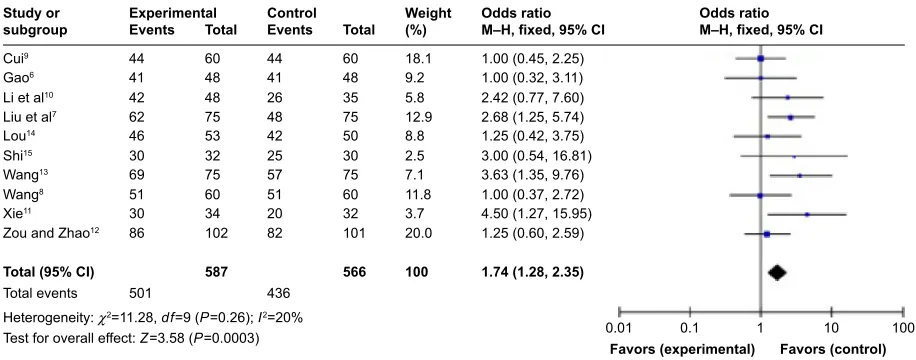
the treatment of arrhythmia (OR =1.74, 95% CI [1.28, 2.35],
P=0.0003; Figure 2) compared to propafenone. Also, in comparison to amiodarone, Wenxin keli again exhibited better clinical efficacy in the treatment of arrhythmia (OR =2.28, 95% CI [1.33, 3.89], P=0.003; Figure 3).
Five studies considered the use of Wenxin keli in the treatment of PVC. The meta-analysis showed that it exhibited better clinical efficacy than propafenone (OR =2.92, 95% CI [1.72, 4.96], P,0.0001; Figure 4).
Efficacy of Wenxin keli on electrocardiogram
Three studies reported on the efficacy of Wenxin keli on electrocardiogram (ECG). Meta-analysis of the random effects model showed no significant difference between Wenxin keli and propafenone in the treatment of arrhythmia based on the ECG (OR =2.15, 95% CI [0.58, 7.97], P=0.25; Figure 5).
Eight studies reported on the use of Wenxin keli in the treatment of PVC. The meta-analysis showed that Wenxin keli showed better efficacy than propafenone based on the ECG (OR =2.19, 95% CI [1.45, 3.30], P=0.0002; Figure 6).
Secondary outcomes
Five studies reported on the effect of Wenxin keli treatment on secondary efficacy variables in PVC. Heterogeneity was minimal; thus, the fixed effects model was applied to the study that reported on secondary efficacy variables, in addition to dizziness. The results showed that Wenxin keli exhibited better efficacy, in addition to dizziness (Table 2).
Adverse reactions
A total of eleven studies reported adverse reactions in the treat-ment of arrhythmia. Wenxin keli showed a lower incidence
of adverse reactions, with reports of mild adverse reactions and favorable clinical application and safety, in comparison to both propafenone and amiodarone (Figures 7 and 8).
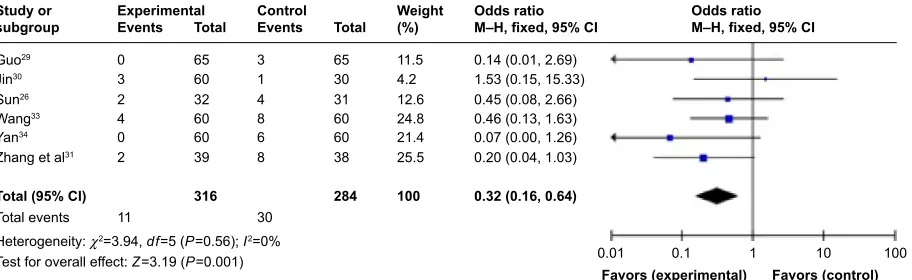
Six studies reported on adverse reactions in the treatment of PVC. Meta-analysis of the fixed effects model showed that Wenxin keli exhibited a lower incidence of adverse reac-tions (OR =0.32, 95% CI [0.16, 0.64], P=0.001; Figure 9) compared to amiodarone.
Publication bias
A funnel plot (Figure 10) showed that the studies report-ing the use of Wenxin keli in the treatment of arrhythmia, included in the analysis, were substantially symmetric. This suggests less publication bias in these reports. According to the Cochrane Handbook, funnel plot analysis should not be performed for other indications if there are less than ten studies.
Meta-analysis of wenxin keli in the treatment of angina
Angina pectoris
Six reports, included in the analysis, reported on the use of Wenxin keli in the treatment of angina pectoris, of which three specifically focused on angina and three on unstable angina. Meta-analysis of the fixed effects model showed that the clinical efficacy of Wenxin keli combined with conventional therapy in the treatment of angina was significantly better than conventional therapy alone (OR =3.12, 95% CI [1.77, 5.52], P,0.0001; Figure 11). The clinical efficacy of Wenxin keli combined with conventional therapy in the treatment of unstable angina was also significantly better than con-ventional therapy alone (OR =3.97, 95% CI [1.92, 8.22],
P=0.0002; Figure 12).
([SHULPHQWDO &RQWURO 2GGVUDWLR
0±+IL[HG&,
)DYRUVH[SHULPHQWDO
(YHQWV
(YHQWV
7RWDO
7RWDO
:HLJKW
2GGVUDWLR 0±+IL[HG&,
7HVWIRURYHUDOOHIIHFW= 3
+HWHURJHQHLW\χ GI 3 ,
)DYRUVFRQWURO
7RWDOHYHQWV
6WXG\RU VXEJURXS
7RWDO&,
&XL
*DR
/LHWDO
/LXHWDO
/RX
6KL
:DQJ
:DQJ
;LH
=RXDQG=KDR
Figure 2 Meta-analysis of wenxin keli and propafenone in the treatment of arrhythmia. Abbreviations: CI, confidence interval; M–H, Mantel–Haenszel.
Drug Design, Development and Therapy downloaded from https://www.dovepress.com/ by 118.70.13.36 on 21-Aug-2020
Dovepress
wang et al
)DYRUVH[SHULPHQWDO )DYRUVFRQWURO 7HVWIRURYHUDOOHIIHFW= 3
+HWHURJHQHLW\χ GI 3 ,
([SHULPHQWDO &RQWURO 2GGVUDWLR
0±+IL[HG&, (YHQWV (YHQWV 7RWDO 7RWDO :HLJKW 2GGVUDWLR 0±+IL[HG&, /LDQG6KHQ 3DQJ :DQJ ;LD ;XHWDO 7RWDO&, 7RWDOHYHQWV 6WXG\RU VXEJURXS
Figure 3 Meta-analysis of wenxin keli and amiodarone in the treatment of arrhythmia. Abbreviations: CI, confidence interval; M–H, Mantel–Haenszel.
)DYRUVH[SHULPHQWDO
)DYRUVFRQWURO
7HVWIRURYHUDOOHIIHFW= 3 +HWHURJHQHLW\χ GI 3 ,
7RWDOHYHQWV
([SHULPHQWDO &RQWURO 2GGVUDWLR
0±+IL[HG&, (YHQWV (YHQWV 7RWDO 7RWDO :HLJKW 2GGVUDWLR 0±+IL[HG&, :X :DQJ 6XQ -LQ *XR 7RWDO&, 6WXG\RU VXEJURXS
Figure 4 Meta-analysis of wenxin keli and propafenone in the treatment of PvC.
Abbreviations: CI, confidence interval; PVC, premature ventricular contractions; M–H, Mantel–Haenszel.
)DYRUVH[SHULPHQWDO )DYRUVFRQWURO
7HVWIRURYHUDOOHIIHFW= 3
+HWHURJHQHLW\τ χ GI 3 ,
([SHULPHQWDO &RQWURO 2GGVUDWLR
0±+IL[HG&, (YHQWV (YHQWV 7RWDO 7RWDO :HLJKW 2GGVUDWLR 0±+IL[HG&, &XL /LHWDO :DQJ 7RWDO&, 7RWDOHYHQWV 6WXG\RU VXEJURXS
Figure 5 Meta-analysis of wenxin keli and propafenone in the treatment of arrhythmia. Abbreviations: CI, confidence interval; M–H, Mantel–Haenszel.
)DYRUVH[SHULPHQWDO )DYRUVFRQWURO
7HVWIRURYHUDOOHIIHFW= 3
+HWHURJHQHLW\χ GI 3 ,
([SHULPHQWDO &RQWURO 2GGVUDWLR
0±+IL[HG&, (YHQWV (YHQWV 7RWDO 7RWDO :HLJKW 2GGVUDWLR 0±+IL[HG&, *XR -LQ /L 6XQ :DQJ :X =KDQJHWDO <DQ 7RWDO&O 7RWDOHYHQWV 6WXG\RU VXEJURXS
Figure 6 Meta-analysis of wenxin keli and propafenone in the treatment of PvC.
Abbreviations: CI, confidence interval; PVC, premature ventricular contractions; M–H, Mantel–Haenszel.
Drug Design, Development and Therapy downloaded from https://www.dovepress.com/ by 118.70.13.36 on 21-Aug-2020
Dovepress Meta-analysis of the effects of wenxin keli
)DYRUVH[SHULPHQWDO )DYRUVFRQWURO
7HVWIRURYHUDOOHIIHFW= 3
+HWHURJHQHLW\χ GI 3 ,
([SHULPHQWDO &RQWURO 2GGVUDWLR
0±+IL[HG&, (YHQWV (YHQWV 7RWDO 7RWDO :HLJKW 2GGVUDWLR 0±+IL[HG&, 7RWDOHYHQWV 7RWDO&, *XR -LQ 6XQ :DQJ <DQ =KDQJHWDO 6WXG\RU VXEJURXS
Figure 9 Meta-analysis of wenxin keli, propafenone, and associated adverse reactions on PvC. Abbreviations: CI, confidence interval; M–H, Mantel–Haenszel.
Table 2 Meta-analysis of secondary efficacy variables in treatment of arrhythmia
Outcomes Number of
included studies
Number of cases
Heterogeneity Model Meta-analysis
I2 P-value OR (95% CI) P-value
Palpitations 4 383 0% 0.99 Fixed 3.29 (1.64, 6.61) 0.0008
Chest tightness 5 451 0% 0.70 Fixed 3.61 (2.22, 5.87) ,0.00001
Restless sleep 4 373 0% 0.50 Fixed 2.49 (1.40, 4.43) 0.002
Dizziness 4 379 55% 0.09 Random 2.53 (0.87, 7.35) 0.09
Shortness of breath 5 462 0% 0.94 Fixed 3.00 (1.74, 5.19) ,0.0001
Abbreviations: CI, confidence interval; OR, odds ratio.
)DYRUVH[SHULPHQWDO )DYRUVFRQWURO
7HVWIRURYHUDOOHIIHFW= 3 +HWHURJHQHLW\χ GI 3 ,
([SHULPHQWDO &RQWURO 2GGVUDWLR
0±+IL[HG&, (YHQWV (YHQWV 7RWDO 7RWDO :HLJKW 2GGVUDWLR 0±+IL[HG&, *DR 6KL :DQJ :DQJ :DQJ ;LH 7RWDO&O 7RWDOHYHQWV 6WXG\RU VXEJURXS
Figure 7 Meta-analysis of wenxin keli, propafenone, and associated adverse reactions on arrhythmia. Abbreviations: CI, confidence interval; M–H, Mantel–Haenszel.
)DYRUVH[SHULPHQWDO )DYRUVFRQWURO
7HVWIRURYHUDOOHIIHFW= 3 +HWHURJHQHLW\χ GI 3 ,
([SHULPHQWDO &RQWURO 2GGVUDWLR
0±+IL[HG&, (YHQWV (YHQWV 7RWDO 7RWDO :HLJKW 2GGVUDWLR 0±+IL[HG&, /LDQG6KHQ 3DQJ :DQJ ;LD ;XHWDO 7RWDO&, 7RWDOHYHQWV 6WXG\RU VXEJURXS
Figure 8 Meta-analysis of wenxin keli, amiodarone, and associated adverse reactions on arrhythmia. Abbreviations: CI, confidence interval; M–H, Mantel–Haenszel.
Drug Design, Development and Therapy downloaded from https://www.dovepress.com/ by 118.70.13.36 on 21-Aug-2020
Dovepress
wang et al
ECG efficacy
Two studies reported on the efficacy of Wenxin keli in the treatment of angina based on the ECG. Meta-analysis of the fixed effects model showed that the efficacy of Wenxin keli combined with conventional therapy was not significantly different from that of the conventional therapy alone (OR =2.02, 95% CI [0.65, 6.24], P=0.22; Figure 13).
Adverse reactions
Three studies mentioned the development of adverse reac-tions to Wenxin keli in the treatment of angina, two of which could not be compared because the experimental and control groups were not described separately. The latter test group and six cases (15%) in the control group exhibited no adverse reactions.
Meta-analysis of wenxin keli in the treatment of heart failure
Clinical efficacy
Two studies reported on the clinical efficacy of Wenxin keli in the treatment of chronic heart failure. Meta-analysis showed that Wenxin keli combined with conventional
treatment showed no greater clinical efficacy (OR =2.62, 95% CI [0.91, 7.56], P=0.07; Figure 14) compared to the conventional treatment group.
Secondary efficacy variables
Analysis of secondary efficacy end points showed that Wenxin keli combined with conventional treatment showed better efficacy in left ventricular ejection fraction (LVEF) values, plasma brain natriuretic peptide (BNP) levels, and stroke volume (Table 3).
Meta-analysis of wenxin keli in the treatment of viral infections
Clinical efficacy
Two studies reported on the clinical efficacy of Wenxin keli in the treatment of viral infections. Meta-analysis showed that Wenxin keli combined with conventional treatment exhibited better clinical efficacy (OR =4.89, 95% CI [1.30, 18.38],
P=0.02; Figure 15) compared to conventional treatment.
Adverse reactions
Two studies investigated adverse reactions associated with Wenxin keli in the treatment of viral infections. No adverse reactions were reported in either study, suggesting the safety of Wenxin keli.
Meta-analysis of wenxin keli in the treatment of climacteric syndrome
Clinical efficacy
Four studies reported on the clinical efficacy of Wenxin keli in the treatment of climacteric syndrome, of which two compared Wenxin keli combined with conventional therapy to conventional therapy alone, and the other two compared Wenxin keli to a combination of oryzanol, propranolol, and vitamin B complex. Meta-analysis showed that in compari-son to conventional treatment alone, Wenxin keli combined
6(ORJ>25@
25
Figure 10 Funnel plot of wenxin keli and propafenone in the treatment of arrhythmia.
Abbreviations: Se, standard error of the mean; OR, odds ratio.
)DYRUVH[SHULPHQWDO
)DYRUVFRQWURO
7HVWIRURYHUDOOHIIHFW= 3 +HWHURJHQHLW\χ GI 3 ,
([SHULPHQWDO &RQWURO 2GGVUDWLR 0±+IL[HG&,
(YHQWV
(YHQWV
7RWDO
7RWDO
:HLJKW
2GGVUDWLR 0±+IL[HG&,
6KXDQG/L :HLHWDO <HHWDO <XHWDO
7RWDO&O
7RWDOHYHQWV
6WXG\RU VXEJURXS
Figure 11 Meta-analysis of wenxin keli and propafenone in the treatment of angina. Abbreviations: CI, confidence interval; M–H, Mantel–Haenszel.
Drug Design, Development and Therapy downloaded from https://www.dovepress.com/ by 118.70.13.36 on 21-Aug-2020
Dovepress Meta-analysis of the effects of wenxin keli
)DYRUVH[SHULPHQWDO )DYRUV&RQWURO
7HVWIRURYHUDOOHIIHFW= 3 +HWHURJHQHLW\χ GI 3 ,
([SHULPHQWDO &RQWURO 2GGVUDWLR 0±+IL[HG&,
(YHQWV
(YHQWV
7RWDO
7RWDO
:HLJKW
2GGVUDWLR 0±+IL[HG&,
<DQJDQG'RQJ <XHWDO
7RWDO&O
7RWDOHYHQWV
6WXG\RU VXEJURXS
Figure 14 Meta-analysis of wenxin keli combined with conventional treatment for chronic heart failure. Abbreviations: CI, confidence interval; M–H, Mantel–Haenszel.
)DYRUVH[SHULPHQWDO )DYRUVFRQWURO
7HVWIRURYHUDOOHIIHFW= 3 +HWHURJHQHLW\χ GI 3 ,
([SHULPHQWDO &RQWURO 2GGVUDWLR
0±+IL[HG&,
(YHQWV
(YHQWV
7RWDO
7RWDO
:HLJKW
2GGVUDWLR 0±+IL[HG&,
:HLHWDO
<XDQ <XDQDQG:HL
7RWDO&, 7RWDOHYHQWV 6WXG\RU VXEJURXS
Figure 12 Meta-analysis of wenxin keli and propafenone in the treatment of unstable angina. Abbreviations: CI, confidence interval; M–H, Mantel–Haenszel.
)DYRUVH[SHULPHQWDO )DYRUVFRQWURO
7HVWIRURYHUDOOHIIHFW= 3
+HWHURJHQHLW\τ χ GI 3 ,
([SHULPHQWDO &RQWURO 2GGVUDWLR
0±+IL[HG&,
(YHQWV
(YHQWV
7RWDO
7RWDO
:HLJKW
2GGVUDWLR 0±+IL[HG&,
:HLHWDO <HHWDO
7RWDO&, 7RWDOHYHQWV 6WXG\RU VXEJURXS
Figure 13 Meta-analysis of wenxin keli combined with conventional therapy in the treatment of angina. Abbreviations: CI, confidence interval; M–H, Mantel–Haenszel.
Table 3 Meta-analysis of secondary efficacy variables in treatment of heart failure
Outcomes Number of
included studies
Number of cases
Heterogeneity Model Meta-analysis
I2 P-value MD (95% CI) P-value
LveF values 4 310 57% 0.08 Random 0.76 (0.41, 1.12) ,0.0001
Plasma BNP levels 3 238 99% ,0.00001 Random -5.92 (-9.70, -2.14) 0.002
Stroke volume 3 212 29% 0.24 Fixed 0.50 (0.18, 0.83) 0.002
Abbreviations: BNP, brain natriuretic peptide; CI, confidence interval; LVEF, left ventricular ejection fraction; MD, mean difference.
)DYRUVH[SHULPHQWDO )DYRUVFRQWURO
7HVWIRURYHUDOOHIIHFW= 3 +HWHURJHQHLW\χ GI 3 ,
([SHULPHQWDO &RQWURO 2GGVUDWLR
0±+IL[HG&,
(YHQWV
(YHQWV
7RWDO
7RWDO
:HLJKW
2GGVUDWLR 0±+IL[HG&,
'HQJ <DQJ
7RWDO&,
7RWDOHYHQWV
6WXG\RU VXEJURXS
Figure 15 Meta-analysis of wenxin keli combined with conventional treatment for viral infections. Abbreviations: CI, confidence interval; M–H, Mantel–Haenszel.
Drug Design, Development and Therapy downloaded from https://www.dovepress.com/ by 118.70.13.36 on 21-Aug-2020
Dovepress
wang et al
with conventional treatment exhibited better clinical efficacy in the treatment of climacteric syndrome (OR =3.67, 95% CI 1.88, 7.18, P=0.0001; Figure 16). In comparison to the control drug (propranolol + oryzanol + vitamin B), Wenxin keli showed better clinical efficacy (OR =7.82, 95% CI [2.92, 20.95], P,0.0001; Figure 17).
Adverse reactions
No adverse reactions were reported in the literature regard-ing the use of Wenxin keli in the treatment of climacteric syndrome. Thus, comparisons between any control and cor-responding experimental groups were not possible.
Discussion
Wenxin keli consists primarily of Codonopsis, Huang Jing,
Panax, amber, nard, and other traditional Chinese herbs.
It represents the first broad-spectrum treatment capable of affecting multiple ion channels (Na+, K+, and Ca2+) that
can also significantly improve heart function (without causing arrhythmias), heart palpitations, chest tightness, and other associated symptoms. Modern pharmacological studies have confirmed that Codonopsis contains inulin and amino acids, and that it exerts anti-platelet aggregation, enhances immunity, and improves myocardial contractile effects.55 Huang Jing exhibits lipid-lowering and
anti-atherosclerotic effect, reduces blood pressure, and increases coronary blood flow.56 Panax can increase coronary blood
flow, inhibit self-discipline of the ectopic pacemaker sinus
node, reduce myocardial oxygen consumption, improve microcirculation, and regulate myocardial ischemia and hypoxia.56 Nard plays a role in relieving depression, and
pharmacological experiments show that it contains valer-ian ketones. These compounds can combine with specific proteins via ion channels in the myocardial cell membrane to reduce myocardial cell automaticity, extend the atrial action potential of ventricular muscle and conduction system time, interrupt reentry, and eliminate arrhythmias.57 The
thera-peutic index of Wenxin keli on the heart, kidneys, and liver was within normal limits. Wenxin keli can enhance immune function, without causing significant adverse reactions, and shows no evidence of the side effects of myocardial ischemia and arrhythmia. It is therefore considered to be safe and effective.3
Limitations
Among the studies included in the meta-analysis, only two of them that had higher scores on the Jadad question-naire were used to evaluate the quality, thereby potentially affecting the strength of the results. There were fewer documents available for some of the indications ana-lyzed, and some studies had smaller sample sizes. Both of these factors represent limitations of the present study. No standards for RCTs have been published in People’s Republic of China; therefore, allocation concealment and blinding were rarely mentioned in the studies included in the analysis. Thus, it is possible that most of the original
)DYRUVH[SHULPHQWDO )DYRUVFRQWURO
7HVWIRURYHUDOOHIIHFW= 3 +HWHURJHQHLW\χ GI 3 ,
([SHULPHQWDO &RQWURO 2GGVUDWLR
0±+IL[HG&,
(YHQWV
(YHQWV
7RWDO
7RWDO
:HLJKW
2GGVUDWLR 0±+IL[HG&,
/HL /LXDQG5HQ
7RWDO&,
7RWDOHYHQWV
6WXG\RU VXEJURXS
Figure 16 Meta-analysis of wenxin keli combined with conventional treatment for climacteric syndrome. Abbreviations: CI, confidence interval; M–H, Mantel–Haenszel.
)DYRUVH[SHULPHQWDO )DYRUVFRQWURO
7HVWIRURYHUDOOHIIHFW= 3
+HWHURJHQHLW\χ GI 3 ,
([SHULPHQWDO &RQWURO 2GGVUDWLR
0±+IL[HG&,
(YHQWV
(YHQWV
7RWDO
7RWDO
:HLJKW
2GGVUDWLR 0±+IL[HG&, +X
/LDQG0LDR
7RWDO&, 7RWDOHYHQWV 6WXG\RU VXEJURXS
Figure 17 Meta-analysis of wenxin keli in the treatment of climacteric syndrome. Abbreviations: CI, confidence interval; M–H, Mantel–Haenszel.
Drug Design, Development and Therapy downloaded from https://www.dovepress.com/ by 118.70.13.36 on 21-Aug-2020
Dovepress Meta-analysis of the effects of wenxin keli
reports were inconclusive and the results were of low qual-ity, thereby increasing bias. To address the aforementioned limitations and verify the results of the present study, additional high-quality RCT studies that employ larger sample sizes are required.
Conclusion
Based on the available evidence, meta-analysis is an effec-tive method to prove the safety and efficacy of a particular treatment. The results of meta-analysis allow physicians and patients to choose the most effective treatment.
For systematic reviews of Wenxin keli in the treatment of cardiovascular disease, we used the indicators of angina pectoris total efficiency, ECG total efficiency, and adverse outcomes for comparison with the control groups that were treated with propafenone and amiodarone. The findings observed in the treatment of arrhythmia, PVC, angina pecto-ris, heart failure, viral myocarditis, and climacteric syndrome, among others, were derived from 49 studies. Overall, these studies reported favorable effects of Wenxin keli, regardless of whether it was used directly or as an adjuvant therapy. Furthermore, a low incidence of adverse reactions was evi-dent among the studies analyzed.
Disclosure
The authors report no conflicts of interest in this work.
References
1. Go AS, Mozaffarian D, Roger VL, et al. Heart disease and stroke sta-tistics – 2014 update: a report from the American Heart Association.
Circulation. 2014;129(3):399–410.
2. World Health Organization. Global Status Report on Noncommunicable
Diseases 2010. Geneva: WHO; 2011.
3. Wang J, Shui LM. 1991–2003 Ningbo City Jiangdong district residents cardiovascular disease mortality dynamic analysis. Chin J Prevent
Control Chronic Dis. 2005;13(5):251–252.
4. Hu XL, Zhou JM, Chen XP. Role of AGXT2 in ADMA metabolism and the development of cardiovascular and cerebrovascular diseases.
Chin Pharmacol Bull. 2015;05:601–605.
5. Li YH, Zhou JM, Yang C, et al. Study on cardiovaseular and cerebro-vaseular diseases and its influencing factors among 5 kinds of occupa-tional populations in 6 provinces in China. Chin J Health Education. 2012;01:3–7.
6. Gao P. Clinical analysis of 52 cases buchang Wenxin keli in treatment of arrhythmia. Chin Comm Doc. 2010;13:144.
7. Liu JF, Cao PL, Ge YZ, et al. Curative effect analysis of Wenxin keli in treatment of cardiac arrhythmia. Acta Acad Med Jiangxi. 2009;09: 52–54.
8. Wang YM. Clinical study of Wenxin keli in treatment of cardiac arrhythmia. Chin Prac Med. 2007;23:3–5.
9. Cui YX. Clinical analysis of buchang Wenxin keli in treatment of arrhythmia. Chin Prac Med. 2010;26:165–166.
10. Li YB, Sun CY, et al. Clinical observation of 48 cases on Wenxin keli in treatment of arrhythmia. Chin Comm Doc. 2006;22(09):43. 11. Xie HQ. Clinical analysis of 34 cases on Wenxin keli in treatment of
arrhythmia. J Kunming Med Coll. 2009;(3B):386–387.
12. Zou GX, Zhao BC. 102 cases of Wenxin keli in treatment of arrhythmia.
J Tradit Chin Med. 2002;09:689–690.
13. Wang CY. 150 cases of Wenxin keli in treatment of arrhythmia.
Clin J Rational Drug Use. 2012;28:65–66.
14. Lou MP. 53 cases of Wenxin keli in treatment of arrhythmia. Modern
Medicine. 2008;17:2627–2628.
15. Shi H. The efficacy of Wenxin keli in treatment of arrhythmia. Chemists
(Academic Edition). 2012;10(12):174–175.
16. Wang MS. Clinical observation on treatment of 58 cases with cardiac arrhythmia by buchang wenxin granule. Henan Coll of Sci and Tech
(Med Science). 2009;02:119–120.
17. Jin HX, Huang T. 20 cases of clinical observation on Wenxin keli treating arrhythmia. Chin Comm Doc. 2007;(15):94.
18. Xue JZ. 126 cases of clinical observation on Wenxin keli treating arrhythmia. Chin J Integr Med Cardio. 2008;3 (Suppl):103–104. 19. Ren YH, Qiao HF. 46 cases of clinical observation on Wenxin keli
treating arrhythmia. Chin J Integr Med Cardio. 2005;3(3):256–257. 20. Wu XW, Yue L. 48 cases of clinical observation on Wenxin keli treating
arrhythmia. Chin J Integr Med Cardio. 2004;2(8):487–488.
21. Li ZY, Shen JX. 40 cases of clinical observation on Wenxin keli treating arrhythmia. Zhejiang J Tradit Chin Med. 2011;09:698.
22. Wang DQ. 40 cases of clinical observation on buchang Wenxin keli treating arrhythmia. J Tradit Chin Med. 2010;51(7):624.
23. Pang YL. 56 cases of clinical observation on buchang Wenxin keli treating arrhythmia. Yunnan J Tradit Chin Med Mater Medica. 2010; 31(12):33.
24. Xu ZM, He YP, et al. 68 cases of clinical observation on buchang Wenxin keli treating arrhythmia. J Chin Physician. 2006;Suppl:562–563. 25. Xia DM. Clinical efficacy obseravation on buchang Wenxin particles
treating arrhythmias. Modern Diagn Treat. 2010;21(6):344–345. 26. Sun XJ. 68 cases of clinical observation on buchang Wenxin keli
treating ventricular contraction. Liaoning J Tradit Chin Med. 2009;09: 1530–1531.
27. Wu Y. Clinical observation on Wenxin keli improving premature patient’s symptoms and ECG. Chin J Exp Med Formul. 2009;8(15):92–93. 28. Wang HQ. Clinical observation on the safety and efficacy of Wenxin keli
treating ventricular contraction. Clin Focus. 2009;12:1082–1083. 29. Guo YH. 112 cases of clinical observation on buchang Wenxin keli
treating premature ventricular contractions. Med Inf. 2013;1(26):163. 30. Jin RS. Clinical observation on buchang Wenxin keli treating ventricular
contractions. Chin Prac Med. 2011;17(6):164–165.
31. Zhang B, Liu F, Duan XX. Clinical observation on buchang Wenxin keli treating premature ventricular contractions. Chin J Mod Drug Appl. 2010;01:103–104.
32. Li ZM. 64 cases of clinical observation on buchang Wenxin keli treating premature ventricular contractions. Chin Hth Nutrition. 2012;12:243–244.
33. Wang YJ. 60 cases of clinical observation on buchang Wenxin keli treating premature ventricular contractions. Chin Prac Med. 2011;16: 158–159.
34. Yan GF. Clinical observation on treatment of 60 cases of premature ventricular vontraction with Wenxin granules. Guid J Tradit Chin Med
Pharm. 2007;13(4):24–25.
35. Yu YH, Li BH, et al. Clinical observation on buchang Wenxin keli treating angina. Xinjiang J Tradit Chin Med Pharm. 2004;04:14–15. 36. Shu B, Li Y. Wenxin granules for treating 37 cases of angina
pectoris of coronary atherosclerosis heart disease. Chin Pharm. 2013;22(16):102–103.
37. Ye GF, Shi YF, et al. Clinical study of Wenxin granule on coronary heart disease with angina pectoris. Jilin Med J. 2008;29(5):362–363. 38. Wei YQ, Zhang XW, et al. Clinical study of Wenxin keli treating unstable
angina. Pract J Cardiac Cereb Pneum Vasc Dis. 2010;03:370–371. 39. Yuan KY. Clinical analysis of Wenxin keli treating unstable angina.
Chin Prac Med. 2011;22:141–142.
40. Wei YQ, Deng GY. Clinical study of Wenxin keli treating angina.
Liaoning J Tradit Chin Med. 2010;08:1516.
41. Yuan JQ, Wei YY. Clinical study of Wenxin keli treating unstable angina. Clin Med. 2005;03:43–44.
42. Yu T, Li DH, et al. 37 cases of clinical observation on Wenxin keli treating chronic heart failure. Jilin J Tradit Chin Med. 2006;11:9–10.
Drug Design, Development and Therapy downloaded from https://www.dovepress.com/ by 118.70.13.36 on 21-Aug-2020
Drug Design, Development and Therapy
Publish your work in this journal
Submit your manuscript here: http://www.dovepress.com/drug-design-development-and-therapy-journal
Drug Design, Development and Therapy is an international, peer-reviewed open-access journal that spans the spectrum of drug design and development through to clinical applications. Clinical outcomes, patient safety, and programs for the development and effective, safe, and sustained use of medicines are the features of the journal, which
has also been accepted for indexing on PubMed Central. The manu-script management system is completely online and includes a very quick and fair peer-review system, which is all easy to use. Visit http://www.dovepress.com/testimonials.php to read real quotes from published authors.
Dovepress
Dove
press
wang et al
43. Yang F, Dong ZH. Effect of Wenxin keli on chronic heart failure, plasma brain natriuretic peptide and cardiac function in patients. Zhejiang
J Tradit Chin Med. 2009;01:72.
44. Kong YH, Deng CJ, Cheng W, et al. Effect of Wenxin keli on cardiac function and plasma brain natrium peptide in patients with chronic heart failure. J Clin Cardiol. 2009;25(6):428–430.
45. Xu KH. Clinical observation on Wenxin keli treating chronic heart failure. Health for Everybody (Medical Guide). 2008;04:128. 46. Hu JH. Effect of Wenxin granuleon chronic heart failure. Chin Tradit
Patent Med. 2010;32(12):2035–2037.
47. Yu XF. 37 cases of clinical observation on Wenxin keli treating heart failure. Chin Prac Med. 2008;05:95–96.
48. Wang H. Clinical observation on Wenxin keli treating chronic conges-tive heart failure. Liaoning J Tradit Chin Med. 2012;11:2229–2230. 49. Yang LL. Clinical observation of Wenxin granule in the treatment
of children with viral myocarditis. Modern Diagn Treat. 2014;20: 4634–4635.
50. Deng XC. Clinical analysis of Wenxin keli in treatment of children with viral myocarditis by assisting. Yunnan J Tradit Chin Med Mater
Medica. 2012;07:86.
51. Liu PX, Ren FX. 118 cases of clinical observation on Wenxin keli treating palpitations in patients with climacteric syndrome. China Med. 2008;8(3):493–494.
52. Lei DF. 42 cases of clinical observation on Wenxin keli treating pal-pitations in patients with climacteric syndrome. Shaanxi J Tradit Chin
Med. 2009;07:791–792.
53. Li L, Miao F. Clinical observation on Wenxin keli treating climacteric syndrome. J Changzhi Med Coll. 2010;05:343–344.
54. Hu XP. 35 cases of clinical observation on Wenxin keli treating climacteric syndrome. Clin Res. 2013;2:161.
55. Qi P. 32 cases of clinical observation on Wenxin keli treating arrhyth-mia. Yunnan J Tradit Chin Med Mater Medica. 2010;08:49. 56. Liu CL, Dong ZS. 32 cases of clinical observation on Wenxin keli
treat-ing tachyarrhythmias. Chin J Integr Med Cardio. 2005;3(1):68–69. 57. Ye F. 63 cases of clinical observation on Wenxin keli treating
arrhyth-mia. The Chin and Forgn Hth Abs. 2013;10(10):204.
Drug Design, Development and Therapy downloaded from https://www.dovepress.com/ by 118.70.13.36 on 21-Aug-2020