Image Filtering and Re-ranking Using Data mining
Techniques
N.Lakshmi Prasanna
Assistant professor,C.S.E.Department, Vignan’s Lara Institute of Technology & Science,
Vadlamudi.
Thirumala Sree G
Pursuing M.Tech,C.S.E.Department, Vignan’s Lara Institute of Technology & Science,
Vadlamudi.
Abstract-Search re-ranking is considered a typical thanks to boost retrieval exactitude. The matter yet isn't trivial particularly once there square measure multiple options or modalities to be thought-about for search, which frequently happens in image and video retrieval. This paper proposes a replacement re-ranking algorithmic program, named data processing based mostly on re-ranking, that reinforces the mutual exchange of knowledge across multiple modalities for up search performance, and following the philosophy that sturdy activity modality might learn from weaker ones, whereas weak modality will have the benefit of interacting with stronger ones. The prevailing strategies for image search re ranking suffer from the undependableness of the assumptions below that the initial text-based pictures search result. The ensuing pictures contain additional tangential pictures. Thus the re ranking idea arises to re rank the retrieved pictures supported the text encompassing the image and information and visual feature. Variety of strategies square measure compared for this re-ranking. The top-ranked pictures square measure used as (noisy) coaching information and SVM visual classifier is learned to boost the ranking additional. We have a tendency to investigate the sensitivity of the cross-validation procedure to the present clangorous coaching information. The principal novelty of the methodology is in combining text/metadata and visual options so as to realize a very automatic ranking of the pictures.
General Terms-Image retrieval and re-ranking.
Keywords- Image retrieval, image search re-ranking, data mining, visual information retrieval.
1. INTRODUCTION
THE existing net image search engines, as well as Bing [1], Google [2], and Yahoo! [3], retrieve and rank pictures largely supported the matter info related to the image within the hosting websites, like the title and also the encompassing text. Whereas text-based image ranking is usually effective to look for relevant pictures, the exactness of the search results for the most part restricted by the couple between verity connexion of a picture and its connexion inferred from the associated matter descriptions [4]. To improve the exactness of the text-based image search ranking, visual re-ranking has been intended to refine the search result from the text-based image computer program by integrating the knowledge thrown by the visualization.
Visual re-ranking has become a well-liked analysis topic in each multimedia system retrieval and pc vision communities .Moreover, except the image search situation. While varied techniques as well as clump [7], topic
modeling[5], [8], support vector machine (SVM) [9], graph learning [10]–[12], etc. are investigated for the aim of making visual search rerankers, all of the prevailing re-ranking algorithms need a previous assumption concerning the connexion of the photographs within the initial, text-based search result[6]. within the most generally used pseudo connexion feedback (PCF) assumption [5], [8], [9], [13]–[15], the top- pictures of the initial result area unit thought to be pseudo relevant and wont to learn a visible classifier for ranking. Even supposing the PCF-based re-ranking ways are ready to improve the exactness over the initial text-based end in the past, the idea that the top- pictures area unit equally relevant will still be seen as too rigorous to be happy well by any arbitrary text-based image computer program. During this sense, suitably restful this assumption and redefining the re-ranking approach consequently has the potential to any improve the exactness of the visual re-ranking. During this paper we tend to address this challenge by recalling the actual fact that image search engines sometimes optimize the system performance supported the relevance measures, like normalized discounted accumulative gain (NDCG) [16], that tend to stress otherwise on the results at totally different ranks. During this paper, we tend to propose a prototype-based methodology to be told a re-ranking perform from human tagged samples, supported the idea that the connexion chance of every image ought to be related to its rank position within the initial search result. Supported the photographs within the initial result, visual prototypes area unit generated that visually represent the question.
2. RELATED WORKS
The strategies for image search re-ranking will be classified into supervised and unattended ones, per whether or not human tagged information has been accustomed derive the re-ranking model or not. The foremost well-known assumption of this kind is that the PCF assumption. It considers the highest graded pictures within the text-based result as equally relevant to the question and uses them as positive samples for learning a re-ranking model [5], [8], [9], [14], [17]. Whereas the re-ranking supported the PCF assumption has been incontestable to usually perform well. We tend to derive the chances from the search results we tend to obtained on the net Queries dataset for 353 representative image search queries. We will observe that on this dataset solely thirty five top-ranked pictures with the connection chance on top of zero may be thought of relevant, although clangorous, and used for learning the re-ranking model. This range of relevant pictures is, however, too tiny to find out a strong model. The opposite widely-adopted image search re-ranking assumption is that the cluster assumption, that says that the visually similar pictures ought to be graded close [12]. Supported this assumption, numerous graph-based strategies [10], [11], [12], [18] are projected to formulate the image search re-ranking downside. The most deficiency of this assumption is that it makes the visual similarity of pictures adequate the similarity of their connection to the question. Additionally, it omits to spot 2 pictures as equally relevant to the question if they're insufficiently visually the same as one another. Though effort has been invested within the choice of visual options and similarity criteria, which map visual similarity into connection [19], this linguistics gap has not however been with success bridged.
A straightforward approach of handling the deficiencies of unattended re-ranking strategies is, to introduce human direction within the re-ranking method. Such direction, however, must be embedded in such the way that the learned re-ranking model will proportion on the far side the coaching information assortment and queries employed in the training step. Hence, connection feedback-based approaches [20], [21] cannot be applied since there query-specific models are going to be learned, which needs labeling from users for every submitted question. Visible of this, the challenge of supervised re-ranking is to style independent re-ranking models supported query-dependent re-ranking options. These options usually model the pairs of a matter question and a picture document taken from the initial, text-based search result. Recent winning makes an attempt during this direction are created by rule and Hanjalic [4] and Krapac et al. [15]. The re-ranking options employed in [4] and [15] area unit still designed supported the PCF and cluster assumptions. Additionally, though in [4] the contribution of pictures into the re-ranking options varies with their initial rank positions; this variation relies on handcrafted rules. These rules may match well for a few information collections and text-based search engines; however their quality is tough to be shown during a general case. The tactic projected during this paper makes an additional step within the development of supervised re-ranking model.
3. SYSTEM OVERVIEW
The basic scheme of image re-ranking is to assist interface between different modalities through mutual corroboration. In this way, the concert of burly modality is improved through communication with weaker ones, while the puny modality is also benefited by knowledge from burly modalities. As illustrated in Fig. 1, the proposed data mining technique-based re-ranking method consists of an online and an offline step.
3.1 Data Collection
We compare 3 completely different approaches to downloading pictures from the online. the primary approach, named internet Search, submits the question word to Google internet search and every one pictures that square measure joined inside the came back websites square measure downloaded. Google limits the quantity of came back websites to 1,000, however several of the online pages contain multiple pictures, thus during this manner, thousands of pictures square measure obtained. The second approach, Image Search, starts from Google image search (rather than internet search). Google image search limits the quantity of came back pictures to 1,000, but here, every picture of the came back pictures is treated as a seed” further pictures square measure downloaded from the Webpage wherever the seed image originated. The third approach, Google pictures, includes solely the photographs directly came back by Google image search (a set of these came back by Image Search). The question will contains one word or additional specific descriptions like “penguin animal” or “penguin” pictures lesser than 120_120 square measure discarded. Additionally to the photographs, text encompassing the image hypertext mark-up language tag is downloaded, alongside different information like the image name.
4. IMPLEMENTATION
In this project implementation should be divided in to 4 parts that are listed in the following
4.1 Query Image
Fig 1: Overview of images re ranking
4.2 Download Associate Images
Give a query to the search engine .The question will include one word or a lot of specific descriptions like “penguin animal” or “penguin” pictures lesser than a hundred and twenty nine a hundred and twenty square measure discarded. Additionally to the photographs, text close the image mark-up language tag is downloaded, at the side of alternative information like the image file name. Image Search offers a really low preciseness (only regarding four percent) and isn't used for the harvest experiments. This low preciseness is maybe as a result of the actual fact that Google selects several pictures from internet gallery pages that contain pictures of all types. Google is ready to pick the in-class pictures from folk’s pages, e.g., folks with the object-class within the filename; but, if we have a tendency to use those websites as seeds, the general preciseness significantly reduces. Therefore, we have a affinity to solely use internet Search and Google pictures, that square measure unified into one knowledge set per object category. Form a table to a pair the eighteen classes downloaded and therefore the corresponding statistics for in-class and non-class pictures. The general preciseness of the photographs downloaded for all eighteen categories is regarding twenty nine images.
4.3 Apply Re-ranking Algorithms
Now describe the re-ranking of the came back pictures supported text and information unaided. Here, we have an affinity to follow and expand the strategy projected by employing a set of matter attributes whose presence may be a sturdy indication of the image content. The goal is to re-rank the retrieved pictures. Every feature is pleasured as binary: “True” if it contains the question word (e.g., penguin) and “False” otherwise. To re-rank pictures for one specific category (e.g., penguin), we have a tendency to don't use the total pictures for that category. Instead, we have an affinity to train the categories exploitation all out there annotations except the class we wish to re-rank. This way, we have a tendency to measure performance as a very automatic category freelance image ranker, i.e., for any new and unknown category, the photographs is re-ranked
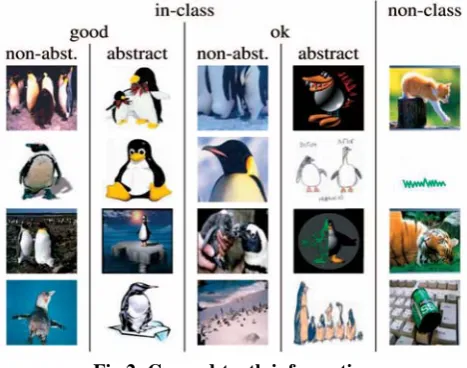
while not ever exploitation labelled ground-truth information (images area unit divided into 3 categories: 1.Good, 2.Ok, 3.non-class) of that category. Figure 2 shows that categories.
Fig 2: Ground-truth information
Ground-truth annotation: In a similar manner, pictures are divided into 3 categories:
In-class-good: Pictures that contain one or several category instances during a clearly visible method (without major occlusion, lighting deterioration, or background muddle, and of comfortable size).
In-class-ok: Pictures that show elements of a category instance, or obfuscated views of the thing attributable to lighting, clutter, occlusion, and also the like.
Nonclass: Pictures not happiness to in-class.
The good and ok sets are more divided into 2 subclasses: Abstract: pictures that don't agree realistic natural objects (e.g., drawings, non-realistic canvas, wits, spreads, or statues).
Nonabstract: Pictures not happiness to the previous category.
4.3.1 Removing Drawings and Symbolic Images
Since we tend to square measure principally fascinated by building databases for natural image recognition, we tend to ideally would love to get rid of all abstract pictures from the downloaded pictures. However, separating abstract pictures from all others mechanically is extremely difficult for classifiers supported visual options. Instead, we tend to tackle the simpler visual task of removing drawings and symbolic pictures. These include: comics, diagrams, plots, visual aid, charts, drawings, and sketches, wherever the pictures is fairly merely characterised by their visual options. Their removal considerably reduces the amount of non-class pictures, up the ensuing preciseness of the item category information sets (overall preciseness goes from twenty nine to thirty five percent). Filtering out such pictures additionally has the aim of removing this sort of abstract image from the in-class pictures.
For learning the filter technique, we tend to train a radial basis operate Support Vector Machine (SVM) on a hand-labelled information set. When the initial coaching, no more user interaction is needed. so as to get this information set, pictures were downloaded exploitation Image Search with one level of formula (i.e., websites coupled from “seed” websites are used) with queries like “sketch” or “drawing” or “draft.” The goal was to retrieve several pictures then choose appropriate coaching pictures manually. The ensuing information set consists of roughly 1,400 drawings and symbolic pictures and a 2,000 non-drawings and symbolic pictures.
Three simple visual exclusively options square measure used:
1) A color histogram chart,
2) A histogram chart of the L2-norm of the gradient, and 3) A histogram chart of the angles (0 . . . _)
Those are weighted by the L2-norm of the corresponding gradient. Altogether cases, 1,000 equally spaced bins square measure used.
The motivation behind this alternative of options is that drawings and symbolic pictures square measure characterised by sharp edges insure orientations and or a particular color distribution (e.g., solely few colours in massive areas). the tactic achieves around ninety % classification accuracy on the drawings and symbolic pictures information (using two-fold cross-validation). This classifier is applied to the complete downloaded image information set to flit rate drawing and symbolic pictures, before more process. The overall variety of pictures that square measure removed for every category. In total, thirty-nine % of non-class pictures square measure removed over all categories. The remaining pictures square measure those employed in our experiments. Still as with success removing non-class pictures, the filter additionally succeeds in removing a median of sixty % (123 pictures) in-class abstract images, with a variety between forty five % (for motorbikes, forty images) and eighty five % (for ticker, 11 images). There’s some loss of the required in-class non-abstract pictures, with, on average, thirteen % (90 images) removed, although explicit categories lose a comparatively high proportion (28 % for shark and wristwatch). Even if this looks to be a high loss, the
preciseness of the ensuing information sets is improved altogether cases aside from the category shark.
4.3.2 Visual Information Retrieval
sVisual info Retrieval (VIR) may be a comparatively new field of analysis in engineering and Engineering. As in standard info retrieval, the aim of a VIR system [16] is to retrieve all pictures (or image sequences) that are relevant to a user question whereas retrieving as few non-relevant images as attainable. The stress is on the retrieval of data as hostile the retrieval of knowledge. Equally to its text-based counterpart a visible info retrieval system should be ready to interpret the contents of the documents (images) during an assortment and rank them in line with a degree of relevancy to the user question. The interpretation method involves extracting (semantic) info from the documents (images) and victimisation this info to match the user desires.
Progress in visual info retrieval has been fostered by several analysis fields, particularly: (text-based) info retrieval, image process and laptop vision, pattern recognition, multimedia system information organization, dimensional assortment, psychological modelling of user behaviour, man-machine interaction, among several others. VIR systems may be classified in 2 main generations, in line with the attributes accustomed search and retrieve a desired image or video file.
• First-generation VIR systems: Use question by text, permitting queries like “all footage of red Ferraris” or “all pictures of Van Gogh’s paintings”. They efficiently collect the information, which might be painted either by alphabetical strings, keywords, or full scripts.
• Second-generation (CB)VIR systems: Support question by content, wherever the notion of content, for still pictures, includes, in increasing level of complexity: sensory activity properties (e.g., color, shape, texture), linguistics primitives (abstractions like objects, roles, and scenes), and subjective attributes like impressions, emotions and which means associated to the sensory activity properties. Several second-generation systems use content-based techniques as a complementary part, instead of a replacement, of text-based tools.
4.3.3 Visual Information Retrieval blends mutually
many research regulations
Their color characteristics square measure separated into 3 parts: hue, lightness, and saturation, which create them a lot of in line with human vision.
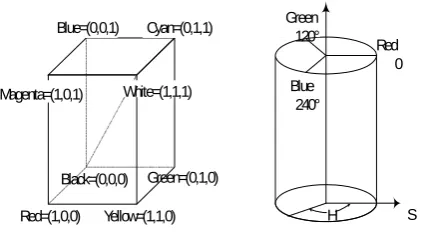
In our approach, we elect the HSV color model to represent the colour data of a picture. The entire color house within the HSV color model is diagrammatical by a cylinder, as shown in Figure 3(b). Within the HSV color model, the colour characteristics square measure separated into 3 parts: hue, saturation, and value. as a result of the full variety of colours within the HSV color model is simply too high, it's necessary to partition the entire HSV color house into many sub-spaces wherever similar colours square measure associated along. The colour values of the initial pixels in a picture square measure diagrammatical by the R, G, and B values, in order that a change from the RGB to the HSV color model is important. It will be accomplished by the algorithmic program planned.
Red=(1,0,0) Black=(0,0,0)
Yellow=(1,1,0) Green=(0,1,0) Blue=(0,0,1) Cyan=(0,1,1)
White=(1,1,1) Magenta=(1,0,1)
Red 0
H V
S Green
120°
Blue 240°
(a) The RGB color model (b) The HSV color model
Fig 3: The whole color space for the two color models
4.4 Ranking Process
The text re-ranking, associates a posterior chance with every image on whether or not it contains the question category or not. The matter we tend to square measure currently moon-faced with is a way to use this info to coach a visible classifier that will improve the ranking more. the matter is one in all coaching from rackety information: we want to make a decision that pictures to use for positive and negative coaching data and the way to pick a validation set so as to optimize the parameters of the classifier. We tend to initial describe the visual options used then however the classifier is trained.
5. RESULTS Textual/Visual Image ranking results
In this section, we have a tendency to measure completely different combos of coaching and testing. If not declared otherwise, the text plus vision system was used. For every selection, 5 completely different random alternatives area unit created for the sets employed in the 10-fold cross validation [12], and mean and variance area unit reportable. The clear improvement brought by the visual classifier over the text-based ranking for many categories is apparent. We have a tendency to 1st investigate however the classification performance is littered with the selection of nþ and metal. It will be seen that increasing metal tends to boost performance. It is, however, tough to pick optimum values for nþ and metal since these numbers area unit
terribly category dependent. It indicates that victimization a lot of pictures within the background category metal tends to boost the performance however there\'s no real distinction between victimization 150=1;000 and 250=1;000 (nþ/n_), that perform at 68:4% nine 1:9 and 68:0% nine 2:0, and therefore don\'t seem to be considerably completely different.
All numbers during this section report exactness at fifteen p.c recall. It will be seen that HOG alone performs considerably worse than the bag of visual words 57:9% nine 1:8, however the mix of BOW and HOG improves the general performance to 69:8% nine 2:1, compared to BOW alone 68:0% nine 2:0. so as to pick the suitable parameter values, we have a tendency to use cross validation, wherever the validation set is an element of the nþ and metal pictures as delineate in Section four.1, alongside exactness at fifteen p.c recall as choice criterion.
There are a unit 2 attainable cases that may occur: 1) A parameter setting that over fits to the coaching information. This downside is detected on the validation set owing to a coffee exactness at fifteen p.c recall.
2) All pictures (training and validation sets) area unit classified as background. This results in dangerous, however detectable, performance additionally.
6. CONCLUSIONS
In this paper, we have a tendency to plan a ranking-based VIR framework that constructs meta rerankers cherish visual prototypes representing the matter question and learns the weights of a linear re-ranking model to mix the results of individual meta rerankers and turn out the re-ranking score of a given image taken from the initial text-based search result. The iatrogenic re-ranking model is learned in a very query-independent method requiring solely a restricted labelling effort and having the ability to proportion to a broad varies of queries.
REFERENCES
[1] [Online]. Available: http://images.bing.com/. [2] [Online]. Available: http://images.google.com/. [3] [Online]. Available: http://images.yahoo.com/.
[4] L. Yang and A. Hanjalic, “Supervised re-ranking for web image search,” in Proc. ACM Multimedia, 2010.
[5] R. Fergus, L. Fei-Fei, P. Perona, and A. Zisserman, “Learning object categories from Google’s image search,” in Proc. ICCV, 2005, IEEE Computer Society.
[6] L.-J. Li and L. Fei-Fei, “OPTIMOL: Automatic online picture collec- Tion via incremental MOdel learning,” Int. J. Comput. Vision, 2009.
[7] M. Fritz and B. Schiele, “Decomposition, discovery and detection of visual categories using topic models,” in Proc. CVPR, 2008. [8] R. Yan, A. G. Hauptmann, and R. Jin, “Multimedia search with
pseudorelevance feedback,” in Proc. CIVR, 2003.
[9] L. S. Kennedy, and S.-F. Chang, “Video explore re-ranking during casual walk over document-level context graph,” in Proc. ACM Multimedia, 2007.
[10] Y. Jing and S. Baluja, “Visualrank: Applying pagerank to large-scale image search,” IEEE Trans. Pattern Anal. Mach. Intell., vol. 30, no. 11, pp. 1877–1890, Nov. 2008.
[11] L. Yang, and X.-S. Hua, “Bayesian video search re-ranking,” in Proc. ACM Multimedia, 2008.
[13] F. Schroff, A. Criminisi, and A. Zisserman, “Harvesting image databases from the web,” in Proc. ICCV , 2007.
[14] J. Krapac, M. Allan, J. Verbeek, and F. Jurie, “Improving web image search results using query-relative classifiers,” in Proc. CVPR, 2010. [15] K. Järvelin and J. Kekäläinen, “IR evaluation methods for retrieving
highly relevant documents,” in Proc. SIGIR, 2000.
[16] R. Fergus, P. Perona, and A. Zisserman, “A visual category filter forGoogle images,” in Proc. ECCV, 2004.
[17] X. Tian, L. Yang, X. Wu, and X.-S. Hua, “Visual re-ranking with local learning consistency,” in Proc. MMM, 2010.
[18] L. Wang, L. Yang, and X. Tian, “Query aware visual similarity propagation for image search re-ranking,” in Proc. ACM Multimedia, 2009.
[19] X. S. Zhou and T. S. Huang, “Relevance feedback in image retrieval: A comprehensive review,” Multimedia Syst., vol. 8, no. 6, pp. 536– 544, 2003.