Investigation On Wire Cut Edm Process Of Ancomposite Material On Sr
And Mrr By Varying The Parameters To Optimize The Machining
Parameters
Puppala Bhanu Venkata Anil Kumar received the B.Tech degree in mechanical engineering from Aditya Engineering College, JNTU, Kakinada, Andhra Pradesh, India, in 2018 year and perusing M.Tech in Advance manufacturing systems from Pydah College of engineering, JNTU,
Kakinada, Andhra Pradesh, India.
Mr. P. RamBabu M.Tech. Asst.Prof. Department of Mechanical engineering from Pydah college of engineering, JNTU, Kakinada, Andhra Pradesh, India.
ABSTRACT
The objective of the current thesis is to investigate the effects of the different process in Wire cut EDM process parameters on the surface quality, maximum material removal rates and obtain the optimal sets of process parameters so that the quality and MRR of machined parts can be optimized. Experiments are conducted on the composite material (Al 6061 (90.5%) + SCi (7.5%) + Graphite (2%)) pieces by varying parameters. The process parameters varied and their respective values are Pulse Time on - 100µsec, 150 µsec, 200µsec & Pulse Time off – 52µsec, 56µsec, 60µsec, Servo Voltage – 30V, 50V, 70V and Wire Feed – 2mm/min, 3mm/min, 4mm/min. Other parameters are kept constant such as Wire diameter - 0.3mm, Peak Current – 1.1Amp, Coolant is Distilled water, Wire Tension – 7Kgf. The optimization is done by using Taguchi technique considering L09 orthogonal array. Optimization is done in Minitab software.
INTRODUCTION
A machining technique is usually used for hard metals, electric discharge machining (usually called ”EDM Machining”) sorts it likely to figure with metals that olden machining method machining are unsuccessful. A critical purpose to recall with Electric discharge machining is that it is all entirely work with things that which are electrically semiconducting.
That which are sensible Electric Discharge Machining equipment it is likely possible to chop tiny odd shaped angles, expanded contours or cavities in toughened steel likewise as exotic metals like Ti, hastelloy, kevlar, Inconel, and some of the inorganic compound.
International Journal of Research
Available athttps://journals.pen2print.org/index.php/ijr/
e-ISSN: 2348-6848 p-ISSN: 2348-795X Volume 07 Issue 06
June 2020
Fig: Wire cut EDM Machine
LITERATURE REVIEW
Within the paper by Atul Kumar, etal [2], variation of cutting performance with pulse on time, pulse off time, open voltage, feed rate override, wire feed, servo voltage, wire tension and flushing pressure were through an experiment investigated in wire spark machining (WEDM) method. Brass wire with zero.25mm diameter and Skd sixty one steel with 10mm thickness were used as tool and work materials within the experiments. The cutting performance outputs thought-about during this study were material removal rate (MRR) and surface roughness. Experimentation has been completed by exploitation Taguchi L18 (21 completely different conditions of parameters. optimum mixtures of parameters were obtained by this system. The study shows that with the minimum variety of experiments the entire downside are often resolved when put next to full factorial style. The results obtained area unit analyzed for the choice of associate optimum combination of WEDM parameters for correct machining of Skd sixty one alloy to attain higher surface end. Additionally the importance of the cutting parameters on the cutting performance outputs is decided by exploitation analysis of variance (ANOVA) L37 orthogonal array.
OBJECTIVE
Here in this thesis we are going to investigate the effect of various parameters used in wire cut EDM process on MRR and surface roughness to obtained the optimal set of parameters on the machined work piece
So here the experiments are conducted on the composite work piece material using the respective parameters i.e., pulse on time - 100µsec, 150 µsec, 200µsec & Pulse Time off – 52µsec, 56µsec, 60µsec, servo voltage – 30V, 50V, 70V & Wire Feed – 2mm/min, 3mm/min, 4mm/min. Other parameters are kept constant such as Wire dia - 0.3mm; peak current – 1.14Amp and Coolant is Distilled water, Wire Tension – 7Kgf. So the optimization process is done using taguchi technique using Minitab software.
EXPERIMENTAL SETUP AND PROCEDURE
The selected work piece materials for this research work are composite work piece material. Experiments have been conducted on Wire Cut EDM. The machine details are:
ACCORDING TO THE TAGUCHI METHOD HERE THE BELOW TABLE REPRESENTS THE L09 ORTHOGONAL ARRAY
JOB NO PULSE TIME
ON (µsec)
PULSE TIME OFF (µsec)
SERVO VOLTAGE (V)
WIRE FEED (mm/min)
1 100 52 30 2
2 100 56 50 3
3 100 60 70 4
4 150 52 50 4
5 150 56 70 2
6 150 60 30 3
7 200 52 70 3
8 200 56 30 4
9 200 60 50 2
Table: Generated L09 Orthogonal array through Taguchi method
EXPERIMENTATION PHOTOS
International Journal of Research
Available athttps://journals.pen2print.org/index.php/ijr/
e-ISSN: 2348-6848 p-ISSN: 2348-795X Volume 07 Issue 06
June 2020
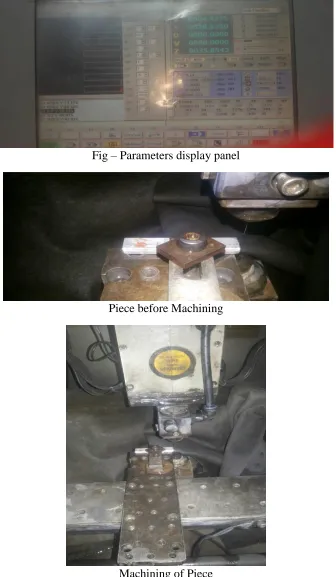
Fig – Parameters display panel
Piece before Machining
Final machined pieces
Hardness tested work piece
THE OBSERVED SURFACE ROUGHNESS VALUES IN TESTING
JOB NO PULSE TIME ON (µsec) PULSE TIME OFF (µsec) SERVO VOLTAGE (V) WIRE FEED (mm/min) SURFACE ROUGHNESS 1 SURFACE ROUGHNESS 2
1 100 52 30 2 3.84 3.46
2 100 56 50 3 3.71 3.42
3 100 60 70 4 3.46 3.27
4 150 52 50 4 3.87 3.67
5 150 56 70 2 3.79 3.64
6 150 60 30 3 3.60 2.97
7 200 52 70 3 4.12 4.40
8 200 56 30 4 4.04 4.69
9 200 60 50 2 3.35 3.45
Table: L09 parameters of surface roughness
OBSERVED MRR VALUES
JOB NO PULSE
TIME ON PULSE TIME OFF SERVO VOLTAGE WIRE FEED (mm/min) MRR
International Journal of Research
Available athttps://journals.pen2print.org/index.php/ijr/
e-ISSN: 2348-6848 p-ISSN: 2348-795X Volume 07 Issue 06
June 2020
(µsec) (µsec) (V)
1 100 52 30 2 330.36
2 100 56 50 3 293.85
3 100 60 70 4 297.93
4 150 52 50 4 312.15
5 150 56 70 2 346.19
6 150 60 30 3 302.18
7 200 52 70 3 259.77
8 200 56 30 4 252.93
9 200 60 50 2 249.59
Table: L09 parameters of MRR
OPTIMIZATION PROCESS OF MACHINING PARAMETERS FOR MRR
USING MINITAB SOFTWARE
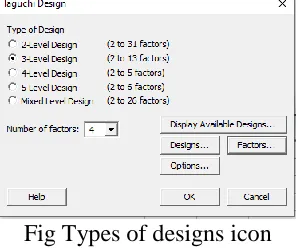
As here we are having 3 parameters for the 4 process machining parameters we are selecting this
Fig Types of designs icon
Now we have to select the design factors option to enter the various machining and process parameters being used for the machining process
Graph Main Effects Plot of SR for SN Ratios
Graph 4.3 Main Effects Plot of MRR for SN Ratios
CONCLUSION
International Journal of Research
Available athttps://journals.pen2print.org/index.php/ijr/
e-ISSN: 2348-6848 p-ISSN: 2348-795X Volume 07 Issue 06
June 2020
So finally for the taguchi method, for the MRR here the optimal result is pulse on time is at 150µsec, pulse off time is at 52µsec, servo voltage should be set at 70V and wire feed has to be at 2mm/min
So when we consider the SR MRR here the optimal result is pulse on time is at 100µsec, pulse off time is at 60µsec, servo voltage should be set at 50V and wire feed has to be at 2mm/min So when we have verified the hardness of this composite material (Al 6061 (90.5%) + SCi (7.5%) + Graphite (2%)) here we have achieved 110BHN, when compared with the base material aluminum alloy block ranges form 75 – 89BHN.
REFERENCES
1. Evaluation of Optimal Parameters for machining with Wire cut EDM Using Grey-Taguchi Method by S V Subrahmanyam, M. M. M. Sarcar
2. Performance Analysis of Wire Electric Discharge Machining (W-EDM) by Atul Kumar, DR.D.K.Singh
3. Analysis of Process Parameters in Wire EDM with Stainless Steel Using Single Objective Taguchi Method and Multi Objective Grey Relational Grade by M. Durairaja, D. Sudharsunb, N. Swamynathan
4. Optimization of process parameters of micro wire EDM by Ricky Agarwal
5. A Study to Achieve a Fine Surface Finish in Wire-EDM by J.T. Huang, Y.S. Liao and Y.H. Chen
6. Rajurkar K.P., Scott D, Boyina S., “Analysis and Optimization of Parameter Combination in Wire Electrical Discharge Machining”, International Journal of Production Research, Vol. 29, No. 11, 1991, PP 2189- 2207.
7. Y. S. Tarng., Ma S.C., Chung L.K., “Determination of Optimal Cutting Parameters in Wire Electrical Discharge Machining”, International Journal of Machine Tools and Manufacture, Vol. 35, No. 12, 1995, PP. 1693-1701.
8. J.Prohaszka, A.G. Mamalis and N.M.Vaxevanidis, “The effect of electrode material on machinability in wire electro-discharge machining”, Journal of Materials Processing technology, 69, 1997, PP 233-237.
9. (A) Y.S. Liao, Y.Y. Chu and M.T. Yan, Study of wire breaking process and monitoring of WEDM, International Journal of Machine Tools & Manufacture, 37 (1997) pp. 555-567. (B) Y.S Liao , J.T.Huang, A study on the machining parameter optimization of WEDM, Journal of Material Processing Technology,71(1997) pp. 487-493