Article
Optimization of Population Distribution Pattern in
China Based on Land Use Efficiency
Minmin Li 1, Biao He 1,*, Renzhong Guo 1, You Li 1, Yu Chen 2 and Yong Fan 1
1 Research Institute for Smart Cities, School of Architecture and Urban Planning, Shenzhen University, Nanhai Ave 3688, Shenzhen 518060, China; [email protected] (M.L.); [email protected] (R.G.); [email protected] (Y.L.); [email protected] (Y.F.)
2 School of Architecture and Urban Planning, Shenzhen University, Nanhai Ave 3688, Shenzhen 518060; [email protected] (Y.C.)
* Correspondence: [email protected]; Tel.: +86-135-1068-4960
Abstract: With the accelerating urbanization process, the population increasingly concentrates in urban areas. In view of the special situation in China and a series of problems in the process of rapid urbanization, there were no reasonable measures for optimizing the population pattern. This study explored the distribution pattern of the Chinese population and proposed an optimization plan for the population distribution using GIS analysis. The main findings were as follows. (1) From 2010 to 2015, the distribution of population density in China presented a pattern of high in the southeast and low in the northwest based on the county-level administrative regions. The population still showed a tendency to migrate to the southeast of the country based on the “Hu Huanyong Line”. (2) There was a great difference in the land use efficiency in terms of population and economic production in China. The economic concentration in China was higher than the population concentration. In the areas where population and economic production were aggregated, GDP per capita and land use efficiency were higher. (3) Based on the land use efficiency in terms of population and economic production, the optimized urbanization plan of “1+4+11” for China’s urbanization was put forward, namely, one national-level aggregated area of population and economic production, 4 regional-level aggregated areas of population and economic production, and 11 local regionally aggregated areas of population and economic production. This optimization plan for urbanization represents an attempt to explore the direction of China’s urbanization, and it can be used to optimize the spatial development pattern and provide scientific guidance for the new urbanization plan.
Keywords: Population Distribution; Optimization; Hu Huanyong Line; Land Use Efficiency; China
1. Introduction
Population distribution refers to the distribution of a population in a certain geographical space at a given time, or to the spatial form of a population [1]. Population size and population density are the main indicators of population distribution and are used to measure regional differences in population distribution. The spatial distribution pattern is closely related to climate, resources and environment and has typical scale characteristics [2]. With the accelerating urbanization process, the population increasingly concentrates in urban areas. In 2017, the global urban population reached 4.11 billion, and the urbanization rate increased from 33.5% in 1960 to 54.92% in 2017. In the same period, the urbanization rate in China reached 57.90%, which is higher than the world average but remains low compared with the developed countries in the world. For example, the urbanization rate was 81.87% in the United States, 83.08% in the United Kingdom, and 94.44% in Japan [3,4]. At the same time, the world average population density increased from 23.00 people per km2 in 1960 to 55.72 people per km2 in 2017, while China’s population density was
147.50 people per km2, which was 2.65 times the average population density in the world [4]. The
area of China was more than 25 times that of Japan, Germany, the United Kingdom, and South
Preprints (www.preprints.org) | NOT PEER-REVIEWED | Posted: 8 August 2018 doi:10.20944/preprints201808.0162.v1
© 2018 by the author(s). Distributed under a Creative Commons CC BY license.
Korea, but the population densities of those four countries were greater than the population density of China; the areas of Canada, the United States, and Australia were slightly different from that of China, while their population densities were far less than the population density in China. It can be seen that population distribution has significant regional differences. By analyzing the characteristics of population distribution and its evolution patterns, the population distribution can be optimized, and the sustainable development of the population, resources, and environment can be achieved.
After the Second World War, influenced by the spatial analysis school of thought in geography, the focus of Western scholars of population distribution was mainly analysis of the spatial distribution and its law variation by quantitative methods, and a series of theoretical models, such as the Clark model [5], the algometric model of growth between urban population and urban area [6], the index model [7] and the multicore model of urban population density [8], were put forward. In the 1970s, Western scholars began to pay attention to the suburbanization of the urban population. The research focused mainly on the changes in population distribution [9,10], the relationship between population density changes and social phenomena [11-13], population suburbanization and spatial structure [14,15] and so on.
In 1935, China's population geologist Hu Huanyong proposed the differential line from southeast and northwest that reveals the population density distribution in China, namely, the Heihe-Tengchong Line, which is now called the “Hu Huanyong Line” [16]. In his research, 36% of the area southeast of the “Hu Huanyong Line” was inhabited by 96% of the population. There was a certain degree of overlap between this demonstration line and the rainfall line in the meteorological area, the dividing line of the geomorphological area, the dividing line of cultural transformation, and the ethnic line. Therefore, the "Hu Huanyong Line" was not only the population line of China but also the boundary of China's ecological environment. Since the "Hu Huanyong Line" was put forward, Chinese scholars have conducted extensive research on population distribution, mainly focusing on the population distribution based on the “Hu Huanyong Line” [17,18], urbanization patterns based on population [19-21], and the relationship between the population and economic environment based on GIS spatial analysis methods and economic statistical methods [22-24].
Scholars at home and abroad have conducted much research on population distribution, but there have been reasonable measures to optimize the population distribution in view of the unique national conditions in China and the series of problems that have arisen in the process of rapid urbanization. As far as China’s current urbanization development management system is concerned, the implementation of each project has undergone rigorous review and scientific argumentation, but the “discrete” review and argument has ultimately led to “systematic” problems. To solve these problems, we must analyze the population distribution at the national macro scale.
To this end, this paper emphasizes the optimization of China's population distribution pattern based on the characteristics of the population distribution to reveal the relationship between the spatial distribution of land, population and economic production in China in 2010 and 2015. The pattern optimization plan can provide a macro-level decision-making reference for the new urbanization construction and long-term development of China.
2. Methodology
2.1. Data
3 of 17
Statistical Yearbook" and the Urban Planning and Design Institute of China, which included the vector database of the county administrative division in China and statistical data of county administrative areas, such as population and GDP in 2010 and 2015 [25-28].
Based on research needs, the following preprocessing of some base maps and statistical data was carried out. (1) Comparative analysis was made of administrative divisions of 1:100,000 county administrative district maps and county-level statistical yearbook data of 2010 and 2015. (2) Because the statistical yearbook data included the data of districts and counties based at the county level, the data of each district were aggregated and integrated into the data of the corresponding city-governed districts. For this purpose, the city-governed districts were consolidated using ArcGIS 10.2 software. For example, in Beijing in 2010 (pre-adjustment) under the jurisdiction of 16 city-governed districts and 2 counties, this paper merged 16 city-governed districts into a whole, and the demographic data of the population were similarly added and connected. (3) To facilitate the analysis of the statistical data, such as the spatial-temporal change of the household registration population and GDP, the city-governed districts in 2010 were made the reference; the corresponding city-governed districts and data in 2015 were corrected; and the administrative divisions that were difficult to adjust were deleted to ensure the accuracy and reliability of vertical comparisons.
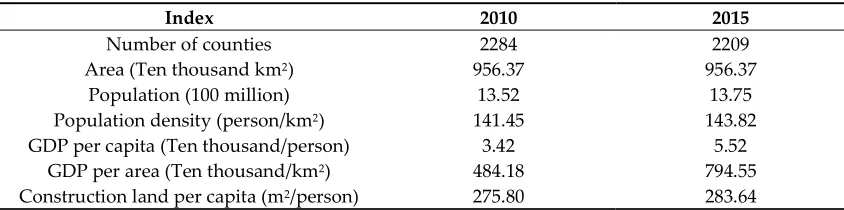
In accordance with the above principles, after preprocessing, there were 2,284 and 2,209 counties, respectively, in 2010 and 2015, with the exceptions of Hong Kong Special Administrative Region, Macao Special Administrative Region, and Taiwan Province. The changes from 2010 to 2015 concerned 93 counties, with 1 county divided into two counties, 11 counties changing names, and 81 counties merged into city-governed districts. After pretreatment, statistics and changes in the population-related indicators in China for both 2010 and 2015 are shown in Table 1.
Table 1. Population-related statistics for the years 2010 and 2015
Index 2010 2015
Number of counties 2284 2209
Area (Ten thousand km2) 956.37 956.37
Population (100 million) 13.52 13.75
Population density (person/km2) 141.45 143.82
GDP per capita (Ten thousand/person) 3.42 5.52
GDP per area (Ten thousand/km2) 484.18 794.55
Construction land per capita (m2/person) 275.80 283.64
It should be noted that the population in this study refers to the household registration population, which includes citizens who have registered permanent residence in the public security household registration management office of residence in accordance with the Regulations of the People's Republic of China on Registration of Household Registration. The household registration population is different from the resident population. The resident population refers to the population that often lives in a certain area for a certain period of time (more than six months, including half a year). Given China's special conditions, there are significant differences between the household registration population and the resident population in the administrative region. For example, the resident population tends to be larger than the household registration population in large cities with large population influx, while the resident population is often smaller than the household registration population in cities with large population outflows.
2.2. Method
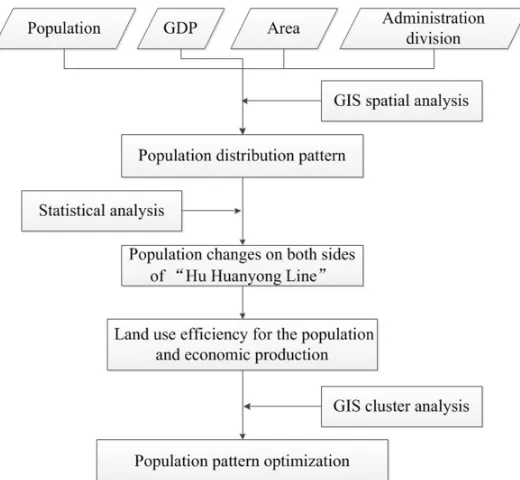
In this study, GIS spatial analysis, cluster analysis and statistical regression analysis were used to carry out the characteristic analysis of the population distribution pattern in China. The specific technical process is shown in Figure 1.
Preprints (www.preprints.org) | NOT PEER-REVIEWED | Posted: 8 August 2018 doi:10.20944/preprints201808.0162.v1
Figure 1. Technical flow of population distribution optimization
The main steps of the study were as follows. (1) Population, area and GDP data were used to analyze the characteristics of the population distribution pattern in China at the county level. First, the characteristics of population density in 2010 and 2015 were analyzed, and then, the population of China was divided according to the population density; second, the changes in the proportion of population and area on both sides of the “Hu Huanyong line” were analyzed to reveal the migration pattern of the Chinese population from 2010 to 2015.
(2) Based on the spatial distribution characteristics of population density, population, area and GDP, the population density was ranked from high to low, and the correlation between cumulative percentage of area and cumulative percentage of population and GDP was analyzed to reveal the efficiency of land use in terms of population and economic production in China.
(3) Based on the efficiency of land use for the population and economic production, the future direction for the optimization of the population distribution pattern in China was noted.
3. Results
3.1. Population distribution in China
Figure 2a and 2b shows the population density distribution of China in 2010 and 2015. Five regions were determined by ranking the population density from high to low: (1) extremely dense
population areas (population density greater than 500 people per km2), (2) dense population areas
(population density greater than 200 people per km2 and less than 500 people per km2), (3) medium
population areas (population density greater than 50 people per km2 and less than 200 people per
km2), (4) sparse population areas (population density greater than 1 person per km2 and less than 50
people per km2) and (5) extremely sparse population areas (population density less than 1 person
5 of 17
(a) (b)
Figure 2. Population distribution pattern of China, (a) Description of population distribution pattern in 2010; (b) Description of population distribution pattern in 2015.
From 2010 to 2015, the distribution of population density based on the county level administrative regions showed a pattern of high in the southeast and low in the northwest. The total population increased from 1.35 billion to 1.38 billion, and the population density increased
from 141.45 people per km2 to 143.82 people per km2. The areas with high population density were
mainly concentrated in the middle and lower reach of the Yellow River, the Yangtze River Delta, the Sichuan Basin, and the southeast coastal areas. The extremely dense population areas carried 51% of the population with 9% of the national land area and were distributed in urban areas such as the North China Plain, Shandong Peninsula, Shanghai, Chengdu, Chongqing, Wuhan, Guangzhou and Shenzhen; 13% of the country's land area, considered a dense population area and containing 30% of the population, was mainly distributed in the plains surrounding the Northeast Plain, the middle and lower reaches of the Yellow River, the Yangtze River Delta, Central China, South China, and southwestern cities; the medium population areas covering 20% of the country’s land area and hosting 16% of the population were distributed in the areas of the Yunnan-Guizhou Plateau, Longxi Mountains, the mountains of the northeastern plains, and the surrounding areas of central China; 41% of the country’s land area, considered the sparse population area, carried only 3% of the population and concerned mainly Inner Mongolia, Xinjiang, most of the mountainous areas in western Sichuan, and the eastern part of the Qinghai-Tibet Plateau; the extremely sparse population area accounted for 17% of the country's land area, but the area was almost unoccupied, mainly in southern Xinjiang, western Inner Mongolia and the Qinghai-Tibet Plateau.
Taking the seat of the government of Heihe City and Tengchong County as the endpoints, we draw the “Hu Huanyong Line” and use it as the boundary to divide the land into the southeast half and the northwest half of China. The county administrative district where the “Hu Huanyong Line” passes was designated by the seat of the county government that belonged to the southeast or the northwest half of China. Table 2 shows the changes in the proportion of the population on both sides of the “Hu Huanyong Line” in China from 2010 to 2015. It reveals that the proportion of the population and population density decreased in the northwest and increased in the southeast of China. The population still showed a tendency to migrate to the southeast of China.
Table 2. Changes in the proportion of population on both sides of the “Hu Huanyong line” in China from 2010 to 2015
Year Area proportion (%) Northwest of the “Hu Huanyong Line” Population ratio (%) Population density (People/ km2)
2010 57.25 6.25 15.38
2015 57.25 6.12 15.34
Preprints (www.preprints.org) | NOT PEER-REVIEWED | Posted: 8 August 2018 doi:10.20944/preprints201808.0162.v1
Year Area proportion (%) Southeast of the “Hu Huanyong Line” Population ratio (%) Population density (People/ km2)
2010 42.75 93.75 309.26
2015 42.75 93.88 314.85
3.2. Land use efficiency in terms of population and economic production
Based on the characteristics of the population distribution pattern in China, we can further explore the land use efficiency for the population and the economic production and then provide support for optimizing the population distribution pattern. The area of mainland China is 9,593,700 km2, and it supports a population of 1.375 billion. Compared with China, the total area of the
United States is 9.832 million km2, and it supports a population of 321 million people, which is less
than one-fourth of the Chinese population. The area of Canada is 9.985 million km2, and it supports
35.85 million people, which is less than 3/100 of the Chinese population [4]. Therefore, based on the similar land area, the population that China needs to feed is 4 times that of the United States and 38 times that of Canada. Hence, choosing the least land to support the most people and optimize the population distribution pattern is the only means to achieve the urbanization and sustainable development of China.
According to the order of population density from high to low, the cumulative percentages of land area, population and GDP are calculated, and the coordinating relationship between population, GDP and land is analyzed. Figure 3 shows the distribution of population density as the base figure, and the blue area shows the overlapping area of population, GDP and land according to the increase in the percentage of population, in which the unit of population is people, the unit of GDP is the Yuan, and the unit of area is square kilometers. The analysis shows that 3.88% of the
land area (0.3725 million km2) supports 30.04% of the population (approximately 413 million) and
50.58% of the GDP (38.43 trillion Yuan); 50% of the population (0.688 billion) lives in 8.46% of the land area (0.8114 million km2) and produces 68.44% of the GDP (52 trillion Yuan); 95% of the
population (1.307 billion) lives on 37.87% of the land area (3.6329 million km2) and produces 96.13%
of the GDP (73.05 trillion Yuan); and 54.19% of the land area (5.1991 million km2) can carry 99.01%
of the population (1.362 billion) and produce 99.08% of the GDP (75.29 trillion Yuan) in China.
7 of 17
(c) (d)
(e) (f)
(g) (h)
Preprints (www.preprints.org) | NOT PEER-REVIEWED | Posted: 8 August 2018 doi:10.20944/preprints201808.0162.v1
(i) (j)
Figure 3. The overlapping distribution of population, GDP and land with the increase of the cumulative percentage of population, (a), (b), (c), (d), (e), (f), (g), (h), (i) and (j) Description of the
overlapping distribution of population, GDP and land with the cumulative percentage of population of 10.04%, 20.02%, 30.04%, 41.38, 50.00%, 60.06%, 70.00%, 80.04%, 95.00% and 99.01%,
respectively.
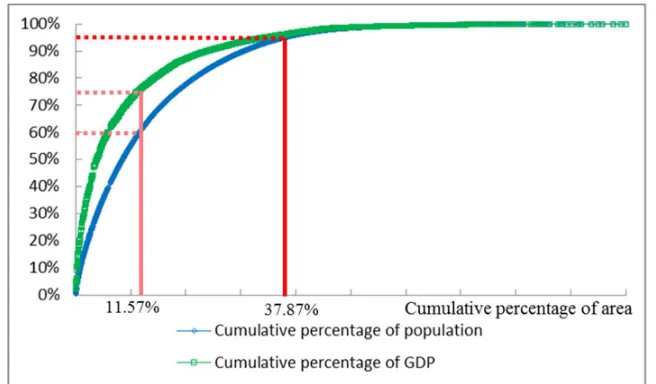
Figure 4 shows the cumulative percentage of land area, population and GDP sorted by population density from high to low. When the cumulative percentage of land area is 11.57%, the cumulative percentages of population and GDP reach 60.06% and 75.66%, respectively; when the cumulative percentage of land area reaches 37.87%, the cumulative percentages of population and GDP are 95% and 96.13%, respectively; beyond this, with the increase in the cumulative percentage of land area, the cumulative percentages of population and GDP increase slowly. In general, the area where the cumulative percentage of land area is less than 37.87% is part of the area where population and economic production are aggregated, and the degree of economic aggregation in these areas is higher than the degree of population aggregation; the per capita GDP is higher, and the land use efficiency is also higher. The area where the cumulative percentage of land area is less than 11.57% is a highly aggregated area of population and GDP. The degree of economic aggregation in these areas is significantly higher than the degree of population aggregation, and these areas have the highest GDP per capita and the highest land use efficiency, which could lead them to become key development areas for urbanization in China.
9 of 17
3.3. Population pattern optimization
Based on section 3.1 on the population distribution in China and section 3.2 on the land use efficiency for the population and economic production, the future trend of urbanization in China is mainly concentrated in the areas of highly aggregated population and economic production. Through spatial superposition and cluster analysis, the aggregated areas of population and economic production are shown in Figure 5. By referring to various standards for the identification of urban agglomerations at home and abroad [29-32] and combining the characteristics of this study, the identification criteria for aggregated areas of population and GDP were determined as follows: (1) the population density from high to low of county-level administrative districts revealed a cumulative percentage of land area less than 11.57%, a cumulative percentage of population less than 60.06% and a cumulative percentage of GDP less than 75.66%; (2) the number of county-level administrative districts was greater than or equal to 3; and (3) the county-level administrative districts were contiguous. Based on the above principles, the key areas for the future development of urbanization in China were proposed following the pattern of “1+4+11”: one nationally aggregated area of population and economic production, 4 regionally aggregated areas of population and economic production and 11 local regionally aggregated areas of population and economic production. The analysis showed that in total, 675 counties belonged to the aggregated areas of population and economic production, with a population of 764 million, an area of 1,209,200
km2, and a GDP of 51.08 trillion Yuan, which accounted for 10.72% of the land area, 55.56% of the
total population and 67.22% of the GDP. According to the number of counties and the size of the aggregated area of population and economic production, the aggregated area of population and economic production was divided into three categories: (1) the first-class aggregated area of population and economic production with the quantity of 1; (2) the second-class aggregated area of population and economic production with the quantity of 4; and (3) the third-class aggregated area of population and economic production with the quantity of 11 (Table 3).
Preprints (www.preprints.org) | NOT PEER-REVIEWED | Posted: 8 August 2018 doi:10.20944/preprints201808.0162.v1
Figure 5. Distribution of aggregated areas of population and economic production.
Table 3. Characteristics of the aggregated areas of population and economic production.
ID Name Population (100 million)
Area (10 thousand
km2)
GDP (Trillion
Yuan) Class Regions
1
Aggregated area of northern and eastern
China 4.34 56.17 29.38 1
Taking Beijing, Tianjin, Shijiazhuang,
Jinan, Qingdao, Zhengzhou, Hefei, Nanjing, Hangzhou
and Ningbo as the centers
2 Aggregated area of Cheng Yu 0.89 13.45 3.90 2 and Chengdu as the Taking Chongqing
centers
3 Aggregated area of central Yangtze
River 0.64 9.94 3.72 2
Taking Wuhan and Changsha as the
centers
4 Aggregated area of the west side 0.41 4.18 2.29 2 Xiamen as the centers Taking Fuzhou and
5 Aggregated area of Guangdong and
Guangxi 0.59 8.60 6.92 2
11 of 17
centers
6 Aggregated area of central Liaoning 0.08 0.64 0.76 3 Taking Shenyang as the center
7 Aggregated area of eastern Liaoning 0.05 0.68 0.38 3 Taking Yingkou as the center
8 Aggregated area of coastal Shandong 0.04 0.69 0.53 3 Taking Yantai as the center
9 Aggregated area of the central Shanxi 0.06 0.74 0.35 3 Taking Taiyuan as the center
10 Aggregated area of western Shanxi 0.04 0.64 0.10 3 Taking Linfen as the center
11 Aggregated area of eastern Shanxi 0.02 0.18 0.07 3 Taking Changzhi as the center
12 Aggregated area of Guanzhong 0.15 1.68 0.80 3 Taking Xian as the center
13 Aggregated area of eastern Zhejiang 0.11 1.13 0.72 3 Taking Wenzhou as the center
14 Aggregated area of central Jiangxi 0.11 1.92 0.66 3 Taking Nanchang as the center
15 Xiang-Gan junction Aggregated area of 0.04 0.65 0.15 3 Taking Yichun as the center
16 Aggregated area of central Guizhou 0.09 1.64 0.36 3 Taking Guiyang as the center
Total Aggregated areas 7.64 102.92 51.08 - Southeastern China
The nationally aggregated area of population and economic production, crossing Beijing, Tianjin, Hebei Province, Shandong Province, Henan Province, Anhui Province, Jiangsu Province, Shanghai and Zhejiang Province with 408 county-level administrative districts and taking as centers the important provincial capitals, municipalities and cities such as Beijing, Tianjin, Shijiazhuang, Jinan, Qingdao, Zhengzhou, Hefei, Nanjing, Shanghai, Hangzhou and Ningbo, was the largest aggregated area of population and economic production in China. The region had a population of
434 million, an area of 561,700 km2 and a GDP of 29.38 trillion Yuan and represented 5.85% of the
total land area, 31.56% of the population and 38.66% of GDP; this was the most important urbanized area.
The regionally aggregated area of population and economic production consisted of 4 regions with 192 county-level administrative districts, which were the aggregated area of Cheng Yu with Chongqing and Chengdu as the centers, the aggregated area of central Yangtze River with Wuhan and Changsha as the centers, the aggregated area of the west side with Fuzhou and Xiamen as the centers, and the aggregated area of Guangdong and Guangxi with Guangzhou, Shenzhen and
Nanning as the centers. The region had a population of 253 million, an area of 361,700 km2 and a
GDP of 16.83 trillion Yuan and accounted for 3.77% of the total land area, 18.40% of the population and 22.15% of the GDP, which was important for the development of urbanization in China.
The local aggregated area of population and economic production included 11 regions with 75 county-level administrative areas, namely, the aggregated area of central Liaoning with Shenyang as the center, the aggregated area of eastern Liaoning with Yingkou as the center, the aggregated area of coastal Shandong with Yantai as the center, the aggregated area of central Shanxi with Taiyuan as the center, the aggregated area of western Shanxi with Linfen as the center, the aggregated area of eastern Shanxi with Changzhi as the center, the aggregated area of Guanzhong with Xi’an as the center, the aggregated area of eastern Zhejiang with Wenzhou as the center, the aggregated area of central Jiangxi with Nanchang as the center, the aggregated area of Xiang-Gan junction with Yichun as the center, and the aggregated area of central Guizhou with Guiyang as the
center. The population of the region was 0.77 billion, the area was 105,800 km2, and the GDP was
Preprints (www.preprints.org) | NOT PEER-REVIEWED | Posted: 8 August 2018 doi:10.20944/preprints201808.0162.v1
4.87 trillion Yuan, and the region occupied 1.10% of the total land area, supported 5.60% of the population and produced 6.41% of the GDP, representing the main area for the development of urbanization in China.
4. Discussions
4.1. Population distribution and National strategy
China has a vast territory and large regional differences. It should build a regional development pattern with different characteristics and coordination based on its natural geography, resource endowments and economic-social development level and follows the general laws of the market economy. Since the founding of New China, China's regional development strategy has gone through three stages of development, namely, the balanced regional development strategy before the reform and opening up, the unbalanced regional development strategy from the beginning of the reform and opening up until the late 1990s, and the regional overall development strategy from the late 1990s until now.
In 2000, the CPC Central Committee decided to implement a major decision-making strategy for the development of the western region. In 2003 and 2006, it was decided to implement the strategy of rejuvenating the old industrial bases in the northeastern region and to promote the strategy for the rise of the central region. With the addition of the development strategy for the eastern region that started in 1979, China's overall development strategy for the region took shape [33].
According to the new situation in China's accelerated economic and social development, the country was divided into four major economic regions: the eastern region, which included Beijing, Tianjin, Hebei Province, Shanghai, Jiangsu Province, Zhejiang Province, Fujian Province, Shandong Province, Guangdong Province and Hainan Province; the northeast region, which included Liaoning Province, Jilin Province and Heilongjiang Province; the central region, which included Shanxi Province, Anhui Province, Jiangxi Province, Henan Province, Hubei Province and Hunan Province; and the western region, which included Inner Mongolia, Guangxi, Chongqing, Sichuan Province, Guizhou Province, Yunnan Province, Tibet, Shanxi Province, Gansu Province, Qinghai Province, Ningxia and Xinjiang [34]. The main content of the economic and social development in the various regions was the development of the western region, the revitalization of the northeast region, the rise of the central region, and the development that took the lead in the eastern region.
13 of 17
(a)
(b)
(c)
Figure 6. Description of the area percentage (a), population percentage (b) and GDP percentage (c) in different intervals of cumulative percentage of population in the four major economic regions.
0.00% 20.00% 40.00% 60.00% 80.00% 100.00% A re a p er ce nt ag e
Cumulative percentage of population
Central region Western region Eastern region Northeast region 0.00% 20.00% 40.00% 60.00% 80.00% 100.00% P op u la ti on p er ce nt ag e
Cumulative percentage of population
Central region Western region Eastern region Northeast region 0.00% 20.00% 40.00% 60.00% 80.00% 100.00% G D P p er ce nt ag e
Cumulative percentage of population
Central region Western region Eastern region Northeast region
Preprints (www.preprints.org) | NOT PEER-REVIEWED | Posted: 8 August 2018 doi:10.20944/preprints201808.0162.v1
In section 3.3, the identification criteria for aggregated areas of population and economic production were determined based on the population density ordered from high to low, considering county-level administrative districts with a cumulative percentage of land area less than 11.57%, a cumulative percentage of population less than 60.06% and a cumulative percentage of GDP less than 75.66%. Hence, in aggregated areas of population and economic production, the area percentage, population percentage and GDP percentage from the highest to the lowest were in the eastern region, the central region, the western region, and the northeast region.
In summary, in the process of China’s urbanization, the eastern region has remained the focus of development, and the rise of the central region has been effective. Despite the strategy of developing the western region and the strategy of rejuvenating the old industrial bases in the northeast, the urbanization effects in the western and northeast regions are still significantly lower than the effects in the eastern and central regions. Since the implementation of the overall regional development strategy, the regional development gap has continuously narrowed, the self-development capabilities of the central, western and northeast regions have increased, the regional economy in China has undergone positive changes, and the development strategy of the “four regions” has been successful to a certain degree. In contrast, the separation of economic ties between regions has restricted the application of regional comparative advantages, formed a policy-to-region comparison and not been conducive to the overall urbanization process in China.
4.2. Division of urban aggregated areas
For different countries and regions and for different research purposes, the division of urban agglomerations also has its own characteristics. Based on the selection criteria and principles of different urban agglomerated areas, the division of China's urban agglomerations included Shimou Yao's "6+7" plan, Chaolin Gu's "3+3+7+17" plan and Chuanglin Fang's "5+9+6" plan. These programs had an important guiding role in the proposed "1+4+11" plan for optimization of the urbanization plan in China.
Prof. Shimou Yao of the Nanjing Institute of Geography and Limnology, Chinese Academy of Sciences, pointed out in the proposed “6+7” scheme for the classification of urban agglomerations in China that Chinese urban agglomerations can include 6 super large urban agglomerations and 7 urban agglomerations with similar urban agglomerations [35]; Prof. Chaolin Gu of Tsinghua University proposed the spatial structure of "3+3+7+17" for China’s urban system, which contained 3 metropolitan areas, 3 large urban areas, 7 urban agglomerated areas and 17 urban development areas [36]; Prof. Fang of the Chinese Academy of Sciences proposed the spatial pattern of “5+9+6” for urban agglomerations in China, which was focused on establishing 5 national-level urban agglomerations, steadily building 9 regional urban agglomerations and guiding the development of 6 local agglomerations [37].
Based on the land use efficiency in terms of population and economic production, the “1+4+11” program proposed in this study for China’s key urban development areas included 1 national aggregated area of population and economic production, 4 regional aggregated areas of population and economic production, and 11 local aggregated areas of population and economic production. To break the restrictions of the previous urban agglomerations with municipal administrative units as the basic unit, the program used the county as the basic unit, which can more accurately reflect the aggregate effect of China's population and economic production; at the same time, the cumulative percentages of land area, population and GDP were sorted by population density from the highest to the lowest to better describe the distribution pattern of China's population and propose the optimization plan for the population distribution pattern based on land use efficiency in terms of population and economic production.
15 of 17
urbanization is still in eastern and central China, which represents the areas of aggregated population and economic production.
5. Conclusions
Based on county-level administrative regions, this study proposed a plan for the optimization of the population distribution pattern of China. The main conclusions were as follows:
(1) From 2010 to 2015, the distribution of population density in China based on the county-level administrative regions presented a pattern of high in the southeast and low in the northwest. The areas with high population density were mainly concentrated in the middle and lower reaches of the Yellow River, the Yangtze River Delta, the Sichuan Basin and the southeastern coastal area. The population density differed significantly on either side of the “Hu Huanyong Line”. From 2010 to 2015, the population still showed a tendency to migrate to the southeast of the country. In the study of Chen et al. (2016), the Chinese population showed a trend of migration to the northwest of the country from 1933 to 2010 [18]. The difference from the results of this study is attributed to the fact that this study used the household population, and Chen et al. (2016) used the China population census data; namely, there was inconsistency in the population statistics. This study considered that the analysis of the distribution pattern of population by household population demographics can more accurately reflect the current status of urbanization in China.
(2) There was a great difference in the land use efficiency in terms of population and economic production in China. Based on the population density from high to low, the cumulative percentages of population and GDP increased with the cumulative percentage of land area. The economic concentration was higher than the population concentration. In the areas with highly aggregated population and economic production, GDP per capita was higher, as was land use efficiency. These regions can be used as main development areas for urbanization in China.
(3) Based on the land use efficiency in terms of population and economic production, the optimized urbanization plan of “1+4+11” for China’s urbanization was put forward, including one national-level aggregated area of population and economic production, 4 regional-level aggregated areas of population and economic production and 11 local regional aggregated areas of population and economic production, which would account for 10.72% of the land area, support 55.56% of the total population and produce 67.22% of the GDP and represent important areas for the development of urbanization in China.
In this study, we proposed the optimization plan of “1+4+11” for urbanization based on the land use efficiency for the population and economic production in an attempt to explore the future direction of China’s urbanization. This plan can be used to optimize the spatial development pattern and provide scientific guidance for the new urbanization plan. It selected only two indicators of land use efficiency for the population and economic production to characterize the population distribution pattern; later, the ecological environment, such as rainfall, water resources and other limiting factors, can be added to better optimize the population structure, enrich the index system of population structure optimization and build a more efficient and sustainable development of urbanization in China.
Author Contributions: Biao He (B.H.) conceptualized this research and contributed extensively to data curation and formal analysis; M.L. contributed to the methodology, investigation and writing of this research; R.G. and Y.C. gave the ideas to validate the conceptualization and methodology; Y.L. and Y.F. provided many suggestions for improving and modifying this article.
Funding: This research was funded by “China Postdoctoral Science Foundation (grant number: 2018M633108)”. Acknowledgments: The authors are grateful for the Project of “Spatial Pattern of Land Using Big Data Resources” and “Connection value of transportation network based on breaking points model” of Shenzhen University. We would like to thank Xi Kuai and Zhilu Yuan, research staff at the Research Institute for Smart Cities, and the respondents of the survey.
Conflicts of Interest: The authors declare no conflict of interest.
Preprints (www.preprints.org) | NOT PEER-REVIEWED | Posted: 8 August 2018 doi:10.20944/preprints201808.0162.v1
References
1. Clarke, J. I. Population geography. Progress in Human Geography 1980, 4, 385-391, https://doi.org/10.1177/030913258000400305.
2. Li, S. C.; Cai, Y. L. Some scaling issues of geography. Geographical Research 2005, 23, 16-26, 10.3321/j.issn:1000-0585.2005.01.002.
3. The World Bank. World Development Indicators. Available online: https://data.worldbank.org (accessed on 7 June 2018).
4. Food and Agriculture Organization of the United Nations. FAOSTAT. Available online: http://www.fao.org/faostat/en/#home (accessed on 7 June 2018).
5. Clark, C. Urban population densities. Journal of the Royal Statistical Society, Series A (General)1951,114, 490-496, https://doi.org/10.2307/2981088.
6. John, Q. S.; Warntz, W. Physics of population distribution. Journal of Regional Science 1958, 1, 99-121, https://doi.org/10.1111/j.1467-9787.1958.tb01366.x.
7. Newling, B. E. The spatial variation of urban population densities. Geographical Review1969,59, 242-252, https://doi.org/10.2307/213456.
8. Berry, B. J. L.; Kim, H. M. Challenges to the Monocentric Model. Geographical Analysis 2010, 25, 1-4, https://doi.org/10.1111/j.1538-4632.1993.tb00275.x.
9. Griffith, D. A. Modelling urban population density in a multi-centered city. Journal of Urban Economics 1981, 9, 298-310, https://doi.org/10.1016/0094-1190(81)90029-2.
10. Crols, T.; Vanderhaegen, S.; Canters, F.; Engelen, G.; Poelmans, L.; Uljee, I.; White, R. Downdating high-resolution population density maps using sealed surface cover time series. Landscape & Urban Planning2017,160, 96-106, https://doi.org/10.1016/j.landurbplan.2016.12.009.
11. Clark, D. E.; Cushing, B. M. Rural and urban traffic fatalities, vehicle miles, and population density. Accident Analysis & Prevention 2004, 36, 967-972, https://doi.org/10.1016/j.aap.2003.10.006.
12. Guimond, L.; Simard, M. Gentrification and neo-rural populations in the Québec countryside: Representations of various actors. Journal of Rural Studies 2010, 26, 449-464, https://doi.org/10.1016/j.jrurstud.2010.06.002.
13. Hagedoorn, P.; Vandenheede, H.; Vanthomme, K.; Gadeyne, S. Socioeconomic position, population density and site-specific cancer mortality: a multilevel analysis of belgian adults, 2001-2011. International Journal of Cancer2017,142, 23-35, https://doi.org/10.1002/ijc.31031.
14. Graves, P. E.; Clawson, M. Rural to urban migration: population distribution patterns. A Survey of Agricultural Economics Literature1981, 3, 362-390, https://works.bepress.com/philip_graves/79/.
15. Hudson, J. Density and pattern in suburban fringes. Annals of the Association of American Geographers 1973, 63, 28-39, https://doi.org/10.1111/j.1467-8306.1973.tb00902.x.
16. Hu, H. Y. Distribution of China's Population – Attached statistical table and density chart. Acta Geographica Sinica1935, 2, 33-74.
17. Hu, Z. C.; Wang, Y. L.; Liu, Y. S.; Long, H. L.; Peng, J. Spatio-temporal patterns of urban-rural development and transformation in east of the ``hu huanyong line'', China. ISPRS International Journal of Geo-Information 2016, 5, 24, https://doi.org/10.3390/ijgi5030024.
18. Chen, M. X.; Gong, X. H.; Li, Y.; Lu, D. D.; Zhang, H. Population distribution and urbanization on both sides of the Hu Huanyong Line: Answering the Premier's question. Journal of Geographical Sciences2016, 26, 1593-1610, https://doi.org/10.1007/s11442-016-1346-4.
19. Fan, J.; Tao, A.; Ren, Q. On the Historical Background, Scientific Intentions, Goal Orientation, and Policy Framework of Major Function-Oriented Zone Planning in China. Journal of Resources and Ecology2010, 4, 289-299, 10.3969/j.issn.1674-764x.2010.04.001.
20. Fang, C.; Wang, J. A Theoretical Analysis of Interactive Coercing Effects between Urbanization and Eco-environment. Chinese Geographical Science2013,23, 147-162, https://doi.org/10.1007/s11769-013-0602-2. 21. Chen, M.; Liu, W.; Lu, D. Challenges and the way forward in China’s new-type urbanization. Land Use
Policy2016,55, 334-339, https://doi.org/10.1016/j.landusepol.2015.07.025.
17 of 17
23. Tan, S.; Li, Y.; Song, Y, Luo, X.; Zhou, M.; Zhang, L.; et al. Influence factors on settlement intention for floating population in urban area: a China study. Quality & Quantity 2017, 51, 147-176, https://doi.org/10.1007/s11135-015-0299-5.
24. Xu, W. P.; Jiang, H.; Li, Y. W. Study on Difference between the Environmental Effects of Population Agglomeration and Economic Agglomeration in China: Based on Analysis of Provincial Panel Data. Ecological Economy 2018,34, 123-127.
25. National Bureau of Statistics of China. China County Statistical Yearbook. China Statistics Press: Beijing, China, 2011.
26. National Bureau of Statistics of China. China County Statistical Yearbook. China Statistics Press: Beijing, China, 2016.
27. National Bureau of Statistics of China. China City Statistical Yearbook-2011. China Statistics Press: Beijing, China, 2011.
28. National Bureau of Statistics of China. China City Statistical Yearbook-2016. China Statistics Press: Beijing, China, 2016.
29. Gottmann, J. Megalopolis or the urbanization of the northeastern seaboard. Economic Geography1957,33, 189-200, https://doi.org/10.2307/142307.
30. Zhou, Y. X.; Laurence, J.; Ma, C. Economic restructuring and suburbanazation in China. Urban Geography 2000, 21, 205-236, https://doi.org/10.2747/0272-3638.21.3.205.
31. Yao, S. M.; Liu, T. The evolution of urban spatial structure in the open area of southeastern coastal China. Urban Geography2013,16, 561-576, https://doi.org/10.2747/0272-3638.16.7.561.
32. Stimson, E. B. R.; Stough, R. R.; Nijkamp, P. Endogenous regional development : perspectives, measurement and empirical investigation. Journal of Regional Science 2011, 51, 1022–1024, https://doi.org/10.1111/j.1467-9787.2011.00748_6.x.
33. Qian, Y. Y.; Weingast B. R. China's transition to markets: market-preserving federalism, Chinese style. Journal of Economic Policy Reform 1996, 1, 149-185, https://doi.org/10.1080/13841289608523361.
34. National Bureau of Statistics of China. Available online:
http://www.stats.gov.cn/ztjc/zthd/sjtjr/dejtjkfr/tjkp/201106/t20110613_71947.htm (accessed on 7 June 2018).
35. Yao, S. M. Urban agglomerations of China. University of Science and Technology of China Press: Hefei, China, 2006.
36. Gu, C. L.; Yu, T. F.; Li, W. M. Urbanization in China: Pattern, Process and Mechanism. Science Press: Beijing, China, 2008.
37. Fang, C. L.; Bao, C.; Ma, H. T. Urban agglomeration development in China. Science Press: Beijing, China, 2016.
Preprints (www.preprints.org) | NOT PEER-REVIEWED | Posted: 8 August 2018 doi:10.20944/preprints201808.0162.v1