A Framework for the Cryptographic Verification
of Java-like Programs
Technical Report
Ralf Küsters University of Trier, Germany
Tomasz Truderung University of Trier, Germany
Jürgen Graf KIT, Germany
Abstract—We consider the problem of establishing cryp-tographic guarantees—in particular, computational indis-tinguishability—for Java or Java-like programs that use cryp-tography. For this purpose, we propose a general framework that enables existing program analysis tools that can check (standard) non-interference properties of Java programs to establish cryptographic security guarantees, even if the tools a priori cannot deal with cryptography. The approach that we take is new and combines techniques from program analysis and simulation-based security. Our framework is stated and proved for a Java-like language that comprises a rich fragment of Java. The general idea of our approach should, however, be applicable also to other practical programming languages.
As a proof of concept, we use an automatic program analysis tool for checking non-interference properties of Java programs, namely the tool Joana, in order to establish computational indistinguishability for a Java program that involves clients sending encrypted messages over a network, controlled by an active adversary, to a server.
I. INTRODUCTION
In this paper, we consider the problem of establishing security guarantees for Java or Java-like programs that use cryptography, such as encryption. More specifically, the security guarantees we are interested in are computational indistinguishability properties: Two systemsS1andS2coded
in Java, i.e., two collections of Java classes, are compu-tationally indistinguishable if no probabilistic polynomially bounded environment (which is also coded as a Java pro-gram) is able to distinguish, with more than negligible probability, whether it interacts withS1or S2. As a special
case,S1andS2might only differ in certain values for certain
variables. In this case, the computational indistinguishability of S1 and S2 means that the values of these variables are
kept private, a property referred to as privacy, anonymity, or strong secrecy. Indistinguishability is a fundamental security property relevant in many security critical applications, such as secure message transmission, key exchange, anonymous communication, e-voting, etc.
Our goal. The main goal of this paper is to develop a general framework that allows us to establish cryptographic indistinguishability properties for Java programs using ex-isting program analysis tools for analyzing (standard)
non-interference properties [17] of Java programs, such as the tools Joana [20], KeY [1], a tool based on Maude [3], and Jif [29], [30]. As such, our work also contributes to the problem of implementation-level analysis of crypto-based software (such as cryptographic protocols) that has recently gained much attention (see Sections X and XI).
A fundamental problem that we face is that existing program analysis tools for non-interference properties cannot deal with cryptography directly. In particular, they typically do not deal with probabilities and the non-interference properties that they prove are w.r.t. unbounded adversaries, rather than probabilistic polynomially bounded adversaries. For example, if a message is encrypted and the ciphertext is given to the adversary, the tools consider this to be an illegal information flow (or a declassification), because a compu-tationally unbounded adversary could decrypt the message. This problem has long been observed in the literature (see, e.g., [36] and references therein).
Our approach. Our approach to enabling these tools to nevertheless deal with cryptography and in the end provide cryptographic security guarantees is to use techniques from simulation-based security (see, e.g., [10], [35], [24]). The idea is to first analyze a (deterministic) Java program where cryptographic operations (such as encryption) are performed within ideal functionalities. Such functionalities typically provide guarantees even in the face of unbounded adver-saries and can often be formulated without probabilistic operations. As we show as part of our framework, we can then replace the ideal functionalities by their realizations, obtaining the actual Java program (without idealized com-ponents) with cryptographic guarantees.
Our contribution in more detail. More precisely, our approach and the contribution of this paper are as follows.
and field/method access modifiers, such aspublic,private, andprotected.
Along the lines of simulation-based security, we formu-late, in Jinja+, rather than in a Turing machine model, what it means for two systems to be computationally indistin-guishable, and for one system to realize another system. We then prove a composition theorem that allows us to replace ideal functionalities (formulated as Jinja+ systems) by their realizations (also formulated as Jinja+ systems) in a more complex system. The definitions and proofs need care because interfaces between different Jinja+ systems are classes with their fields and methods, and hence, these interfaces are very different and much richer than in the case of interactive Turing machines, where machines are simply connected by tapes on which bit strings are exchanged.
As mentioned before, we are mainly interested in es-tablishing computational indistinguishability properties for crypto-based Java or Java-like programs (i.e., programs that use cryptography) using existing analysis tools for language-based information flow analysis. At the core of our ap-proach, sketched above, is a theorem that says that if two systems that both use an ideal functionality are perfectly indistinguishable, then these systems are computationally indistinguishable if the ideal functionality is replaced by its realization, where perfect indistinguishability is defined (for deterministic Java programs) just as computational in-distinguishability but w.r.t. unbounded adversaries. Together with another theorem that we obtain, and which states that (termination-insensitive) non-interference [36] is equivalent to perfect indistinguishability, we obtain that by proving non-interference using existing program analysis tools, we can establish computational indistinguishability properties.
Many program analysis tools can deal only with closed Java programs. The systems we want to analyze are, how-ever, open, because they interact with a network or use some libraries that we do not (have to) trust, and hence, do not have to analyze. In our setting, the network and such libraries are simply considered to be part of the environment (the adversary). As part of our framework, we therefore also propose proof techniques that help program analysis tools to deal with these kinds of open systems, and in particular, to prove non-interference properties about these systems. These techniques are used in our case study (see below), but they are rather general, and hence, relevant beyond our case study. Since we use public-key encryption in our case study, we also propose an ideal functionality for public-key encryption coded in Jinja+, in the spirit of similar functionalities in the simulation-based approach (see, e.g., [10], [27]), and prove that it can be realized with any IND-CCA2-secure public-key encryption scheme. This result is needed whenever a Java system is analyzed that uses public-key encryption, and hence, is relevant beyond our case study. We note that the formulation of our ideal functionality is more restricted than the one in the cryptographic literature in that corruption is
not handled within the functionality.
As a case study and as a proof of concept of our frame-work and approach, we consider a simple Java program, which in fact falls into the Jinja+-fragment of Java and in which clients (whose number is determined by an active adversary) encrypt secrets under the public key of a server and send them, over an untrusted network controlled by the active adversary, to a server who decrypts these messages. Using the program analysis tool Joana [20], which is a fully automated tool for proving non-interference properties of Java programs, we show that our system enjoys the non-interference property (with the secrets stored in high variables) when the ideal functionality is used instead of real encryption. The theorems proved in our framework thus imply that this system enjoys the computational in-distinguishability property (in this case strong secrecy of the secrets) when the ideal functionality is replaced by its realization, i.e., the actual IND-CCA2-secure public-key encryption scheme.
Structure of the paper. The language Jinja+ is introduced in Section II. Perfect and computational indistinguishability for Jinja+ systems are formulated in Section III. In Sec-tion IV, we define simulaSec-tion-based security for Jinja+ and present the mentioned composition theorem. The relation-ship between computational and perfect indistinguishability as well as non-interference is shown in Sections V and VI. The proof technique for non-interference in open systems is discussed Section VII. The ideal functionality for public-key encryption and its realization can be found in Section VIII, with the case study presented in Section IX. In Section X, we discuss related work. We conclude in Section XI. More details are provided in the appendix.
II. JINJA+: A JAVA-LIKE LANGUAGE
As mentioned in the introduction, our framework is stated for a Java-like language which we call Jinja+. Jinja+ is based on Jinja [23] and extends this language with some additional features that are useful or needed in the context of our framework.
Jinja+ covers a rich subset of Java, including classes, inheritance, (static and non-static) fields and methods, the primitive types int,boolean, andbyte(with the usual op-erators for these types), arrays, exceptions, and field/method access modifiers, such aspublic,private, andprotected. Among the features of Java that arenot covered by Jinja+ are: abstract classes, interfaces, strings, and concurrency. We believe that extending our framework to work for these features of Java, except for concurrency, is quite straightfor-ward. We leave such extensions for future work.
A. Jinja
Syntax. Expressions in Jinja are constructed recursively and include: (a) creation of a new object, (b) casting, (c) lit-eral values (constants) of types boolean and int, (d) null,
(e) binary operations, (f) variable access and variable as-signment, (g) field access and field asas-signment, (h) method call, (i) blocks with locally declared variables, (j) sequential composition, (k) conditional expressions, (l) while loop, (m) exception throwing and catching.
A program or a system is a set of class declarations. A class declaration consists of the name of the class and the class itself. A class consists of the name of its direct superclass (optionally), a list of field declarations, and a list of method declarations, where we require that different fields and methods have different names. Afield declaration consists of a type and a field name. A method declaration consists of the method name, the formal parameter names and types, the result type, and an expression (the method body). Note that there is noreturnstatement, as a method body is an expression; the value of such an expression is returned by the method.
In what follows, by a program we will mean a com-plete program (one that is syntactically correct and can be executed). We assume that a program contains a unique static method main (declared in exactly one class); this method is the first to be called in a run. By a system we will mean a set of classes which is syntactically correct (can be compiled), but possibly incomplete (can use not defined classes). In particular, a system can be extended to a (complete) program.
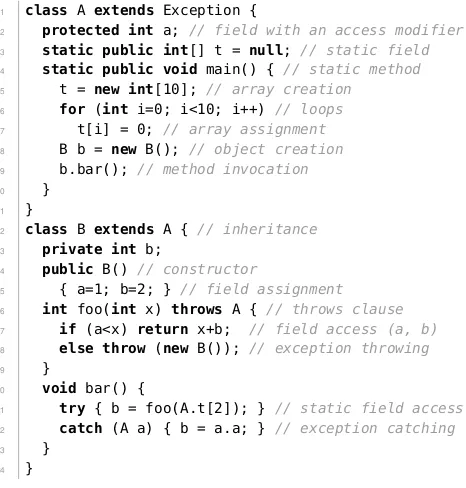
Some constructs of Jinja (and the richer language Jinja+, specified below) are illustrated by the program in Figure 1, where we use Java-like syntax (we will use this syntax as long as it translates in a straightforward way to a Jinja/Jinja+ syntax).
Jinja comes equipped with a type system and a notion of typed programs. In this paper we consider only well-typed programs.
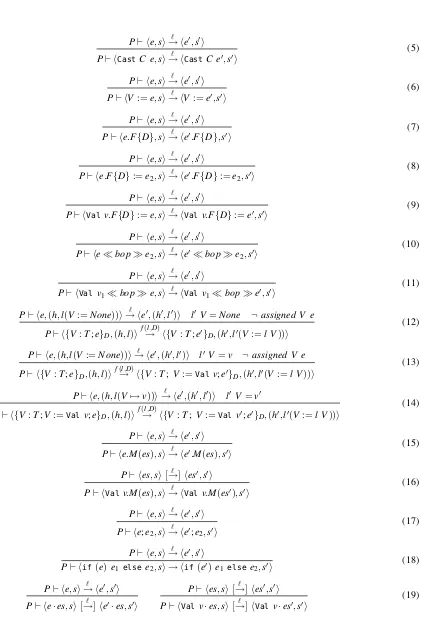
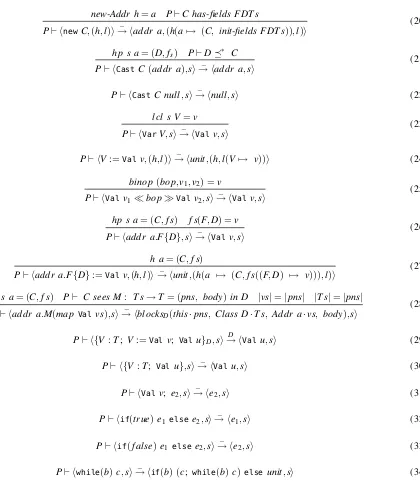
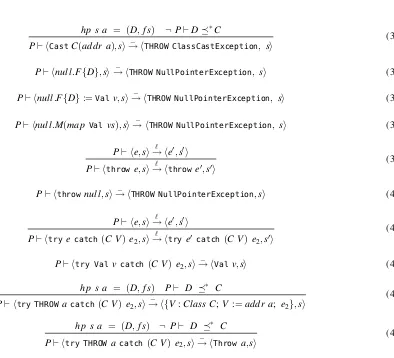
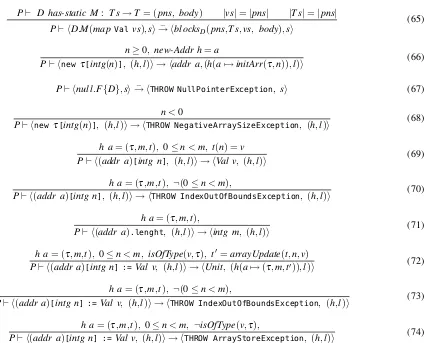
Semantics. Following [23], we briefly sketch the small-step semantics of Jinja. The full set of rules, including those for Jinja+ (see the next subsection) can be found in Appendix B. Astateis a pair ofheapand astore. Astoreis a map from variable names to values. Aheap is a map from references (addresses) toobject instances. Anobject instance is a pair consisting of a class name and afield table, and a field table is a map from field names (which include the class where a field is defined) to values.
The small-step semantics of Jinja is given as a set of rules of the formP` he,si → he0,s0i, describing a single step of the
program execution (reduction of an expression). We will call he,si (he0,s0i) a configuration. In this rule,P is a program in the context of which the evaluation is carried out, eand e0 are expressions ands ands0 are states. Such a rule says
that, given a program Pand a state s, an expression ecan be reduced in one step toe0, changing the state tos0. B. Jinja+
As a basis of our formal results we take a language that extends Jinja with: (a) the primitive type byte with natural conversions from and to int, (b) arrays, (c) abort primitive, (d) static fields (with the restriction that they can be initialized by literals only), (e) static methods, (f) access modifier for classes, fields, and methods (such as private, protected, andpublic), (g) final classes (classes that cannot be extended), (h) thethrowsclause of a method declaration. Exceptions, which are already part of Jinja, are particu-larly critical for the security properties we are interested in because they provide an additional way information can be transfered from one part of the program to another.
We assume that Jinja+ programs have unbounded mem-ory. The reason for this modeling choice is that the formal foundation for the security notions adopted in this paper are based on asymptotic security. This kind of security definitions only makes sense if the memory is not bounded, since the security parameter grows indefinitely.
Randomized programs. So far, we have considered deter-ministic programs. We will also need to consider random-ized programs in our framework. For this purpose, Jinja+ programs may use the primitive randomBit() that returns a random bit each time it is used. Jinja+ programs that do not make use ofrandomBit()are (called)deterministic, and otherwise, they are called randomized.
An example of a Jinja+ program is, as mentioned, presented in Figure 1.
Runs of Jinja+ programs. As already mentioned, the full set of rules of the small-step semantics of Jinja+ can be found in Appendix B. Based on this small-step semantics, we now define runs of Jinja+ programs.
Definition 1. A run of a deterministic program P is a sequence of configurations obtained using the (small-step) Jinja+ semantics from the initial configuration of the form he0,(h0,l0)i, wheree0=C.main(), forCbeing the (unique)
class wheremainis defined,h0=/0 is the empty heap, l0is
the store mapping the static (global) variables to their initial values (if the initial value for a static variable is not specified in the program, the default initial value for its type is used). A randomized program induces a distribution of runs in the obvious way. Formally, such a program is a random variable from the set {0,1}ω of infinite bit strings into the set of runs (of deterministic programs), with the usual probability space over{0,1}ω, where one infinite bit string determines the outcome ofrandomBit(), and hence, induces exactly one run.
1 class A extends Exception {
2 protected int a; // field with an access modifier 3 static public int[] t = null; // static field 4 static public void main() { // static method 5 t = new int[10]; // array creation
6 for (int i=0; i<10; i++) // loops 7 t[i] = 0; // array assignment 8 B b = new B(); // object creation 9 b.bar(); // method invocation
10 }
11 }
12 class B extends A { // inheritance 13 private int b;
14 public B() // constructor
15 { a=1; b=2; } // field assignment 16 int foo(int x) throws A { // throws clause 17 if (a<x) return x+b; // field access (a, b) 18 else throw (new B()); // exception throwing
19 }
20 void bar() {
21 try { b = foo(A.t[2]); } // static field access 22 catch (A a) { b = a.a; } // exception catching
23 }
24 }
Figure 1. An example Jinja+ program (in Java-like notation).
runtime of a program. Thelength of a run of a deterministic programis the number of steps taken using the rules of the small-step semantics. Given this definition, for a randomized program the length of a run is a random variable defined in the obvious way.
For a runr of a programPcontaining some subprogram S (a subset of classes ofP), we define the number of steps performed by S or the number of steps performed in the code of S in the expected way. To define this notion, we keep track of the origin of (sub)expressions, i.e., the class they come from. If a rule is applied on a (sub)expression that originates from the class C, we label this step withC and count this as a step performed inC(see Appendix B-B for details).
III. INDISTINGUISHABILITY
We now define what it means for two systems to be indis-tinguishable by environments interacting with those systems. Indistinguishability is a fundamental relationship between systems which is interesting in its own right, for example, to define privacy properties, and to define simulation-based security, as we will see in the subsequent sections.
For this purpose, we first define interfaces that systems use/provide, how systems are composed, and environments. We then define the two forms of indistinguishability already mentioned in the introduction, namely perfect and compu-tational indistinguishability. Since we consider asymptotic security, this involves to define programs that take a security parameter as input and that run in polynomial time in the security parameter.
Our definitions of indistinguishability follow the spirit of definitions of (computational) indistinguishability in the cryptographic literature (see, e.g., [10], [24], [21]), but, of course, instead of interactive Turing machines, we consider Jinja+ systems/programs. In particular, the simple commu-nication model based on tapes is replaced by rich object-oriented interfaces between subsystems.
A. Interfaces and Composition
Before we define the notion of an interface, we emphasize that it should not be confused with the concept of interfaces in Java; we use this term with a different meaning. Definition 2. Aninterface Iis defined like a (Jinja+) system but where all method bodies as well as static field initializers are dropped.
If I and I0 are interfaces, then I0 is a subinterface of I, writtenI0vI, ifI0can be obtained fromIby dropping whole classes (with their method and field declarations), dropping methods and fields, droppingextendsclauses, and/or adding thefinalmodifier to class declarations.
Two interfaces are calleddisjointif the set of class names declared in these interfaces are disjoint.
IfSis a system, then thepublic interface of Sis obtained fromSby (1) dropping all private fields and methods fromS and (2) dropping all method bodies and initializers of static fields.
Definition 3. A systemS implementsan interfaceI, written S:I, ifI is a subinterface of the public interface ofS.
Clearly, for every system Swe have that S: /0.
Definition 4. We say that a system S uses an interface I, written I`S, if, besides its own classes, S uses at most classes/methods/fields declared inI. We always assume that the public interface ofSandI are disjoint.
We note that if IvI0 and I`S, then I0`S. We write I0`S:I1 for I0`S andS:I1. If I=/0, i.e., I is the empty
interface, we often write`S instead of /0`S. Note that`S means thatSis a complete program.
Definition 5. Interfaces I1 and I2 are compatible if there
exists an interfaceI such thatI1vI andI2vI.
Intuitively, if two compatible interfaces contain the same class, the declarations of methods and fields of this class in those interfaces must be consistent (for instance, a field with the same name, if declared in both interfaces, must have the same type). Note that if I1 and I2 are disjoint, then they
are compatible. Systems that use compatible interfaces and implement disjoint interfaces can be composed:
Definition 6 (Composition). Let IS,IT,IS0 and I 0
T be
inter-faces such that IS and IT are disjoint and IS0 and I 0 T are
andT contain the methodmain,IS0 `S:IS, and IT0 `T:IT.
Then, we say that S and T are composable and denote by S·T the composition of S and T which, formally, is the union of (declarations in) S and T. If the same classes are defined both inS andT (which may happen for classes not specified in IS and IT), then we always implicitly assume
that these classes are renamed consistently in order to avoid name clashes.
We emphasize that the interfaces between subsystems as considered here are quite different and much richer than the interfaces between interactive Turing machines considered in cryptography. Instead of plain bit strings that are sent over tapes between different machines, objects can be created, classes of another subsystem can be extended by inheritance, and data of different types, including references pointing to possibly complex objects, can be passed between different objects. Also, the flow of control is different. While in the Turing machine model, sending a message gives control to the receiver of the message and this control might not come back to the sender, in the object-oriented setting communication goes through method calls and fields. After a method call, control comes back to the caller, provided that potential exceptions are caught and the execution is not aborted.
We also emphasize that while a setting of the form `S :I and I `T, i.e., in S·T the system T uses the interface I implemented by S, suggests that the initiative of accessing fields and calling methods always comes from T, it might also come from S by using callback objects: T could extend classes of S by inheritance, create objects of these classes and pass references to these objects to S (by calling methods ofS). Then, via these references,S can call methods specified in T. (This, in fact, is a common programming technique.)
B. Environments
An environment will interact with one of two systems and it has to decide with which system it interacted (see Section III). Its decision is written to a distinct static boolean variableresult.
Definition 7. A system E is called an environment if it declares a distinct private static variable result of type boolean with initial valuefalse.
In the rest of the paper, we (often implicitly) assume that the variableresultis unique in every Java program, i.e., it is declared in at most one class of a program, namely, one that belongs to the environment.
Definition 8. LetSbe a system withS:Ifor some interface I. Then an environment E is called anI-environment for S if there exists an interface IE disjoint from I such that (i)
IE`S:IandI`E:IE and (ii) eitherSorEcontainsmain().
Note that E andS, as in the above definition, are com-posable andE·S is a (complete) program.
For a finite run ofE·S, i.e., a run that terminates, we call the value ofresultat the end of the run theoutput of E or the output of the program E·S. For infinite runs, we define the output to be false. If E·S is a deterministic program, then we write E·S trueif the output ofE·S istrue. If E·Sis a randomized program, we writeProb{E·S true} to denote the probability that the output ofE·S is true. Definition 9 (same interface). The systemsS1 andS2 use the same interfaceif (i) for everyIE, we have thatIE`S1iff IE`S2, and (ii)S1contains the methodmainiffS2contains
main.
Observe that if S1 andS2 use the same interface and we
have that S1:I and S2:I for some interface I, then every I-environment forS1is also anI-environment forS2. C. Programs with security parameter
As mentioned at the beginning of this section, we need to consider programs that take a security parameter as input and run in polynomial time in this security parameter.
To ensure that all parts of a system have access to the security parameter, we fix a distinct interface ISP
consist-ing of (one class containconsist-ing) one public static variable securityParameter. We assume that, in all the considered systems/programs, this variable (after being initialized) is only read but never written to. Therefore, all parts of the considered system can, at any time, access the same, initial value of this variable.
For a natural number η, we define a system SPη that implements the interface ISP by setting the initial value of
securityParametertoη. We do not fix here how this value
is represented because the representation is not essential for our results; it could be represented as a linked list of objects or an array (see also the discussion below).
We call a system P such that ISP`P aprogram with a
security parameter or simply a program if the presence of a security parameter is clear from the context. Note that by this,SPη·Pis a complete program, which we abbreviate by P(η).
One solution could be to use another representation of messages, such as lists of bytes. This, however, would result in unnatural programs and we, of course, want to be able to analyze programs as given in practice. Another solution could be to use concrete instead of asymptotic security definitions. However, most results in simulation-based security are formulated w.r.t. asymptotic security, and hence, we would not be able to reuse these results and avoid, for example, reproving from scratch realizations of ideal functionalities.
Therefore, we prefer the following solution. We param-eterize the semantics of Jinja+ with the maximal (abso-lute) value integers can take. So if P is a deterministic program, the run of P with integer size s≥1 is a run of P where the maximal (absolute) value of integers is s; analogously for randomized programs. We writeP strue
if the output of such a run is true; analogously, we de-fine Prob{P strue}. In our asymptotic formulations of
indistinguishability, the size of integers may depend on the security parameter.
D. Perfect Indistinguishability
We now formulate perfect indistinguishability, which, as we will prove in Section V, implies computational in-distinguishability. We say that a deterministic program P terminates for integer size s, if the run of P with integer sizes is finite.
Definition 10(Perfect indistinguishability). LetS1andS2
be deterministic systems with a security parameter and such that S1:I and S2:I for some interface I. Then, S1 and S2
are perfectly indistinguishable w.r.t. I, writtenS1 ≈Iperf S2,
if (i) S1 and S2 use the same interface and (ii) for every
deterministic I-environment E for S1 (and hence, S2) with
security parameter, for every security parameterηand every
integer size s≥1, it holds that if E·S1(η) and E·S2(η)
terminate for integer size s, thenE·S1(η) strue iff E·
S2(η) strue.
We note that the notion of perfect indistinguishability introduced above is termination-insensitive, i.e. it puts no restrictions on non-terminating runs. This (weak) form of perfect indistinguishability, nevertheless implies computa-tional indistinguishability (see Theorem 3).
E. Polynomially Bounded Systems
As already mentioned at the beginning of this section, in order to define the notion of computational indistinguisha-bility we need to define programs and environments whose runtime is polynomially bounded in the security parameter. For this purpose, we fix now and for the rest of this section a polynomially computable functionintsizethat takes a security parameterηas input and outputs a natural number
≥1. We require that the numbers returned by this function are bounded by a fixed polynomial in the security parameter.
All notions defined in what follows are parameterized by that function. However, due to ease of notion this will not be made explicit.
Our runtime definitions follow the spirit of definitions in cryptographic definitions of simulation-based security, in particular, [24], [21].
We start with the definition of almost bounded programs. These are programs that, with overwhelming probability, terminate after a polynomial number of steps.
Definition 11 (Almost bounded). A programPwith secu-rity parameter isalmost boundedif there exists a polynomial psuch that the probability that the length of a run ofP(η)
(with integer size intsize(η)) exceeds p(η) is a negligible function inη.1
It is easy to see that an almost bounded program P can be simulated by a probabilistic polynomial time Turing machine that simulates at most p(η)steps of a run ofP(η)
(with integer size intsize(η)) and produces output that is
distributed the same up to a negligible difference.
We also need the notion of a bounded environment. The number of steps such an environment performs in a run is bounded by a fixed polynomial independently of the system the environment interacts with.
Definition 12 (Bounded environment). An environmentE is called bounded if there exists a polynomial p such that, for every system S such that E is an I-environment for S (for some interface I) and for every run of E·S(η) (with
integer size intsize(η)), the number of steps performed in
the code of E does not exceed p(η).
This definition makes sense since E can abort a run by calling abort(), and hence, E can prevent to be called by S, which would always require to execute some code in E. (Without abort(), E can, in general, not prevent that code fragments ofE are executed, e.g.,Scould keep calling methods of classes ofE.)
If an environmentEis both bounded and anI-environment for some system S, we call E abounded I-environment for S.
For the cryptographic analysis of systems to be mean-ingful, we study systems that run in polynomial time (with overwhelming probability) with any bounded environment. Definition 13 (Environmentally I-bounded). A system S is environmentally I-bounded, ifS:I and for each bounded I-environmentEforS, the programE·Sis almost bounded. It is typically easy to see that a system is environmentally I-bounded (for all functions intsize).
We note that environmentally I-bounded systems, as de-fined above, are reactive systems that are free to process 1As usual, a function f from the natural numbers to the real numbers is
negligible, if for everyc>0 there existsη0 such that f(η)≤ 1
ηc for all
an unbounded number of requests of the environmentE. In particular, a reactive system S does not need to terminate after some fixed and bounded number of requests. Clearly, every bounded I-environment, being bounded, will only invoke S a bounded number of times, more precisely, the number of invocations the environment makes is bounded by some polynomial in the security parameter.
F. Computational Indistinguishability
Having defined polynomially bounded systems and pro-grams, we are now ready to define computational indistin-guishability of systems, where, again, we fix the function intsize. (However, computational guarantees for Java pro-grams will be independent of a specific functionintsize.) We start with the notion of computationally equivalent programs. Definition 14(Computational Equivalence). LetP1andP2
be (complete, possibly probabilistic) programs with security parameter. Then P1 andP2 are computationally equivalent,
written P1 ≡comp P2, if |Prob{P1(η) intsize(η) true} −
Prob{P2(η) intsize(η)true}|is a negligible function in the
security parameter η.
Definition 15 (Computational indistinguishability). Let S1 andS2 be environmentally I-bounded systems. Then S1
andS2arecomputationally indistinguishable w.r.t. I, written S1 ≈Icomp S2, if S1 andS2 use the same interface and for
every bounded I-environment E for S1 (and hence, S2) we
have that E·S1 ≡comp E·S2.
Typically, this definition is applied to systemsS1 andS2
that do not use the statementabort(). However, our results also work in this case.
We also note that this definition of indistinguishability is w.r.t. uniform environments. A definition w.r.t. non-uniform environments can be obtained in a straightforward way by giving the environment additional auxiliary input (besides the security parameter).
Furthermore, we point out that in the above definition two cases can occur: (1)main()is defined inE or (2)main()is defined in both S1 and S2. In the first case, E can freely
create objects of classes in the interfaceI (which is a subset of classes ofS1/S2) and initiate calls. Eventually, even in case
of exceptions,E can get back control (method calls return a value toE andE can catch exceptions if necessary), unless S1/S2usesabort. The kind of controlEhas in the case (2),
heavily depends on the specification of S1/S2. This can go
from having as much control as in case (1) to being basically a passive observer. For example, main() (as specified in S1/S2) could call a method of E and from then on E can
use the possibly very rich interface I as in case (1). The other extreme is that I is empty, say, so E cannot create objects of (classes of)S1/S2 by itself, onlyS1/S2can create
objects of (classes of)Eand ofS1/S2. Hence,S1/S2has more
control and can decide, for instance, how many and which
objects are created and when E is contacted. Still even in this case, if so specified, S1/S2 could give E basically full
control by callback objects (see Section III-A). (As a side note, illustrating the richness of the interfaces, compared to Turing machine models,Ecould also extend classes ofS1/S2
and by this, if not properly protected, might get access to information kept in these classes.)
IV. SIMULATABILITY
We now formulate what it means for a system to re-alize another system, in the spirit of the simulation-based approach.
As before, we fix a functionintsize(see Section III-E) for the rest of this section. Typically, one would prove that one system realizes the other for all such functions.
Our formulation of the realization of one system by another follows the spirit of strong simulatability in the simulation-based approach (see, e.g., [24]). In a nutshell, the definition says that the (real) systemRrealizes an (ideal) systemF if there exists a simulatorSsuch that RandS·F behave almost the same in every bounded environment. Definition 16 (Strong Simulatability). Let Iin,Iout,IE,IS
be disjoint interfaces. Let F and R be systems. Then R realizes F w.r.t. the interfaces Iout, Iin, IE, and IS, written
R≤(Iout,Iin,IE,IS) F or simply R≤F, if i) I
E∪Iin`R:Iout
andIE∪Iin∪IS`F:Iout, ii) either both F andR or neither
of these systems contain the method main(), iii) R is an environmentally Iout-bounded system (F does not need to
be), and iv) there exists a systemS(the simulator) such that Sdoes not containmain(),IE`S:IS,S·Fis environmentally
Iout-bounded, and R ≈Icompout S·F.
The intuition behind the way the interfaces between the different components (environment, ideal and real function-alities, simulator) are defined is as follows: Both R and F provide the same kind of functionality/service, specified by the interfaceIout. They may require some (trusted) services
Iin from another system component and some services IE
from an (untrusted) environment, for example, networking and certain other libraries. In addition, the ideal functionality Fmay require servicesISfrom the simulatorS, which in turn
may require services IE from the environment. Recall from
the discussion in Section III-A that the interfaces can be very rich—they allow for communication and method calls in both directions.
In the applications we envision, with our case study being the first example, F will typically be an ideal functionality for one or more cryptographic primitives and its realization R will basically be the actual cryptographic schemes.
Lemma 1. Let IEand I be disjoint interfaces and let S1and S2be environmentally I-bounded systems such that S1≈Icomp
S2 (in particular, S1 and S2 use the same interface) and IE`S1:I, and hence, IE`S2:I. Let E be a (not necessarily bounded) I-environment for S1(and hence, S2) with I`E:IE
such that E·S1 is almost bounded. Then E·S2 is almost bounded and E·S1 ≡comp E·S2.
Now we can prove reflexivity and transitivity of strong simulatability.
Lemma 2 (Reflexivity of strong simulatability). Let Iout,
Iin, and IE be disjoint interfaces and let R be a system such
that IE∪Iin`R:Iout and R is environmentally Iout-bounded.
Then, R≤R, i.e., R realizes itself.
Proof: We define S=/0, i.e., S does not contain any class, and immediately obtain thatR ≈Iout
comp R=S·R.
Lemma 3(Transitivity of strong simulatability). Let Iout,
Iin, IE, IS0, and IS1be disjoint interfaces and let R0, R1, and R2 be environmentally I-bounded systems. If R1≤(Iout,Iin,IE∪I
1
S,IS0) R0 and R2≤(Iout,Iin,IE,I
1
S)R1, then R2≤(Iout,Iin,IE,IS0∪IS1)R0. Proof: Under the assumption of the lemma, we know that there existS0andS1such thatIE∪IS1`S0:IS0,IE`S1: IS1,S0·R0andS1·R1are environmentallyIout-bounded, and
R1 ≈Icompout S0·R0andR2 ≈compIout S1·R1. We defineS=S0·S1.
Obviously, we have that IE `S:IS0∪IS1. Now let E be a
bounded Iout-environment forR2. Then, we obtain: E·R2 ≡ E·S1·R1 ≡ E·S1·S0·R0 = E·S·R0 .
The first equivalence holds because of our assumptions. For the second equivalence, first note that E·S1·R1 is almost
bounded andR1 ≈Icompout S0·R0. By Lemma 1, we now obtain
that E·S1·S0·R0 is almost bounded and that the second
equivalence holds.
In short, the following composition theorem says that if R0 realizes F0 andR1 realizes F1, then the composed real
systemR0·R1realizes the composed ideal systemF0·F1. In
other words, it suffices to prove the realizations separately in order to obtain security of the composed systems. Theorem 1(Composition Theorem). Let I0, I1, IE, IS0, and
IS1be disjoint interfaces and let R0, F0, R1, and F1be systems such that R0≤(I0,I1,IE,I
0
S)F0, R1≤(I1,I0,IE,IS1)F1, not both R0 and R1containmain(), and R0·R1are environmentally(I0∪ I1)-bounded. Then, R0·R1≤(I0∪I1,/0,IE,I
0
S∪IS1)F0·F1.
Proof: Under the assumptions of the theorem, there existS0andS1such thatIE`Si:ISi,Si·Fiis environmentally
Ii-bounded and Ri ≈Icompi Si·Fi fori∈ {0,1}.
We defineS=S0·S1,R=R0·R1,F=F0·F1,I=I0∪I1,
and IS=IS0∪IS1 . In order to show that R≤(I,/0,IE,IS) F it
suffices to prove that a)S·F is environmentallyI-bounded and b)R ≈I
comp S·F; the remaining conditions are obvious.
LetE be a boundedI-environment forR. Similarly to the proof of Lemma 3, by Lemma 1 we obtain the following equivalences:
E·R = E·R0·R1 ≡ E·R0·(S1·F1)
≡ E·(S0·F0)·(S1·F1) =E·S·F,
This implies b). By Lemma 1 we, in particular, get that all the above systems are almost bounded. Since we quantified over all bounded I-environments forR (and hence,S·F) it follows that S·F is environmentallyI-bounded, thus a).
Note that with R0·R1≤(I0∪I1,/0,IE,I
0
S∪IS1)F0·F1we thatR0· R1realizesF0·F1also for all subinterfaces ofI0∪I1.
For simplicity, Theorem 1 is stated in such a way that the trusted service that Ri may use is completely provided
by Ri−1, namely through Ii−1. It is straightforward (only
heavy in notation) to state and prove the theorem for the more general case that the trusted service is only partially provided by the other system.
V. FROMPERFECT TOCOMPUTATIONAL
INDISTINGUISHABILITY
We now prove that if two systems that use an ideal func-tionality are perfectly indistinguishable, then these systems are computationally indistinguishable if the ideal function-ality is replaced by its realization. As already explained in the introduction, this is a central step in enabling pro-gram analysis tools that cannot deal with cryptography and probabilistic polynomially bounded adversaries to establish computational indistinguishability properties. As before, we fix a function intsize (see Section III-E) for the rest of this section.
The proof is done via two theorems. The first says that if two systems that use an ideal functionality are computa-tionally indistinguishable, then they are also computacomputa-tionally indistinguishable if the ideal functionality is replaced by its realization.
Theorem 2. Let I, J, IE, IS, and IP be disjoint interfaces
with JvIP∪I. Let F, R, P1, and P2 be systems such that (i) IE∪I`P1:IP and IE∪I`P2:IP, (ii) R≤(I,IP,IE,IS)F,
in particular, IE∪IP`R:I and IE∪IP∪IS`F:I, (iii) P1 containsmain()iff P2 containsmain(), (iv) not both P1 and F (and hence, R) containmain(), (v) F·Piand R·Pi, for i∈
{1,2}, are environmentally J-bounded. Then, F·P1 ≈Jcomp
F·P2 implies R·P1 ≈Jcomp R·P2.
Proof: Assume that F·P1 ≈Jcomp F·P2. In particular, F·P1 andF·P2use the same interface and, thereforeR·P1
andR·P2use the same interface as well.
LetE be a boundedJ-environment forR·P1. We need to
Because R≤(I,IP,IE,IS)F, there exists a simulator S such
that IE`S:IS,S·F is environmentallyI-bounded and
R ≈Icomp S·F (1)
Now, becauseR·Pi,i∈ {1,2}, is environmentallyJ-bounded,
the systemE·R·Pi is almost bounded. By (1) and Lemma 1
we can conclude thatE·S·F·Pi is almost bounded and
E·R·Pi ≡comp E·S·F·Pi . (2)
As we have assumed thatF·P1 ≈Jcomp F·P2, by Lemma 1
we obtain
E·S·F·P1 ≡comp E·S·F·P2. (3)
Combining (2) and (3), we obtainE·R·P1 ≡comp E·R·P2.
For simplicity of presentation, the theorem is formulated in such a way thatPi, i∈ {1,2}, uses only I as a (trusted)
service and F/Ruses IP. It is straightforward to also allow
for other external services.
We now show that perfect indistinguishability implies computational indistinguishability (see Appendix C-B) for the proof.
Theorem 3. Let I be an interface and let S1 and S2 be deterministic, environmentally I-bounded programs such that Si:I, for i∈ {1,2}, and S1 and S2 use the same interface. Then, S1 ≈Iperf S2implies S1 ≈Icomp S2.
By combining Theorem 2 and Theorem 3, we obtain the desired result explained at the beginning of this section. Corollary 1. Under the assumption of Theorem 2 and more-over assuming that P1·F and P2·F are deterministic systems, it follows that P1·F ≈Jperf P2·F implies P1·R ≈Jcomp P2·R.
Recall that P1·R ≈Jcomp P2·R is (implicitly) defined
w.r.t. the integer size function intsize(η). However, since
the statement P1·F ≈Jperf P2·F does not depend on any
integer size function, we obtain that computational indistin-guishability holds independently of a specific integer size function.
VI. PERFECTINDISTINGUISHABILITY AND NON-INTERFERENCE
In this section we prove that perfect indistinguishability and non-interference are equivalent. Hence, in combination with Corollary 1 it suffices for tools to analyze systems that use an ideal functionality w.r.t. non-interference in order to get computational indistinguishability for systems when the ideal functionality is replaced by its realization. As already mentioned in the introduction, many tools can analyze non-interference for Java programs.
The (standard) non-interference notion for confidentiality [17] requires the absence of information flow from high to low variables within a program. In this paper, we define non-interference for a (Jinja+) program Pwith some static
variables~xof primitive types that are labeled as high. Also, some other static variables of primitive types are labeled as low. We say that P[~x] is a program with high and low variables. By P[~a] we denote the program P where the high variables~x are initialized with values~a and the low variables are initialized as specified in P. We assume that the length of~xand~aare the same and~acontains values of appropriate types; in such a case we say that~ais valid. Now, non-interference for a (deterministic) program is defined as follows.
Definition 17 (Non-interference for Jinja+ programs). LetP[~x] be a program with high and low variables. Then, P[~x]has the non-interference propertyif the following holds: for all valid~a1 and~a2 and all integer sizes s≥1, if P[~a1]
and P[~a2] terminate for integer size s, then at the end of
these runs, the values of the low variables are the same. Similarly to the definition of perfect indistinguishability (Definition 10), the above definition captures termination-insensitivenon-interference.
We note that the non-interference property is quite pow-erful:P could have just one high variable of type boolean. Depending on the value of this variableP could run one of two systemsS1andS2, illustrating that the non-interference
property can be as powerful as perfect indistinguishability. The above notion of non-interference deals with complete programs (closed systems). We now generalize this defini-tion to open systems:
Definition 18(Non-interference in an open system). Let I be an interface and let S[~x] be a (not necessarily closed) deterministic system with a security parameter, high and low variables, and such that S:I. Then, S[~x] isI-noninterferent if for every deterministicI-environmentEforS[~x]and every security parameter η non-interference holds for the system
E·S[~x](η), where the variable result declared in E is considered to be a low variable.
Now, equivalence of this notion and perfect indistin-guishability follows easily by the definitions of I -non-interference and perfect indistinguishability:
Theorem 4. Let I and S[~x]be given as in Definition 18 with no variable of S labeled as low (only the variable result declared in the environment is labeled as low). Then the following statements are equivalent:
(a) For all valid~a1and~a2, we have that S[~a1] ≈Iperf S[~a2]. (b) I-non-interference holds for S[~x].
VII. A PROOFTECHNIQUE FORNON-INTERFERENCE IN
OPENSYSTEMS
There are many tools that can deal with classical non-interference for closed systems, i.e., complete programs. In this section, we develop proof techniques that enable such tools, at least some of them, to also deal with open systems. Technically, we will show that in order to check non-interference for open systems according to Definition 18 it is sufficient to consider only a very restricted class of environments, rather than all environments. The input these environments give to the system they interact with is fixed for every environment and does not depend on the output the environment got from the system. In fact, the environments in this class are all almost identical, they only differ in the input sequence that they use. Now, the analysis a tool performs often ignores or can ignore specific values encoded in the program, such as the input sequence. So, if such an analysis establishes non-interference for a system and a fixed environment in the considered class, then this implies that non-interference holds for all environments in this class. By our proof technique, it then follows that non-interference holds for all environments, as required by Definition 18.
In our case study, we demonstrate that using our proof techniques, the tool Joana, which is designed to check non-interference for closed systems, can now deal with (a relevant class of) open systems as well.
To illustrate the main idea, we start with a simple case where communication between the environment and the sys-tem is restricted to primitive types only. We then generalize the result to the case where the environment and the system can communicate using also exceptions, arrays of bytes, and simple objects.
A. Communication through Primitive Types Only
In this section, we assume that a systemScommunicates with an environment E only through static functions with primitive types. More precisely, we consider programs S such that (1) methodmainis defined inSand (2)IE`S, for
some interfaceIE, where all methods are static, use primitive
types only (for simplicity of presentation we will consider only the typeint), and have emptythrows clause. We will consider indistinguishability w.r.t. the empty interface (i.e. environments we consider do not directly call S).
The above assumptions will allow us to show, in the proof of Theorem 5, thatEandSdo not share any references: their states are in this sense disjoint.
We now define the class of environments mentioned at the beginning of this section. We then show that to establish I-non-interference, it is enough to consider only those environments (see Theorem 5).
For a finite sequence~u=u1, . . . ,unof values of typeint,
we denote by ˜EIE
~u the following system.
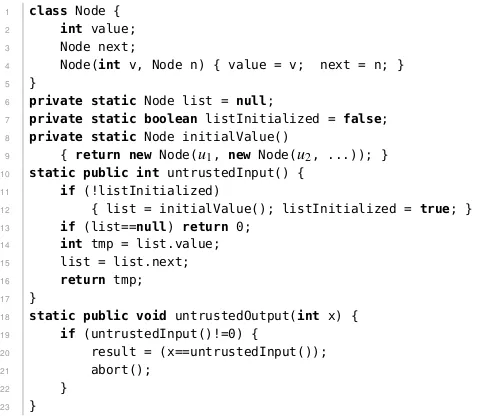
The environment E˜IE
~u contains two static methods:
untrustedOutputanduntrustedInput, as specified in
Fig-1 class Node { 2 int value; 3 Node next;
4 Node(int v, Node n) { value = v; next = n; }
5 }
6 private static Node list =null;
7 private static boolean listInitialized = false;
8 private static Node initialValue()
9 { return new Node(u1,new Node(u2, ...)); }
10 static public int untrustedInput() { 11 if (!listInitialized)
12 { list = initialValue(); listInitialized = true; }
13 if (list==null)return 0; 14 int tmp = list.value;
15 list = list.next; 16 return tmp;
17 }
18 static public void untrustedOutput(int x) { 19 if (untrustedInput()!=0) {
20 result = (x==untrustedInput());
21 abort();
22 }
23 }
Figure 2. Implementation ofuntrustedInputanduntrustedOutput in ˜
E~u. We assume that classNodeis not used anywhere else.
ure 2. For the sake of the discussion, letSbe the system the environment ˜EIE
~u interacts with. (Note that the definition of
˜ EIE
~u is independent of a specific S. It only depends on IE.)
As we will see below, the method untrustedOutput gets all data passed byS to ˜EIE
~u . The method untrustedInput
determines what the environment passes on toS.
More specifically. the method untrustedInput() returns consecutive values of~uand, after the last element of~u has been returned, it returns 0. Note that the consecutive values returned by this method are hardwired in line 9 (determined by~u) and do not depend on any input to ˜EIE
~u .
The method untrustedOutput, depending on the values given byuntrustedInput(), either ignores its argument or compares its value to the next integer it obtains, again, from untrustedInput()and stores the result of this comparison in the (low) variableresult. The intuition is the following: untrustedOutput gets, as we will see below, all the data the environment gets from S. If the two instances of S, S[~a1] andS[~a2], which the environment tries to distinguish,
behave differently, then there must be some point where the environment gets different data from the two systems in the corresponding runs, i.e.,untrustedOutput will be invoked with different values for x, say the values x takes at this point areb1andb2, respectively. By choosing an appropriate ~u, this can be detected by untrustedOutput:~u should be defined in such a way that the method untrustedInput() returns 1 at this point and that the valueuntrustedInput() returns next equalsb1, say (b2would also work). Then, in the
run of the environment with S[~a1] the variableresult will
be assigned 1 and in the run withS[~a2] it will be assigned
24 static public intfoo(int x) { 25 untrustedOutput(FOO_ID); 26 untrustedOutput(x);
27 return untrustedInput()
28 }
Figure 3. E˜IE
~u : the implementation of a method ofIE with the signature static public int foo(int x), where FOO_ID is an integer constant serving as the identifier of this method (we assign a different identifier to every method).
andS[~a2].
Finally, for every method declarationminIE, the system
˜ EIE
~u contains the implementation of m as illustrated by the
example in Figure 3. As we can see, the defined method forwards all its input data to untrustedOutput and lets untrustedInputdetermine the returned value.
This completes the definition of ˜EIE
~u . The next theorem
(see Appendix D-A for the proof) states that, to proveI -non-interference, it is enough to consider only environments ˜EIE ~u
for all~u. In this way we need to study only (almost) closed systems, namely systems that differ in only one expression (line 9). As discussed at the beginning of this section, this restriction is often sufficient for tools are designed to deal with closed systems only.
Theorem 5. Let IEbe an interfaces with only static methods
of primitive argument and return types as introduced above. Let S be a system with high and low variables such that main is defined in S and IE`S. Then, I-non-interference,
for I=/0, holds for S if and only if for all sequences~u as above non-interference holds forE˜IE
u ·S.
B. Communication through Arrays, Simple Objects, and Exceptions
The result stated in Theorem 5 can be extended to cover some cases where, E and S exchange information not only through values of primitive types, but also arrays, simple object, and throwing exceptions. Some restrictions, however, have to be imposed on IE and the program S.
These restrictions guarantee that, although references are exchanged betweenE andS, the communication resembles exchange of pure data.
More precisely, our result works for the following class of systemsS. LetIE be the minimal interface such thatIE`S.
We assume that:
1. Methods of classes in IE are static and their arguments
are of primitive types or of type byte[]. (Let us notice that this only restricts the way S uses the environment; an environment that implements the interfaceIEcan have
arbitrary fields and methods. Note also that methods of IE can throw exceptions.)
2. Fields of classes in IE are non-static and of primitive
types or of typebyte[]. (Again, a system implementing IE is not restricted to such fields).
1 static public byte[] foo(int x, byte t[]) throws C { 2 // consume the input:
3 untrustedOutput(FOO_ID); 4 untrustedOutput(x); 5 untrustedOutput(t.lenght); 6 for( int i=0; i<t.length; ++i ) 7 untrustedOutput(t[i]);
8 // decide whether to throw some exception: 9 if(untrustedInput()==0) throw new C1();
10 ...
11 if(untrustedInput()==0) throw new Ck(); 12 // determine the array to return: 13 int len = untrustedInput(); 14 if (len<0) return null; 15 byte[] result = new byte[len]; 16 for( int i=0; i<len; ++i)
17 result[i] = (byte) untrustedInput(); 18 return result;
19 }
Figure 4. E˜~u: the implementation of a method with the sig-nature static public byte[] foo(int x,byte[] t)throws C, where C1, . . . ,Ck are all subclasses of C, including C itself, which are either standard exceptions or empty classes inIE.
3. Whenever an array (i.e. the reference to an array) is passed to the environment, this reference is not used byS afterwards. (This property can be easily guaranteed by a syntactical restriction to pass only fresh copies of arrays to the environment).
4. IfScalls a (static) method ofIEwhich returns a reference
r, the way S can use r is subject to the following restrictions: (1) Ifris a reference of typebyte[], thenS is only allowed to immediately clone r; r is not used afterwards. (2) If r is a reference to an object, then S is only allowed to immediately clone the fields of r (of primitive types and of type byte[]); r is not used afterwards. S cannot use r in any way not specified explicitly above.
5. For every try-catch statement inS of the form try { ... } catch (C r) { B }
if C or a subclass of C is listed in the throws clause of some method in IE (and thus this statement may
potentially catch an exception thrown by E), then r is subject to the same restrictions as in item 4. case (2) above.
For such programs we can, as in the previous section, construct a fixed ˜E~u such that it is enough to consider only these system (for all~u). This system consists of the static methods untrustedInputanduntrustedOutputas defined above and, for every classCofIE, the declaration ofCwith
the values of its fields that are specified inIE are filled using untrustedInput, as for the array in the example.
The following theorem is a generalisation of Theorem 5 to the richer family of progarms considered in this section (see Appendix D-B for the proof).
Theorem 6. Let S be as above. I-non-interference, for I=/0, holds for S if and only if for all sequences~u as above non-interference holds forE˜u·S.
VIII. PUBLIC-KEYENCRYPTION
In our case study, we will analyze a system that uses public-key encryption. We therefore now provide an ideal functionality for public-key encryption, denoted by
IdealPKE. Our example program will be analyzed based on this functionality (see Section IX). Details ofIdealPKEare given in Appendix A-A. We prove that this functionality can be realized by a system, which we call RealPKE, that implements, in the obvious way, an IND-CCA2-secure public-key encryption scheme.
The interface implemented by IdealPKE and RealPKE, denoted by IPKE, consists of two classes:
1 public final class Decryptor {
2 public Decryptor(); // class constructor 3 public Encryptor getEncryptor(); 4 public byte[] decrypt(byte[] message);
5 }
6 public final class Encryptor {
7 public byte[] getPublicKey();
8 public byte[] encrypt(byte[] message);
9 }
An object of classDecryptoris supposed to encapsulate a public/private key pair. These keys are created when the object is constructed. It allows a party who owns such an object to decrypt messages (for which, intuitively, the private key is needed) by the method decrypt. This party can also obtain an encryptor which encapsulates the related public key and encrypts messages via the method encrypt. The encapsulated public key can be obtained by the method getPublicKey. Typically, the party who creates (owns) a decryptor gives away only an associated encryptor.
Our ideal functionality IdealPKEis in the spirit of ideal public-key functionalities in the cryptographic literature (see, e.g., [10], [27]). However, it is more restricted in that we do not (yet) model corruption in that functionality, and hence, in its realization. So far, corruption, if considered, needs to be modeled in the higher-level system using IdealPKE. In particular, whenever an encryptor object is used, it is guaranteed that the public key encapsulated in this object was honestly generated and no party has direct access to the corresponding private key.
While this might be too restricted and inconvenient in some scenarios (and it is interesting future work to extend this functionality), we took this design choice because our functionality facilitates the automated verification process
and is nevertheless useful in interesting scenarios. We em-phasize that the theorem for the realization of IdealPKE
(Theorem 7) would hold for more expressive functionali-ties, in particular, those that model corruption and exactly resemble the ones that can be found in the cryptographic literature.
Our ideal functionality IdealPKE :IPKE is defined on
top of the interface IEnc (which, in a complete system,
is implemented by the environment or the simulator), i.e. IEnc`IdealPKE, where IEnc is as follows:
10 class KeyPair {)
11 public byte[] publicKey; 12 public byte[] privateKey;
13 }
14 class Encryption {
15 static public KeyPair generateKeyPair();
16 static public byte[]
17 encrypt(byte[] publKey, byte[] message);
18 static public byte[]
19 decrypt(byte[] privKey, byte[] message);
20 }
In a nutshell, IdealPKE works as follows: On initializa-tion, viaDecryptor(), a public/private key pair is created by callinggenerateKeyPair()inIEnc.IdealPKEalso maintains
a list of message/ciphertext pairs; this list is shared with all associated encryptors (objects returned by getEncryptor). When method encrypt inIPKE is called for a messagem,
the ideal functionality callsencryptinIEnc to encrypt a
se-quence of zeros of the same length, obtaining the ciphertext m0, and stores (m,m0) in the list. The method decrypt in IPKE called for m0 looks for a pair (m,m0) in the list and,
if it finds it, returns m; otherwise, it decrypts m0 (calling decryptinIEnc) obtainingm00 and returns this message. The
idea behind this functionality is that the ciphertext returned by encryption is not related in any way (except for the length of the message) to the plaintext.
As already mentioned, RealPKE is defined in a straight-forward way using any IND-CCA2-secure encryption scheme. The following theorem, which says that RealPKE
in fact realizes IdealPKE, is proved in Appendix E. Theorem 7. IfRealPKEuses an IND-CCA2-secure encryp-tion scheme, then RealPKE≤(IPKE,/0,/0,IEnc)IdealPKE.
IX. CASESTUDY
In our case study and as a proof of concept of our framework, we consider a simple system that uses public-key encryption: clients send secrets encrypted over an untrusted network, controlled by an active adversary, to a server who decrypts the messages. This can be seen as a rudimentary way encryption can be used. Based on our framework, we use the Joana tool (see below), to verify strong secrecy of the messages sent over the network, i.e., non-interference is shown using Joana for the system when it runs with
We emphasize that, while the code of client and server are quite small, the actual code that needs to be analyzed is larger because it includes the ideal functionality and the code that results from applying the techniques developed in Section VII-B (we note that the verified program is in the family of systems considered in this section); altogether the code in our case study comprises 376 LoC in a rich fragment of Java. Moreover, the adversary model we consider in the case study is strong in that the (active) adversary dictates the number of clients, sends a pair of messages to every client of which one is encrypted (in the style of a left-right oracle), and controls the network.
The main goal of our case study is to demonstrate that it is, in principle, possible to establish strong cryptographic security guarantees for Java(-like) programs using existing tools for checking standard non-interference properties.
The verification of the program considered in our case study took just a few seconds (see below), and hence, our approach, in conjunction with Joana, should also work for bigger programs and more complex settings.
A. The Analyzed Program
We now describe the analyzed program in more detail (see Appendix A-B for the code).
Besides the code for the client and server, the program also contains a setup class which contains the methods main() and creates instances of protocol participants and organizes the communication. This setup first creates a public/private key pair (encapsulated in a decryptor object) for the server. In a while-loop it then expects, in every round, i) two input messages from the network (adversary), ii) depending on a static boolean variablesecret(which will be declared to behigh), one of the two messages is picked, iii) a client is created and it is given the public key of the server and the chosen message (the client will encrypt that message and send it over the network to the server), iv) a message from the network is expected, and v) given to the server, who will then decrypt this message and assign the plaintext to some variable.
We denote the class setup by Setup[b], where b ∈ {false,true} is the value with whichsecretis initialized inSetup. BySreal[b], forb∈ {false,true}, we denote the system consisting of the classSetup[b], the class Client, the class Server, and the systemRealPKE. This system is open: it uses unspecified network (and untrusted input from the environment) which is controlled by the adversary. Anal-ogously, Sideal[b] contains IdealPKE instead of RealPKE. Note that Sideal[b] is even more open in that the ideal functionality asks the environment to encrypt and decrypt some messages (see the definition ofIdealPKE).
We note that for the analysis with Joana we consider a variant of the ideal functionality where the ideal encryption is done always with the zero byte, and hence, the ideal functionality does not reveal the length of the encrypted
message. (This is reasonable if only messages of fixed length are supposed to be encrypted.)
B. The Property to be Proven The property we want to show is
Sreal[false] ≈comp/0 Sreal[true], (4)
that is, the two variants of the system are indistinguishable from the point of view of an adversary who implements the networking, but does not call (directly) methods ofSreal[b]; he, however, through the setup class, determines the number of clients that are created and the message pair for every client.
By our framework, to prove (4) it is enough to show I -non-interference of the system Sideal[b]. Since the system Sideal[b] is in the class of systems considered in Sec-tion VII-B, we can use the results from that secSec-tion which says that we only need to show (classical) non-interference of the systemT~u[b], for all~u, which extendsSideal[b]by ˜EuIE,
whereIE is the interface IdealPKE extended with methods
for network input and output.
To show that, for all~u, non-interference holds forT~u[b],
we used the Joana tool, as described in the next section. The verification carried out establishes (4), under the (reasonable) assumption that Joana is sound with respect to the subset of Java covered in Jinja+ (as explained in the next section, Joana has been proved to be sound with respect to the semantics of Jinja).
C. Analysis with Joana
Joana [20] is a static analysis tool. It uses a technique called slicing for program dependence graphs (PDG)—a graph-based representation of the program—to detect illegal information flows. It can handle full Java bytecode including exceptions. A machine-checked proof [37] provides a formal specification of PDGs and shows that slicing can be used to obtain a sound approximation of the information flows inside a program. Additional work [38], [39] verified that a variant of the slicing algorithm used by Joana can help to guarantee classical Goguen/Meseguer non-interference [16] (which is the kind of non-interference we are interested in) for the semantics of the Jinja language. The technique used by Joana does not depend on such details of the semantics as the maximum value of integers. Therefore, the guarantees Joana gives apply to all variants of the semantics that differ on this maximum value.
Joana is a whole-program analysis tool that analyzes an explicit version of a program and thus cannot reason about the security of a family of programs in general. We show, however, that this is possible for the specific families of (closed) programs ˜E~u·S (parametrized by~u), considered in
that the results of Appendix F are not specific to the protocol analyzed in this case study; they enable Joana to reason about any system that complies with the restrictions of Section VII-B, and hence, these results are of general interest.
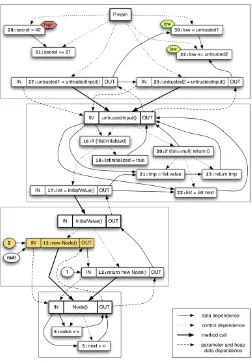
In the verification process we have carried out, we have marked the initialization of the variable secret as high input and modifications to the result variable of unstrustedOutputas low output. Then Joana automatically has built the PDG model of the program, marked the corresponding nodes in the graph with high and low, and checked if no information flow is possible from high input to low output through a data flow analysis on the graph. (In case an illegal flow is detected Joana issues a violation of the security property and returns the set of all possible paths (slice) of illegal flow in the program.)
Because of various precision enhancements in Joana— especially detection of impossibleNullPointerExceptions and object-sensitivity—we were able to analyze the given family of programs (without any false positives that might have stemmed from the involved overapproximations) and thus to guarantee the absence of information flow.
Joana took about 11 seconds on a standard PC to finish the analysis of the program (with a size of 376 LoC). PDG computation took 10 seconds and only 1 second was needed to detect the absence of illegal flow inside the PDG.
The complete source code that was analyzed can be download from [26].
X. RELATEDWORK
As already mentioned in the introduction, our work con-tributes to the area of language-based analysis of software that uses cryptography, such as cryptographic protocols, an area that recently has gained much attention. We discuss some of the more closely related work in this area in what follows.
The work most closely related to our work is the work by Fournet et al. [14]. Fournet et al. also aim at establish-ing computational indistestablish-inguishability properties for systems written in a practical programming language; this work, in fact, seems to be the first to study such strong properties in the area of language-based cryptographic analysis, other work, including the work mentioned below, considers trace properties, such as authentication and weak secrecy. How-ever, there are many differences between the work by Four-net et al. and our work, in terms of the results obtained, the approach taken, and the programming language considered. Fournet et al. consider a fragment of the functional language F#, while we consider a fragment of Java. Their approach, with theorems of the form “if a program type-checks, then it has certain cryptographic properties”, is strongly based on type checking (with refinement types), while the point of our framework is to enable different techniques and tools that a priori cannot deal with cryptography to establish
cryptographic guarantees. While the results of Fournet et al. concern specific cryptographic primitives, we establish general results for ideal functionalities and their realizations. While simulation-based techniques are used in theproofsof the theorems in the work of Fournet et al., in our approach, ideal functionalities are part of the program to be analyzed by the tools; by our framework, the ideal functionalities can then be replaced by their realizations and for the resulting systems we obtain computational indistinguishability.
In most of the work on language-based analysis of crypto-based software the analysis is carried out crypto-based on a sym-bolic (Dolev-Yao), rather than a cryptographic model (see, e.g., [18], [6], [11], [8]). Some works obtain cryptographic guarantees by applying computational soundness results [5], [2], where the usual restrictions of computational soundness results apply [13], or by compiling the source code to a specification language that then can be analyzed by a specialized tool, namely CryptoVerif [9], for cryptographic analysis [7]. In contrast, our approach, just as the one by Fournet et al. discussed above, does not take a detour through symbolic models in combination with computational soundness results. Also, our approach does not rely on specialized tools for cryptographic analysis.
The existing works on the security analysis of crypto-based software has mostly focussed on fragments of F# and C, including the above mentioned works. Some works consider (fragments of) Java [22], [33], but in a symbolic model and without formal guarantees.
Our framework might also be applicable in the context of computational non-interference (see, e.g., [15], [28]) since computational non-interference can be seen as a specific form of computational indistinguishability. It is interesting future work to investigate the connection between these works and our work further.
Our work also contributes to the mostly unexplored field of non-interference for interactive/open systems [32], [12]. Our technique presented in Section VII enables program analysis tools for checking non-interference of closed sys-tems to deal with open/interactive syssys-tems in a practical pro-gramming language, namely Java. Existing works on non-interference for interactive systems [32], [12] are orthogonal to our work in that on the one hand they consider abstract system models (labeled transition systems with input and output), rather than a practical programming language, and on the other hand they study systems w.r.t. a more general lattice of security labels for input/output channels.
Finally, we mention a line of work that considers methods for generating secure Java programs from abstract models of cryptographic protocols (see, e.g. [4]).
XI. CONCLUSION
![Figure 4.˜CE⃗u: the implementation of a method with the sig-nature static public byte[] foo(int x, byte[] t) throws C, where,](https://thumb-us.123doks.com/thumbv2/123dok_us/7892458.1309853/11.612.317.553.88.280/figure-implementation-method-nature-static-public-byte-throws.webp)