New Classes of Public Key Cryptosystems over
F2
8Constructed
Based on Reed-Solomon Codes, K(XVII)SE(1)PKC and
K(XVII)ΣΠPKC
Masao KASAHARA
∗July 22, 2014
Abstract
In this paper, we present new classes of public key cryptosystem over F28 based on Reed-Solomon codes,
referred to as K(XVII)SE(1)PKC and K(XVII)ΣΠPKC, a subclass of K(XVII)SE(1)PKC. We show that K(XV II)SE(1)PKC overF28 can be secure against the various attacks. We also present K(XVII)ΣΠPKC overF28,
a subclass of K(XVII)SE(1)PKC. We show that any assertion of successfull attack on K(XVII)SE(1)PKC including K(XVII)ΣΠPKC whose parameters are properly chosen is a coding theoretical contradiction. We thus conclude that K(XVII)SE(1)PKC and K(XVII)ΣΠPKC would be secure against the various attacks including LLL attack.
The schemes presented in this paper would yield brand-new techniques in the field of code-based PKC.
keyword
Public Key Cryptosystem, Error-Correcting Code, Reed-Solomon code, Code based PKC, McEliece PKC.
1
Introduction
Various studies have been made of the Public-Key Cryptosystem(PKC). The security of PKC’s proposed so far, in most cases, depends on the difficulty of discrete logarithm problem or factoring problem. For this reason, it is desired to investigate another classes of PKC’s that do not rely on the difficulty of these two problems. The multivariate PKC is one of the very promising candidates of the member of such classes. However, most of the multivariate PKC’s are constructed by the simultaneous equations of degree larger than or equal to 2 [1]∼[7]. Recently the author proposed a several classes of multivariate PKC’s that are constructed by many sets of linear equations [8] ∼[13] based on error-correcting code, in a sharp contrast with the conventional multivariate PKC where a set of simultaneous equations of degree more than or equal to 2 is used.
Let us refer to such PKC constructed based on error correcting code as code based PKC(CB·PKC). It should be noted that McEliece PKC [14], a class of CB·PKC, can be regarded as a member of the linear multivariate PKC.
In this paper, we present new classes of public key cryptosystem overF28 based on Reed-Solomon codes,
referred to as K(XVII)SE(1)PKC and K(XVII)ΣΠPKC, a subclass of K(XVII)SE(1)PKC. We show that any assertion of successfull attack on K(XVII)SE(1)PKC including K(XVII)ΣΠPKC whose parameters are properly chosen is a coding theoretical contradiction. We thus conclude that K(XVII)SE(1)PKC and K(XVII)ΣΠPKC would be secure against the various attacks including LLL attack.
∗Research Institute for Science and Engineering, Waseda University. Research and Development Initiative, Chuo University.
K(XVII)SE(1)PKC and K(XVII)ΣΠPKC have the following advantages :
A1 : K(XVII)SE(1)PKC and K(XVII)ΣΠ PKC overF28 can be constructed based on the Reed-Solomon
code over F28, which is extensively used for the various storage and transmission systems.
A2 : In encryption and decryption process for (XVII)SE(1)PKC and K(XVII)ΣΠPKC, the conventional encoders and decoders for the Reed-Solomon code overF28 can be advantageously used.
Throughout this paper, the vectorv = (v1, v2,· · · , vn) will be represented by the polynomial as
v(x) =v1+v2x+· · ·+vnxn−1. (1)
2
K(XVII)SE(1)PKC over
F2
82.1
Preminaries
Let us define several symbols:
G(x) : generator polynomial of extended Reed-Solomon code*1overF2
8. g : degree of G(x).
D : minimum distance of Reed-Solomon code generated with G(x), g+ 1.
mη : first message, (m1, m2,· · ·, mη)
at : second message, (a1, a2,· · ·, at)
ατ : third message, (α1, α2,· · · , ατ)
{ui} : set of first public key for mη
{si} : set of second public key for ατ
wµ : word for mη
wρ : word for ατ
C : Ciphertext, wµ+wρ
K : 28− g.
w(v) : Hamming weight of v .
P : random column permutation matrix.
P−1 : inverse operation of P.
p : random permutation determined from P .
Throughout this paper, we assume that any message symbol over F28 takes on a non-zero value.
2.2
First word,
w
µLetµi(x) be
µi(x) =ei(1)x(1)+ei(2)x(2)+· · ·+ei(η)x(η);i= 1,2,· · ·, η, (2)
where the exponent (i) satisfies
0≤(1)<(2)<· · ·<(η)≤K−1. (3) The coefficientsei(j)’s are randomly chosen fromF28, under the following condition:
Let the matrix M be
M =
e1(1), e1(2), · · · , e1(η)
e2(1), e2(2), · · · , e2(η)
..
. ... ...
eη(1), eη(2), · · · , eη(η)
. (4)
whereei(j)’s are randomly chosen so thatM may be non-singular.
We see that the Hamming weight ofµi, w(µi),isη or less. Letµi(x) be transformed to
µi(x)xg≡ri(x) modG(x),
=ri1+ri2x+· · ·+rigxg−1;i= 1,2,· · · , η.
(5)
The code word is then
vi(x) =µi(x)xg+ri(x)≡0 modG(x);i= 1,2,· · · , η. (6) LetR andR·P be
R=
r11, r12, · · ·, r1g
r21, r22, · · ·, r2g ..
. ... ...
rη1, rη2, · · ·, rηg
. (7)
R·P =
u11, u12, · · ·, u1g
u21, u22, · · ·, u2g ..
. ... ...
uη1, uη2, · · ·, uηg
=
u1
u2
.. .
uη
(8)
whereP is anη×g random column permutation matrix.
According to the random column permutationP, the row vectorri is permuted toui. We shall denote such permutation:
ri·p=ui;i= 1,2,· · · , η. (9)
Let us suppose that the elements of ui’s are ordered as u1,u2,· · ·,uη. We shall refer to subscriptj as locationj.
Let the second message at(x) be transformed toaT(x):
at(x)7→aT(x) =a1x[1]+a2x[2]+· · ·+atx[t]; 0≤[i]≤g−1, (10) where the exponents [1],[2],· · ·,[t] are randomly chosen by a sender Bob.
These exponents satisfy
0≤[1]<[2]<· · ·<[t−1]<[t]≤g−1. (11) Given the first message mη = (m1, m2,· · · , mη), the first wordwµ is
wµ=m1u1+m2u2+· · ·+mηuη. (12) The first ciphertextCµ is
Cµ=wµ+aT. (13)
From the Eqs.(9) and (12) we see that the randomly permuted version, Sµ·p, of the following syndrome
Sµ proves to be
Sµ=m1r1+m2r2+· · ·+mηrη. (14) In the polynomial form, letSµ·pbe denotedSµ(x)p.
We have the following straightforward theorem : Theorem 1 : The syndromeSµp(x) is
m1u1(x) +m2u2(x) +· · ·+mηuη(x)≡
[∑η
i=1
µi(x)xgmodG(x)
]
2.3
Second word
w
ρLetρi(x) be
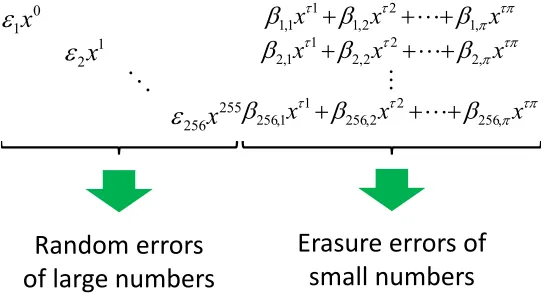
ρi(x) =εixi−1+βi1xτ1+βi2xτ2+· · ·+βiπxτ π;i= 1,2,· · ·,256. (16) whereτ i’s satisfy
0≦τ1< τ2<· · ·< τ π≦255. (17)
Letϵbe
ϵi= (00· · ·010· · ·0);i= 1,2,· · · ,256, (18)
where only one nonzero element, 1, is located at thei-th cordinate. In Fig.1, we show an example of {ρi} overF28.
255 256 1 2 0 1
x
x
x
ε
ε
ε
O
τπ π τ τ τπ π τ τ τπ π τ τβ
β
β
β
β
β
β
β
β
x
x
x
x
x
x
x
x
x
, 256 2 2 , 256 1 1 , 256 , 2 2 2 , 2 1 1 , 2 , 1 2 2 , 1 1 1 , 1+
+
+
+
+
+
+
+
+
L
M
L
L
Random errors
of large numbers
Erasure errors of
small numbers
Figure 1: An example of{ρi} overF28.
For the third messageατ = (α1, α2,· · · , ατ), the sender Bob randomly selects locations (1),(2),· · · ,(τ)
from the set{i}. The random errorsErand the erasure errorsEeare represented by the following polynomial form:
Er(x) = τ
∑
i=1
α(i)ε(i)x(i)−1 (19)
Ee(x) = τ ∑ i=1 π ∑ j=1
α(i)β(i)jxτj (20)
Letεi(x) andβi(x) be
εi(x) =εixi−1;i= 1,2,· · ·,256,
βi(x) =βi1xτ1+βi2xτ2+· · ·+βiπxτ π;i= 1,2,· · · ,256.
(21)
Theρi(x) is
ρi(x) =εi(x) +βi(x);i= 1,2,· · ·,256. (22) We see that ρi can be represented by
Letρi(x) be transformed to
ρi(x)·xg≡ti(x) modG(x)
=ti1+ti2+· · ·+tigxg−1;i= 1,2,· · · ,256.
(24)
LetAt andAt·P be
At=
t1,1, t1,2, · · ·, t1,g
t2,1, t2,2, · · ·, t2,g ..
. ... ...
t256,1, t256,2, · · ·, t256,g
= t1 t2 .. . t256
, (25)
At·P =
s1,1, s1,2, · · · , s1,g
s2,1, s2,2, · · · , s2,g ..
. ... ...
s256,1, s256,2, · · · , s256,g
= s1 s2 .. . s256
. (26)
The wordwτ, for the third messageατ = (α1, α2,· · · , ατ), is
wρ=α1s(1)+α2s(2)+· · ·+ατs(τ), (27)
wheres(1),s(2),· · · ,s(τ)are randomly selected public key from the set of public keys,{si}. We let the following relation hold:
π+ 2(τ+t) + 1 =D. (28)
2.4
Ciphertext
C
for
m
η,
a
tand
α
τThe ciphertextC is
C=wµ+aT+wρ. (29)
Set of keys are :
Public key : {ui},{si}
Secret key : {µi},{ρi},{ri},{ti}, P, p
2.5
Encryption and decryption
Brief description of the encryption process
The encryption can be performed by the following steps :
S1 : Given the first messgemη = (m1, m2,· · · , mη), Bob calculates the wordwµ.
S2 : Given the second messageat= (a1, a2,· · ·, at), Bob randomly select locations [1],[2],· · ·,[t] and
calculatesaT.
S3 : Given the third messageατ = (α1, α2,· · · , ατ), Bob randomly selects public keys,s(1),s(2),· · · ,s(τ)
from the set of public keys,{si}, and calculates wρ. S4 : Bob calculates the ciphertext C :
C=wµ+aT +wρ.
Brief description of the decryption process
The decryption process can be performed by the following steps : S1 : Alice calculates
CP−1=sµ+sρ+aTP−1,
wheresµ is the syndrome due to the first messagemη= (m1, m2,· · ·, mη) andsρ, the syndrome due to the third messageατ= (α1, α2,· · ·, ατ).
2.6
Security considerations
In this subsection we assume the following parameters are chosen:
m= 8, g= 128, K = 128, η= 56, t= 32, π= 8. Attack 1 : Exhaustive attack on vectorµi
The probability that the vector µi is estimated correctly,Pc[cµi] is
Pc[ ˆµi] =
(
K η
)−1
(2m−1)−η <1.93×10−172. (30)
We conclude that K(XVII)SE(1)PKC is secure against Attack 1. Attack 2 : Exhaustive attack on permutation matrix,P
The probability that the matrixP is estimated correctly is
Pc[ ˆP] = (g!)−1<2.60×10−216, (31)
yielding an extremely small value.
We conclude that K(XIV)SE(1)PKC is secure against Attack 2. Attack 3 : Exhaustive attack on vectorρi.
The probability that the vector ρi is estimated correctly is
Pc[ ˆρi] =
(
K
1
)−1
2−m
(
K π
)−1
2−mπ= 1.15×10−36, (32)
a sufficiently small value.
We conclude that K(XVII)SE(1)PKC is secure against Attack 3. Attack 4 : Exhaustive attack on the selected locations, (1), (2),· · ·, (t).
The probability thattlocations among 256 locations are estimated correctly,Pc[ ˆ{(i)}] is
Pc[ ˆ{(i)}] =
(
256
t
)−1
<1.71×10−41, (33)
a sufficiently small value.
Attack 5 : Attack on ciphertextC=wµ+wρ.
Suppose that wµ only is given as a ciphertext and consider the following Onlywµ Attack: Namely we suppose that the ciphertextC isC=wµ.
Only wµ Attack :
We see that {µi} spans a vector space of dimension η. As a result any η error-free symbols (efs),
w(1), w(2),· · ·, w(η)of wordwµ is able to disclose the messagemη by solving the equation:
m1u1+m2u2+· · ·+mηuη = (w(1), w(2),· · ·, w(η)). (34)
The probability thatη efs’s are estimated correctly, form= 8, is
Pc[def s] =
(
g−t η
)
(
g η
) = 1.24×10⁻¹¹. (35)
.
We conclude that K(XVII)SE(1)PKC is not secure against Only wµ Attack
Suppose also that wρ only is given and consider the following Only wρ Attack. Namely we let the ciphertextC be C=wρ.
Only wρ Attack
Proof: The following straightforward relation holds:
(Er(x) +Ee(x))xg≡Sρ(x) modG(x), (36)
for correctly given syndromeSρ(x). Suppose that the following relation holds forSρ′(x)̸=Sρ(x):
(Er(x) +Ee(x))xg≡Sρ′(x) modG(x), (37)
for incorrectly givenSρ′(x).
From Eqs.(36) and (37), the relation:
0≡Sρ(x) +Sρ′(x) mod G(x), (38)
which is contradictory, yielding the proof. 2
Theorem 2: For Onlywρ Attack, even if the syndrome is correctly given, with no knowledge of locations of erasure errors,τ1, τ2,· · ·, τ π, the assertion that random errorsErand erasure errorsEecan be successfully corrected is a coding theoretical contradiction.
Proof: In K(XVII)SE(1)PKC, the relationπ+ 2(t+τ) + 1 =D holds (Eq.(28)). In order to correct erasure errors as random errors, the following relation is asked to hold:
2π+ 2(t+τ) + 1 =D, (39)
which is contradictory to Eq.(28), yielding the proof. 2
We have seen that K(XVII)SE(1)PKC is secure against Only wρ Attack. Besides wµ is added towρ as an entirely independent noisy vector. It should be noted that the wordwµ is constructed independently of the wordwρ.
We conclude that K(XVII)SE(1)PKC is secure against Attack 5.
3
Product sum type PKC, K(XVII)
ΣΠ
PKC
We have seen that K(XVII)SE(1)PKC is secure against Only wρ Attack, which implies that a particular member of the class of K(XVII)SE(1)PKC can be an independent class of PKC that uses onlysi as a public key. As this class of PKC is proved to be a product sum type PKC, often referred to as knapsack type PKC, we shall refer to this PKC as K(XVII)ΣΠ PKC. In K(XVII)ΣΠPKC, let us consider only third messege
α= (α1, α2,· · ·, ατ). The ciphertextCρ=wρ is
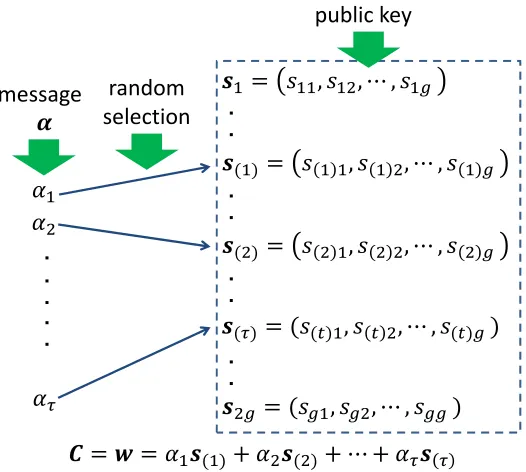
Cρ=α1s(1)+α2s(2)+· · ·+ατs(τ), (40)
wheres(i) is a public key randomly chosen from the set of public keys{s(i)}.
In Fig.2, we show a schematic illustration of encryption.
=
,
, ⋯ ,
( )
=
,
, ⋯ ,
( )
=
,
, ⋯ ,
( )
= (
( ),
, ⋯ ,
( ))
= (
,
, ⋯ ,
)
=
=
( )+
( )+ ⋯ +
・ ・ ・ ・ ・
message
・ ・
・ ・
・ ・
・ ・
public key
random
selection
Figure 2: Schematic illustration of encryption.
4
Conclusion
We have presented a new class of public key cryptsystem, referred to as K(XVII)SE(1)PKC and K(XVI I)ΣΠPKC based on the Reed-Solomon code over F28 that are extensively used for the various storage and
transmission systems.
We have shown that any assertion that K(XVII)SE(1)PKC and K(XVII)ΣΠPKC can be broken is con-tradictory from the coding theoretical point of view, provided that the parametersπ, τ andt are properly chosen.
We thus conclude that K(XVI)SE(1)PKC and K(XVII)SE(1)PKC over F28 can be secure against the
various attacks.
This work is partly supported by the NICT’s project:Research and development for public key cryptosys-tem for secure communication between social syscryptosys-tems. and by 21st.Century Informatic Culture Center.
References
[1] M. Kasahara, “A New Class of Public Key Cryptosystems Constructed Based on Reed-Solomon Codes K(XII)SE(1)PKC”, Technical Report of IEICE, ISEC 2013-5 (2013-05).
[2] M. Kasahara and R. Sakai “A Construction of Public Key Cryptosystem for Realizing Ciphertext of size 100 bit and Digital Signature Scheme”, IEICE Trans. Vol. E87-A, 1, pp.102-109 (2004-01).
[3] M. Kasahara and R. Sakai “A Construction of Public Key Cryptosystem Based on Singular Simultaneous Equations”, IEICE Trans. Vol. E88-A, 1, pp.74-79 (2005-01).
[4] N. Koblitz “Algebraic Aspect of Cryptography”, Springer Verlag, Berlin Heidelberg.
[6] J. C. Faugere and A. Joux “Algebraic cryptanalysis of hidden field equation (HFE) cryptosystems using Gr¨obner bases”, In Advances in Cryptoglogy-CRYPTO 2003 pp.44-60 (2003).
[7] C. Wolf: “Multivariate Quadratic Polynomials in Public Key Cryptography”, Dr. Thesis, Katholieke Universiteit Leuven, (2005-11).
[8] M. Kasahara “Construction of New class of Linear Multivariate Public Key Cryptosystem - Along With a Note on the Number 9999990 and its Application”, Technical Report of IEICE, ISEC 2009-44 (2009-09).
[9] M. Kasahara “A New Class of Public Key Cryptosystems Constructed Based on Perfect Error-Correcting Codes Realizing Coding Rate of exactly 1.0”, Cryptology ePrint Archive , Report 2010/139 (2010-03).
[10] M. Kasahara “A Construction of New Class of Linear Multivariate Public Key Cryptosystem Con-structed Based on Error Correcting Codes”, Technical Report of IEICE , ISEC 2009-135 (2010-03).
[11] M. Kasahara: “Public Key Cryptosystems Constructed Based on Pseudo Cyclic Codes, K(IX)SE(1)PKC, Realizing Coding Rate of Exactly 1.0”, Cryptology ePrint Archive, Report 2011/545, (2011-09).
[12] M. Kasahara: “A New Class of Product-sum Type Public Key Cryptosystem, K(V)ΣΠPKC, Con-structed Based on Maximum Length Code”, Cryptology ePrint Archive, Report 2013/180, (2013-03).
[13] M. Kasahara: “A New Class of Public Key Cryptosystems Construted Based on Reed-Solomon Codes, K(II)SE(1)PKC.–Along with a presentation of K(II)SE(1)PKC over the extension field extensively used for present day various storage and transmission systems”, Cryptology ePrint Archive, Report 2013/363, (2013-06).
[14] R. J. McEliece: “A Public-key Cryptosystem Based on Algebraic Coding Theory”, DSN Progress Re-port, no.42-44, pp.114-116 (1978).
[15] F. J. MacWilliams and N. J. A. Sloane: “The Theory of Error-Correcting Codes”, North-Holland, (1977).