On the Collision and Preimage Security of MDC-4
in the Ideal Cipher Model
Bart Mennink
Dept. Electrical Engineering, ESAT/COSIC and IBBT Katholieke Universiteit Leuven, Belgium
Abstract. We present a collision and preimage security analysis of MDC-4, a 24 years old construction for transforming an n-bit block cipher into a 2n-bit hash function. We start with MDC-4 based on one single block cipher, and prove that any adversary with query access to the underlying block cipher requires at least 25n/8 queries (asymptotically) to find a collision. For the preimage resistance, we present a surprising
negative result: for a target image with the same left and right half, a preimage for the full MDC-4 hash function can be found in 2nqueries. Yet, restricted to target images with different left and right halves, we prove that at least 25n/4 queries (asymptotically) are required to find a preimage. Next, we consider MDC-4 based on two independent block ciphers, a model that is less general but closer to the original design, and prove that the collision bound of 25n/8queries and the preimage bound of 25n/4 queries apply to the MDC-4
compression function and hash function design. With these results, we are the first to formally confirm that MDC-4 offers a higher level of provable security compared to MDC-2.
Keywords. MDC-4; double block length; hash function; collision resistance; preimage resistance.
1 Introduction
The focus of this work is the classical block cipher based hash function MDC-4. MDC-4 and its related hash function MDC-2 have first been described by Meyer and Schilling in 1988 [25], and have been patented by Brachtl et al. in 1990 [4]. MDC-2 has been standardized in ISO/IEC 10118-2 [13] and is used in numerous applications (see [15, 28] for an exposition), while MDC-4 is part of the IBM CLiC cryptographic module [6, 7]. In their original specification, MDC-2 and MDC-4 are instantiated using the block cipher DES. In this work, we step away from this design criterion and consider the designs based on any block cipherE :Zn2 ×Zn2 →Zn2 with key and message length nbits (throughout, the first
input to the block cipher is the key input).
MDC-2 is a Merkle-Damg˚ard (MD) hash function design [5, 24] using a compression functionfMDC-2 :
Z32n→ Z22n that internally calls the block cipher E twice. It additionally employs two mappings v and
w, applied on the key inputs to the two block cipher calls. Asv and w are originally constructed so as to have a distinct range1, we can consider MDC-2 to be based on two block ciphers E1(·,·) =E(v(·),·)
andE2(·,·) =E(w(·),·) [28]. The compression functionfMDC-2 :Z32n→Z22n is defined as follows.
fMDC-2(A, B, C)
W ←E1(A, C)⊕C, X ←E2(B, C)⊕C,
Y ←WlkXr, Z ←XlkWr,
return(Y, Z).
Here, for a bit string X of even length we denote by Xl and Xr its left and right halves. fMDC-2 can
be considered as a parallel evaluation of two Matyas-Meyer-Oseas (MMO) constructions [22] followed by a swapping of the right halves of both states. Consequently, fMDC-2 does not achieve the desired
level of security: finding a collision or a preimage forfMDC-2 is as hard as finding it for the two MMO
constructions independently, hence requires about 2n/2 or 2n block cipher calls, respectively. For the full MDC-2 hash function, Knudsen et al. [15] demonstrated that roughly 2n/nblock cipher calls suffice for finding a collision, and about 2n calls for finding a preimage. In 2007, Steinberger derived a non-trivial security lower bound on MDC-2 [28]. Steinberger considers the MDC-2 hash function using one single block cipherE modeled as an ideal cipher, and proves that any adversary with query access to
1
2 MDC4
A C B
S T
U V
W X
Y Z
E1 E2
E2 E1
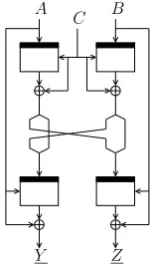
fMDC-4(A, B, C)
S ←E1(A, C)⊕C,
T ←E2(B, C)⊕C,
U ←TlkSr, V ←SlkTr,
W ←E2(U, A)⊕A,
X ←E1(V, B)⊕B,
Y ←XlkWr, Z ←WlkXr,
return(Y, Z).
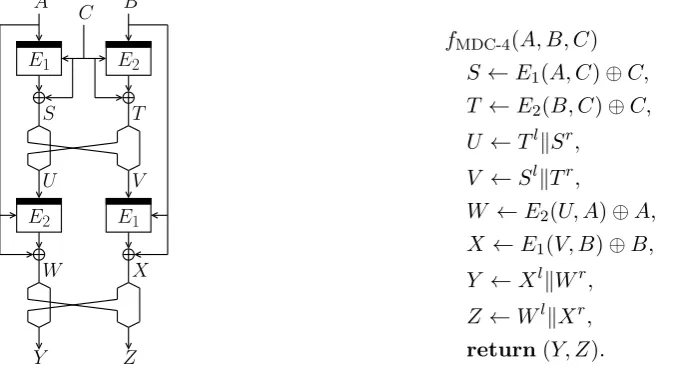
Fig. 1.The fMDC-4 compression function. For convenience, we swapped the left and right block ciphers
of the secondfMDC-2 evaluation.
E requires at least 23n/5 queries (asymptotically) to find a collision. His proof relies on the observation that a collision for MDC-2 implies a collision for the last two rounds of MDC-2, except for some special cases. These results on MDC-2 are summarized in Table 1; all of these results hold for the caseE1 and
E2 are different block ciphers as for the case they are the same.
The MDC-4 hash function differs from MDC-2 in the sense that its underlying compression function
fMDC-4 makes four calls to the underlying block cipher rather than two. fMDC-4 is defined as two
consecutive evaluations of fMDC-2, where the message inputs to the MMO executions in the second
evaluation areB forE1 and AforE2. The definition offMDC-4:Z32n→Z22n is given in Fig. 1. Knudsen
and Preneel [16] showed that approximately 23n/4 block cipher executions suffice to find a collision for
fMDC-4. With respect to preimage resistance, the same authors report that 23n/2 calls suffice for finding
a preimage for fMDC-4 and 27n/4 calls result in a preimage for MDC-4. The latter result is recently
improved to 23n/2 by Hong and Kwon [12]. These results are summarized in Table 1. In independent concurrent research, Fleischmann et al. [7, 8] analyzed the collision resistance of MDC-4. They proved that MDC-4 is collision secure up to approximately 23n/5 queries. Hence, they prove that the bound of Steinberger for MDC-2 also holds for MDC-4 (in fact, numerically their bound is worse than the bound on MDC-2). A preimage security lower bound has so far never been derived. Since the introduction of the functions in [4, 25], however, the MDC-4 hash function has always been considered the more secure variant of MDC-2. Although mainly a matter of theoretical interest (given that MDC-2 is twice as fast as MDC-4), formal security lower bounds for MDC-4 or fMDC-4 that confirm this longstanding claim
have never been derived. In particular, for years the MDC-4 structure has not been thoroughly analyzed, which makes it impossible to classify MDC-4 among other double block length constructions known in literature (see “Related Work”).
Our Contributions
In this work, we formally analyze the collision and (everywhere) preimage security of MDC-4 and its underlyingfMDC-4 compression function of Fig. 1. We start with considering the general setting where
fMDC-4is built on one block cipherE =E1 =E2, the single block cipher setting. Then, we consider the
more constrained double block cipher setting, where MDC-4 is based on two independently distributed ciphersE1 and E2.
Single block cipher setting.A customary approach for proving collision and preimage resistance of a hash function is to analyze the compression function first and use a preservation result to show that the findings also apply to the full hash function. However, when the two block ciphers underlying MDC-4 are modeled as one single random block cipherE, collisions and preimages forfMDC-4can be found in at
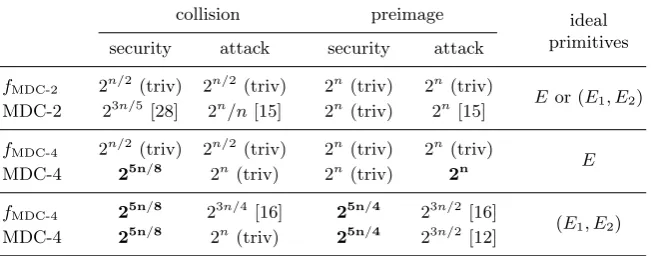
Table 1.Known security results for the MDC-2 and MDC-4 compression and hash functions. The security bound gives a lower bound and the attack bound gives an upper bound on the number of queries in order to find an attack. By “(triv)” we note that the bound is trivial; these bounds come from the security of the MMO construction [3], or correspond to generic attacks. The results printed inboldare derived in this work.
collision preimage ideal
primitives security attack security attack
fMDC-2 2n/2(triv) 2n/2 (triv) 2n(triv) 2n(triv)
E or (E1, E2)
MDC-2 23n/5 [28] 2n/n[15] 2n(triv) 2n [15] fMDC-4 2n/2(triv) 2n/2 (triv) 2n(triv) 2n(triv)
E MDC-4 25n/8 2n(triv) 2n(triv) 2n
fMDC-4 25n/8 23n/4 [16] 25n/4 23n/2 [16]
(E1, E2)
MDC-4 25n/8 2n(triv) 25n/4 23n/2 [12]
half (for Fig. 1 this meansA=B and Y =Z, and consequently S =T,U =V, and W =X), and the security boils down to the security of two subsequent MMO evaluations. For the preimage resistance, these type of target images (with Y =Z) can be considered as weak images, these give the adversary significantly more power. In any case, the security preservation approach does not help us out here, and instead we consider the security of the MDC-4 hash function design directly.
Starting with collision resistance, we formally prove that any adversary with query access to E, modeled as an ideal cipher, needs at least 25n/8 queries (asymptotically) to find a collision for MDC-4.
This is beyond the collision bound 23n/5 on MDC-2 by Steinberger [28] and on MDC-4 concurrently derived by Fleischmann et al. [7, 8]. The proof consists of two parts: given that the initial value of MDC-4 consists of two different halves, we prove that all intermediate state values of a MDC-MDC-4 evaluation consist of different halves, except with a small probability. Then, it suffices to analyze collision resistance of fMDC-4 restricted to state values with different left and right halves, which we prove up to at least
25n/8 queries. At the first glance, asfMDC-4 roughly consists of two evaluations offMDC-2, one is inclined
to say the results of Steinberger [28] directly carry over. However, this is not true due to the differences at the secondfMDC-2 evaluation where the inputs are swapped and the message inputs differ for the left
and right cipher. Instead, we conduct a new collision resistance proof forfMDC-4, and although it shows
some similarities with the proof of Steinberger, it differs in many aspects and uses several new ideas to facilitate the analysis.
For (everywhere) preimage resistance, we derive a more surprising result, namely that if the target image (Y, Z) satisfiesY =Z, a preimage for the MDC-4 hash function can be found in approximately 2n queries. The attack resembles ideas from the preimage attack on MDC-2 by Knudsen et al. [15] and from above-described preimage attack on fMDC-4 in the single block cipher setting. We stress that the
attack does not apply to the original MDC-4 design due to the domain separation by the functions v
and w. On the other hand, if the target image satisfies Y 6= Z, we prove that any adversary requires at least 25n/4 queries (asymptotically) to find a preimage for fMDC-4 or MDC-4, hence security beyond
the birthday bound is achieved. In order to achieve security beyond 2n queries, we employ the ideas
of free queries and wish lists. These proof tools have been used before by Armknecht et al. and Lee et al. [2, 21] for compression functions based on two block cipher calls (see “Related Work”), but because MDC-4 makes four block cipher calls rather than two, and additionally the corresponding wish lists are much harder to bound, the security proof has become considerably more complex. We remark that target images with the same left and right half are rather rare, 2n out of 22n target images satisfy this property. If we had opted for preimage resistance where the challenge is randomly generated, we obtain in the single block cipher setting a security bound of approximately 25n/4 queries forfMDC-4 and
MDC-4, rather than the bound of 2n queries.
The findings on MDC-4 based on one block cipherE are included in Table 1.
that, despite its more constrained character, this model is closer to the original design due to the domain separation by the functionsv and w.
We show that in this model, any adversary with query access to E1 and E2, needs at least 25n/8
queries (asymptotically) to find a collision forfMDC-4 and at least 25n/4 queries (asymptotically) to find
a preimage for fMDC-4. These results almost immediately follow from the results in the single block
cipher setting. Note that here we do not make the restriction that the state values should consist of different halves. Because MDC-4 is a MD transform, it preserves collision and (everywhere) preimage resistance [1], which means that if the compression function satisfies these security notions, then so does the hash function. Therefore, these results forfMDC-4 directly carry over to the MDC-4 hash function.
With the 25n/8 collision and 25n/4 preimage security bounds we have formally confirmed the widespread belief that MDC-4 offers a higher level of security compared to MDC-2. Despite that this security gain is obtained at the price of efficiency loss, it is an interesting and important result that allows us to make a fairer comparison among the double block length hash functions and that gives us more insight in the possibilities and impossibilities of block cipher based hashing. In particular, to our knowledge this is the first time the preimage resistance of a double block length compression function design with more than two block cipher evaluations is analyzed. Given that MDC-4 is originally not constructed from a provable security point of view (but rather an efficiency point of view), more elaborate designs with more than two block cipher calls may likely offer a higher level of security; our work is a good starting point for this research direction. Although our findings improve the existing bounds on MDC-4 significantly, large gaps between the security bounds and the best known attacks remain. A more technical and elaborate analysis may result in better bounds, and it remains an interesting open problem to improve the security bounds or the generic attacks for MDC-2 and MDC-4.
Related Work
Closely related to this work are the classical double block length compression functions Abreast-DM and Tandem-DM [17] and Hirose’s compression function [11], as well as the general compression function designs by Hirose [10] and ¨Ozen and Stam [26]. And in fact, these constructions all beat MDC-2 and MDC-4 with respect to collision and preimage resistance. Each of these constructions is provided with almost optimal collision security (see Fleischmann et al. [9] and Lee and Kwon [18] for Abreast-DM, see Lee et al. [20] for Tandem-DM). With respect to preimage resistance, Armknecht et al. and Lee et al. [2, 21] prove security of Abreast-DM, Tandem-DM and Hirose’s compression function up to almost 22n queries (as mentioned, our preimage resistance proof of MDC-4 employs some proof ideas from [2, 21]). These double block length constructions, however, all fundamentally differ from MDC-2 and MDC-4 in the sense that their underlying block ciphers have a double key size, i.e. they use a block cipherE:Z22n×Zn2 →Zn2 that clearly allows for higher compression and that renders a much stronger
underlying assumption. Regarding primitives using ann-bit key block cipher, an interesting design is by Jetchev et al. [14], who presented a two-call function achieving 22n/3 collision and 2n preimage security.
In [23], Mennink presented a class of compression functions making three block cipher calls with optimal 2n collision security and preimage security up to 23n/2 queries.
Outline
In Sect. 2, we introduce some mathematical background and the security model used in this work. The security result on the collision resistance of MDC-4 (based on one block cipherE =E1 =E2) is given in
Sect. 3, along with its formal security proof. In Sect. 4, we present our security result on the preimage resistance of MDC-4 (based onE). In Sect. 5, we discuss the implications of these results to the MDC-4 design based on two block ciphersE1, E2.
2 Preliminaries
For n ∈ N, by Zn2 we denote the set of bit strings of length n. For two bit strings X, Y, by XkY we
andXr its left and right halves. Throughout, we assume nis even. We denote by Bloc(n) the set of all block ciphersE :Zn2 ×Zn2 →Zn2, where the first input corresponds to the key input.
An adversary A is a probabilistic algorithm with oracle access to two block ciphers E1, E2
$
← Bloc(n) randomly sampled from Bloc(n) (the security model for the single block cipher setting follows after straightforward simplifications). We consider the adversary to be information-theoretic, which means that it has unbounded computational power, and that its complexity is measured by the number of queries made to its oracles. The adversary can make forward and inverse queries to E1 and E2. The
queries are stored in a query history Q as elements (ki, Ki, xi, yi), where i is the index of the query, ki ∈ {1,2} indicates the corresponding block cipher, Ki is the key input, and xi and yi denote the
(plaintext) input and (ciphertext) output of the block cipher. Byxi⊕yi, we define its XOR-output. The
indexiand the parameter k are omitted if they are irrelevant or clear from the context. Forq ≥0, by
Qq we define the query history after q queries. We assume that the adversary never makes queries to which it knows the answer in advance. In this work, we consider two types of adversaries, namely one that aims at finding collisions and one that aims at finding preimages forfMDC-4.
We say that adversary A finds a collision for fMDC-4 if it obtains a query history Q that
al-lows it to output two distinct tuples (A1, B1, C1),(A2, B2, C2) ∈ Z32n such that fMDC-4(A1, B1, C1) =
fMDC-4(A2, B2, C2) and for which Q contains all block cipher queries required to compute the two
evaluations offMDC-4. We define by
advcolfMDC-4(A) =Pr E1, E2
$
←Bloc(n), (A1, B1, C1),(A2, B2, C2)← AEi,E −1
i :
(A1, B1, C1)= (6 A2, B2, C2), fMDC-4(A1, B1, C1) =fMDC-4(A2, B2, C2)
!
the probability thatAsucceeds in finding such query history, and define byadvcolf
MDC-4(q) the maximum collision advantage taken over all adversaries makingq queries. Byadvcol(f 6=)
MDC-4(q) we denoteadv
col
fMDC-4(q) with the restriction that the state values (A1, B1) and (A2, B2) should satisfyA16=B1 andA26=B2.
With respect to preimage resistance, we opt for the notion of everywhere preimage resistance [27]. This security notion intuitively guarantees preimage security for every range point. Before making queries to its oracles, the (preimage finding) adversary A decides on a range point (Y, Z) ∈ Z2n
2 . We
say that Afinds a preimage for fMDC-4 if it obtains a query historyQ that allows it to output a tuple
(A, B, C) ∈Z3n
2 such that fMDC-4(A, B, C) = (Y, Z) and for which Q contains all block cipher queries
required to compute the evaluation offMDC-4. We define by
advepref
MDC-4(A) =(Y,Zmax)∈ Z22n
Pr E1, E2
$
←Bloc(n), (A, B, C)← AEi,Ei−1(Y, Z) : fMDC-4(A, B, C) = (Y, Z)
!
the maximum probability thatAsucceeds in finding such query history, and define byadvepref
MDC-4(q) the maximum (everywhere) preimage advantage taken over all adversaries makingqqueries. Byadvepre(f 6=)
MDC-4(q) we denoteadvepref
MDC-4(q) restricted to target images (Y, Z) withY 6=Z.
The security definitions for the full MDC-4 hash function are defined similarly. Here, rather than tuples fromZ32n the adversary outputs messages of arbitrary length. Throughout, we denote the initial
state value of MDC-4 by (F0, G0). In the single block cipher setting, we consider one block cipher E
to be generated randomly from Bloc(n) rather than two, and the definitions follow immediately. In the remainder of this work, it is clear from the context which of the security models we consider.
3 Collision Resistance of MDC-4
We derive a collision security lower bound for MDC-4 in the case the two underlying block ciphers are identical, i.e. E = E1 = E2. Due to the attack on fMDC-4 (described in Sect. 1), the classical way of
proving collision resistance by ways of property preservation does not work here. Therefore, the security analysis is done in a slightly different way. Recall that the attack onfMDC-4 relies on the property that
the block cipher evaluations on the left and right sides of Fig. 1 can be the same. The proof is now roughly divided into two parts: we first prove that, restricted to states with different halves, fMDC-4 is
Theorem 1. Let n∈Zn
2 andq <2n−1. Let t1, t2, t3>0 be any integral values. Then,
advcol(f 6=) MDC-4(q)≤
2(t1+ 11t1t2+ 3t1t2t3+ 12t2+ 4t22)q
2n +
2q2 t12n
+ 2·2n/2
2eq t22n/2
t2 + 2n
2eq t32n
t3
.
(1) The proof of Thm. 1 is given in Sect. 3.1. It shows similarities with the proof by Steinberger [28] of collision resistance of the MDC-2 hash function, but its structure is entirely different so as to facilitate the proof. The proof is based on using thresholds t1, t2, t3, and (1) holds for any choice of these values.
We elaborate on this threshold approach after Thm. 2.
Employing this result, we now obtain the main result for the collision resistance of MDC-4 using a single block cipher E.
Theorem 2. Let n∈Zn
2 andq <2n−1. Let t1, t2, t3>0 be any integral values. Then,
advcolMDC-4(q)≤ 2(2t1+ 11t1t2+ 3t1t2t3+ 14t2+ 5t 2 2)q
2n +
2q2 t12n
+ 2·2n/2
2eq t22n/2
t2 + 2n
2eq t32n
t3
.
(2) The proof of Thm. 2 is given in Sect. 3.2, and we give a brief intuition. Recall that the attack onfMDC-4
relies on the fact that the two halves of the evaluation can be the same. However, for a full MDC-4 iteration, the initial state value consists of two different halves, and in fact all intermediate state values consist of two different halves, except with some small probability. Now, by ways of collision resistance preservation [1], the result of Thm. 1 carries over with as additional term a bound on the probability that the adversary ends up with a state value with two the same halves.
The proof derived for Thm. 2 (similarly for Thm. 1) is based on using threshold values t1, t2, t3.
This is a proof approach that has for instance been employed in [20, 23, 28]. The intuitive idea of this approach is to split the “hard” event (finding collisions) into two “less hard” events, where the thresholds form a balance between the two events: for smaller values of the thresholds, one event happens with a larger probability and the other one with a smaller probability. Due to this approach, one can divide the bound of (2) into two parts. The first term forms the first part and increases for increasing parameters
t1, t2, t3. The remaining three terms form the second part that decreases for increasing t1, t2, t3.
Clearly, for naive choices of the values the bound of (2) becomes non-informative: for instance, if
t1= 1 the term 2q
2
2n appears and the bound indicates security up to approximately 2n/2queries. However,
(2) holds for all integral valuest1, t2, t3 >0, so we can equivalently state the bound as
advcolMDC-4(q)≤ min
t1,t2,t3>0
2(2t1+ 11t1t2+ 3t1t2t3+ 14t2+ 5t22)q
2n +
2q2 t12n
+ 2·2n/2
2eq t22n/2
t2 + 2n
2eq t32n
t3
,
wheret1, t2, t3may depend onn. For obtaining a sharp bound, we need to fine tune the integral positive
parameters t1, t2, t3 so that this bound is as low as possible: the trick is to take parameters t1, t2, t3
minimal so that the second part of (2) still goes to 0 for n → ∞. We will show that the advantage of any adversary making slightly less than 25n/8 queries approaches 0 when n goes to infinity. To this end, letε >0 be any parameter, we consider any adversary making at most q= 25n/8/nε queries to its oracle. We set t1 = 22n/8, t2 = 2n/8, and t3 = 3. Here, for simplicity we assume t1, t2 to be integral. If
nis no multiple of 8, one setst1, t2 to the nearest integers. Note that these parameters satisfyt1 > q
2
2n, t2> 2n/q2 and t3 >
q
2n, which are minimal requirements for the second part of (2) to be <1. Now, it is
an easy exercise to verify that the bound of (2) approaches 0 forn→ ∞whenq= 25n/8/nε andt1, t2, t3
are as specified.
Corollary 1. For any ε >0, we obtain limn→∞advcolMDC-4 25n/8/nε
= 0.
60 65 70 75 80 log2HqL 0.2
0.4 0.6 0.8 1.0 Collision Resistance
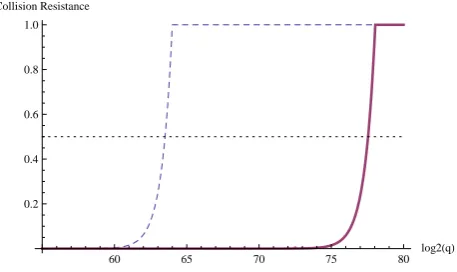
Fig. 2.The function advcolMDC-4(q) of (2) forn= 128, in comparison with the trivial boundq(q+ 1)/2n (dashed line).
t1, t2 to facilitate the analysis for smaller n and smaller q (the previously chosen values were set to
analyze limiting behavior for n, q), we see an improvement over the best known bound and the bound independently derived in [7, 8]. Forn= 128 the collision resistance advantage hits 1/2 for log2q≈77.5, which is smaller than the threshold forq8/25n, 79.9. For larger values ofn, by Cor. 1 the difference goes to 0 forn→ ∞.
3.1 Proof of Thm. 1
The collision resistance proof shows some similarities with the proof of Steinberger for MDC-2 [28], but fundamentally differs in various aspects and is as such of independent interest. In particular, due to a different and more structured case distinction we obtain a sharper bound (security up to 25n/8 queries) than the bound of Steinberger for MDC-2 (security up to 23n/5 queries). Also, our proof improves over the proof by Fleischmann et al. [7, 8], who basically confirmed that the 23n/5 bound of MDC-2 applies to MDC-4 too.
We consider any adversary makingqqueries to its oracleE, which tries to find a collision forfMDC-4.
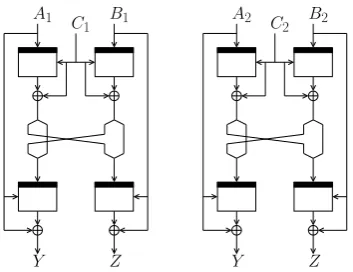
Finding a collision corresponds to obtaining a query history Qq of size q that satisfies configuration
col(Qq) of Fig. 3. In other words,
advcol(f 6=)
MDC-4(q) =Pr(col(Qq)), (3)
and we consider the probability of obtaining any query historyQq that satisfies configuration col(Qq). Notice that in this configuration, we omit the shifting at the end: as this shifting is bijective, it does not influence the collision finding advantage. In Fig. 3, as well as in all subsequent figures in this section, we label the block ciphers as follows to uniquely identify their positions. In the left word of Fig. 3 (with inputs (A1, B1, C1)) the block ciphers are labeled 1tl, 1tr, 1bl, 1br, for top/bottom left/right. For the
right word the block ciphers are identified as 2tl, 2tr, 2bl, 2br. In the remainder, when talking about “a query 1tl”, we mean “a query that in a collision occurs at position 1tl” (and the same for the other positions). The capitalized variables in the figures may take any value, and are simply used to accentuate relations among the two words.
We need to evaluate the probability of the adversary finding a query history Qq that satisfies con-figurationcol(Qq) of Fig. 3. For this analysis we introduce a helping eventhelp(Qq). Lett1, t2, t3 >0 be
integral. Eventhelp(Qq) is satisfied if either of the following sub-eventshelpk(Qq) (k= 1, . . . ,4) occurs.
help1(Qq) :
(Ki, xi, yi),(Kj, xj, yj)∈ Qq
i6=j ∧ xi⊕yi=xj⊕yj > t1;
help2(Qq) : max
z∈Zn/2 2
(Ki, xi, yi)∈ Qq
(xi⊕yi)l=z > t2;
help3(Qq) : maxz∈
Zn/2 2
(Ki, xi, yi)∈ Qq
(xi⊕yi)r=z > t2;
help4(Qq) : maxz∈Zn2
(Ki, xi, yi)∈ Qq
1 colQ-left
A1 C B1 1
Y Z
2 colQ-right
A2 C B2 2
Y Z
Fig. 3. Configurationcol(Q). We require (A1, B1, C1)6= (A2, B2, C2),A16=B1, and A2 6=B2.
By basic probability theory, we obtain for (3):
Pr(col(Qq))≤Pr(col(Qq)∧ ¬help(Qq)) +Pr(help(Qq)). (4)
For the analysis of the eventcol(Qq), it may be the case that a single query occurs at multiple positions in the configuration. Therefore, we divide col(Qq) into sub-configurations. For two distinct positions
a, b∈ {1tl,1tr,1bl,1br,2tl,2tr,2bl,2br}and a binary valueα∈ {0,1}, bya=b≡αwe say that the same query occurs at both positionsaand b if and only ifα= 1. Now, we define for αtl, αtr, αbl, αbr ∈ {0,1} the sub-configurationcolαtlαtrαblαbr(Q) as col(Q) of Fig. 3 with the restriction that
1tl= 2tl≡αtl, 1tr= 2tr≡αtr, 1bl= 2bl≡αbl, 1br= 2br≡αbr.
Clearly,
col(Qq)⇒ _
αtl,αtr,αbl,
αbr∈{0,1}
colαtlαtrαblαbr(Qq). (5)
It may be the case that the same query occurs at positions 1tl and 1br or 2br, but as becomes clear these cases are included in the analysis. By (3-5), we obtain the following bound onadvcol(f 6=)
MDC-4(q): advcol(f 6=)
MDC-4(q)≤
X
αtl,αtr,αbl,
αbr∈{0,1}
Pr(colαtlαtrαblαbr(Qq)∧ ¬help(Qq)) +Pr(help(Qq)). (6)
The probabilities constituting to the sum of (6) are analyzed in Lems. 1-6 as further set forth in Table 2. ProbabilityPr(help(Qq)) is analyzed in Lem. 7. In this section we only include the proof of Lem. 1. The proofs of Lems. 2-7 are given in App. A.
Table 2. For αtl, αtr, αbl, αbr ∈ {0,1}, the probability bound on colαtlαtrαblαbr(Qq)∧ ¬help(Qq) (cf. (6)) is analyzed in the corresponding lemma.
αtlαtrαblαbr 0000 0001 0010 0011 0100 0101 0110 0111 1000 1001 1010 1011 1100 1101 1110 1111
Lemma 1 2 2 3 4 5 6 6 4 6 5 6 6 6 6 6
Lemma 1. Pr(col0000(Qq)∧ ¬help(Qq))≤ (t1t2t3+2nt1−tq2+2t2)q.
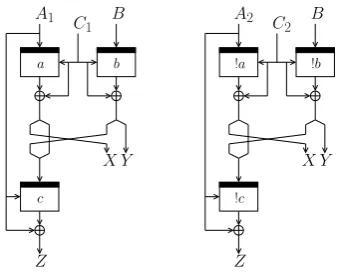
Proof. A visualization of configuration col0000(Qq) can be found in Fig. 4. In this figure, the queries
corresponding to locationsaand !aare required to be different, and the same for the queries at positions (b,!b), (c,!c) and (d,!d). For the analysis of col0000(Qq)∧ ¬help(Qq), we say that the i-th query (i ∈
basic probability theory, we can analyze the probability of thei-th query being successful, and sum over
i= 1, . . . , q.
Let i∈ {1, . . . , q}. We will analyze the probability of the i-th query to be successful, i.e. to satisfy
col0000(Qi)∧ ¬help(Qi). If help(Qi) holds, thei-th query can certainly not be successful, so we assume
¬help(Qi) and analyze the probability the i-th query makescol0000(Qi) satisfied.
Without loss of generality (by symmetry), the i-th query occurs in the left word. It may be the case that thei-th query also occurs in the right word (e.g. at 2br), but as becomes clear from the proof, this case is automatically included. Note that, asA1 6=B1, it can impossibly occur at (1tl,1tr) or (1bl,1br).
Therefore, without loss of generality (by symmetry) it suffices to analyze the cases the query occurs at the following positions: 1tl only, 1bronly, (1tl,1br) only, or (1tl,1bl) only. We distinguish among these four cases.
Query occurs at 1tl only.By ¬help1(Qi), there are≤t1 choices for queries at positions (1br,2br)
(we note that the query at 2br may equal the i-th query, but this does not invalidate the ongoing analysis). For any of these≤t1 choices, letK1br and K2br be the key inputs corresponding to positions 1brand 2br. By¬help2(Qi), there are≤t2 choices for 2tl. For any of these≤t1t2choices 2tl, the query at
position 2trand consequently the query at position 2blis uniquely determined (if they exist at all), and so is the XOR-outputY of 2bl. By ¬help4(Qi), there are ≤t3 choices for 1bl. For any of these≤t1t2t3
choices 1bl, let K1bl be the key input corresponding to position 1bl. The i-th query is successful only if its XOR-output equalsK1lbrkK1rbl, which happens with probability at most 2n1−q. The total probability
is at most t1t2t3
2n−q.
Query occurs at 1br only.By ¬help1(Qi), there are ≤ t1 choices for (1bl,2bl). For any of these ≤ t1 choices, let K2bl be the key input corresponding to position 2bl. By ¬help2(Qi), there are ≤ t2
choices for 2tr. For any of these≤t1t2 choices 2tr, the query at position 2tland consequently the query
at position 2bris uniquely determined, and so is the XOR-outputZ of 2br. Thei-th query is successful only if its XOR-output equals this value Z, which happens with probability at most 2n1−q. The total
success probability is at most t1t2
2n−q.
Query occurs at 1tland 1br only.LetK be the key input for thei-th query. As the query occurs at both positions, we requireKl =Zl, which fixesZl. By¬help2(Qi), there are≤t2 choices for 2br. For
any of these≤t2 choices 2br, we obtain a differentZ. Thei-th query is successful only if its XOR-output
equals this valueZ, which happens with probability at most 2n1−q. The total success probability is at
most t2
2n−q.
Query occurs at 1tl and1bl only.LetK be the key input for thei-th query. As the query occurs at both positions, we requireKr =Yr, which fixesYr. By¬help
3(Qi), there are≤t2choices for 2bl. For
any of these≤t2 choices 2bl, we obtain a differentY. Thei-th query is successful only if its XOR-output
equals this valueY, which happens with probability at most 2n1−q. The total success probability is at
most t2
2n−q.
Thei-th query is successful with probability at most t1t2t3+t1t2+2t2
2n−q . The claimed bound is obtained by
summing overi= 1, . . . , q. ut
Lemma 2. Pr(colαtlαtrαblαbr(Qq)∧ ¬help(Qq))≤
(2t1t2+2t2+t22)q
2n−q for αtlαtrαblαbr∈ {0001,0010}. Lemma 3. Pr(col0011(Qq)∧ ¬help(Qq))≤ 2tn1−qq.
Lemma 4. Pr(colαtlαtrαblαbr(Qq)∧ ¬help(Qq))≤
(t1t2t3+2t1t2+2t2)q
2n−q for αtlαtrαblαbr∈ {0100,1000}. Lemma 5. Pr(colαtlαtrαblαbr(Qq)∧ ¬help(Qq))≤
(t1t2+t2+t22)q
2n−q for αtlαtrαblαbr∈ {0101,1010}. Lemma 6. Pr(colαtlαtrαblαbr(Qq)∧ ¬help(Qq)) = 0for αtlαtrαblαbr∈ {11∗ ∗,1∗ ∗1,∗11∗}.
Lemma 7. Pr(help(Qq))≤ t q2
1(2n−q)+ 2·2
n/2 eq2n/2
t2(2n−q)
t2
+ 2nt eq 3(2n−q)
3 colQ0000-left
A1 C B1 1
Y Z
a b
c d
4 colQ0000-right
A2 C B2 2
Y Z
!a !b
!c !d
Fig. 4. Configuration col0000(Q) of Lem. 1. We require (A1, B1, C1) = (6 A2, B2, C2), A1 6= B1, and
A2 6=B2.
We are ready to finish the proof of Thm. 1. Lemmas 1-7 imply for advcol(f 6=)
MDC-4(q) of (6):
advcol(f 6=) MDC-4(q)≤
(t1+ 11t1t2+ 3t1t2t3+ 12t2+ 4t22)q
2n−q +
q2 t1(2n−q)
+
2·2n/2 eq2
n/2
t2(2n−q)
!t2 + 2n
eq t3(2n−q)
t3
,
where t1, t2, t3 >0 are integral. The result of Thm. 1 is obtained by observing that 2n−q > 2n−1 for
q <2n−1.
3.2 Proof of Thm. 2
As explained in Sect. 3 we essentially only need to consider the probability that an adversary finds an
fMDC-4 evaluation where the state consists of two different halves and the output state consists of two
the same halves. The formal treatment of this is more elaborate.
We consider any adversary makingqqueries to its oracleE, which tries to find a collision for MDC-4. Denote by (F0, G0) the initial state value of MDC-4, where F0 6= G0. Suppose the adversary finds a
collision, i.e. two lists
(F0, G0)
m1
−−→(F1, G1)
m2
−−→ · · · mk
−−→(Fk, Gk),
(F0, G0)
m0 1
−−→(F10, G01) m
0 2
−−→ · · · m
0
k
−−→(Fk00, G0k0)
of internal state values of the two evaluations, where k, k0 ≥1 and (Fk, Gk) = (Fk00, G0k0). The collision
is non-trivial if k 6= k0 or if (Fi, Gi, mi) 6= (Fi0, G0i, m0i) for some i = 1, . . . , k = k0, and we consider
non-trivial collisions only. If the adversary finds a collision of this form, we can distinguish between the following two cases:
(1) Fi 6=Gi for alli∈ {1, . . . , k}and Fi0 6=G
0
i for all i∈ {1, . . . , k
0}; (2) Fi =Gi for somei∈ {1, . . . , k} orFi0 =G0i for somei∈ {1, . . . , k0}.
Suppose the adversary finds a collision in case (1). This implies (by basic collision security preservation [1]) the adversary necessarily needs to obtain a query history Qq of size q that satisfies configuration
col(Qq) of Fig. 3.
On the other hand, suppose the adversary finds a collision in case (2). Without loss of generality, a state-half collision occurs in the first word. As F0 6= G0, there exists an i such that Fi = Gi but Fi−1 6= Gi−1. This means that in this case the adversary necessarily needs to obtain a query history Qq of size q that satisfies configuration statecol(Qq) of Fig. 5. Here, Z represents Fi =Gi and (A, B)
represents (Fi−1, Gi−1). As in Sect. 3.1, in this configuration we have omitted the shifting at the end.
15 statecolQ
A C B
Z Z
Fig. 5. Configurationstatecol(Q). We requireA6=B.
Concluding, we find
advcolMDC-4(q)≤Pr(col(Qq)∨statecol(Qq)). (7)
We employ the helping eventhelp(Qq) from Sect. 3.1, and obtain for (7):
Pr(col(Qq)∨statecol(Qq))≤Pr(col(Qq)∧ ¬help(Qq)) +Pr(help(Qq)) +
Pr(statecol(Qq)∧ ¬help(Qq)). (8)
For the first two probabilities, the proof of Thm. 1 applies. The probability bound on statecol(Qq)∧
¬help(Qq) is analyzed in Lem. 8.
Lemma 8. Pr(statecol(Qq)∧ ¬help(Qq))≤ (t1+2t2+t22)q
2n−q .
Proof. We consider configuration statecol(Qq) of Fig. 5. The proof idea is the same as the proof of Lem. 1. Let i ∈ {1, . . . , q}. As in Lem. 1, we assume ¬help(Qi) and analyze the probability the i-th query makesstatecol(Qi) satisfied.
Recall that the positions in Fig. 5 are simply referred to as tl,tr,bl,br, without a leading 1. Without loss of generality (by symmetry), thei-th query occurs at the following positions:tlonly,blonly, (tl,br) only, or (tl,bl) only. Note that, asA6=B, it can impossibly occur at (tl,tr) or (bl,br).
Query occurs at tl only.By ¬help1(Qi), there are ≤t1 choices for (bl,br). For any of these≤t1
choices, let Kbl and Kbr be the key inputs corresponding to positions bl and br. The i-th query is successful only if its XOR-output equals Kl
brkKblr, which happens with probability at most 2n1−q. The
total success probability is at most t1
2n−q.
Query occurs atblonly.LetK be the key input for thei-th query. By¬help2(Qi) and¬help3(Qi), there are≤t2 choices fortland≤t2 choices fortr. For any of these≤t22 choices, the query at positionbr
is uniquely determined, and so is the XOR-outputZ ofbr. Thei-th query is successful only if its XOR-output equals this valueZ, which happens with probability at most 2n1−q. The total success probability
is at most t22
2n−q.
Query occurs at tl and br only.LetK be the key input for thei-th query. As the query occurs at both positions, we requireKl=Zl, which fixes Zl. By¬help2(Qi), there are ≤t2 choices forbl. For
any of these≤t2 choicesbl, we obtain a differentZ. Thei-th query is successful only if its XOR-output
equals this valueZ, which happens with probability at most 2n1−q. The total success probability is at
most t2
2n−q.
Query occurs at tl and bl only.Let K be the key input for the i-th query. As the query occurs at both positions, we requireKr=Zr, which fixesZr. By¬help3(Qi), there are≤t2 choices forbr. For
any of these≤t2 choicesbr, we obtain a differentZ. Thei-th query is successful only if its XOR-output
equals this valueZ, which happens with probability at most 2n1−q. The total success probability is at
most t2
2n−q.
The i-th query is successful with probability at most t1+2t2+t22
2n−q . The claimed bound is obtained by
We are ready to finish the proof of Thm. 2. The findings of Sect. 3.1 and Lem.8 imply for (8):
advcolMDC-4(q)≤ (2t1+ 11t1t2+ 3t1t2t3+ 14t2+ 5t 2 2)q
2n−q +
(t1+ 2t2+t22)q
2n−q +
q2 t1(2n−q)
+ 2·2n/2 eq2
n/2
t2(2n−q)
!t2 + 2n
eq t3(2n−q)
t3
,
where t1, t2, t3 >0 are integral. The result of Thm. 2 is obtained by observing that 2n−q > 2n−1 for
q <2n−1.
4 Preimage Resistance of MDC-4
We analyze the preimage security of MDC-4 in the case the two underlying block ciphers are identical, i.e.E =E1 =E2. Let (Y, Z) be the target image. We distinguish betweenY =Z and Y 6=Z.
Y =Z. If the two halves of the image are the same, a preimage for the compression function fMDC-4
can be found in about 2n queries (cf. Sect. 1): one focuses on preimages with the same left and right halvesA=B, in which case it suffices to findA, C such that
E(E(A, C)⊕C, A)⊕A=Y =Z.
We demonstrate that this weakness propagates through the iteration of the MDC-4 hash function, resulting in an everywhere preimage attack for the MDC-4 hash function in 2n queries (on average). We recall that everywhere preimage resistance is defined as the maximum advantage over all images, thus including the weak images consisting of two identical halves. If we had opted for preimage resistance where the challenge is randomly generated, this preimage attack succeeds only with small probability as 2n out of 22n target images are weak.
The attack uses ideas from Knudsen et al. [15] to find preimages for MDC-2. It is a meet-in-the-middle attack and at a high level works as follows. First, one constructs a tree with 2n leaves with root (Y, Z). The edges in this tree correspond to evaluations offMDC-4. In the general case, the construction
of this tree requires the adversary to find approximately 2n+1 preimages, but as turns out for fMDC-4
the workload is significantly lower. Then, starting from the initial value (F0, G0), one varies the message
inputC to hit any of the 2n leaves. In more detail, the attack works as follows:
1. Fix anym0, m1 ∈Zn2 such that Xkmb is a correct padding for anyX ∈Zn2·n and b∈ {0,1};2
2. Forb= 0,1 operate as follows. For anyA∈Zn
2 queryV ←E(A, mb) andW ←E(V⊕mb, A). These
queries correspond to the evaluation fMDC-4(A, A, mb) = (W ⊕A, W ⊕A). Add the input-output
tuple ((A, A); (W ⊕A, W ⊕A)) to a listLb;
3. Let (Z, Z) be the target image. On average, this item occurs once in each listL0, L1, which results in
two fMDC-4 preimages for (Z, Z). It may result in more than twofMDC-4 preimages if (Z, Z) occurs
multiple times in one of the lists. The same procedure can be iteratively executed for all resulting preimages, until a tree of approximately 2n leaves is formed, with from each leave a path ofnedges to (Z, Z);3
4. Starting from initial value (F0, G0), vary m untilfMDC-4(F0, G0, m) hits any of the 2n leaves.
Step 1 requires 2n+2 block cipher queries. Step 4 is a brute force attack and requires approximately 4·(22n/2n) evaluations of E. In total, this attack requires approximately 2n+3 queries. The attack has time and space complexityO(2n).
Y 6=Z.For the everywhere preimage resistance of thefMDC-4 compression function of Fig. 1 with the
restriction thatY 6=Z, we derive the following results. The findings directly carry over to MDC-4 as it is a MD transform, which preserves everywhere preimage resistance [1].
2
We assume the padding takes less thannbits.
3
Due to collisions in the listsL0, L1, the amount of 2n will usually not be reached. Elaborate statistical analysis shows
120 130 140 150 160 log2HqL 0.2
0.4 0.6 0.8 1.0 Preimage Resistance
Fig. 6. The functionadvepre(f 6=)
MDC-4(q) of (9) for n= 128, in comparison with the best known bound q/2
n
(dashed line).
Theorem 3. Let n ∈ Zn2. Let t1, t2 > 0 be any integral values with t1 ≤q. Then, provided the image
(Y, Z) satisfies Y 6=Z,
advepre(f 6=) MDC-4(q)≤
4t32+ 4t1t2+ 20 + 4·2n/2
2n +
16t1t2+ 24t1t22n/2
22n +
64q
23n +
2·2n/2
4eq t12n/2
t1/2 + 4q
2n/2
8eq t12n/2
t12 n
4q
+ 2n
4eq t22n
t2/2 + 2q
8eq t22n
t22 n
4q
. (9)
The proof of Thm. 3 is given in Sect. 4.1. It employs ideas of the preimage resistance proof by Armknecht et al. [2] and Lee et al. [19, 21] for double block length compression functions, namely the issuance of free queries and the usage of wish lists. However, the analysis has become considerably more complex because the MDC-4 compression function uses four block ciphers rather than two, and consequently the derivation of bounds on the sizes of the wish lists has become more elaborate.
The bound of (9) can be analyzed in a similar manner as is done in Sect. 3, and we skip the details. Let ε > 0 be any parameter, we consider any adversary making at most q = 25n/4/nε queries to its oracle. We set t1 = 23n/4 and t2 = 2n/4/nε/2. Again, t1, t2 are assumed to be integral. Note that for
interesting values ofε, we have t1 ≤q as desired. As before, it immediately follows that the bound of
(9) approaches 0 forn→ ∞ when q= 25n/4/nε and t1, t2 are as specified.
Corollary 2. For any ε >0, we obtain limn→∞advfepre(MDC=)6-4 25n/4/nε
= 0.
The result means that forn→ ∞the functionadvepre(f 6=)
MDC-4 (as well asadv
epre(6=)
MDC-4 by preimage resistance
preservation) behaves asq4/25n. a graphical representation ofadvepre(f 6=)
MDC-4 forn= 128 is given in Fig. 6. As in the case of Sect. 3, we have slightly adjusted the parameters t1, t2 to facilitate the analysis for
smallernand smallerq. Forn= 128 the preimage resistance advantage hits 1/2 for log2q ≈151.9. Also in this case, the gap between this value and threshold for q4/25n, 159.75, is caused by the choice for smalln. By Cor. 2 the difference goes to 0 for n→ ∞.
4.1 Proof of Thm. 3
We consider any adversary making q queries to its oracleE, which tries to find a preimage for fMDC-4.
Let (Y, Z) ∈ Z22n be the point to invert, chosen by the adversary prior to making any query. Finding
a preimage for (Y, Z) corresponds to obtaining a query history Qq of size q that satisfies configuration
pre(Qq) of Fig. 7. In other words,
advepre(f 6=)
MDC-4(q) =Pr(pre(Qq)), (10)
and we consider the probability of obtaining any query historyQq that satisfies configurationpre(Qq).
that in Fig. 7 the variablesY, Z are underlined to denote that these are fixed. As we only consider one word (rather than two, in Sect. 3.1), we label the block ciphers simply as tl, tr, bl,br for top/bottom left/right.
1 preQ
A B
C
Y Z
Fig. 7. Configuration pre(Q). We have Y 6=Z.
The analysis in this section relies on the issuance of free super queries [2, 19, 21]. If the adversary has made 2n−1 queries to E under the same key, it will receive the remaining 2n−1 queries for this key for free. As in [2, 21], we call this query a super query. Formally, these free queries can be modeled as queries the adversary is forced to make, but at no charge. For convenience, we use Qq to denote the query history afterq normal queries. This query history thus contains all normal queries plus all super queries made so far. A super query is a set of 2n−1 single queries, and any query in the query history is either a normal query or a part of a super query, but not both. Notice that the adversary needs 2n−1 queries as preparatory work to enforce a super query. As the adversary makes at mostq queries, at most
q/2n−1 super queries will occur.
For the analysis of pre(Qq), we introduce a helping eventhelp(Qq). Let t1, t2 >0 be integral. Event help(Qq) is satisfied if either of the following sub-eventshelpk(Qq) (k= 1,2,3) occurs.
help1(Qq) : maxz∈
Zn/2 2
(Ki, xi, yi)∈ Qq
(xi⊕yi)l=z > t1;
help2(Qq) : max
z∈Zn/2 2
(Ki, xi, yi)∈ Qq
(xi⊕yi)r=z > t1;
help3(Qq) : maxz∈Zn2
(Ki, xi, yi)∈ Qq
xi⊕yi=z > t2.
These helping events are the same as the ones used in the proof of collision resistance in Sect. 3.1, but are reintroduced for simplicity. Note thathelp3(Qq) particularly covers the valuesY, Z as XOR-outputs. By basic probability theory, we obtain for (10):
Pr(pre(Qq))≤Pr(pre(Qq)∧ ¬help(Qq)) +Pr(help(Qq)). (11)
In Lem. 9, we bound Pr(pre(Qq)∧ ¬help(Qq)) and probability Pr(help(Qq)) is analyzed in Lem. 10.
The proofs are given in App. B.
Lemma 9. Pr(pre(Qq)∧ ¬help(Qq))≤ 4t
3
2+4t1t2+20+4·2n/2
2n +16t1t2+24t1t22 n/2
22n +
64q
23n.
Lemma 10. Provided t1 ≤q, we have
Pr(help(Qq))≤2·2n/2
4eq t12n/2
t1/2 + 4q
2n/2
8eq t12n/2
t12 n
4q
+ 2n
4eq t22n
t2/2 + 2q
8eq t22n
t22 n
4q .
With respect to Lem. 10, we note thathelp3(Q) is similar to the eventLucky(Q) analyzed by Armknecht et al. [2] and Lee et al. [21]: the only difference is that help3(Q) is required to hold for any z∈ Zn
2. In
is consequently much simpler. However, because our helping events are required to hold for anyz∈Zn
2
(eventhelp3(Q)) and for any z∈Z2n/2 (eventhelp1∨2(Q)), a similar approach using Markov’s inequality
would result in a trivial bound and a more elaborate treatment was required.
The proof of Thm. 3 is finished by adding the bounds of Lems. 9-10, as set forth in (10-11).
5 Security of MDC-4 with Two Distinct Block Ciphers E1, E2
We consider the collision and preimage resistance of MDC-4 in the setting where the two block ciphers
E1, E2 are independently distributed. Although the analysis of MDC-4 with one block cipher is more
general, the MDC-4 mode of operation with two independent block cipher is much closer to the original design due to the domain separation by the functionsvandw(see Sect. 1). In this setting, the following results can be obtained by straightforward simplifications of the proofs of Thms. 1 and 3.
Starting with collision resistance, we obtain the following results. They directly carry over to MDC-4 as it is a MD transform, which preserves collision resistance [1]. We stress that we pose no limitation on the state values.
Theorem 4. Let n∈Zn
2 andq <2n−1. Let t1, t2, t3>0 be any integral values. Then,
advcolfMDC-4(q)≤ 2(t1+ 7t1t2+ 3t1t2t3+ 5t2+ 4t 2 2)q
2n +
2q2 t12n
+ 2·2n/2
2eq t22n/2
t2 + 2n
2eq t32n
t3
. (12)
In the proof of Thm. 1, the restrictions A1 6= B1 and A2 6= B2 are essentially used to guarantee
that the queries occurring at positions (1tl,1tr) are distinct, and so are the ones at (1bl,1br). But as, regarding Thm. 4,E1, E2are independently distributed this is directly guaranteed. The bound of Thm. 4
immediately follows by leaving out some cases in the proof of Thm. 1 (such as for col0000(Qq) the case
that the last query appears at (1tl,1bl)). By a similar reasoning as before, Cor. 1 applies toadvcolf MDC-4(q) too.
By the same arguments, we find the following bound on the preimage resistance. Corollary 2 applies toadvepref
MDC-4(q) too. The results directly carry over to MDC-4 as it is a MD transform, which preserves everywhere preimage resistance [1].
Theorem 5. Let n∈Zn2. Let t1, t2 >0 be any integral values with t1 ≤q. Then,
advepref
MDC-4(q)≤
4t32+ 4t1t2
2n +
16t1t2
22n +
8
2n + 2·2 n/2
4eq t12n/2
t1/2 +
4q
2n/2
8eq t12n/2
t12 n
4q
+ 2n
4eq t22n
t2/2 + 2q
8eq t22n
t22 n
4q
. (13)
Acknowledgments. This work has been funded in part by the IAP Program P6/26 BCRYPT of
the Belgian State (Belgian Science Policy), in part by the European Commission through the ICT program under contract ICT-2007-216676 ECRYPT II, and in part by the Research Council K.U.Leuven: GOA TENSE. The author is supported by a Ph.D. Fellowship from the Institute for the Promotion of Innovation through Science and Technology in Flanders (IWT-Vlaanderen).
References
[1] Andreeva, E., Neven, G., Preneel, B., Shrimpton, T.: Seven-property-preserving iterated hashing: ROX. In: Advances in Cryptology - ASIACRYPT 2007. Lecture Notes in Computer Science, vol. 4833, pp. 130–146. Springer, Heidelberg (2007)
[2] Armknecht, F., Fleischmann, E., Krause, M., Lee, J., Stam, M., Steinberger, J.: The preimage security of double-block-length compression functions. In: Advances in Cryptology - ASIACRYPT 2011. Lecture Notes in Computer Science, vol. 7073, pp. 233–251. Springer, Heidelberg (2011)
[4] Brachtl, B., Coppersmith, D., Hyden, M., Matyas, S., Meyer, C., Oseas, J., Pilpel, S., Schilling, M.: Data Authenti-cation Using ModifiAuthenti-cation Detection Codes Based on a Public One Way Encryption Function. U.S. Patent Number 4,908,861 (March 13, 1990)
[5] Damg˚ard, I.: A design principle for hash functions. In: Advances in Cryptology - CRYPTO ’89. Lecture Notes in Computer Science, vol. 435, pp. 416–427. Springer, Heidelberg (1990)
[6] FIPS 140-2: Security Policy for IBM ‘CryptoLite in C’ (CLiC) (2003)
[7] Fleischmann, E., Forler, C., Lucks, S.: The collision security of MDC-4. In: Progress in Cryptology - AFRICACRYPT 2012. Lecture Notes in Computer Science, vol. 7374, pp. 252–269. Springer, Heidelberg (2012)
[8] Fleischmann, E., Forler, C., Lucks, S., Wenzel, J.: The collision security of MDC-4. Cryptology ePrint Archive, Report 2012/096 (2012), full version of [7]
[9] Fleischmann, E., Gorski, M., Lucks, S.: Security of cyclic double block length hash functions. In: IMA International Conference 2009. Lecture Notes in Computer Science, vol. 5921, pp. 153–175. Springer, Heidelberg (2009)
[10] Hirose, S.: Provably secure double-block-length hash functions in a black-box model. In: Information Security and Cryptology 2004. Lecture Notes in Computer Science, vol. 3506, pp. 330–342. Springer, Heidelberg (2005)
[11] Hirose, S.: Some plausible constructions of double-block-length hash functions. In: Fast Software Encryption 2006. Lecture Notes in Computer Science, vol. 4047, pp. 210–225. Springer, Heidelberg (2006)
[12] Hong, D., Kwon, D.: New preimage attack on MDC-4. Cryptology ePrint Archive, Report 2012/633 (2012)
[13] ISO/IEC 10118-2:2010. Information technology – Security techniques – Hash-functions – Part 2: Hash-functions using ann-bit block cipher (1994, revised in 2010)
[14] Jetchev, D., ¨Ozen, O., Stam, M.: Collisions are not incidental: A compression function exploiting discrete geometry. In: Theory of Cryptography Conference 2012. Lecture Notes in Computer Science, vol. 7194, pp. 303–320. Springer-Verlag, Berlin (2012)
[15] Knudsen, L., Mendel, F., Rechberger, C., Thomsen, S.: Cryptanalysis of MDC2. In: Advances in Cryptology -EUROCRYPT 2009. Lecture Notes in Computer Science, vol. 5479, pp. 106–120. Springer, Heidelberg (2009) [16] Knudsen, L., Preneel, B.: Fast and secure hashing based on codes. In: Advances in Cryptology - CRYPTO ’97. Lecture
Notes in Computer Science, vol. 1294, pp. 485–498. Springer, Heidelberg (1997)
[17] Lai, X., Massey, J.: Hash function based on block ciphers. In: Advances in Cryptology - EUROCRYPT ’92. Lecture Notes in Computer Science, vol. 658, pp. 55–70. Springer, Heidelberg (1992)
[18] Lee, J., Kwon, D.: The security of Abreast-DM in the ideal cipher model. Cryptology ePrint Archive, Report 2009/225 (2009)
[19] Lee, J., Stam, M., Steinberger, J.: The collision security of Tandem-DM in the ideal cipher model. Cryptology ePrint Archive, Report 2010/409 (2010), full version of [20]
[20] Lee, J., Stam, M., Steinberger, J.: The collision security of Tandem-DM in the ideal cipher model. In: Advances in Cryptology - CRYPTO 2011. Lecture Notes in Computer Science, vol. 6841, pp. 561–577. Springer, Heidelberg (2011) [21] Lee, J., Stam, M., Steinberger, J.: The preimage security of double-block-length compression functions. Cryptology
ePrint Archive, Report 2011/210 (2011)
[22] Matyas, S., Meyer, C., Oseas, J.: Generating strong one-way functions with cryptographic algorithm. IBM Techn. Disclosure Bull. 27(10A), 5658–5659 (1985)
[23] Mennink, B.: Optimal collision security in double block length hashing with single length key. In: Advances in Cryptology - ASIACRYPT 2012. Lecture Notes in Computer Science, Springer, Heidelberg (2012), to appear [24] Merkle, R.: One way hash functions and DES. In: Advances in Cryptology - CRYPTO ’89. Lecture Notes in Computer
Science, vol. 435, pp. 428–446. Springer, Heidelberg (1990)
[25] Meyer, C., Schilling, M.: Secure program load with manipulation detection code. In: Proc. Securicom. pp. 111–130 (1988)
[26] ¨Ozen, O., Stam, M.: Another glance at double-length hashing. In: IMA International Conference 2009. Lecture Notes in Computer Science, vol. 5921, pp. 176–201. Springer, Heidelberg (2009)
[27] Rogaway, P., Shrimpton, T.: Cryptographic hash-function basics: Definitions, implications, and separations for preim-age resistance, second-preimpreim-age resistance, and collision resistance. In: Fast Software Encryption 2004. Lecture Notes in Computer Science, vol. 3017, pp. 371–388. Springer, Heidelberg (2004)
[28] Steinberger, J.: The collision intractability of MDC-2 in the ideal-cipher model. In: Advances in Cryptology - EU-ROCRYPT 2007. Lecture Notes in Computer Science, vol. 4515, pp. 34–51. Springer, Heidelberg (2007)
A Appendix to Sect. 3.1: Proofs of Lems. 2-7
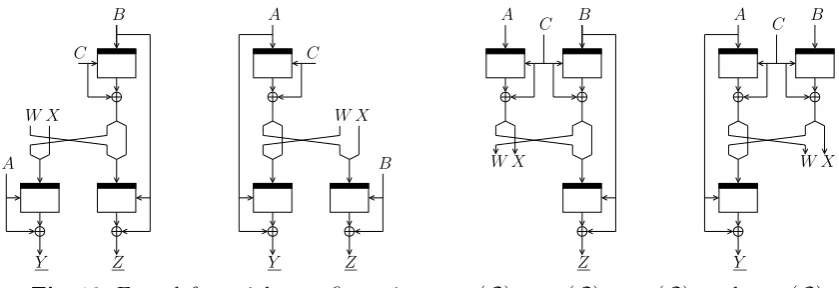
In this appendix, we prove Lems. 2-7 of Sect. 3.1. The proofs of Lems. 2-6 are supported by Figs. 8-11, and for these figures the same convention is used as for Fig. 4. In particular, the queries corresponding to locations aand !a are required to be different, and the same for the queries at positions (b,!b) and (c,!c).
A.1 Proof of Lem. 2
The cases are equivalent by symmetry, and we considercol0001(Qq) only. A visualization of configuration
5 colQ0001-left
A1 C B 1
X Y
Z
a b
c
6 colQ0001-right
A2 C B 2
X Y
Z
!a !b
!c
Fig. 8. Configuration col0001(Q) of Lem. 2. We
require (A1, C1) 6= (A2, C2), A1 6= B, and A2 6=
B.
9 colQ0011mid-left
A C B 1
Y Z
a b
10 colQ0011mid-right
A C B 2
Y Z
!a !b
Fig. 9. Configuration col0011(Q) of Lem. 3. We
requireC1 6=C2 and A6=B. 11 colQ0100-left
A1
B C
W X
Y Z
a
b c
12 colQ0100-right
A2
B C
W X
Y Z
!a
!b !c
Fig. 10.Configuration col0100(Q) of Lem. 4. We
requireA1 6=A2,A16=B, and A26=B.
13 colQ0101-left
A1
C
X
Y
Z
a
b
14 colQ0101-right
A2
C
X
Y
Z !a
!b
Fig. 11.Configuration col0101(Q) of Lem. 5. We
requireA1 6=A2.
i ∈ {1, . . . , q}. As in Lem. 1, we assume ¬help(Qi) and analyze the probability the i-th query makes
col0001(Qi) satisfied.
Without loss of generality (by symmetry), the i-th query occurs at the following positions: 1tl only, 1tronly, 1bl only, (1tr,1bl) only, or (1tl,1bl) only. We distinguish among these five cases. Note that, as
A1 6=B, it can impossibly occur at (1tl,1tr). It may be the case that the i-th query also occurs in the
right word, but this case is automatically included.
Query occurs at 1tl only. By ¬help1(Qi), there are ≤ t1 choices for (1bl,2bl). For any of these ≤t1 choices, letK1blandK2blbe the key inputs corresponding to positions 1bl and 2bl. By¬help3(Qi),
there are≤t2choices for 2tl. For any of these≤t1t2 choices 2tl, we obtain a differentX. Thei-th query
is successful only if its XOR-output equalsXkK1rbl, which happens with probability at most 2n1−q. The
total success probability is at most t1t2
2n−q.
Query occurs at 1tr only. By ¬help1(Qi), there are ≤ t1 choices for (1bl,2bl). For any of these ≤t1 choices, letK1blandK2blbe the key inputs corresponding to positions 1bl and 2bl. By¬help2(Qi),
there are≤t2 choices for 2tr. For any of these≤t1t2choices 2tr, we obtain a differentY. Thei-th query
is successful only if its XOR-output equals K1lblkY, which happens with probability at most 2n1−q. The
total success probability is at most t1t2
2n−q.
Query occurs at 1bl only: inverse query x←E−1(K, y).By¬help3(Qi), there are≤t2 choices
for 1tl. For any of these ≤t2 choices, let K1tl be the key input corresponding to position 1tl. The i-th query is successful only if x = K1tl, which happens with probability at most 2n1−q. The total success
probability is at most t2
2n−q.
Query occurs at 1bl only: forward query y ← E(K, x). By ¬help2(Qi), there are ≤t2 choices
for 1tr. For any of these ≤ t2 choices 1tr, the query at position 1tl is uniquely determined (it requires
key inputxand message inputC1 defined by query 1tr), and so are the strings (B, X). By¬help2(Qi),
determined (it requires key input B and message input C2 defined by query 2tl). Consequently, the
query at position 2br is uniquely determined, and so is the XOR-output Z of 2br. The i-th query is successful only if its XOR-output equals this value Z, which happens with probability at most 2n1−q.
The total success probability is at most t22
2n−q.
Query occurs at 1trand 1bl only.LetK be the key input for thei-th query. As the query occurs at both positions, we requireKl=Zl, which fixes Zl. By¬help2(Qi), there are ≤t2 choices for 2bl. For
any of these≤t2 choices 2bl, we obtain a differentZ. Thei-th query is successful only if its XOR-output
equals this valueZ, which happens with probability at most 2n1−q. The total success probability is at
most t2
2n−q.
Query occurs at 1tl and1bl only.LetK be the key input for thei-th query. As the query occurs at both positions, we requireKr=Zr, which fixesZr. By¬help3(Qi), there are≤t2 choices for 2bl. For
any of these≤t2 choices 2bl, we obtain a differentZ. Thei-th query is successful only if its XOR-output
equals this valueZ, which happens with probability at most 2n1−q. The total success probability is at
most t2
2n−q.
The i-th query is successful with probability at most 2t1t2+2t2+t22
2n−q . The claimed bound is obtained by
summing overi= 1, . . . , q.
A.2 Proof of Lem. 3
A visualization of configurationcol0011(Qq) can be found in Fig. 9. For the basic proof idea, we refer to
the proof of Lem. 1. Leti∈ {1, . . . , q}. As in Lem. 1, we assume¬help(Qi) and analyze the probability
thei-th query makes col0011(Qi) satisfied.
Without loss of generality (by symmetry), thei-th query occurs at the position 1tlonly. Note that, as
A 6=B, it can impossibly occur at (1tl,1tr). It may be the case that the i-th query also occurs in the right word, but these cases is automatically included.
Query occurs at 1tl. By ¬help1(Qi), there are ≤ t1 choices for (1tr,2tr). For any of these ≤ t1
choices, as A is fixed (it equals the key input for the i-th query) the query at position 2tl is uniquely determined, and so is the XOR-output Y of 2tl. The i-th query is successful only if its XOR-output equals this valueY, which happens with probability at most 2n1−q. The total success probability is at
most t1
2n−q.
Thei-th query is successful with probability at most t1
2n−q. The claimed bound is obtained by summing
overi= 1, . . . , q.
A.3 Proof of Lem. 4
The cases are equivalent by symmetry, and we considercol0100(Qq) only. A visualization of configuration
col0100(Qq) can be found in Fig. 10. For the basic proof idea, we refer to the proof of Lem. 1. Let i ∈ {1, . . . , q}. As in Lem. 1, we assume ¬help(Qi) and analyze the probability the i-th query makes
col0100(Qi) satisfied.
Without loss of generality (by symmetry), the i-th query occurs at the following positions: 1tl only, 1bl only, 1bronly, (1tl,1br) only, or (1tl,1bl) only. We distinguish among these five cases. Note that, as
A1 6=B, it can impossibly occur at (1bl,1br). It may be the case that thei-th query also occurs in the
right word, but this case is automatically included.
Query occurs at 1tl only.We note that the query at position 1tr= 2tris not depicted in Fig. 10 but is defined as a query (2, B, C, WkX⊕C). By ¬help1(Qi), there are ≤ t1 choices for queries at
positions (1br,2br). For any of these≤t1 choices, letK1br andK2brbe the key inputs corresponding to positions 1brand 2br. By ¬help2(Qi), there are ≤t2 choices for 2tl. For any of these≤t1t2 choices 2tl,
choices 1bl, let K1bl be the key input corresponding to position 1bl. The i-th query is successful only if its XOR-output equalsKl
1brkK1rbl, which happens with probability at most 2n1−q. The total probability
is at most t1t2t3
2n−q.
Query occurs at 1bl only. By ¬help1(Qi), there are ≤t1 choices for (1br,2br). For any of these ≤ t1 choices, let K2br be the key input corresponding to position 2br. By ¬help2(Qi), there are ≤ t2
choices for 2tl. For any of these≤t1t2 choices 2tl, the query at position 2blis uniquely determined, and
so is the XOR-outputY of 2bl. Thei-th query is successful only if its XOR-output equals this valueY, which happens with probability at most 2n1−q. The total success probability is at most 2tn1−t2q.
Query occurs at1bronly.By¬help1(Qi), there are≤t1choices for (1bl,2bl). For any of these≤t1
choices, letK2blbe the key input corresponding to position 2bl. By¬help3(Qi), there are≤t2 choices for
2tl. For any of these≤t1t2 choices 2tl, the key input to the query at position 2br, sayK2br, is uniquely determined. Suppose thei-th query is a forward queryy←E(K, x) (exactly the same reasoning applies to inverse queries). IfK2br=K, the queries at positions 1brand 2brmust be the same and the collision is invalid. Therefore, we assume K2br 6=K. For the key K2br, let (K2br, x2br, y2br) be any query in the query history. The i-th query makes the configuration satisfied if x2br =x and x2br⊕y2br =x⊕y, or more concretely if
x2br=x and y2br=y. (14)
This means that, irrespectively of whether the i-th query is a forward or inverse query, the query at position 2bris uniquely determined. The i-th query is successful only if it satisfies (14), which happens with probability at most 2n1−q. The total probability is at most 2tn1−t2q.
Query occurs at 1tland 1br only.LetK be the key input for thei-th query. As the query occurs at both positions, we requireKl =Zl, which fixesZl. By¬help2(Qi), there are≤t2 choices for 2br. For
any of these≤t2 choices 2br, we obtain a differentZ. Thei-th query is successful only if its XOR-output
equals this valueZ, which happens with probability at most 2n1−q. The total success probability is at
most t2
2n−q.
Query occurs at 1tl and1bl only.LetK be the key input for thei-th query. As the query occurs at both positions, we requireKr =Yr, which fixesYr. By¬help3(Qi), there are≤t2choices for 2bl. For
any of these≤t2 choices 2bl, we obtain a differentY. Thei-th query is successful only if its XOR-output
equals this valueY, which happens with probability at most 2n1−q. The total success probability is at
most t2
2n−q.
Thei-th query is successful with probability at most t1t2t3+2t1t2+2t2
2n−q . The claimed bound is obtained by
summing overi= 1, . . . , q.
A.4 Proof of Lem. 5
The cases are equivalent by symmetry, and we considercol0101(Qq) only. A visualization of configuration
col0101(Qq) can be found in Fig. 11. For the basic proof idea, we refer to the proof of Lem. 1. Let i ∈ {1, . . . , q}. As in Lem. 1, we assume ¬help(Qi) and analyze the probability the i-th query makes
col0101(Qi) satisfied.
Without loss of generality (by symmetry), thei-th query occurs at the following positions: 1tlonly, 1bl
only, or (1tl,1bl) only. We distinguish among these three cases. It may be the case that the i-th query also occurs in the right word, but this case is automatically included.
Query occurs at 1tl only. By ¬help1(Qi), there are ≤ t1 choices for (1bl,2bl). For any of these ≤t1 choices, letK1blandK2blbe the key inputs corresponding to positions 1bl and 2bl. By¬help3(Qi),
there are≤t2 choices for 2tl. For any of these≤t1t2 choices 2tl, we obtain a differentY. Thei-th query
is successful only if its XOR-output equals YkK1rbl, which happens with probability at most 2n1−q. The
total success probability is at most t1t2
2n−q.
Query occurs at 1bl only. Let K be the key input for the i-th query. By ¬help3(Qi), there are
≤t2 choices for 1tl. For any of these≤t2 choices, we obtain a differentY. By¬help2(Qi), there are≤t2
choices for 2tl. For any of these ≤t2