ISSN 2286-4822 www.euacademic.org
Impact Factor: 3.4546 (UIF) DRJI Value: 5.9 (B+)
Regression with Earning Management Variable
Dr. SITI CHANIFAH, SE. MM. Lecture FEB Universitas Muhammadiyah Tangerang, Indonesia
Abstract:
This paper aims to investigate how the relationship between variable earnings management and some other banking financial ratios by using multiple regression. Multiple regression in this do have 3 variables Y and 8 variables X. With regression model 3 variable Y which in proposed seen result how significant relation between variable dependent and independent simultaneously and partial between variable Y and X. This paper use research data to financial statements of the banking industry over a period of 10 years, where the banking industry as a whole is listed on BEI Until now, but there are some who have been bankrupt because of the economic crisis during the period of research data.
Key words: earnings management, multiple regression, financial ratio.
1. PRELIMINARY
Some notions of profit management in general can be interpreted as a way to manipulate profits in the financial statements in order to gain more profit. But what about the opinions of experts on earnings management. Here are some excerpts that the authors summarize about the notion of profit management:
specific purpose in the external financial reporting process, to gain some private advantage (as opposed to facilitating the neutral operation of the process).
Understanding earnings management by Fischer and Rozenzwig (1995) earnings management is the actions of managers who raise (lower) reported earnings from units that are the responsibility but have no relationship with the increase or decrease in company profitability in the long term.
In the opinion of Healy et, all (1998), earnings management occurs when managers use judgment in financial statements and the preparation of transactions to alter financial statements, thus affecting results relating to contracts that depend on accounting figures.
2. LITERATURE REVIEW
Earnings management is a controversial and important area of financial accounting. Earnings management is not always interpreted as an adverse negative effort because it is not always earnings management oriented to profit manipulation. Earnings management is not always associated with attempting to manipulate accounting data or information, but rather is related to the selection of accounting methods deliberately chosen by management for certain purposes within GAAP limits.
Techniques and Profit Management Patterns
William, R.S., (2009) also mentions that in earnings management, there are four patterns of implementation that are often performed by managers, such as taking a bath, income minimization, income maximization, and income smoothing.
Taking a Bath
addition, he must also clear the desk, so that reported earnings in the coming periods increase.
Income Minimization
This pattern is done when the profitability of the company is very high. The point is not to get political attention. Actions taken in the form of removal of capital goods and intangible assets, advertising costs, as well as expenditures for research and development.
Income Maximization
This action is done when profit decreases. In addition to getting a bigger bonus, this way can also protect the company when the breach of the debt agreement. The action taken by management is to manipulate accounting data in the report.
Income Smoothing
This form is probably the most interesting. This is done by leveling the reported earnings for external reporting purposes, especially for investors because investors generally prefer relatively stable earnings.
In general, the techniques used in earnings management is divided into three according to Jensen, Michael C; Meckling, W.H. (1976). Here's an explanation
The first is to take advantage of opportunities to make accounting estimates. Management estimates accounting estimates such as estimated bad debts, estimated depreciation periods of fixed assets or amortization of intangible assets, estimated cost of warranty.
Both change the method of accounting. Management makes changes to accounting methods used to record a transaction. For example, change the method of depreciation of fixed assets, namely the method of depreciating the number of years to a straight line depreciation method.
development until the next accounting period, speeding up or delaying promotional expenditures until the next accounting period and so forth.
Well that's just a few things about profitable management profits, but have a negative effect. Among the financial laps that are given to be less relevant and the way impressed 'cunning' if allowed.
Hopefully this little one can be useful. If you have questions, criticisms and suggestions you can pass them through the comments box provided. I thank you and see you in the next article.
Watts and Zimmerman (1978) suggest that the manager's opportunistic behavior can be proxied in Positive Accounting Theory into three hypothetical forms:
The Bonus Plan Hypothesis
In this hypothesis it is assumed that if all things are equal (ceteris paribus), then the manager of a company that has a bonus plan will provide the possibility of choosing an accounting procedure that can shift the income of the period to come into the present period.
The Debt Covenant Hypothesis
In this hypothesis it is assumed that if all things are equal (ceteris paribus), the closer the manager is to breaking the accounting-based debt covenant, the more likely it is that managers choose accounting procedures that can shift the earnings of the period to come into the current period.
The Political Cost Hypothesis
profits as they see fit. Managers can raise earnings by shifting future earnings periods to current periods or vice versa, lowering profits by shifting current period earnings to the next period Schipper, K., (1989).
3. RESEARCH METHODS
This study uses the financial statements of the banking industry over a period of 10 years. This research is done in april 2018, for model of research proposal as attached below:
CFO__IT__TAIT_1 (Y1) DISEXPIT_TAIT_1 (Y2) EARNING (Y3) = a + GCG (X1) + GROWTH (X2) + LEVERAGE (X3) + NIM (X4) + NPL (X5) + ROA (X7) + SIZE (X7) + CAR (X8)
From the proposed regression model above there are 3 variables Y and 8 variable X as the basis of regression analysis.
4. DISCUSSION PAPER
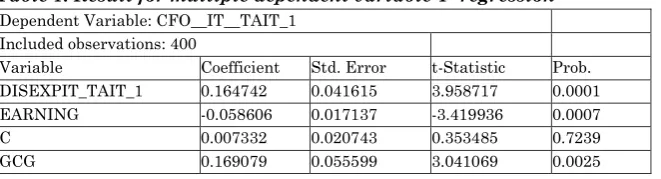
Multiple Linear Regression Analysis is a multivariate technique used to estimate the relationship between a dependent variable metric with a set of independent variables of metric or nonmetric. By multiple regression analysis the researcher can estimate and / or predict the average value (population) of one dependent variable based on two or more independent variables. Regression analysis will produce an equation / regression model. But in this study using more than one variable 1, following output display results for multiple regression.
Table 1: Result for multiple dependent variable Y regression
Dependent Variable: CFO__IT__TAIT_1 Included observations: 400
Variable Coefficient Std. Error t-Statistic Prob. DISEXPIT_TAIT_1 0.164742 0.041615 3.958717 0.0001
EARNING -0.058606 0.017137 -3.419936 0.0007
C 0.007332 0.020743 0.353485 0.7239
GROWTH -0.000407 0.021319 -0.019072 0.9848
LEVERAGE 0.040041 0.039889 1.003800 0.3161
NIM 0.067538 0.049509 1.364152 0.1733
NPL 0.054553 0.043082 1.266253 0.2062
ROA -0.004764 0.034828 -0.136778 0.8913
SIZE -0.018621 0.043435 -0.428715 0.6684
CAR -0.104369 0.039584 -2.636660 0.0087
R-squared 0.229522 Mean dependent var 0.180013 Adjusted R-squared 0.209716 S.D. dependent var 0.227002 S.E. of regression 0.201800 Akaike info criterion -0.335964 Sum squared resid 15.84134 Schwarz criterion -0.226199 Log likelihood 78.19286 Hannan-Quinn criter. -0.292496 F-statistic 11.58817 Durbin-Watson stat 1.156763 Prob(F-statistic) 0.000000
Source: Proceed author with eviews
In the literature of accounting research, there are various notions of the quality of profit in the perspective of utility in decision making (decision usefulness). In Schipper, K., (1989) classifies the construct of profit quality and its measurements by means of determining the quality of profit, based on: the time-series nature of profit, qualitative characteristics in the conceptual framework, profit-cash-accrual relationship, and implementation decision. Four groups of earnings quality determination can be summarized as follows. From the results of regression in Table 1 above shows how the model in the show by using 3 variables Y in earnings management to variable financial ratios and GCG.
high-quality earnings are profits that have relatively low variability or smooth profits.
Second, the quality of earnings is based on measurable cash-accrual-cash relationships with various measures, namely: operating cash ratios with profits, total accruals changes, abnormal / discretionary accruals (accruals abnormal / policy), and cash accruals estimates. By using the size of the operating cash ratio with the profit, the quality of profit is shown by the proximity of earnings to the operating cash flow. Profits that are closer to the operating cash flow indicate an increasingly qualified return. By using the size of the total accrual change, the qualified return is the profit that has a small total accrual change. This measurement assumes that the total accrual of account is caused by discretionary accruals changes. Discretionary accruals estimates can be measured directly to determine the quality of earnings. The smaller the discretionary accruals the higher the profit quality and vice versa. Furthermore, the closeness of the relationship between accrual and cash flow can also be used to measure the quality of earnings. The closer the relationship between accrual and cash flow, the higher the quality of profit.
Third, the quality of profit can be based on the Qualitative Concept of the Conceptual Framework (Financial Accounting Standards Board, FASB, 1978). A quality profit is a useful profit in decision making that has characteristics of relevance, reliability, and comparability / consistency. Measuring each of these quality criteria separately is difficult or impossible. Therefore, in empirical research the price regression coefficients and stock returns on earnings (and other related measures eg cash flow) are interpreted as measures of earnings quality based on the characteristics of relevance and reliability.
by the financial statements. The more estimates needed by the financial reporters in implementing reporting standards, the lower the quality of earnings, and vice versa. In the second approach, quality is negatively related to the amount of profits taken by management in using consideration to deviate from standard goals for earnings management. Increased earnings management indicates lower earnings quality, and vice versa. Here's the ouput estimation for the proposed model.
Estimation Command:
CFO__IT__TAIT_1 = 0.164741626021*DISEXPIT_TAIT_1 -
0.058606433357*EARNING + 0.00733237204667 + 0.169079005772*GCG -
0.000406584278055*GROWTH + 0.0400409435196*LEVERAGE +
0.0675380698492*NIM + 0.0545526237991*NPL - 0.00476369772371*ROA - 0.0186211727103*SIZE - 0.104368659134*CAR
5. CONCLUSION
As explained by Mulford, C. W. and E. E. Comiskey. (2010) in assessing the good and bad earnings management depends on the nature of the profits management steps undertaken and the purpose of earnings management. Profit management measures can be in the range from the most cautious by using flexibility within the SAK limits, using flexibility that is virtually beyond the constraint of IFRSs, to breaking IFRSs by making fraudulent financial statements.
There are various views on earnings management itself, usually academics argue that earnings management is not bad by assuming that the financial statements have disclosed all earnings management done, or in other words good earnings management is a profit management that is still within the constraints of SAK and disclosed in full regarding its impact on the current and future financial performance.
REFERENCES
1. Schipper, K. (1989). Commentary on earnings management. Accounting Horizons 3: 91
2. Fischer, M and Rosenzweig, K. (1995). Attitude of Students and Accounting Practitioners Concerning the Ethical Acceptability of Earnings Management Journal of Business Ethics. Vol. 14. p. 433–444.
3. Healy, P. et, all, (1998). A review Of The Earnings Management Literature And Its Implications For Standart Setting. http://ssrn.com accessed date 15 March 2018.
4. Watts, R and Zimmerman, (1978). Towards a Positive Theory of The Determination of Accounting Standards. The Accounting Review 53, 112-134.
5. William R, S., (2009). Financial Accounting Theory. 5th Edition. Canada Prentice Hall.
6. Jensen, Michael C ; Meckling, W.H. (1976). Theory of The Firm: Managerial Behavior Agency Cost and Ownership Structure. Journal of Financial Economics 3. hal. 305-360.
7. Mulford, C. W. and E. E. Comiskey. (2010). Deteksi Kecurangan Akuntansi. The Financial Numbers Game. Cetakan I. Penerbit PPM.
Additional website: