VOLUME 2
January 1949
Number 1
In this Issue
Field Comments on the range Condition Method of
Forage Survey ... R.R. Humphrey
1
Ranch Management... Herman Oliver
11
Distribution and Control on Several Woody Plants in
Oklahoma And Texas ... B.W. Allred
17
Determining Forage Weight on Southern Forest Ranges
Robert S. Campbell and John T. Cassidy
30
News and Notes . ... ... ... 33
Book Review:
Proceedings, Society of American Foresters'
Meeting 1947 ... Donald R. Cornelius
34
Current Literature
Robert A. Darrow
35
Published Quarterly by
Volume 2, Number 1 l January, 1949
Journal of
RANGE
MANAGEMENT
Field Comments on the Range Condition Method
of Forage Survey
R. R. HUMPHREY
University of Arizona, Tucson, Arizona
M
ETHODS for the appraisal of na- tural resources normally undergo a period of testing and modification early in their development. This is a natural and healthy sign indicating improvement of a basic concept. Modifications of field techniques should come in large part from field workers.The thoughts in this paper represent conclusions about the range-condition survey method reached during the past several years while tramping the hills and mountains of Washington surveying many thousands of acres, talking with ranchers and co-workers, preparing ranch plans and analyzing and writing about the method. The ideas are presented in the hope they may be of value in further developing the range-condition survey method or at least in helping to clarify thinking about survey methods in general. Range condition, as the term is used today, commonly indicates forage produc- tion on an area expressed in terms of the amount it would produce under good management. Range condition is meas- ured directly in terms of forage production and indirectly in pounds of meat or wool produced.
HISTORY
The value of range condition surveys in analyzing range problems was early recog- nized by the Soil Conservation Service in
1
the Pacific Northwest, and it is from this region that the technique has received its greatest impetus.
Various aspects of range condition have been covered in several publications. It is probable that the first published ac- count was by Spence (12). There seems to be some doubt as to the originator of the basic idea. It has been traced back, however, to Dr. L. A. Stoddart who ap- pears to have been the first to attempt to give the method general field use.
The earliest general analysis of range condition showing its application to sound range management and to flood control was made by Humphrey and Lister in 1941 (8). Six condition classes were de- scribed and the predominating vegetation characteristic of each was given. Other features pertaining to each were discussed. These included: (a) Management prac- tices responsible for condition, (b) Revi- sions required in present management practices, (c) Erosion or flood control remedial measures indicated.
A USDA Farmers Bulletin by Renner and Johnson (11) was published in 1942. This bulletin gave criteria for recognizing ranges in each of 4 condition classes; told how to recognize upward and downward trends, and recommended desirable range management practices on each class.
2 R. R. HUMPHREY
underlying the method; the 1947 paper gave in some detail the steps required in making range-condition, surveys in the field.
Reid and Pickford (IO) in 1946 dis- cussed range condition as applied to mountain meadows in eastern Oregon and eastern Washington. They described cri- teria for recognizing 4 condition classes in mountain meadows and pointed out the grazing value of each condition class for sheep and for cattle.
Parker and Woodhead (9) in 1944 de- veloped a score card for ranchers to use in determining the condition of their ranges. Although t’he score card given as an example was particularly adapted to southwestern perennial grassland ranges grazed yearlong, application of the method is not restricted to these ranges. Bailey (1) in 1945 developed rather fully the importance of recognizing range- condition trends. The value of deter- mining trends has also been shown by
others (7, 10, II). Bailey’s principal contribution lies in his stress of the eco- logical nature of the factors affecting tarends and the need for a better knowledge of soils in range-condition analyses.
Costello and Turner (3) described range condition classes in the central Great Plains region. The purpose of their work was “to furnish ranchers with guides for judging prevailing condition of the range, yearly forage production, and current forage utilization of the short-grass range on the central Great Plains.”
Talbot (13) in 1937 described reliable criteria for determining whether ranges were improving or deteriorating. Al- though his criteria largely pertain to de- gree of utilization rather than range condition, as the term is commonly now used, they do in many instances indicate range-condition trends. Some of them,
as a consequence, have been rather widely adopted in recent field guides.
Any biographical account should men- tion the range condition guides developed by the Soil Conservation Service for use by ranch planners and ranchers. These describe each of the principal forage types within an area, the area generally being a Soil Conservation District. Each type is analyzed on a condition-class basis. Criteria for recognizing each class are given together with the essentials for de- termining trend. Desirable range man- agement practices are then listed for application within each class.
These guides are written in simple, non- technical language and are adapted for use by the non-technical man as well as the trained technician. The first of these (6) appeared in 1945. Since then exten- sive range areas in the states of Washing- ton, Oregon, Idaho, Nevada, and Califor- nia have been similarly described. Some of these guides vary in form or organiza- tion but the general approach has re- mained unchanged. Modifications of this field application approach have been developed in other western states where grazing is an important industry.
Two RANGE CONDITION CONCEPTS The climatic approach
nial grasses and require d only one acre to concerned in this pnper. It might be graac a cow for onr month may hnve de- called the rangr-polenfial approach since t&orated until it, now produces only it expresses current production in terms annual weeds and grasses and may reqnirc of the ultim;ttF potential for the same area 10 acres to produce a cow month of feed. (Figs. 1, 2). This classification may Yet, both might be classified as in thr indicnt,e t,o a minor extent a temporary
same condition. forage ahundnnce or shortage resulting
This type of range-condition classifirn- from recent growing condit,iom. Prop- t,ion might apt,ly be termed the clima/ic erly t,rained t,echnicians, however, make approach. lt is typified by the mont,hly little nllowmrr for such temporary flu+ range-summary reports published for the tuations. The basis for the range-poten- various range-livestock states. t,i:tl approach lirs in the assumption that
This concept of condition has a place. This place, howver, is strictly one of the temporary effect, of growing conditions on forage production. It cannot be ex- tended to indicate the relative grazing values of various ranches or range units, or to show the sust,ained improvanent on a run-do\vn range.
The range-polenlial approach The second concept of range condition is the one with which ve are primarily
ESSENTIALS
OF A RANGE CONDITIONCLASSIFICATIOhT
Essentially, under the range-potential concept, the more forage an area is pro- ducing the hetter the range condition. As the method is most commonly used in field surveys today the follon%,g clasws have been adopted.
Excellent: Range producing 8O-lOO70 of possible forage (Fig. 1).
therefore, it is necessary to determine the amount of forage being produced. This figure must then he analyzed to ascertain its relative value with respect to the
maximum production possible on the
area.
Although an evaluation of present
forage production is the first step in de- termining condition it is only one of several. The final classification is an exprwsion of the combined effect of all the factors involved.
Good: Range producing GO-80~0 of
possible forage.
LFair: Range producing 40-607, of
possible forage.
Poor: Range producing ZO-40% of
possible forage.
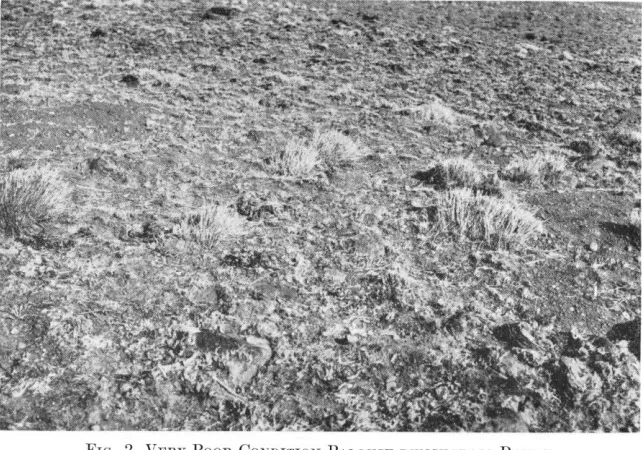
Very Poor: Range producing less than 2075 of possible forage (Fig. 2).
It is seen from the above that range condition, for practical purposes, has been defined in terms of forage production. In order to classify a range as to condition,
RANGE CONDITION METHOD OF FORAGE SURVEY 5
Density
Forage, being in a continual state of flux, does not lend itself well to classifica- tion. This is perhaps particularly true with respect to forage-production classi- fications. For this reason, it is desirable, or even essential to measure all the major factors that may affect production. In some instances field guides for range- condition analyses have been developed that omit the density factor. It is the conviction of the writer that in omitting this factor we deprive ourselves of an essential tool for determining not only range condition but even forage evalua- tion per se.
The amount of forage required to sus- tain a grazing animal is expressed as vol- ume. Volume reflects not only height of forage; it also reflects ground cover or density. Thus, a range capable of sup- porting .4 of a complete ground cover is not in excellent condition when it is cur- rently supporting only a .2 cover. An added indication of the essential nature of the density factor is seen in the fact that many ranges, when classified without density, would seem to be in excellent condition. These same ranges, when rated as to density in addition to other factors, would be classed as no more than fair. This condition has been observed many times on ranges overgrazed for years by sheep. In these instances the coarser grasses were grazed lightly or not at all when mature. Seedlings of these species, however, were grazed wherever they appeared. At the same time the fine grasses were grazed out. As the old perennial grasses gradually died they were not replaced and the density was gradually lowered. Yet, their vigor was excellent and as a consequence a consider- able amount of litter, often accumulated. Furthermore, the areas involved were essentially level and the soils porous so
that there was no measurable erosion. If these ranges were to be judged on a basis of plant composition, litter, forage vigor, and erosion, but excluding density, they would appear to be in excellent con- dition. Yet they are not producing the amount of forage required for an excel- lent-condition range. Including a meas- ure of density in cases of this sort and, indeed, in all estimates of grazable forage produced, would seem to be essential.
Erosion
Failure to record degree of current erosion may lead to an over-evaluation of range condition and consequently of a safe stocking rate. A range where erosion is active must have more forage left un- grazed than one where there is little or no erosion. When erosion is one of the factors used in determining range condi- tion, the matter of a safe stocking rate is determined by virtue of the correct con- dition classification. For example, a range might rate as excellent and have a stocking rate of 1 acre per cow month of forage if current erosion were slight or negligible. This same range if producing the same amount of forage, but with moderate erosion would be classified as good and would carry the recommenda- tion by definition (good = GO-8Oa/, of full production) that about l+ acres be allowed per cow month. The approxi- mate rule can be followed that other fac- tors remaining unchanged, moderate ero- sion will reduce a condition rating one class; severe erosion will reduce it two, or occasionally more, classes.
either uulled UD or starved out bv con- ” tinued close grazing. After a number of years this results in almost pure stands of rhentgrass composed largely of the old coarse plants. The accumulation of nn- grazed dead material in the plants makes them gradually more and more unpalat- able to sheep and as R result they charac- teristically possess good to excellent rigor. Yet, 8s mentioned under the discussion of density, this range may be in no more t,han fair condition.
generally indicate an improving range. Old gullies completely grown o\‘er may indicate a range that MS once in poor condition but t,hat has recovrred to the excellent level (Fig. 3).
Forage vigor
Forage vigor, though used as a criterion for determining condition, is probably the least dependable ol those commonly em- ployed. The rw.son for this can bc show, best by cx-ample. ‘1 range long over-
grazed by sheep gradually changes in composition. In the Mouse bunchgrass region of the Sorthmest, for example, the fine-leaved Sandberg bluegrass (Pea secunda) and Idaho fescue (F~stuca idahocnsis) are heavily grazed. This ulti- mately may result in their partial or com- plete disappearance. Mature plants of the accompanying bluehunch wheatgrass
(Agropyron spicalum) are very lightly grazed. Seedlings of this species, how ever, being small and good sheep feed, have little chance for survival, being
RANGE CONDITION METHOD OF FORAGE SURVEY 7
low, that the stocking rate is less than would be expected from the vigor of the plants. It should be noted in this exam- ple, also, that omission of density as a rating factor would further weaken the classification.
It is not recommended that forage vigor be abandoned as one of the criteria for determining range condition. It should, however, be used with care and with due consideration for the factors that might make it misleading.
Litter
On open grassland ranges litter has proved to be one of the most reliable fac- tors employed in determining condition ratings. Rather generally on open grass- lands, an increase in litter indicates an improvement in condition. Moderate to abundant litter provides a surface layer of organic material that protects the soil surface from the erosive and puddling action of raindrops and surface runoff. It also constitutes part of the raw material for humus formation. And, likewise im- portant, an accumulation of litter indi- cates that past grazing use was not ab- normally heavy.
In forested areas, as contrasted with open grassland, abundant litter may not indicate unused forage or, for that matter, that any forage was produced. The litter may be derived largely or entirely from fallen leaves, needles, or other tree- derived material. This may provide adequate erosion control and improve the soil. It does not, however, indicate range condition as defined by forage-pro- duction classes. This fact must be con- sidered in classifying timbered ranges.
A DYNAMIC APPROACH
Range-condition surveys have sup- planted the reconnaissance and square- foot surveys as a Soil Conservation Serv- ice forage evaluation method. The methods formerly used were compara-
tively slow and gave results of no more value in ranch planning than the more rapid range-condition method.
The greatest asset of the range-condi- tion method, however, lies in its dynamic approach. The reconnaissance and square-foot systems classify a range into forage types based solely on current as- pect. They do not indicate whether a range is improving or deteriorating, nor do they indicate whether a range once produced, and is again capable of produc- ing, more forage than at present. These two methods are, therefore, static in their approach. The range-condition method, in contrast, is an analysis of present pro- duction expressed in terms of possible future production. Emphasis is also laid on the direction of current changes in range condition to determine whether present range-management practices are benefiting or harming the range (Fig. 3). This dynamic approach, together with its relative simplicity, have given the method a popularity among practical- minded ranchers that the older systems never enjoyed.
PROPOSED MODIFICATIONS
Four condition classes
No range survey method yet devised has proven entirely satisfactory. Because of the complexity of forage it is possible that none ever will be. Several defects, some of which are remediable, exist in the method as it is commonly used for surveys today.
In most instances a breakdown into 4 condition classes rather than 5 would be adequate. Several years’ field experience in making range condition surveys indi- cates that the following 4 classes would serve in most instances and might possi- bly be universally adequate:
8 R. R. HUMPHREY
Good: 50-75% of possible forage pro- duction.
Fair: 25-50% of possible forage pro- duction.
Poor: Less than 25% of possible forage production.
Depleted areas would not be classed as poor condition but would be mapped separately as “depleted”. This reduc- tion of the number of classes would sim- plify field surveys, reduce compilation time, and provide a breakdown more readily accepted by most ranchers. The slight sacrifice in detail would not ad- versely affect ranch planning.
Modi$cation for sheep grazing Sheepmen object to the method because they say it frequently does not correctly classify their ranges for sheep use. This objection is justified, for the method ex- presses condition in terms of maximum forage production regardless of kind of livestock. Thus, for example, a Palouse bunchgrass range generally produces the maximum amount of forage when blue- bunch wheatgrass is the principal species. Bluebunch wheatgrass, however, because of its coarseness, makes poor sheep feed. This range, therefore, might rate excellent in terms of forage production for cattle, but no more than fair for sheep. If, on the other hand, the bulk of the wheatgrass were replaced by Sandberg bluegrass, a classification according to present stand- ards would rate this range as no more than fair. Because of the value of Sand- berg bluegrass as spring sheep feed, how- ever, the sheepman would probably con- sider this range as excellent. And, in terms of forage production for sheep, he would be right.
In areas where sheep raising is an im- portant industry separate range-condi- tion classifications should be set up for cattle and sheep. This would involve enlarging our concept to permit basing
the classes on kind of livestock to be run, rather than on total volume produced regardless of kind of livestock, as at present.
Preparation of condition guides The objection is raised by some that the method is difficult to apply broadly because, as a prerequisite to its use, de- scriptive guides must first be made of the types involved. This is true. However, the time required for the field work of preparing such a guide generally runs into no more than 2 to 5 days. The training obtained in observing successional trends and causes for these trends generally proves in itself to more than pay for the time expended. Careful analysis of for- age types and grazing management prob- lems frequently will show that extensive areas can be included in a single so-called type. This should be true particularly of National Forest areas or on Indian Reservations where the local administra- tive problems common on Soil Conserva- tion Districts may not obtain.
It is believed, therefore, that the time required to lay the ground-work requisite to application of the range-condition method is one of the definite benefits of the method rather than one of its draw- backs. The condition of many of our public and private ranges today would seem to indicate that we must be forced to stop and consider what is happening to our forage resources. If the range- condition method will succeed where pre- vious methods have failed, it may be worth adopting universally at any cost of time.
Subtype mapping
RANGE CONDITION METHOD OF FORAGE SURVEY 9
surveyor will ask himself these questions before mapping a new subtype.
1. Is there enough change in composi- tion, density, erosion, litter, or plant vigor to indicate a different condi- t ion class?
2. Is there a marked change in factors that should affect allowable grazing? These factors include erodibilit,y of soils, steepness of slope, direction of slope, potential productivity of site, presence of rocks, down timber, or dense brush.
3. Are there special range management or other recommendations that ap- ply to one area and not to anot’her that would be masked if no sub- division were made?
When the answer is no to all 3 of these questions there will generally be no need to subtype.
The use of estimates
The objection has been raised that the condition method, like other widely used range-survey systems, relies on estimates rather than on verifiable measurements. This is largely correct; density and forage composition are still estimates. In a sense erosion, plant vigor, and litter are also based on estimates. With due con- sideration for the inaccuracy of estimates as compared with exact measurements, however, the information derived from condition surveys has proved to be ade- quate for planning on many hundred- thousand acres of range land. This rec- ord has extended over a period of several years, long enough to indicate fairly con- clusively that the method is serving its purpose.
In discussing the adequacy of any method, the use to which the result,s will be put should be considered. Forage production, livestock prices, overhead and, indeed, most items involved in a ranch operation are subject to wide fluc-
tuations. This being so, there is little to be gained, and perhaps much to be lost, by gearing any one operation as, for example, a forage evaluation method, down to a higher degree of accuracy. The means should justify the end, but no more than that. A more accurate system does not seem to be needed in ranch planning.
Condition ratings in timber
The writer is aware of no unified ap- proach to rating range condition in dense timber where competition pre- cludes the production of much forage. Two approaches seem to be most com- monly used. One considers condition in terms of the effect of livestock upon it; the other in terms of the effect of all factors.
Range condition is defined in terms of potential forage production. On open grassland the factor that usually prevents development to the potential is grazing pressure from either domestic livestock or game. animals. Even here, however, other influences are sometimes important. Abandoned cropland, for example, on which the native sod was destroyed by plowing, may rate poor or very-poor condition. Reseeding to native or intro- duced species may be necessary to restore such areas within a reasonable period of time to excellent condition. The po- tential, however, is still there and the correct treatment will bring it out.
10 R. R. HUMPHREY
it may correctly be classed as being in very-poor condition.
Whether it may be economically de- sirable to remove the timber in order to produce more forage does not seem to be involved. The basic fact is that a range- condition classification is a classification of forage resources. In making such a
classification, therefore, present as com- pared with potential, forage production is the only factor to be considered. For economic or other reasons it may be desirable to maintain a dense stand of timber or brush. Yet, from a forage production viewpoint, this area is of little value and consequently must be given a low condition rating.
LITERATURE CITATIONS
1. BAILEY, R. W. 1945. Determining Trend of Range Watershed Condition Essential to Success in Management. Jour. For., 43 : 733-737.
2. COSTELLO, D. F. 1945. Reading the Range. The American Hereford Jour- nal, 3 pp., July.
3. COSTELLO, D. F., AND G. T. TURNER. 1944. Judging Condition and Utilization of Shortgrass Ranges on the Central Great Plains. USDA Farmers Bull. No. 1949. 21 pp.
4. ELLISON, LINCOLN, AND A. R. CRDFT. 1944. Principles and Indicators for
Judging Condition and Trend of High Range Watersheds. Intermountain For- est & Range Esperimcnt, Station, Rc- search Paper No. 6. 65 pp. Apr. 5. HUMPHREY, R. R. 1945. Some Funda-
mentals of the Classification of Range Condition. Jour. For. 43 : 646-647. 6. HUMPHREY, R. R. 1945. Range Condi-
tion : A Classification of the Palousc Grass Type. U. S. Soil Conservation Service. 13 pp. Multilithed. May. 7. HuhwHREY, R. R. 1947. Range Forage
Evaluation by the Range Condition Method. Jour. For. 45: 10-16.
8. HUMPHREY, R. Et., AND 1’. B. LISTE:R. 1941. Native Vegetation as a Criterion for De- termining Correct Range Mnnagcment and Run-off Characteristics of Grazing Lands. Jour. For. 39 : 837-842.
9. PARKER, K. W., AND I’. V. WOODHEAD. 1944. What’s Your Range Condition? American Cattle Producer, 4 pp., Nov. 10. REID, E. H., AND G. D. PICKFORD. 1946.
Judging Mountain Meadow Range Con- dition in Eastern Oregon. USDA Cir- cular No. 748,31 pp.
11. RENNER, F. G., AND E. A. JOHNSON. 1942. Improving Range Conditions for War- time Livestock Production. USDA Farmers Bull. No. 1921. 18 pp. 12. SPENCE, L. F. 1938. Range Management
for Soil and Water Conservation. The Utah Juniper. 9: 18-25.
Ranch Management
HERMAN OLIVER
John Day, Oregon
A
S A livestock producer, I am going to write in a general way about range conditions and management. Back in the early days when the hills were covered with waving bunch grasses, little t)hought was given to the matter of preserving ranges for future generations. If the great value of preserving the grasses had been realized years ago, perhaps the ranges would not have been subjected to the heavy grazing and other abuses which unthinking stockmen have resorted to in order to run a larger num- ber of animals on a given area.It was only recently that government personnel and farsighted stockmen came t,o realize the fact) that if grazing practices were not changed, in a few years most of t)he range lands of this western country would be almost denuded of grass and t,hereafter be of little value to stockmen. If stockmen in the early days had realized that those wonderful stands of grass might some day be destroyed by over- grazing, perhaps they would have exer- cised better range management.
However, the present generation of st)ockmen seem more conscious of the importance of range management and are attempting to devise methods of improving carrying capacity. Grazing lands are like livestock; some produce better than others. The better care any range land receives the better returns it will make in improved forage for livestock just as more care of livestock results in better and greater production. .
The time of year when the livestock business shows the greatest progress is when the animals are grazing on good ranges. It is then that the stock put on
their cheapest growth and good flesh. Contrast this period with the winter months when the overhead cost really takes place. Back in the days when there was an abundance of free range with waving grasses and no controlled grazing, the livestock operator was only concerned with the problem of having some meado\\ lands where he could harvest enough hay to carry his stock through the severe part of the winter. He made no provision for spring pasture nor for summer range other than the control of some of the water holes in certain areas. Many operators never owned a ranch where they could put up their own hay but depended on buying feed when needed wherever it could be obtained. The livestock were not off of ranges for long periods and in many cases roamed the open ranges year-long. Almost continuous usage resulted in overgrazing. When the lands were grazed at a time when the ground was soft, many of the perennial grasses were entirely killed out.
This condition brought about the need of doing something about our badly abused ranges. Better range manage- ment has been of great value to the over- grazed areas. Then came the task of reseeding depleted ranges. Thanks to the State colleges, the Forest Service, the Grazing Service, and the Soil Con- servation Service-many experiments have been conducted and are still being carried on by these agencies to deter- mine the best grasses adapted to the conditions in different sections of the West.
Reseeding of ranges is no easy task. It requires patience and time. It is my
12 HERMAN OLIVER
belief that on ranges having a fairly good stand of perennial grasses, it would be a waste of time and money to try to artifici- ally reseed them. However, much im- provement could be made on these ranges by strictly controlled grazing, water de- velopment, drift fences, good distribution of stock, better salting methods, and rotation grazing. If grass gets a good start on ranges and is not overgrazed, some will be left standing to protect the roots and new growth, and to produce seeds. It is surprising what improve- ment can be made on a range in a few years in this manner, and the range con- tinues to carry a certain amount of stock while the improvement is under way.
As to reseeding, there are several things to take into consideration:
1. The type of soil in the area in which reseeding is to take place.
2. The kind of grasses best adapted to the soil and the annual rainfall.
3. The character of the range as to brush or rocks.
4. The manner of reseeding if by hand or by drill.
5. The necessity of preliminary ground preparation.
6. Care, if any, of ground after re- seeding.
7. The depth which the seed should be sown.
8. Size of area to be seeded at one time.
9. Best time of year to seed.
All of the foregoing points are im- portant when considering a reseeding program, and much discussion could enter into this subject as to what might be right or wrong. The proper procedure for one locality might be infeasible for another place.
I was much interested recently in a panel discussion on this subject which occurred at the annual Feeders’ Day Program at the Experiment Station at
Union, Oregon. The panel was made up of men of many years’ experience. A summary of the discussion would be about as follows:
1. Controlled burning of sections with a heavy undergrowth of brush and of sections with a heavy growth of cheat- grass eliminated competition for better grasses.
2. Reseeding was successful on areas where soil had been previously plowed and a good firm seed-bed prepared.
3. More or less success was obtained on logged-off and freshly burned areas. 4. Broadcast seeding in general did not prove satisfactory.
5. Controlled grazing was also em- phasized; i.e., not to allow too early grazing or overgrazing.
So much for this over-all picture of our ranges from my personal observation, but I would again stress my former state- ment that range or meadow lands are similar to livestock in that the more care they receive the better the results obtained.
I have never been sorry that I took as a business career that of a livestock producer. I hope to continue in that business for some time to come. I have always thought, and still do, that the livestock business is as sound and promising a business as can be found anywhere in this country of great op- portunities. And I believe it is one of the most independent. Surely it re- quires foresight, long-range planning, and close personal application; but so does any other business if it is to be car- ried on successfully.
RANCH MANAGEMENT 13
value. These are, in a way, interlocking principles. Failure to develop any one of them to the utmost means setting a heavy handicap upon the whole opera- tion.
We operate a range or commercial cattle business only. Previous to the year 1929, aside from running a cow herd, we bought annually enough one- and two-year-old steers, which, added to the number we raised, would make from 1000 to 1200 head of steers to be marketed off .of grass at three years old. During t,his period of buying steers from many different breeders, it always developed t)hat we had some of all the different breeds. The practice now is to more nearly operate on a straight breed basis. We realized that different breeds have different habits and characteristics, so in the year the steers were being fitted for market, they were separated as follows. The dairy type and any others showing undesirable qualities were separated from the rest of the herd as these are the first to be noticed by a buyer. They look and sell better if separated from the main bunch and also do not devaluate the better quality and more desirable steers. Then the remainder of the steers were classed as to breed: Herefords, Durhams, or Blacks. We found that the steers handled easier, were more con- tented, fattened faster, and brought higher prices than when all breeds were run together. This method of operation was carried on at a time when feed was more plentiful in our part of the country than it has been for the past 15 to 18 years.
After the depression in the early 30’s, we embarked on a different program and policy of operation. We quit buying extra steers and confined our J operations
to a breeding program and resolved to improve the quality of our cattle and to increase the calving percentages.. I could
dwell for quite a while upon quality of livestock as I feel very keenly about this. It is not a question of breed. Any manager will succeed best with the breed he likes. The main point is to have the best quality obtainable within the breed of his choice. On our range we are now running Herefords, but, in earlier days we ran Durhams. In both instances, our efforts were to get the growthiest, smoothest, earliest maturing, and most uniform cattle which we could possibly breed. Good quality cattle eat little if any more than poorer types.
Perhaps two great failings of many cattlemen in this connection are that they do not cull the cow herds closely enough, and all too often they buy cheap bulls to save an immediate cash outlay. These failings may easily become ex- pensive. When cattle have top quality and uniformity, they take on a quicker and easier finish. In short, they make good beef faster.
14 HERMAN OLIVER
We are calving two-year-olds success- fully. There used to be an opinion in our country that calving heifers at this age tended to reduce the size at maturity. It was thought also that the calf crop the following year would be light when the cows were three years old. Our ex- perience does not bear this out. Our two-year-olds always raise a good calf and breed satisfactorily the next year. If there is actually any difference in the size of a bunch of three-year-olds between those that calved at two years old and those that calved at three, it is in favor of the two-year-old calving. We are very careful that our yearlings are bred under good pasture conditions, and we also have them on extra good pasture the next breeding season. We use one bull for every 20 cows and hold back turning on the open range until as late as June 10.
It goes without saying that with this percentage calf crop we are free of Bangs’ disease. That is true, but it was not always the case. We were experiencing considerable losses for a number of years and concluded that we had ‘better take this matter in hand if we were going to be successful cattle operators. We then started a testing program. Our herd was tested five times the first year, showing 18 percent reactors. The testing program was followed for five years. On the last test we found one reactor and one sus- pect. In the fourth year we started calfhood vaccination and have continued that practice to the present time.
Culling of the breeding herd is very important in improving quality. We have followed the practice of annually culling from 15 to 18 percent of the cows. This might appear to be heavy, but to rapidly improve the quality it is not too severe. Those we cull are dry cows, old cows, those poorly developed, poor milk- ers, and any undesirable type or cripples. These “out” cows, as we call them, are
kept in good pastures throughout the summer. In early November the calves are weaned and the cows are continued on good green feed. By early December many of them are ready to be shipped, and the remainder are put on hay and grain to finish, which requires from 30 to 50 days. Following this practice a calf is produced and a cow readied for market in a 12-month period. These “out” cows are replaced with careful selections from the top end of the yearling heifers, selecting those of smooth, uniform type, well developed, heavy boned, and good- headed. By this method the quality of the cow herd is improved and kept up. Improvement can be seen from year to year.
For breeding the yearling heifers, the smaller type bulls that may be in the bull herd are selected. During the winter these heifers are fed wild hay in racks and ample amounts are before them at all times. About 30 days before calving time they are given 2 pounds of grain or its equivalent in some other concentrated feed. This grain feeding is continued until they go back on grass. Beginning as yearlings, the heifers are pastured and wintered in straight-aged lots. In the spring when they are three years old, they are mixed with the mature cows. We keep a close eye on breeding prac- tices with the mature cows also. Of course, we have them divided into lots, and we try to keep special type-varia- tions in like groups. Then we figure out from our herd of bulls the best type to use on each of the mature cow herds. The cows are kept in separate lots on good pasture six weeks before they are mixed for summer grazing. During this six weeks’ period the greater percentage are bred the way we want them.
RANCH MANAGEMENT 15
ences her offspring only; the bull affects upwards of 20 calves each season. There- fore, we are a little cranky on the subject of bull selection. The qualities of a bull, whether good or bad, will be at once reflected in his offspring. If his char- acteristics are good, there is an immediate improvement in the quality of the herd. If the sire’s characteristics are poor, there is either no improvement at all or there is a decline in quality. We do not go out for the strictly small “show type” bulls as we feel they are not large enough for commercial purposes. Instead, we buy the top grade of range bulls. We are very particular when buying bulls to know that they are descended from a cow herd that has good milking qualities. A good milk strain in a breeding herd is very important in calf development. We like bulls of good quality and con- formation, with plenty of size, strong backs and loins, plenty of natural flesh- ing, well-developed rounds, low set, and good heads.
A good policy, and one which we practice, is to remove the bulls from the regular herd of cattle in early October and to pasture and feed them well until t#he next breeding season. It has been my observation that well-fed bulls are an important factor in getting a high percentage of calves that are strong at birth.
We buy our bulls as yearlings in lots of around 25 head but do not use them until they are two-year-olds. They are win- tered separately with plenty of hay and just enough grain so they develop steadily without putting on too much fat. In the early spring, before the regular breeding season opens, the better type and most promising are each bred to four. or five cows and a record kept. By this procedure we soon learn which are the top breeding individuals. These are later used with the top-cow lots. It is from
these lots that the larger number of our replacement heifers are taken. Again I want to repeat that a low grade bull at a low price is not a profitable investment. :I’here is no end to the damage a poor bull can do to a herd if he is continued in service.
In order to observe the results from different bulls, the cows in our herds are identified by a shoulder brand. This is in addition to the recorded iron which is used on the hip. A letter is used for each year and since we do not have a cow older than 12 years, we use the first 12 letters of the alphabet and then start over again. Since only 200 heifers are retained each year, we start, for instance, with A-l, A-2, and so on up to A-99. The next 100 head are branded with the figure first, as l-A, 2-A, and so on. Thus, the letter designates a certain year and the figure indicates the cow’s number. The brands are about two inches long and are readily observed. There is also a special mark for the heifer calves from the top herd of cows.
The steers are sold about the middle of September as two-year-olds. They weigh around 1100 to 1140 as they come off of the grass. The entire steer crop is sold each year, therefore, there are no “short)s” or cut-backs to be put in the next year’s steer crop.
16 HERMAN OLIVER
left at turning-out time. Just as im- portant, of course, is provision for ample summer range and fall and spring pas- tures.
Too much emphasis cannot be placed, on the importance of winter care of live- stock. They are at the mercy of the owner when confined in small fields, in some cases with little or no natural shelter, with bad feeding conditions and perhaps a rationed amount of feed. During the severe winter months when stock really need care and attention, they should have plenty of feed to main- tain their vitality and disease resistance. The young stock then will continue to grow, and the cow will be able to raise a good calf. The young, growing animals, such as weaner calves, should have feed that contains plenty of protein. They grow and develop much better when supplied with such feed. Classing cattle for winter feeding is extremely profitable. For instance, in a bunch of weaner calves, they can easily be classed in three lots: the younger and thinner ones; the in- between kind; and the .earlier, better- developed ones. By this method more attention can be given those requiring extra care which is not possible when all are together. This same procedure should also be carried out in the rest of the herd. There are two reasons: it helps the development of those that need it; and it builds up vitality and makes them more disease-resistant. Wind breaks and brush shelter are extremely helpful in the winter care of stock.
Another point of much importance in the wintering of stock is the manner in which the hay crop is handled. It should be cut and cured at the proper time to insure the proper retention of its impor- tant nutrients and vitamins. Hay that is baled or put in stacks before it is over-
ripened is high in proteins, high in vita- mins, and high in feeding value.
We are very careful not to overgraze our pastures and range allotments. The cattle are rotated between pastures as much as possible, but we cannot always work out an ideal rotation program be- cause of the practical conditions involved. In the fenced pastures, the fences are not always on section lines but run according to contour of the land and relationship to available water. Our practice has been to turn out after the grasses have a good start. One other point we think very important is placing of salt before the cattle are turned out, which then is done in relation to the salt location. Under this plan the cattle are quickly and easily established on the range where wanted.
Of course, there are many other points involved in the actual work of managing a commercial cattle herd. Close personal observation cannot be slighted. Many of the factors in management which con- tribute to profits result from close obser- vation of little points by the manager, which would entirely escape a foreman or other employee. During all the years of our livestock operation I have given per- sonal supervision to all activities and have never had a foreman.
Distribution
Range Division, Soil Conservation Service, Fort Worth, Texas
and Control of Several Woody Plants
in Texas and Oklahoma
B. W. ALLRED
D
URING the period that civilized man has held dominion over the Southwest, dwarf forests of invading shrubs and small trees have insidiously taken possession of millions of acres of the remaining uncultivated grassland. Acreage of mesquite alone in Texas and Oklahoma is greater than the area of the state of Wyoming.Many have been deceived into believing that trees and brush moved in like a plague or passover and killed out the grass (13), but that viewpoint is slowly dying out as the real cause of grass de- struction and brush invasion is being understood.
The primeval grasslands that were free of brush stayed free of brush because the dominating grasses had the strength to hold the land against invaders. When livestock crowded the ranges and ate down the best grasses first, the lower class plants which succeeded them were not strong enough to hold off the aggressive brush and trees.
The original native grasses grow with trees and brush when correct grazing is practiced. On heavily grazed brush ranges, the only traces of original grasses are usually found within the thorny basal branches of brush, which guard the grasses against grazing animals. One Texas ranchman says that a sure clue to range improvement is when grazing lightens up so the good grasses can “come out of the bushes into the open”. Cedar and other evergreen plants with dense horizontal spreading branches shade the
ground so completely that they afford little or no sanctuary to grasses.
While the good grasses may flourish in brush land, they can never reach excel- lent condition until the trees or shrubs are killed out.
Successful removal and control of dense stands of undesirable woody vegeta- tion gives farmers and stockmen a major opportunity to conserve water and to increase forage production. In areas where there are dense stands of useless woody vegetation more water is lost by transpiration through the leaves each year than runs off down the draws, streams and rivers (1).
For the most part woody plants on the range are water hogs. Some, like mes- quite, require two to four times more water to grow a pound of dry leaves than do grasses.
WOODY PLANT INVASIONS Woody plants have spread and in- creased in density since domestic live- stock first began intensive grazing of the original grasses and forbs. There are numerous written accounts by scientists about this. Ferdinand Roemer (10) , father of Texas geology, describes the vegetation found on Mission Hill well enough that present day comparisons can be made easily. Mission Hill lies two or three miles west of New Braunfels, Texas, along Highway 46. Writing in 1846, Roemer says :
“As soon as we reached the summit of the hill, the cedar forest ended. An
18 B. W. ALLRED
open, grassy plain, broken only here and there by brushwood and scattered live- oak trees, spread out before us. It ex- tended to Mission Hill about two miles distant and we had to follow a narrow Indian trail to reach it.”
“Mission Hill, . . . is a small round hill,
covered with shrubs. From its summit one has a panoramic view of the sur- rounding hilly country, which is almost barren. Only here and t,here a sparse growth of trees is seen. . . . The fauna
was also not well represented on these heights. Lindheimer’s dogs chased a few rabbits of the small American species (Lepus nanus Schreber) and at another time we saw a black wolf slinking through the high grass.”
The Mission Hill panorama described by Roemer has been modified. Today, a ragged forest dominates the scene. Two short grasses, buffalograss and curly- mesquite, and numerous weeds have re- placed the “high grass” that Roemer referred to. Ashe juniper, also called blue-berried cedar, migrated from its original canyon habitat and. is inter- spersed on t’he uplands with live oak, mesquite, hackberry, cactus, and a va- riety of invading underbrush. This range is probably less than half as pro- ductive as it was when Roemer saw it over one hundred years ago.
COMPETITIVE GRASSES HELP CONTROL BRUSH INVASION
The most efficient natural enemy of brush is vigorous grass of the kind that dominated when the prairies and plains were first settled. This natural defense has been broken down on too many ranges by intensive grazing that has killed or reduced the number and decreased the vigor of the good grasses. Fortunately, a few areas remain where sound grazing management has prevailed. Brush has
been unable to invade ranges dominated by competitive grasses. The rare areas of excellent grass demonstrate the value of original plants in controlling brush invasion. On many ranges, however, there no longer are enough choice grasses left to colonize the ranges naturally. Before such ranges can be improved to the maximum, the best grasses will have to be brought back artificially by plant- ing.
On many ranges the only remaining good grasses are found within the protec- tive low-growing branches of trees and bushes. Once these protective nurseries are removed the remaining seed stock of good grasses is killed when heavy grazing is continued. Artificial seeding is gener- ally far more expensive than natural re- seeding would be through correct man- agement.
Correct use of forage must be practiced or the remaining nursery stock of grasses formerly protected by bushes and trees, will be killed and seed stock will be forever lost.
A good stand of vigorous climax grasses is nature’s best defense against invading shrubs and trees. This shows up plainly on two adjoining ranges on the Kerr County Soil Conservation District near Center Point, Texas. One of these is in fair condition, the other in good condi- tion. That in fair condition had 456 cedar trees per acre; the other 196. The cedars had invaded the latter area back when it too had been in fair range condi- tion (8).
WOODY PLANTS IN TEXAS AND OKLAHOMA 19
tenance methods. Large sums must be devoted to seeding and managing grass- lands correctly to prevent reinvasion of unwanted woody vegetation.
Landowners have waged aggressive killing campaigns against brush for sev- eral decades. In spite of their efforts, woody vegetation is still spreading faster than curative programs are controlling it. There are a variety of reasons why cur- rent control methods have failed to rid the ranges of brush. Too often overuse of ihe forage paralleled brush killing work.
That gives native vegetation no op- portunity to revive and check reinvasion of brush. In some cases where light grazing accompanied the brush killing operation, the range plants provided no competition against brush seedlings be- cause they were sometimes lower in the plant succession scale than the brush. Most of the undesirable woody plants are difficult to kill because of abundant sprouting root buds which machinery and chemicals often miss. Brush which can sprout from roots makes vigorous revival unless the live buds are uprooted or killed by fire or chemicals such as kerosene, arsenic, ammate, and hormones. New plants continually are growing from buried seeds which sometimes remain viable for many years. The U. S. Forest Service reports that 40-year-old mesquite seeds germinated at Tucson, Arizona (9). Seeds of many woody plants continually are being brought in from adjoining seed sources by birds and mammals.
EXTENT OF WOODY PLANTS
Following is a table listing a few of the more important woody plants and the acreage they occupy in Region 4 (3) of the Soil Conservation Service.
Approximate acreage of several wood3 plants in Texas and Oklahoma
NAME OF PLANT
1
TOTALACREAGF.
Texas Oklahoma
Mesquite . . . 55,000,000 3,000,000
All cedar. . . . 18,000,OOO Not determined Live oak.. . . . 20,000,OOO Not important Shinnery oak. . . . 8,800,000 1,000,000 Guaj illo . . . . . . . 6,800,OOO None present
Huisache . . . . . 6,380,OOO None present Creosote bush. . 16,300,OOO None present Tarbush. . . . . . . 12,100,OOO None present Wild rose.. . . . 40,000 None present Sand sagebrush.. 6,400,OOO 600,000
Blackjack oak and post oak which are not included in the table occupy a greater area then mesquite in Arkansas, Louisi- ana, Oklahoma, and Texas. It is doubt- ful if these two trees have extended their range perceptibly in the past hundred years, but there is distinct evidence that they have increased in density because of faulty grazing and unsound forestry practices.
Some of the woody pIants are not completely troubIesome or worthless un- less they occur in dense stands. Small amounts of live oak
(14)
and guajillo provide some desirable forage. Mes- quite, post oak, and blackjack oak, shinnery and many other trees and shrubs that invade are eaten by animals during certain seasons and also during drought or other periods of feed shortage. However, when conditions prevail that allow for a general displacement of choice grasses by brush, livestock forage is decreased and usually the erosion hazard is increased.20 B. W. ALLRED
in that they increase and finally become per has no obvious commercial value. It exceedingly bothersome. The final goal is especially pestiferous and costly to kill for control of many such plants must be because of its active sprouting bud zone extinction of the species. Otherwise, seed with its dozens of dormant sprouts sources remain a constant threat. ready to thrust forth whenever the sur-
Ashe juniper and eastern redcedar face parts are cut back.
grown in favorable sites often have con- siderable commercial value since they yield posts, veneer and cedar oil. They don’t sprout from roots and they can .be killed by fire, dozing, chopping, and probably with 2,4-D applied on the lower trunk. The scrubby redberry juni-
WOODY PLANTS IN TEXAS AND OKLAHOMA 21
Mesquite has never forestalled the effects over adjacent soils from pure grassland. of drought nor made it possible to carry Neither did mesquite roots of grown livestock through extended dry periods. trees or seedlings display nitrogen no- Forced sales of livestock because of dules.
drought has been severest in areas where HISTORY OF BRUSH CONTROL mesquite is abundant.
Some claim that mesquites help put sizable amounts of nitrogen in the soil, but this appears to be untrue. Chemical analyses made by the Soil Conservation Service of soils from 11 major mesquite areas in Texas showed no nitrogen ad- vantages from soils under mesquite trees
22 B. W. ALLRED
cabled, kerosened, and sprayed from the Oklahoma, that: “The average yield air. Some stands have been worked over of grass on fully cleared land was five four or five times in t’he past fifty years. times that grown on land 90 per cent C. J. Whitfield, of Soil Conservation shaded by blackjack and post oak.” Service Research Division at Amarillo, They removed original stands of black- Texas, has results from seven years of
research work on mesquite control which was started on the Jay Taylor ranch
jack and post oak with saws, bulldozers and tree dozers. Small trees were killed with ammate and larger ones with sodium near Vega, Texas, in 1941.
given in the following table.
These are arsenite. Sumac and oak sprouts were kept down with mowers and brush beaters.
Dave Savage, of Plains Experiment ward, Oklahoma, results in control
the Southern Great Station at Wood-
COST PER ACRE MAN-HOURS PER ACRE ERADI- CATION Me-
dium Dense dFi Dense
reports satisfactory of sand sagebrush,
---
-~__
1 I
%
skunkbush sumac, sand plum, and manyHand- range weeds with 2,4-D sprayed from an
grubbing.. . $19.49 $31.96,55.7 91.3 85 airplane. Savage states that, “Sand Kerosenebasin 13.23 18.1727.1 36.8 92 sagebrush and many range weeds can be
Kerosene-pour 4.02 14.67 2.8 10.5 76 controlled much easier and more effec- Rootcutter.. 3.40 5.86, 0.8 1.6 63 tively with 2,4-D than with a mower.
Applying the chemical at the per-acre rate Whitfield states, “If care is used, a of one pound of acid equivalent, 4 gallons consistent kill of 80 to 90 per cent can be of water, and one of diesel oil with an obtained with the kerosene-pour method. airplane at adjacent flight intervals of 30 The procedure followed in the research feet in 1947, completely eradicated 80 work was to measure a quart of kerosene
in an opened-top container, pour the oil
per cent of the sagebrush plants and greatly reduced the vigor of the re- on the ground at the base of the tree and mainder.” (12).
let it soak into the soil so that the bark Per-acre beef yields on the Woodward of the underground trunk was saturated. Experiment Station were nearly twice The quantity of oil was always carefully greater for ranges sprayed from the air measured and the amount applied varied than similar untreated ones. Landowners according to the size of the tree. Digging in the sand sagebrush belt of Western several feet into the ground a day after
treatment showed whether enough kero- sene was being used to penetrate deep
Oklahoma and the Texas Panhandle have sprayed brush and range weeds on
than 100,000 acres of rangeland more
enough to soak the underground buds during the past two years. Commercial that are found at the junction of trunk air services have provided planes and and roots a few inches below the soil chemicals for about $2 to $4 an acre (12). surface. To be effective, whatever treat-
ment is used must kill the buds; other- wise they will sprout and make the in-
The Soil Conservation Service has as- sisted local soil conservation districts in developing brush and weed control pro- festation worse than it was to start with.” grams as part of a coordinated soil con-
Harley Daniel, H. M. Elwell and servation program.
WOODY PLdNTS IN TEXAS AND “KIAHOM.~ 23
Red Plains Soil Conservation Experi-
ment Station, and others. Best me-
chanical, chemical and management
methods recommended by these stations and by experienced landowners have been tried. Also, soil conservation district cooperators have carried on numerous field trials with 2,4-D, ammate, kerosene and diesel oil.
various undesirable kinds of moody
plants and weeds by spraying chemicals from airplanes. The 2,4-D, plus a new spreading and penetrating agent, is the
brush and weed poison being used.
While it is too soon to predict the final results, the effects are being closely
matched. Several thousand acres have
been sprayed (Fig. 1).
orgenization.
Kerosene has continued to give the
most, thorough and cheapest kill on
mesquite and huisache. Water solu-
tions of various 2,4-D compounds killed a multitude of nxeds like plantain, an- nual horsemint, broomweed, bitterwed,
lambsquarter, ragweeds-including the
perennial western ragweed, Canada flea- bane, and pigweeds.
Several soil conservat,ion districts are cooperating with Stull Bras., Inc., of Sebree, Kentucky, in attempts to kill
Current results from airplane spraying are summarized as follows: Hog plum was killed near Fort Worth, Texas, and one species of Yucca was killed near
Granbury, Texas. The palatable shrub,
black dalea, escaped vit,h no substanital damage noted after two months.
Prairie sumac appears to be mortally affected by the spray. Examination of buds and rootstocks showed at least 50 out of 52 defoliated specimens dead.
24 B. W. ALLRED
skunkbush sumac were dead, but some roots were still alive on September 6. Condition of sprayed live oak was similar to that of skunkbush sumac, except more of the stems and root buds were still alive. Shinnery oak was turning brown and buds and roots were killed on a few plants. Action on this plant apparently is slow. Grass was specked but generally uninjured, except that the threeawn sprayed June
1
was set back.Mesquite defoliation took place within one to two weeks. Examination of buds and roots showed several trees were dead. A good many mesquites developed some limb sprouts but rare few had sent up root sprouts by early Septem- ber. Similar reports have been made from other ranches where mesquite was sprayed.
Cattle prefer the sprayed grass and concentrate on such areas. Grass formed numerous seed heads on unsprayed areas but leaves and seed stalks were eaten completely on sprayed grass.
WOODY VEGETATION CONTROL METHODS
The three best known methods of controlling woody vegetation on grazing lands are: Mechanical, chemical, and biological.
A. Mechanical equipment methods
1. The tree dozer is composed of a tractor to which is attached a gigantic push-bar or bumper with a cutting edge that pushes the tree over, exposing the roots. These then are freed from the ground by a v-shaped concave blade that also has a cutting edge
(4).
2. The root cutter has a three or four foot blade set in front of a tractor and operated on a hydraulic lift. The blade gouges deeply enough to sever roots below the bud zone and to lift the tree out of the ground.
3. The pull-type root cutter is hitched behind a tractor. Its blade, raised with a hydraulic lift, cuts 12 to 18 inches below the surface.
4. The brush cutter has a v-shaped blade attached firmly <to side frames. Cutting edges are scalloped much like an old-fashioned hay knife.
5. The stinger blade digs out small trees that cannot be forced out by a tree dozer. It is a narrow plate centered in the middle of, but extending below, the dozer blade. 6. The brush beater, constructed at the Red Plains Experiment Station, has high steel wheels, steel gears and an eight-inch drum for chain mountings. This type machine works well on brittle shrubs like creosotebush, threeleaf, and skunkbush sumac and on sprouts and weeds on rough or stony land where mowers and saws cannot be taken.
7. Saws, mowers, and clippers. Large circular saws have been used to cut dense brush. Old brush is removed and sprouts are cut in succeeding years at a time when root reserves are low. Trials are being made to see if continued mowing will exhaust root reserves and finally kill the plants. Sprouts are cut either with circular saws, mowers, brush beaters, or stalk cutters (Fig. 2).
8. Cabling has been used quite a bit on stiff heavy brush and low-branching and shallow-rooted trees. Double cables are attached to two tractors which run parallel and drag the cable between them, pulling over trees and brush. Large cedar, live oak, post oak, blackjack oak, and mesquite are easiest to cable.