Improved Meet-in-the-Middle Attacks on AES-192 and
PRINCE
Leibo Li1,2, Keting Jia2and Xiaoyun Wang1,2,3?
1 Key Laboratory of Cryptologic Technology and Information Security,
Ministry of Education, Shandong University, Jinan 250100, China [email protected]
2
Department of Computer Science and Technology, Tsinghua University, Beijing 100084, China [email protected]
3
Institute for Advanced Study, Tsinghua University, Beijing 100084, China [email protected]
Abstract. This paper studies key-recovery attacks on AES-192 and PRINCE under single-key model by methodology of meet-in-the-middle attack. A new technique namedkey-dependent sieve
is proposed to further reduce the memory complexity of Demirciet al.’s attack at EUROCRYPT 2013, which helps us to achieve 9-round attack on AES-192 by using a 5-round distinguisher; the data, time and memory complexities are 2121 chosen plaintexts, 2185 encryptions and 2185 128-bit memories, respectively. The new technique is also applied to attack block cipher PRINCE. Instead of 6-round results in the previous cryptanalysis, we first present attacks on 8-round (out of 12) PRINCEcore and PRINCE with about 253 and 260encryptions, respectively. Furthermore, we construct an interesting 7-round distinguisher and extend the attack to 9-round PRINCE; the attack needs about 257 chosen plaintexts, 264 encryptions and 257.3 64-bit memories.
Keywords:AES-192, PRINCE, Block Cipher, Meet-in-the-Middle Attack, Differential Character-istic.
1
Introduction
The meet-in-the-middle (MITM) attack was first applied to block cipher by Diffie and Hellman [1]. The idea is as follows: A block cipherEKcan be seen as the cascade of two subciphersEK =E2K2◦E
1 K1; for a
plaintext-ciphertext pair (P, C), the adversary guessesK1, K2and checks whetherE1K1(P) =E
2 K2
−1 (C). If so, then the adversary might have the right key; otherwise, the guessed key must be wrong. This attack will be slower than the exhaustive search if the key information included in the union set of K1 andK2 (K1∪K2) is more than that ofK. However, the adversary can apply the time-memory trade-off technique to pre-compute the value ofEK11(P) under eachK1 and store them in a hash table; then he guessesK2, calculates E2
K2
−1
(C), and looks for it in the precomputed table. Nevertheless, for a block cipher with a good key schedule, the number of rounds that could be broke is still limited.
Demirci et al. [2,3] went a step further when they applied the MITM attack to AES. They follow an idea similar to in [4] and treated the cipher E as EK = EK22 ◦E
m◦E1
K1. In their strategy, at
first, the adversary builds a distinguisher inEm associated with the so-calledδ−set: A set including 28 states, where a byte traverses all values and the other bytes are constant. If one considers encryptions of aδ−set (X0,· · ·, X255) for the input ofEm, then the output value (Em(X0),· · ·, Em(X255)) can be expressed as a function of some intermediate variables ofXiand partial subkeys involved inEm. In this paper, we symbol the sequence (Em(X0),· · · , Em(X255)) asS, and all intermediate variables along with sufficient subkeys for the computation of S as V. If the total number of bits of S is small enough, then the distinguisher will work, and the adversary pre-computes all possible values ofS and stores them in a table H. With the distinguisher, the adversary mounts an attack by guessing the value ofK1, choosing
suitable plaintexts (thus obtaining the corresponding ciphertexts) to construct a δ−set of Em, then partially decrypting the ciphertexts (by guessingK2) to get the corresponding sequenceS, and checking whether the sequenceS lies inH. By this means, some wrong (K1, K2) pairs will be discarded while the right one will be kept.
At ASIACRYPT 2010, combining MITM attacks with the differential enumeration technique, Dunkel-man, Keller and Shamir [5] proposed a novel idea for MITM attacks on AES. They set up a correlation in
V and a truncated differential characteristicDwith average probability. That is to say, if a pair conforms to D, where they assume one pair of message belongs to the δ−set (X0,· · ·, X255), then the possible values of V will be restricted to a small subset of the value space. The attack also contains two phases. In the offline phase, the adversary precomputes all possible values ofS in the case of that one message of theδ−set that follows the truncated differential characteristicD, and stores the unordered sequences in a tableH. In the online phase, the adversary guesses subkeys (K1, K2) and looks for a pair that follows the differential characteristic D. Once such a pair is found, the adversary takes one a pair of message and constructs aδ−set for the input ofEm, then computes the corresponding sequenceS by the guessed (K1, K2). In the end, he detects whetherS belongs toHor not. Apparently, the direct advantage of this attack is reducing the memory requirement, while the disadvantage is increasing the data complexity of looking for a pair which conforms toDin the online phase.
More recently, Derbez, Fouque and Jean presented a significant improvement to Dunkelmanet al.’s attacks at EUROCRYPT 2013 [6]. Combined with the rebound-like view of the cipher, they showed that the number of possible values ofS could be further reduced. In fact, it is determined by the number of in-termediate difference states of the pair satisfyingD. Their work not only reduces the memory requirement of precomputation, but also extends the distinguisher to one more round for AES-256.
Our contribution.While great progress have been made in previous works, we know that the bottleneck of Dunkelman et al.’s attack to be extended to more rounds is still the memory complexity. So it is very meaningful for us to look for some approaches to further reduce the memory requirement in the precomputation phase of the attack.
In this paper, we introduce an interesting technique which makes us utilize the 5-round distinguisher to 9-round attack on AES-192. In [6], Derbezet al.pointed out that for each possible value ofVsatisfying the truncated differential characteristic D, there exists a corresponding subkey of Em. More precisely, for AES block cipher, there exists 64-bit subkey for 4-round distinguisher and 192-bit subkey for 5-round distinguisher. In their work, a 4-round distinguisher was applied to attack 7-round AES-128 and 8-round AES-192, and 5-round distinguisher was applied to attack 9-round AES-256. On the basis of that, we take into account the application of the 5-round distinguisher to AES-192. We find that 16-bit information of subkey will be deduced twice by two independent approaches in such case, which means the corresponding
Vshould be incorrect if the two 16-bit subkeys are different. Thus, we can perform a filter from all possible
V with probability 2−16, subsequently, the number ofS should also be reduced by a factor of 1−2−16. As a result, combined with time/memory trade-off and other sophisticated methods, we present a non-marginal 9-round attack on AES-192 with about 2121chosen plaintexts, 2185encryptions and 2185128-bit memories, this result is the most efficient one compared with the previous works. Since this technique utilizes the self-contradictory phenomenon of subkeys involved in distinguisherEmto reduce the number of possible values ofS, we call it key-dependent sieve.
to consider all input nibbles of diffusion layer if we only need to compute one-bit of an output nibble. Combined with the key-dependent sieve (eliminating about 1−2−28 of S), we launch a 9-round attack on PRINCE with about 264 encryptions, 257chosen plaintexts and 257.3 64-bit memories.
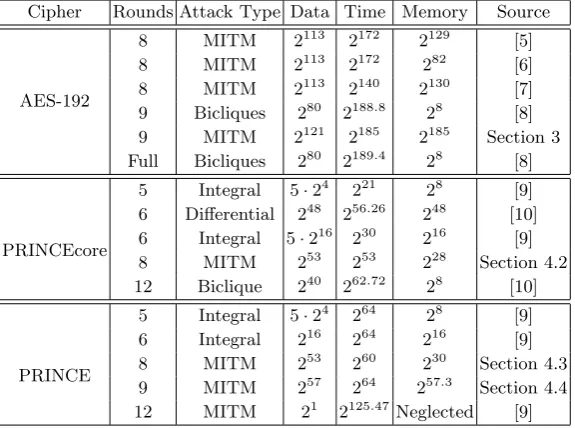
Table 1 summarizes our results along with some major previous results of AES-192 and PRINCE under single-key model. The rest of this paper is organized as follows. Section 2 describes the improved attack on 9-round AES-192. In Section 3, we apply the new technique to block cipher PRINCE, which includes 8-round attacks on PRINCEcore and PRINCE, and 9-round attack on PRINCE. Finally, we conclude the paper in Section 4.
Table 1.Summary of the Attacks on AES-192 and PRINCE in the Single-key Model
Cipher Rounds Attack Type Data Time Memory Source
AES-192
8 MITM 2113 2172 2129 [5]
8 MITM 2113 2172 282 [6]
8 MITM 2113 2140 2130 [7]
9 Bicliques 280 2188.8 28 [8]
9 MITM 2121 2185 2185 Section 3
Full Bicliques 280 2189.4 28 [8]
PRINCEcore
5 Integral 5·24 221 28 [9]
6 Differential 248 256.26 248 [10]
6 Integral 5·216 230 216 [9]
8 MITM 253 253 228 Section 4.2
12 Biclique 240 262.72 28 [10]
PRINCE
5 Integral 5·24 264 28 [9]
6 Integral 216 264 216 [9]
8 MITM 253 260 230 Section 4.3
9 MITM 257 264 257.3 Section 4.4
12 MITM 21 2125.47Neglected [9]
2
Primitive
3
The Meet-in-the-Middle Attack on 9-Round AES-192
Throughout the paper, the bit-wise exclusive OR (XOR) operation is denoted by ⊕, and bit string concatenation is denoted by ||. A 128-bit (or 64-bit) stateAis represented as a 4×4 matrix, we use the symbolA[i] to express the bytes (or nibbles), wherei(i= 0,· · · ,15) represents the order of the byte (or nibble). We also define the column ofAwhich includes four bytes (or nibbles) as (A[4j]· · ·A[4j+ 3]) for
j= 0,· · · ,3.
3.1 Brief Description of AES-192 and Previous Results
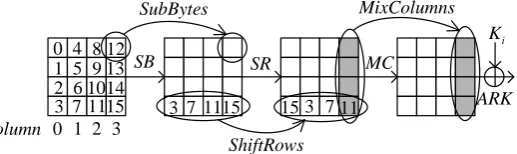
AES-192 [11] is an iterated block cipher which encrypts a 128-bit plaintext with a 192-bit key. It has 12 rounds, where each round is composed of four basic operations (see Fig. 1):
– SubBytes (SB) is a nonlinear byte-wise substitution that applies an 8 by 8S-box to every byte.
– ShiftRows (SR) is a linear operation that rotates on the left of thei−th row byibytes.
– MixColumns (MC) is a matrix multiplication over a finite field applied to each column.
Before the first round an additional whitening ARK operation is performed, and in the last round the MC operation is omitted. In this section, Xi, Yi, Zi and Wi denote the state before SB, SR, MC, and ARX in roundi, respectively.
SB SR MC
ARK
0 1
15 2 3
4 5 6 7
8 9 10 11
12 13 14
15
3 7 11 15 3 7 11
i
K SubBytes
ShiftRows
MixColumns
column 0 1 2 3
Fig. 1.The AES round function
Key schedule. The 192-bit master key is divided into 6 words of 32 bits each (w0, w1,· · · , w5). Then the following algorithm is utilized to generate the 13 subkeys of 128-bit which consists of 52 words of 32-bit. Here,ki represents the 128-bit subkey of roundi, and ui=M C−1(ki).
– Fori= 6 toi= 51 do the following:
• Ifi≡0 mod 6, thenwi=wi−6⊕SB(RotByte(wi−1))⊕Rconi/6,
• Elsewi=wi−6⊕wi−1,
where RotByte represents one byte rotation (a0, a1, a2, a3) → (a1, a2, a3, a0), and Rcon is an array of fixed constants. For more details about AES, we refer the readers to [11].
Previous attacks.For the reason of importance and popularity, there are many significant cryptanalysis results of AES-192 with various methods in previous years, such as [12,2,13,8,14,15,16]. For the single-key model, until 2010, the best result is an 8-round cryptanalysis with MITM attack given by Dunkelmanet al.[5], which costs about 2172encryptions. Then at Asiacrypt 2011, Bogdanovet al.[8] proposed 9-round and full-round attacks with bicliques method, which need 2188.8 and 2189.4 encryptions, respectively. Recently, Derbez et al.[7] improved the 8-round result of MITM attack to about 2140encryptions.
3.2 The Meet-in-the-Middle Attack on 9-Round AES-192
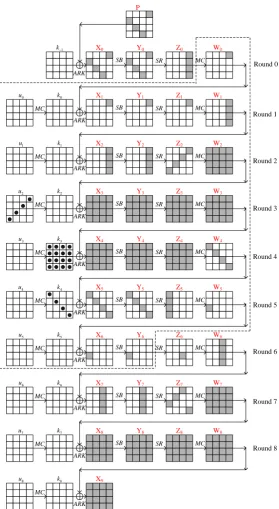
Our attack is based on a 5-round distinguisher which is outlined by dotted line in Fig. 3 (Appendix A). The distinguisher was first proposed by Derbezet al.in [6], and was used to attack on 9-round AES-256. To be consistent with previous works, theδ−set utilized in this section contains 28values which traverses all values in byteW0[12] and are constants in the other bytes. Nevertheless, for the purpose of obtaining a better attack, we define it as an ordered sequence, and symbol it as (W00,· · · , W0255).
Proposition 1. Considering the encryption of the first 25 values (W0
0,· · ·, W031) of theδ−set through
5-round AES-192, in the case that a pair(Wi 0, W
j
0) (0≤i, j≤255)conforms to the truncated differential
characteristic outlined in Fig. 3, the corresponding 256-bit sequence (Yi
6[2]⊕Y60[2],· · · , Y6i[2]⊕Y631[2])
only takes about2192 values.
Proof. The proof is similar to those of the previous works in [5] and [6]. Firstly, the sequence (Yi 6 ⊕
Y60,· · ·, Y6i⊕Y631) is computed by the 42-byte variable
V = (X1i[12], X2i[12,· · ·,15], X3i[0,· · · ,15], k3[0,· · ·,15], k4[0,5,10,15], k5[2]),
Secondly, the 42-byte value is determined by the 26-byte variable of difference
(∆Y1[12], ∆Y2[12,· · · ,15], ∆Y3[0,· · ·15], ∆X5[0,5,10,15], ∆X6[2]),
where∆Y and∆Xdenote corresponding difference values (Yi⊕Yj) and (Xi⊕Xj) for the pair (Wi 0, W
j 0). Moreover, by the aid of 208-bit difference, we can get a 192-bit subkey
(u2[3,6,9,12], k3[0,· · · ,15], k4[0,5,10,15]).
According to key schedule of AES-192, we can linearly deduce the forth column ofk0andk1, and the first two columns ofk2 with the knowledge ofk3. Meanwhile,k5[2] can also be obtained byk3[10] andk4[15]. Here, we notice thatu2[3,6] could be computed by two independent methods, one is deduced immediately by the truncated differential characteristic, the other is got by k3. Therefore, the corresponding 208-bit difference must be an incorrect state if the two values of u2[3,6] are not equal. Otherwise, it is a proper state. The probability that a proper state occurs is about 2−16, so there exist about 2192 possible values ofV, actually.
Finally, with the knowledge ofk0[12],k1[12,· · ·15] andk5[2], we obtain the ordered sequence (Y6i[2]⊕
Y0
6[2],· · · , Y6i[2]⊕Y6255[2]) of theδ−set. ut
Note that, for the reason of reducing the memory complexity, we only need to compute the first 32-byte value of the δ−set since it is sufficient to distinguish a proper sequences with the probability of 2192/2256 = 2−64. Furthermore, the time complexity can be reduced by 23 times in the online phase of the attack.
Attack procedure. The attack is composed of two phases: precomputation phase and online phase. In the precomputation phase, we get all possible 256-bit sequences described as Proposition 1 by using of differential match technique.
For each 128-bitk3, do the following steps.
1. Compute the subkeyu2[3,6],k1[12,13,14,15], k0[12] by the key schedule.
2. Traverse (∆W5[2], W5[0,1,2,3]) to compute (∆X5[0,5,10,15], X5[0,5,10,15]), and store (X5[0,5,10, 15]) in a tableT0 indexed by ∆X5[0,5,10,15]. There are about 28 values ofX5[0,5,10,15] for each index.
3. For all 32-bit difference∆Y2[12,· · · ,15] and∆X5[0,5,10,15], we apply the super-sbox technique [?] to connect the differences∆Y2[12,· · ·,15] and ∆X5[0,5,10,15], and deduce the intermediate values (X3, W4). ThenY2[14,15] is obtained byX3andu2[3,6]. Store these values with the index of the 48-bit value (∆Y2[12,· · ·,15],Y2[14,15]) in a tableT1. There are about 216 values of (∆X5[0,5,10,15], X3,
W4[0,5,10,15]) corresponding to the index (∆Y2[12,· · · ,15],Y2[14,15]). 4. For each (∆W0[12], W0[12],X1[1,6,11]), execute the following substeps.
(a) ComputeX1[12], X2[12,13,14,15],∆Y2[12,13,14,15] andY2[12,13,14,15] by partial encryption. (b) Then look up tableT1to get about 216values (∆X5[0,5,10,15], X3, W4[0,5,10,15]) by the values
of (∆Y2[12,13,14,15],Y2[14,15]). Andu2[9,12] are obtained byX3 andY2[12,13].
(c) For every (∆X5[0,5,10,15], X3, W4[0,5,10,15]), we get 28 values of X5[0,5,10,15] by accessing the table T0. Then k4[0,5,10,15] = X5[0,5,10,15]⊕W4[0,5,10,15], and k5[2] = S(k4[15])⊕
k3[10]⊕Rcon. Here we obtain the intermediate valuesV.
(d) For eachV, construct theδ−set, compute the corresponding sequence (Y6[2]⊕Y60[2],· · ·,Y6[2]⊕
Y631[2]), and store them in tableH.
In the online phase, we deduce all possible subkeys for the plaintext-ciphertext pairs satisfying the trun-cated differential characteristic, and identify the first 32 bytes value of aδ−set. Finally, detect whether it belongs to the precomputation table. The attack procedure is described as follows.
2. For each pair, do the following substeps.
(a) Guess the difference value∆Y7[8,9,10,11], and compute the subkeyu8. Then deduceu7[2,5]. (b) Compute the difference∆X7[9,10], delete the wrong guesses which do not lead to∆Z6[8,9,11] =
0, and there are about 224 guesses remaining after this step. (c) For each remaining guess, deduce subkeyu7[8,15].
(d) Guess the difference∆W0[12], and compute the subkeyk−1[1,6,11,12].
3. For each deduced subkey, select a pair of message and get the valueW0[12]. Then change the value ofW0[12] to be (0,· · ·,32) and compute plaintexts (P0,· · ·, P31). Query their corresponding cipher-texts, and get the corresponding sequence (Y6[2]⊕Y60[2],· · ·, Y6[2]⊕Y631[2]) by partial decryption, where Y6[2] represents the intermediate value of the selected message under the deduced subkeys. Note that we don’t guessu6[10] in such case.
4. Delete the wrong subkeys by verifying whether the sequence lies in tableH. There are about 2176×2−64 subkeys remaining in the end. Then exhaustively search foru7[9,· · ·14] to find the real key, which needs about 2160encryptions.
Complexity analysis.The time complexity of the precomputation phase is about 2192simple operations, which also needs about 2193 128-bit memories. The time complexity of the online phase is dominated by Step 3, which is equivalent to about 2144×232×25×2−4= 21779-round encryptions. With time-memory tradeoff, the adversary only needs to precompute a fraction 2−8 of possible sequences, so the memory complexity reduces to 2185 128-bit memories, the data and time complexities increase to 2121 chosen plaintexts and 2185encryptions, respectively.
4
The Improved Attack on Block Cipher PRINCE
In this section, we introduce the application of the new technique to the lightweight block cipher PRINCE. We firstly present attacks on 8-round PRINCEcore and PRINCE utilizing a 6-round distinguisher. After that, we propose an interesting 7-round distinguisher and 9-round attack on PRINCE.
4.1 The Block Cipher PRINCE
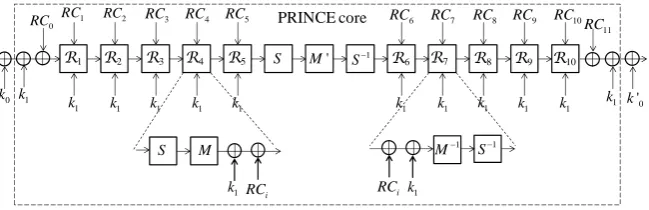
PRINCE [17] is a 64-bit block cipher with a 128-bit key. The key is split into two parts,k=k0||k1, and generates the subkey k00 = (k0 ≫1)⊕(k063), wherek0 and k1 are 64 bits. The subkeys k0 andk00 are used as input and output whitening keys respectively, whilek1is used as the internal key for the core of the block cipher which is named PRINCEcore (see Fig. 2).
R1 R2 R3 R4 R5 R6 R7 R8 R9 R10
0
RC RC1 RC2 RC3 RC4 RC5 PRINCE core RC6 RC7 RC8 RC9 RC10 11
RC
'
M
M M1
1
k
1
k k1 k1 k1 k1 k1 k1 k1 k1 k1 1
k
0
k
0 '
k
S
S 1
S
1
S
1
k k1
i
RC RCi
Fig. 2.Description of PRINCE block cipher
The PRINCEcore is a Substitution-Permutation Network composed of 12 rounds. Each round function
Ri includes a key addition, a Sbox-layer, a linear layer, and a constant addition layer.
– In the linear layer, the 64-bit state is multiplied with a 64×64 matrixM (orM0), respectively. More precisely, for 64-bit state (x0||x1||x2||x3), the linear layer M0 is defined as
M0(x0||x1||x2||x3) = M0(x0)||M1(x1)||M1(x2)||M0(x3),
where M0 and M1 are two different 16×16 matrixes, of which each output bit is only determined by three bits of the input value. The linear diffusion layerM is composed ofM0 and an AES-like ShiftRows operation:M = SR◦M0.
– Key addition is defined by the bitwise addition of the 64-bit subkeyk1.
– The constant addition layer is a XORed operation of the 64-bit state with a 64-bit constantRCr(r=
1· · ·12). Note that the differenceRCr⊕RC11−iequals to a constant valueα= 0xc0ac29b7c97c50dd.
The encryption of PRINCEcore has three parts: forward rounds, middle rounds and backward rounds. The round functions is defined as follows.
– The forward rounds are defined as
Ri(x) =M(S(x⊕k1⊕RCi)) f or i= 0· · ·4.
– The middle two rounds are defined as
R(x) =S−1(M0(S(x⊕k1⊕RC5)))⊕k1⊕RC6.
– The backward rounds are the inversion of forward rounds, which are defined as
Ri(x) =S−1(M−1(x))⊕k1⊕RCi f or i= 7· · ·11.
The designers claim that given 2n encryption/decryption pairs, the adversary can not recover the key with a complexity significantly lower than 2127−n under the single-key setting. For more details of PRINCE, please refer to [17].
Previous results. As far as we know, the best results for PRINCEcore under single-key model are 6 rounds with 230encryptions [9] and full rounds with 262.72encryptions [10]. For PRINCE, the best results are 6 rounds with 264 encryptions and full rounds with 2125.47 encryptions [9,18].
4.2 The Meet-in-the-Middle Attack on 8-Round PRINCEcore
In order to simplify the attack, we denote the equivalent keyM−1(k1) asK1, seen Fig. 4 (Appendix B). Firstly, we present two useful propositions in the following.
Proposition 2. Consider the function y = g(x) = S−1(Mi(S(x))) (i = 0,1), where S represents the
S-box layer, Mi is defined in Section 4.1,xandy are 16-bit variables. Given two nonzero differences∆x
and∆y, the equation
g(x)⊕g(x⊕∆x) =∆y,
has a solution on average.
Proof. The function y = g(x) is actually a super-sbox {0,1}16 → {0,1}16. According to the general property of S-box, there exists a pair on average that satisfies the known nonzero input and output
differences. ut
Thus, the function (y0||y1||y2||y3) =S−1(M0(S(x0||x1||x2||x3))) is sliced as four independent{0,1}16→
{0,1}16super-sboxes. For equation
if all 16-bit differences ∆xi and ∆yi (i = 0· · ·3) are nonzero values, we averagely get a pair to sat-isfy a given difference. Note that this operation can be performed by constructing two small difference distribution tables, the time complexity is about 232 simple computations.
In this section, we define theδ-set including 24 values (X0,· · ·X15), which traverses all values of a nibble X1[0] (with an ordered sequence) and keeps the values in the other nibbles to be constants. The six round distinguisher is outlined with dotted line in Fig. 4, where the black boxes represent the nonzero differences for truncated differential characteristic, the gray boxes represent uncertain differences (zero or nonzero), and the white boxes represent the zero difference.
Proposition 3. If there exists a pair (Xi
1,Xe1) which satisfies the truncated difference characteristic as
described in Fig. 4, then after 6-round encryption of aδ-set(X0
1,· · ·X115)which traverses the nibbleX[0],
the corresponding sequence of ciphertexts(X60[0],· · · , X615[0])takes about228 values out of264 theoretical
values.
Proof. We consider the computation ofX6l[0] for 0≤l≤15 and l6=i. Actually,X6l[0] is determined by a 96-bit intermediate variable
V= (X2i[0,7,10,13], X3i[0,· · ·,15], K4[0,7,10,13]),
whereX2iandX3idenote the corresponding intermediate variables ofX1i. Using the known value of (X1i[0],
Xl
1[0]), we obtain the value of (Y2i[0]⊕Y2l[0]), and then get (X2i[0,7,10,13]⊕X2l[0,7,10,13]).After that, based on the known value of (Xi
2[0,7,10,13]), we get the difference (X3i[0· · ·15]⊕X3l[0· · ·15]). Then according to the value of (Xi
3[0,· · ·,15]), we obtain (Y4l[0,7,10,13]). In the end, we get the value X6l[0]
through the known (K4[0,7,10,13]).
Then we focus on the possible 96-bit intermediate variables V, if there exists a pair (Xi
1,Xe1) which satisfies the truncated differential characteristic D as described in Fig. 4. We conclude that 96-bit V is determined by a 44-bit difference variable
(∆Y2[0,1], ∆Y3[0,7,10,13], ∆Y4[0,7,10,13], ∆Y5[0]),
where ∆Yj represents the intermediate difference (Yji ⊕Yej) for the pair (X1i,Xe1). According to dif-ferential match technique, if all gray boxes are active, we deduce the value (Xi
2[0,7,10,13]) with the difference (∆Y2[0,1], ∆Y3[0,7,10,13]). Similarly, the value (X5i[0,7,10,13]) is obtained by the differ-ence (∆Y4[0,7,10,13], ∆Y5[0]), and the value (X3i, X4i) is deduced by the difference (∆Y3[0,7,10,13],
∆Y4[0,7,10,13]). In the end, (K4[0,7,10,13]) is computed subsequently. However, different from AES, the branch number of diffusion layer is 4 for PRINCE, so it may be possible that one or some gray boxes are inactive in some D, then the differential match does not work for such S−boxes, and we have to search all possible input and output values of theseS−boxes. But it is clear that the probability of this occurrence is not so high, we presume that it does not influence the total number of possible values ofV. Therefore, there are only about 244possible values for 96-bitV ofX1i if a pair (X1i,Xe1) conforms to the expected D.
Finally, we prove that there are only 228 possible values of V by key-dependent sieve. For each 44-bit difference, we can get the corresponding subkey (K4[0,7,10,13]). Moverover, we can also obtain the subkey (K3[0,7,10,13]) at same time. In the line of key schedule of PRINCEcore, they should be the same value. The probability of the subkeys to be equal to each other is about 2−16, then the number of
V is only about 228.
In a word, the sequence (X60[0],· · ·, X615[0]) only takes about 228 possible values if there exists a pair (X1i,Xe1) satisfying the truncated differential characteristic. ut
Remark 1. As described in Proposition 3,Y5i[1,2,3] (i= 0,· · ·,15) are also obtained in the computation of the sequence. Thus, the 192-bit sequence
are deduced in the computation of the sequence (X0
6[0],· · · , X615[0]). There are 228 192-bit sequences,
too.
Attack procedure.We mount an attack on 8-round PRINCEcore by extending one round forward and one round backward of the 6-round distinguisher (see Fig. 4). The attack procedure is similar to that of the AES-192, we first need to precompute all possible sequences as follows.
1. As described in Proposition 2, construct two tablesT1andT2, which list all input and output difference values (∆x, ∆y) and their corresponding pairs (x, y, x0, y0) for functions y = S−1◦M
0◦S(x) and
y=S−1◦M
1◦S(x), respectively.
2. For all (∆Y2[0,1], Y2[0,1,2,3]), deduce the valueW2[0,7,10,13] and∆Y3[0,7,10,13], and then store the difference (∆Y2[0,1], Y2[0], W2[0,7,10,13]) indexed by the value∆Y3[0,7,10,13] in tableT3. There are about 28 values for each index.
3. Similarly, for all (∆Y5[0], Y5[0,1,2,3]), deduce the values (W5[0,7,10,13], ∆Y4[0,7,10,13]), and then store these values (∆Y5[0], Y5[0], W5[0,7,10,13]) with the index of∆W5[0,7,10,13] in tableT4. 4. For each possible difference (∆Y3[0,7,10,13], ∆Y4[0,7,10,13]), perform the following substeps:
(a) Compute the differences ∆X3 and ∆X4, and then deduce the values Y3[0,7,10,13] andY4[0,7, 10,13] by querying the tablesT1 andT2 in the first step.
(b) Query the tableT3 with values∆Y3[0,7,10,13] to get (∆Y2[0,1], Y2[0], W2[0,7,10,13]). And ac-cess the table T4 with values ∆Y4[0,7,10,13] to get (∆Y5[0], Y5[0], W5[0,7,10,13]). If the equa-tion (W2[0,7,10,13]⊕Y3[0,7,10,13]) = (W5[0,7,10,13]⊕Y4[0,7,10,13]) holds,K4[0,7,10,13] =
W5[0,7,10,13]⊕Y4[0,7,10,13]. Then we computeX2[0,7,10,13] andX1[0]. Here, we obtainV. (c) On the basis ofV, we construct aδ−set, compute the corresponding sequence (X60[0],· · · , X615[0]),
and store it in a tableH.
Then, in the online phase, we retrieve the master key as follows.
1. Ask for the encryptions of 221 structures of 232 plaintexts, such that nibbles P[0· · ·7] traverse all possible values and the other nibbles are constants. For each structure, perform the following substeps:
(a) Store the ciphertexts in a hash table indexed by nibblesC[4· · ·15], the pairs which lie in the same line form right pairs. This step performs a 48-bit filter, the expected number of the remaining pairs is about 215.
(b) Guess 16-bit valuek1[0,1,2,3], compute (∆Z1[0,1,2,3], ∆Z6[0,1,2,3]), delete pairs which do not satisfy∆Z1[1,2,3] = 0 and∆Z6[1,2,3] = 0. We expect that there are about 2−9pairs remaining for each structure. In total, there are about 212pairs left for each 16-bit key guess after this step.
2. For every above 16-bit subkey guess, guessk1[4,5,6,7] and get the value ∆Z1[4,5,6,7], then keep the pair which satisfies ∆Z1[4,6,7] = 0. Thus, for each 32-bit subkey guess, we obtain a pair which conforms to the expected differential characteristic on average.
3. For the obtained pair under each 32-bit key guess, select one message and compute the valueX1[0], then deduce the corresponding plaintexts for δ−set (X0
1,· · ·, X115). Afterwards, encrypt the
plain-texts and get the corresponding cipherplain-texts. Partially decrypt the cipherplain-texts and get the sequence (X0
6[0],· · · , X615[0]), detect whether the sequence lies in the tableH, if not, go back to step 2 for the
next subkey guess. Otherwise, exhaustively search for 32-bit keyk1[8,· · · ,15] and recover the master key.
Complexity analysis. The time complexity of the precomputation phase is about 240 simple compu-tations. In the online phase, it is obvious that the time complexity is dominated by step 1, which needs about 253encryptions to get the plain-ciphertexts. The data complexity of the attack is about 253chosen plaintexts. The memory complexity is about 228 64-bit memory which is used to store all possible values of (X0
4.3 Extend the Attack to 8-Round PRINCE
For the 8-round attack on PRINCE, the adversary has to retrieve the equivalent key ˆk1[0,· · ·7] and ˜
k1[0,1,2,3], where ˆk1=k0⊕k1 and ˜k1=k00 ⊕k1. The attack procedure is demonstrated as follows:
1. Similar to the attack on PRINCEcore, look for a proper pair for every key guess, select one message and construct aδ−set, then retrieve 64-bit key (ˆk1[0,· · ·7],k˜1[0,1,2,3], k1[0,1,2,3]),wherek1[0,1,2,3] is decided by ˆk1[0,1,2,3],˜k1[0,1,2,3] and 1-bit key guess ofk1. This step needs about 260 computa-tions.
2. For the selected pair and 64-bit key obtained in the above step, guess the equivalent key ˜k1[4,5,6,7], and compute
(W6[1]⊕W60[1],· · ·, W6[1]⊕W615[1]),
then find the correct guess by remark 1, whereW6[1] represents the intermediate value of the message. 3. Similar to step 2, retrieve the key ˜k1[8,9,10,11] and ˜k1[12,13,14,15], respectively.
4. Search for the remaining 32-bit key ˆk1[8,· · ·15] and find the master key.
In the total, the data complexity is about 253, the time complexity is about 260, the memory complexity is about 23064-bit memory which is used to store 256-bit possible sequences.
4.4 The Meet-in-the-Middle Attack on 9-Round PRINCE
Our attack is based on a fact that each bit of the output value ofMi (i= 0,1) operation only depends on three bits of the input value. We first introduce a 7-round distinguisher which is composed of two forward rounds, two middle rounds and three backward rounds (without the last S−box layer). It is outlined with dotted line in Fig. 5 (Appendix C), where a represents a special value satisfyingM1(a||0||0||0) = (b1||b2||b3||0).
Proposition 4. Suppose a pair (X1i,Xe1) conforms to the differential characteristic described in Fig.
5, then after 7-round encryption of a δ−set (X0
1,· · ·, X115), there are only about 256 values for 152-bit
sequence
Xi
1[4,7], K4[0,1,3,4,6,7,9,10,11,12,13,14], W71[j](1),· · ·, W715[j](1),
for j=0,1,4,7,13,14, where W7[j](1) represents a bit value which is determined by three nibblesZ6[4,5,6].
Proof. According to the property of M0 function, there must exist a bit of Y6[4] which doesn’t depend onZ6[7], we symbol such bit asY6[4](1). Then, for aδ−set (X10,· · ·, X115), we consider the computation
of (Y60[4](1)· · ·Y615[4](1)).In fact, this sequence is determined by a 128-bit intermediate variable
V = (X2i[1,4,11,14], X3i[1,· · · ,15], K4[0,1,3,4,6,7,9,10,11,12,13,14]).
Nevertheless, if there exists a pair (X1i,Xe1) following the expected truncated differential characteristic, the 128-bit variable is determined by the 84-bit difference variable
(∆Y2[4,7], ∆Y3[1,4,11,14], ∆Y4[0,1,3,4,6,7,9,10,11,12,13,14], ∆Y5[1,4,14]),
where ∆Yj means (Yji⊕Yej).
However, the 76-bit subkeys are deduced from the difference variable
(K3[1,4,11,14], K4[0,1,3], K4[4,6,7], K4[9,10,11], K4[12,13,14], K5[1,4,14]).
By key schedule, we knowK3[1,4,14] =K4[1,4,14] =K5[1,4,14] and K3[11] =K4[11]. Thus, there are only about 284×2−28= 256 values ofV.
Finally, with the knowledge of 48-bit equivalent key, it is sufficient to compute intermediate values
for 0≤j≤15. Therefore, we obtain a bit-based sequence
(Y61[j](1)· · · , Y615[j](1)),
for j = 0· · ·7,12,· · ·15. More precisely, for j = 0· · ·3, Y1
6[j](1) represents a bit value which doesn’t depend onZ6[2]. Forj = 4· · ·7 andj = 12· · ·15,Y61[j](1) represent the values do not rely on Z6[7] and
Z6[13], respectively. In our attack, we only take advantage of the case j = 0,1,4,7,13,14 and compute
the corresponding values of W7. ut
Note that, as a general approach, if we do not restrict the value of ∆Y6[4] in such D, and S of distinguisher is based on the nibble value of W7, then the number of S is determined by 27 nibbles’ difference
(∆Y2[4,7], ∆Y3[1,4,11,14], ∆Y4, ∆Y5[1,4,11,14], ∆Y6[4]).
Combined with key-dependent sieve (eliminating 1−2−32ofS), there are 276possible values ofS, totally. It is infeasible since the complexity is too high to overstep the security claimed by designers. Therefore, we construct a bit-based sequence instead of a nibble-based sequence.
Attack procedure. Our attack is mounted by extending one round forward and one round backward for 7-round-like distinguisher (see Fig. 5). The precomputation is given as follows.
For each∆Y4[0,1,3,4,6,7,9,10,11,12,13,14], we do the following steps.
1. For all possible differences∆Y3[1,4,11,14], deduce the values (Y3, Y4) by using of differential match technique, and store (∆Y3[1,4,11,14], Y3[1,4,11,14], X3, Y4) indexed by 12-bit informationY4[1,4,14] in tableT1. There are about 24values for every index.
2. For all the possible differences∆Y5[1,4,14] and the fixed value∆Y6[4].
(a) Deduce the values (W5[0,1,3,4,6,7,9,10,11,12,13,14], Y5[1,4,14], W6[1,4,14], Z6[4,5,6]) by con-necting the differences∆Y4[0,1,3,4,6,7,9,10,11,12,13,14],∆Y5[1,4,14] and∆Y6[4].
(b) Then computeK5[1,4,14] =Y5[1,4,14]⊕W6[1,4,14]. Then we knowY4[1,4,14] =K5[1,4,14]⊕
W5[1,4,14], and access tableT1to get (∆Y3[1,4,11,14], Y3[1,4,11,14], X3, Y4). Thus,K4[0,1,3,4, 6,7,9,10,11,12,13,14] is deduced fromY4 andW5.
(c) ComputeW2[1,4,11,14] =Y3[1,4,11,14]⊕K4[1,4,11,14], and deduce the valuesX2[1,4,11,14] and ∆Y2[4,5,6,7] by partial decryption. If∆Y2[5] =∆Y2[6] = 0 holds , we obtain a value ofV, i.e., (X2[1,4,11,14], X3[1,· · · ,15], K4[0,1,3,4,6,7,9,10,11,12,13,14]).
(d) By the value of V, we construct the δ−set and its corresponding 152-bit sequence as listed in Proposition 4, and store it in tableH.
Compared with the 8-round attacks, we need more complicated steps to identify the right key in the online phase as follows.
1. Ask for encrypting 225 structures of 232 plaintexts, such that nibbles P[0· · ·7] traverse all possible values and the other nibbles are constants. For each structure, store the ciphertexts with a hash table indexed by nibbles C[0,· · ·,3,8,· · · ,15], the pair which lie in the same line may be a right pair. There are about 240 right pairs remaining.
2. Look for pairs which satisfy the truncated differential characteristic.
(a) Guess 16-bit equivalent key ˆk[4,5,6,7], compute the value ∆Z1[4,5,6,7], and delete the pairs which do not satisfy ∆Z1[5,6,7] = 0, where ˆk =k0⊕k1. The expected number of left pairs is about 228after this step.
(b) Guess 16-bit equivalent key ˜k[4,5,6,7], compute the value∆Z7[4,5,6,7] and only keep the pairs satisfying∆Z7[5,6,7] = 0, where ˜k=k00⊕k1. There are about 216 remaining pairs.
(c) By the 32-bit equivalent key
(ˆ
k[4,5,6,7] =k1{17,· · · ,32} ⊕k0{17,· · ·,32} ˜
we deduce the master key (k1{17,· · ·,32}, k0{18,· · · ,33}) by guessing 1-bit valuek0{17}, where
k{j} symbol the j−th bit of k. Compute the difference ∆W7[4] and discard the pairs which do not satisfy ∆W7[4] =a. Thus, there are about 212 pairs left.
(d) Guess ˆk[0,1,2,3], compute the value∆Z1[0,1,2,3], keep the pairs which satisfy∆Z1[0,1,2] = 0. There is a pair left for each 49-bit key guess on average.
3. For the left pairs under the 49-bit key guess, select one message and guess subkey (k1[1,14], k0{64}), then do the following substeps.
(a) Compute the value (X1[4,7]), construct a δ−set, and get its ciphertext. Then, compute 48-bit value
W71[j](1),· · ·, W715[j](1) f or j= 1,4,14,
check the hash table H, and find the sequences which have the same 56-bit value
(X1[4,7], W71[j] (1),
· · ·, W715[j](1)).
There are about a sequence obtained for each 58-bit key guess.
(b) For each 58-bit key guess along with its sequence, deduce the real key k1 by the information of 48-bit K4 (in sequence) and 24-bitk1 (guessed). It is obvious that there exists 8-bit information redundance, so there are about 250 58-bit key guesses remaining after this step.
(c) For every the key guess along with its sequence, deducek0{1· · ·16}, compute ˜k[0,1,2,3], and get 48-bit value
W71[j](1),· · ·, W715[j](1) f or j= 0,7,13.
Check whether it equals to the value of sequence. The expected number of proper 58-bit key guess is about 250×2−48.
4. For the remained 58-bit key guesses along with the computation ofk1, search for 30-bitk0{34· · ·63} to obtain the master key.
Complexity analysis.The time complexity of the precomputation phase is dominated by substeps 2.(b) and 2.(c), which are about 264 computations. The memory requirement is about 256 152-bit, which is equivalent to 257.364-bit. In the online phase, step 1 needs about 257computations. The time complexity of step 2 is dominated by substep 2.(d), which needs about 261 computations. The time complexity of step 3 is dominated by substep 3.(a), which is about 258×24 computations. Overall, the attack needs about 257chosen plaintexts and 257.364-bit memory bytes, the time complexity is lower then 2649-round encryptions.
5
Conclusion
In this article, we propose a new technique named key-dependent sieve to further reduce the memory complexity of MITM attack. In particular, we apply this technique to attack on 9-round AES-192, 8-round PRINCEcore and PRINCE. Furthermore, we propose a bit-based distinguisher and achieve 9-8-round attack on PRINCE. To the best of our knowledge, these are the most efficient results in single-key model for AES-192 and PRINCE. The new technique takes an interesting view of MITM attack, we believe that this view, in a sense, will give rise to more attentions about application of MITM cryptanalysis.
References
1. Diffie, W., Hellman, M.E.: Special Feature Exhaustive Cryptanalysis of the NBS Data Encryption Standard. Computer10(1977) 74–84
3. Demirci, H., Taskin, I., C¸ oban, M., Baysal, A.: Improved meet-in-the-middle attacks on aes. In Roy, B.K., Sendrier, N., eds.: INDOCRYPT 2009. Volume 5922 of Lecture Notes in Computer Science., Springer (2009) 144–156
4. Gilbert, H., Minier, M.: A Collision Attack on 7 Rounds of Rijndael. In: AES Candidate Conference. (2000) 230–241
5. Dunkelman, O., Keller, N., Shamir, A.: Improved Single-Key Attacks on 8-Round AES-192 and AES-256. In Abe, M., ed.: Advances in Cryptology - ASIACRYPT 2010. Volume 6477 of Lecture Notes in Computer Science., Springer (2010) 158–176
6. Derbez, P., Fouque, P.A., Jean, J.: Improved key recovery attacks on reduced-round aes in the single-key setting. In: EUROCRYPT 2013 (to appear). (2013)
7. Derbez, P., Fouque, P.A., Jean, J.: Exahusting demirici-sel¸cuk meet-in-the-middle attacks against reduced-round aes. In: FSE 2013 (to appear). (2013)
8. Bogdanov, A., Khovratovich, D., Rechberger, C.: Biclique Cryptanalysis of the Full AES. In Lee, D.H., Wang, X., eds.: Advances in Cryptology - ASIACRYPT 2011. Volume 7073 of Lecture Notes in Computer Science., Springer (2011) 344–371
9. Jean, J., Nikolic, I., Peyrin, T., Wang, L., Wu, S.: Security analysis of prince. In: FSE 2013 (to appear). (2013)
10. Farzaneh, A., Eik, L., Stefan, L.: On the security of the core of prince against biclique and differential cryptanalysis. In: IACR Cryptology ePrint Archive 2012/712. (2012)
11. National Institute of Standards and Technology: ADVANCED ENCRYPTION STANDARD. In: In FIPS PUB 197, Federal Information Processing Standards Publication. (2001)
12. Ferguson, N., Kelsey, J., Lucks, S., Schneier, B., Stay, M., Wagner, D., Whiting, D.: Improved Cryptanalysis of Rijndael. In Schneier, B., ed.: Fast Software Encryption 2008. Volume 1978 of Lecture Notes in Computer Science., Springer (2000) 213–230
13. Lu, J., Dunkelman, O., Keller, N., Kim, J.: New Impossible Differential Attacks on AES. In Chowdhury, D.R., Rijmen, V., Das, A., eds.: Progress in Cryptology - INDOCRYPT 2008. Volume 5365 of Lecture Notes in Computer Science., Springer (2008) 279–293
14. Biryukov, A., Khovratovich, D.: Related-key cryptanalysis of the full aes-192 and aes-256. In Matsui, M., ed.: ASIACRYPT 2009. Volume 5912 of Lecture Notes in Computer Science., Springer (2009) 1–18
15. Mala, H., Dakhilalian, M., Rijmen, V., Modarres-Hashemi, M.: Improved impossible differential cryptanalysis of 7-round aes-128. In Gong, G., Gupta, K.C., eds.: INDOCRYPT 2010. Springer (2010) 282–291
16. Wei, Y., Lu, J., Hu, Y.: Meet-in-the-middle attack on 8 rounds of the aes block cipher under 192 key bits. In Bao, F., Weng, J., eds.: ISPEC 2011. Volume 6672 of Lecture Notes in Computer Science., Springer (2011) 222–232
17. Borghoff, J., Canteaut, A., G¨uneysu, T., Kavun, E.B., Knezevic, M., Knudsen, L.R., Leander, G., Nikov, V., Paar, C., Rechberger, C., Rombouts, P., Thomsen, S.S., Yal¸cin, T.: Prince - a low-latency block cipher for pervasive computing applications - extended abstract. In Wang, X., Sako, K., eds.: ASIACRYPT 2012. Volume 7658 of Lecture Notes in Computer Science., Springer (2012) 208–225
18. Soleimany, H., Blondeau, C., Yu, X., Wu, W., Nyberg, K., Zhang, H., Zhang, L., Wang, Y.: Reflection cryptanalysis of prince-like ciphers. In: FSE 2013 (to appear). (2013)
Y1 X1 SB SR MC 0 k MC 0
u Z1 W1
Y0 X0 SB SR 1 k MC
Z0 W0
ARK Y2 X2 SB SR MC 1 k MC 1
u Z2 W2
ARK Y3 X3 SB SR MC 2 k MC 2
u Z3 W3
ARK Y4 X4 SB SR MC 3 k MC 3
u Z4 W4
ARK Y5 X5 SB SR MC 4 k MC 4
u Z5 W5
ARK Y6 X6 SB SR MC 5 k MC 5
u Z6 W6
ARK Y7 X7 SB SR MC 6 k MC 6
u Z7 W7
ARK Y8 X8 SB SR MC 7 k MC 7
u Z8 W8
ARK X9 MC 8 k 8 u ARK P ARK Round 0 Round 1 Round 2 Round 3 Round 4 Round 5 Round 6 Round 7 Round 8
B
Attack on 8-Round PRINCEcore
X1
Y1 Z1
Y2 Z2 X2
X3 X4 X5 X6 Y3 Y4 Y5 Y6 Z3 Z4 Z5 Z6 P 1 ' M ' M ' M ' M 1 ' M 1 ' M SR SR SR 1 SR 1 SR 1 SR 1 M 1 M 1 M 1 M SB 4 RC 5 RC 6 RC 7 RC 8 RC 3 RC 1
k k1
1 k 1 k 1 k 1 k 1 k Sbox 1 SB ' M 2 RC C 1 k 1 Sbox 9 RC K2 K3 K4 K5 W1 W2 W3 W4 W5 W6 SB SB 1 SB 1 SB
C
Attack on 9-Round PRINCE
X1
Y1 Z1
X2 X4 X6 Y2 Y4 Y6 Z2 Z4 Z6 P 1 ' M ' M ' M 1 ' M SR SR 1 SR 1 SR 1 M 1 M 1 M SB 4 RC 6 RC 8 RC 3 RC 1 k 0 k 1 k 1 k 1 k 1 k Sbox 1 SB ' M X3
Y3 Z3
' M SR 1 M 5 RC 1 k 2 RC K2 K3 K4 K6 W1 W2 W3 W4 W6 SB SB 1 SB
X7 Z7 Y7
1 ' M 1 SR 9
RC k1
C 1 k 1 Sbox 10 RC W7 1 SB
X5 Z5 Y5
1 '
M
1
SR 1
M 7 RC 1 k K5 W5 1 SB 0 ' k a a 1 b 2 b 3 b 1 b 2 b 3 b 1 b 2 b 3 b