Generalised tally-based decoders
for traitor tracing and group testing
Boris ˇSkori´c and Wouter de Groot
Abstract—We propose a new type of score function for Tardos traitor tracing codes. It is related to the recently introduced tally-based score function [27], but it utilizes more of the information available to the decoder. It does this by keeping track ofsequences of symbols in the distributed codewords instead of looking at columns of the code matrix individually.
We derive our new class of score functions from a Neyman-Pearson hypothesis test and illustrate its performance with simulation results.
Finally we derive a score function for (medical) group testing applications.
I. COLLUSION ATTACKS ON WATERMARKING
Forensic watermarking is a means for tracing the origin and distribution of digital content. Before distribution, the content is modified by embedding an imperceptible watermark, which is unique for each recipient. When an unauthorized copy of the content is found, the watermark present in this copy reveals information about the identities of those who created the copy. A tracing algorithm (‘decoder’) outputs a list of suspicious users. This procedure is known as Traitor Tracing.
The most powerful attacks against watermarks are collusion attacks: multiple attackers (the ‘coalition’) combine their differently watermarked versions of the same content; the observed differences point to the locations of the hidden marks and allow for an informed attack.
Several types of collusion-resistant codes have been developed. The most popular type is the class of bias-based codes, introduced by G. Tardos in 2003. The initial paper [25], [26] was followed by improved analyses [3], [10], [11], [17], [23], [31], [30], code modifications [12], [20], [21], more advanced decoders [1], [5], [19], [22], [9], [27] and various generalizations [4], [28], [29], [32]. Bias-based codes have the advantage that they can achieve the asymptotically optimal relationship ` ∝c2 between the sufficient code length` and the coalition size c.
One of the main advances in recent years was finding the saddlepoint of the information-theoretic max-min game [12], [15] in the case of joint decoding. Knowing the location of the saddlepoint allows the tracer to build auniversal decoder that works optimally against the worst-case attack and that works well against all other attacks too.
II. CONTRIBUTIONS AND OUTLINE
We generalize the tally-based score function recently intro-duced by ˇSkori´c [27]. We combine a number (s) of
neigh-bouring symbols in a user’s codeword into a single composite symbol. If the original alphabet is denoted asQ, the composite
symbols are elements of Qs. We apply the tally-based score system of [27] to the composite symbols. The result is a Neyman-Pearson score that is based on more information than the original tally-based score.
The outline of this paper is as follows. In Section III we introduce notation and briefly review Tardos codes and the tally-based score function. In Section IV we derive our main result: a recipe for computing a universal score function for general s. Unfortunately the generic result is rather cumber-some; therefore we provide explicit formulas only up tos= 4
(Section V). We show that in the limitc→ ∞the composite-symbol score reduces to a sum ofs= 1scores.
Section VI discusses the performance of our new score func-tions up to s = 3. ROC curves show a clear improvement when the collusion attack is Interleaving or Majority Voting. However, for the Minority Voting attack the performance is worse than [27].
In Section VII we apply our composite-symbol technique to the field of group testing. We derive a simple recipe for computing group-testing score functions for generic s.
III. PRELIMINARIES
A. General notation and terminology
Random variables are written as capitals, and their realisations in lower-case. Sets are written in calligraphic font. (E.g. ran-dom variableX ∈ X with realisations x.) The probability of
an eventAis denoted asPr[A], and the expectation over a
ran-dom variable X is denoted asEX[f(X)]
def
= Px∈XPr[X = x]f(x). We define [s] = {1, . . . , s}. Vectors are written in boldface. The 1-norm of a vectorvis denoted as|v|=Pαvα. Falling factorials are written asx(k) def= x(x
−1)· · ·(x−k+1). The number of users is n. The alphabet is Q, with size
|Q| = q. The length of the code is `. Abstractly speaking, the content containspositionsi∈ {1, . . . , `}; in each position a symbol fromQis embedded. The number of colluders isc. The set of colluders is denoted asC ⊂[n] with|C|=c. The coalition size that the code is built to withstand is c0. (We will not always strictly distinguish between c and c0.) The term ‘asymptotically’ will be used in the meaning ‘coalition size going to infinity’.
B. Bias-based fingerprinting codes
The bias vector in position i is denoted as pi = (piα)α∈Q.
It satisfies |pi|
def
= Pα∈Qpiα = 1. The bias vectors
Dirichlet distribution (multivariate Beta distribution): F(p) = Γ(q2)[Γ(12)]−qQ
α∈Qp−
1/2
α . We use the ‘bar’ notation to in-dicate a quantity in all positions, e.g.p¯def
= (pi)i∈[`].
The code matrix is a matrixx∈ Qn×`; the matrix rows are the codewords. The j’th row is denoted as x¯j
def
= (xji)i∈[`]. The entries ofxare generated column-wise from the bias vectors:
in position i, the probability distribution for user j’s symbol
is given by Pr[Xji=α|Pi=pi] =piα.
Fori∈[`],α∈ Q, tally variables are defined as follows,
tiα def
= |{j∈[n] : xji=α}|
miα def
= |{j∈ C: xji=α}|. (1) In words:tiαis the number of users who have symbolαin the
i’th position of their codeword;miαis the number ofcolluders who have symbol α in the i’th position of their codeword. We write ti = (tiα)α∈Q andmi = (miα)α∈Q. These tallies
satisfy |ti|=nand|mi|=c.
In the Restricted Digit Model (RDM), in each position the colluders are allowed to output only a single symbol y ∈ Q
with nonzero tally my, which symbol then gets detected with 100% fidelity by the tracer. As is customary in the literature on traitor tracing, we will assume that the attackers equally share the risk. This leads to “colluder symmetry”, i.e. the attack is invariant under permutation of the colluder identities. Furthermore we assume that there is no natural ordering on the alphabet Q. Given these two symmetries, the attack depends only onm¯, the set of colluder tallies. Any attack strategy can
then be fully characterized by a set of probabilities θ¯y|m¯. The process of generating the matrix x is fully
position-symmetric, i.e. invariant under permutations of the columns of x. However, that does not guarantee that the optimal
collusion strategy is position-symmetric as well, since the realisation ofxitself breaks the symmetry. Asymptotically the
symmetry is restored (due to `→ ∞); the attack strategy can then be parametrized more compactly as a set of probabilities
θy|m applied in each position independently. In the RDM the
asymptotically optimal attack [13], [15] is the Interleaving attack: a colluder is selected uniformly at random and his symbol is output.
The process of tracing colluders based onp¯,xandy¯is referred
to as ‘decoding’. The decoder outputs a list L ⊂ [n] of
suspicious users. Often a thresholding procedure is used: a score is computed for each user, or tuple of users, and they whose score exceeds the threshold are accused. In this scenario a decoder can make two kinds of mistake: (i) Accusation of one or more innocent users, known as False Positive (FP); (ii) Not finding any of the colluders, known as False Negative (FN). The error probabilities of the decoder are
PFP= Pr[L \ C 6=∅] andPFN= Pr[L ∩ C=∅].
C. Tally-based score function in a single position
Practically all known score functions assign a score in each position i ∈ [`] and then take a sum over all positions to
obtain a user’s/tuple’s overall score. The tally-based decoder proposed in [27] also has this structure. It was derived from the Neyman-Pearson hypothesis test for the hypothesis ‘j ∈
C’ versus ‘j /∈ C’ for a user j ∈ [n], making use of the properties of hypergeometric-distributed random variables (see Section III-D). It has the form of a log-likelihood ratio. The score for user j is given byPi∈[`]h(xji, yi,ti), with
h(x, y,t) =δxyln(1 +
1 c0−1 ·
n−1 ty−1
). (2)
Although the hypothesis concerns a single user, the score takes into account the symbols received by other users via the tallies¯t.
D. The multivariate hypergeometric distribution
Consider a single column of the matrixx. LetT be the total
tally vector andMthe colluders’ tally vector, as defined in (1).
If a coalition ofcusers is selected uniformly at random out of
thenusers, the probabilityLm|tthat colluder tallymoccurs,
for givent, is
Lm|t
def
= Pr[M =m|T =t] = 1n
c
Y
α∈Q
tα
mα
. (3)
(For each symbol α, a number mα of users have to be selected out of the tα users who have that symbol). Eq. (3) is known as the multivariate hypergeometric distribution. Let
r= (rα)α∈Q, withrα∈N. Moments of the hypergeometric distribution can be obtained from
EM|t Y
α∈Q M(rα)
α =
c(|r|) n(|r|)
Y
α∈Q t(rα)
α . (4)
(See e.g. [2]). In particular, the first and second moment are given by
EM|tM =
c
nt, (5)
EM|tMαMβ= c
(2)
n(2)tαtβ+
c(n−c)
n(2) δαβtα. (6) IV. GENERALISED TALLY-BASED SCORE
A. Composite symbols
Instead of looking at user codewords symbol-by-symbol, we consider combinations ofsconsecutive locations. For simplic-ity we assume that ` = L·s, with L ∈ N. For a ∈[L] we
define a sequence ofssymbols as follows,
ξj,adef= (xj,(a−1)s+1, xj,(a−1)s+2, . . . , xj,as). (7) I.e. ξj1 is the first s-sequence andξjL is the last s-sequence in user j’s codeword. We view ξja as a composite symbol taking values in the alphabetQs. In analogy with (7) we define sequences iny as λa
def
= (y(a−1)s+1, . . . , yas)∈ Qs. Forβ ∈
Qs we define the tally t
aβ as the number of users whose sequenceξja exactly equalsβ.
Letξ∈ Qs andJ ⊆[s]. Then ξ[J]∈ Q|J| denotes a length-|J|sub-sequence ofξobtained by selecting the components of ξ indicated byJ. Forβ ∈ Q|J|we define tJ
aβ as the number of users whoseJ-part ofξja equalsβ. We define a vector eξ of lengthqs as (e
B. Derivation of the score function for arbitrary s
In [27] it was found that the Neyman-Pearson score for the hypothesis j∈ C vs.j /∈ C can be expressed as
lnEM¯|x,j∈Cθy¯|M¯
EM¯|x,j /∈Cθy¯|M¯
= lnEM¯|x,j∈C
Q
i∈[`]θyi|Mi
EM¯|x,j /∈CQi∈[`]θyi|Mi
. (8)
Evaluating the expectations over M¯ for given x involves
computing a sum over all possible candidate coalitions, i.e. all size-csubsets of[n]. Whennis of order105 or larger, this is infeasible already for moderatec. In order to get an expression
that can be handled more easily, some of the information inxhas to be ‘forgotten’. In [27] the solution was to discard
everything except the codewordx¯jand the tallies¯t. This leads to a complete factorization into single-position scores. Furthermore, in [27] the Interleaving strategyθyi|mi=miyi/c
was substituted, resulting in (2). Forc→ ∞ the Interleaving attack lies in the mutual information maxmin game saddlepoint [15], [14], and for finite c it lies very close to this point;
substitution of the saddlepoint-θ into the Neyman-Pearson
score results in auniversalscore function, i.e. a score that not only performs optimally against the saddlepoint-value of the attack but also performs well against all other attacks. Hence, substituting the Interleaving attack into (8) yields an almost universal score function.
We now follow the same approach with respect to θ, but we discard less information from x. We ‘remember’ x¯j and the composite-symbol tallies taζ for a ∈ [`/s], ζ ∈ Qs. This results in a score that is a sum of s-sequence sub-scores.
Theorem 1:Let `=s. Let ξ∈ Qs be shorthand notation for the codeword x¯j of the user under scrutiny. Let λ∈ Qs be the colluders’ output. Then the Neyman-Pearson score (8) for user j is equivalent to
w(ξ, λ,t)def= ln(
n c
EM|tθλ|M
n−1 c
EM|t−eξθλ|M
−1) (9)
whereM andtare defined overQs. The proof is given in Appendix A.
Eq. (9) can be rewritten in many different ways. The presented form has the advantage that, once an analytic expression has (laboriously) been found for the numerator, a formula for the denominator can simply be obtained by replacingt→t−eξ.
Note that the fraction n c
/ n−c1in (9) simplifies ton/(n−c). We now consider `=Ls, with L > 1, as explained in Sec-tion IV-A, and look again at the general score expression (8). On the one hand we will keep track of the composite symbols tallieswithineach bunch ofscolumns, but on the other hand
we ‘forget’, except for user j, how these composite symbols
are organised into codewords.1 According to Theorem 1 this leads to the following score system,
rj= L
X
a=1
w(ξja, λa,ta). (10)
1For example,q = 2, s = 3, ` = 9 and a user6= j has codeword 000111001. We take into account that there is a contribution tot1,000from
the first bunch ofssymbols, a contribution tot2,111from the second bunch
and tot3,001 from the third. However, we will forgetwhocontributed what
to the tallies, and thus we donotremember that the composite symbols 000, 111 and 001 are connected to each other.
whererj is the score of userj, and the function wis defined in (9). Our next task is to compute the expectationEM|tθλ|M
for one bunch of columns.
Lemma 1:Let the attack strategy be Interleaving. Then
EM|tθλInt|M =c−
s X
z1,...,zs∈Qs (
s
Y
i=1
δzi[i],λ[i])EM|t
s
Y
i=1
Mzi. (11)
Proof: The colluders apply the Interleaving strategy indepen-dently in each position, which yieldsθλ|m=Qsi=1(m{
i}
λ[i]/c). Furthermore, the sub-component tally m{αi}, for α∈ Q, can be expressed as
m{αi}=
X
z∈Qs
mzδz[i],α. (12)
We use (12)stimes, i.e. fori= 1. . . s, substitutingα=λ[i].
The expectation EM|tQ
s
i=1Mzi in (11) can be computed
using (4). This leads to rather complicated expressions, es-pecially for larges, since (11) contains powers of talliesMzi,
whereas (4) works with falling factorials. The powers that occur in the productQs
i=1Mzidepend on the
structure of the ‘collisions’ between z1, . . . , zs, i.e. whether some of the zi symbols are equal to each other and if so, which ones. This information can be captured in the notion of partitions. A partition of the set[s]into kparts is defined as
a setζ={ζ1, . . . , ζk}withζa⊆[s], ζa 6=∅,ζa∩ζb=∅ for
a6=b and Saζa = [s]. We denote the space of partitions of
[s]as P[s].
Theorem 2:It holds that
EM|tθIntλ|M =
1 csn(s)
X
ζ∈P[s] Λnc(ζ)
|ζ|
Y
a=1 tζa
λ[ζa] (13)
where the Λnc(ζ) are expressions that depend only on n, c andζ.
A proof sketch is given in Appendix B.
Corollary 1:The Neyman-Pearson score against the Interleav-ing attack is given by
gs(ξ, λ,t) def
= (14)
ln[n−s n−c ·
P
ζ∈P[s]Λnc(ζ)Q|aζ=1| t ζa
λ[ζa]
P
ζ∈P[s]Λn−1,c(ζ)Q|aζ=1| (tλζa[ζa]−δξ[ζa]λ[ζa]) −1].
Proof: Follows from substituting (13) into (9).
In general the parametersΛnc(ζ) are complicated, especially for large s. For s = 2, s = 3 and s = 4 we will give
explicit results in the coming sections. The Λ parameter for
the ‘easiest’ partition is given below for general s.
Lemma 2:Letζ={{1},{2}, . . . ,{s}}. ThenΛnc(ζ) =c(s). Proof: We consider (11) and use (4). For all terms in the
z1, . . . , zs summation, the expectation EM|t Q
iMzi
con-tains exactly one term that concon-tains s powers of t, namely
c(s)
n(s)tz1· · ·tzs. All the other terms contain fewer powers oft.
Finally, performing the summations Pzi with the constraint
δzi[i],λ[i] yields factorst {i}
Note that fors= 1 thegs is equivalent to the known single-position score function h.
g1(ξ, λ,t) = ln( n−1 n−c ·
ty
ty−δxy −
1)
= lnc−1
n−c+ ln(1 + n−1 c−1 ·
δxy
ty−δxy
)
= lnc−1
n−c+h(x, y,t). (15)
The constant shift lnc−1
n−c does not depend on x, y,t and therefore does not affect the score system.
C. Computational effort for computing the scores
How much computational effort is involved in computing the user scores g? First of all, the tally tJ
λ[J] has to be computed for each subset J ⊆ [s]. There are 2s −1 of these subsets. Each tally can be computed with practically the same amount of effort. Start with the s n-component
vectors (δξj[1]λ[1])j∈[n] · · · (δξj[s]λ[s])j∈[n] and compute the t{λi[}i] from them by summing over the users. Then create the
s 2
vectors
(δξj[ik]λ[ik])j∈[n]by componentwise multiplication
of the vectors(δξj[i]λ[i])j∈[n] and(δξj[k]λ[k])j∈[n]. Store these
vectors. Compute the t{λi,k[ik}] from them by summing over j, etc. Given code length`, the total effort of computing all these tallies scales as 2sn`/s.
Next the sum over all partitions ζ ∈ P[s] has to be taken. The number of partitions is given by the Bell numberBs. For
largesone can approximateBs≈(elnss)s[7]. The number of multiplications needed in the summation terms is proportional tos. Finally, the number of composite-symbol scores that has to be computed is n`/s.
In conclusion, for large s the total effort involved in the
computation of all users scores scales as n`(lnss)s, and the
main effort lies in multiplying the tallies in each term of the
ζ-summation.
V. SCORES FOR SMALLs
A. Score for s= 2
Theorem 3: For s = 2the Neyman-Pearson score (9) in the
case of the Interleaving attack is given by
g2(ξ, λ,t) = ln[−1 + n−2
n−c · (16)
(c−1)t{λ1[1]}tλ{2[2]} + (n−c)tλ
(c−1)(t{λ1[1]}−δξ[1]λ[1])(t{ 2}
λ[2]−δξ[2]λ[2])+(n−1−c)(tλ−δξλ)
].
Proof: The expectationEM|tMz1Mz2 follows from (6).
Sub-stitution into (11) gives c2E
M|tθIntλ|M =
c(2)
n(2)t {1}
λ[1]t
{2}
λ[2] + c(n−c)
n(2) tλ. Substitution of this expression, and of its shifted
version with(t→t−eξ, n→n−1), into (9) yields (16).
B. Score for s= 3
Lemma 3: Let α, β, γ be symbols in some alphabet. Let m
and t be the colluder tally and all-user tally respectively for
this alphabet. Then
EM|tMαMβMγ =
c(3) n(3)tαtβtγ
+ c
(2)(n
−c)
n(3) tα(δαβtγ+δαγtβ+δβγtγ) + c(n−c)(n−2c)
n(3) δαβδβγtα. (17) Proof: Follows from (4) after some diligent work.
Theorem 4: For s= 3 the Neyman-Pearson score (9) in the
case of the Interleaving attack is given by
g3(ξ, λ,t) = ln[−1 + n−3 n−c ·
A3 B3
], with (18)
A3 = c(3)t{λ1[1]}t{λ2[2]}t{λ3[3]}
+c(2)(n−c)(t{λ1[12],2}tλ{3[3]} +t{λ1[13],3}tλ{2[2]} +tλ{2[23],3}t{λ1[1]})
+c(n−c)(n−2c)tλ (19)
B3 = A3 witht→t−eξ, n→n−1 (20)
Proof:Follows the same steps as the proof of Theorem 3, but now starting from Lemma 3.
C. Score for s= 4
Lemma 4:Letα, β, γ, εbe symbols in some alphabet. Letm
andt be the colluder tally and all-user tally respectively for
this alphabet. Then
n(4)EM|t[MαMβMγMε] =
c(4)tαtβtγtε
+c(3)(n
−c)[δαβtαtγtε+δαγtαtβtε+δαεtαtβtγ
+δβγtαtβtε+δβεtαtβtγ+δγεtαtβtγ]
+c(2)(n−c)(2)[δαβδγεtαtγ+δαγδβεtαtβ+δαεδβγtαtβ]
+c(2)(n
−c)(n−2c+ 1)[δαβδβγtαtε+δαβδβεtαtγ
+δαγδγεtαtβ+δβγδγεtαtβ]
+c(n−c)[(n−2c)(n−3c) + (n−c)]δαβδβγδγεtα. (21) Proof: Follows from (4) after diligent labour.
Theorem 5: For s= 4 the Neyman-Pearson score (9) in the
case of the Interleaving attack has the form (14), with
Λnc({{1},{2},{3},{4}}) = c(4)
Λnc({{12},{3},{4}}) = c(3)(n−c)
Λnc({{12},{34}}) = c(2)(n−c)(2)
Λnc({{123},{4}}) = c(2)(n−c)(n−2c+ 1)
D. Large-c asymptotics
We now study the large-c asymptotics of the score function (14). We define ν =E[n/(cTY)]. For most attack strategies it holds that ν 1 asymptotically. The Minority Voting
attack is an exception. We look at the case ν 1. In
Sections V-A to V-C we notice that each ‘disappearance’ of a factortis accompanied by a factor≈n/c. Thus, the dominant
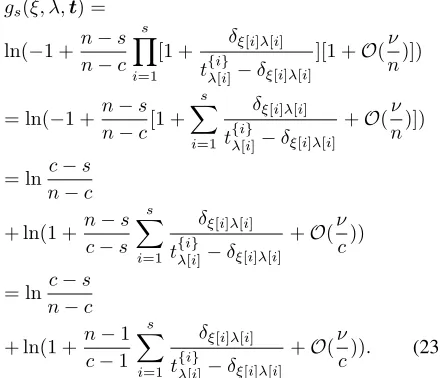
term in the ζ-summations in (14) comes from the partition {{1}, . . . ,{s}}. The other terms are of relative order ν or
smaller. We have
gs(ξ, λ,t) =
ln(−1 + n−s n−c
s
Y
i=1
[1 + δξ[i]λ[i] t{λi[}i]−δξ[i]λ[i]
][1 +O(ν n)])
= ln(−1 + n−s n−c[1 +
s
X
i=1
δξ[i]λ[i] t{λi[}i]−δξ[i]λ[i]
+O(ν n)])
= lnc−s n−c
+ ln(1 +n−s c−s
s
X
i=1
δξ[i]λ[i] t{λi[}i]−δξ[i]λ[i]
+O(ν c))
= lnc−s n−c
+ ln(1 +n−1 c−1
s
X
i=1
δξ[i]λ[i] t{λi[}i]−δξ[i]λ[i]
+O(ν
c)). (23)
On the other hand, the sum of single-position scores
Ps
i=1h(ξ[i], λ[i],t{i})can be written as s
X
i=1
ln(1 +n−1 c−1
δξ[i]λ[i] t{λi[}i]−δξ[i]λ[i]
)
= ln
s
Y
i=1
(1 +n−1 c−1
δξ[i]λ[i] t{λi[}i]−δξ[i]λ[i]
)
= ln(1 +n−1 c−1
s
X
i=1
δξ[i]λ[i] t{λi[}i]−δξ[i]λ[i]
+O(ν2)). (24)
We see that asymptotically the composite-symbol score be-comes equivalent to the sum of single-position scores, up to an unimportant term ln c−s
n−c which depends on neither the code matrix x nor the collusion output y¯. This result is not surprising; the s = 1 score is known to reach asymptotic capacity.
VI. NUMERICS
Fig. 1 shows simulation results. For each shown combination of parameters we have run the following experiment106times: generate p¯; generate the colluder symbols; apply the attack strategy to obtainy¯; generate theδxy-matrix for the innocent
users; compute thetJ
λ[J] tallies; compute scores usingc0=c. The ROC curve for each score function is plotted by varying the threshold Z. An estimate for PFP is computed as the fraction of simulation runs in which it occurs that innocent scores exist above Z. Similarly, PFN is estimated as the fraction of simulation runs in which all colluder scores lie below Z. Due to the finite number of runs, probabilities of
order1/#runsand smaller cannot be estimated accurately, as is evident from the jumps at the bottom of the graphs. Note that we generated the bias vectorswithouta cutoff onp
-space. In the graphs we do not show the (symmetrized) Tardos score and the score of Oosterwijk et al. since they generally perform worse than the Laarhoven score.
In the ROC curves we notice the following trends:
• In case of the Interleaving attack there is a clear
im-provement in the effectiveness of the tally-based score when we go froms= 1(the score introduced in [27]) to s= 2. The step from s= 2tos= 3has far less effect.
All improvements become smaller with increasing c, in accordance with Section V-D.
• When there is a mismatch between the anticipated attack
(Interleaving) and the actual attack, the composite tally-based score function is not necessarily the best one. Furthermore, with increasing sthe performance can get worse. In a sense the mismatch between the actual attack and the expected attack gets worse with increasing s.
More information is being used in the hypothesis test, but in the wrong way.
We conclude that our composite tally-based scores improve on the state of the art, but should be used as part of a battery of different score functions rather than stand-alone. When the attack is (close to) Interleaving, the new scores (s≥2) have
the lowest error rates; in case of different attacks another score function (e.g.s= 1) will catch the attackers.
VII. GROUPTESTING
A. Connection between traitor tracing and group testing There is a well known link [24], [6], [18], [16] between on the one hand Traitor Tracing in the Restrictive Digit Model with the ‘All-1’ attack, and on the other hand (non-adaptive) Group Testing [8]. The Group Testing scenario is as follows. There is a population of n people, of which c are infected. Medical tests are expensive, and there is money to do only
`tests, with`n. Furthermore the tests take a long time, so
they are done non-adaptively, in parallel. An efficient way has to be devised to find out who is infected. Luckily it is possible to combine samples (e.g. blood samples) from multiple people and run a single test on the combination; if one or more of the individual samples come from an infected person, the medical test is positive.
The analogy with Traitor Tracing is straightforward. The user symbol xji ∈ {0,1} indicates whether person j’th blood is included in the i’th test. The result of the i’th test is yi ∈
{0,1}. The way the combined test works exactly matches the
All-1 strategy:θ1|m1 equals 1if m1≥1 and0 ifm1= 0.
B. Score function for group testing
In order to derive scores for group testing, we start from (9) and substitute the All-1 attack. The results are much simpler than for the Interleaving attack.
Theorem 6: Let tJ
0 denote the number of users who have
6
The other⇤-parameters are obtained by permuting the set[s].
Proof:Follows the same steps as the proof of Theorem 3, but now starting from Lemma 4.
D. Large-casymptotics
We now study the large-c asymptotics of the score function (14). We define⌫=E[n/(cTY)]. For most attack strategies it holds that ⌫ ⌧ 1 asymptotically. The Minority Voting attack is an exception. We look at the case ⌫ ⌧ 1. In Sections V-A to V-C we notice that each ‘disappearance’ of a factortis accompanied by a factor⇡n/c. Thus, the dominant term in the ⇣-summations in (14) comes from the partition
{{1}, . . . ,{s}}. The other terms are of relative order⌫ or smaller. We have
gs(⇠, ,t) =
ln( 1 +n s
n c
s
Y
i=1
[1 + ⇠[i] [i]
t{i[}i] ⇠[i] [i] ][1 +O(⌫
n)])
= ln( 1 +n s
n c[1 +
s
X
i=1
⇠[i] [i] t{i[}i] ⇠[i] [i]
+O(⌫
n)])
= lnc s
n c
+ ln(1 +n s
c s
s
X
i=1
⇠[i] [i] t{i[}i] ⇠[i] [i]
+O(⌫
c))
= lnc s
n c
+ ln(1 +n 1
c 1
s
X
i=1
⇠[i] [i] t{i[}i] ⇠[i] [i]
+O(⌫
c)). (23) On the other hand, the sum of single-position scores
Ps
i=1h(⇠[i], [i],t{i})can be written as
s
X
i=1
ln(1 +n 1
c 1
⇠[i] [i] t{i[}i] ⇠[i] [i]
)
= ln
s
Y
i=1
(1 +n 1
c 1
⇠[i] [i] t{i[}i] ⇠[i] [i]
)
= ln(1 +n 1
c 1
s
X
i=1
⇠[i] [i] t{i[}i] ⇠[i] [i]
+O(⌫2)). (24)
We see that asymptotically the composite-symbol score be-comes equivalent to the sum of single-position scores, up to an unimportant term lnc s
n c which depends on neither the code matrix xnor the collusion outputy¯. This result is not surprising; the s = 1score is known to reach asymptotic capacity.
VI. NUMERICS
Figs. @@ show simulation results. For each shown combi-nation of parameters we have run the following experiment
106times: generatep; generate the colluder symbols; apply¯
the attack strategy to obtain y¯; generate the xy-matrix for the innocent users; compute thetJ
[J]tallies; compute scores
usingc0=c. The ROC curve for a given score function is
plotted by varying the thresholdZ. An estimate forPFP is
computed as the fraction of simulation runs in which it occurs that innocent scores lie aboveZ. Similarly,PFNis estimated
as the fraction of simulation runs in which all colluder scores lie belowZ. Due to the finite number of runs, probabilities of order1/#runsand smaller cannot be estimated accurately, as is evident from the @jumps at the bottom of the graphs. Note that we generated the bias vectorswithouta cutoff on p-space. This means that our results for the Tardos score and Oosterwijk score are too pessimistic, as they require a cutoff to perform optimally.
0.0 0.2 0.4 0.6 0.8 1.0
− 6 − 5 − 4 − 3 − 2 − 1 0 interleaving fn log10(Pfp)
log10PFP
PFN
Interleaving attack c= 5
n= 1000
`= 864
q= 2
Laarhoven s= 1
s= 3
s= 2
Fig. 1. .
@********************* Welke plotjes willen we:
• Interleavingc= 5. Het plotje metn= 1000,L= 1002
zag er leuk uit. Kunnen we een variant maken met een wat kleinereL, zodat des= 2curve de 6bereikt rond PFP= 0.5?
• Interleavingc= 12. • Minority Voting
• Majority Voting. variant op plotje van 22 mei, met wat grotereLen aantal runs.
@*********************
In the ROC curves we notice the following trends:
• In case of the Interleaving attack there is a clear im-provement in the effectiveness of the tally-based score when we go froms= 1(the score introduced in [27]) to s= 2. The step froms= 2tos= 3has far less effect. All improvements become smaller with increasingc, in accordance with Section V-D.
• When the attack is not Interleaving, the composite tally-based score is not necessarily the best score function. Furthermore, with increasingsthe performance can get worse. (The mismatch between the actual attack and the expected attack gets worse with increasings. More information is being used in the hypothesis test, but in the wrong way.)
IEEE TRANSACTIONS ON INFORMATION FORENSICS AND SECURITY 5
The other⇤-parameters are obtained by permuting the set[s].
Proof:Follows the same steps as the proof of Theorem 3, but now starting from Lemma 4.
D. Large-casymptotics
We now study the large-casymptotics of the score function (14). We define⌫ =E[n/(cTY)]. For most attack strategies
it holds that ⌫ ⌧ 1 asymptotically. The Minority Voting attack is an exception. We look at the case⌫ ⌧ 1. In Sections V-A to V-C we notice that each ‘disappearance’ of a factortis accompanied by a factor⇡n/c. Thus, the dominant term in the⇣-summations in (14) comes from the partition
{{1}, . . . ,{s}}. The other terms are of relative order⌫ or smaller. We have
gs(⇠, ,t) =
ln( 1 +n s
n c
s Y
i=1
[1 + ⇠[i] [i]
t{i[}i] ⇠[i] [i]
][1 +O(⌫
n)])
= ln( 1 +n s
n c[1 + s X
i=1 ⇠[i] [i]
t{i[}i] ⇠[i] [i]
+O(⌫
n)])
= lnc s
n c
+ ln(1 +n s
c s s X
i=1 ⇠[i] [i] t{i[}i] ⇠[i] [i]
+O(⌫
c))
= lnc s
n c
+ ln(1 +n 1
c 1
s X
i=1 ⇠[i] [i] t{i[}i] ⇠[i] [i]
+O(⌫
c)). (23)
On the other hand, the sum of single-position scores
Ps
i=1h(⇠[i], [i],t{i})can be written as s
X
i=1
ln(1 +n 1
c 1
⇠[i] [i] t{i[}i] ⇠[i] [i]
)
= ln
s Y
i=1
(1 +n 1
c 1
⇠[i] [i] t{i[}i] ⇠[i] [i]
)
= ln(1 +n 1
c 1
s X
i=1 ⇠[i] [i] t{i[}i] ⇠[i] [i]
+O(⌫2)). (24)
We see that asymptotically the composite-symbol score be-comes equivalent to the sum of single-position scores, up to an unimportant termlnc s
n c which depends on neither the
code matrixxnor the collusion outputy¯. This result is not surprising; the s = 1 score is known to reach asymptotic capacity.
VI. NUMERICS
Figs. @@ show simulation results. For each shown combi-nation of parameters we have run the following experiment
106times: generatep¯; generate the colluder symbols; apply
the attack strategy to obtainy¯; generate the xy-matrix for
the innocent users; compute thetJ
[J] tallies; compute scores
usingc0=c. The ROC curve for a given score function is
plotted by varying the thresholdZ. An estimate forPFP is
computed as the fraction of simulation runs in which it occurs that innocent scores lie aboveZ. Similarly,PFNis estimated
as the fraction of simulation runs in which all colluder scores lie belowZ. Due to the finite number of runs, probabilities of order1/#runsand smaller cannot be estimated accurately, as is evident from the @jumps at the bottom of the graphs. Note that we generated the bias vectorswithouta cutoff on
p-space. This means that our results for the Tardos score and Oosterwijk score are too pessimistic, as they require a cutoff to perform optimally.
0.0 0.2 0.4 0.6 0.8
-6 -5 -4 -3 -2 -1 0 interleaving fn lo g1 0(Pf p)
log10PFP
PFN
Interleaving attack
c= 12
n= 1000
`= 2502
q= 2
From top to bottom: Laarhoven,s= 1,s= 2,s= 3
Fig. 1. .
@********************* Welke plotjes willen we:
• Interleavingc= 5. Het plotje metn= 1000,L= 1002
zag er leuk uit. Kunnen we een variant maken met een wat kleinereL, zodat des= 2curve de 6bereikt rond
PFP= 0.5? • Interleavingc= 12. • Minority Voting
• Majority Voting. variant op plotje van 22 mei, met wat
grotereLen aantal runs. @*********************
In the ROC curves we notice the following trends:
• In case of the Interleaving attack there is a clear
im-provement in the effectiveness of the tally-based score when we go froms= 1(the score introduced in [27]) to
s= 2. The step froms= 2tos= 3has far less effect. All improvements become smaller with increasingc, in accordance with Section V-D.
• When the attack is not Interleaving, the composite
tally-based score is not necessarily the best score function. Furthermore, with increasingsthe performance can get worse. (The mismatch between the actual attack and
IEEE TRANSACTIONS ON INFORMATION FORENSICS AND SECURITY 5
The other⇤-parameters are obtained by permuting the set[s].
Proof:Follows the same steps as the proof of Theorem 3, but now starting from Lemma 4.
D. Large-casymptotics
We now study the large-casymptotics of the score function (14). We define⌫=E[n/(cTY)]. For most attack strategies it holds that ⌫ ⌧ 1 asymptotically. The Minority Voting attack is an exception. We look at the case ⌫ ⌧ 1. In Sections V-A to V-C we notice that each ‘disappearance’ of a factortis accompanied by a factor⇡n/c. Thus, the dominant term in the⇣-summations in (14) comes from the partition
{{1}, . . . ,{s}}. The other terms are of relative order⌫ or smaller. We have
gs(⇠, ,t) = ln( 1 +n s
n c s
Y
i=1
[1 + ⇠[i] [i]
t{i[}i] ⇠[i] [i]
][1 +O(⌫
n)])
= ln( 1 +n s
n c[1 + s
X
i=1 ⇠[i] [i] t{i[}i] ⇠[i] [i]
+O(⌫
n)])
= lnc s
n c
+ ln(1 +n s
c s s
X
i=1 ⇠[i] [i] t{i[}i] ⇠[i] [i]
+O(⌫
c))
= lnc s
n c
+ ln(1 +n 1
c 1
s
X
i=1 ⇠[i] [i] t{i[}i] ⇠[i] [i]
+O(⌫
c)). (23) On the other hand, the sum of single-position scores
Ps
i=1h(⇠[i], [i],t{i})can be written as s
X
i=1
ln(1 +n 1
c 1
⇠[i] [i] t{i[}i] ⇠[i] [i]
)
= ln
s
Y
i=1
(1 +n 1
c 1
⇠[i] [i] t{i[}i] ⇠[i] [i]
)
= ln(1 +n 1
c 1
s
X
i=1 ⇠[i] [i] t{i[}i] ⇠[i] [i]
+O(⌫2)). (24) We see that asymptotically the composite-symbol score be-comes equivalent to the sum of single-position scores, up to an unimportant term lnc s
n c which depends on neither the code matrixxnor the collusion outputy¯. This result is not surprising; the s = 1 score is known to reach asymptotic capacity.
VI. NUMERICS
Figs. @@ show simulation results. For each shown combi-nation of parameters we have run the following experiment
106 times: generatep; generate the colluder symbols; apply¯ the attack strategy to obtainy¯; generate the xy-matrix for the innocent users; compute thetJ
[J]tallies; compute scores usingc0=c. The ROC curve for a given score function is plotted by varying the thresholdZ. An estimate forPFPis
computed as the fraction of simulation runs in which it occurs that innocent scores lie aboveZ. Similarly,PFNis estimated as the fraction of simulation runs in which all colluder scores lie belowZ. Due to the finite number of runs, probabilities of order1/#runsand smaller cannot be estimated accurately, as is evident from the @jumps at the bottom of the graphs. Note that we generated the bias vectorswithouta cutoff on p-space. This means that our results for the Tardos score and Oosterwijk score are too pessimistic, as they require a cutoff to perform optimally.
0.0 0.2 0.4 0.6 0.8 1.0
− 6 − 5 − 4 − 3 − 2 − 1 0 majority voting fn log10(Pfp)
log10PFP
PFN Majority Voting attack c= 12
n= 1000
`= 1998
q= 2
Laarhoven s= 1
s= 3
s= 2
Fig. 1. .
@********************* Welke plotjes willen we:
• Interleavingc= 5. Het plotje metn= 1000,L= 1002 zag er leuk uit. Kunnen we een variant maken met een wat kleinereL, zodat des= 2curve de 6bereikt rond PFP= 0.5?
• Interleavingc= 12. • Minority Voting
• Majority Voting. variant op plotje van 22 mei, met wat grotereLen aantal runs.
@*********************
In the ROC curves we notice the following trends: • In case of the Interleaving attack there is a clear
im-provement in the effectiveness of the tally-based score when we go froms= 1(the score introduced in [27]) to s= 2. The step froms= 2tos= 3has far less effect. All improvements become smaller with increasingc, in accordance with Section V-D.
• When the attack is not Interleaving, the composite tally-based score is not necessarily the best score function. Furthermore, with increasingsthe performance can get worse. (The mismatch between the actual attack and
IEEE TRANSACTIONS ON INFORMATION FORENSICS AND SECURITY 5
The other⇤-parameters are obtained by permuting the set[s].
Proof:Follows the same steps as the proof of Theorem 3, but now starting from Lemma 4.
D. Large-casymptotics
We now study the large-casymptotics of the score function (14). We define⌫=E[n/(cTY)]. For most attack strategies it holds that ⌫ ⌧ 1 asymptotically. The Minority Voting attack is an exception. We look at the case⌫ ⌧ 1. In Sections V-A to V-C we notice that each ‘disappearance’ of a factortis accompanied by a factor⇡n/c. Thus, the dominant term in the⇣-summations in (14) comes from the partition
{{1}, . . . ,{s}}. The other terms are of relative order⌫ or smaller. We have
gs(⇠, ,t) = ln( 1 +n s
n c s
Y
i=1
[1 + ⇠[i] [i]
t{i[}i] ⇠[i] [i]
][1 +O(⌫
n)])
= ln( 1 +n s
n c[1 + s
X
i=1 ⇠[i] [i]
t{i[}i] ⇠[i] [i]
+O(⌫
n)])
= lnc s
n c
+ ln(1 +n s
c s s
X
i=1 ⇠[i] [i] t{i[}i] ⇠[i] [i]
+O(⌫
c))
= lnc s
n c
+ ln(1 +n 1
c 1
s
X
i=1 ⇠[i] [i] t{i[}i] ⇠[i] [i]
+O(⌫
c)). (23) On the other hand, the sum of single-position scores
Ps
i=1h(⇠[i], [i],t{i})can be written as s
X
i=1
ln(1 +n 1
c 1
⇠[i] [i] t{i[}i] ⇠[i] [i]
)
= ln
s
Y
i=1
(1 +n 1
c 1
⇠[i] [i] t{i[}i] ⇠[i] [i]
)
= ln(1 +n 1
c 1
s
X
i=1 ⇠[i] [i] t{i[}i] ⇠[i] [i]
+O(⌫2)). (24) We see that asymptotically the composite-symbol score be-comes equivalent to the sum of single-position scores, up to an unimportant termlnc s
n c which depends on neither the code matrixxnor the collusion outputy¯. This result is not surprising; thes = 1score is known to reach asymptotic capacity.
VI. NUMERICS
Figs. @@ show simulation results. For each shown combi-nation of parameters we have run the following experiment
106times: generatep; generate the colluder symbols; apply¯ the attack strategy to obtainy¯; generate the xy-matrix for the innocent users; compute thetJ
[J] tallies; compute scores usingc0=c. The ROC curve for a given score function is plotted by varying the thresholdZ. An estimate forPFPis
computed as the fraction of simulation runs in which it occurs that innocent scores lie aboveZ. Similarly,PFNis estimated as the fraction of simulation runs in which all colluder scores lie belowZ. Due to the finite number of runs, probabilities of order1/#runsand smaller cannot be estimated accurately, as is evident from the @jumps at the bottom of the graphs. Note that we generated the bias vectorswithouta cutoff on p-space. This means that our results for the Tardos score and Oosterwijk score are too pessimistic, as they require a cutoff to perform optimally.
0.0 0.2 0.4 0.6 0.8
− 6 − 5 − 4 − 3 − 2 − 1 0 minority voting fn log10(Pfp) Tally Laarhoven s = 2 s = 3
log10PFP
PFN Minority Voting attack c= 5
n= 1000
`= 1002
q= 2
From top to bottom: s= 3,s= 2, Laarhoven,s= 1
Fig. 1. .
@********************* Welke plotjes willen we:
• Interleavingc= 5. Het plotje metn= 1000,L= 1002
zag er leuk uit. Kunnen we een variant maken met een wat kleinereL, zodat des= 2curve de 6bereikt rond PFP= 0.5?
• Interleavingc= 12. • Minority Voting
• Majority Voting. variant op plotje van 22 mei, met wat grotereLen aantal runs.
@*********************
In the ROC curves we notice the following trends: • In case of the Interleaving attack there is a clear
im-provement in the effectiveness of the tally-based score when we go froms= 1(the score introduced in [27]) to s= 2. The step froms= 2tos= 3has far less effect. All improvements become smaller with increasingc, in accordance with Section V-D.
• When the attack is not Interleaving, the composite tally-based score is not necessarily the best score function. Furthermore, with increasingsthe performance can get worse. (The mismatch between the actual attack and Fig. 1. ROC curves for the Laarhoven score function, the tally-based score function (“s= 1”) and the composite-symbol score functions withs= 2and
s= 3, for various attacks and parameter settings.
the set of indices whereλ∈ Qs contains a ‘0’.2 Then
n
c
EM|tθAll1λ|M = X
J⊆[s]:Z(λ)⊆J
tJ
0
c
(−1)|J|−|Z(λ)|. (25)
In case Z(λ) is empty, the term J = ∅ is part of the summation.
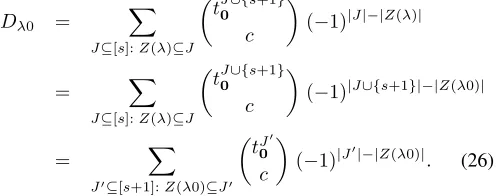
Proof: We introduce the abbreviation Dλ def= ncEM|tθAll1λ|M.
We use induction on s, starting at s= 1. For s= 1 we get D0= ncPrM|t[M =ce0] = tc0, andD1= ncEM|t[1−
θAll1 0|M] =
n c
− t0
c
. This is consistent with the right hand side of (25). Next we assume that (25) holds for somes≥1.
We append a ‘0’ to the (composite) symbolλ∈ Qs, creating a composite symbol λ0 ∈ Qs+1. The appended 0 does not ‘do’ anything, in the sense that it only imposes the simple constraint that all colluders receive a 0 in positions+ 1. The
result Dλ0 is obtained from (25) simply by appending a ‘0’ in the index of the tallytJ
0,
Dλ0 =
X
J⊆[s]:Z(λ)⊆J
tJ∪{s+1}
0
c
(−1)|J|−|Z(λ)|
= X
J⊆[s]:Z(λ)⊆J
tJ0∪{s+1}
c
(−1)|J∪{s+1}|−|Z(λ0)|
= X
J0⊆[s+1]:Z(λ0)⊆J0
tJ0
0
c
(−1)|J0|−|Z(λ0)|. (26) Eq. (26) exactly matches (25). Furthermore, we can permute the positions in λ0; this yields Dperm(λ0) expressions that also satisfy (25). The only symbol inQs+1 that we have not covered yet is11· · ·1. For this one we usePλθλ|M = 1.
D1s+1 =
n c
− X
λ∈Qs+1:λ6=1s+1 Dλ = n c − X λ∈Qs+1 λ6=1s+1 X J⊆[s+1] Z(λ)⊆J tJ 0 c
(−1)|J|−|Z(λ)|
= n c −X J⊆[s+1] J6=∅ tJ 0 c
(−1)|J| X λ∈Qs+1 λ6=1s+1,Z(λ)⊆J
(−1)−|Z(λ)|.
The λ-summation can be seen as a sum that starts with the
uniqueλsatisfyingZ(λ) =J, and then in increasingly more positions a 0 is flipped to 1. The number of choices how to flip
b positions is |J|
b
. Thus the λ-summation can be computed using the binomial sum rule as P|J|−1
b=0 | J|
b
(−1)|J|−b=
−1. The result for D1s+1 is precisely of the form (25), with n
c
being theJ =∅term.
Substitution of (25) into (9) yields a full score system. Example 1:Fors= 2, Theorem 6 yields
D00 =
t
00 c
D01 =
t
00+t01 c − t 00 c (27)
D11 =
n
c
−
t
00+t01 c
−
t
00+t10 c + t 00 c .
TheD10follows by permuting the positions in theD01result. Note thatt00+t01=t0{1},t00+t10=t{02},t00=t{01,2} and
n=t∅
0.
We briefly comment on the amount of work required to compute all user scores. First, all the tallies have to be computed. The effort is similar to the Interleaving attack case, of order 2s−|Z(λ)|n`/s.
The number of terms in (25) is 2s−|Z(λ)|, and each term
requires a number of multiplications proportional to c. There are n users. The number of composite-symbol scores is `/s. Hence the multiplication effort scales as cn`2s−|Z(λ)|/s.
VIII. SUMMARY
We have introduced a new class of score functions for q
-ary traitor tracing. It is obtained from the tally-based score function of [27] by combining s consecutive q-ary symbols
from a user’s codeword into a single composite symbol. For general s the score is given by the rather complicated expression (14). From our numerical experiments it seems that in practice one rarely needs more thans= 2. When the attack is not Interleaving, other scores can perform better. Hence our new score functions should be used as part of a battery of different score functions.
We applied the composite-symbol technique to Group Testing; this yields the general result (25). Future work will show how much performance is gained. Note that the Neyman-Pearson approach to obtain score functions is particularly well suited here since the ‘attack’ θis known precisely.
As other future work we mention: (i) Going to the Combined Digit Model [29] instead of the Restricted Digit Model. Eq. (9) is general enough to accommodate this. (ii) Study q ≥ 3.
(iii) Sorting the columns of the code matrix in order of increasing ty, and apply a large s to the lowest-ty columns. This binds the most informative columns (low ty) together.
(iv) Study the casec > c0.
ACKNOWLEDGMENT
Thijs Laarhoven and Benne de Weger are thankfully acknowl-edged for useful discussions.
REFERENCES
[1] E. Amiri and G. Tardos. High rate fingerprinting codes and the fingerprinting capacity. InSODA 2009, pages 336–345, 2009. [2] Y.M.M. Bishop, S.E. Fienberg, and P.W. Holland.Discrete multivariate
analysis: theory and practice. M.I.T. Press, 1975.
[3] O. Blayer and T. Tassa. Improved versions of Tardos’ fingerprinting scheme.Designs, Codes and Cryptography, 48(1):79–103, 2008. [4] A. Charpentier, C. Fontaine, T. Furon, and I.J. Cox. An asymmetric
fingerprinting scheme based on Tardos codes. InInformation Hiding 2011, volume 6958 ofLNCS, pages 43–58. Springer, 2011.
[5] A. Charpentier, F. Xie, C. Fontaine, and T. Furon. Expectation maxi-mization decoding of Tardos probabilistic fingerprinting code. InSPIE Media Forensics and Security 2009, page 72540, 2009.
[6] C.J. Colbourn, D. Horsley, and V.R. Syrotiuk. Frameproof codes and compressive sensing. In48th Allerton Conference on Communication, Control, and Computing, pages 985–990, 2010.
[7] N.G. de Bruijn.Asymptotic methods in analysis (3rd ed.). Dover, 1981. [8] R. Dorfman. The detection of defective members of large populations.
The Annals of Mathematical Statistics, 14(4):436–440, 1943. [9] T. Furon and M. Desoubeaux. Tardos codes for real. InIEEE Workshop
on Information Forensics and Security (WIFS) 2014, 2014.
[10] T. Furon, A. Guyader, and F. C´erou. On the design and optimization of Tardos probabilistic fingerprinting codes. InInformation Hiding 2008, volume 5284 ofLNCS, pages 341–356. Springer, 2008.
[11] T. Furon, L. P´erez-Freire, A. Guyader, and F. C´erou. Estimating the minimal length of Tardos code. InInformation Hiding 2009, volume 5806 ofLNCS, pages 176–190, 2009.
[12] Y.-W. Huang and P. Moulin. Capacity-achieving fingerprint decoding. InIEEE Workshop on Information Forensics and Security (WIFS) 2009, pages 51–55, 2009.
[13] Y.-W. Huang and P. Moulin. On the saddle-point solution and the large-coalition asymptotics of fingerprinting games. IEEE Transactions on Information Forensics and Security, 7(1):160–175, 2012.
[14] Y.-W. Huang and P. Moulin. On the fingerprinting capacity games for arbitrary alphabets and their asymptotics. IEEE Transactions on Information Forensics and Security, 9(9):1477–1499, 2014.
[15] Ye.-W. Huang and P. Moulin. On fingerprinting capacity games for arbitrary alphabets and their asymptotics. In IEEE International Symposium on Information Theory (ISIT) 2012, pages 2571–2575, 2012. [16] T. Laarhoven. Efficient probabilistic group testing based on traitor tracing. In 51st Allerton Conference on Communication, Control and Computing, pages 1458–1465, 2013.
[17] T. Laarhoven and B. de Weger. Optimal symmetric Tardos traitor tracing schemes. Designs, Codes and Cryptography, pages 1–21, 2012. [18] P. Meerwald and T. Furon. Group testing meets traitor tracing. InIEEE
International Conference on Acoustics, Speech and Signal Processing (ICASSP) 2011, pages 4204–4207, 2011.
[19] P. Meerwald and T. Furon. Towards Joint Tardos Decoding: The ‘Don Quixote’ Algorithm. InInformation Hiding 2011, pages 28–42, 2011. [20] K. Nuida. Short collusion-secure fingerprint codes against three pirates.
In Information Hiding 2010, volume 6387 of LNCS, pages 86–102. Springer, 2010.
[21] K. Nuida, S. Fujitsu, M. Hagiwara, T. Kitagawa, H. Watanabe, K. Ogawa, and H. Imai. An improvement of discrete Tardos fingerprint-ing codes. Designs, Codes, and Cryptography, 52(3):339–362, 2009. [22] J.-J. Oosterwijk, B. ˇSkori´c, and J. Doumen. Optimal suspicion functions
for Tardos traitor tracing schemes. In ACM Information Hiding and Multimedia Security Workshop (IH&MMSec) 2013, pages 19–28, 2013. [23] A. Simone and B. ˇSkori´c. Accusation probabilities in Tardos codes: beyond the Gaussian approximation.Designs, Codes and Cryptography, 63(3):379–412, 2012.
[24] D.R. Stinson, T. van Trung, and R. Wei. Secure frameproof codes, key distribution patterns, group testing algorithms and related structures.
Journal of Statistical Planning and Inference, 86(2):595–617, 2000. [25] G. Tardos. Optimal probabilistic fingerprint codes. InACM Symposium
on Theory of Computing (STOC) 2003, pages 116–125, 2003. [26] G. Tardos. Optimal probabilistic fingerprint codes.J. ACM, 55(2):1–24,
2008.
[27] B. ˇSkori´c. Tally-based simple decoders for traitor tracing and group testing. IEEE Transactions on Information Forensics and Security, 10(6):1221–1223, 2015.
[28] B. ˇSkori´c, S. Katzenbeisser, and M.U. Celik. Symmetric Tardos fingerprinting codes for arbitrary alphabet sizes. Designs, Codes and Cryptography, 46(2):137–166, 2008.
[29] B. ˇSkori´c, S. Katzenbeisser, H.G. Schaathun, and M.U. Celik. Tardos Fingerprinting Codes in the Combined Digit Model.IEEE Transactions on Information Forensics and Security, 6(3):906–919, 2011.
[30] B. ˇSkori´c and J.-J. Oosterwijk. Binary and q-ary Tardos codes, revisited.
Designs, Codes, and Cryptography, July 2013.
[31] B. ˇSkori´c, T.U. Vladimirova, M.U. Celik, and J.C. Talstra. Tardos Fingerprinting is Better Than We Thought. IEEE Transactions on Information Theory, 54(8):3663–3676, 2008.
[32] F. Xie, T. Furon, and C. Fontaine. On-off keying modulation and Tardos fingerprinting. InMultimedia & Security (MM&Sec) 2008, pages 101– 106. ACM, 2008.
APPENDIX
A. Proof of Theorem 1
The score (8) is invariant under permutation of all the users other than j. Hence all the relevant information present in x is contained in the codeword x¯j = ξ ∈ Qs and the tally vector t (which is now defined over Qs). For ` = s the
¯
sequence y¯ corresponds to λ ∈ Qs. The expectation E ¯
M|x equals EM|t,ξ. The score (8) now takes the form
ln
P
mθλ|m(n−11 c−1)
tξ−1 mξ−1
Q
α∈Qs\{ξ}
tα
mα
P
mθλ|m(n−11 c )
tξ−1 mξ
Q
α∈Qs\{ξ} mtα α
. (28)
Here we have used that for j ∈ C we have to choose c−1
colluders fromn−1users, while symbolξis ‘used up’ once by acolluder. Forj /∈ Cwe have to chooseccolluders fromn−1
users, with ξ being used up by aninnocent user, which does
not affect mξ. Next we discard the factors nc−−11
and n−1
c
,
since they lead to a constant offset of the logarithm, which has no effect on the score system. Then we use tξ−1
mξ−1
=
tξ
mξ
− tξ−mξ1
, allowing us to simplify the score to
ln(
P
mθλ|mQα∈Qs
tα
mα
P
mθλ|mQα∈Qs
tα−δαξ
mα
−1)
= ln(
P
mθλ|mQα∈Qs
tα
mα
P
mθλ|m Q
α∈Qs (
t−eξ)α
mα
−1). (29)
Finally we use the definition (3) for the conditional probability
Lm|t, taking into account that the tally vectort−eξ pertains ton−1users.
B. Proof (sketch) of Theorem 2 We start from (11). We write Qs
i=1Mzi as
Q
α∈QsMαrα,
with Pαrα = s. Every increase of a counter rα requires a Kronecker Delta of the formδzizj. Next we express powers
in terms of falling factorials using Stirling numbers of the 2nd kind, Mrα
α =
Prα
kα=0{
rα
kα}M
(kα)
α . Then we compute the expectation EM|t using (4). If rα = 1 then the result contains one power of tα. For larger rα, the powers of tα that occur in the result are trα
α , trαα−1, . . . , tα. All of these contributions can be written as a product oftzi factors, where
theδzizj factors cause the powers≥1. The constraints on the
composite symbols zi, as imposed by the Kronecker Deltas δzi[i],λ[i] in (11), when summed over in combination with the tzi tallies and theδzizj factors, yield expressions of the form tJ
λ[J] def
= Pztzδz[J],λ[J] as defined in Section IV-A. For every i ∈ [s] there is a δzi[i],λ[i] constraint; hence the whole set [s]is covered and the distribution of the constraints over the