A Low-Complexity Model-Free Approach for Real-Time
Cardiac Anomaly Detection Based on Singular Spectrum
Analysis and Nonparametric Control Charts
Michael Lang1,∗ ID
1 Graduate School of Excellence Computational Engineering, Technische Universtät Darmstadt, Dolivostraße 15, 64293
Darmstadt, Germany; Tel.:+49 6151 1624401, Fax: 49 6151 1624404 ∗Correspondence: [email protected]
Abstract: While the importance of continuous monitoring of electrocardiographic (ECG) or 1
photoplethysmographic (PPG) signals to detect cardiac anomalies is generally accepted in preventative medicine, 2
there remain major barriers to its actual widespread adoption. Most notably, current approaches tend to lack 3
real-time capability, exhibit high computational cost, and be based on restrictive modeling assumptions or 4
require large amounts of training data. We propose a lightweight and model-free approach for the online 5
detection of cardiac anomalies such as ectopic beats in ECG or PPG signals based on the change detection 6
capabilities of Singular Spectrum Analysis (SSA) and nonparametric rank-based cumulative sum (CUSUM) 7
control charts. The procedure is able to quickly detect anomalies without requiring the identification of fiducial 8
points such as R-peaks and is computationally significantly less demanding than previously proposed SSA-based 9
approaches. Therefore, the proposed procedure is equally well suited for standalone use and as an add-on to 10
complement existing (e.g. heart rate (HR) estimation) procedures. 11
Keywords: nonparametric change point detection; singular spectrum analysis; cumulative sums; ecg; ppg; 12
arrhythmias; cardiac monitoring 13
1. Introduction 14
The ubiquity of powerful smartphones and other smart devices, which nowadays incorporate a plethora 15
of advanced sensing capabilities, has led to an increasing trend in the consumer sphere to continuously gather 16
and evaluate physiological signals [1,2]. In particular, cardiovascular parameters such as heart rate and pulse 17
rate (PR), extracted respectively from measurements of myocardial electrical potentials through ECG [3–6] and 18
from measurements of volumetric changes of blood perfusion during cardiac cycles by optical means through 19
PPG [7–9] are being recorded and analyzed in apps, fitness trackers and the like with great potential benefits for 20
public health [1,10–12]. 21
Virtually all of said consumer-oriented apps and devices fall into the category of fitness and well-being 22
products, thereby avoiding the substantial burden of having to comply with requirements imposed by medical 23
devices regulatory frameworks [13,14], which is reflected in often notoriously inaccurate and unreliable results 24
[15,16]. Moreover, functionality is usually limited to providing estimates of the average heart rate. 25
While low-resolution averaged HR estimates may be of some use in fitness and well-being scenarios, from 26
a clinical perspective the detection of sudden changes in the signal structure are of utmost importance. ECG 27
recordings from a healthy heart are characterized by asinus rhythm, wherein the normal cardiac cycle begins
28
with an action potential in thesinoatrial (SA) node, located in theright atrium, which propagates and depolarizes
29
neighboring cells. The depolarization of theSA nodespreads rapidly throughout both atria, specifically to theleft
30
atriumthroughBachmann’s bundleand through internodal pathways in theright atriumto theatrioventricular 31
(AV) node. Full depolarization gives rise to the P wave, which initiates atrial contraction. From the AV node, 32
excitation is further propagated after an initial delay of about 100 ms through thebundle of His, which splits up
33
into theright bundle branchand theleft bundle branch, initiating respectively the depolarization of theright and
34
left ventricle, yielding to theQRS-complexwhich ends with completely depolarized and contracting ventricles. 35
Ventricular repolarization following the contraction eventually results in the T-wave and concludes the normal 36
cardiac cycle. Note that both left and right bundle branches eventually differentiate into a large number of
37
Purkinje fibers, the repolarization of which is thought to occasionally result in an additional U-wave [3]. 38
Deviations from the normal sinus rhythm are referred to asarrhythmiasand comprise a large number of
39
specific arrhythmias (see, e.g.[17]). Heart rhythms exhibiting variations in timing such as those that are either
40
below 60 beats per minute (bpm) or above 100 bpm as well as rhythms disrupted by changes in the morphology, 41
e.g. due to ectopic beats (i.e. heart beats whose origin is different from and outside of the region typically
42
responsible for impulse generation, namely the SA node) such aspremature ventricular contractions(PVCs) or
43
premature atrial contractions(PACs) all qualify as arrhythmias. Furthermore, they all tend to induce distinctive 44
changes in the ECG signal thereby allowing for a change detection approach which must not necessarily be based 45
on templates corresponding to the various arrhythmia-induced changes [18]. Also, many arrhythmias, though 46
usually not acutely life-threatening, are paroxysmal and asymptomatic and therefore likely to go unnoticed for 47
long periods of time, which carries the risk of exacerbation and possibly the development of more serious types 48
of arrhythmias [3,17,18]. Continuous outpatient cardiac monitoring through wearable devices is commonly 49
accepted as a promising approach to tackle this issue and improve treatment outcome while at the same time 50
lowering overall healthcare costs [1,10–12,18,19]. 51
While the automatic monitoring of ECG signals has been researched for a couple of decades and various 52
algorithms have been proposed and implemented, the shift towards continuous outpatient monitoring through 53
low power wearable devices introduces numerous additional and challenging requirements such as real-time 54
capability, the ability to cope with rather noisy and low-quality signals with various artifacts and harsh constraints 55
on computational complexity and power consumption [18–20]. Various approaches for the automatic online 56
detection of cardiac arrhythmias have been proposed in the literature. Machine Learning approaches have been 57
adopted by numerous authors [21,22], as have Wavelet [22,23], Artificial Neural Network (ANN) [24–26], and 58
decision tree [27] based approaches. For a more detailed review, the reader is referred to some recent review 59
papers [18,28]. Typically most of these approaches require the extraction of certain features from the signal, e.g. 60
the location of the QRS-complexes [20,27,29,30] or the R-peaks [22,23,31–33], commonly performed using 61
the algorithm proposed by Pan and Tompkins [34] or variations thereof [18,28], and are therefore inherently 62
vulnerable to inaccuracies in the initial estimation of these fiducial points. Moreover they tend to be based on 63
rather restrictive modeling assumptions and/or require large amounts of training data, which makes them hard to
64
reconcile with the requirements arising in real world outpatient monitoring scenarios. 65
66
We propose a lightweight and model-free approach for the online detection of cardiac anomalies such 67
as ectopic beats in ECG or PPG signals based on the change detection capabilities of Singular Spectrum Analysis 68
(SSA) and nonparametric rank-based cumulative sum (CUSUM) control charts. The procedure is able to quickly 69
detect anomalies without requiring templates, extensive training data sets or the identification of fiducial points 70
such as R-peaks and is computationally significantly less demanding than previously proposed SSA-based 71
approaches. 72
The proposed method is essentially composed of two consecutive steps: an SSA-based algorithm is 73
sequentially applied to the observed data to construct viable test statistics that reflect potential changes in the 74
cardiac signal, and these statistics are then monitored using distribution-free CUSUM-type control charts. 75
The use of SSA in a sequential framework as a means for change detection as introduced in Section2
76
is based on works by Moskvina and Zhigljavsky, discussed in detail in [35] and in a more condensed fashion 77
in [36], although it should be noted that the concept was earlier already described in [37]. Said algorithm has 78
successfully been applied to various real world detection problems, e.g. anomaly detection in Cognitive Radio 79
Networks [38], smart power grids [39], software engineering [40] and change point detection for complex-valued 80
time series [41]. In the biomedical context it has shown to be useful for the identification of freezing of gait in 81
patients with Parkinson’s disease [42], the detection of anomalies in periodic biosignals such as ECGs [43] as 82
well as other biomedical applications [44]. 83
84
Building on the prior art outlined in Section 2, we introduce a novel SSA-based change detection
procedure (l-SSA-CPD) that exhibits very reasonable performance characteristics while at the same time 86
drastically reducing the computational burden. As shall be shown in Section3, this is accomplished by modifying
87
the conventional SSA-based change detection algorithm such that the computationally expensive task of 88
computing the Singular Value Decomposition (SVD) is only performed at the very beginning instead of each 89
time a new data point becomes available. Furthermore, the proposed procedure uses more elaborate test statistics 90
that take into account the information derived from the angle between data vectors representing new observations 91
and the subspace representing the signals characteristics as well as the euclidean distances. Lastly, our procedure 92
differs from previous approaches also in that rank-based control limits and the reinitialization of control charts
93
after an anomaly has been detected are used. A performance evaluation of l-SSA-CPD using ECG and PPG 94
records from the publicly available Physionet Challenge 2015 training database (PC15) [45,46] will be presented 95
in Section4and followed by a short discussion in Section5which concludes this paper.
96
2. Singular Spectrum Analysis 97
2.1. Fundamentals of Singular Spectrum Analysis 98
Singular Spectrum Analysis is a technique of time series analysis and can be interpreted as belonging 99
to the general class of Principal Component Analysis (PCA) methods. SSA has become a standard tool in 100
meteorology and climatology but is mostly unknown outside of those disciplines. Golyandina et al. [37] attribute 101
this to the nature of SSA being more a technique of multivariate geometry than of statistics. According to their 102
representation, SSA should rather be seen as an exploratory, model-building tool than a confirmatory procedure. 103
In essence, SSA can be seen as the application of PCA to the so-called trajectory matrix (obtained directly from 104
the original time series) with the subsequent attempt to reconstruct the original series. Prior to proceeding to SSA 105
for change detection a short introduction to the basic SSA algorithm appears in order. 106
2.1.1. Basic SSA Algorithm 107
ConsiderNobservationsXN= (x1,. . .,xN)of a univariate time series and an integerM(1<M <<N)
108
commonly referred to aswindow length,lag-integerorembedding dimension. The basic SSA algorithm is
109
commonly described as being composed of the following four stages (see, e.g.[37,44,47]):
110
1. Embedding:XN= (x1,. . .,xN)→X∈RM×K
111
A so-calledtrajectory matrixXis constructed by mappingXNinto a sequence ofK=N−M+1 lagged
112
column vectorsXj = (xj,. . .,xj+M−1)T,j=1,. . .,Kof sizeM, yielding
113
XN = (x1,x2,. . .,xN)→X=
xn+1 xn+2 . . . xn+K
xn+2 xn+3 . . . xn+K+1
..
. ... . .. ...
xn+M xn+M+1 . . . xn+N
(1)
Notice theHankel-structureofX= (xi j)iM,j,=K1, i.e.Xhas equal elements on the anti-diagonalsi+j=const. 114
One can think ofXas multivariate data withMcharacteristics andKobservations and accordinglyXjofX
115
as vectors in theM-dimensional spaceRM.
116
117
2. Singular Value Decomposition ofX
118
Taking the SVD ofXdecomposes the trajectory matrix into its orthogonal bases and yields a collection
119
ofM eigenvalues and eigenvectors. Letλ1 ≥ · · · ≥ λM ≥ 0 andU1,. . .,UM denote, respectively, the
120
eigenvalues and eigenvectors ofXXTand therankofXbe denoted asd=max(i, such thatλi>0). The
121
SVD ofXcan then be rewritten as the sum ofd elementary matrices
122
with matricesXi= √λiUiViT being of rank 1 andVi=XTUi/
√ λi. 123
Note thatViare the eigenvectors ofXTXand
√
λi,Ui,Vi
theeigentriplesof the SVD in Eq. (2). 124
Also note that due to the symmetry of left and right singular vectors, the SVD of trajectory matrices 125
obtained with window lengthM andK = N−M+1 are equivalent. Accordingly, one can impose the
126
limitationM≤N/2 on the window length since there is no additional benefit in using a larger window (see,
127
e.g.[47] at 47, [37] at 69).
128
129
3. Eigentriple Grouping
130
In order to separate the signals of interest from noise and artifacts, the third stage of basic SSA aims to find 131
particular disjoint subsets of the set of indices{1,. . .,d}such that the respective systems of eigenvectors
132
span the subspaces associated with the different signal components.
133
Consider the task of separating a signal of interest from unwanted noise. One then looks for a certain subset 134
of indicesI={i1,. . .,il},l<d≤Mthat span anl-dimensional subspace inRM, denoted asLI⊂RM =
135
span{UI}=span{Ui1,. . .,Uil}. Analogously, the remaining eigentriples withI¯={i1,. . .,id} \Ispan the
136
noise subspaceLI¯⊂RM =span{UI¯}. 137
The trajectory matrix componentXIcorresponding to the subsetIof eigentriples associated with the signal
138
of interest is then 139
XI=Xi1+· · ·+Xil (3)
and the componentXI¯corresponding to the subsetI¯={i1,. . .,id} \Iassociated with the remainder of the
140
observed signal is 141
X¯I=X
i∈I¯
Xi (4)
such that 142
X=XI+X¯I=X
i∈I
Xi+X
i∈I¯
Xi (5)
In the case of separability (see, e.g.[47] at 17), the contribution ofXIto the entire observed signalXis
143
represented by the respective share of eigenvaluesP
i∈Iλi/Pdi=1λi. 144
145
4. Diagonal Averaging
146
For perfectly separable components, all matrices in the expansion of Eq. (5) are Hankel matrices. For real 147
world problems, however, such perfect separability is rarely achievable and results in matrices with unequal 148
entries on the antidiagonals. The last step of the basic SSA algorithm therefore performs a Hankelization of 149
said matrices, i.e. a diagonal averaging is performed on all theXiof Eq. (5) yielding matricesXeithat have
150
equal elements on the antidiagonals 151
e
X=eXI+eX¯I= X
i∈I e Xi+
X
i∈I¯ e
Xi (6)
One can then e.g. easily reconstruct the approximation of the signal of interest through the eigentriples 152
with indicesIthrough the one-to-one correspondence betweeneXIand the respective time seriesXeN =
153
(x˜1,. . .,x˜N) which provides an approximation of the entire time seriesXN or some components of it, 154
depending on the particular choice of indicesI.
The usefulness of basic SSA is illustrated in the example depicted in Figure1where the wandering baseline 156
of an ECG signal (blue solid line) is removed by subtracting the trend reconstructed through SSA (with a window 157
length ofM=100 and using the first two eigentripleseXI=eXi1+eXi2 −→X˜N= (x˜1,. . .,x˜N)(red solid line))
158
from the original signal, i.e. 159
XNcleaned =XN−XeN= (x1,. . .,xN)−
˜
xi11,. . .,x˜i1N
−x˜i21,. . .,x˜i2N
(7)
yielding the cleaned ECG signal (green solid line). 160
0 200 400 600 800 1000 1200
samples
-200 -100 0 100 200 300
ECG signal
Trend approx. by leading 2 eigentriples
0 200 400 600 800 1000 1200
samples
-200 -100 0 100
200 ECG signal (baseline wander removed)
Figure 1.Application example of basic SSA: baseline wander removal. Showing excerpt 02:20 - 02:30 from record 14149m MIT-BIH ltdb [46]
For a more detailed discussion of SSA, we refer to two well-known monographs [37,48] in the field as well 161
as [44,47] and references therein. 162
2.2. SSA Based Change Detection: Prior Art 163
The sequential application of SSA described in the following is based on work by Moskvina and Zhigljavsky 164
and will be referred to as MZ in the remainder of this paper (see[35–37]). The need for an adaptation of basic
165
SSA is due to the circumstance that it operates in batch mode and is therefore not suited for online change-point 166
detection. 167
Assume a truly sequential problem in which observationsx1,x2,. . . arrive one at a time. Having collected a
168
sufficiently large numberNof observations, MZ constructs the trajectory matrixX(Bn)(the subindex B refers to
169
‘base’ for reasons that will become obvious in a moment) for time indexnwithM≤N/2,K=N−M+1 and
170
performs the SVD and grouping steps as in basic SSA yielding anl-dimensional subspaceL(n)
I ⊂R
Mspanned
171
by the respective eigenvectors which captures the main structure of the signal. 172
The basic idea of MZ relies on the fact that the distance between the vectorsX(jn),j=1,. . .,KandL(n)
I , 173
controlled by the specific choice ofI, can be reduced to rather small values. If monitoring of the series{xt}Nt=1
174
continues fort>Nwithout a change in the underlying data generating mechanism, the vectorsXj,j>Kare
175
expected to remain relatively close toL(n)
I while, on the other hand, if such a change were to occur at timeN+τ,
176
the distance betweenXj,j≥K+τandLIwould increase as it would move such vectorsXjout of the subspace
177
L(n)
I (see[36] at 2). Therefore, said distance can be used as a test statistic for change-point detection. Note that
178
only the first three steps of basic SSA need to be performed since reconstruction of the original series is not 179
MZ constructs two matrices, the above mentionedbase matrixX(Bn), i.e. the trajectory matrix using data 181
samples xn+1,. . .,xn+N, and atest matrix X( n)
T using observations xn+p+1,. . .,xn+q+M−1. The former is
182
subjected to SVD and used to obtain the subspaceL(n)
I while the latter serves to calculate the sum of squared
183
Euclidean distances between its column vectors andL(n)
I . This process can be thought of as having two (possibly
184
intersecting) windows (ofM-dimensional data), of lengthKandQ=q−prespectively, slide over the data.
185
186
Let N,M,l,p,q be fixed integers s.t. l < M < N/2 and 0 ≤ p < q. Then, for each n = 0, 1,. . . MZ
187
proceeds as follows: 188
1. Apply SSA on the interval[n+1,n+N]to getL(n)
I 189
(a) Construct the trajectory/base matrixX(Bn)
190
X(Bn)=
xn+1 xn+2 . . . xn+K xn+2 xn+3 . . . xn+K+1
..
. ... . .. ...
xn+M xn+M+1 . . . xn+N (8)
whereK=N−M+1.
191
192
(b) Singular Value Decomposition ofX(Bn).
193
194
(c) Selection ofI={i1,. . .,il},l<d ≤Mwithd=max(i, such thatλi>0). 195
196
2. Construct test matrixX(Tn)on the interval[n+p+1,n+q+M−1]
197
X(Tn)=
xn+p+1 xn+p+2 . . . xn+q xn+p+2 xn+p+3 . . . xn+q+1
..
. ... . .. ...
xn+p+M xn+p+M+1 . . . xn+q+M−1
(9)
3. Compute the detection statisticDn,I,p,q
198
Dn,I,p,q= q X
j=p+1
" X(jn)
T X(jn)−
X(jn)
T U(In)
U(In)
T X(jn)
#
(10)
where X(jn) = [xn+j,. . .,xn+j+M−1]T andU(In) =
Ui(n)
1 ,. . .,U (n)
il
is theM×lmatrix of eigenvectors
199
spanningL(n)
I , i.e. Dn,I,p,qis the sum of squared Euclidean distances between the columns ofX
(n)
T and 200
L(n)
I . MZ normalizes the sum of distancesDn,I,p,qto the number of elements inX
(n)
T 201
˜
Dn,I,p,q= Dn,I,p,q
MQ (11)
and further normalizes the test statistic as 202
Sn,I,p,q= ˜ Dn,I,p,q
vn
(12)
such that it does not depend on the unknown variance of the noise (see[35] at 28) with vn being an
203
estimator ofD˜n,I,p,q, e.g.vn=D˜m,I,0,Kwithm≤nsuch that the hypothesis of no change can be accepted. 204
4. Monitoring ofSn,I,p,qusing CUSUM-type Control Charts 206
MZ then constructs the following CUSUM-type control chart 207
W1=S1,I,p,q, Wn+1=max(0,Wn+Sn+1,I,p,q−Sn,I,p,q−κ), n≥1 (13)
withκsuggested asκ=1/3√MQ(see[35] at 29) and thresholdhMZ =1+1.9
√
M(see[35] at 35). A
208
change-point atnis then declared if
209
Wn≥hMV (14)
holds. 210
3. The Proposed Method (l-SSA-CPD) 211
While MZ provides a powerful methodology that could be applied directly to raw ECG (or PPG) data, it 212
exhibits some drawbacks (for the particular application at hand) that motivated the development of the novel 213
approach to be presented below which we shall refer to aslightweight-SSA-ChangePointDetection(l-SSA-CPD).
214
3.1. Motivation and Informal Description of the Improvements 215
As discussed in the preceding Section, MZ makes use of two (possibly intersecting) windows that are slid 216
over the observed time series, one comprising the data that is embedded to form the trajectory matrix, which 217
is then decomposed by means of SVD to identify an appropriate low(er)-dimensional subspace, and another 218
one containing new (or, in case of overlap, a combination of old and new) observations whose distance to said 219
low-dimensional subspace is then used as a test statistic. This entails the quite burdensome step of performing a 220
SVD every time a new data sample becomes available. 221
222
We shall first highlight the main improvements of our method prior to its formal description. 223
• Low Computational Complexity
224
Small variations over time are intrinsic to cardiac signals and may, besides noise and motion artifacts, e.g. 225
be due toHeart Rate Variability. Contrary to anomalies caused by abnormal cardiac excitation phenomena,
226
these changes in the time between consecutive R-peaks are subtle and often not readily discernible. Most 227
importantly, they do not induce changes as severe as to change the signal’s main characteristics which are 228
captured through the decomposition and grouping stages of SSA. This is illustrated in Figure2which shows
229
a raw (unfiltered) ECG signal with two distinctly shaped PVCs (highlighted in purple) in the third quarter 230
of the excerpt. 231
For the task at hand, performing the SVD of a newly generated trajectory matrix each time a new data point 232
becomes available is not strictly necessary. We are able to drastically reduce the computational burden 233
by generating only one initial trajectory matrixX(B0)and relying on the obtained reference subspaceL(0)
I 234
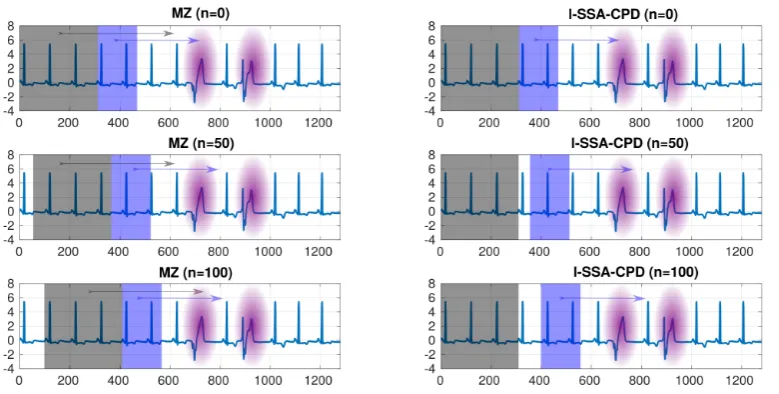
throughout the monitoring. This is shown in Figure2with the section of the signal highlighted through gray
235
and blue backgrounds representing the intervals used to generateX(Bn)andXT(n), respectively. Note how in
236
MZ (left part of Figure2) bothX(Bn)andX(Tn)are being slid over the observations while in our algorithm
237
(right part of Figure2) onlyX(Tn)is a sliding window sinceXB(n)|∀n=X(
0)
B . 238
• Simplicity
239
By sliding only a single instead of two windows over the time series the entire procedure is simplified and 240
benefits from a reduction in tuning parameters. 241
In fact, while the total numberQof columns inXT is of course relevant, pandqare not since, due to
242
X(Bn)|∀n=XB(0)an overlap ofXBandXT can only occur in the firstN−psamples forp<N. While our
243
algorithm allows for such an initial overlap ofXBandXT, the following discussion is purposely limited
244
0 200 400 600 800 1000 1200 -4
-2 0 2 4 6
8 MZ (n=0)
0 200 400 600 800 1000 1200
-4 -2 0 2 4 6
8 l-SSA-CPD (n=0)
0 200 400 600 800 1000 1200
-4 -2 0 2 4 6
8 MZ (n=50)
0 200 400 600 800 1000 1200
-4 -2 0 2 4 6
8 l-SSA-CPD (n=50)
0 200 400 600 800 1000 1200
-4 -2 0 2 4 6
8 MZ (n=100)
0 200 400 600 800 1000 1200
-4 -2 0 2 4 6
8 l-SSA-CPD (n=100)
Figure 2.Comparison of MZ (left) and l-SSA-CPD (right). The computational burden of l-SSA-CPD is greatly reduced compared to MZ by relying on the reference subspace obtained from an initial, non-sliding trajectory matrix (illustrated by the gray background area). Furthermore, note that l-SSA-CPD’s reference subspace remains locked on the main signal’s characteristics while in MZ, since the reference subspace is updated at each observation (illustrated by the gray area sliding as well), it will lock on the two anomalies (highlighted in pink) for some time as the two moving windows are pass over them.
p=N,q=N+1 and accordinglyQ=1 is a very reasonable choice if minimizing the detection delay is
246
of importance, sinceQ>1 entails a smoother behavior of the test statistic and thus a loss of agility (see,
247
e.g.[35] at 30).
248
The question as to whether or notXBandXT should overlap and if so by how much is therefore removed.
249
Furthermore, sincep=N,q=N+1 can generally be recommended (seeSection4), we can omit both
250
tuning parameterspandq.
251
252
• Augmentation of Test Statistic by considering the angle betweenL(0)
I andX
(n)
j 253
Some authors [49–51] successfully proposed a modified version of MZ, wherein the test statistic is based on 254
angles rather than on Euclidean distances. While both approaches are viable on their own merits, we chose 255
to merge them as they augment each other yielding a test statistic that, according to our results on raw ECG 256
and PPG records, performs favorably compared to the test statistic constructed using either one on its own. 257
In other words, we augment and improve upon the test statistic of MZ by making use of the information 258
from the angles betweenL(0)
I andX
(n)
j as well.
259
260
• Improved thresholding through Sequential Ranks CUSUM
261
MZ provides further potential for improvement by employing a CUSUM-type control chart (seeEq. (13-14))
262
whose control limit (or threshold)his obtained through suitable normal approximation and asymptotic
263
considerations (see[35] at 31;see also[36] at 8). The nuisance of having to properly normalize the test
264
statistic (seeEq. (12)) is a direct consequence of this design choice.
265
We instead propose the use of McDonald’s Sequential Ranks CUSUM (SRC) [52] which we deem to be 266
more appropriate and in line with the model-free nature of SSA. 267
268
• Restarting of SRC control chart after it signaled
Lastly, to allow for the detection of multiple and potentially nearby change-points we restart the SRC every 270
time after it signaled an anomaly by exceeding the preset thresholdhSRC.
271
0 1000 2000 3000 4000 5000 6000 7000
-0.5 0 0.5 1
ECG signal (excerpt record 14046m ltdb)
raw ECG
0 1000 2000 3000 4000 5000 6000 7000
0 0.5 1
SRC without restarting
Q=1 Q=20 Q=40 h
SRC
0 1000 2000 3000 4000 5000 6000 7000
0 0.5 1
SRC with restarting
Q=1 Q=20 Q=40 h
SRC
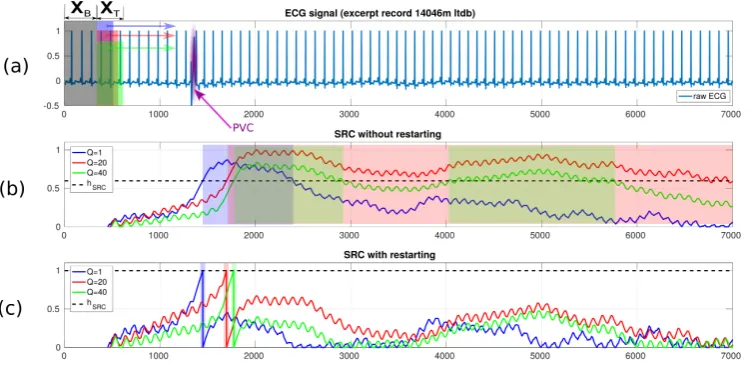
Figure 3.Restarting the SRC each time the threshold was hit (c) is indicated to avoid potentially lengthy delays before the anomaly propagates through and clearsXT(b)
This is indicated since otherwise, depending on the extent of the anomaly (in terms of number of samples) 272
and how it relates to the embedding dimensionMas well as the numberQof columns in the Hankel matrix
273
XT, it may take some time before the anomaly propagates through and clearsXT (i.e. our sliding window)
274
thereby resulting in a return of the test statistic to its ‘baseline level’. This is illustrated in Figure3where,
275
as depicted in (a), three windows (differing in size) withQ={1, 20, 40}are slid over an ECG containing
276
a single PVC (highlighted in purple and marked with an arrow). As can be seen in (b), whileQ=1 is
277
a feasible choice even without restarting the control chart after exceeding the thresholdhSRC, since the
278
respective SRC returns to values belowhSRCafter a relatively long but perhaps still acceptable amount of
279
time, the same cannot be said forQ={20, 40}. Part (c) of Figure3illustrates the clear benefits of restarting
280
the control charts, in that regardless of the choice ofQthe PVC is detected and monitoring for further
281
changes can swiftly resume. As was to be expected,Q=1 is favorable in terms of detection delay.
282
3.2. Formal Description of l-SSA-CPD 283
To allow for better comparison, we use the notation introduced in Section2.2as far as possible.
284
LetN,M,l,p,qbe fixed integers s.t.l<M<N/2 and 0≤p<q. Then our method proceeds as follows:
285
1. Initialization atn=0
286
287
SSA is applied on the interval[n+1,n+N]to getLI=L(n=0)
I , which akin to MZ involves
288
(a) Construction of the trajectory/base matrixXB=X(
0)
B =X
(n=0)
B .
289
XB=
xn+1 xn+2 . . . xn+K xn+2 xn+3 . . . xn+K+1
..
. ... . .. ...
xn+M xn+M+1 . . . xn+N
(15)
whereK=N−M+1.
290
(b) Singular Value Decomposition ofXB. 292
293
(c) Selection ofI={i1,. . .,il},l<d ≤Mwithd=max(i, such thatλi>0). 294
295
Then, for eachn=0, 1,. . . we proceed as follows
296
297
2. Construct test matrixX(Tn)on the interval[n+p+1,n+q+M−1]
298
XT(n)=X(j|n)
j=p+1,...,q
=
xn+p+1 xn+p+2 . . . xn+q xn+p+2 xn+p+3 . . . xn+q+1
..
. ... . .. ...
xn+p+M xn+p+M+1 . . . xn+q+M−1
(16)
withX(jn)= [xn+j,. . .,xn+j+M−1]T.
299
300
3. Compute the detection statisticsD†n1,,I...,p,3,q 301
D†1
n,I,p,q= 1 Q
q X
j=p+1
" X(jn)
T X(jn)−
X(jn)
T
UI(UI)TX( n)
j #
(17)
D†2
n,I,p,q=1−cos
∠
X(Tn),LI
(18)
D†3
n,I,p,q=D
†1
n,I,p,q◦D
†2
n,I,p,q (19)
with 302
∠
X(Tn),LI
=∠
X(Tn),UI
= 1
Q q X
j=p+1
1 l il X
k=i1
arccos
hX(jn),Uki
X
(n)
j kUkk
(20)
taking values inh0,π2i, accordingly D†2
n,I,p,q ∈ [0, 1], UI = [Ui1,. . .,Uil] being the M×l matrix of
303
eigenvectors spanningLI, and◦denoting the Hadamard (element-wise) product.
304
305
4. Monitoring ofD†n1,,I...,p,3,qusing the Sequential Ranks CUSUM Control Chart
306
Let us denote the sequential rank ofD†n1,,I...,p,3,qas 307
Rn=1+ n−1
X
r=1
max
0,D†n1,,I...,p,3,q−D†r,1,I...,p,3,q
(21)
The Sequential Ranks CUSUM is then 308
Cn=max
0,Cn−1+
Rn
n+1−kSRC
, n≥1 (22)
withC0=0 andkSRCbeing a reference constant.
309
The SRC then signals and a change-point atnis declared if
310
holds, i.e. ifCnexceeds a predetermined control limithSRC.
311
It can be shown [52] that, given that no change in the monitored signal occurred, the quantities Rn
n+1are
312
independent and discrete uniform on 313
{ 1
n+1, 2 n+1,· · · ,
n n+1}
which represents a crucial advantage of the SRC in that it implies that for anykSRCwe can obtain the control
314
limithSRCwithout the need for any historical training data or further assumptions through simulations as
315
follows: 316
Algorithm 1:CalculatehSRCfor fixedkSRC
(a) Set a constantNSRC
(b) fori=1toBdo
i. Construct the set of random variables{Yn}nN=SRC1 as discrete uniform on{n+11,n+21,· · · ,n+n1}
ii. ConstructCSRCn =max{0,CSRCn−1+Yn−kSRC}
iii. Extract the maximum value of{CSRCn}
NSRC
n=1
end
(c) Set the control limithSRCas theB·(1−ARL0−1)ordered extracted maximum value withARL0being
the nominal in-control average run length (ARL) (seeAppendixA).
4. Performance Evaluation 317
To evaluate and assess the performance and utility of our method we use records which are publicly 318
available through Physiobank [46], a vast and commonly used resource for ECG and other biophysiological 319
data. In particular, since we claim our method to be suitable for both ECG and PPG data, we found the 320
Physionet Challenge 2015 training database (PC15) [45] to be of particular interest as it provides a collection 321
of synchronized ECG and PPG recordings from which we chose a subset similar to the one used in [53]. With 322
PC15 records not being annotated, we purposely chose to limit our evaluation to records containing PVCs (with 323
different frequencies of occurrence) since they can quite accurately be spotted by careful visual inspection.
324
Before presenting some results, it seems appropriate to briefly restate the goal of our method, which is 325
to provide a lightweight, model-free tool capable of providing a rough assessment under tight constraints on 326
computational resources, e.g. as a pre-screening tool. It is therefore not to substitute for but rather to complement 327
more sophisticated and (computationally) expensive procedures. 328
4.1. Performance Metrics 329
In reporting our results we rely on established metrics commonly used in the literature and reportsensitivity
330
(Se),specificity(Sp), andaccuracy(Acc) defined as
331
S e= T P
T P+FN (24)
S p= T N
T N+FP (25)
Acc= T P+T N
T P+FP+FN+T N (26)
withT P,FP,T N,FNbeing the number oftrue positives,false positives,true negatives, andfalse negatives,
332
Accordingly,sensitivityquantifies the ability to correctly detect actual anomalies while vice versaspecificity 334
quantifies the proportion of non-abnormal segments that are correctly identified as such.Accuracy, on the other
335
hand, assesses the overall performance in terms of both correctly identified abnormal and non-abnormal segments. 336
337
Note that there is a nonzero detection delay introduced by the use of a control chart. Typically, said
338
delay tends to be longer for nonparametric control charts such as the SRC compared to parametric charts (see, 339
e.g.[52]). Use of the latter however would require imposing a parametric model and therefore inevitably conflict
340
with our goal of minimizing (distributional) assumptions as much as possible. 341
For an event occurring at time instancenwe allow for a certain detection delayτdand consider a signal
342
from the control chart as true positive if it falls in the interval[n,n+τd]. All results presented here were obtained
343
usingτd=N, i.e. we allow for a detection delay less or equal to the length of the interval used to construct the
344
initial trajectory matrixXB.
345
Furthermore, note that when directly comparing (synchronized) ECG and PPG signals there is an inherent 346
delay (between the R-peak of the ECG and the respective pulse peak in the PPG) in the PPG signal due to 347
the propagation delay of the pulse pressure wave through the arterial system. This is commonly referred to as 348
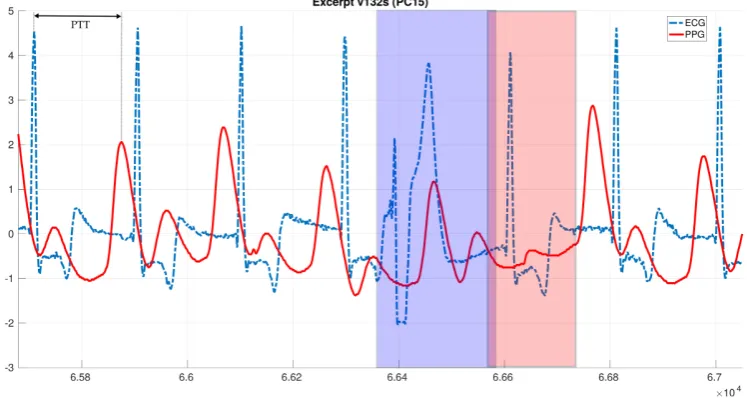
Pulse Arrival Time(PAT) orPulse Transit Time(PTT) (see, e.g.[9,54]) and illustrated on a short data excerpt 349
(containing a single PVC, highlighted by blue and red backgrounds for ECG and PPG, respectively) in Figure4.
350
To account for the PTT delay, when dealing with PPG signals we shift the interval[n,n+τd]byb2M/5c, taken
351
to be a rough estimate of the actual PTT. 352
6.58 6.6 6.62 6.64 6.66 6.68 6.7
104
-3 -2 -1 0 1 2 3 4
5 Excerpt v132s (PC15)
ECG
PPG
Figure 4.Excerpt of a synchronized recording of ECG (blue dash-dotted) and PPG (red solid) containing a single ectopic beat, highlighted with blue and red backgrounds respectively. Note the shift between the R-peak of the ECG and the respective pulse peak of the PPG, known as Pulse Transit Time (PTT)
4.2. Setup and l-SSA-CPD Parameters 353
The PC15 database [45] provides a collection of ECG and PPG recordings from which we chose a subset 354
similar to the one used in [53]. With PC15 records not being annotated, we purposely chose to limit our evaluation 355
to records containing PVCs (with different frequencies of occurrence), since they can quite accurately be spotted
356
by careful visual inspection, eventually including 8 records (composed of two ECG and one PPG signal per 357
record) with varying frequency of PVC occurrence in our analysis. The records are approximately 5 minutes 358
long with the sampling frequency being 250Hz yielding about 75000 observations each. 359
Since an in-depth discussion of how to select important SSA tuning parameters, most notably window 360
lengthMand number of eigentriples used (i.e. selection ofI), would be beyond the scope of this paper (see, e.g.
[35–37,44,47,48] and references therein), it shall suffice to briefly discuss our settings and the rationale behind 362
them. 363
Consider a periodic signal with periodT, then for SSA to capture the main structure of the signal it is
364
important thatMbe at least equal toT. Taking into account the physiological limits on HR and the sampling
365
frequency of our signals,M=300 appears to be a safe and reasonable choice. Accordingly, since as discussed
366
in Section2.1.1we imposeM ≤N/2, we setN = 2M =600. Furthermore, we setIto contain the leading
367
l eigentriples such as to account for 90% of the data’s variance. As for the SRC’s control limit, we use
368
hSRC =79.4107 which we obtained through Algorithm1forB=106,NSRC =5000,ARL0=5000,kSRC =0.5.
369
370
It shall further be emphasized that we apply l-SSA-CPD on the raw unfiltered data without any preprocessing 371
steps. Clearly, suitable preprocessing steps might further enhance performance, the objective here however is to 372
ascertain whether or not usable pre-screening information (pertaining to presence or absence of anomalies) can 373
be obtained by solely applying our l-SSA-CPD with very general parameter settings. A direct performance 374
comparison to MZ is therefore omitted for two main reasons: 375
• MZ would be computationally prohibitively expensive.
376
Recall that the PC15 records are approximately 75·103samples long, requiring computing the SVD of a
377
300×301 trajectory matrix, assumingM=300,N=600,K=N−M+1,Q=1 about 74100 times as
378
opposed to just once for l-SSA-CPD (seeFigure2).
379
• We aim to assess whether, based on its own merits, the performance of l-SSA-CPD suffices to be considered
380
for potential real life applications such as the use case presented in this paper. To further this goal an 381
in-depth comparative analysis to competing algorithms is not required and deemed to be beyond the scope 382
of this paper. 383
4.3. Performance Evaluation Using ECG Signals 384
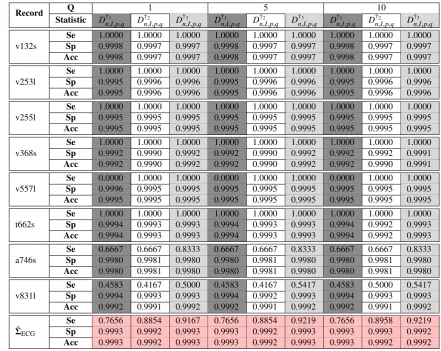
Table1shows the experimental results obtained by applying l-SSA-CP configured as described above to 8
385
PC15 ECG records with varying lengthQ={1, 5, 10}of the test matrixX(Tn).
386
A crucial condition for l-SSA-CPD to work properly is that the firstNsamples, which are embedded to
387
form the trajectory matrixXB, be an adequate representation of the underlying signal. In other words, we require
388
this initial segment to be free of anomalies. If an anomaly occurs in the firstNsamples, those samples are to
389
be discarded. This was the case for record t662s, which contains a premature ventricular contraction at about 390
n=332<Nand required us to discard the first few hundred observations.
391
Examining the entries of Table1it is apparent that l-SSA-CPD performs well, especially keeping in mind
392
that in our setup it is applied with fairly general parameters to raw, unfiltered ECG traces. The bottom of the 393
table highlighted in red presents the average performance over the entire 8 records for the three different test
394
statistics{D†1
n,I,p,q,D
†2
n,I,p,q,D
†3
n,I,p,q}and test matrix widthsQ={1, 5, 10}. 395
Note the increased performance of l-SSA-CPD with test statisticD†3
n,I,p,qand the rather small benefit (if 396
any) of using larger values forQ. These findings corroborate our recommendations made in Section3.1to use
397 D†3
n,I,p,qandQ=1, with the latter being in agreement with results reported by other authors (see, e.g.[35,36]).
398
Table 1.Detection on PC15 ECG trace I
Record Q 1 5 10
Statistic D†1
n,I,p,q D
†2
n,I,p,q D
†3
n,I,p,q D
†1
n,I,p,q D
†2
n,I,p,q D
†3
n,I,p,q D
†1
n,I,p,q D
†2
n,I,p,q D
†3
n,I,p,q
v132s
Se 1.0000 1.0000 1.0000 1.0000 1.0000 1.0000 1.0000 1.0000 1.0000
Sp 0.9998 0.9997 0.9997 0.9998 0.9997 0.9997 0.9998 0.9997 0.9997
Acc 0.9998 0.9997 0.9997 0.9998 0.9997 0.9997 0.9998 0.9997 0.9997
v253l
Se 1.0000 1.0000 1.0000 1.0000 1.0000 1.0000 1.0000 1.0000 1.0000
Sp 0.9995 0.9996 0.9996 0.9995 0.9996 0.9996 0.9995 0.9996 0.9996
Acc 0.9995 0.9996 0.9996 0.9995 0.9996 0.9996 0.9995 0.9996 0.9996
v255l
Se 1.0000 1.0000 1.0000 1.0000 1.0000 1.0000 1.0000 1.0000 1.0000
Sp 0.9995 0.9995 0.9995 0.9995 0.9995 0.9995 0.9995 0.9995 0.9995
Acc 0.9995 0.9995 0.9995 0.9995 0.9995 0.9995 0.9995 0.9995 0.9995
v368s
Se 1.0000 1.0000 1.0000 1.0000 1.0000 1.0000 1.0000 1.0000 1.0000
Sp 0.9992 0.9990 0.9992 0.9992 0.9990 0.9992 0.9992 0.9992 0.9991
Acc 0.9992 0.9990 0.9992 0.9992 0.9990 0.9992 0.9992 0.9990 0.9991
v557l
Se 0.0000 1.0000 1.0000 0.0000 1.0000 1.0000 0.0000 1.0000 1.0000
Sp 0.9996 0.9995 0.9995 0.9995 0.9995 0.9995 0.9995 0.9995 0.9995
Acc 0.9995 0.9995 0.9995 0.9995 0.9995 0.9995 0.9995 0.9995 0.9995
t662s
Se 1.0000 1.0000 1.0000 1.0000 1.0000 1.0000 1.0000 1.0000 1.0000
Sp 0.9994 0.9993 0.9993 0.9994 0.9993 0.9993 0.9994 0.9992 0.9993
Acc 0.9994 0.9993 0.9993 0.9994 0.9993 0.9993 0.9994 0.9992 0.9993
a746s
Se 0.6667 0.6667 0.8333 0.6667 0.6667 0.8333 0.6667 0.6667 0.8333
Sp 0.9980 0.9981 0.9980 0.9980 0.9981 0.9980 0.9980 0.9981 0.9980
Acc 0.9980 0.9981 0.9980 0.9980 0.9981 0.9980 0.9980 0.9981 0.9980
v831l
Se 0.4583 0.4167 0.5000 0.4583 0.4167 0.5417 0.4583 0.5000 0.5417
Sp 0.9994 0.9993 0.9993 0.9994 0.9992 0.9993 0.9994 0.9993 0.9993
Acc 0.9992 0.9991 0.9992 0.9992 0.9991 0.9992 0.9992 0.9991 0.9992
¯ ΣECG
Se 0.7656 0.8854 0.9167 0.7656 0.8854 0.9219 0.7656 0.8958 0.9219
Sp 0.9993 0.9992 0.9993 0.9993 0.9992 0.9993 0.9993 0.9993 0.9992
Acc 0.9993 0.9992 0.9993 0.9993 0.9992 0.9993 0.9993 0.9992 0.9992
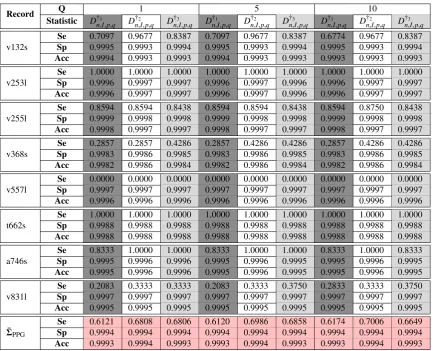
4.4. Performance Evaluation Using PPG Signals 400
Experimental results obtained by applying l-SSA-CPD to the PPG trace of the same 8 PC15 records are 401
shown in Table2, again with varying lengthQ={1, 5, 10}of the test matrixX(Tn).
402
Comparing the entries of Table2with those Table1we notice an overall drop in performance. Nevertheless,
403
l-SSA-CPD still manages to provide reasonable results. Furthermore, the recommendation of usingD†3
n,I,p,qand 404
Q=1 is shown to hold for the PPG traces as well.
405
406
It should be pointed out that, as has already been observed by other authors (see, e.g. [53]), there are
407
some inconsistencies in the PC15 records in that the some of the supposedly synchronized PPG traces exhibit an 408
unusual delay not consistent with the assumption that the PPG pulse peak should have an offset equal to the
409
PTT with respect to the respective R peak in the ECG. Pflugradt et al. attribute this occasional unusual offset to
410
glitches in the original measurement setup (see[53] at 11) and we assume it to have negatively impacted the
411
performance characteristics presented in Table2since we allow only for a very limited detection delayτd.
Table 2.Detection on PC15 PPG trace
Record Q 1 5 10
Statistic D†1
n,I,p,q D
†2
n,I,p,q D
†3
n,I,p,q D
†1
n,I,p,q D
†2
n,I,p,q D
†3
n,I,p,q D
†1
n,I,p,q D
†2
n,I,p,q D
†3
n,I,p,q
v132s
Se 0.7097 0.9677 0.8387 0.7097 0.9677 0.8387 0.6774 0.9677 0.8387
Sp 0.9995 0.9993 0.9994 0.9995 0.9993 0.9994 0.9995 0.9993 0.9994
Acc 0.9994 0.9993 0.9993 0.9994 0.9993 0.9993 0.9993 0.9993 0.9993
v253l
Se 1.0000 1.0000 1.0000 1.0000 1.0000 1.0000 1.0000 1.0000 1.0000
Sp 0.9996 0.9997 0.9997 0.9996 0.9997 0.9996 0.9996 0.9997 0.9997
Acc 0.9996 0.9997 0.9997 0.9996 0.9997 0.9996 0.9996 0.9997 0.9997
v255l
Se 0.8594 0.8594 0.8438 0.8594 0.8594 0.8438 0.8594 0.8750 0.8438
Sp 0.9999 0.9998 0.9998 0.9999 0.9998 0.9998 0.9999 0.9998 0.9998
Acc 0.9998 0.9997 0.9997 0.9998 0.9997 0.9997 0.9998 0.9997 0.9997
v368s
Se 0.2857 0.2857 0.4286 0.2857 0.4286 0.4286 0.2857 0.4286 0.4286
Sp 0.9983 0.9986 0.9985 0.9983 0.9986 0.9985 0.9983 0.9986 0.9985
Acc 0.9982 0.9986 0.9984 0.9982 0.9986 0.9984 0.9982 0.9986 0.9984
v557l
Se 0.0000 0.0000 0.0000 0.0000 0.0000 0.0000 0.0000 0.0000 0.0000
Sp 0.9997 0.9997 0.9997 0.9997 0.9997 0.9997 0.9997 0.9997 0.9997
Acc 0.9996 0.9996 0.9996 0.9996 0.9996 0.9996 0.9996 0.9996 0.9996
t662s
Se 1.0000 1.0000 1.0000 1.0000 1.0000 1.0000 1.0000 1.0000 1.0000
Sp 0.9988 0.9988 0.9988 0.9988 0.9988 0.9988 0.9988 0.9988 0.9988
Acc 0.9988 0.9988 0.9988 0.9988 0.9988 0.9988 0.9988 0.9988 0.9988
a746s
Se 0.8333 1.0000 1.0000 0.8333 1.0000 1.0000 0.8333 1.0000 0.8333
Sp 0.9995 0.9996 0.9996 0.9995 0.9996 0.9995 0.9995 0.9996 0.9995
Acc 0.9995 0.9996 0.9996 0.9995 0.9996 0.9995 0.9995 0.9996 0.9995
v831l
Se 0.2083 0.3333 0.3333 0.2083 0.3333 0.3750 0.2833 0.3333 0.3750
Sp 0.9997 0.9997 0.9997 0.9997 0.9997 0.9997 0.9997 0.9997 0.9997
Acc 0.9995 0.9995 0.9995 0.9995 0.9995 0.9995 0.9995 0.9995 0.9995
¯ ΣPPG
Se 0.6121 0.6808 0.6806 0.6120 0.6986 0.6858 0.6174 0.7006 0.6649
Sp 0.9994 0.9994 0.9994 0.9994 0.9994 0.9994 0.9994 0.9994 0.9994
Acc 0.9993 0.9994 0.9993 0.9993 0.9994 0.9993 0.9993 0.9994 0.9993
5. Discussion and Outlook 413
In this paper, we have proposed e a novel lightweight and model-free approach for the online detection of 414
cardiac anomalies such as ectopic beats in ECG or PPG signals based on the change detection capabilities of 415
Singular Spectrum Analysis (SSA) and nonparametric rank-based cumulative sum (CUSUM) control charts. 416
The procedure is able to quickly detect anomalies without requiring the identification of fiducial points such as 417
R-peaks and is computationally significantly less demanding than previously proposed SSA-based approaches. 418
This is accomplished by modifying the conventional SSA-based change detection algorithm such that the 419
computationally expensive task of computing the SVD is only performed at the very beginning instead of each 420
time a new data point becomes available. Furthermore, our procedure uses more elaborate test statistics that take 421
into account the information derived from the angle between data vectors representing new observations and the 422
subspace representing the signals characteristics as well as the euclidean distances. Lastly, our procedure differs
423
from previous approaches also in that rank-based control limits and the reinitialization of control charts after an 424
anomaly has been detected are used. 425
Using a set of ECG and PPG records we demonstrated that the direct application of our l-SSA-CPD without 426
any further pre- or post-processing yields not only viable but surprisingly accurate results with an average 427
sensitivity and specificity of 0.9167 and 0.9993 for ECG and 0.6806 and 0.9994 for PPG records, respectively. 428
With regards to the selection and fine-tuning of SSA-parameters, the performance evaluation on records 429
containing cardiac anomalies other than PVCs and a comparative performance analysis, questions for future 430
works are left open. 431
Acknowledgments:The work of M. Lang was supported by the ’Excellence Initiative’ of the German Federal and State
432
Governments and the Graduate School of Excellence Computational Engineering at Technische Universtät Darmstadt. The
views expressed in this article are solely those of the author in his private capacity and do not necessarily reflect the views of
434
Technische Universtät Darmstadt or any other organization.
435
Conflicts of Interest:The author declares no conflict of interest.
436
Abbreviations 437
The following abbreviations are used in this manuscript:
438 439
ANN Artificial Neural Network ARL Average Run Length AV Atrioventricular Node CUSUM Cumulative Sum Control Chart ECG Electrocardiography
HR Heart Rate
PAC Premature Atrial Contraction PAT Pulse Arrival Time
PCA Principal Component Analysis PPG Photoplethysmography
PR Pulse Rate
PTT Pulse Transit Time
PVC Premature Ventricular Contraction SA Sinoatrial Node
SRC Sequential Ranks CUSUM Control Chart SSA Singular Spectrum Analysis
SVD Singular Value Decomposition
440
Appendix A. CUSUM Control Charts 441
Consider an observed sequence {x(n),n ≥ 1} of independent random variables such that
442
{x(1),. . .,x(τ−1)} ∼ F and{x(τ),x(τ+1),. . .} ∼ G, i.e. a distributional shiftF → Goccurs at time 443
instanceτ.
444
Under the assumption thatFandGwere normally distributed with known parameters, Page’s CUSUM [55]
445
represents the gold-standard change detection technique and can be computed sequentially as 446
CC(0) =0, CC(n) =max{0,CC(n−1) +x(n)−kC}, n≥1 (A1) The CUSUM signals, thereby declaring a distributional shift to have occurred, if
447
CC(n)>hC (A2)
with pre-specified control limit/threshold and reference constanthCandkC, respectively. hCandkCare
448
chosen such that a nominal average run length (ARL) of ARL0is attained when the control chart operates
449
in-control, i.e. without distributional shifts occurring (see, e.g.[56]).
450
Formally, the in-control ARL is defined as the expected time until a change is signaled underF, i.e.
451
ARL=EFinf{n>0:CC(n)>hC}. (A3) which can be interpreted as akin to setting a nominal type-I error level in hypothesis testing with the 452
closeness of the actual in-controlARLtoARL0then being an indicator of the CUSUM chart’s robustness [57]. It
453
is well known that, under some regularity conditions, choosingkC=δ/2, withδbeing the shift in the transition
454
F→G, is optimal [58]. 455
References 456
1. Mukhopadhyay, S.C., Ed. Wearable Electronics Sensors - For Safe and Healthy Living, 1st ed.; Springer, 2015.
2. Selke, S., Ed. Lifelogging: Digital self-tracking and Lifelogging - between disruptive technology and cultural
458
transformation, 1st ed.; Springer, 2016.
459
3. Iaizzo, P.A., Ed. Handbook of Cardiac Anatomy, Physiology, and Devices, 3rd ed.; Springer International Publishing,
460
2015.
461
4. Gupta, R.; Mitra, M.; Bera, J. ECG Acquisition and Automated Remote Processing, 1st ed.; Springer, 2014.
462
5. Gacek, A.; Pedrycz, W. ECG Signal Processing, Classification and Interpretation: A Comprehensive Framework of
463
Computational Intelligence, 1st ed.; Springer, 2012.
464
6. Kiasaleh, K. Biological Signals Classification and Analysis, 1st ed.; Springer, 2015.
465
7. Webster, J., Ed. Design of Pulse Oximeters, 1st ed.; CRC Press, 1997.
466
8. Sazonov, E.; Neuman, M.R., Eds. Wearable Sensors: Fundamentals, Implementation and Applications, 1st ed.;
467
Academic Press, 2014.
468
9. Allen, J. Photoplethysmography and its application in clinical physiological measurement. Physiological
469
Measurement2007, 28, R1–R39.
470
10. Adibi, S., Ed. Mobile Health - A Technology Road Map, 1st ed.; Springer International Publishing, 2015.
471
11. Holzinger, A.; Röcker, C.; Ziefle, M., Eds. Smart Health - Open Problems and Future Challenges, 1st ed.; Springer
472
International Publishing, 2015.
473
12. Malvey, D.; Slovensky, D.J. mHealth: Transforming Healthcare, 1st ed.; Springer US, 2014.
474
13. Lang, M. Heart Rate Monitoring Apps: Information for Engineers and Researchers About the New European Medical
475
Devices Regulation 2017/745. JMIR Biomed Eng2017, 2, e2.
476
14. Quinn, P. The EU commission’s risky choice for a non-risk based strategy on assessment of medical devices.
477
Computer Law & Security Review2017, 33, 361–370.
478
15. Sperlich, B.; Holmberg, H.C. Wearable, yes, but able. . . ?: it is time for evidence-based marketing claims! Br J Sports
479
Med Published Online First: 16 December 2016, doi: 10.1136/bjsports-2016-097295.
480
16. Lang, M. Beyond Fitbit: A Critical Appraisal of Optical Heart Rate Monitoring Wearables and Apps, their Current
481
Limitations and Legal Implications. Alb. L. J. Sci. & Tech.2018, 28. forthcoming.
482
17. Tripathi, O.N.; Ravens, U.; Sanguinetti, M.C., Eds. Heart Rate and Rhythm: Molecular Basis, Pharmacological
483
Modulation and Clinical Implications, 1st ed.; Springer Berlin Heidelberg, 2011.
484
18. Jangra, M.; Dhull, S.K.; Singh, K.K., Recent trends in arrhythmia beat detection: A review. In Communication and
485
Computing Systems; Prasad, B.; Singh, K.K.; Ruhil, N.; Singh, K.; O’Kennedy, R., Eds.; Taylor & Francis Group,
486
CRC Press, 2016; pp. 177–183.
487
19. Veeravalli, B.; Deepu, C.J.; Ngo, D., Real-Time, Personalized Anomaly Detection in Streaming Data for Wearable
488
Healthcare Devices. In Handbook of Large-Scale Distributed Computing in Smart Healthcare; Khan, S.U.; Zomaya,
489
A.Y.; Abbas, A., Eds.; Springer International Publishing, 2017; pp. 403–426.
490
20. Elgendi, M.; Eskofier, B.; Dokos, S.; Abbott, D. Revisiting QRS Detection Methodologies for Portable, Wearable,
491
Battery-Operated, and Wireless ECG Systems. PLOS ONE2014, 9, 1–18.
492
21. Lemkaddem, A.; Proença, M.; Delgado-Gonzalo, R.; Renevey, P.; Oei, I.; Montano, G.; Martinez-Heras, J.A.; Donati,
493
A.; Bertschi, M.; Lemay, M. An autonomous medical monitoring system: Validation on arrhythmia detection. 2017
494
39th Annual International Conference of the IEEE Engineering in Medicine and Biology Society (EMBC), 2017, pp.
495
4553–4556.
496
22. Ye, C.; Coimbra, M.T.; Kumar, B.V.K.V. Arrhythmia detection and classification using morphological and dynamic
497
features of ECG signals. 2010 Annual International Conference of the IEEE Engineering in Medicine and Biology,
498
2010, pp. 1918–1921.
499
23. Chang, R.C.H.; Lin, C.H.; Wei, M.F.; Lin, K.H.; Chen, S.R. High-precision real-time premature ventricular contraction
500
(PVC) detection system based on wavelet transform. Journal of Signal Processing Systems2014, 77, 289–296.
501
24. Yaghouby, F.; Ayatollahi, A.; Bahramali, R.; Yaghouby, M.; Alavi, A. Towards automatic detection of atrial fibrillation:
502
a hybrid computational approach. Comput. Biol. Med.2010, 40, 919–930.
503
25. Acharya, U.; Bhat, B.; Iyengar, S.; Rao, A.; Dua, S. Classification of heart rate data using artificial neural network
504
and fuzzy equivalence relation. Pattern Recognit.2003, 36, 61–68.
505
26. Kumar, S.; Bansal, A.; Tiwari, V.; Nayak, M.; Narayanan, R. Remote health monitoring system for detecting cardiac
506
disorders. Proceedings of 2014 IEEE International Conference on Bioinformatics and Biomedicine, 2014, pp. 30–34.
507
27. Gradl, S.; Kugler, P.; Lohmüller, C.; Eskofier, B. Real-time ECG monitoring and arrhythmia detection using
508
Android-based mobile devices. 2012 Annual International Conference of the IEEE Engineering in Medicine and
509
Biology Society, 2012, pp. 2452–2455.
28. Luz, E.J.S.; Schwartz, W.R.; Cámara-Chávez, G.; Menotti, D. ECG-based heartbeat classification for arrhythmia
511
detection: A survey. Computer Methods and Programs in Biomedicine2016, 127, 144–164.
512
29. Oresko, J.J.; Jin, Z.; Cheng, J.; Huang, S.; Sun, Y.; Duschl, H.; Cheng, A.C. A Wearable Smartphone-Based
513
Platform for Real-Time Cardiovascular Disease Detection Via Electrocardiogram Processing. IEEE Transactions on
514
Information Technology in Biomedicine2010, 14, 734–740.
515
30. Amiri, A.M.; Abhinav.; Mankodiya, K. m-QRS: An efficient QRS detection algorithm for mobile health applications.
516
2015 17th International Conference on E-health Networking, Application Services (HealthCom), 2015, pp. 673–676.
517
31. Kim, Y.J.; Heo, J.; Park, K.S.; Kim, S. Proposition of novel classification approach and features for improved
518
real-time arrhythmia monitoring. Computers in biology and medicine2016, 75, 190–202.
519
32. Tsipouras, M.G.; Fotiadis, D.I. Automatic arrhythmia detection based on time and time–frequency analysis of heart
520
rate variability. Computer Methods and Programs in Biomedicine2004, 74, 95–108.
521
33. de Chazal, P.; O’Dwyer, M.; Reilly, R.B. Automatic classification of heartbeats using ECG morphology and heartbeat
522
interval features. IEEE Transactions on Biomedical Engineering2004, 51, 1196–1206.
523
34. Pan, J.; Tompkins, W.J. A Real-Time QRS Detection Algorithm. IEEE Transactions on Biomedical Engineering
524
1985, BME-32, 230–236.
525
35. Moskvina, V. Application of the Singular Spectrum Analysis for change-point detection in time serie. PhD thesis,
526
UK, 2001. CardiffUniversity.
527
36. Moskvina, V.; Zhigljavsky, A. An Algorithm Based on Singular Spectrum Analysis for Change-Point Detection.
528
Communications in Statistics2003, 32, 319–352.
529
37. Golyandina, N.; Nekrutkin, V.; Zhigljavsky, A. Analysis of Time Series Structure: SSA and related techniques, 1st
530
ed.; Chapman & Hall/CRC Monographs on Statistics & Applied Probability (Book 90), Chapman and Hall/CRC,
531
2001.
532
38. Dong, Q.; Yang, Z.; Chen, Y.; Li, X.; Zeng, K. Anomaly Detection in Cognitive Radio Networks Exploiting Singular
533
Spectrum Analysis. International Conference on Mathematical Methods, Models, and Architectures for Computer
534
Network Security. Springer, 2017, pp. 247–259.
535
39. Yang, Z.; Zhou, N.; Polunchenko, A.; Chen, Y. Singular Spectrum Analysis Based Quick Online Detection of
536
Disturbance Start Time in Power Grid. 2015 IEEE Global Communications Conference (GLOBECOM), 2015, pp.
537
1–6.
538
40. Zhang, S.; Liu, Y.; Pei, D.; Chen, Y.; Qu, X.; Tao, S.; Zang, Z.; Jing, X.; Feng, M. FUNNEL: Assessing Software
539
Changes in Web-based Services. IEEE Transactions on Services Computing2016, PP.
540
41. Georgescu, V.; Delureanu, S.M. Fuzzy-valued and complex-valued time series analysis using multivariate and complex
541
extensions to singular spectrum analysis. 2015 IEEE International Conference on Fuzzy Systems (FUZZ-IEEE),
542
2015, pp. 1–8.
543
42. Jarchi, D.; Lo, B.; Wong, C.; Ieong, E.; Nathwani, D.; Yang, G.Z. Gait Analysis From a Single Ear-Worn
544
Sensor: Reliability and Clinical Evaluation for Orthopaedic Patients. IEEE Transactions on Neural Systems and
545
Rehabilitation Engineering2016, 24, 882–892.
546
43. Uus, A.; Liatsis, P. Singular Spectrum Analysis for detection of abnormalities in periodic biosignals. 2011 18th
547
International Conference on Systems, Signals and Image Processing, 2011, pp. 1–4.
548
44. Sanei, S.; Hassani, H. Singular Spectrum Analysis of Biomedical Signals, 1st ed.; CRC Press, 2016.
549
45. Clifford, G.; Silva, I.; Moody, B.; Li, Q.; Kella, D.; Shahin, A.; Kooistra, T.; Perry, D.; Mark, R. The
550
PhysioNet/Computing in Cardiology Challenge 2015: Reducing False Arrhythmia Alarms in the ICU. Computing in
551
cardiology2015, 42, 273–276.
552
46. Goldberger, A.L.; Amaral, L.A.; Glass, L.; Hausdorff, J.M.; Ivanov, P.C.; Mark, R.G.; Mietus, J.E.; Moody, G.B.;
553
Peng, C.K.; Stanley, H.E. Physiobank, physiotoolkit, and physionet. Circulation2000, 101, e215–e220.
554
47. Golyandina, N.; Zhigljavsky, A. Singular Spectrum Analysis for Time Series, 1st ed.; Springer Briefs in Statistics,
555
Springer, 2013.
556
48. Elsner, J.B.; Tsonis, A.A. Singular Spectrum Analysis: A New Tool in Time Series Analysis; Language of Science,
557
Springer, 1996.
558
49. Idé, T.; Inoue, K. Knowledge discovery from heterogeneous dynamic systems using change-point correlations.
559
Proceedings of the 2005 SIAM International Conference on Data Mining. SIAM, 2005, pp. 571–575.
560
50. Mohammad, Y.; Nishida, T. Robust Singular Spectrum Transform. Next-Generation Applied Intelligence: 22nd
561
International Conference on Industrial, Engineering and Other Applications of Applied Intelligent Systems, IEA/AIE
2009, Tainan, Taiwan, June 24-27, 2009. Proceedings; Chien, B.C.; Hong, T.P.; Chen, S.M.; Ali, M., Eds.; Springer
563
Berlin Heidelberg: Berlin, Heidelberg, 2009; pp. 123–132.
564
51. Idé, T.; Tsuda, K. Change-Point Detection using Krylov Subspace Learning. Proceedings
565
of the 2007 SIAM International Conference on Data Mining, 2007, pp. 515–520,
566
[http://epubs.siam.org/doi/pdf/10.1137/1.9781611972771.54].
567
52. McDonald, D.R. A Cusum Procedure Based on Sequential Ranks; Laboratory for Research in Statistics and
568
Probability, Carleton University, 1985.
569
53. Pflugradt, M.; Geissdoerfer, K.; Goernig, M.; Orglmeister, R. A Fast Multimodal Ectopic Beat Detection Method
570
Applied for Blood Pressure Estimation Based on Pulse Wave Velocity Measurements in Wearable Sensors. Sensors
571
2017, 17.
572
54. Salvi, P. Pulse Waves: How Vascular Hemodynamics Affects Blood Pressure, 1st ed.; Springer, 2012.
573
55. Page, E.S. Continuous Inspection Schemes. Biometrika1954, 41, pp. 100–115.
574
56. Lucas, J.M. The Design and Use of Cumulative Sum Control Schemes. Technometrics1976, pp. 51–59.
575
57. Chatterjee, S.; Qiu, P. Distribution-free cumulative sum control charts using bootstrap-based control limits. Ann.
576
Appl. Stat2009, 3, 349–369.
577
58. Reynolds, M.R. Approximations to the average run length in cumulative sum control charts. Technometrics1975, pp.
578
65–71.
![Figure 1. Application example of basic SSA: baseline wander removal. Showing excerpt 02:20 - 02:30 fromrecord 14149m MIT-BIH ltdb [46]](https://thumb-us.123doks.com/thumbv2/123dok_us/7966570.1321340/5.595.123.512.210.412/figure-application-example-baseline-removal-showing-excerpt-fromrecord.webp)