Toward RSA-OAEP without Random Oracles
Nairen Cao
1Adam O’Neill
2Mohammad Zaheri
3February 11, 2020
In Memoriam: John C. O’Neill (1953–2018).
Abstract
We show new partial and full instantiation results under chosen-ciphertext security for the widely imple-mented and standardized RSA-OAEP encryption scheme of Bellare and Rogaway (EUROCRYPT 1994) and two variants. Prior work on such instantiations either showed negative results or settled for “passive” security notions like IND-CPA. More precisely, recall that RSA-OAEP adds redundancy and randomness to a mes-sage before composing two rounds of an underlying Feistel transform, whose round functions are modeled as random oracles (ROs), with RSA. Our main results are:
• Either of the two oracles (while still modeling the other as a RO) can be instantiated in RSA-OAEP under IND-CCA2 using mild standard-model assumptions on the round functions and generalizations of algebraic properties of RSA shown by Barthe, Pointcheval, and B´aguelin (CCS 2012). The algebraic properties are only shown to hold at practical parameters for small encryption exponent (e= 3), but we argue they have value for largereas well.
• Both oracles can be instantiated simultaneously for two variants of RSA-OAEP, called “t-clear” and “s-clear” RSA-OAEP. For this we use extractability-style assumptions in the sense of Canetti and Dakdouk (TCC 2010) on the round functions, as well as novel yet plausible “XOR-type” assumptions on RSA. While admittedly strong, such assumptions may nevertheless be necessary at this point to make positive progress.
In particular, our full instantiations evade impossibility results of Shoup (J. Cryptology 2002), Kiltz and Pietrzak (EUROCRYPT 2009), and Bitanskyet al. (STOC 2014). Moreover, our results fors-clear RSA-OAEP yield the most efficient RSA-based encryption scheme proven IND-CCA2 in the standard model (using bold assumptions on cryptographic hashing) to date.
1Dept. of Computer Science, Georgetown University, Email:
Contents
1 Introduction 3
1.1 Background and Motivation . . . 3
1.2 Our Thesis . . . 3
1.3 Discussion of The Properties and Our Goals . . . 4
1.4 Using PA + IND-CPA . . . 4
1.5 Partial Instantiation Results . . . 5
1.6 Full Instantiation Results . . . 5
1.7 Discussion and Perspective . . . 7
1.8 Related Work . . . 7
1.9 Organization . . . 8
2 Preliminaries and Some Generalizations 8 2.1 Notation and Conventions . . . 8
2.2 Public-Key Encryption and its Security . . . 8
2.3 Trapdoor Permutations and Their Security . . . 10
2.4 Function Families and Associated Security Notions . . . 11
2.5 The OAEP Framework . . . 13
3 Partial Instantiation Results for RSA-OAEP 13 3.1 Algebraic Properties of RSA . . . 14
3.2 Main Results . . . 14
3.3 Partial Instantiation ofG . . . 15
3.4 Partial Instantiation ofH . . . 19
4 A Hierarchy of Extractability Notions 23 5 Results for Padding Schemes and OAEP 25 5.1 Scope and Perspective . . . 25
5.2 Our Results . . . 26
6 Full Instantiation Results for t-Clear RSA-OAEP 30 6.1 Notions of High-Entropy-Message Security . . . 30
6.2 Main Results . . . 32
6.3 $IND-CPA-KI result . . . 32
6.4 PA0 and PA1 results . . . 33
7 Full Instantiation Results for s-Clear RSA-OAEP 38 7.1 XOR Assumptions on Trapdoor Permutations and RSA . . . 38
7.2 Main Results . . . 41
7.3 IND-CPA Result . . . 43
7.4 PA0 and PA1 Results . . . 44
7.5 PA2 Result . . . 46
A Generalized SIE and CIE of RSA 53 B IND-CPA Result Under Partial One-Wayness 55 C $IND-CPA-KI implies $SIM-CPA-KI 57 D Security of s-clear RSA-OAEP in the RO Model 61 E Deferred Proofs 65 E.1 Proof of Lemma 7.11 . . . 65
1
Introduction
In this paper, we show new partial and full instantiations under chosen-ciphertext attack (CCA) for the RSA-OAEP encryption scheme [12] and some variants. This helps explain why the scheme, which so far has only been shown to have such security in the random oracle (RO) model, has stood up to cryptanalysis despite the existence of “uninstantiable” RO model schemes and other negative results. It also leads to the fastest CCA-secure RSA-based public-key encryption scheme in the standard model (where one assumes standard-model properties of cryptographic hash functions) to date. We now discuss some background and motivation before an overview of our results.
1.1
Background and Motivation
In the random oracle (RO) model of Bellare and Rogaway [11], every algorithm has oracle access to the same truly random functions. This model has been enormously enabling in the design of practical protocols for various goals; examples include public-key encryption [11, 12, 51], digital signatures [11, 13], and identity-based encryption [26]. When a RO model scheme is implemented, one “instantiates” the oracles, that is, replaces their invocations with invocations of functions with publicly-available code. Thus, there are many possible “instantiations” of a protocol, depending on the choice of the latter. To obtain a practical instantiation, it was suggested by [11] to build these functions from cryptographic hashing in an appropriate way. We call this the canonical instantiation. The RO model thesis of [11] is that if a protocol is secure in the RO model then its canonical instantiation remains secure in the standard (RO devoid) sense.
Unfortunately, the RO model thesis has been refuted in a strong sense, starting with the work of Canetti et al. [33]. These works show that there exist RO model schemes for which any instantiation, let alone the canonical one, yields a scheme that can be broken efficiently in the standard model. However, the consensus of the community is that such schemes always seem contrived or artificial in some way. Indeed, RO model schemes that have been standardized have stood up to decades of cryptanalysis. If the RO model thesis is false, what explains this? This leads to what may be called thepractical RO model thesis: For a “practical” scheme proven secure in the RO model scheme, its canonical instantiation remains secure in the standard model. However, from a scientific standpoint this thesis is unsatisfactory because it lacks adefinition of “practical.”1 This shortcoming
is the starting point for our work.
1.2
Our Thesis
Candidate differentiating properties. It seems problematic to try to define practicality in the above sense. Instead, we propose some candidate properties that we conjecture to differentiate schemes to which the RO model thesis applies from those to which it does not. Here are some such properties, some of which are inspired by our work described below:
1. There exist standard-model properties of the constituent functions that together suffice to prove security of the scheme, ideally as well as realizations of such functions under standard assumptions.
2. Each individual constituent function can be separately instantiated as above, while possibly modeling the others as ROs.
3. Variants of the scheme that fall under the same framework satisfy one of the above properties.
4. There exist constructions of standard-model hash functions that allow to prove security of the scheme when replacing the ROs, ideally these constructions being under standard assumptions.
schemes, without transitioning between the RO and standard models, for example with Chaum’s blind signature scheme [9] and Damg˚ard’s ElGamal [39]. It was also advocated by Pandeyet al.[63] to resolve some long-standing theoretical questions.
It is also worth mentioning that there are impossibility results in the standard model for RSA-OAEP [58] and RSA-FDH, RSA-PSS [41, 40]. However, these areblack-box impossibility results that demonstrate that a proof treating the functions as black-boxes cannot suffice. As in other areas of cryptography [2] this motivates looking at non-blackbox assumptions.
1.3
Discussion of The Properties and Our Goals
Our focus: RSA-OAEP. We focus our study on whether the RO model thesis applies to a very influential scheme, namely RSA-OAEP [12]. Roughly, RSA-OAEP is defined as follows. RSA-OAEP encrypts a message as f(skt) where f is the RSA function, where for functions G and H (originally modeled as ROs) we have s=G(r)⊕mk0ζ for randomnessr∈ {0,1}ρ and messagem∈ {0,1}µ,t=H(s)⊕r. (We denotes=s
1ks2.) Thus,
we would like to examine whether RSA-OAEP satisfies the properties listed above.
The first property. Here we seek standard model properties of RSA, G, and H that suffice to prove IND-CCA. For this property, we mentioned that ideally we would also have theoretical realizations of such functions under standard assumptions. We make it clear that we do not advocate using these theoretical realizations in practice, but they would show that the goal is not impossible to achieve. The importance of this is illustrated by the fact that the most general forms of assumptions such as correlation intractability (CI) [33] and universal computational extraction (UCE) [7, 28] have been shown (likely) impossible. (But special cases of CI and UCE which suffice for the schemes considered remain plausible [7, 28, 30].) Unfortunately, we do not know how to achieve the first property for RSA-OAEP, even without such theoretical realizations.
The second property. The second property asks for so-called “partial instantiations” for each one ofG orH, while still modeling the other as a RO. Partial instantiations are valuable because ROs are used in different ways in a scheme, and instantiating one of them isolates a property it relies on. Moreover, we ask that every oracle can be (separately) instantiated. This has provable implications in practice as well, as now an attacker would need to exploit weakness in theinteraction between these functions in order to break the scheme in the standard model. In our eyes this makes a standard model attack much less plausible. We show that RSA-OAEP satisfies this property under suitable assumptions.
The third property. The third property is more subjective than the others, as it hinges on what constitutes a scheme falling under the same framework. The aim is to capture the scheme designers’ intent or their general approach. Again, the idea is not to use the modified schemes in practice necessarily (although one certainly could if the efficiency penalty is acceptable), but to validate the framework more than simply proving the original scheme is secure in the RO model. An upshot is that this approach can indeed lead to variants of the scheme that offer better security with similar efficiency. We show the third property holds for RSA-OAEP, and in fact our results for one of our variants, namelys-clear RSA-OAEP, leads to the most efficient IND-CCA secure scheme in the standard model, albeit under bold assumptions on cryptographic hashing.
The fourth property. Note that this property differs from the first in that it does not require giving higher-level properties that the hash functions should satisfy in order to make the scheme secure. Thus, it does not really give insight into what properties hash functions used in the canonical instantiation should satisfy to do this. Still, existence of such hash functions refutes uninstantiability of the scheme, showing that the job of the hash functions in making the scheme secure is at least plausible. As with the first property, we leave it as an open problem to show this for RSA-OAEP. We note that this property has been shown for other RO model schemes in,e.g, [54, 72].
We proceed to describe our approach and results in more detail.
1.4
Using PA + IND-CPA
overall analyses more tractable. Moreover, while it seems that PA necessitates using knowledge assumptions, this is somewhat inherent anyway due to black-box impossibility results discussed below.
Flavors and implications. PA comes in various flavors: PA-RO [5], and PA0, PA1, and PA2 [10]. PA-RO refers to a notion in the RO model, while PA0, PA1, and PA2 refer to standard model notions that differ in what extent the adversary can query its decryption or encryption oracles. (In particular, in PA2 the adversary can query for encryptions of unknown plaintexts.) Similarly, IND-CCA comes in flavors [66, 5]: IND-CCA0, IND-CCA1, and IND-CCA2. We use that [5, 10] show that IND-CPA + PA-RO implies IND-CCA2 in the RO model, IND-CPA + PA0 implies IND-CCA1 with one decryption query, IND-CPA + PA1 implies IND-CCA1, and IND-CPA + PA2 implies IND-CCA2.
1.5
Partial Instantiation Results
High-level approach. We first give partial instantiation results of RSA-OAEP under IND-CCA2. Such results have been sought after in prior work [29, 21, 22] but have proven negative results or settled for weaker security notions. The heroes for us here are new generalizations of the notions of “second-input extractability” (SIE) and “common-input extractability” (CIE) proven by Barthe et al.[3] to hold for small-exponent RSA (e= 3). SIE says that an RSA image point can be inverted given a sufficiently-long (depending on e) part of the preimage, whereas CIE says that two RSA images can be inverted if the preimages share a common part. They were used by [3] where the “part” is the least-significant bits to analyze a no-redundancy, one-round version of RSA-OAEP in the RO model. The assumptions are proven via Coppersmith’s algorithm to find small roots of a univariate polynomial moduloN [35].
We show that generalized versions where the “part” refers to some of the middle or most-significant bits, rather than least-significant bits, is useful for analyzing RSA-OAEP more generally. We show these versions also hold for small-exponent RSA, but based on the bivariate Coppersmith algorithm [35, 19, 37]. Moreover, despite the similarity of assumptions, our proof strategies in the partial instantiations are somewhat different than that of Bartheet al. [3]. Another interesting point is that while (generalized) SIE and CIE hold fore= 3, we argue they have practical value for larger eas well. Namely, whilee >3 would require an impractical “part” length using Coppersmith’s technique, they could possibly hold for practical parameters via other (in particular, non-blackbox) techniques. At least, we do not see how to refute that, which could lend insight into why there is no IND-CCA2 attack on the scheme for generale. 2
Results and intuition. Namely, we show partial instantiations of both oraclesG,Hunder very mild assump-tions on the round funcassump-tions — roughly, that G is a pseudorandom generator andHis a hardcore function for RSA, respectively — in both cases assuming RSA is SIE and CIE. We first prove IND-CPA security in these cases. Interestingly, the instantiation ofG under IND-CPA uses that RSA is SIE while the instantiation ofHdoes not, the intuition being that in the latter case we assumeHis a hardcore function so its output masksr∈ {0,1}ρused
in the challenge ciphertext unconditionally. Now for PA-RO, in both cases we use SIE and CIE, but wrt. different bits of the input. In the case of instantiating G, it is wrt. the redundancy bits s2. Intuitively, for a decryption
query there are two cases. Firstly, that it has adifferent r-part than the challenge and therefore this must have been queried to the RO, in which case the SIE extractor works. Secondly, that it has the same r-part as the challenge, but it therefore sharess2, in which case the CIE extractor works. In the case of instantiatingH, there
are again two cases for an encryption query depending on whether it shares the sames-part of the challenge or not; thus the assumption is wrt. the wholes-part.
1.6
Full Instantiation Results
High-level approach. We next give full instantiation results for two variants of RSA-OAEP, calledt-clear ands-clear RSA-OAEP. Prior results on t-clear RSA-OAEP [22] showed only partial instantiations or relatively weak security notions, ands-clear RSA-OAEP was only considered indirectly by Shoup [70] for negative results. Int-clear RSA-OAEP, a message is encrypted asf(s1)ks2ktwheref is the RSA functions1ks2=G(r)⊕mk0ζ for
randomnessr∈ {0,1}ρand messagem∈ {0,1}µ,t=H(s
1ks2)⊕r. Here we dividesintos1ks2, wheres2∈ {0,1}ζ,
so the name “t-clear” while consistent with prior work [22], is somewhat of a misnomer. On the other hand, in s-clear RSA OAEP a message is encrypted asskf(t). One of the heroes for us here is a hierarchy of “extractability”
notions we define and assume for the round functions, called EXT-RO, EXT0, EXT1, EXT2, roughly paralleling PA-RO, PA0, PA1, PA2 respectively, and significantly generalizing prior work [31, 32]. Besides this parallel, our generalizations consider adversaries that output only part of an image point or an image point along with part of a pre-image. These are bold assumptions to make on (functions constructed out of) cryptographic hash functions, but, as discussed above, we believe studying their implications is justified. In the case of s-clear, another hero is a family of new“XOR-type” assumptions we introduce, and give intuitive justifications for in light of the multiplicative structure of RSA. Again, we view part of our contribution as putting forth novel assumptions that the research community can analyze (say in the generic ring model) in the future.
We make several remarks about our results, particularly how they avoid known impossibility results, before detailing them:
• Extractability is a non-blackbox assumption (saying for every adversary there exists a non-blackbox “extrac-tor”) so we avoid the impossibility result of Kiltz and Pietrzak [58].3. That is, the fact we use extractable hash functions (extractability being an intuitive property used in the original RO model proof) is somewhat unavoidable.
• While extractability ofHwouldprima facie be false, we use it only in a plausible way for a cryptographic hash function. Namely, the adversary also outputspart of the preimage. Extractability assumptions we use onG, even where the adversary outputs only part of an image point, remain plausible as it is an expanding function with a sparse range (usually constructed something likeG(x) = (H(0kx)kH(1kx), . . .).
• For extractability we use only bounded key-independent auxiliary input (basically, the keys for the other functions in the scheme), so we avoid the impossibility result of Bitansky et al. [17]. Moreover, the key-dependent auxiliary information is just one image query (at least in the proof of IND-CCA2).
• Our “XOR-type” assumptions on RSA avoid a negative result of Shoup [70], showing that there is an attack if the general trapdoor permutation is “XOR-malleable.”4
• We typically use the various forms of extractability in combination with (at least) collision-resistance, so that the extractor returns the “right” preimage. The collision-resistant construction of [61] based on knowledge assumptions, albeit where the adversary outputs the entire image point, is on the lowest level of our hierarchy (EXT0); furthermore, it is not known to work when the adversary outputs part of the image point. Any theoretical constructions for higher levels (EXT1, EXT2) are similarly open. We hope these are targeted in future work.
Results and intuition for t-clear. Our results for t-clear RSA-OAEP are weaker than those for s-clear RSA-OAEP. First, for t-clear we prove IND-CPA for high-entropy, public key independent messages, under mild assumptions on the round functions, namely that His a hardcore function for RSA and G is a pseudorandom generator. Intuitively, the high-entropy requirement comes from the fact that the adversary attackingH needs to knowrto prepare its challenge ciphertext, so the randomness of the input toHneeds to come fromm. (We could avoid it using the stronger assumption of UCE as per the result of [7], which could be viewed as a hedge.) Furthermore,mneeds to be public-key independent so as to not bias the output. Then we can prove PA0 based on forms of EXT0 forGandH, the intuition being that the plaintext extractor first extracts from the partG(r) that is left in clear by the redundancy to get rand then runs the extractor for Hont⊕rfrom which it can compute m, with the above part of the pre-image to gets. Note that when running the extractor here and below we have to be careful that the constructed extractor uses the same coins as the starting one for consistency (otherwise we won’t end up with the right extractor). We can also prove PA1, although we have to make an extractability assumption directly on the padding scheme.5 Interestingly, even this approach does not work for PA2, which we
leave completely open fort-clear (cf. Remark 7.6).
Results and intuition for s-clear. We finds-clear is much more friendly to a full instantiation by making novel but plausible assumptions on RSA. One is XOR-nonmalleability (XOR-NM), saying that from F(x) it is hard to find someF(x0) andzsuch thatz=x⊕x0. Another is XOR-indistinguishability (XOR-IND), saying for 3As acknowledged by the authors there was a bug in the proceedings version of this paper, but this has been fixed for the full version [59].
4In more detail, note that fors-clear the “overall” TDP (including the part output in the clear) is not partial one-way [46] so their security proof doesnot apply. In fact, Shoup [70] considers the scheme in his proof that RSA-OAEP is not IND-CCA2-secure for general one-way TDPs, exhibiting the above-mentioned attack.
Scheme Assumptions on OAEP Assumptions onF Security Size Ref RSA-OAEP G: PRG and H: RO OW, SIE and CIE IND-CCA2 n Section 3 RSA-OAEP G: RO and H: PHCF OW, SIE and CIE IND-CCA2 n Section 3
RSA-OAEP G: t-wise independent Lossy TDP IND-CPA n [57]
RSA-OAEP G,H: UCE OW IND-CPA-KI n [7]
RSA-OAEP G: PRG, EXT0 and NCR OW $IND-CCA0-KI 3n+ 3k Full version
t-clear H: HCF, EXT0 and CR
RSA-OAEP OAEP: EXT1 and NCR OW $IND-CCA1-KI 3n+ 3k Full version
t-clear G : PRG and H: HCF
RSA-OAEP G: PRG and NCR OW IND-CCA2 n+k [22]
t-clear H: RO
RSA-OAEP G: RO OW IND-CCA2 n+k [22]
t-clear H: NM PRG with hint
RSA-OAEP G: PRG and NCR OW $NM-CPA n+k [22]
t-clear H: NM PRG with hint
RSA-OAEP G: PRG, EXT1 and NCR XOR-IND0 IND-CCA1 2n+k+µ Section 7
s-clear
RSA-OAEP G: PRG, EXT2 and NCR XOR-IND1,2 IND-CCA2 2n+k+µ Section 7
s-clear H: CR and XOR-NM0
Figure 1: Instantiability results for RSA-OAEP, wherenis modulus length,kis security param andµis message length. Typically n= 2048, k = 128 andµ= 128.
randomxand adversarially-chosenzone cannot tellF(x) fromF(x⊕z) given “hint”G(x). In our results,Gis a PRG, which we show also impliesGis a HCF forF. So, the notion can be viewed as an extension of the classical notion of HCF. In fact, we use XOR-IND just to show IND-CPA. The intuition is that it allows breaking the dependency of s in the input to OAEP with the input to RSA. The proofs of PA0 and PA1 are very similar, and showcase one reasons-clear is much more friendly to a full instantiation, namely it heavily depends on the extractability of G. That is, if G is suitably extractable, the plaintext extractor can simply recover r and then compute the plaintext as s⊕G(r). For PA2, one has to be careful as when the adversary makes an encryption query, the plaintext extractor should call the image oracle for G, where in addition to G(x) for random x it receives the hint of RSA on x. We show that if RSA is XOR-IND then this implies the adversary can get the whole ciphertext as a hint to simulate the encryption oracle. Then we also have the worry about the adversary querying “mauled” ciphertexts to the extract oracle. Intuitively, if ther-part is the same then it cannot run the extractor for G, but we show this violates XOR-NM of RSA. On the other hand, if the s-part is the same then we cannot break XOR-NM but this creates a collision forG.
1.7
Discussion and Perspective
We summarize and compare our results to prior work in Figure 1. Note that we get a lot of mileage from assuming the trapdoor permutation is specifically RSA, whereas prior work, which has mostly shown negative results CCA-style security notions, went for a general approach. We also highlight that while our assumptions on both RSA and the round functions for our full instantiability results are expectedly stronger than what we need for partial instantiations, they still compare favorably to prior work. In particular, while our assumption of EXT2 for G in our s-clear result is already “PA2-flavored,” prior work [22, Definition 3.3] made CCA-style assumptions on the round functions even to obtain relatively weak notions of non-malleability. It can also be viewed as a strengthening of “adaptive” (CCA-style) security notions on one-way functions [63, 56].6 Plus, it is
not clear how to get an IND-CCA2 encryption scheme from EXT2 functions in a simpler way.
1.8
Related Work
RO model results. Results about security of F-OAEP for an abstract TDP F with applications to RSA-OAEP in the RO model were shown in [12, 70, 46]. Ultimately, these works showed RSA-RSA-OAEP is IND-CCA2 secure in the RO model assuming only one-wayness of RSA, but with a loose security reduction. Interestingly, Shoup [70] considerss-clear RSA-OAEP indirectly in a negative result about RSA-OAEP with a general one-way TDP. Security oft-clear RSA-OAEP (under the name “RSA-OAEP++‘’) has been analyzed in the RO model by Boldyreva, Imai and Kobara [23], who show tight security in the multi-challenge setting.
Partial instantiation results. Canetti [29] conjectured that his notion of perfect one-wayness sufficed to instantiate one of the two oracles in F-OAEP. This was disproved in general by Boldyreva and Fischlin [21], but their results do not contradict ours because they use a contrived TDP F. Subsequently, Boldyreva and Fischlin [22] gave partial instantiations for t-clearF-OAEP under stronger assumptions on the round functions.
Full instantiation results. Brown [27] and Paillier and Villar [62] showed negative results for proving RSA-OAEP is IND-CCA secure in restricted models, and Kiltz and Pietrzak [58] showed a general black-box impossibility result. As mentioned above, their results do not contradict ours because we use non-blackbox as-sumptions. Moving to weaker notions, Kiltzet al.[56] show IND-CPA security of RSA-OAEP using lossiness [64], while Bellare, Hoang, and Keelveedhi [7] show RSA-OAEP is IND-CPA secure for public-key independent mes-sages assuming the round functions meet their notion of universal computational extraction. Boldyreva and Fischlin [22] show a weak form of non-malleability for t-clearF-OAEP, again using very strong assumptions on the round functions. Lewkoet al.[60] show IND-CPA security of the RSA PKCS v1.5 scheme, with the bounds later being corrected and improved by Smith and Zhang [71].
Candidate instantiability assumptions. General notions for function families geared towards instantiating ROs that have been proposed include correlation intractability [33, 30], extractable hash functions [31, 32, 15, 17], perfect one-wayness [29, 34, 44], seed incompressibility [50], non-malleability [20, 1], and universal computational extraction (UCE) [7, 28, 8].
1.9
Organization
In Section 2, we give the preliminaries. In Section 3, we formalize the algebraic properties of RSA we use and our partial instantiation results for RSA-OAEP. In Section 4, we give a new hierarchy of extractable functions. In Section 5, we abstract out some properties of the OAEP padding scheme we use. Then, in Section 7 we give novel “XOR-type” assumptions on RSA and combine them with the above to give our full instantiation result s-clear RSA-OAEP. Due to space constraints, our results fort-clear RSA-OAEP are deferred to the supplementary materials. We also defer all detailed proofs to the supplementary materials.
2
Preliminaries and Some Generalizations
We overview notations and definitions we use that are mostly from prior work.
2.1
Notation and Conventions
For a probabilistic algorithmA, byy←$A(x) we mean thatAis executed on inputxand the output is assigned toy. We sometimes usey←A(x;r) to makeA’s random coins explicit. We denote by PrA(x) =y: x←$Xthe probability thatAoutputsyon inputxwhenxis sampled according toX. We denote by [A(x)] the set of possible outputs of A when run on inputx. The security parameter is denoted k ∈ N. Unless otherwise specified, all algorithms must run in probabilistic polynomial-time (PPT) ink, and an algorithm’s running-time includes that of any overlying experiment as well as the size of its code. Integer parameters often implicitly depend onk. The length of a stringsis denoted|s|. We denote bys|ji thei-th least significant bits (LSB) toj-th least significant bits ofs(including the i-th andj-th bits), where 1≤i≤j ≤ |s|. For convenience, we denote bys|`=s|`1 the` least
significant bits of sands|`=s||s|
|s|−` the`most significant bits (MSB) of s, for 1≤`≤ |s|. We writePX for the
distribution of random variableX andPX(x) for the probability thatX puts on valuex, i.e.PX(x) = Pr[X=x].
We denote by U` the uniform distribution on {0,1}`. We write US for the uniform distribution on the setS.
Vectors are denoted in boldface, for examplex. Ifxis a vector then|x|denotes the number of components ofx
andx[i] denotes itsi-th component, for 1≤i≤ |x|. For convenience, we extend algorithmic notation to operate on each vector of inputs component-wise. For example, ifAis an algorithm andx,yare vectors thenz←$A(x,y) denotes thatz[i]←$A(x[i],y[i]) for all 1≤i≤ |x|. LetX be a random variable taking values on a common finite domain. Themin-entropy of a random variableX is H∞(X) =−log(maxxPr [X =x]).
2.2
Public-Key Encryption and its Security
Public-key encryption. Apublic-key encryption scheme PKEwith message spaceMsgis a tuple of algorithms (Kg,Enc,Dec). The key-generation algorithm Kg on input 1k outputs a public key pk and matching secret
GameIND-ATKAPKE(k)
b←${0,1}; (pk,sk)←$Kg(1k) (M0,M1,state)←$A1O1(·)(1k,pk) mb←$Mb(1k,pk)
c←$Enc(pk, mb) d←$AO2(·)
2 (pk, c,state) Return (b=d)
Figure 2: Game to defineIND-ATK security.
GamePA-ROA,PKEExt(k) b←${0,1}; i←1 ; j←1 (pk,sk)←$Kg(1k)
b0←$ARO(·,1),Enc(pk,·),D(sk,·)(pk) Return (b=b0)
ProcedureRO(x, i)
IfH[x] =⊥thenH[x]←${0,1}` Ifi= 1 then
x[j]←x; h[j]←H[x] ; j←j+ 1 ReturnH[x]
ProcedureEnc(pk,M) m←$M(1k,pk)
c←$EncRO(·,2)(pk, m)
c[i]←c; i←i+ 1 Returnc
ProcedureD(sk, c) Ifc∈cthen return⊥ m0←Dec(sk, c)
m1←$ExtRO(·,3)(x,h,c, c, pk) Returnmb
Figure 3: Game to define PA-RO security.
deterministic decryption algorithmDecon inputssk and ciphertextcoutputs a messagemor⊥. We require that for all (pk,sk)∈[Kg(1k)] and allm∈Msg(1k),Dec(sk,(Enc(pk, m)) =mwith probability 1.
Security of public-key encryption [48, 67]. LetPKE= (Kg,Enc,Dec) be a public key encryption scheme andA= (A1, A2) be an adversary. LetMbe a PPT algorithm that takes inputs 1kand a public keypkto return
a messagem ∈Msg(1k). For ATK∈ {CPA, CCA1, CCA2} we associate the experiment in Figure 2 for every k∈N. Define theind-atk advantage ofAagainstPKEas
AdvindPKE-atk,A(k) = 2·Pr
IND-ATKAPKE(k)⇒1 −1 .
If atk = cpa, then O1(·) =ε, andO2(·) =ε. We say PKEissecure under chosen-plaintext attack (IND-CPA) if AdvindPKE-cpa,A(k) is negligible inkfor all PPTA.
Similarly, if atk = cca1, then O1(·) = Dec(sk,·), and O2(·) = ε; if atk = cca2, then O1(·) = Dec(sk,·), and O2(·) =Dec(sk,·). In the case of cca2,A2is not allowed to askO2to decryptc. We say thatPKEis secure under
non-adaptive chosen-ciphertext attack or IND-CCA1 (resp. adaptive chosen-ciphertext attack or IND-CCA2), if
AdvPKEind-cca1,A (k) (resp.AdvPKEind-cca2,A (k)) is negligible inkfor all PPTA.
PA-RO security. We first define plaintext-awareness in the RO model following [6], which builds on the definition in [12]. Note that PA-RO combined with IND-CPA security is strictly stronger than IND-CCA2 security in general. LetPKE= (Kg,Enc,Dec) be a public key encryption scheme and letMbe a PPT algorithm that takes as inputs 1k and a public keypk, and outputs a messagem∈Msg(1k). To adversaryAand extractor
Ext, we associate the experiment in Figure 3 for everyk∈N. We say thatPKEis PA-RO secure if for every PPT adversaryAthere exists an extractorExtsuch that
AdvpaPKE-ro,A,Ext(k) = 2·PrhPA-ROA,PKEExt(k)⇒1i−1 .
is negligible ink.
Remark 2.1 Our definition of plaintext awareness in the random oracle model differs from the definition given in [6] in the following way. In our definition, we are giving the extractor access to the random oracle. We observe that the analogous result of [6, Theorem 4.2] that IND-CPA and PA-RO together imply IND-CCA2 still holds for our modified definition, since in the proof the IND-CPA adversary could query its own random oracle to answer to the random oracle queries of the extractor.
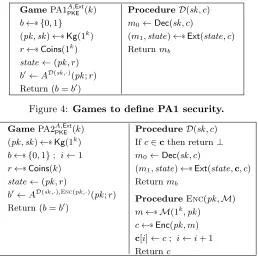
GamePA1A,PKEExt(k) b←${0,1}
(pk,sk)←$Kg(1k) r←$Coins(1k)
state←(pk, r) b0←AD(sk,·)(pk;r) Return (b=b0)
ProcedureD(sk, c) m0←Dec(sk, c)
(m1,state)←$Ext(state, c) Returnmb
Figure 4: Games to define PA1 security.
GamePA2A,PKEExt(k) (pk,sk)←$Kg(1k) b←${0,1}; i←1 r←$Coins(k)
state←(pk, r) b0←AD(sk,·),Enc(pk,·)
(pk;r) Return (b=b0)
ProcedureD(sk, c) Ifc∈cthen return⊥ m0←Dec(sk, c)
(m1,state)←$Ext(state,c, c) Returnmb
ProcedureEnc(pk,M) m←$M(1k,pk)
c←$Enc(pk, m)
c[i]←c; i←i+ 1 Returnc
Figure 5: Games to define PA2 security.
PA1 security. LetPKE = (Kg,Enc,Dec) be a public key encryption scheme. To adversary A and extractor
Ext, we associate the experiment in Figure 4 for everyk∈N. We say thatPKEis PA1 secure if for every PPT adversaryAwith coin spaceCoinsthere exists an extractorExt such that,
AdvPKEpa1,A,Ext(k) = 2·PrhPA1PKEA,Ext(k)⇒1i−1 .
is negligible ink.
PA0 security. We define PA0 similarly to PA1, exceptA is only allowed to make a single oracle query. Let PA0 be the corresponding experiment, and define
AdvPKEpa0,A,Ext(k) = 2·PrhPA0PKEA,Ext(k)⇒1i−1 .
We sayPKEis PA0 secure if for every PPT adversaryAthere exists an extractorExtsuch thatAdvpa0PKE,A,Ext(k) is negligible ink.
PA2 security. Let PKE= (Kg,Enc,Dec) be a public-key encryption scheme. To adversary A and extractor
Ext, we associate the experiment in Figure 5 for everyk∈N. We say thatPKEis PA2 secure if for every PPT adversaryAthere exists an extractorExtsuch that,
AdvPKEpa2,A,Ext(k) = 2·PrhPA2PKEA,Ext(k)⇒1i−1 .
is negligible ink.
Remark 2.2 Our PA2 definition comes from [10]. Other than PA1 adversary, we will give PA2 adversary extra access to encryption oracle. This models the ability IND-CCA2 adversary obtains ciphertext without knowing the randomness.
2.3
Trapdoor Permutations and Their Security
Trapdoor permutations. A trapdoor permutation family with domain TDom is a tuple of algorithmsF = (Kg,Eval,Inv) that work as follows. AlgorithmKgon input a unary encoding of the security parameter 1k outputs
y∈TDom(k). We often writef(x) instead ofEval(f, x). AlgorithmInvon inputs a functionf−1andy∈TDom(k) outputsx∈TDom(k). We often writef−1(y) instead ofInv(f−1, y). We require that for any (f, f−1)∈[Kg(1k)] and any x∈TDom(k), f−1(f(x)) =x. We callF ann-bit trapdoor permutation family ifTDom={0,1}n. We
will think of the RSA trapdoor permutation family [68] n-bit for simplicity, although its domain is Z∗N for an
n-bit integerN. Additionally, for convenience we define the following. For anν-bit trapdoor permutation family
F and`∈N, we defineF |`= (Kg|`,Eval|`,Inv|`) as the (ν+`)-bit trapdoor permutation families such that for all
k∈N, all (f|`, f−1|`)∈[Kg|`(1k)], and allx∈ {0,1}ν+`, we havef|`(x) =f(x|n−`)kx|`, and analogously forF |`.
One-wayness. Let F = (Kg,Eval,Inv) be a trapdoor permutation family with domain TDom. We say F is one-way if for every PPT inverterI:
AdvowfF,I(k) = Pr
(f,f−1)←$Kg(1k)
x←$TDom(k)
x0←I(f , f(x)) x0 =x
.
is negligible ink.
Partial one-wayness. LetF= (Kg,Eval,Inv) be a trapdoor permutation family with domainTDom. We say
F isζ-partial one way if for every PPT inverterI:
AdvpowF,I(k) = Pr
(f,f−1)←$Kg(1k)
x←$TDom(k)
x0←I(f , f(x)) x0=x|ζ
.
is negligible in k. It is shown in [45] that for RSA one-wayness implies partial one-wayness but the reduction is lossy.
2.4
Function Families and Associated Security Notions
Function families. A function family with domainF.Domand rangeF.Rngis a tuple of algorithmsF = (KF, F)
that work as follows. Algorithm KF on input a unary encoding of the security parameter 1k outputs a keyKF.
Deterministic algorithm F on inputsKF and x∈F.Dom(k) outputsy ∈F.Rng(k). We alternatively write F as
a function F:KF ×F.Dom→F.Rng. We callF an`-injective function if for all distinctx1, x2∈F.Dom(k) and
KF ∈[KF(1k)], we haveF(KF, x1)|`6=F(KF, x2)|`.
Collision resistance. LetH: KH×HDom→HRngbe a function family. We sayHiscollision resistant(CR)
if for any PPT adversaryA:
AdvcrH,A(k) = Pr KH←$KH(1k)
(x1, x2)←A(KH)
x1, x2∈HDom(k)
∧ H(KH, x1) =H(KH, x2)
x16=x2
.
is negligible ink. Again, this is a standard notion that can be realized in a variety of ways, in particular it is one of the basic properties believed for cryptographic hash function.
Near-collision resistance. Let H: KH ×HDom → HRng be a function family. For ` ∈ N, we say H is near-collision resistantwith respect to`-least significant bits of the outputs (NCR`) if for any PPT adversaryA:
Advn-cr`
H,A(k) = Pr KH←$KH(1k)
(x1, x2)←A(KH)
x1, x2∈HDom(k)
∧ H(KH, x1)|`=H(KH, x2)|`
x16=x2
.
is negligible ink. We note that our definition differs slightly from [22] as bothx1, x2are adversarially chosen. In
terms of feasibility, the same construction based on one-way permutations given in [22] works in our case as well. Similarly, we define NCR` where the adversary try to find collision on the`-most significant bits of the output.
Pseudorandom generators. LetG:KG×GDom→GRngbe a function family. To adversaryA, we associate
the experiment in Figure 6 for every k ∈ N. We say that G is a pseudorandom generator if for every PPT adversaryA,
AdvprgG,A(k) = 2·Pr
PRG-DISTAG(k)⇒1 −1 .
GamePRG-DISTAG(k) b←${0,1}
KG←$KG(1k) ; x←$GDom(k) r0←G(KG, x) ; r1←$GRng(k) b0←$A(KG, rb)
Return (b=b0)
Figure 6: Games to define PRG-DIST security.
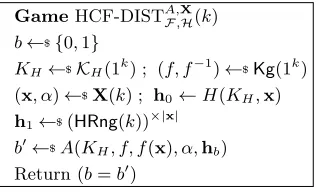
GameHCF-DISTA,F,XH(k) b←${0,1}
KH←$KH(1k) ; (f, f−1)←$Kg(1k) (x, α)←$X(k) ; h0←H(KH,x)
h1←$(HRng(k))×|x| b0←$A(KH, f, f(x), α,hb) Return (b=b0)
Figure 7: Games to define HCF-DIST security.
Pseudorandom generators with image verifier. Let G : KG ×GDom → GRng be a function family.
Pseudorandom generators with `-bit image verifier is similar to pseudorandom generator except we will give adversaryAwith oracle access toV`, whereV` is an`-bit image verifier that on inputy works as follows:
V`(y) =
(
1 if ∃x:y =G(KG, x)|`
0 otherwise .
Note that adversaryA is not allowed to query for the challenge to the image verifier oracle. We say thatG is a pseudorandom generator with`-bit image verifier (VPRG`) if for every PPT adversaryA,
Advvprg`
G,A (k) = 2·Pr
VPRG-DISTAG(k)⇒1 −1 .
is negligible in k. In our results we do not require V` to be efficient, so they are (we believe) plausible for
constructions based on cryptographic hash functions. It is weaker than the “adaptivity” assumption made in [63].
Hardcore functions. We define a notion of hardcore functions for non-uniform, correlated distributions as in [47], but we extend it to consider auxiliary input as well. Let F = (Kg,Eval,Inv) be a one-way trapdoor permutation family with domain TDom. Let H:KH×TDom → HRng be a function family. For k ∈ N, let X(k) be a distribution on input vector in TDom(k) and auxiliary information α∈ {0,1}∗. To attacker A and distributionX(k), we associate the experiment in Figure 7 for everyk∈N. We say thatHis ahardcore function for the trapdoor permutation familyFon a family of such distributionsXif for everyX(k)∈X(k) and for every PPT adversaryA,
AdvhcfF,H,X,A(k) = 2·PrhHCF-DISTA,F,XH(k)⇒1i−1 .
is negligible ink. For messages drawn from a block-source, ifF is sufficiently lossy in the sense of [65] then a universal hash function meets this notion. Additionally, a 2t-wise independent function meets this notion fort arbitrarily correlated, high-entropy messages if F loses a 1−o(1) fraction of its input. It is an open problem to construct such a hardcore function for an unbounded number of arbitrarily correlated, high-entropy messages. However, we see it as plausible that a cryptographic hash function meets this definition.
Partial hardcore functions. For convenience, we also generalize the notion of hardcore function in the following way. LetF= (Kg,Eval,Inv) ben-bit trapdoor permutation family. LetH:KH× {0,1}n−`→HRngbe
a function family, for some` < n. To attackerA, we associate the experiment in Figure 8 for every k∈N. We say thatHis a`-partial hardcore function for the trapdoor permutation familyF if for every PPT adversaryA,
AdvphcfF,H,A(k) = 2·Pr
PHCF-DISTAF,H(k)⇒1 −1 .
is negligible ink. Note if (f(x), x|n−`) is a one-way function ofx, thenHis a`-partial hardcore function forF
GamePHCF-DISTAF,H(k) b←${0,1}
KH←$KH(1k) ; (f, f−1)←$Kg(1k) x←${0,1}n; h0←H(KH, x|`) h1←$HRng(k)
b0←$A(KH, f, f(x), x|n−`, hb) Return (b=b0)
Figure 8: Games to define PHCF-DIST security.
Kg(1k) (π,π)ˆ ←$Π (f, f−1)←$Kg(1k) pk←(π, f)
sk←(ˆπ, f−1) Return (pk,sk)
Enc(pk, m||r) (π, f)←pk
y←$π(m||r) c←f(y) Returnc
Dec(sk, c) (ˆπ, f−1)←pk y←f−1(c) m←π(y)ˆ Returnm
Figure 9: Padding based encryption schemePAD[F] = (Kg,Enc,Dec).
is small enough that Coppersmith’s techniques do not apply. This meansn−`≤n(e−1)/e−log 1/such that N≥2k for security parameterk.
2.5
The OAEP Framework
Padding scheme. We define a general notion of padding scheme following [12, 58]. Forν, ρ, µ∈N, the associated padding scheme is a triple of deterministic algorithmsPAD= (Π,PAD,PAD−1) defined as follows. Algorithm Π on input a unary encoding of the security parameter 1k outputs a pair (π,π) whereˆ π:{0,1}µ+ρ → {0,1}ν and
ˆ
π:{0,1}ν → {0,1}µ∪{⊥}such thatπis injective and for allm∈ {0,1}µandr∈ {0,1}ρwe have ˆπ(π(mkr)) =m.
AlgorithmPADon inputsπandm∈ {0,1}µ outputsy∈ {0,1}ν. AlgorithmPAD−1
on inputs a mapping ˆπ and y∈ {0,1}ν outputsm∈ {0,1}µ or⊥.
Padding-based encryption. LetPAD be a padding transform from domain {0,1}µ+ρ to range{0,1}ν. Let
F be a TDP with domain {0,1}ν. The associated padding-based encryption scheme is a triple of algorithms
PAD[F] = (Kg,Enc,Dec) defined in Figure 9.
OAEP padding scheme. We recall the OAEP padding scheme [12]. Let message lengthµ, randomness length ρ, and redundancy length ζ be integer parameters, and ν = µ+ρ+ζ. Let G: KG × {0,1}ρ → {0,1}µ+ζ
and H: KH × {0,1}µ+ζ → {0,1}ρ be function families. The associated OAEP padding scheme is a triple of
algorithms OAEP[G,H] = (KOAEP,OAEP,OAEP−1) defined as follows. On input 1k, KOAEP returns (K G, KH)
whereKG←$KG(1k) andKH←$KH(1k), andOAEP,OAEP−1 are as defined in Figure 10.
OAEP encryption scheme and variants. Slightly abusing notation, we denote byOAEP[G,H,F] the OAEP-based encryption scheme F-OAEP withn = ν. We also consider two other OAEP-based encryption schemes, called t-clear and s-clear F-OAEP, and denoted OAEPt-clear[G,H,F |ζ+ρ] and OAEPs-clear[G,H,F |µ+ζ]. Here
n=µandn=ρ, respectively. We often writeOAEPt-clear andOAEPs-clear instead of OAEPt-clear[G,H,F |ζ+ρ] and
OAEPs-clear[G,H,F |µ+ζ]. We typically think of F as RSA, and all our results apply to this case under suitable
assumptions. Note that, following prior work, despite its namet-clearF-OAEP we actually applyF to only the µmost significant bits of the output of the underlying padding scheme, leaving the redundancy part of sin the clear as well.
3
Partial Instantiation Results for RSA-OAEP
AlgorithmOAEP(KG,KH)(mkr)
s←(mk0ζ)⊕G(K G, r) t←r⊕H(KH, s) x←skt
Return x
AlgorithmOAEP−(K1
G,KH)(x)
skt←x
r←t⊕H(KH, s) m0←s⊕G(KG, r) Ifm0|ζ= 0ζ returnm0|µ Else return⊥
Figure 10: OAEP padding scheme OAEP[G, H].
results of Kiltzet al.[57] and Bellare et al.[7] are not suitable, the first requiring largeeand the second holding only for public-key independent messages.
3.1
Algebraic Properties of RSA
We first give the (generalizations of) algebraic properties of RSA from Barthe et al. [3] that we use and their parameters. Note that they used these assumptions to analyze security of a zero-redudancy one-round version of RSA-OAEP. We show these are useful for analyzing security of RSA-OAEP more generally.
Second-input extractability. LetF= (Kg,Eval,Inv) be a trapdoor permutation family with domain{0,1}n. For 1≤i≤j≤n, we sayF is(blackbox) (i, j)-second-input-extractable(BB (i, j)-SIE) if there exists an efficient extractor E such that for every k ∈ N, every f ∈ [Kg(1k)], and every x ∈ {0,1}n, extractor E on inputs
f, f(x), x|ji+1outputsx. We often writeζ-SIE instead of (n−ζ, n)-SIE.
Common-input extractability. Let F = (Kg,Eval,Inv) be a trapdoor permutation family with domain
{0,1}n. For 1 ≤ i ≤ j ≤ n, we say F is (blackbox) (i, j)-common-input-extractable if there exists an efficient
extractor E such that for every k∈ N, every f ∈[Kg(1k)], and every x
1, x2 ∈TDom(k), extractor E on inputs
f, f(x1), f(x2) outputs (x1, x2) ifx1|
j
i+1=x2|
j
i+1. We often writeζ-CIE instead of (n−ζ, n)-CIE.
Comparison to Barthe et al. Compared to [3], we generalize the notions of SIE and CIE to consider arbitrary runs of consecutive bits. That is, [3] only considers the most significant bits;i.e.,ζ-SIE andζ-CIE in our notation. We also explicitly call the notionsblackbox to emphasize the extractor does not make use of the code or random coins of an adversary producing its input. Interestingly, we define analogous notions in Section 4 where this is not the case.
Parameters. Barthe et al. [3] show via the Coppersmith algorithm [35] that RSA is ζ-SIE and ζ-CIE for sufficiently largeζ. Specifically, they show RSA isζ1-SIE forζ1> n(e−1)/e, andζ2-CIE forζ2> n(e2−1)/e2. We
show that a generalization to runs of arbitrary consecutive bits holds in Appendix A. Specifically, in Appendix A we show that RSA is (i, j)-SIE for (j−i)> n(e−1)/e, and (i, j)-CIE for (j−i)> n(e2−1)/e2. In our partial
instantiation results for RSA-OAEP,j−irefers to the length of the redundancyζ.
3.2
Main Results
Main results. We now give our main results, namely partial instantiations for RSA-OAEP of either oracle G
or H. These results refer to IND-CCA security for simplicity, whereas we actually prove PA-RO + IND-CPA.
Theorem 3.1 Letn, µ, ζ, ρbe integer parameters. LetG:KG×{0,1}ρ→ {0,1}µ+ζbe a pseudorandom generator
and H:{0,1}µ+ζ → {0,1}ρ be a RO. Let F be a family of trapdoor permutations with domain {0,1}n, where
n = µ+ζ+ρ. Suppose F is one-way, (µ+ζ)-second input and (µ+ζ)-common input extractable. Then
OAEP[G,H,F] is IND-CCA2 secure. In particular, for any adversaryA, there is an adversaryD and an inverter I such that
AdvindOAEP-cca2[G,H,F],A(k)≤2·AdvowfF,I(k) + 10·AdvprgG,D(k) + 2p 2µ+ζ +
4q 2ζ .
whereq is the total number of the decryption queries andpis the total number of RO queries made by A.
Theorem 3.2 Letn, µ, ζ, ρbe integer parameters. LetH:KH× {0,1}µ+ζ → {0,1}ρ be a hash function family
and G :{0,1}ρ → {0,1}µ+ζ be a RO. LetF be a family of trapdoor permutations with domain {0,1}n, where
n=µ+ζ+ρ. SupposeFis (ρ, ρ+ζ)-second input and (ρ, ρ+ζ)-common input extractable. Suppose furtherH
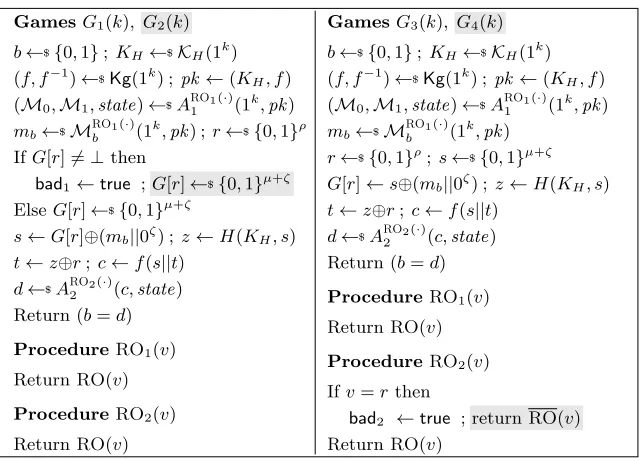
GamesG1(k), G2(k)
b←${0,1};KG←$KG(1k) (f, f−1)←$Kg(1k) ; pk←(KG, f) (M0,M1,state)←$A1RO1(·)(1k,pk) mb←$MRO1(·)
b (1
k,pk)
r←${0,1}ρ;x←G(KG, r) s←x⊕(mb||0ζ)
IfH[s]6=⊥then
bad1 ←true ;H[s]←${0,1}ρ ElseH[s]←${0,1}ρ
z←H[s] ;t←z⊕r;c←f(s||t) d←$ARO2 2(·)(c,state)
Return (b=d)
ProcedureRO1(v)
Return RO(v)
ProcedureRO2(v)
Return RO(v)
GamesG3(k), G4(k)
b←${0,1};KG←$KG(1k) (f, f−1)←$Kg(1k) ;pk ←(KG, f) (M0,M1,state)←$A1RO1(·)(1k,pk) mb←$MRO1(·)
b (1
k,pk)
r←${0,1}ρ;x←G(KG, r) s←x⊕(mb||0ζ) ; t←${0,1}ρ z←t⊕r;H[s]←z;c←f(s||t) d←$ARO2(·)
2 (c,state) Return (b=d)
ProcedureRO1(v)
ReturnRO(v)
ProcedureRO2(v)
Ifv=sthen
bad2 ←true ; returnRO(v) ReturnRO(v)
Figure 11: GamesG1–G4 in the proof of Theorem 3.3.
A= (A1, A2), there exists an adversaryB such that
AdvindOAEP-cca2[G,H,F],A(k)≤2·Adv
phcf
F,H,B(k) +
2p 2ρ +
4q 2ζ .
whereq the total number of the decryption queries andpis the total number of RO queries made by A.
The proofs of both theorems follow from below.
Parameters for RSA-OAEP.We discuss when our results support RSA-OAEP encryption of an AES key of appropriate length, based on Subsection 3.1. The main requirement is encryption exponent e= 3. In this case, with length 2048 bits we can use randomness and message length 128 bits, and for modulus length 4096 we can use randomness length 256. The choice that e = 3 is sometimes used in practice but it is an interesting open problem to extend our results to other common choices such as e = 216+ 1. In particular, it is a reasonable
conjecture that results for SIE and CIE hold in this case for the same parameters.
3.3
Partial Instantiation of
G
We first show how to instantiateGwhen modelingHas a RO. In particular, we showOAEP[G,H,F] is IND-CPA + PA-RO whenG is a pseudorandom generator andF is one-way, (blackbox) (µ+ζ)-SIE and (µ+ζ)-CIE.
IND-CPA result. Under IND-CPA, we show a tight reduction whenG is a pseudorandom generator andF is one-way and (µ+ζ)-SIE. Alternatively, in Appendix B we give result where F is only partial one-way, but the reduction is lossy. Notes that it is shown in [45] that one-wayness of RSA implies partial one-wayness, but the reduction is even more lossy, while SIE and CIE unconditionally hold for appropriate parameters.
Theorem 3.3 Letn, µ, ζ, ρbe integer parameters. LetG:KG×{0,1}ρ→ {0,1}µ+ζbe a pseudorandom generator
and H:{0,1}µ+ζ → {0,1}ρ be a RO. Let F be a family of trapdoor permutations with domain {0,1}n, where
n=µ+ζ+ρ. SupposeF is one-way and (µ+ζ)-second input extractable. ThenOAEP[G,H,F] is IND-CPA. In particular, for any adversaryA= (A1, A2), there are an adversaryD and an inverterI such that
AdvindOAEP-cpa[G,H,F],A(k)≤2·AdvowfF,I(k) + 6·AdvprgG,D(k) + 2q 2µ+ζ .
GamesG5(k)
b←${0,1};KG←$KG(1k) (f, f−1)←$Kg(1k) ; pk←(KG, f) (M0,M1,state)←$A1RO1(·)(1k,pk) mb←$MRO1(·)
b (1
k,pk)
r←${0,1}ρ;x←${0,1}µ+ζ s←x⊕(mb||0ζ)
t←${0,1}ρ;c←f(s||t) d←$ARO2(·)
2 (c,state) Return (b=d)
ProcedureRO1(v)
Return RO(v)
ProcedureRO2(v)
Ifv=sthen returnRO(v) Return RO(v)
GamesG6(k)
b←${0,1};KG←$KG(1k) (f, f−1)←$Kg(1k) ;pk ←(KG, f) (M0,M1,state)←$A1RO1(·)(1k,pk) mb←$MRO1(·)
b (1
k,pk)
r←${0,1}ρ;s←${0,1}µ+ζ x←s⊕(mb||0ζ)
t←${0,1}ρ; c←f(s||t) d←$ARO2(·)
2 (c,state) Return (b=d)
ProcedureRO1(v)
ReturnRO(v)
ProcedureRO2(v)
Ifv=sthen returnRO(v) ReturnRO(v)
Figure 12: GamesG5, G6 in the proof of Theorem 3.3.
AlgorithmB(KG, x)
(f, f−1)←$Kg(1k) ; out←0 pk←(KG, f) ; b←${0,1}
(M0,M1,state)←$AROSim1 1(·)(1k,pk) mb←$MROSim1(·)
b (1
k,pk)
s←x⊕(mb||0ζ)
IfH[s]6=⊥thenout←1 Return out
ProcedureROSim1(v)
IfH[v] =⊥then H[v]←${0,1}ρ Return H[v]
Figure 13: Adversary B in the proof of Theorem 3.3.
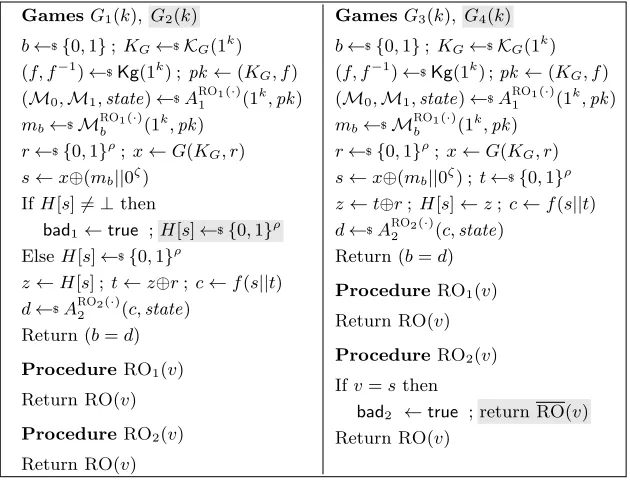
Proof:Consider gamesG1–G6in Figures 11–12. Each game maintains two independent random oraclesROand
RO. ProcedureRO maintains a local arrayH as follows:
ProcedureRO(v)
IfH[v] =⊥thenH[v]←${0,1}ρ ReturnH[v]
For simplicity, we omit the code ofRO,ROin the games. In each game, we useRO1to denote the oracle interface
of adversaryA1 and message samplersM0,M1, and we useRO2 to denote the oracle interface of adversaryA2.
GameG1 corresponds to game IND-CPAOAEP[G,H,F]. Then
AdvindOAEP-cpa[G,H,F],A(k)≤2·Pr[G1(k)⇒1]−1 .
We now explain the game chain. Game G2 is identical to game G1, except in the encryption of message mb.
Namely, if either adversaryA1 or message samplerMb queriessto their random oracleRO1, it chooses a fresh
random value for H[s]. GamesG1 and G2 are identical-until-bad1, and thus from the Fundamental Lemma of
Game-Playing [14],
Pr [G1(k)⇒1 ]−Pr [G2(k)⇒1 ]≤Pr [G2(k) setsbad1] .
Now, consider adversary B attacking the pseudorandom generatorGin Figure 13. We know thatAdvprgG,B(k) = 2·PrPRG-DISTBG(k)⇒1−1. Let PRG-REALBG be the game identical to game PRG-DISTBG conditioned on b= 1, and PRG-RANDBG be the game identical to game PRG-DISTBG conditioned onb= 0. Then,
AdvprgG,B(k) = Pr
PRG-REALBG⇒1
−Pr
PRG-RANDBG ⇒1
AlgorithmC(KG, x)
(f, f−1)←$Kg(1k) ; out←0 pk←(KG, f) ; b←${0,1}
(M0,M1,state)←$AROSim1 1(·)(1k, pk) mb←$MROSim1(·)
b (1
k,pk)
s←x⊕(mb||0ζ) ;t←${0,1}ρ c←f(s||t)
RunAROSim2(·)
2 (c,state) Returnout
ProcedureROSim1(v)
IfH[v] =⊥thenH[v]←${0,1}ρ ReturnH[v]
ProcedureROSim2(v)
Ifv=sthen
out←1 ; Halt run ofA2 IfH[v] =⊥thenH[v]←${0,1}ρ ReturnH[v]
Figure 14: Adversary C in the proof of Theorem 3.3.
AlgorithmI(f, c)
b←${0,1}; out← ⊥
KG←$KG(1k) ; pk←(KG, f) (M0,M1,state)←$AROSim1(·)
1 (1
k, pk)
mb←$MROSim1(·)
b (1
k ,pk) RunAROSim2(·)
2 (c,state) Returnout
ProcedureROSim1(v)
IfH[v] =⊥thenH[v]←${0,1}ρ ReturnH[v]
ProcedureROSim2(v)
t←$Ext(f, c, v) Ift6=⊥then
out←t; Halt run ofA2 IfH[v] =⊥thenH[v]←${0,1}ρ ReturnH[v]
Figure 15: InverterI in the proof of Theorem 3.3.
Note that Pr
PRG-REALBG⇒1
= Pr [G2(k) setsbad1]. Moreover, in the PRG-RANDBG, the probability
that any given of adversary A to its RO equals s is 1/2µ+ζ. Taking a union bound over all queries we have
Pr[PRG-RANDBG⇒1]≤q/2µ+ζ. Thus
Pr [G2(k) setsbad1]≤AdvprgG,B(k) +
q 2µ+ζ .
In gameG3, we reorder the code of gameG2producingt. The change is conservative, meaning that Pr[G2(k)⇒
1] = Pr[G3(k)⇒1]. GameG4 is identical to gameG3, except in procedureRO2. Namely, if adversaryA2 make
a query fors, then the oracle lies, callingROinstead. GameG3and gameG4are identical-until-bad2, thus based
on Fundamental Lemma of Game-Playing [14]
Pr [G3(k)⇒1 ]−Pr [G4(k)⇒1 ]≤Pr [G4(k) setsbad2] .
Consider the adversaryC attacking the pseudorandom generatorGin Figure 14. Let PRG-REALCG be the game identical to game PRG-DISTCG condition onb= 1, and PRG-RANDCGbe the game identical to game PRG-DISTCG condition on b= 0. Then,
AdvprgG,C(k) = Pr
PRG-REALCG⇒1
−Pr
PRG-RANDCG⇒1
.
Note that PrPRG-REALCG⇒1
= Pr [G4(k) setsbad2]. Let Ext be the second-input extractor for F. To
bound the probability that PRG-RANDCG outputs 1, we construct an inverter I attacking F in Figure 15. Note that if adversary A2 queries s then inverterI can invert challenge c using extractor Ext. Hence, we have
PrPRG-RANDCG⇒1≤AdvowfF,I(k). Thus,
Pr [G4(k) setsbad2] =AdvprgG,C(k) +Adv
owf
F,I(k) .
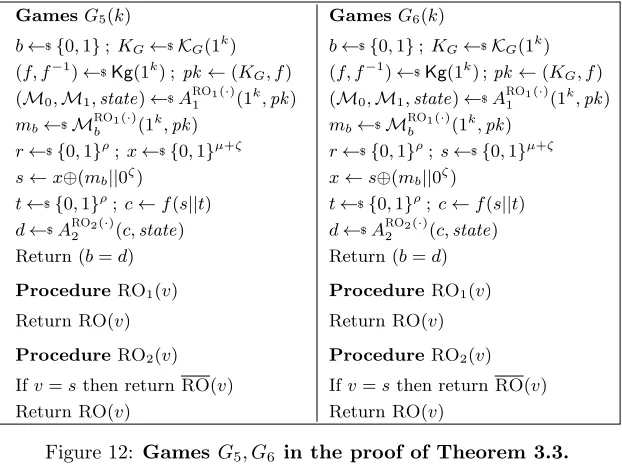
Next, game G5 is identical to game G4, except it uses a uniformly random xin the encryption phase instead of
a pseudorandom valueG(K, r). Consider adversaryD as shown in Figure 16. We have
AlgorithmD(KG, x)
(f, f−1)←$Kg(1k) pk←(KG, f) ;b←${0,1}
(M0,M1,state)←$A1ROSim1(·)(1k, pk) mb←$MROSim1(·)
b (1
k,pk)
s←x⊕(mb||0ζ) ; t←${0,1}ρ c←f(s||t)
b0←$AROSim2 2(·)(c,state) Return (b=b0)
ProcedureROSim1(v)
IfH[v] =⊥thenH[v]←${0,1}ρ ReturnH[v]
ProcedureROSim2(v)
Ifv=sthenH[v]←${0,1}ρ IfH[v] =⊥thenH[v]←${0,1}ρ ReturnH[v]
Figure 16: Adversary D in the proof of Theorem 3.3.
AlgorithmExtH(x,h,c, c i,pk) (f, K)←pk
Forj= 1 to|x|do sikti←$Ext1(f, ci,x[j]) Ifti6=⊥then
ri←h[j]⊕ti;mi←x[j]⊕G(K, ri) Ifmi|ζ= 0ζ then returnmi|µ Forj= 1 to|c|do
(sikti, sikti0)←$Ext2(f, ci,c[j]) Ifsi6=⊥then
ri←H(si)⊕ti;mi←si⊕G(K, ri) Ifmi|ζ= 0ζ then returnmi|µ Return⊥
Figure 17: PA-RO extractor Ext in the proof of Theorem 3.4.
In gameG6, we reorder the code of gameG5 producings. The change is conservative, meaning that Pr[G5(k)⇒
1] = Pr[G6(k)⇒1]. Note that Pr[G6(k)⇒1] = 1/2, since the ciphertexts are independent of the bitb. Assuming
that the advantage of adversaryD is greater than the advantage ofB andC, we have
AdvindOAEP-cpa[G,H,F],A(k)≤2·AdvowfF,I(k) + 6·AdvprgG,D(k) + 2q 2µ+ζ .
This completes the proof.
PA-RO result. We show RSA-OAEP is PA-RO when modelingHas a RO if G is a pseudorandom generator andF is both second-input extractable and common-input extractable.
Theorem 3.4 Letn, µ, ζ, ρbe integer parameters. LetG:KG×{0,1}ρ→ {0,1}µ+ζbe a pseudorandom generator
and H:{0,1}µ+ζ → {0,1}ρ be a RO. Let F be a family of trapdoor permutations with domain {0,1}n, where
n=µ+ζ+ρ. Suppose F is (µ+ζ)-second input and (µ+ζ)-common input extractable. ThenOAEP[G,H,F] is PA-RO secure. In particular, for any adversaryA, there exists an adversaryD and an extractorExtsuch that
AdvpaOAEP-ro[G,H,F],A,Ext(k)≤2·AdvprgG,D(k) +2q 2ζ .
where qis the total number of the extraction queries made byA. Furthermore, the running time ofD is about that of Aand the running time ofExt is about that of SIE and CIE extractors.
Proof: LetExt1 be the second-input extractor andExt2 be the common-input extractor forF. For any
adver-sary A, we define the extractor Ext as shown in Figure 17. Now, we bound the advantage of adversary A in distinguishing between the decryption algorithm and the extractorExt.
Assume adversary A makesq extract queries. Letci be the i-th such query. Let’s denote by si and ti the last
outputs 1. We also define E to be the event that adversaryAor the encryption oracle query for the valuesi to
random oracleH, for alli∈[q]. Then
AdvpaOAEP-ro[G,H,F],A,Ext(k) = 2·(Pr [S∧E] + PrS∧E)−1 .
We know, if eventEhappens then extractorExtcan use the second-input extractor or the common-input extractor to recover plaintextm. Therefore, we have Pr [S|E] = 1/2. Thus,
AdvpaOAEP-ro[G,H,F],A,Ext(k)≤Pr [E] + 2·Pr
S∧E −1 .
Next, we bound the probability that ciphertextci with no prior random oracle querysi, is valid. We know when
event E happens, there exists at least a ciphertext ci with no prior query si to random oracleH. LetC be the
set of such ciphertexts. Note that extractorExtalways outputs ⊥on such ciphertexts. LetT be the event where there exists at least a valid ciphertext ci∈C. Then
Pr
S∧E
= Pr
S∧E∧T
+ Pr
S∧E∧T
≤ Pr
E∧T
+ Pr
E∧T ·Pr
S|E∧T
.
Note that Pr
S|E∧T
= 1/2, since the outputs ofExtand decryption algorithmDecare always equal. More-over, we have Pr
E∧T
≤Pr
E
. Therefore,
AdvpaOAEP-ro[G,H,F],A,Ext(k)≤2·Pr
E∧T
.
We know the challenge ciphertext ci is valid if and only if there exists a plaintext mi such thatG(K, ri)⊕si =
mik0ζ, where ri = H(si)⊕ti. Moreover, when there is no prior random oracle query si, ri looks uniformly
random to adversary A. Therefore, if event T |E happens then there exists a ciphertext ci such that the first
ζ-bits ofG(K, ri) andsiare equal, whereri is chosen uniformly at random. Consider adversaryDattacking the
pseudorandom generatorGin Figure 18. Note that when adversary D is in the real game then it simulates the PA-RO game for the adversaryA. On the other hand, when adversaryDis in the ideal game then the firstζ-bits ofsi andxare equal with probability 1/2ζ. Taking a union bound, we get
AdvprgG,D(k)≥Pr
T∧E
− q
2ζ .
Hence, we have PrT ∧E≤AdvGprg,D(k) +q·2−ζ.Summing up,
AdvpaOAEP-ro[G,H,F],A,Ext(k)≤2·AdvprgG,D(k) +2q 2ζ .
This completes the proof.
3.4
Partial Instantiation of
H
Now, we instantiate the hash function H when modeling G as a RO. In particular, we show OAEP[G,H,F] is IND-CPA + PA-RO whenHis a special type of hardcore function andF is one-way, second-input and common-input extractable. Note that Boneh [24] previously showed a simplified RSA-OAEP with one Feistel roundG is IND-CCA2 secure and Bartheet al.[3] showed such a scheme does not even need redundancy, but these proofs can not applied to the case ofHas a cryptographic hash function.
IND-CPA result. Under IND-CPA, we show a tight reduction when His a (µ+ζ)-partial hardcore function forF. In particular, it is plausible forHas a computational randomness extractor [38] and thatF is RSA in the common settingρ=k(e.g.,ρ= 128 for modulus lengthn= 2048), since Coppersmith’s technique fails.
Theorem 3.5 Letn, µ, ζ, ρbe integer parameters. LetH:KH× {0,1}µ+ζ → {0,1}ρ be a hash function family
AdversaryD(K, x) out←0 ; Dom← ⊥ i←1 ; j←1 ; b←${0,1} (f, f−1)←$Kg(1k)
pk ←(K, f) ; sk ←(K, f−1) b0←$AROSim(·,1),Enc(pk,·),D(sk,·)(pk) Returnout
ProcedureROSim(s, i)
Ifi6= 3 thenDom←Dom∪ {s} IfH[x] =⊥thenH[x]←${0,1}` Ifi= 1 then
x[j]←x;h[j]←H[x];j←j+1 ReturnH[x]
ProcedureEnc(pk,M) m←$M(1k,pk)
c←$EncROSim(·,2)(pk, m)
c[i]←c; i←i+ 1 Returnc
ProcedureD(sk, c)
(s, t)←f−1(c) Ifs /∈Domthen
Ifx|ζ=s|ζ thenout←1 Ifc∈cthen return⊥ m0←Dec(sk, c)
m1←$ExtROSim(·,3)(x,h,c, c, pk) Returnmb
Figure 18: Adversary D in the proof of Theorem 3.4.
GamesG1(k), G2(k)
b←${0,1}; KH←$KH(1k) (f, f−1)←$Kg(1k) ;pk ←(KH, f) (M0,M1,state)←$ARO1(·)
1 (1 k,pk)
mb←$MRO1(·)
b (1
k,pk) ;r←${0,1}ρ
IfG[r]6=⊥then
bad1←true ;G[r]←${0,1}µ+ζ ElseG[r]←${0,1}µ+ζ
s←G[r]⊕(mb||0ζ) ; z←H(KH, s) t←z⊕r;c←f(s||t)
d←$ARO2 2(·)(c,state) Return (b=d)
ProcedureRO1(v)
ReturnRO(v)
ProcedureRO2(v)
ReturnRO(v)
GamesG3(k), G4(k)
b←${0,1};KH←$KH(1k) (f, f−1)←$Kg(1k) ; pk←(KH, f) (M0,M1,state)←$ARO1(·)
1 (1 k,pk)
mb←$MRO1(·)
b (1
k,pk)
r←${0,1}ρ;s←${0,1}µ+ζ G[r]←s⊕(mb||0ζ) ; z←H(KH, s) t←z⊕r; c←f(s||t)
d←$ARO2(·)
2 (c,state) Return (b=d)
ProcedureRO1(v)
ReturnRO(v)
ProcedureRO2(v)
Ifv=rthen
bad2 ←true ; returnRO(v)
ReturnRO(v)
Figure 19: GamesG1–G4 in the proof of Theorem 3.5.
n =µ+ζ+ρ. Suppose His a (µ+ζ)-partial hardcore function for F. Then OAEP[G,H,F] is IND-CPA. In particular, for any adversaryA= (A1, A2), there exists an adversaryB such that
AdvindOAEP-cpa[G,H,F],A(k)≤2·AdvphcfF,H,B(k) +2q 2ρ ,
whereq is the total number of RO queries made byA. The running time ofB is about that ofA.
Proof: Consider gamesG1–G4 in Figure 19. Each game maintains two independent random oracles RO and
RO. ProcedureRO maintains a local arrayGas follows:
Procedure RO(v)
IfG[v] =⊥thenG[v]←${0,1}µ+ζ ReturnG[v]
For simplicity, we omit the code ofRO,ROin the games. In each game, we useRO1to denote the oracle interface
AlgorithmB(KH, f, c, t, z)
pk←(KH, f) ; b←${0,1}
(M0,M1,state)←$AROSim1 1(·)(1k, pk) mb←$MROSim1(·)
b (1
k ,pk) r←t⊕z;out← ⊥ RunAROSim2(·)
2 (c,state) Returnout
ProcedureROSim1(v)
IfG[v] =⊥thenG[v]←${0,1}ρ ReturnG[v]
ProcedureROSim2(v)
Ifv=r
out←1 ; HaltA
IfG[v] =⊥thenG[v]←${0,1}ρ ReturnG[v]
Figure 20: Adversary B in the proof of Theorem 3.5.
GameG1 corresponds to game IND-CPAAOAEP[G,H,F]. Then
AdvindOAEP-cpa[G,H,F],A(k)≤2·Pr[G1(k)⇒1]−1 .
We now explain the game chain. Game G2 is identical to game G1, except in the encryption of message mb,
if either adversary A1 or message sampler Mb queried r to their random oracle RO1, then it chooses a fresh
random value for G[r]. Games G1 and G2 are identical-until-bad1, and thus from the Fundamental Lemma of
Game-Playing [14],
Pr [G1(k)⇒1 ]−Pr [G2(k)⇒1 ]≤Pr [G2(k) setsbad1] .
Moreover, the probability is 1/2ρ that any given RO query of A
1 or message samplers M0,M1 equals r . Let
q1 be the number of random oracle query that A1 and M0,M1 make. Taking a union bound over all queries,
we have Pr [G2(k) setsbad1]≤q1/2ρ. In game G3, we reorder the code of game G2 producing s. The change
is conservative, meaning that Pr[G2(k) ⇒ 1] = Pr[G3(k) ⇒ 1]. Game G4 is identical to game G3, except in
procedure RO2, if adversaryA2 queries r, then the oracle lies, callingRO instead. GameG3 and gameG4 are
identical-until-bad2, and based on Fundamental Lemma of Game-Playing [14],
Pr [G3(k)⇒1 ]−Pr [G4(k)⇒1 ]≤Pr [G4(k) setsbad2] .
Now, consider adversaryB attacking partial hardcore functionHin Figure 20. We know that
AdvphcfF,H,B(k) = 2·Pr
PHCF-DISTBF,H(k)⇒1 −1.
Let PHCF-REAL be the game identical to game PHCF-DIST conditioned on b= 1, and PHCF-RAND be the game identical to game PHCF-DIST conditioned onb= 0. Then,
AdvphcfF,H,B(k) = Pr
PHCF-REALBF,H⇒1
−Pr
PHCF-RANDBF,H⇒1
.
Note that Pr
PHCF-REALBF,H⇒1
= Pr [G4(k) setsbad1]. Moreover, in game PHCF-RAND, the probability
is 1/2ρ that any given RO queried by adversaryA
2 equals r . Let q2 be the number of queries that A2 makes.
Taking a union bound we have Pr[PHCF-RANDBF,H⇒1]≤q2/2ρ. Thus
Pr [G4(k) setsbad1]≤AdvphcfF,H,B(k) +
q2
2ρ .
Note that, Pr[G4(k) ⇒ 1] = 1/2, since the distribution of the ciphertexts are completely independent of b.
Summing up,
AdvindOAEP-cpa[G,H,F],A(k)≤2·AdvphcfF,H,B(k) +2q 2ρ .
This completes the proof.