On the Power of Pair Encodings: Frameworks for Predicate
Cryptographic Primitives
Mridul Nandi and Tapas Pandit Indian Statistical Institute, Kolkata
[email protected],[email protected]
Abstract
Recently Attrapadung (Eurocrypt 2014) proposed a generic framework for fully (adaptively) secure predicate encryption (PE) based on a new primitive, calledpair encodings. The author shows that if the underlying pair encoding scheme is either perfectly secure or computationally (doubly-selectively) secure, then the PE scheme will be fully secure. Although the pair encodings were solely introduced for PE, we show that these can also be used to construct predicate signatures, a signature analogue of PE. More precisely, we propose a generic construction for predicate signature (PS) from the pair encoding schemes. Our construction provides the signer privacy, and unforgeability in the adaptive-predicate model. Thereafter, we instantiate many PS schemes with new results, e.g., the first practical PS schemes for regular languages, the first attribute-based signature (ABS) scheme with constant-size signatures in adaptive-predicate model, the unbounded ABS with large universes in key-policy flavor, etc.
Following the CCA conversions of Yamada et al. (PKC 2011, 2012) and Nandi et al. (ePrint Archive: 2015/457), one can have CCA-secure PE from CPA-secure PE if the primitive PE has either verifiability or delegation. We show that the fully secure CPA-construction of Attrapadung possesses the verifiability. The aforesaid approach degrades the performance of the resultant CCA-secure PE scheme. As an alternative, we provide a direct fully secure CCA-construction for PE from the pair encoding scheme. This costs an extra computation of group element in encryption and three extra pairing computations in decryption as compared to the CPA-construction of Attrapadung.
The predicate signcryption (PSC) is a super class of the existing class, the attribute-based sign-cryption (ABSC), where the confidentiality, unforgeability and signer privacy are well preserved. By combining the proposed frameworks for PS and PE, we provide a generic construction for PSC from the pair encodings. It achieves the perfect privacy, and the strong unforgeability and CCA security in the adaptive-predicates model. The construction has the support ofcombined-setup, where the distributions of public parameters and keys in the underlying signature and encryption schemes are identical. The proposed PSC provides many new results, e.g., the first PSC schemes for regular languages, the first ABSC with constant-size signcryptions and constant-size keys respectively, the unbounded ABSC with large universes in adaptive-predicates model, etc.
Keywords: Pair encodings, predicate encryption, predicate signature, predicate signcryption.
1
Introduction
a new primitive, called pair encoding schemes which are implicitly contained in many predicate encryption schemes. Using the pair encodings [2], the author proposed a generic framework for adaptively secure predicate encryption, which captures the core technique of the dual system methodology [50]. They showed that by applying the generic approach on the pair encoding, the adaptively-secure PE is possible. Their conversion assumes either the perfect security or computational (doubly-selective) security of the underlying pair encoding scheme. Using this framework, the author constructed the first fully secure predicate encryption schemes for which only selectively secure schemes were known. They instantiated some surprising results, e.g., PE for regular languages, unbounded ABE for large universes, ABE with constant-size ciphertexts, etc. Concurrently and independently, Wee [52] proposed the notion of predicate encodings which is exactly identical to the perfectly secure pair encodings of [2]. Some of the instantiations in [52] are similar to [2], viz., the ABE for small universe with improved efficiency and doubly-spatial encryption. Later, Attrapadung and Yamada [6] showed a conversion for obtaining the dual of a computationally secure pairing encoding scheme. The conversion is required to construct dual of a predicate encryption scheme which is based on computational secure pair encoding scheme.
Predicate signature (PS) [4] is a signature analogue of predicate encryption (PE) [13], where Alice signs a document under an associated data index (policy), provided Alice’s key index x∈ X is related to the associated data index y ∈ Y. The term “related” is defined by a binary relation ∼, called predicate
defined over X × Y, where X and Y are respectively called key space and associated data space. Some times, we call the tuple (∼,X,Y) as predicate tuple. The attribute-based signature (ABS) [36] is a larger
subclass of PS. Like ABS, the predicate signature schemes are available in two forms, key-policy predicate signature (KP-PS) and signature-policy predicate signature (SP-PS). If the contents of X have complex representations than the contents ofY, then the predicate signature is called KP-PS, otherwise it is SP-PS. Similar to ABS, we have two types of security, the unforgeability and signer privacy. The former ensures that the signatures are generated by a valid user and later protects from revealing the signer key index.
The concept of signcryption was introduced by Zheng [56]. Since then, many signcryption schemes [1, 38, 35] have been proposed. Among the three well known paradigms of [1], the paradigm “Commit then Encrypt and Sign (CtE&S)” runs faster as the implicit subroutines execute in parallel in signcrypt and unsigncrypt algorithms.
Attribute-based signcryption (ABSC) [24] is a natural extension of attribute-based encryption (ABE) and attribute-based signature (ABS) such that the confidentiality, unforgeability and signer privacy are well maintained. Like ABS, if the key is labeled with the set of attributes and the policies (signer policy and receiver policy) are associated with the signcryption, then the ABSC is known to be the key-policy based signcryption (KP-ABSC) and its dual form is called the signcryption-policy attribute-based signcryption (SCP-ABSC). Thecombined-setupin ABSC [17,43] and combining public-key scheme [27, 48] allow to keep the distributions of public parameters and keys in the underlying signature and encryption schemes identical. In this setup [17,43], the underlying ABS and ABE schemes have identical setup and key-gen algorithms. On the contrary, the setup and key-gen algorithms for ABS and ABE in
independent-setupare not necessarily identical and they are run independently to generate the keys and public parameters for the individual primitives, ABS and ABE. We note that the same keys and public parameters are used for both the primitives, ABS and ABE in combined-setup as opposed to independent-setup. Therefore, the schemes in combined-setup have a benefit of sizes of key and public parameters than the schemes in independent-setup.
Predicate signcryption (PSC) is a generalization of the attribute-based signcryption. In this paper, we have a special interest the PSC with combined-setup. Let (∼,X,Y) be a predicate tuple. For this
The data-indexys is called the sender data-index. A sender with a key SKx can signcrypt the messagem
on behalf of community represented byysifx∼ys. The data-indexye is called the receiver data-index. A
receiver with a keySKx can legitimately unsigncrypt a signcryption with the underlying receiver policy,ye
ifx∼ye. Similar to ABSC, if the contents ofX have complex representations than the contents ofY, then
the predicate signcryption is called key-policy predicate signcryption (KP-PSC). Its dual form is called signcryption-policy predicate signcryption (SCP-PSC). For example, consider a predicate signcryption for regular languages over an alphabet Σ. If the key-indices are represented by the regular languages over Σ and both the data-indices are represented by the strings over Σ, then the form of PSC is called KP-PSC for regular languages. Its dual form is called SCP-PSC for regular languages. Other forms of PSC are possible, but in combined-setup, these are the only forms of PSC in our consideration.
A predicate signcryption scheme is said to have public verifiability if a receiver always can convince the third party that the received message (m, ys) was actually sent by a user whose key index satisfiesys(policy
of the sender). As pointed out in [43] that any predicate signcryption which extends theCtE&S-approach of [1] can be shown to have public verifiability. But, for that, we have to assume the relaxed-binding property of the primitive commitment scheme.
Motivation. All the predicate encryption schemes of [2, 6, 52] were shown to be CPA-secure in the adaptive-predicate model. Using the technique [54, 53, 39], the above CPA-secure constructions can be lifted to show the CCA-security. In all these CCA conversions, a sort of index-transformation for predicate family is applied to the primitive secure PE scheme for the same family. In addition to the CPA-decryption, the CCA-decryption of the traditional approach [54,53, 39] has to preform either delegation or verifiability. But the problems the above techniques suffer, are (1) increased lengths of key-indices and data-indices and (2) extra cost for performing verifiability or delegation. In the literature, most of the predicate encryption schemes are constructed using bilinear pairing groups. If the verifiability-based approach (where delegation is not known) is applied to those schemes, then checking in verifiability requires a number of pairing computations which is nearly equal to the number of pairing computations in the CPA-decryption. Altogether the techniques degrade the performance of decryption. Therefore, a direct CCA-secure construction of PE based on pair encoding scheme whose cost is very close to that of the existing CPA-secure construction [2] is always welcome.
The available pair encoding schemes [2,6,52] have been reached out for most of the practical predicate families. Therefore, it is interesting to see a construction of predicate signatures from the pair encoding schemes which were solely introduced for predicate encryptions.
Recently, Pandit, Pandey and Barua [43] proposed an ABSC scheme which supports perfect privacy, public verifiability, combined-setup and follows theCtE&S paradigm. The strong unforgeability and IND-CCA security of the ABSC scheme were proven in the adaptive-predicates models. In current state-of-art, no generic construction of predicate signcryption with the above properties was known. Therefore, it is interesting to see any generic construction of predicate signcryptions from the pair encoding schemes along with all the above properties. The above discussion is summarized as the questions given below.
(1). Is it possible to construct a generic predicate signature scheme from the pair encoding scheme and at the same time, it enjoys all the features analogous to those of [2]?
(2). Can a direct CCA-secure PE scheme be constructed from the pair encoding scheme whose perfor-mance is very close to that of CPA-secure construction [2]?
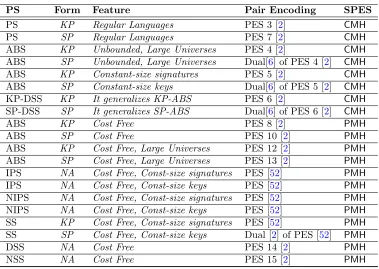
Our Contribution. All the above questions are answered in a novel way. We provide generic construc-tions of predicate signature, (CCA-secure) predicate encryption and predicate signcryption schemes from the pair encoding schemes. If the underlying pair encoding scheme with a least security1, fulfills some (natural) conditions, then the PS and PSC schemes will achieve the perfect signer privacy, and the un-forgeability in adaptive-predicate(s) model. But to ensure the adaptive-predicate(s) IND-CCA security of the PE and PSC schemes, we assume either both the computational security (CMHandSMH) or thePMH security of the underlying pair encoding scheme. All the constructions are given in the setting of composite order bilinear groups. The unforgeability (of PS and PSC) and IND-CCA security (of PE and PSC) are proven under the three subgroup assumptions, DSG1, DSG2, DSG3 and the extra hardness assumption(s) required for the CMH (and SMH)-security of the underlying pair encoding scheme. If the primitive pair encoding scheme has PMH-security, then we do not need any extra hardness assumption. In this case, we say that the corresponding predicate scheme is cost free. Through these generic constructions what we achieved are summarized below:
– Predicate Signature. All the pair encoding schemes of [2,6,52] maintain the least security and satisfy the the natural conditions (seeConditions 3.1 of Section 3.1). Therefore, the resultant predicate signature schemes are adaptive-predicate unforgeable and perfectly private. Our generic predicate signature can be used to derive the following new results.
• (PS for Regular Languages.) Predicate signature schemes for regular languages in both the forms, key-policy and signature-policy are provided in this paper. Both the schemes support the large universe alphabet. To the best of our knowledge, these are the first practical non-trivial predicate signature schemes beyond ABS.
• (Unbounded KP-ABS.) We present an unbounded KP-ABS scheme with large universes, where the size of the universe is super-polynomial and no restriction has been imposed on the access polices and sets of attributes. To the best of our knowledge, this is the first large universes KP-ABS construction with the featureunbounded.
• (Constant-size Signatures and Constant-size Keys.) Till date, the only available ABS scheme [4] with constant-size signatures for general access structures is known to be unforgeable in the selective-predicate model. We propose the first KP-ABS with constant-size signatures, where the unforgeability is proven in adaptive-predicate model. A dual version, SP-ABS with constant-size keys is also provided in this paper.
• (Cost Free Signatures.) The following predicate signatures are cost free as the underlying pair encoding schemes are PMH secure. The schemes are ABS for both small and large universes and predicate signatures for policy over doubly-spatial predicate. We can also obtain predicate signature schemes with constant-size keys and constant-size signatures respectively for both zero inner product and non-zero inner product predicates. Predicate signatures for doubly-spatial predicate and negated doubly-spatial predicate can be derived. Spatial signature schemes with constant-size keys and constant-size signatures respectively can be instantiated.
– CCA Secure Predicate Encryption. We obtain adaptive-predicate IND-CCA predicate encryption schemes from the pair encoding schemes via the following two approaches:
• (Traditional Approach.) We first show that if the underlying pair encoding scheme fulfills the condition (1) ofConditions3.1, then the fully secure construction in Section 4.3 of [2] satisfies
1
verifiability (Definition2.9). Then, by applying the CCA conversion technique [53,54,39], one can obtain adaptive-predicate IND-CCA predicate encryption schemes.
• (New Approach (Direct CCA-secure PE).) We pointed out earlier in this paper that the traditional approach has a major drawback, the degradation of performance of the decryption. This motivates us to study the direct adaptive-predicate CCA-secure construction of predicate encryptions from the pair encodings. For this construction, we assume the conditions (1) and (3) ofConditions 3.1on the pair encodings. It has one extra group element in ciphertext and three extra pairing computations in decryption as compared to the CPA construction of [2].
All the underlying pair encodings [2, 6, 52] satisfy the conditions (1) and (3) of Conditions 3.1. Therefore, using this new approach, we are able to achieve CCA security of all the predicate encryp-tions found in [2,6,52].
Recently, Bl¨omer and Liske [8] proposed a direct CCA-secure construction of predicate encryptions from the pair encodings. Although they did not use the traditional approach, a sort of verifiability checking is involved before the actual CPA-decryption. The number of pairing computations for this checking is nearly equal to the number of paring computations in CPA-decryption. Therefore, our direct CCA-secure construction of PE has a better performance than [8].
– Predicate Signcryption. All the pair encoding schemes of [2,6,52] either have both the computational security (CMH and SMH) or the PMH security. Also, the aforementioned pair encodings fulfill the natural conditions, Conditions 3.1. Therefore, the resultant predicate signcryption schemes are strongly unforgeable and IND-CCA secure in adaptive-predicates models, and perfectly private. All the predicate signcryption schemes have the combined-setup, public verifiability and follow the CtE&StS paradigm of [43]. To the best of our knowledge, all the results described below are new except the SCP-ABSC with small universes construction of [43].
• (PSC for Regular Languages.) We present predicate signcryptions for regular languages in both policies, key-policy (KP) and signcryption-policy (SCP) which support the large universe alphabet.
• (Unbounded ABSC.) Unbounded ABSC schemes with large universes in both forms, KP and SCP are provided in this paper.
• (Constant-size Signcryptions and Constant-size keys.) A KP-ABSC with constant-size signcryp-tions and an SCP-ABSC with constant-size keys are proposed in this paper.
• (Cost Free Signcryptions.) We can instantiate many cost free predicate signcryptions which are analogous to the cost free predicate signatures.
Outline of Our Constructions. In brief, a pair encoding scheme [2] consists of four deterministic algorithms, Param,Enc1,Enc2 and Pair. Let N ∈ N. Param(j) → n, where j is the index for a system parameter and n describes the length of the common parameters h ∈ Zn
N. Enc1(x) → (kx, m2), where kx is a sequence of polynomials over ZN with |kx|= m1 and m2 is length of the random coin r ∈ Zm2N . Enc2(y) → (cy, ω2), where cy is a sequence of polynomials over ZN with |cy|= ω1 and ω2+ 1 is length of the random coin s= (s0, . . . , sω2)∈ZNω2+1. Pair(x, y) →E ∈Z
m1×ω1
N . The correctness says for x ∼y,
(kx, m2)←Enc1(x), (cy, ω2)←Enc2(y) andE ←Pair(x, y), we havekx(α,r,h)Ec>y(s,h) =αs0.
1. Outline for PS.Before describing the outline of the predicate signature, we state the following two facts:
–Fact 2. To maintain the signer privacy, the signature is labeled with policy y, at least not labeled with the key-index x.
The above facts are implicitly used in many predicate signatures and also provide an insight to the predicate signature. Let (N := p1p2p3,G,GT, e) be a composite order bilinear groups and gT := e(g, g), where
g∈Gp1 andG=Gp1 ×Gp2 ×Gp3.
In the following, we first give an outline of the initial structure of our predicate signature using structure of predicate encryption of [2] based on pair encodings. Recall that SKx = gkx(α,r,h) ·R3 ∈ Gm1 with
R3 ∈Gm1p3 is the key structure of [2] for the key-index x.
– Signature Generation. Suppose Alice is playing the role of a sender. LetSKx=gkx(α,r,h)·R3 ∈Gm1 be
the key of Alice. To sign a messagem under a policy y withx ∼y, Alice first runsE ←Pair(x, y).
Then, it generates the signature asδy :=SKEx ·R
0
3∈Gω1 where R 0 3
U
←−Gω1p3. On simplification, we
have δy =gkx(α,r,h)E ·Rf3, where Rf3 :=RE3 ·R03. This signature δy plays the role of a diluted key,
derived from the actual keySKx.
– Signature Verification. The verification process considered here is a probabilistic one as it is performed by running the routines which are similar to the encryption and decryption of the predicate encryption of [2]. Since, a signature is a poor or diluted key, so verifying a signature is nothing but checking its capability to extract out some information from the part of a ciphertext. Therefore, to verify a signatureδy, we first prepare a verification text (it is same as the ciphertext, but without the message
m) V := (VINT :=gTαs0,Vy := gcy(s,h)). The signature is accepted if e(δy,Vy) = VINT else rejected.
We note that theGp3 part of δy gets canceled in the verification due to the orthogonal property of
the composite order bilinear groups.
– Correctness. For x ∼ y, e(δy,Vy) = e(g, g)kx(α,r,h)Ec
>
y(s,h) = gαs0
T , where the last equality is obtained
from the correctness of pair encoding scheme.
Limitations of the initial structure of the signature. The above initial structure of the signature only shows that Alice is capable to generate such a signature. We note that neither the message nor the policy is binded in the above signature which is very crucial to guarantee unforgeability. Although the above signature is not labeled with the key-indexx, it misses a very important property of the predicate signature, the perfect-privacy of the signer.
To overcome the limitations of the above signature, we have to modify the initial structure. The modifications are explained briefly in the following two steps.
– Step 1. The initial structure of the signature isδy =gkx(α,r,h)E·Rf3 ∈Gω1. To ensure unforgeability, the
messagemand the policyyare to be binded toδy. The binding is to be done in such a way that the
binding part of the signature cannot be updated, once the signature has been generated. The binding is made in the following way. A collision resistance hash function H :{0,1}∗ → ZN and two others
parameters,gθ1, gθ2 are added to the public parametersPP. A group element,gτ(θ1~+θ2) is composed
with the first component ofgkx(α,r,h)E, whereτ ←−U ZN and~=H(m, y). Additionally,g−τ is given
as a part of the signature. In other words, the modified signature becomes, δy =gv·Rf3 ∈Gω1+1,
wherevis implicitly set tov := (−τ,ψ+kx(α,r,h)E)∈Zω1N+1andψ := (τ(θ1~+θ2),0, . . . ,0)∈Zω1N.
To verify this signature, the verification text is to be changed to V := (VINT := gTαs0,Vy :=
gcMy(s,θ1,θ2,h)), wherecM
y (s, θ1, θ2,h) := (c0(s0, θ1, θ2,~),cy(s,h))∈Zω1N+1,c0(s0, θ1, θ2,~) :=s0(θ1~+
Vy) =VINT else rejected. For correctness of the verification, we assume thatcy,ι(s,h) =s0 for some
ι∈[ω1].
– Step 2. For perfect-privacy, the authors of [37] assume the perfectly hiding property of the underlying non-interacting witness-indistinguishable (NIWI) scheme. For the ABS schemes of [41, 42, 43], an additional secret sharing (0-sharing) was used to assure the perfect-privacy. For perfect-privacy of the proposed signature, we explore a novel approach (for details, refer to Section 3.4) which works irrespective of the predicate families. This is done by uniformly sampling from the orthogonal space (VM)⊥ of VM := {cMy (s, θ1, θ2,h) ∈ Zω1N+1 |s:= (s0, . . . , sω2) ∈Z
ω2+1
N }. The final signature of the
proposed construction (for complete description, refer to Section3.3) has the form,δy =gv+vsp·Rf3 ∈
Gω1+1, where vsp
U
←−(VM)⊥. The verification is same as before, where vsp gets canceled due to the
orthogonality ofvsp and cMy (s, θ1, θ2,h).
We show that uniformly sampling from (VM)⊥ is done by solving the homogeneous system,
A>X =0, where A∈ Zω1N×(ω2+1). For 1 ≤ι ≤ω1 and 0≤j ≤ω2, the (ι, j)th entry of the matrix A is of the form, aι,j+Pi∈[n]aι,j,ihi, where aι,j and aι,j,i are co-efficients of ιth polynomial of cy.
The only available information to solve the system are aι,j,aι,j,i and ghi for 1≤ι≤ω1, 0 ≤j ≤ω2 and i∈[n]. Since,hi’s are not given explicitly, applying Gaussian elimination onA is troublesome.
Although hi’s are not given explicitly, we manage to solve the system A>X = 0 smoothly. For
that we assume a restriction on the underlying pair encoding scheme which is very natural. This restriction is given as condition (2) in Section 3.1. To the best of our knowledge, most of the pair encodings (in fact, all the pair encoding of [2,6,52]) satisfy this condition.
One of the motivations of this paper is to achieve the adaptive security. We utilize the dual system proofs of [50] in a novel way to guarantee the adaptive unforgeability of the proposed construction. For the proof of adaptive-predicate unforgeability of the proposed signature, we abstract the dual system methodology of [50] as a signature analogue of [2]. The hybrid arguments over the games in this signature analogue of the dual system proof technique follow the style of [41,43]. However, the hybrid arguments in [41,43] were handled for a particular ABS through the linear secret sharing scheme (LSSS). But, here we manage the dual system proof technique generically for arbitrary predicates. In this style, we consider the semi-functional (mimic) forms of the original objects, the verification text, signatures and keys. Through the hybrid arguments, we finally reach to a game, where theVINT is chosen independently and uniformly
at random fromGT. This implies that the forgery will be invalid with respect to the verification textV.
2. Outline for Direct CCA-secure PE. We have already observed that the initial structure of the verification text for the predicate signature is similar to the structure of the ciphertext of [2]. We also notice that the verification text for the final signature has a structure which is similar to a variant of the ciphertext of [2]. In fact, if a messagemis included in the verification text, the structure of the ciphertext becomes,CT:= (y, CINT:=m·gαs0T , CyM :=gc
M
y(s,θ1,θ2,h)) with
~=H(m, y). After a rearrangement, we have CT:= (Ccpa, C0:=gs0(θ1~+θ2)), where Ccpa := (y, CINT,Cy :=gcy(s,h)). Now, look at the major concern in
the construction of the CCA-secure ciphertext. It simply says that a new ciphertext (mostly well-formed or ill-formed but up to certain extent) cannot be created from a given ciphertext. In the traditional approach [53,54], the aforementioned concern is handled by using a strong one-time signature (OTS) scheme. We also note that for the traditional approach, theCcpa part of theCTis not required. However, in this direct
CCA-secure construction, the hash value, ~ appearing in C0 is changed to H(Ccpa) to form CCA-secure
For the decryption of the CCA-ciphertext, we use the chemistry between the verification text Vy and predicate signature δy. In fact, given a ciphertext CT = (y, CINT,CyM = (C0,Cy)) and a key SKx, the
decryption is performed in the following way. It first creates an alternative keySKMx :=gv·Rf3 exactly in
the same manner as δy found in Step 1. Then, it returns CINT/e(SKMx,Cy). For complete description of
the direct CCA-secure PE, refer to Section6.1.
The adaptive security is obtained by modifying the dual system proof style of [2] (which incorporates the dual system methodology of [50]). This modification is required to answer the decrypt queries appropriately.
3. Outline for PSC. Our proposed predicate signature and predicate encryption have the identical key distribution and identicalPP distribution. Using the advantage of these distributions, we take a step towards the first generic construction of predicate signcryptions from the pair encodings. Recall the outline of the construction of ciphertext in direct CCA-secure predicate encryption. It first runs the encryption of [2] (we call itEncrypt∗) to create the CPA-secure ciphertextCcpa. Then, an additional (delayed) component C0 :=gs0(θ1~+θ2) is computed to complete the CCA-ciphertextCT:= (Ccpa, C0).
Both the proposed modules, the predicate signature and predicate encryption use the individual hash functions. In the proposed predicate signcryption, we handle the hash values in signature and encryption using a single hash function H. Let~s and ~e be the hash values respectively used in predicate signature
and predicate encryption. To distinguish the hash values ~s and ~e, we respectively use the prefix bit of
the hash arguments to be ‘1’ and ‘0’.
Suppose Alice has a keySKx for the key-indexx. To signcrypt a messagemunder a sender’s policyys
and a receiver’s policyye, Alice does the following. She runs in parallel (com,decom)← Commit(m) and
(vk,signk)←OTS.Gen(1κ). Computes~s:=H(1,vk, ys). Then, runs in parallelδys ←PS.Sign(vk,SKx, ys) and Ccpa ← PE.Encrypt∗(decom, ye). To bind all the components, Alice computes the hash value,
~e := H(0,com,δys,vk,Ccpa). Similar to the direct CCA-ciphertext, she computes the delayed compo-nent C0 := gs0(θ1~e+θ2). Then, the one-time signature is generated as δo ← OTS.Sign(C0||ys,signk). The
final signcryption is of the form,U:= (com, δ:= (δys, δo,vk),CT).
Given a signcryption U, key SKx and sender’s policy ys, the unsigncrypt algorithm does the
fol-lowing steps. If the output of OTS.Ver(C0||ys, δ0,vk) is 0, it returns ⊥. Otherwise, it runs in par-allel flag ← PS.Ver(vk,δys, ys) and decom ← PE.Decrypt(CT,SKx). If flag = 0, it returns ⊥ else
m←Open(com,decom).
We note that the OTS is used mainly to provide the strong unforgeability of the signcryption. In the originalCtE&S paradigm of [1],comis signed anddecomis encrypted. We deviate a bit from the approach ofCtE&S [1], where we sign (under PS)vk, instead ofcom. Later, we derive a simple predicate signcryption by a minor modification (viz., ignoring the primitive scheme, commitment) of the current signcryption. For details of modification, we refer to Section7.
Related Works. In addition to the fully CPA-secure construction of PE, Attrapadung [2] showed a dual conversion for the pair encodings. If the source pair encoding P is perfectly secure, then the dual of P, denoted by D(P) is also perfectly secure encoding. Using this conversion the full security of the dual of a
PE, denoted byD(PE), is guaranteed if the underlying pair encodingP has the perfect security. However,
there are many PE schemes for which the perfectly secure encodings were not known, so the fully secure realizations of their dual form were unsolved. Later, Attrapadung and Yamada [6] showed that the same dual conversion of [2] actually works for the computationally secure encodings. By applying this conversion on the underlying pair encoding of previously proposed KP-ABE [2], the authors achieved the first fully secure unbounded CP-ABE and a CP-ABE with short keys for Boolean formulas. Recently, Chen, Gay and Wee [19] and Attrapadung [3] proposed new generic frameworks for achieving adaptively secure ABE in the prime order bilinear groups which are nothing but the prime order version of [52] and [2] respectively. The main difference between the frameworks of [19] and [3] is that the former deals with only the perfectly secure encodings, whereas the later can deal with the computationally secure encodings.
Attribute-based signature. In the literature many ABS schemes [36,37,41,23,42,34,46,47,55,47,55] have been studied. Among them only the schemes [37, 41, 23] were known to achieve the signer privacy, adaptive-predicate unforgeability in the standard model and support the general access structures. In [37], the authors proposed a general framework for ABS using the credential bundle and NIWI scheme as primitives. This general framework provides the attribute-based signatures for monotone span programs in signature-policy form. The authors showed two practical instantiations of ABS in the standard model using Groth-Sahai proof system [26] for satisfiability of pairing product equations. In the first instantiation, they used Boneh-Boyen signature [10] as the candidate for credential bundle, whereas in the second instantiation, other Boneh-Boyen signature [9] was used. The ABS construction of [41] is based on the concept of dual pairing vector space of [40] and relies on DLIN assumption. The authors first utilized the dual system methodology [50] in ABS for adaptive unforgeability. The ABS of [41] is more efficient as compared to [37], since the later uses the Groth-Sahai non-interactive zero-knowledge (NIZK) proof systems [26] as building blocks. Although the performance of the ABS construction [41] defeats the same of [37], the scheme [41] has the following drawbacks. The size of the public parameters is linear to the size of sub-universe and a bound is imposed on the number of times an attribute could appear in a policy. The ABS schemes [37,41,23] have signature-policy form, among them the schemes [37,41] support the large universe.
Functional signature. Bellare and Fuchsbauer [7] proposed a notion of policy-based signature which unifies the existing signatures, e.g., group signatures [16], mess signatures [14], attribute-based signatures [37], etc. For a policy-based signature (PBS) scheme, the authors defined the policy languageLto be any member of the complexity classNP. In this scheme, a keySKp which is associated with policyp can sign a messagem (without revealingp) if (p, m)∈ L. Since L ∈NP, the messagem together with the witness
w is to be supplied while generating the signature. If we restrict the policy language to come from the complexity classP(⊆NP), then what we have is nothing but the predicate signatures, where the witness is computed in polynomial time. At the same time, Boyle, Goldwasser and Ivan [15] introduced a concept of functional signatures. In this signature, a key SKf is associated with a function f and the key SKf has the power to sign a message m ifm belongs to its range. This can be considered as a special case of PBS, in which the policy languageL is the set of all pairs, (f, m) such thatm is in the range off and the witness for (f, m) is a pre-imagem under f.
restricted predicate family, viz., the conjunction and disjunction of pairing product equations. Recently, Sakai, Attrapadung and Hanaoka [45] proposed an efficient ABS for arbitrary circuits from the symmetric external Diffie-Hellman assumption. Their ABS construction is based on the efficiency of Groth-Sahai proof system [26] and the expressiveness of Groth-Ostrovsky-Sahai proof system [25].
Attribute-based signcryption. In recent years, many ABSC schemes [49, 44, 43, 21, 17] have been proposed to deal with various aspects, e.g., efficiency, expressibility, security feature, model, etc. Among them only the scheme of [43] has the support of combined setup, signer privacy, and confidentiality and unforgeability in the adaptive-predicates model. However, we show that this can be instantiated from our framework.
Functional signcryption. Recently, Datta, Dutta and Mukhopadhyay [20] proposed a concept of func-tional signcryption (FSC) which provides the funcfunc-tionalities of funcfunc-tional signature [15] and functional encryption [12] together. Using indistinguishability obfuscation, CPA-secure PKE, statistical simulation-sound NIZK proof system with proof of knowledge and a weakly unforgeable signature scheme as building blocks, they proposed a generic construction of FSC. They showed an ABSC scheme for general circuits from the proposed functional signcryption. The authors did not provided any practical instantiation of ABSC scheme. As discussed above, if Groth-Ostrovsky-Sahai proof system [25] (modified form to assure statistical simulation-sound) forNP-complete language is applied, then size of signcryption will blow up a huge due to Karp reduction. However, this construction neither supports combined-setup nor enjoys public verifiability. The security of the ABSC scheme was shown to be secure in the selective-predicates models (Definitions2.20and 2.24).
Organization. This paper is organized as follows. The basic notation, composite order bilinear groups, hardness assumptions, the syntaxes and security definitions of commitment, one-time signature, predicate encryption, predicate signature, predicate signcryption and pair encoding schemes, and other related things are given in Section 2. Framework, security and instantiations of predicate signature are respectively provided in Section 3, Section 4 and Section 5. A direct-CCA secure PE and its security proof are given in Section6. Framework, security and instantiations of predicate signcryption are illustrated respectively in Section7, Section 8and Section9.
2
Preliminaries
2.1 Notations
For a setX,x←−R X denotes thatxis randomly picked from Xaccording to the distributionR. Likewise,
x ←−U X indicates x is uniformly selected from X. For an algorithm A and variables x, y, the notation
x ←− A(y) (or A(y) −→ x) carries the meaning that when A is run on the input y, it outputs x. The symbols,poly and PPT stand for polynomial and probabilistic polynomial-time respectively. Fora, b∈N, define [a, b] := {i ∈ N : a ≤ i ≤ b} and [b] := [1, b]. Let str1||. . .||strn denote the concatenation of the
strings,str1, . . . , strn∈ {0,1}∗. For algorithmsA1, . . . , Anand variablesx1, . . . , xn,y1, . . . , yn, the notation
x1 ←− A1(y1);k . . .;k xn ←− An(yn); stands for the parallel execution of x1 ←− A1(y1), . . . , xn ←−
An(yn).
Throughout this paper, bold character denotes vector objects. For h ∈ Zn
N and p|N, we define h
mod p := (h1 mod p, . . . , hn mod p). For a vector x (resp. xk), the ith component is denoted by xi
(resp. xki). For x,y ∈ ZnN, we define < x,y >:=
Pn
i=1xi ·yi. For S ⊂ ZnN and α ∈ ZnN, we define
For a matrix M, the notations M> and Mij denotes the transpose of M and entry of M at (i, j)th
position respectively. The notation Mi denotes the ith row of the matrix M. Null(M) represents the
nullity of the matrixM. The notation 0m×n stands for an m×n matrix with all the entries as 0. For a
groupGand n∈N, the entries fromGn are assumed to be the row vectors.
LetGbe a cyclic group of orderN with respect to the group operation ‘·’. Forg∈Gandh∈ZnN, we
definegh:= (gh1, . . . , ghn). ForX,Y ∈
Gn, the notationX·Y stands for component wise group operations,
i.e., X·Y := (X1·Y1, . . . , Xn·Yn)∈Gn. ForW ∈Gn and E ∈ZNn×m, we defineWE :=z∈Gm, where
zi :=W1E1i· · ·WnEni. IfW =gw, forg∈Gand w>∈ZnN, then we can write W
E =gwE.
For a matrix A ∈ Z`×ϑ
q , we define the linear space Ker(A) := {u ∈ Z`q | u>A = 0}. For (X,x) ∈
Z`q×ϑ×Z`q, an affine space generated by (X,x) is defined by Aff(X,x) :={Xu+x|u∈Zϑq} ⊂Z`q. The
nullity of a matrix Ais defined by Null(A) := the dimension of Ker(A>).
2.2 Composite Order Bilinear Groups
Composite order bilinear groups [11, 32] are defined to be a tuple J := (N := p1p2p3,G, GT, e), where
p1, p2, p3 are three distinct primes and G and GT are cyclic groups of order N and e:G×G→ GT is a
map with the following properties:
1. (Bilinear). For allg1 ∈G1,g2 ∈G2 and ∀s, t∈Zp, e(g1s, g2t) =e(g1, g2)st.
2. (Non-degenerate). e(g1, g2) has orderp inGT.
3. (Computable). There is an efficient algorithm for computinge(g1, g2) for all g1 ∈G1 and g2 ∈G2.
LetGcbgdenote an algorithm which takes 1κ as a security parameter and returns a description of composite
order bilinear groups J = (N = p1p2p3,G,GT, e). Composite order bilinear groups enjoy orthogonal
property defined below.
Definition 2.1 (Orthogonal Property). Let Gp1,Gp2 and Gp3 denote subgroups of Gof order p1, p2 and
p3 respectively. The subgroups Gp1,Gp2 and Gp3 are said to have orthogonal property if for all hi ∈Gpi and hj ∈Gpj withi, j∈ {1,2,3}and i6=j, it holds that e(hi, hj) = 1.
Additional Notations. Let 1G and 1 denote the identity elements of G and GT respectively. For
X,Y ∈Gn, we define e(X,Y) :=Qn
i=1e(Xi, Yi). For three distinct primes, p1, p2 and p3, a cyclic group Gof orderN =p1p2p3, can be written asG=Gp1Gp2Gp3, whereGpi’s are subgroups of Gof orderpi. So, each elementX ∈Gcan be expressed as X =X1X2X3, where Xi ∈Gpi. For X ∈G, the notationX
Gpi means the projection ofX overGpi, i.e.,Xi =X
Gpi. For Y ∈G
n, let Y
Gpi denote (Y1
Gpi, . . . , Yn
Gpi). LetgT stand for the elemente(g, g), whereg∈Gp1.
2.3 Hardness Assumptions in Composite Order Bilinear Groups
We describe here three Decisional SubGroup (DSG) assumptions [33] for 3 primes, DSG1, DSG2 and
DSS3 in composite order bilinear groups. Let J := (N = p1p2p3,G,GT, e)
U
←− Gcbg(1κ) be the common
parameters for each assumptions. In the following, we define instance for each assumption.
• DSG1. Letg←−U Gp1;Z3 U
←−Gp3;T0 U
←−Gp1; T1 U
• DSG2. Let g, Z1 ←−U Gp1; Z2, W2 ←−U Gp2; W3, Z3 ←−U Gp3; T0 ←−U Gp1p3; T1 ←−U G. Then define D:= (J, g, Z1Z2, W2W3, Z3).
• DSG3. Let α, s ←−U ZN; g
U
←− Gp1; W2, Y2, g2 U
←− Gp2; Z3 U
←− Gp3; T0 := e(g, g)αs; T1 U ←− GT.
DefineD:= (J, g, gαY2, gsW2, g2, Z3).
The advantage of an algorithm A in breaking DSGi, fori= 1,2,3 is defined by
AdvDSGiA (κ) =Pr [A(D, T0) = 1]−Pr [A(D, T1) = 1] .
We say that the DSGi assumption holds inJ if for every PPT algorithmA, the advantageAdvDSGiA (κ) is negligible in security parameterκ.
2.4 Some Results of Linear Algebra
We recall the three types of elementary row operations (for details, refer to [29]) on a matrix.
• type-1: Interchange rowsiand j (in short, we write Ri ↔Rj).
• type-2: Multiply rowiby k, withk6= 0 (in short, Ri ←kRi).
• type-3: Addk times rowj to rowi (in short, Ri ←Ri+kRj).
Similarly, we can define three types of elementary column operations. Let E be a matrix obtained by applying a single elementary row operation on the identity matrix, called elementary matrix. Note that the affect of a single elementary row (resp. column) operation on a matrixB can also be obtained by pre (resp. post)-multiplying the matrixB by the corresponding elementary matrixE (resp. E>).
Definition 2.2. A matrixM is said to be row (resp. column) equivalent to a matrixB ifM is obtained fromB by applying a finite sequence of elementary row (resp. column) operations.
Definition 2.3. A non-zero row of a matrix R is said to be row reduced if (1) the first non-zero entry of the row is equal to 1 (called leading 1) and (2) the column containing the leading 1 has all its other entries 0.
Definition 2.4. A matrix R is said to be row reduced if each of its non-zero rows is row reduced.
A well known result that will be used very often is given below.
Theorem 2.1. If two matrices B and M are row equivalent, then the systems BX = 0 and M X =0 have the same solutions.
But, the scenario is slightly changed in case of column equivalence.
Theorem 2.2. Suppose the matrixMis obtained fromBby applyingnelementary column operations, i.e.,
BE>1E>2 · · ·E>n =M, where Ei’s are elementary matrices. Then,v is a solution of the system M X =0 if and only if E>1E>2 · · ·E>nv is a solution of BX =0.
Theorem 2.3. LetRbe a ring with 1. LetB ∈Rm×nbe a matrix such that fori∈[m],Bi1 = 1ifi= 1else
0. Fort ∈R, define ˜t:= (t,0, . . . ,0)> ∈Rm×1. Let BM := [˜t:B]∈Rm×(n+1) be the augmented matrix. Then,(v1, . . . , vn)> is a solution of BX =0 if and only if for each v0∈R, (v0,−tv0+v1, v2, . . . , vn)> is
a solution of the system BMX =0.
Proof. The proof is straightforward.
Assumption: The factorization problem is intractable. For our purpose, we mainly apply the elementary row operations of type-2 and type-3. However, for simple representation of the solutions, one may use elementary row and column operations of type-1. Theorems 2.1 and 2.2 assume the fact that
k 6= 0 (involved in type-2 operation) which implies that k in invertible. When matrices are considered over a field, then k6= 0 implies kis invertible. But if the matrices are not defined over field, then we may be in trouble. Here we consider the matrix A over ZN, with N = p1p2p3 which is not a field. Since we assume that the factorization problem is intractable, perhaps it can help out from the said trouble. Let 0 6= k ∈ ZN. It is sufficient to show that k is co-prime to N. If k is not a co-prime to N, then we can
establish an algorithm for breaking the factorization problem in polynomial time of the parameter κ. In fact, gcd(k, N) is a non-trivial factor of N, which is a contradiction.
2.5 Commitment scheme
A non-interactive commitment scheme consists of three PPT algorithms -Setup,Commit and Open.
• Setup: It takes a security parameterκ and outputs a public commitment keyCK.
• Commit: It takes as input a message m, the public commitment key CK and returns a pair (com,decom), where comis a commitment of the message m and decom is the decommitment.
• Open: takes a pair (com,decom), the public commitment keyCK as input and outputsm or⊥.
For correctness, it is required that2 Open(Commit(m)) = m for all message m ∈ M, where M is the message space.
2.6 Security of Commitment
A commitment scheme is said to have hiding, binding and relaxed-binding properties if it satisfies the following respectively:
Hiding: For all PPT A the following is negligible:
Pr
"
CK ←−CSetup(1κ), (m0, m1, st)←−A(CK),
b←− {U 0,1},(comb,decomb)←−Commit(CK, mb),
:A(CK, st,comb) =b
#
−1 2
.
Binding: For all PPT A the following is negligible:
Pr
CK ←−CSetup(1κ), (com,decom,decom0)←−A(CK),
m←−Open(com,decom), m0 ←−Open(com,decom0), : (m6=m
0)∧(m, m0 6=⊥)
.
Relaxed-Binding: For all PPTA the following is negligible:
Pr
CK ←−CSetup(1κ), (m, st)←−A(CK),(com,decom)←−Commit(m),
decom0 ←−A(CK, st,com,decom), m0←−Open(com,decom0), : (m6=m
0)∧(m0 6=⊥)
.
Remark 2.2. It is immediate that the relaxed-binding property is weaker than the binding property.
2.7 Signature Scheme
A signature scheme consists of three PPT algorithms -Gen,Signand Ver.
• Gen: It takes a security parameter κ as input and outputs a verification key vk and a signing key signk.
• Sign: It takes a messagem and a signing key signkas input and returns a signature σ.
• Ver: It receives a messagem, a signature σ and a verification key vkas input and returns a boolean value 1 for acceptance or 0 for rejection.
2.8 Strongly Unforgeable One-Time Signature
Strongly unforgeable one-time signature (OTS) model is defined as a game between a challengerBand an adversaryA, whereA has to forge a signature for a message. It consists of the following phases:
Gen: The challenger B runsGen(1κ)−→(vk,signk). Then vkis given to the adversary A.
Query: The adversary A is given access to the oracle Sign(.,signk) at most once. Let (m, σ) be the corresponding query message and relied signature.
Forgery: The adversary outputs a signature (m∗, σ∗).
We say the adversary succeeds in this game ifVer(m∗, σ∗,vk) = 1 and (m, σ)6= (m∗, σ∗).
LetAdvsUFA,OTS−CMA(κ) denote the success probability for any adversaryA in the above experiment. A signa-ture scheme is said to be strongly unforgeable one-time signasigna-ture or simply strong OTS ifAdvsUFA,OTS−CMA(κ) is at most negligible function inκ.
2.9 Predicate Family
To define a predicate-based cryptosystem, we have to define predicate family. The predicate family is defined for an index set Λ. For most of the predicate families, the index sets are considered to be subsets of{j: j ∈Ni and i∈N}. The following definition of predicate family is adopted from [8,2].
Definition 2.5 (Predicate Family). For an arbitrary index set Λ, we define predicate family to be ∼:= {∼j}j∈Λ, where ∼j:Xj× Yj → {0,1} is an indicator function, andXj and Yj are respectively called key
space and associative data space.
The function∼j is also called predicate or binary relation overXj× Yj. For (x, y)∈ Xj× Yj, we write
x∼j y if∼j(x, y) = 1 elsex6∼j y. For a predicate family, the corresponding index set Λ is called
system-index space. A memberjof the index space Λ is called index for system parameter or simply system-index. To design a predicate-based scheme for some predicate family, first a system-indexjis fixed for that family. Then, this index will define a predicate tuple (∼j,Xj,Yj) for the corresponding predicate-based scheme.
For example, the system-indices for predicate families, regular languages, circuits, access structures, inner product and doubly-spatial relation are respectively alphabet, maximum depth and number variables for circuits, attribute universe or size of the attribute universe, length of vectors and dimension of affine space.
Equality relation. Let X =Y = {0,1}∗. Forx, y ∈ {0,1}∗, we define x
∼y if and only if x =y. The
well known predicate encryption for the equality relation is called identity-based encryption (IBE).
Inner product relation. LetX =Y =Z`q. Forx= (x1, . . . , x`)∈ X and y= (y1, . . . , y`)∈ Y, we define
x ∼ y if and only if < x, y >= 0. This relation is called zero inner product relation. Similarly, a
non-zero inner product relation is defined by x ∼y if and only if < x, y >6= 0. The corresponding
encryption schemes are known as inner-product encryption (IPE).
(Doubly)-spatial relation. X = Y := {Aff(A,a) | (A,a) ∈ Z`×k
q ×Z`q, 0 ≤ k ≤ `}. For x ∈ X
and y ∈ Y, doubly-spatial relation is defined by x ∼ds y if and only if y ∩x 6= ∅. For spatial
relation, we restrictY to be Z`q. In [18], the doubly-spatial relation was defined overX × Y, where
X := {Ker(X) | X ∈ Zq`×k, 0 ≤ k ≤ `} and Y := {Aff(A,a) | (A,a) ∈ Z`q×k×Z`q, 0 ≤ k ≤ `}.
The predicate encryption using the (doubly)-spatial relation is called (doubly)-spatial encryption ((D)SE). The authors in [18] showed that predicate encryption for doubly-spatial relation defined later generalizes the predicate encryption for the former defined doubly-spatial relation.
Access structure based relation. Let U be a universe of attributes. Define X = 2U and Y be the set of all access structures overU. ForA∈ X and Γ∈ Y, we define a binary relationA∼Γ if and only
ifA ∈ Γ. The encryption scheme realizing this relation is called attribute-based encryption (ABE) for access structures.
Policy over doubly-spatial relation. We have defined access structure based relation above through the equality relation over universe of attributes. Here we define a new access structure based relation of [2], called policy over doubly-spatial relation using the doubly-spatial relation over universe of affine subspaces. This predicate generalizes the former access structure based relation. Let`be a system-index for this new access structure based relation. We defineU :={Aff(A,a)|(A,a)∈Z`×k
q ×Z`q, 0≤
k ≤ `}. Let X := 2U and Y be the set of all policies of the form (M, ρ), where M ∈ Zdq×r and
ρ : [d]→ U is a row labeling function. For S := {Y1, . . . , Yt} ∈ X and A := (M, ρ)∈ Y, we define
S ∼ A if and only if there exist coefficients {µi}i∈I with I = {i ∈ [d] | ∃Yj ∈ S with ρ(i) ∼ds Yj}
such that P
i∈IµiMi = (1,0). The encryption scheme realizing this relation is called policy over
doubly-spatial encryption [6,2].
Acceptance relation in regular language. A deterministic finite automatonM is defined to be a quin-tuple (Q,Σ, δ, q0, F), where Q is a finite set of states, Σ is a finite set of symbols, called alphabet,
q0 ∈ Q is called the start state,F ⊆Q is called the set of final states and δ :Q×Σ→ Q is called transition function. The language, also called regular language, recognized by a deterministic finite automaton (DFA)M is defined as
L(M) ={σ1σ2· · ·σn∈Σ∗ :δ(· · ·δ(δ(q0, σ1), σ2)· · ·σn)∈F}.
LetTrdenote the set of all transitions (qx, qy, σ)∈Q×Q×Σ with the understanding thatδ(qx, σ) =qy.
If we identify theδ byTr, then a DFA M can always be represented by (Q,Σ,Tr, q0, F). Let Σ be an alphabet,X := Σ∗andYbe the set of all DFAs with the same alphabet Σ. Forw∈ X andM ∈ Y, we define a binary relationw∼M ifw∈ L(M). We also call this relation as DFA-based relation. The
corresponding encryption scheme is known as functional encryption (FE) [51] for regular languages.
A relation defined overX × Y is called symmetric ifX =Y andx∼y ⇔y∼x for allx, y∈ X, otherwise
Definition 2.6 (Dual predicate). For a predicate tuple (∼,X,Y), its dual predicate tuple ( ¯∼,X¯,Y¯) is
defined by ¯X :=Y, ¯Y :=X and for (x, y)∈X ׯ Y¯,x∼¯y holds if and only if y∼x holds. The predicate ¯∼
is called dual predicate of∼.
Remark 2.3. In this paper, we consider predicate-based constructions for all the relations described above and their dual (for asymmetric relations). By predicate-based constructions, we mean predicate encryption (PE), predicate signature (PS) and predicate signcryption (PSC). If the underlying predicate or relation of PE, PS and PSC is not clearly stated, we assume that the PE, PS and PSC stand for one of the aforementioned relations.
Here we are interested to design the predicate signature, predicate encryption and predicate signcryption over composite order bilinear groups (CBG) and letN be the order of the groups. ThisN describes some domain, for example, the domain of IBE isZN with equality predicate. We therefore reserve the first entry
of j to be N as described in [2]. For notational simplicity, we omit j and write (∼N,XN,YN) or simply
(∼,X,Y) depending upon requirements.
Definition 2.7. (Domain-transferable [2]). We say that∼is domain-transferable if forp dividingN, the
projection mapf1:XN → Xp and f2 :YN → Yp such that for all (x, y)∈ XN × YN, we have:
• (Completeness). Ifx∼N y then f1(x)∼p f2(y).
• (Soundness). (1) If x6∼N y, then f1(x) 6∼p f2(y) or (2) there exists an algorithm which takes (x, y) as input, where (1) does not hold, outputs a non-trivial factorF such thatp|F|N.
Remark 2.4. Attrapadung [2] showed that the equality predicate (for IBE) is domain-transferable. Since, all other predicates are defined through the equality predicate, all the predicates of [2, 52] are domain-transferable.
2.10 Predicate Encryption
A predicate encryption (PE) scheme for a predicate family ∼ consists of four PPT algorithms - Setup, KeyGen,Encryptand Decrypt.
• Setup: It takes a security parameterκand a system-indexj as input, outputs public parametersPP and master secret keyMSK.
• KeyGen: It takes as input PP, MSK and a key-index x ∈ X and outputs a secret key SKx corre-sponding tox.
• Encrypt: It takesPP, a messagem∈ Mand an associated data-indexy∈ Y and returns a ciphertext C, which implicitly containsy.
• Decrypt: It takes as input PP, a ciphertext Cand a keySKx. It returns a value from M ∪ {⊥}.
Correctness. For all (PP,MSK)←−Setup(1κ,j), ally ∈ Y, allx∈ X,SKx←−KeyGen(PP,MSK, x)
and for all messages m∈ M, it is required that
Decrypt(PP,Encrypt(PP, m, y),SKx) =m (resp. ⊥) ifx∼y (resp. x6∼y).
There is another notion of predicate encryption, called PE with hidden data-index. In this encryption, plaintext and data-index are both concealed. Predicate encryption considered throughout this paper is the predicate encryption with public data-index. Unless stated otherwise, by a predicate encryption we mean the predicate encryption with public data-index.
Form of PE. Unlike ABE, we cannot define ciphertext-policy and key-policy for predicate encryption in general. But, for further references in this paper, we specify CP-PE and KP-PE for some relations defined in Section2.9. A functional encryption for the acceptance relation in regular languages is called CP-FE for regular languages and the functional encryption for its dual relation is called KP-FE for regular languages. A predicate encryption for the policy over spatial relation is called ciphertext-policy over doubly-spatial encryption (CP-DSE) and the predicate encryption for its dual relation is called key-policy over doubly-spatial encryption (KP-DSE).
Definition 2.8. A ciphertext C is said to be ill-formatted if for all m ∈ M, y ∈ Y, Pr[Encrypt(PP, m, y) =C] = 0. Otherwise it is calledcorrectly-formatted.
Definition 2.9(Verifiability [53]). A predicate encryption schemePEis said to have verifiability property if there is a polynomial time algorithmVerify such that for all ciphertextsC (possibly ill-formatted) with the data-indexy ∈ Y, and all x,x˜∈ X withx ∼y,x˜ ∼y, it holds that (for simplicity, we skip PP from Decrypt):
• (Soundness). Verify(PP,C, x,x˜) = 1⇒Decrypt(C,SKx) =Decrypt(C,SKx˜).
• (Completeness). Verify(PP,C, x,x˜) = 1 if C is correctly-formatted ciphertext.
Roughly speaking, verifiability verifies that a ciphertext is correctly-formatted or if it is ill-formatted then it can be decrypted to the same message under two keys with two different indices both related to the associated data-index.
2.11 Security of Predicate Encryption
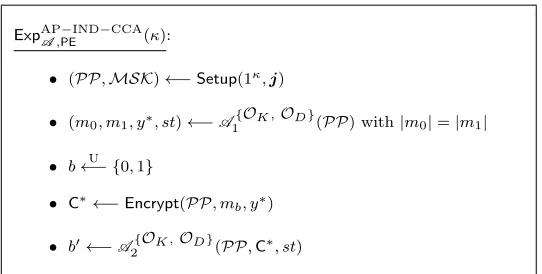
Definition 2.10 (Adaptive-Predicate IND-CCA Security). A PE scheme is said to be IND-CCA secure in adaptive-predicate model (or AP-IND-CCA secure) if for all PPT algorithmsA := (A1,A2), the advantage
AdvAPA,PE−IND−CCA(κ) :=
Prb=b0∧NRn−1 2
inExpAAP,PE−IND−CCA(κ) defined in Figure1is negligible function in security parameterκ, whereA is provided access to key-gen oracleOK and decrypt oracleOD (described below) andNRnis a natural restriction that
(C∗, x) withx∼y∗ was never queried toOD and for each key-indexx queried toOK, it holds thatx6∼y∗.
• KeyGen oracle(OK): Given a key-index x, oracle returns SKx←−KeyGen(PP,MSK, x).
• Decrypt oracle(OD): Given (C, x), it runsSKx ←−KeyGen(MSK, x) ifSKx has not been generated previously3, and then returnsDecrypt(PP,C,SKx).
We may refer the above security model as AP-IND-CCA security model in this paper.
3
The challenger maintains a log for storing the pairs of the forms (x,SKx). Before generating a key for an index x, it
searchesxin the log. Ifxis not found, then it runsSKx←−KeyGen(PP,MSK, x) and inserts (x,SKx) in the log, otherwise
ExpAPA,PE−IND−CCA(κ):
• (PP,MSK)←−Setup(1κ,j)
• (m0, m1, y∗, st)←−A{OK ,OD}
1 (PP) with|m0|=|m1|
• b←− {U 0,1}
• C∗←−Encrypt(PP, mb, y∗)
• b0←−A{OK ,OD}
2 (PP,C
∗, st)
Figure 1: Experiment for confidentiality (adaptive-predicate IND-CCA Security)
Definition 2.11 (Selective-Predicate IND-CCA Security). Likewise in IND-CCA security in selective-predicate model (or SP-IND-CCA security), the adversary A submits the challenge data-index y∗ before receivingPP of PE. In this case, the advantage of A is denoted byAdvASP,−PEIND−CCA(κ).
Definition 2.12 (IND-CPA Security). A weaker notion of the above security can be defined similarly as above except, A is not given access to OD oracle. It is called IND-CPA security in both adaptive-predicate (AP-IND-CPA) and selective adaptive-predicate (SP-IND-CPA) models. The advantages of A in the respective models are denoted byAdvAPA,PE−IND−CPA(κ) and AdvSPA,−PEIND−CPA(κ).
2.12 Predicate Signature
A predicate signature (PS) scheme for a predicate family ∼ consists of four PPT algorithms - Setup, KeyGen,SignandVer.
• Setup: It takes a security parameterκand a system-indexj as input, outputs public parametersPP and master secret keyMSK.
• KeyGen: It takes as input PP, MSK and a key-index x ∈ X and outputs a secret key SKx
corre-sponding tox.
• Sign: It takes PP, a message m ∈ M, a secret key SKx and an associated data-index y ∈ Y with
x∼y and returns a signatureδ.
• Ver: It receivesPP, a messagem∈ M, a signatureδ and a claimed associated data-indexyas input. It returns a boolean value 1 for acceptance or 0 for rejection.
Correctness. For all (PP,MSK) ←− Setup(1κ,j), all m ∈ M, all x ∈ X, SKx ←− KeyGen(PP,MSK, x) and ally∈ Y with x∼y, it is required that
Ver(PP, m,Sign(PP, m,SKx, y), y) = 1.
Remark 2.5. As in ABS of [37], we assume that signer sends both signature and data-indexyto receiver.
data-index. From now onwards, by predicate signature we mean the predicate signature with public data-index.
Form of PS. Similar to the form of PE, we specify signature-policy predicate signature (SP-PS) and key-policy predicate signature (KP-PS) for some relations defined in Section2.9. A predicate signature for the access structure based relation is called signature-policy attribute-based signature (SP-ABS) for access structures and its dual form is called key-policy attribute-based signature (KP-ABS) for access structures. A predicate signature for the acceptance relation in regular languages is called SP-PS for regular languages and its dual form is called KP-PS for regular languages. A predicate signature for the policy over doubly-spatial relation is called signature-policy over doubly-doubly-spatial signature (SP-DSS) and its dual form is called key-policy over doubly-spatial signature (KP-DSS).
2.13 Security of Predicate Signature
Definition 2.13 (Signer Privacy). A PS scheme is said to be perfectly private if for all (PP,MSK)←− Setup(1κ,j), all x
1, x2 ∈ X, SKx1 ←− KeyGen(PP,MSK, x1), SKx2 ←− KeyGen(PP,MSK, x2), all
m ∈ M, and all y ∈ Y with x1 ∼ y and x2 ∼ y, the distributions of Sign(PP, m,SKx1, y) and
Sign(PP, m,SKx2, y) are identical, where the random coins of the distributions are only the random coins involved in theSignalgorithm.
Note that the signer-privacy defined above is also called perfect-privacy. A predicate signature scheme with signer-privacy is called perfectly private.
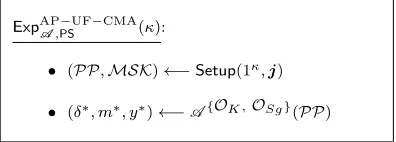
Definition 2.14 (Adaptive-Predicate Unforgeability). A PS scheme is said to be existential unforgeable in adaptive-predicate model (or AP-UF-CMA) if for all PPT algorithmsA, the advantage
AdvAPA,PS−UF−CMA(κ) := Pr [Ver(PP, m∗, δ∗, y∗) = 1∧NRn]
inExpAAP,PS−UF−CMA(κ) defined in Figure 2is negligible function inκ, whereA is provided access to key-gen oracle OK and sign oracle OSg (described below) and NRn is a natural restriction that (m∗, x, y∗) with
x∼y∗ was never queried to OSg oracle and for each key-index xqueried to OK, it holds thatx6∼y∗.
• KeyGen oracle(OK): Given a key-index x, oracle returns SKx←−KeyGen(PP,MSK, x).
• Sign oracle (OSg): Given (m, x, y), it runs SKx ←− KeyGenPP,MSK, x) if SKx has not been generated previously, and then returnsδ ←−Sign(PP, m,SKx, y).
ExpAPA,PS−UF−CMA(κ):
• (PP,MSK)←−Setup(1κ,j)
• (δ∗, m∗, y∗)←−A{OK ,OSg}(PP)
Figure 2: Experiments for unforgeability
Definition 2.15 (Selective-Predicate Unforgeability). There is another variant of unforgeability, called selective-predicate existential unforgeability (SP-UF-CMA), whereA submits a challenge data-indexy∗ ∈ Y (later on which A will forge) before obtaining the PP of ABS.
Definition 2.16 (Strong Unforgeability). The unforgeability defined in Definition2.14and2.15are called weak unforgeability becauseA is not allowed to forge on queried messages. In strong unforgeability,A is allowed to forgeδ∗ even on the queried message (m∗, y∗) but thenδ∗ 6=δ must hold, whereδ is a signature obtained from sign oracle on the query message (m∗, y∗).
We use the notations, AP-sUF-CMA and SP-sUF-CMA respectively for strong unforgeability in adaptive-predicate and selective-predicate models.
2.14 Predicate Signcryption
A predicate signcryption (PSC) scheme for a predicate family ∼consists of four PPT algorithms -Setup, KeyGen,Signcryptand Unsigncrypt.
• Setup: It takes a security parameterκand a system-indexj as input, outputs public parametersPP and master secret keyMSK.
• KeyGen: It takes PP, master secretMSK and a key-index x∈ X as input and outputs a secret key SKx corresponding tox.
• Signcrypt: It takes PP, a message m ∈ M, a signing key SKx, an associated data-index ys ∈ Y
for sender with x ∼ ys and an associated data-index ye ∈ Y for receiver as input and returns a
signcryptionU for (ys, ye) (we assume thatU implicitly containsye).
• Unsigncrypt: It takes as inputPP, a signcryption U, a secret keySKx and an associated data-index
ys∈ Y for sender. It returns a value fromM ∪ {⊥}.
Correctness. For all (PP,MSK) ←− Setup(1κ,j), all m ∈ M, all key-indices x ∈ X, SKx ←−
KeyGen(PP,MSK, x), all sender’s associated data-indices ys ∈ Y with x ∼ ys, all receiver’s
asso-ciated indices ye ∈ Y, all signcryptions U ←− Signcrypt(PP, m,SKx, ys, ye) and all indices ˜x ∈ X,
SK˜x ←− KeyGen(PP,MSK, ˜x), it is required that Unsigncrypt(PP,U,SKx˜, ys) =m (resp. ⊥) if ˜x ∼ye
(resp. ˜x6∼ye).
Remark 2.6. Similar to predicate signature, we assume that the signer sends both signcryption and sender’s data-indexysto the receiver in predicate signcryption. Again, the syntax of predicate signcryption
defined above says that U implicitly containsye. So, the predicate signcryption allows the data-index of
sender and receiver to be publicly available to the receiver. In other words, the predicate signcryption defined above is called public data-indices PSC or PSC with public data-indices. From now onwards, by predicate signcryption we mean the predicate signcryption with public data-indices. Similar to the forms of PS and PE, we can define the forms of PSC for the relations defined in Section2.9.
2.15 Security of Predicate Signcryption
Definition 2.17(Signer Privacy). A PSC scheme is said to be perfectly private if for all (PP,MSK)←− Setup(1κ,j), all key-indices x1, x2 ∈ X, all keys SKx1 ←− KeyGen(PP,MSK, x1), SKx2 ←−
andx2 ∼ys, and all receiver’s associated data-indicesye∈ Y, the distributions ofSigncrypt(PP,m,SKx1,
ys, ye) and Signcrypt(PP, m,SKx2, ys, ye) are identical, where the random coins of the distributions are
only the random coins involved inSigncrypt algorithm.
The signer-privacy defined above is also called perfect-privacy. A PSC scheme with signer-privacy is called perfectly private.
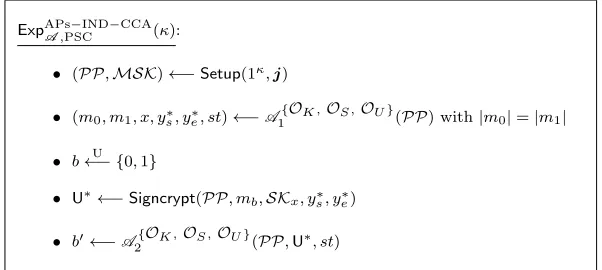
Definition 2.18(Adaptive-Predicates IND-CCA Security). A PSC scheme is said to be IND-CCA secure in adaptive-predicates model (or APs-IND-CCA secure) if for all PPT algorithms A := (A1,A2), the advantage
AdvAPsA,PSC−IND−CCA(κ) :=
Pr
b=b0∧NRn
−1 2
in ExpAAPs,PSC−IND−CCA(κ) defined in Figure 3 is negligible function in security parameter κ, where A is provided access to key-gen oracleOK, signcrypt oracleOS and unsigncrypt oracle OU (described below),
andNRnis a natural restriction that (U∗, x, y∗s) withx∼ye∗was never queried toOU and for each key-index
x queried toOK, it holds thatx6∼ye∗.
• KeyGen oracle(OK): Given a key-index x, oracle returns SKx←−KeyGen(PP,MSK, x).
• Signcrypt oracle (OS): Given (m, x, ys, ye), it runs SKx ←− KeyGen(PP,MSK, x) if SKx has not
been generated previously, and then returnsSigncrypt(PP, m,SKx,ys, ye).
• Unsigncrypt oracle(OU): Given (U, x, ys), it runsSKx ←−KeyGen(PP,MSK, x) ifSKxhas not been
generated previously, and then returnsUnsigncrypt(PP,U,SKx, ys).
ExpAPsA,PSC−IND−CCA(κ):
• (PP,MSK)←−Setup(1κ,j)
• (m0, m1, x, ys∗, y∗e, st)←−A
{OK ,OS ,OU}
1 (PP) with|m0|=|m1|
• b←− {U 0,1}
• U∗←−Signcrypt(PP, mb,SKx, y∗s, y∗e)
• b0←−A{OK ,OS ,OU}
2 (PP,U
∗, st)
Figure 3: Experiment for confidentiality (adaptive-predicates IND-CCA security)
We may refer the above security model as APs-IND-CCA security model in this paper.
Definition 2.19 (Selective-Predicate IND-CCA Security). Similarly to Definition 2.18, except in this model,A has to submit the challenge receiver’s data-indexy∗ebefore receivingPP of PSC and the challenge sender’s data-indexys∗ in the challenge phase.
Remark 2.7. The selective-predicate IND-CCA (SP-IND-CCA) security model (Definition2.19) is weaker than APs-IND-CCA security model (Definition2.18).
Remark 2.8. Selective-predicates IND-CCA (SPs-IND-CCA) security model (Definition 2.20) is weaker than SP-IND-CCA security model (Definition2.19).
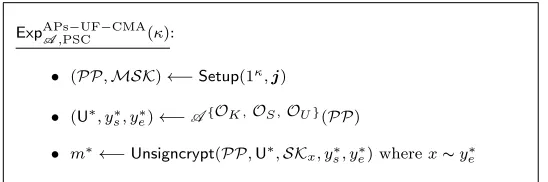
Definition 2.21(Adaptive-Predicates Unforgeability). A PSC scheme is said to be existential unforgeable in adaptive-predicates model (or APs-UF-CMA secure) if for all PPTA, the advantage
AdvAPsA,PSC−UF−CMA(κ) := Pr [m∗ 6=⊥ ∧NRn]
inExpAAPs,PSC−UF−CMA(κ) defined in Figure4 is negligible function in κ, where A is provided access to key-gen oracle OK, signcrypt oracle OS and unsigncrypt oracle OU (described below), and NRn is a natural
restriction that for each tuple (m, x, ys, ye) queried to OS oracle, (m, ys, ye) 6= (m∗, ys∗, ye∗) and for each
key-indexx∈ X queried to OK oracle, it holds thatx6∼ys∗.
• KeyGen oracle(OK): Given a key-index x, oracle returns SKx←−KeyGen(PP,MSK, x).
• Signcrypt oracle (OS): Given (m, x, ys, ye), it runs SKx ←− KeyGen(PP,MSK, x) if SKx has not
been generated previously, and then returnsSigncrypt(PP, m,SKx,ys, ye).
• Unsigncrypt oracle(OU): Given (U, x, ys), it runsSKx ←−KeyGen(PP,MSK, x) ifSKxhas not been
generated previously, and then returnsUnsigncrypt(PP,U,SKx, ys).
ExpAPsA,PSC−UF−CMA(κ):
• (PP,MSK)←−Setup(1κ,j)
• (U∗, ys∗, y∗e)←−A{OK ,OS ,OU}(PP)
• m∗←−Unsigncrypt(PP,U∗,SKx, y∗s, y∗e) wherex∼ye∗
Figure 4: Experiment for unforgeability (adaptive-predicates UF-CMA security)
We may refer the above security model as APs-UF-CMA security model in this paper.
Definition 2.22(Adaptive-Predicates Strong Unforgeability). The above unforgeability (Definition2.21) is also called weak unforgeability in the sense that in forgeryA is not allowed to forge for the queried mes-sages. In strong unforgeability (we use notation, APs-sUF-CMA), the restriction (m, ys, ye)6= (m∗, y∗s, y∗e)
is replaced by (U, m, ys, ye)6= (U∗, m∗, ys∗, ye∗), whereUis the reply for the query (m, x, ys, ye) toOS oracle.
Definition 2.23 (Selective-Predicate Strong Unforgeability). Similarly to Definition 2.22, except in this model,A has to submit the challenge sender’s data-indexy∗s before receivingPPof PSC and the challenge receiver’s data-indexye∗ at the time of forgery.
Remark 2.9. The selective-predicate sUF-CMA (SP-sUF-CMA) security model (Definition2.23) is weaker than APs-sUF-CMA security model (Definition2.22).
Definition 2.24 (Selective-Predicates Strong Unforgeability). Similarly to Definition 2.22, except in this model,A has to submit the challenge sender’s data-indexys∗ and challenge receiver’s data-indexye∗ before receivingPP of PSC.