The Impact of the Independence of the Central Bank on the
Effectiveness Monetary Policy in Iraq
Qahtan Lafta Atiyah
M.Sc, Economics,
College of Administration & Economics, University of Baghdad, Iraq
ABSTRACT:
The point of this paper is that demonstrates
the relationship between the monetary
policy and effectiveness of central banks for
country Iraq. In this setting in econometrical
part we utilize board OLS strategy with the
reel GDP information of country and
dummy variable which represent to
independence of central bank of Iraq for
investigation. We expect that effectiveness
of central bank influences financial fiscal
arrangement emphatically. This paper
evaluates the relative adequacy of central
bank effectiveness versus policy rules for
the approach instruments in realizing great
monetary policy. It analyzes recorded
changes in (1) macroeconomic performance,
(2) the adherence to rules based money
policy, and (3) the level of central bank of
Iraq effectiveness. Macroeconomic
performance is characterized regarding both
financial stability and output stability. Both
by right and accepted central bank
effectiveness at the Federal Reserve are
considered. The fundamental finding is that
progressions in macroeconomic execution
amid the past half century were nearly
connected with changes in the adherence to
rules-based fiscal arrangement and in the
level of accepted money related autonomy at
the Federal Reserve. In any case, changes in
financial execution were not connected with
changes in dejure central bank effectiveness.
Formal central bank effectiveness alone has
not created great money related approach
results. A framework based structure is
fundamental.
Keywords: Central Banks, Monetary
Policy, Macroeconomic Performance, Policy
INTRODUCTION:
The central banks have existed for over a
century but their purposes; functions and
operations have evolved over time. Interest
on the Central Bank Independence (CBI)
intensified after models of monetary policy
found the likelihood of an inflationary bias
in monetary policy operated by democratic
governments. The consensus is that,
democratic governments generate a more
pronounced inflation bias, requiring greater
delegation of authority. The second is that
democratic government is more open and
pluralistic, involving more checks and
balances, and therefore more amenable to
delegation within the political system. As
the economies tend towards democracy, the
search began for how to establish monetary
institutional policies that can be viewed as
credible commitments. Delegation of
monetary policy to an independent central
bank was one strand of that exploration.
Thus, since then, greater independence
became the practice across all groups of
countries, but has been particularly marked
for developing and emerging market
economies.
As central banks have become more
independent, so the demand for transparency
has increased, both for reasons of
accountability and legitimacy, and to guide
the expectations of financial market
participants (whose appetite for information
has expanded as financial markets have
become broader and deeper). Transparency
became more necessary with the experience
of the banking crises in Mexico in 1994 and
the South East Asian. In1997, official
bodies, including the IMF and the Basel
Committee on Banking Supervision,
therefore, called for increased transparency
of banking industry. Their suspicion is that
the crises emanated from general lack of
transparency in the affairs of both lender and
borrowers and policies responsible for the
depth of the crises which would not have
been undertaken, had there been
transparency. Also, monetary policy has
become more information-intensive with the
increasing popularity of inflation targeting
(IT) over simpler policy anchors such as a
fixed exchange rate or money aggregate
rule. Hence both the supply of and demand
for central bank transparency seem to have
increased.
Monetary control and the central bank
debates currently brought into agenda due to
the increasing monetary policy
implementations. Because, the basic source
of inflation remains to be the disparity
monetary growth. This is the reason why
governments increase the budget deficits in
order to finance the increased government
spending instead of increasing the tax
revenues due to the electional concerns. Free
use of central bank resources causes the
institution to be kept under the governmental
coordination (pressures). This situation
brings barriers to the efficient use of
monetary policies. Monetary policy tools
have an important place within the
governments‘ economic interventions. The
governments, with the hope of monetary
adjustment accordingly with their output and
employment targets, try to make policy
implementations with the tools of open
market operations and the reserve
requirement ratios based on the general
economic conditions.
The most important factor with the use of
these tools is the existence of an
independent monetary authority. Increasing
the central bank autonomy debates are
brought into agenda with the latest reforms
in order to dispel the devastations caused by
the inflation problem observed in many
countries and also ameliorate the social
structure in these countries. Debates reveal
that there are four conditions required in the
making of a sound monetary policy strategy.
It is essential to examine these conditions
under the institutional framework. The
discussions concerning the issues such as
setting these conditions within an
institutional framework, and justification of
the need for these conditions are of special
importance. Bringing the central banks into
an independent position render the use of
monetary policy tools more efficient in
attaining the price stability target.
First; the central bank autonomy definition,
indicators and the relationship between the
central bank independency and the
economic performance issues are evaluated
within this paper. Second, the effects of an
independent central bank to the economies‘
growth are examined based on the cross –
country applications.
MONETARY POLICY
In general, stabilisation policies can be
implemented with the aid of either monetary
or fiscal policy. As to the role of monetary
stabilisation policy, let me take the example
of the euro area. In the euro area the
Maastricht Treaty assigns to monetary
policy the responsibility for maintaining
price stability. The clear assignment of price
stability as the overriding objective of the
Central Bank – specified by a quantitative
agents as to what can be expected from
monetary policy. Without doubt this
enhances the credibility of monetary policy,
contributing to the anchoring of medium and
long-term inflation expectations in the euro
area. Stable inflation expectations eliminate
an important source of macroeconomic
instability, namely the possibility that
economic shocks affecting inflation in the
short-term become amplified via a
corresponding adjustment in inflation
expectations. In turn, the stability of these
expectations contributes to economic
welfare via a reduction of inflation risk
premia contained, for example in nominal
bond yields. By insuring price stability,
monetary policy can thus make an important
contribution to macroeconomic stability.
In its monetary policy strategy the
Eurosystem has adopted a medium-term
orientation. The forward-looking nature of
this strategy insures that timely action is
taken to address any potential threats to
price stability. Yet, the medium-term
orientation also reflects the existence of
economic shocks, the consequences of
which monetary policy cannot control
without inducing excessively high
variability in real activity and interest rates.
A medium-term orientation should
effectively guarantee that monetary policy
itself does not become a source of economic
fluctuations: it avoids misguided reactions to
short-term developments, providing a safety
net against overly ambitious economic
fine-tuning. As is well-known, monetary history
is full of examples where monetary policy
activism – concerned too much with the
short run – led to a sequence of decisions
which had to be reversed within short
periods of time. Such a policy is a source of
instability and generates results opposite to
the ones initially envisaged. Overall, the
medium-term orientation of monetary policy
– guided by the objective of price stability –
helps policy concentrating on the relevant
economic shocks, that is on shocks and
economic developments that monetary
policy can effectively address. The focus on
the medium-term may in a certain sense be
interpreted as a practicable and
economically reasonable compromise
between Friedman‘s idea on economic
self-stabilisation, which focuses entirely on the
long-run, and the Keynesian view on
economic fine-tuning, focused on
shorter-term developments.
THE ROLE OF FISCAL POLICY
Fiscal policy can promote
aggregate demand and private sector
incomes during an economic downturn and
by moderating economic activity during
periods of strong growth. An important
stabilising function of fiscal policy operates
through the so-called ―automatic fiscal
stabilisers‖. These work through the impact
of economic fluctuations on the government
budget and do not require any short-term
decisions by policy makers. The size of tax
collections and transfer payments, for
example, are directly linked to the cyclical
position of the economy and adjust in a way
that helps stabilising aggregate demand and
private sector incomes. Automatic stabilisers
have a number of desirable features. First,
they respond in a timely and foreseeable
manner. This helps economic agents to form
correct expectations and enhances their
confidence. Second, they react with an
intensity that is adapted to the size of the
deviation of economic conditions from what
was expected when budget plans were
approved. Third, automatic stabilisers
operate symmetrically over the economic
cycle, moderating overheating in periods of
booms and supporting economic activity
during economic downturns without
affecting the underlying soundness of
budgetary positions, as long as fluctuations
remain balanced.
In principle, stabilisation can also result
from discretionary fiscal policy-making,
whereby governments actively decide to
adjust spending or taxes in response to
changes in economic activity. I shall argue,
however, that discretionary fiscal policies
are not normally suitable for demand
management, as past attempts to manage
aggregate demand through discretionary
fiscal measures have often demonstrated.
First, discretionary policies can undermine
the healthiness of budgetary positions, as
governments find it easier to decrease taxes
and to increase spending in times of low
growth than doing the opposite during
economic upturns. This induces a tendency
for continuous increases in public debt and
the tax burden. In turn, this may have
adverse effects on the economy‘s long-run
growth prospects as high taxes reduce the
incentives to work, invest and innovate.
Second, many of the desirable features of
automatic stabilisers are almost impossible
to replicate by discretionary reactions of
policy makers. For instance, tax changes
must usually be adopted by Parliament and
their implementation typically follows the
timing of budget-setting processes with a
lag. Not surprisingly, therefore,
discretionary fiscal policies aiming at
to be pro-cyclical in the past, often
becoming effective after cyclical conditions
have already reversed, thereby exacerbating
macroeconomic fluctuations.
Clearly, the short-term stabilising
function of fiscal policy can become
especially important for countries that are
part of a monetary union, as nominal interest
rates and exchange rates do not adapt to the
situation of an individual country but rather
to that of the union as a whole. Fiscal policy
can then become a crucial instrument for
stabilising domestic demand and output,
which remains in the domain of individual
governments. At the same time, however,
the limitations of active fiscal policy may be
greater when there is increased uncertainty
about future income developments. This is
the case today in many European countries
where there is a growing concern about the
difficulties faced by public pension and
health care systems in view of demographic
trends. Under such circumstances,
cyclically-oriented tax cuts and expenditure
increases today may simply translate into
higher taxes or lower expenditure tomorrow.
Aware of this, the public may increasingly
react to fiscal expansions by raising
precautionary savings rather than
consumption. In the light of the previous
discussion, what is the scope for
discretionary fiscal policies? Discretionary
policies are needed to implement long-term
structural changes in public finances and to
deal with exceptional situations, particularly
when the economy experiences
extraordinary shocks. Discretionary policies
in fact reflect the changing tastes about the
desirable size of the public sector, about the
priorities of public spending, and about the
level and characteristics of taxation. These
policies determine the structure of public
finances and substantially affect the
functioning of the economy but also the
features of a country's automatic stabilisers.
Discretionary fiscal policy decisions are also
needed to preserve the sustainability of
public finances in the medium-term. This is
the precondition for automatic stabilisers to
operate freely, as fiscal policy can only act
as an effective stabilising tool when there is
the necessary room for manoeuvre.
The experience of the industrialised
countries in recent decades clearly shows
that persistent fiscal imbalances limit the
room for fiscal policy to stabilise the
economy. Imbalances often necessitate tight
fiscal policies during downturns to prevent
unsustainable deficits and debt
in doubt, expansionary measures and even
automatic stabilisers may not have the
desirable effect on output as people adjust
their behaviour. Consolidation measures
may then re-establish confidence and
improve expectations about the long-term
outlook of public finances. These so-called
‗non-Keynesian‘ effects may have the result
that fiscal consolidation even has an
expansionary impact on the economy.
Active fiscal consolidation with
discretionary policies is therefore
appropriate when budgetary positions are
perceived as not being safe or when there
are risks to fiscal sustainability due to high
debt and future fiscal obligations. Finally,
although automatic fiscal stabilisers are
effective in dampening normal cyclical
fluctuations, there may be situations where
active policy decisions might be needed. For
example, automatic stabilisers alone may not
be sufficient to stabilise the economy when
economic imbalances do not stem from
normal cyclical conditions or are considered
as irreversible. However, the benefits from
expansionary policies in a recession must
still be assessed against the risks to
long-term sustainability or the persistent adverse
effects on the structure of public finances,
such as a permanently higher tax level, as
well as the economic costs of an eventual
policy reversal.
DIFFERENT PATHS TOWARD AND
AWAY FROM THE GREAT
MODERATION
To measure changes over time in
macroeconomic performance, I focus here
on the size of the fluctuations in real output
and inflation. A simple framework for
evaluating the effect of monetary policy on
such fluctuations is the tradeoff between
variance of inflation and the variance of
output which was developed in the years
preceding the Great Moderation. This is the
framework that Ben Bernanke used in his
assessment of monetary policy and
performance in his paper ―The Great Moderation‖ first presented in 2004. The
framework has also been used by other
central bankers. While the tradeoff between
the levels of inflation and output (or
unemployment) is very short lived, the
tradeoff between the fluctuations of these
two variables is longer lasting and
appropriate for comparing economic
performance for more than two or three
years. This framework naturally takes
research beyond the question of why the
broader context of why the downturn was
large and why the recovery so slow and,
depending on the future, why the next
downturn is large or small. We are
considering fluctuations over longer periods
of time.
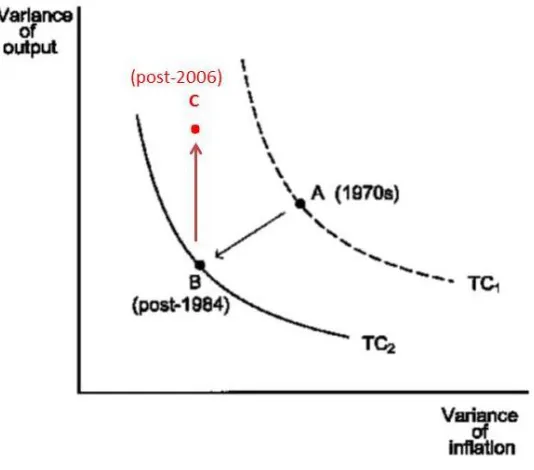
Figure 1 replicates the tradeoff diagram
as it appears. On the horizontal axis is the
variance of inflation; on the vertical axis is
the variance of real output (deviations from
potential GDP). Points more to the north or
to the east represent more macroeconomic
instability and thus poorer economic
performance.
Figure 1: chart from bernanke (2004) "the great moderation"
The curve represents a tradeoff in the sense
that along the curve monetary policy can
achieve smaller inflation fluctuations only
by generating larger output fluctuations.
Points to the left or below this tradeoff curve
are infeasible for a given structure of the
economy. Points to the right and above are
inefficient, in the sense that a better
monetary policy would be on the curve. The
position and shape of the curve depend on
the underlying structure of the economy and
the size of the exogenous shocks to which it
is subject. An economy with less rigid wage
and price setting has a tradeoff curve closer
to the origin than an economy with more
rigid wages and prices. An economy with
further away from the origin than an
economy with smaller shocks.
Tradeoff curves can be derived
quantitatively from a wide range of
estimated or calibrated macroeconomic
models, including DSGE models and
New-Keynesian models of the type collected in
monetary model data base. Of course the
curve will differ somewhat from model to
model because the economic structures of
the models differ. The position of the
economy on a given curve depends on how
much emphasis the monetary authority
places on inflation fluctuations versus output
fluctuations. For example, a higher weight
on inflation in the central bank‘s objective
function implies a position on the curve
more to the upper left.
Conceptualizing Central Bank
Independence
There is no clear definition of Central Bank
Independence (CBI) in the literature, as
many authors give the definition in various
ways. According to Friedman (1962), CBI
relates to the relationship between the
government and the Central Banks (CBs) as
the government relates to the Judiciary. As
the Judiciary can rule only on the basis of
the laws provided by the legislation so also
the CBs can only work on the policy of the
government. Numerous episodes in the
world‘s economic history testify to a government‘s potential abuse of its power to
create money. He gave an analogy of this as
what happened around the third century AD
in the Roman Empire, where the
government collected silver coins as tax
from the people melted and combined them
with inferior metals, yielding many more
coins to spend on the Caesar‘s priorities than
the initial tax taken. With too much money
chasing too few goods, the end result was
hyper- inflation. Therefore, highlighted three
major areas where the influence of
government must either be excluded or
radically reduced. These areas include;
personnel, Financial and Policy sectors of
the central bank.
Thus, there is the need for independence in
the operations of the Central Banks in these
three major areas. These are explained
below; 1. Personnel Independence: This
refers to the level of the influence of
government in appointment of personnel in
the Bank. 2. Financial Independence: This
refers to the extent of power and type of
access given to the government to handle
Central Bank‘s Credits. If the government is
given direct access, it means that the Central
Bank is not financially independent. While
indirect access like the power to have the
government or having the power to handle
government debt management means
independent of the Central Bank. 3. Policy
Independence: This is given as the
maneuvering room allowed for a central
bank to formulate and implement monetary
policy. This can be in respect of goal or
instrument. In respect of goal, two important
issues are raised. (1) the scope the Central
Bank has to exercise its discretion and (2)
the presence or absence of monetary policy
as its central goal. A central bank is
independent if it has the power to
manipulate effective policy instruments and
given the power by the law of the land to
choose the means by which it will
accomplish its goals. It is however not
independent if it will have to seek the
endorsement of the government before it
could use any instrument to attain its goal,
then it is not independent with respect to
instrument.
The Road Away from the Great
Moderation
However, the Great Moderation has ended
and it is time to move on to study the causes
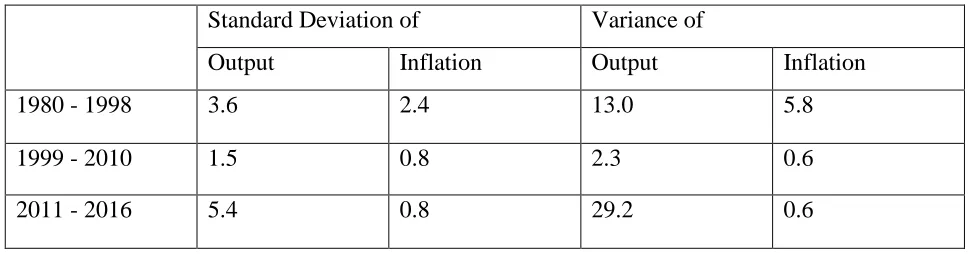
of this equally momentous change. In Table
1, I show the actual variability of the key
variables. I report the variance as well as the
standard deviation, which was the variability
metric I originally focused on in where I
drew the tradeoff curve in standard deviation
space.
Table 1. Variability of Output and Inflation in Three Periods (%)
Standard Deviation of Variance of
Output Inflation Output Inflation
1980 - 1998 3.6 2.4 13.0 5.8
1999 - 2010 1.5 0.8 2.3 0.6
2011 - 2016 5.4 0.8 29.2 0.6
The variability measures in Table 1 are
computed for the three time periods
indicated.
They represent the periods before, during,
and after the Great Moderation. The
variance and the standard deviation of
inflation are measured by the quarterly
percentage change (at an annual rate) in the
GDP price index. The variance and the
from the GDP gap, or the percentage
deviation of real GDP from the
Congressional Budget Office‘s (CBO)
estimate of potential GDP. Note that the
period since the end of the Great Moderation
is only five years in length and shorter than
the other periods. The recovery from the
2011-2013 recession does not appear to be
over, and thus the change in the standard
deviation may exaggerate the deterioration
of performance in a post Great Moderation
regime. It is very difficult to identify an
emerging historical period in real time (and
of course we hope the economy will go back
to Great Moderation conditions soon). By
way of comparison I first wrote about the
post-1999 secular decline in volatility in—
fourteen years after it began. By that time
we had the strong recovery from the
recession in the early 1980s, the small
recession of the early 1990s, and the start of
a long expansion in the 1990s. Nevertheless
there is already plenty to study about this
post Great Moderation period even though
we will certainly learn more as time goes on.
To represent this change I have updated, the
variance tradeoff diagram used by adding a
point C and an arrow from point B to point
C.
Observe that the line from point B to point C
does not simply retrace in reverse the path
from point A to point B. The movement
from the 1970s toward the Great Moderation
is much as in Bernanke‘s (2004) generic
sketch. But the movement away from the
Great Moderation, thus far, is much
different. It is a nearly perfectly vertical
move up from the in the diagram. Virtually
all of the deterioration in performance is
reflected in a major increase in output
volatility due to the Great Recession and the
very slow recovery. Inflation performance
has remained steady, though that could
change in the future. The end of the Great
Moderation raises many of the same
questions as have been raised about Great
Moderation itself. Was the end due to a
change in the structure of the economy
traced, for example, to less aversion to risk
as argued. In this case the tradeoff would
have shifted back away from the origin. Or
was there a change in monetary policy as I
have argued in Taylor (2011, 2016), in
which case the tradeoff curve did not simply
move exogenously, but rather policy took
the economy to point C. That virtually all of
the deterioration in macroeconomic
performance has been on the output
dimension, not the inflation dimension, is an
important fact that helps identify the reasons
Monetary Policy Regime Change or
Other Factors?
To answer the causation question it is
helpful to address it within the broader
context of why macroeconomic stability first
increased and then decreased.
Exogenous Shocks and the Structure of the
Economy
One of the structural explanations for the
Great Moderation was that the U.S.
economy became much more
service-oriented than in the past. The production of
services is not as cyclical as the production
of goods. The problem with this explanation
for the Great Moderation is that the
transition to a service-oriented economy was
very gradual. It could not explain the sudden
shift toward greater economic stability. But
it is an even less plausible explanation for
the reversal of output volatility, because the
move to services has not gone into reverse,
even if it has slowed down. Another
explanation for the Great Moderation was
better control of inventories, such as the
just-in-time approach to inventory
management. During recessions and
recoveries, inventory fluctuations accentuate
the ups and downs in GDP. Firms cut
inventories when sales weaken and rebuild
inventories when sales strengthen. Better
inventory control could thus explain the
improved stability. But this explanation also
had problems. When one looked at final
sales GDP less inventories—one saw the
same amount of improvement in economic
stability. And as an explanation of the
higher volatility now the depth of the
recession and the weak recovery this
explanation is even less plausible because
inventory management has not deteriorated.
The Change in Monetary Policy
It was through such considerations that
others were led to consider changes in
monetary policy as a major reason for the
improved economic performance in the
1980s and 1990s. And in fact there were
clearly identifiable changes in policy during
this period, including the more rule like
focus on price stability and the closer
adherence to simple predictable policy rules
starting with Paul Volker and continuing for
much of Alan Greenspan‘s term. In my
view, the same monetary policy
considerations working in reverse are
relevant for explaining the recent
deterioration of performance. Monetary
policy became much less rule like, starting
in my view in the period from 2003 to 2005
when the policy interest rate was held far
below levels that would have pertained in
the 1980 s and 1990s under similar
Many empirical researchers have uncovered
evidence of such deviations from policy
rules, but one can also simply compare the
settings of the federal funds rate at different
times and come to the same conclusion. In
addition, policy became much more
discretionary with the interventions into
particular markets such as the mortgage
backed securities market, with the expansion
of the Fed‘s balance sheet, and with the
commitment to hold the interest rate to zero
after traditional rules would call for higher
rates. In his comprehensive history of the
documents this change toward discretion
flowing the more rule like policy in the
1983-2003 period. Of course, as with onset
of the Great Moderation, one can point to
exogenous shocks, other than these
monetary policy shocks, as another factor. In
examining the period up to the crisis argue
that there was a shock to preferences in the
form reduced risk aversion. Indeed, King
(2012) argues explicitly that this structural
change shifted the tradeoff curve in Figure 2
back up and out as investors took on greater
risk which led to the boom and the bust. He
argues that the very stability of the Great
Moderation caused this shift in preferences
as people got complacent in a Minsky-like
―stability breeds instability‖ line of
argument. Of course, as discussed below,
monetary policy may have caused this shift
as the low interest rates led to a search for
yield and risk taking.
To be sure, other government policies
largely unrelated to monetary policy may
also have contributed to these financial
market shocks.
The Impact of the Change in Monetary
Policy
While there is already much evidence that
there was a change in monetary policy
regime starting around 2003, there is
growing empirical and theoretical research
showing that this change was largely
responsible for the deterioration of
performance. The study consider this
evidence briefly here. Much of the research
has focused on the impact of the Fed holding
interest rate below what was suggested by
policy rules that were effective during the
Great Moderation. More recently showed
that housing booms are closely associated
with deviations from simple monetary
policy rules over time and across countries.
As they put it, ―our evidence for close to a
century, for many countries, and for three
types of asset booms, that expansionary
monetary policy is a significant trigger,
makes the case that central banks should
These should be based on well understood
and credible monetary rules.‖Another effect
of extra low policy rates is on risk aversion.
Using time series techniques Bekaert,
Hoerova, and Duca (2012) found that this
effect is empirically significant. They
decompose the VIX into a risk aversion
component and an uncertainty component.
They then look at the cross autocorrelations
between policy rates and these two
components. Their empirical results show
that ―Lax monetary policy [below policy
rule rates] increases risk appetite (decreases
risk aversion) in the future, with the effect
lasting for about two years and starting to be
significant after five months.‖ These results
provide a reason why a change in monetary
policy might actually shift the tradeoff curve
back up a channel to poor economic
performance which is quite different than
the risk aversion channel or with much
different policy implications.
Bekaert et al. (2012) also find that increased
uncertainty leads the Fed to lower rates, a
policy reaction that explains deviations from
conventional policy rules in recent years. A
similar response has been uncovered by Steil
(2012) who uses a completely different
measure of risk aversion and uncertainty.
The impact of the recent discretionary policy
interventions is uncertain and not fully
understood by either the policy makers or
economists. A particular source of
uncertainty is the Fed‘s enlarged and
growing balance sheet which will have to be
drawn down in the future. The risk is two
sided: if the balance sheet is drawn down too
quickly it will cause a downturn and if it is
drawn down too slowly it will lead to
inflation.
Deviations from conventional monetary
policy also create a number of distortions
which could push the economy in a
suboptimal direction. In my view these
distortions are akin to price controls which
interfere with the functioning of markets and
are known to have negative effects, though
they are frequently hard to measure in
practice. For example, the short term interest
rate has been driven down to zero by the
exploded balance sheet, and the money
market is no longer providing its usual
allocation and price discovery function. The
Fed has effectively replaced the money
market and the longer term treasury market
with itself. The commitment to hold rates at
zero and the large purchases of long term
Treasury securities for several years into the
future reduces the usefulness of longer term
treasuries as benchmarks as Pringle (2012)
With rates held this low there is
disequilibrium in the money market. While
borrowers might like the near zero rate,
there is little incentive for lenders to extend
business or consumer loans at that rate. It is
much like the effect of a price ceiling in an
agricultural market, and it can be illustrated
with a standard supply and demand diagram.
The supply curve of loans is upward sloping
with the interest rate on the horizontal axis.
The demand curve is downward sloping and
also dependent on the interest rate. Firms
will not supply more than what the supply
curve implies at that ceiling rate, even
though consumers would be willing to
borrow at the low rate. The result is excess
demand and lower volume than in the case
of an equilibrium interest rate. As Fisher
(2012) put it: ―as they approach zero, lower
rates will not automatically create more
credit and more economic activity but,
rather, run the significant risk of perversely
discouraging the lending and investment we
need.‖ There are many other potential
negative effects of the low rates and the
unconventional policies. Low rates are a
drag on consumption for many people
whose income is significantly negatively
affected by the low rates. This effect may be
larger than any offsetting substitution effect
which would tend to encourage consumption
by households and investment by business
firms. And then there is effect on pension
fund solvency. In addition the low rates
make it possible to roll over rather than
write off bad loans at banks, and they reduce
fiscal discipline on the congress and the
administration. As McKinnon (2011)
describes it, the bond vigilantes have been
replaced by the central bank.
Recent research on the overall macro effects
of the change in policy regime includes the
economy wide regime switching model of
Baele, Bekaert, Cho, Inghelbrecht, Moreno
(2012). They find that monetary policy
regime changes are responsible for both the
improved economic performance in the
Great Moderation and the recent
deterioration in performance. Their work
thus extends the economy wide empirical
work of Stock to recent events.
Changes in Central Bank Independence?
So there clearly have been large shifts
during these three periods in the degree to
which monetary policy has been rules-based
in the United States. But have there been
comparably large shifts in the underlying
legal basis for Federal Reserve
independence? To be sure, there have been
several notable changes in the Federal
so-called dual mandate was added to the
Federal Reserve Act in 1977 and the
requirement to report on the monetary
aggregates was removed in 2000. But when
you look at the conventional indices of de
jure. There have been shifts, of course, in de
facto independence. Allan Meltzer (2009)
showed in his comprehensive history how
the Fed sacrificed its independence in the
late 1960s and 1970s, regained it in the
1980s and 1990s, and has since sacrificed its
independence again by cooperating with the
Treasury and engaging in fiscal policy.
Marvin Goodfriend (2012) and Otmar Issing
(2012) come to similar conclusions about
central bank independence in recent years.
Note that these changes in de facto
independence can be driven either by the
executive branch or the central bank, or
both. Meltzer explains how the loss of de
facto independence in the late 1960s was
originally driven by the U.S. Administration,
while the loss of de facto independence
more recently was driven by the Fed itself.
In any case there is a very close correlation
between the ups and downs in de facto
independence and the adherence to rules
ased policy in the United States during this
period. In other words within a given legal
framework, policy makers in the United
States have been able to engage in varying
degrees of de facto independence and
adherence to rules-based policy. For these
reasons we have seen major shifts in the
efficiency of monetary policy within the
same framework of central bank
independence.
CONCLUSION:
The study concludes that changes in
macroeconomic performance during the past
half century were closely associated with
changes the adherence to rules-based
monetary policy and in the degree of de
facto monetary independence. But
performance was not associated with de jure
central bank independence. In the absence of
a rules-based framework it appears that
formal Federal Reserve independence does
not generate good monetary policy
outcomes. These conclusions are very
similar to those of Friedman (1962) who
argued fifty years ago that in reality we have
never had a de facto independent central
bank that does not take account of the
preferences of the government or does not
work together with the government to
encourage various interventions. He argued
that the attractiveness of independent central
banks at that time came from those
interested in limiting the scope of
government. Central bankers, being ―sound
―tended to oppose many of the proposals for extending the scope of government.‖ But in
recent years some central bankers have been
the main advocates of extending the scope
of government interventions, so that
attractiveness has vanished.
REFERENCE:
1. Taylor, John B. (2011), ―Legislating
a Rule for Monetary Policy,‖ The
Cato Journal, 31 (3), Fall, pp.
407-415.
2. Steil, Benn (2012), ―Bernanke's
‗Risk-On, Risk-Off‘ Monetary
Policy,‖ Wall Street Journal,
September 19.
3. Pringle, Robert (2012) ―How
Governments Are Undermining
World Finance,‖ Central Banking
November 24.
4. Meltzer, Allan H. (2009), A History
of the Federal Reserve, Vol. 2.
Chicago: University of Chicago
Press, Chicago.
5. McKinnon, Ronald I. (2011),
―Where are the Bond Vigilantes?‖
Wall Street Journal, September 30.
6. King, Mervyn (2012), ―Twenty years
of Inflation Targeting,‖ Stamp
Memorial Lecture, London School of
Economics, London, October 9
7. Issing, Otmar (2012), ―The
Mayekawa Lecture: Central Banks—
Paradise Lost,‖ Monetary and
Economic Studies, Bank of Japan,
Vol. 30, November, pp. 55-74
8. Goodfriend, Marvin (2012), ―The
Elusive Promise of Independent
Central Banking,‖ Monetary and
Economic Studies, Bank of Japan,
Vol. 30, November, pp. 39-54.
9. Friedman, Milton (1962). ―Should
There Be an Independent Monetary
Authority?‖ in Leland B. Yeager
(Ed.), In Search of a Monetary
Constitution, Harvard University
Press, Cambridge, Massachusetts.
10.Bernanke, Ben S. (2004) ―The Great
Moderation,‖ Eastern Economic
Association, Washington, DC,
February 20.
11.Bekaert, Geert, Marie Hoerova,
Marco Lo Duca (2012) ―Risk,
Uncertainty and Monetary Policy,‖
Unpublished paper, Columbia
University.
12.Baele, Lieven, Geert Bekaert,
Seonghoon Cho, Koen Inghelbrecht,
Antonio Moreno (2012),
―Macroeconomic Regimes,‖