Automatic Railway Level Crossing Gate
Control
Dr.T.Menakadevi
1, M.Raja Rajeshwari
2, S.Priyanka
3, M.Philphee Ninu
4, S.Monisha Clara
5Professor, Department of ECE, Adhiyamaaan college of Engineering, Hosur, Tamilnadu, India
1U.G. Student, Department of ECE, Adhiyamaaan college of Engineering, Hosur, Tamilnadu, India
2,3,4,5ABSTRACT: The Indian railway system is very big and complicated. Usually, railway level crossing gates have a person in a nearby booth that clears the track and closes the gates on the arrival of the train. Then, when the train leaves the particular place, the person opens the railway gate. However, there are certain unattended railway level crossings which may lead to several accidents. Sometimes, accidents may even occur at manually operated railway gates due to human errors. . Hence, this paper is proposed to prevent accidents occurring at the railway gates. By applying this system at the railway level crossing gates, the approach of the train can be detected by the Infrared detectors placed near the gate. Thus, the proposed system is highly economical and can be used in all the manned and unmanned level crossings.
KEYWORDS: Railway gate, Level crossing, unmanned, Sensor.
I.
INTRODUCTIONIndia organizes the world's biggest railway network. More than several rails run on the tracks every day. The railroads have given rail line gates to well-being at the level intersection. The railway level intersection is isolated in to two classifications, such as manned railway level crossings and unmanned railway level crossings. In earlier days, the railway crossings had a gatekeeper in a nearby booth that waves a flag, clears the tracks and closes the gates on the arrival of a train.
Generally, the gates are kept open to road traffic and are closed against the traffic only for the passage of trains or for other railway services by taking off the signals. Nowadays, most of the railway gates are operated manually to open or close the gate while the train arrives or departs. But several railway level crossing gates are unmanned in rural areas, which may lead to several accidents since the people may not be aware of the arrival of the train. Even in certain manned railway gates, accidents may occur due to human carelessness. Hence, this project will be helpful to avoid these tragic accidents.
In present system, the railway gate control is achieved by using GSM technology.The level crossing gate operation is controlled based on the SMS sent by the station master or the driver to the control area. The system has a GSM modem combined with a control system. When station master sends a message to open or close by using GSM module, it receives the message that has been sent by the station master and the data sends to the microcontroller. The microcontroller identifies these signals and sends the command data to the motor driver, which controls the direction for opening and closing the gate. The major disadvantage of GSM technology is that several users share the same bandwidth. With large number of users, the transmission can encounter interface. Bandwidth limitation occurs. Due to bandwidth limitations, the transmission of signal from the GSM module to the microcontroller may get delayed, which may leads to severe accidents. Due to these disadvantages, the implementation of this system in the railway level crossing gates is a risk factor.
II.
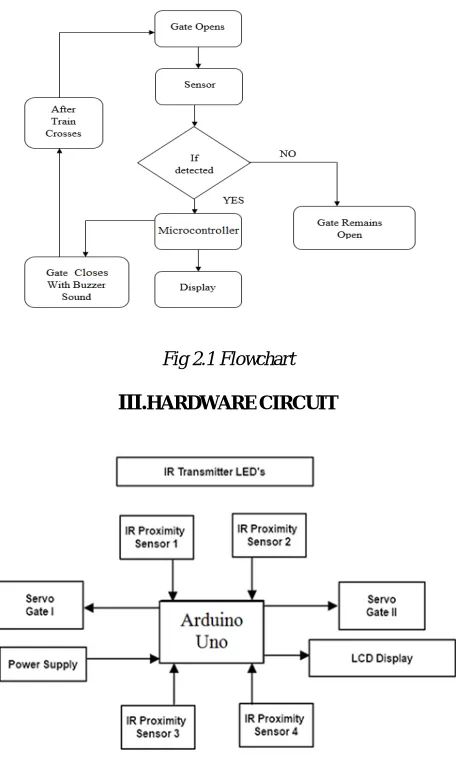
PROPOSEDWORKIn our proposed method, the approach of the train is sensed by the IR detectors. The IR sensor works based on voltage which emits light and detects objects. This light proliferates through the air and when any object hits the light, it reflects back towards the sensor. Hence, when the train passes through this sensor region, the IR sensors transmit signals to the Arduino Uno. The Arduino Uno is a microcontroller board based on the ATmega328. From the Arduino the signal is sent to the timer connected to the LCD display near the gate. The LCD display is used to display the timing remaining for opening or closing the gate according to the necessary situations. This is necessary to provide an alert to the passengers on road regarding the timing remaining for the closure or opening of the gate. The LCD display which can be worked when voltage is applied which has untwisted. This changes the angle of the top polarizing filter which allows only a lesser amount of light to pass the polarized glass. Thus that particular area becomes darker compared to other.
An I2C interface is used along with the LCD so that fewer pins are required to use the LCD display. Along with this LCD display, a buzzer is placed near the gate which is used to provide alert to the passengers while the gate is closed or opened. A buzzer is an audio signalling device, which it works on current passed to relay and indicates to buzz. When the train arrives, the IR sensors sense the train and as a result power is transmitted to the servo motor from the Arduino. Servo motor consists of a motor connected to a sensor for position feedback. The servo motor is used for accurate control based on angular or linear position of the railway gate.
Fig 2.1 Flowchart
III.
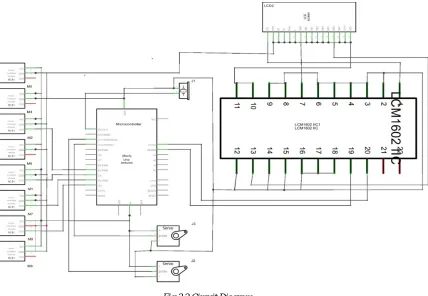
HARDWARECIRCUITFig 3.2 Circuit Diagram
IV.
SOFTWAREDETAILSThe system is coded by the Arduino IDE (Integrated Development Environment) software. The Arduino IDE software is a free and open source. It is used to write and upload programs to the Arduino board. The software part plays a vital role in working of the system. The hardware system works only based on the coding instructions provided in the software. The hardware part and the software part are integrally coupled together. Hence, without the software part the hardware is just a simple circuit connection and no output can be obtained.
Fig 4.1 Sample Code
V.
EXPERIMENTALRESULTSprecise control of angular or linear position of the railway. A buzzer is placed near the gate which is used to provide alert to the passengers while the gate is closed or opened.
CONDITION OUTPUT DISPLAYED IN LCD
Idle State Look both sides while crossing
When the train is detected Alert! gate closing (time remaining for closing the gate) After the gate is closed Train on station
After the train leaves Gate opening (time remaining for opening the gate)
After the gate opens Go
Table 1: Conditions and output displayed
VI.
CONCLUSIONThus, by implementing this proposed method, most of the major accidents that occur in unmanned railway level crossing can be controlled. This method is highly secured and safe in which no human presence is needed. Maintenance and operation of the system is easy. This system can be further developed by adding GPS system for live tracking of train and also a crack detection system can be added to identify presence of any cracks in the railway tracks. By using this system, automatic operation of the gate can be accomplished and no manual work is needed. When the sensor detects the train, it transmits signals to the Arduino. Gate closing and opening operation is done by software coding written for the Arduino. Thus the automatic railway gate control works efficiently and it reduces the human work and time. This is the easy way to control the railway gate operation and it reduces the occurrence of faults.
REFERENCES
[1] Maldague, Xavier P.V., "Theory and Practice of Infrared Technology for Nondestructive Testing," May 2001
[2] J. Banuchandar, V. Kaliraj, P. Balasubramanian, S. Deepa, N. Thamilarasi, "Automated unmanned Railway Level Crossing System" on 2012 International Journal of Modern Engineering Research (IJMER).
[3] J.C. Priyanka, A. Saranya, C. Shanmathi, S. Baranikumar, “Automatic level crossing gate with database collection” on 2015 International Conference on Computation of Power, Energy, Information and Communication (ICCPEIC).
[4] B. BrailsonMansingh ; K.S. Selvakumar ; S.R.Vignesh Kumar, “Automation in unmanned railway level crossing” on 2015 IEEE 9th International Conference on Intelligent Systems and Control (ISCO).
Fig1.1 Hardware Setup
Fig 5.2 LCD output at idle condition
Fig 5.3LCD output when the train is detected
Fig 5.4 LCD output after the gate is closed
[5] Saifuddin Mahmud, Ishtiaq Reza Emon, Md. MohaiminBillah, “Automated Railway Gate Controlling System” on 2015 International Journal of Computer Trends and Technology (IJCTT).
[6] H. Bharathi, T. Vijetha, "Railway Level Crossing Gate Control through GSM by SMS with User Programmable Number Features by the Station Master or the Driver" on 2016 International Journal for Research Trends and Innovation (IJRTI).