A Review on Waste Reduction through Value Stream Mapping Analysis Page 200
A Review on Waste Reduction through Value Stream
Mapping Analysis
Praveen Saraswat1, Manoj Kumar Sain2, Deepak Kumar3 1
M.Tech. Scholar, 2Reader, 3Associate Professor 2
Swami Keshvanand Institute of Technology, Jaipur 1, 3
Poornima College of Engineering, Jaipur 1
Email- [email protected]
Abstract
Manufacturers face cost-reduction and efficiency challenges in their operations. They need to find ways to reduce production time, costs and eliminate waste in order to improve operating performance and product quality to survive in today’s highly competitive world, Value Stream Mapping (VSM) technique involves flowcharting the steps, activities, material flows, communications, and other process elements that are part of the transformation process. In this respect, Value Stream Mapping helps an organization to identify the non-value-adding elements in a targeted process and brings a product or a group of products that use the same resources through the main flows, from raw material to the arms of customers. This paper discusses the method of Value Stream Mapping and its benefit to different industries. The paper also presents a Literature Review to summarize the various applications of this technique and improvements achieved in lead time, cycle time and inventory reduction by various industries. The paper concludes with highlighting VSM’s important contribution to revealing and curtailing extravagances in the target process.
Keywords-
A Review on Waste Reduction through Value Stream Mapping Analysis Page 201
I. INTRODUCTION
The use of Value Stream Mapping (VSM) has been attributed to the cause of much of the success that Toyota of Japan has had since the 1980’s. VSM is a systematic methodology to identify wastage of resources suchas time, material, movement and similar actions in a manufacturing process. It developed as a result of the work conducted by TaiichiOhno at Toyota in the 1960’s and 70‘s.
Bo & Mingyao[1] report that VSM can create a high-level look at total efficiency, present a visual representation of material flow, product flow and information flow to identify improvement opportunities and thereby help to identify applicable lean
improvement tools and their
implementation.(Bo & Mingyao, 2012) Summarize that VSM can make us understand where we are (currentstate), where we want to go (future state) and map a routeto get there (implementation plan).
VSM helps to visualize the station cycle times, inventory at different stages, and flows of manpower and information across
company to ‘see’ the entire process in both its current and desired future state, so as to develop an effective road map that prioritizes the tasks needed to be completed to migrate from the current state to the future state.
II. VALUE STREAM MAPPING METHODOLOGY
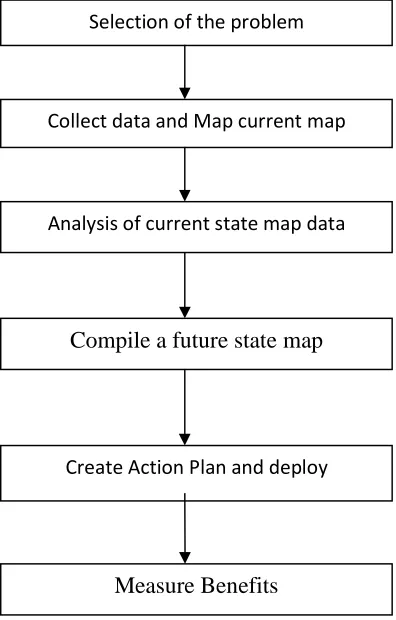
A Review on Waste Reduction through Value Stream Mapping Analysis Page 202 Figure 1 Methodology of Value Stream Mapping
III. LITERATURE REVIEW
1. Bo & Mingyao [1] use value stream mapping tool in a Chinese enterprise to reduce costs, increase efficiency and improve product quality. They suggested a combined kaizen plan to implement lean manufacturing and manage each opportunity plan as a project.
2. Rajenthirakumar et. al [3] reported a noticeable reduction in cycle time and increase in cycle efficiency with an application of value stream mapping (VSM). They constructed
present and future states of value stream maps to improve the production process by identifying waste and its sources. The production flow was optimized thus minimizing several non-value added activities/times such as bottleneck time, waiting time, material handling time, etc.
3. Rajenthirakumar & Thyla [7] show how the value stream mapping and other lean tools such as kaizen can be used to map the current state of a production line and design a desired future map. They reduced change Selection of the problem
Collect data and Map current map
Analysis of current state map data
Compile a future state map
Create Action Plan and deploy
A Review on Waste Reduction through Value Stream Mapping Analysis Page 203 productivity by 25 %.
4. K. P. Paranitharan et.al [5] provide useful platform for research in implementation of lean tools in any manufacturing unit. Their results show a significant improvement in productivity, reduction of lead time and reduction in inventory. These can be achieved by creating flow by layout modification and balance to TAKT time.
5. R.M. Belokar et. al [6] reported a case study of application of VSM in an automobile industry where they achieved nearly 67% improvement in cycle time by improvement in value adding activities.
6. D. Rajenthira Kumar et. al [2] report the methodology and results of implementation of VSM lean in anwind turbine gearbox assembly line of a gearbox manufacturing company in India. The waiting time was reduced by almost 60 hours.
7. A case study is described by D. Rajenthira Kumar et. al [8] where lean tools and techniques are adapted for the consumer durables manufacturing company. The work is focused on a specific product family, table-top wet grinders. Value stream mapping was the main tool used to identify the opportunities for various lean techniques. Also ‘‘before’’ and ‘‘after’’ scenarios in detail are described in order to illustrate the potential benefits such as reduced lead-time and improver lean rate. TAKT time is reduced by 26%, cycle time is reduced by 8%.
8. Goriwondo, W. M., Mhlanga et. al [4] detail the use of the VSM tool in reducing waste in bread manufacturing for a company in Zimbabwe. The case study shows how the VSM tool was used to identify and reduce defects by 20%, unnecessary inventory by 18% and motion by 37%. This was achieved through the development of the Future State Map which has an increased throughput of 16%.
A Review on Waste Reduction through Value Stream Mapping Analysis Page 204
10. Renu Yadav et. al [9] describes the implementation of value stream mapping technique in manufacturing of helical springs by a railway spring manufacturing company. It focuses on product family, current state map improvements and the future state map. The aim is to identify waste in the form of non value added activities & processes and then removing them to improve the performance of the company. Current state map was prepared to describe the existing position and various problem areas. Future state map was prepared to show the proposed improvement action plans. The achievements of value stream implementation reported are
reduction in lead time, cycle time and inventory level. It was concluded that the company could reduce the manufacturing lead time from 36.86 days to 34.06 days.
IV. RESULTS AND DISCUSSIONS
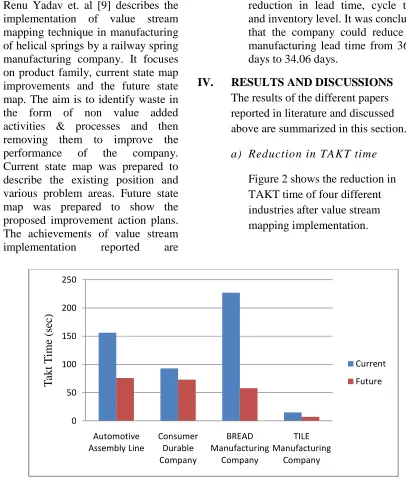
The results of the different papers reported in literature and discussed above are summarized in this section. a) Reduction in TAKT time
Figure 2 shows the reduction in TAKT time of four different industries after value stream mapping implementation.
Figure 2 Reduction in TAKT time
b) Reduction in cycle time
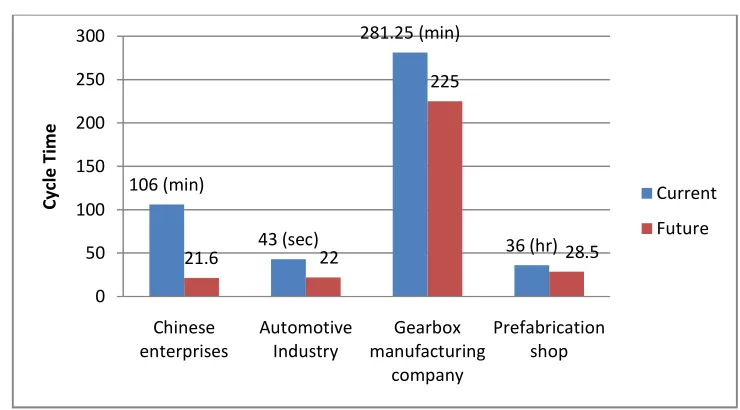
Figure 3 shows the comparative view of Cycle Time before and after value
stream mapping implementation in different industries.
0 50 100 150 200 250
Automotive Assembly Line
Consumer Durable Company
BREAD Manufacturing
Company
TILE Manufacturing
Company
T
ak
t
T
im
e
(s
ec
)
A Review on Waste Reduction through Value Stream Mapping Analysis Page 205 Figure 3 Reduction in cycle time
c) Reduction in Inventory
Value Stream Mapping is also helpful in
inventory reduction. According to Bo &
Mingyao [1] inventory in current state map was reported as 327,000 units and in future state map it was 65000 units.
Similarly the study by
Rajenthirakumar & Thyla [7] shows that the inventory in current state map was reported as 2200 units and in future state map it was 200 units. In the study by K. P. Paranitharan et.al [5] the inventory found in current state map was 5 units and in future state map it was 2 units.
d) Reduction in Lead Time:-
Figure 4 Reduction in Lead time
Figure 5 shows the reduction in lead time by Value stream mapping implementation in various industries.
106 (min)
43 (sec) 36 (hr)
A Review on Waste Reduction through Value Stream Mapping Analysis Page 206
V. CONCLUSION
This paper reports some significant results of the application of value stream mapping from review of literature.VSM provides the facility of projecting the estimated gains in different scenario by creating different future state maps, and then selecting the most feasible beneficial state. This enables the company to implement a feasible improvement plan with full confidence and knowledge of expected gainsThe practicality of VSM is amply demonstrated by several
recorded case studies in literature, some of which have been reviewed and reported in this paper. This study show considerable improvement in lead time, cycle time, takt time and inventory for different types of industries. It can be concludedthat VSM is an effective tool for identifying the processing wastes and improving overall effectiveness and efficiency and is equally applicable to different types of manufacturing processes and industries.
References
[1] Bo, M., & Mingyao, D. (2012). Research on the Lean Process Reengineering Based on Value
Stream Mapping. Management Science and Engineering, 6(2), 103-106.
[2] D. Rajenthira Kumar, P. R. (2010). Implementation of Lean Assembly Line: A Case Study.
International Journal of Engineering.
[3] D. Rajenthirakumar, R. G. (2011). Analyzing The Benefits of Lean Tools: A Consumer Durables
Manufacturing Company Case Study. International Journal Of Engineering.
[4] Goriwondo, W. M., Mhlanga, S., & Marecha, A. (2011). Use of The Value Stream Mapping Tool
for Waste Reduction In Manufacturing. Case Study for Bread Manufacturing in Zimbabwe.
International Conference On Industrial Engineering and Operations Management Kuala Lumpur, Malaysia.
[5] K. P. Paranitharan, A. S. (2011). Redesinging an Automotive Assembly Line Through Lean
Strategy. International Journal of Lean thinking.
[6] R.M. Belokar, V. K. (2012). An Application of Value Stream Mapping In Automotive Industry:
A Case Study. International Journal of Innovative Technology and Exploring Engineering.
[7] Rajenthirakumar, D., & Thyla, P. (2011). Transformation to Lean Manufacturing By an
Automative Component Manufacturing Company. International Journal of Lean Thinking.
[8] Rajenthirakumar, D., Mohanram, P., & Harikarthik, S. (2011). Process Cycle Efficiency
A Review on Waste Reduction through Value Stream Mapping Analysis Page 207
through Value Stream Mapping. International Journal of Mechanical and Industrial Engineering.
[10] Rumbidzayi Muvunzi, C. M. (2013). Application of Lean Value Stream Mapping To
Reduce Waste And Improve Productivity: A Case of Tile Manufacturing Company. International
Journal of Application or Innovation in Engineering & Management.
[11] Vendan, S., & Sakhtidashan, K. (2010). Reduction of Wastages in Motor Manufacturing