Xoodoo cookbook
Joan Daemen
2, Seth Hoffert, Michaël Peeters
1, Gilles Van Assche
1and
Ronny Van Keer
11 STMicroelectronics 2 Radboud University
Abstract. This document presents Xoodoo, a 48-byte cryptographic permutation that allows very efficient symmetric crypto on a wide range of platforms and a suite of cryptographic functions built on top of it. The central function in this suite is Xoofff, obtained by instantiating Farfalle withXoodoo. Xoofffis what we call adeck function and can readily be used for MAC computation, stream encryption and key derivation. The suite includes two session authenticated encryption (SAE) modes: Xoofff-SANE and Xoofff-SANSE. Both are built on top of Xoofff and differ in their robustness with respect to nonce misuse. Other members of the suite are a tweakable wide block cipherXoofff-WBCand authenticated encryption modeXoofff-WBC-AE, obtained by instantiating the WBC and Farfalle-WBC-AE constructions withXoofff. Finally, for lightweight applications, we de-fineXoodyak, a cryptographic scheme that can be used for hashing, encryption, MAC computation and authenticated encryption. Essentially, it is a duplex object extended with an interface that allows absorbing strings of arbitrary length, their encryption and squeezing output of arbitrary length. This paper is a specification and security claim reference for theXoodoosuite. It is astanding document: over time, we may extend theXoodoosuite, and we will update it accordingly.
Date: 14 March 2019
Keywords:permutation-based crypto·Farfalle·duplex construction·dec functions ·hashing·deck functions·authenticated encryption
1
Introduction
In [2] we presented new parallel modes of use of permutations for encryption, authentica-tion, session authenticated encryption and wide block ciphers under the umbrella name Farfalle. We also proposed concrete instantiations called Kravatte by plugging in the Keccak-p[1600, nr] permutation with 6 rounds. All-over, Kravatte is very fast on a wide range of platforms but can hardly be called lightweight: it operates on a large state giving rise to considerable overhead on low-end CPUs and has for short inputs a relatively large overhead per byte.
It therefore makes sense to consider instantiating Farfalle with a smaller permutation, somewhere between 256 and 400 bits wide. TakingKeccak-p[400, nr]is problematic as it is defined in terms of operations on 16-bitlanes. The permutation Gimli [1] has the nice feature that it has a state of 384 bits and a round function that lends itself to low-end 32-bit CPUs but also vectorization and dedicated hardware. Unfortunately, its propagation properties are less than what could be expected. For constructing a Farfalle instance with 128-bit security strength one would have to take a relatively high number of rounds.
functions built as modes ofXoodoo. This suite covers the symmetric-key crypto functions and we expect it to be very efficient on a wide range of CPUs and in dedicated hardware while having a comfortable safety margin. This makes theXoodoosuite very competitive to, e.g., block cipher based crypto.
Xoofffis the central instance of the suite, covering keyed symmetric crypto functions. For more lightweight applications, we addXoodyakto the suite, a compact and versatile cryptographic object that is suitable for most symmetric-key functions, including hashing, pseudo-random bit generation, authentication, encryption and authenticated encryption. This document does not include extensive design rationale or analysis, nor does it provide performance benchmarks. For this, please see [8]. Its purpose is to expose the Xoodoocipher suite to the cryptographic research community and security practicioners by serving as specification and security claim reference. At this stage the security claims serve as a challenge for cryptanalists and only a distant promise of security strength for users. This promise will gain in credibility as over time third-party cryptanalysis and public scrutiny accumulate.
Additionally, a reference implementation in C++ ofXoodooand the members of the Xoodoosuite is available in [13] and optimized implementations in C and assembler in theeXtended (or Xoodooand)Keccak Code Package (XKCP) [23].
Over time, we may add more cryptographic functions to theXoodoo suite. When that is the case, we will update this document accordingly. In ISO/IEC terminology this would be called astanding document.
1.1
Notation
The set of all bit strings is denoted Z∗2 and ϵ is the empty string. The size in bits of the string X is denoted |X|. We denote a sequence of m strings X(0) to X(m−1) as X(m−1)◦ · · · ◦X(1)◦X(0). The set of all sequences of strings is denoted (Z∗2)∗ and∅ is the sequence containing no strings at all. Similarly, the set of all sequences containing at least one string is denoted (Z∗2)+.
1.2
Deck functions
The central function in the Xoodoo suite is a Xoodoo-based Farfalle instance called Xoofff. Most other members of the suite are built as modes on top of Xoofff. Some of these modes are specified in [2] while others are introduced in this document. We follow the same naming conventions as in [2]. The name of the mode has two parts: a prefix indicating the underlying primitive type and a suffix referring to the target functionality. In instantiations with a particular primitive, we replace the prefix by the name of the primitive.
In our paper on Farfalle [2] we introduced the concept of a keyed cryptographic function with an extendable input and able to return an output of arbitrary length. In lack of a better name, we called these pseudorandom functions (PRF). We called the primitive type in our modes Farfalle as they needed support for sequences of strings as input and a specific incremental property, present in Farfalle instances: computingF(Y ◦X)costs only the processing of Y if F(X) was previously computed. Clearly, Farfalle is not the only way to build functions with such properties and we now think it would be better to decouple the input-output signature of the function (PRF with incremental sequence of strings input) from the implementation (Farfalle).
Definition 1 ([8, 22]). Adeck function takes as input a secret keyK and a sequence of an arbitrary number of stringsX(m−1)◦ · · · ◦X(0)∈(Z∗
2)+, produces a potentially infinite string of bits and takes from it the range starting from a specified offset q∈Nand for a specified lengthn∈N. We denote this as
Z= 0n+FK (
X(m−1)◦ · · · ◦X(0) )
≪q .
A deck function should allow efficient incremental computing. In particular, by keep-ing state after computkeep-ing an output for input sequence X = X(m−1)◦ · · · ◦X(0), com-puting an output for Y(n−1)◦ · · · ◦Y(0)◦X should have a cost independent of X. In addition, by keeping state after compting0n+F
K (
X(m−1)◦ · · · ◦X(0))≪q, computing
0m+F K
(
X(m−1)◦ · · · ◦X(0))≪(q+n)should have a cost independent ofnorq.
As such, we will indicate the modes we define this document and that we will instan-tiate withXoofffby the prefix Deck. The modes on top of Farfalle specified in [2] may as well be renamed by replacing the prefix Farfalle by Deck. To avoid confusion, we will not do that.
1.3
Dec functions
Naturally, we can define the unkeyed equivalent of deck functions, namely dec functions, where dec stands for Doubly-Extendable Cryptographic function [22]. In short, a dec function is an extendable output function (XOF) that accepts sequences of strings as input and that supports incremental queries efficiently.
Definition 2 ([22]). Adec function takes as input a sequence of an arbitrary number of stringsX(m−1)◦ · · · ◦X(0)∈(Z∗
2)+, produces a potentially infinite string of bits and takes from it the range starting from a specified offsetq∈Nand for a specified length n∈N. We denote this as
Z= 0n+H (
X(m−1)◦ · · · ◦X(0) )
≪q .
Like a deck function, a dec function should allow efficient incremental computing.
1.4
Session authenticated encryption
In many use cases where one wishes confidentiality, authentication is required too and it makes sense to offer a scheme that provides both: an authenticated encryption scheme. Doing this with a deck function is simple: one enciphers the plaintext by adding to it the output of a deck function applied to a nonce and computes a tag on the ciphertext (and possibly metadata) also using the deck function.
Often, one does not only want to protect a single message, but rather asessionwhere multiple messages are exchanged, such as in the Transport Layer Security (TLS) protocol [10] or the Secure Shell (SSH) protocol [24]. Examples of session authenticated encryption schemes are Keyak[5], Ketje [4] and Kravatte-SAE [2]. They require only a nonce at the startup of the session and each tag authenticates all messages already sent in the session.
We consider authenticated encryption of a message as a process that takes as input metadata A and plaintextP and that returns a cryptogramC and a tag T. We denote this operation by the term wrapping and the reverse operation of taking metadata A, a cryptogramCand a tagT and returning the plaintextPif the tagTis correct by the term
We use the abbreviation SAE to indicate session authenticated encryption in general. The generic term SAE should not be confused with Farfalle-SAE, that is a particular SAE mode of a deck function specified in [2].
1.5
Overview
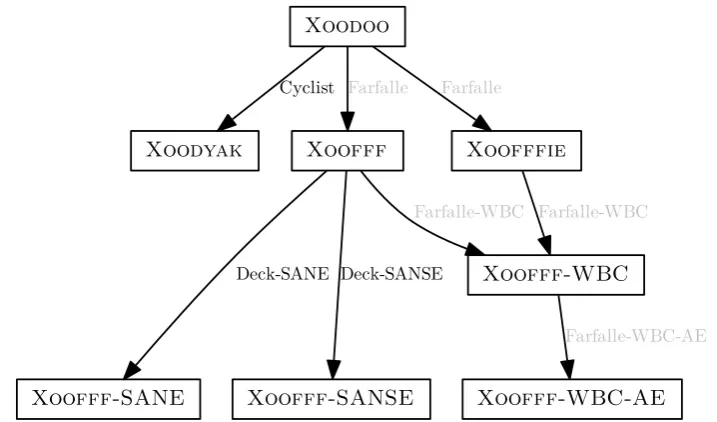
We specify the core of all functions in the Xoodoo suite, the Xoodoo[nr] family of permutations, in Section 2. We depict in Figure1 all suite members and their relations. They are the following:
• The Xoofff deck function, specified in Section 3. We obtain this deck function by instantiating Farfalle with Xoodoo and suitable rolling functions and make a security claim.
• TheXoofff-SANESAE scheme, specified in Section4. We obtain this by defining an SAE mode of deck functions called Deck-SANE and instantiate it withXoofff. Xoofff-SANErelies on user-provided nonces for confidentiality.
• TheXoofff-SANSESAE scheme, specified in Section5. We obtain this by defin-ing an SAE mode of deck functions called Deck-SANSE and instantiate it with Xoofff. Xoofff-SANSE is more robust against nonce misuse and realizes this by using the SIV mechanism.
• TheXoofff-WBCwide block cipher, specified in Section6. We obtain this by in-stantiating Farfalle-WBC withXoofffandXoofffie, a variant of Xoofffwhose purpose is solely to provide differential uniformity. We give security claims for Xoofff-WBCand a dedicated claim forXoofffie. Finally, we define the Xoofff-WBC-AEauthenticated encryption scheme by applying Farfalle-WBC-AE on top of Xoofff-WBC.
• TheXoodyakscheme, specified in Section7. We obtain this by instantiating Cyclist withXoodoo.
Xoodoo
Xoodyak
Cyclist
Xoofff
FarfalleXoofffie
FarfalleXoofff-SANE
Deck-SANE
Xoofff-SANSE
Deck-SANSE
Xoofff-WBC
Farfalle-WBC Farfalle-WBC
Xoofff-WBC-AE
Farfalle-WBC-AE2
Xoodoo
Xoodoois a family of permutations parameterized by its number of rounds nr and de-notedXoodoo[nr].
Xoodoohas a classical iterated structure: It iteratively applies a round function to a state. The state consists of 3 equally sized horizontalplanes, each one consisting of 4
parallel 32-bit lanes. Similarly, the state can be seen as a set of 128 columns of 3 bits, arranged in a4×32array. The planes are indexed byy, with planey= 0at the bottom and plane y = 2 at the top. Within a lane, we index bits with z. The lanes within a plane are indexed by x, so the position of a lane in the state is determined by the two coordinates(x, y). The bits of the state are indexed by(x, y, z)and the columns by(x, z).
Sheetsare the arrays of three lanes on top of each other and they are indexed byx. The Xoodoostate is illustrated in Figure2.
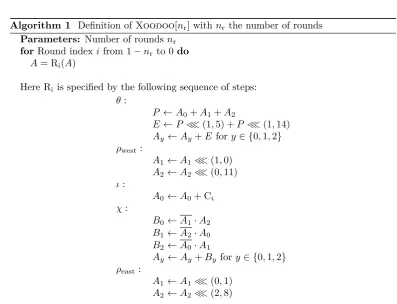
The permutation consists of the iteration of a round function Ri that has 5 steps: a mixing layerθ, a plane shiftingρwest, the addition of round constantsι, a non-linear layer χ and another plane shiftingρeast.
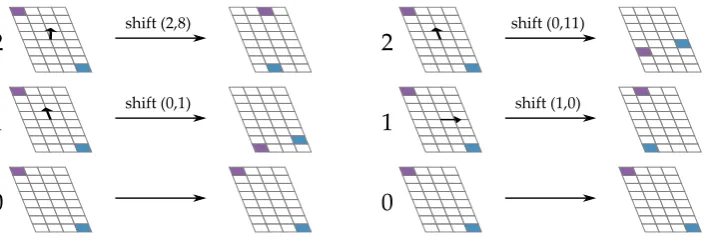
We specifyXoodooin Algorithm1, completely in terms of operations on planes and use thereby the notational conventions we specify in Table 1. We illustrate the step mappings in a series of figures: the χ operation in Figure3, the θ operation in Figure4, theρeastandρwest operations in Figure5.
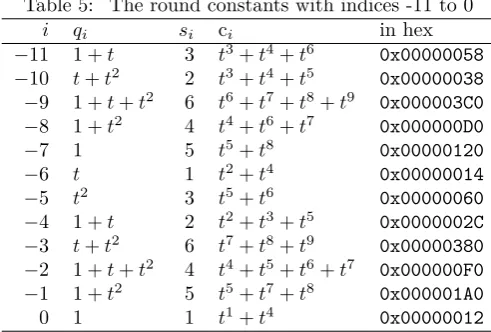
The round constantsCiare planes with a single non-zero lane atx= 0, denoted asci. We specify the value of this lane for indices−11to0in Table2 and refer to AppendixA
for the specification of the round constants for any index.
x y
z
lane x
y z
plane x
y z
state x
y z
sheet x
y z
column
Figure 2: Toy version of the Xoodoo state, with lanes reduced to 8 bits, and different parts of the state highlighted.
Table 1: Notational conventions Ay Planey of stateA
Ay ≪(t, v) Cyclic shift ofAy moving bit in(x, z)to position(x+t, z+v) Ay Bitwise complement of planeAy
Ay+Ay′ Bitwise sum (XOR) of planesAy andAy′ Ay·Ay′ Bitwise product (AND) of planesAy and Ay′
Algorithm 1 Definition ofXoodoo[nr]withnr the number of rounds Parameters: Number of roundsnr
forRound indexifrom1−nrto 0do A= Ri(A)
Here Ri is specified by the following sequence of steps: θ:
P ←A0+A1+A2
E←P ≪(1,5) +P ≪(1,14)
Ay ←Ay+Efory∈ {0,1,2} ρwest:
A1←A1≪(1,0) A2←A2≪(0,11) ι:
A0←A0+ Ci χ:
B0←A1·A2 B1←A2·A0 B2←A0·A1
Ay ←Ay+By fory∈ {0,1,2} ρeast:
A1←A1≪(0,1) A2←A2≪(2,8)
Table 2: The round constants ci with −11≤i≤0, in hexadecimal notation (the least significant bit is atz= 0).
i ci i ci i ci i ci
−11 0x00000058 −8 0x000000D0 −5 0x00000060 −2 0x000000F0
−10 0x00000038 −7 0x00000120 −4 0x0000002C −1 0x000001A0
0
1
2
complement
Figure 3: Effect ofχ on one plane.
+
=
column parity θ-effect
fold
Figure 4: Effect ofθon a single-bit state.
0
1
2
shift (2,8)shift (0,1)
0
1
2
shift (0,11)shift (1,0)
Table 3: Notational conventions for specification of the rolling functions Ay,x Lanexof planeAy
B An auxiliary variable that has the shape of a plane Ay,x≪v Cyclic shift of laneAy,xmoving bit fromxtox+v
Ay,x≪v Shift of laneAy,xmoving bit fromxtox+v, setting bitsx < vto 0 Ay,x+Ay′,x′ Bitwise sum (XOR) of lanesAy,xandAy′,x′
Ay,x·Ay′,x′ Bitwise product (AND) of lanesAy,xandAy′,x′
3
Xoofff
Xoofffis a deck function obtained by applying the Farfalle construction onXoodoo[6]
and two rolling functions: rollXcfor rolling the input masks and rollXefor rolling the state. We specify them with operations on the lanes of the state, following the conventions of Table1and Table3.
The input mask rolling function rollXc updates a stateAin the following way:
A0,0←A0,0+ (A0,0≪13) + (A1,0≪3) B ←A0≪(3,0)
A0←A1
A1←A2
A2←B
The state rolling function rollXe updates a stateAin the following way:
A0,0←A1,0·A2,0+ (A0,0≪5) + (A1,0≪13) +0x00000007 B←A0≪(3,0)
A0←A1
A1←A2
A2←B
Definition 3 (Xoofff). Xoofff is Farfalle[pb, pc, pd, pe,rollc,rolle] with the following parameters:
• pb=pc=pd=pe=Xoodoo[6], • rollc=rollXc and
• rolle=rollXe.
We make the following security claim onXoofff.
Claim 1. Let K = (K0, . . . , Ku−1) be an array of u secret keys, each uniformly and
independently chosen from Zκ
2 with κ < 384. Then, the advantage of distinguishing the
array of functions XoofffKi(·)withi∈Zu from an array of random oraclesRO(i,·), is
at most
uN+(u2) 2κ +
N
2192 + M
2128 + √
uN′
2κ/2−1 + N′
295. (1)
Here,
• N is the computational complexity expressed in the (computationally equivalent) number of executions ofXoodoo[6],
• M is theonlineor data complexityexpressed in the total number of input and output blocks processed by XoofffKi(·).
In (1), the first term accounts for the effort to find one of theusecret keys by exhaustive search, and for the probability that two keys are equal. The second term expresses that the complexity of recovering the accumulator or any rolling state insideXoofffmust be as hard as recovering192secret bits. The third term expresses the effort to find a collision in the accumulator.
The fourth and fifth terms only apply if the adversary has access to a quantum com-puter. The fourth term accounts for a quantum search (or quantum amplification algo-rithm) to find one of theukeys [11,7]. The probability of success afterN′ iterations is
sin2((2N′+ 1)θ)withθ= arcsin√u/2κ. We upper bound this as2N′√u/2κ. The fifth term similarly accounts for a quantum search of a 192-bit secret.
Note that we assume thatXoofffis implemented on a classical computer. In other words, we do not make claims w.r.t. adversaries who would make quantum superpositions of queries to the device implementingXoofffand holding its secret key(s).
We restrict keys to the uniform distribution to keep our claim simple and to avoid pathological cases that would not offer good security. In the multi-user setting, we require the keys to be independently drawn. If an adversary can manipulate Ki, such as in so-calledunique keysthat consist of a long-term key with a counter appended, we recommend hashing the key and the counter with a proper hash function.
We do support the use of variable-length keys in the multi-user setting, where we assume that a key of given length is selected uniformly of the strings with that length. The claimed distinguishing bound then becomes slightly more complex and is given in Equation (2):
∑
κ∈L
uκN+ (uκ
2 )
2κ + N
2192+ M
2128 + ∑
κ∈L
√u κN′
2κ/2−1 + N′
295, (2)
withLthe array of the distinct key lengths in use andulthe number of keys of lengthl.
4
Xoofff-SANE
Xoofff-SANEis an SAE function built on top of Xoofffwith a mode we introduce in this document called Deck-SANE: deck function based Session Authentication and Nonce-based Encryption. This mode keeps track of a nonce and the sequence of messages in a string sequence called the history. It encrypts the plaintext of a message by adding a keystream that is the result of applying the deck function to the history covering all previous messages in this session. The consequence is that for confidentiality, the history must be unique across all sessions for a given key. For that reason, Deck-SANE initializes the history at the beginning of a session with a user-provided nonce.
4.1
A flaw in Farfalle-SAE
In [2], we presented a mode very similar to Deck-SANE, Farfalle-SAE. Unfortunately, we found a flaw in Farfalle-SAE after closely inspecting it. This was triggered by an email we received from Ted Krovetz reporting a weakness in Farfalle-SIV (see Section5.1). So, Deck-SANE can be seen as a fixed version of Farfalle-SAE.
• a message(A, P)withA̸=ϵandP ̸=ϵ,
• a message(A, ϵ)followed by a message(ϵ, P).
Both message sequences extend the history with C||1◦ A||0, so the tag returned by
wrap(A, P) in the first case and the tag returned by wrap(ϵ, P) in the second case are equal. A situation where an adversary could exploit this would be if the sender intends on sending two messages: one containing metadata only, followed by another containing plaintext only. We would haveT1= wrap(A, ϵ)then(C, T2) = wrap(ϵ, P). The adversary withholdsT1, and passes off(A, C)as a single message with resulting tagT2. The receiver is unable to detect this and successfully authenticates the message, and returns garbled plaintext. We fix this in Deck-SANE by using an additional frame bit that toggles on every message.
4.2
Deck-SANE
We define the SAE mode for deck functions Deck-SANE in Algorithm 2. The session presents the history to a deck function for generating tags and keystream. Starting a session initializes the history to a nonceN and returns a tag.
From then on, it supports messages consisting of metadata A and/or plaintext P. Deck-SANE wraps a message in four phases:
1. Encryption: If the plaintext is non-empty, it generates the ciphertext by adding to the plaintext the output of the deck function applied to the history.
2. If the metadata is non-empty or if the ciphertext is empty, it appends the metadata to the history.
3. If the plaintext is non-empty, it appends the ciphertext to the history.
4. Tag generation: It generates the tag by applying the deck function to the history.
Note that a tag authenticates the full history of the session up to that point. Unwrapping is similar.
Deck-SANE has two length parameters: the tag lengthtand an alignment unit length ℓ. It reserves the firsttbits of the output of the deck function for tags and takes keystream from the output of the deck function from an offset that is the smallest multiple ofℓnot shorter than t. It applies domain separation between metadata and ciphertext strings in the history to skip the second phase for plaintext-only messages or the first and third phase for metadata-only or even empty messages. Moreover, Deck-SANE has an attribute ethat takes the 1-bit string value0or1and toggles at each call to (un)wrap. Hence, the individual calls to (un)wrap can be identified in the history without ambiguity.
4.3
Xoofff-SANE
Definition 4 (Xoofff-SANE). Xoofff-SANEis Deck-SANE(F, t, ℓ)with
• F=Xoofff,
• t= 128bits and
Algorithm 2Definition of Deck-SANE(F, t, ℓ)
Parameters: deck functionF, tag lengtht∈Nand alignment unit lengthℓ∈N
Initializationtaking keyK∈Z∗2 and nonceN ∈Z∗2, and returning tagT ∈Zt 2
offset =ℓ⌈t ℓ ⌉
: the smallest multiple ofℓnot smaller thant e←01
history←N
T ←0t+FK(history) return T
Wraptaking metadataA∈Z∗2and plaintextP ∈Z∗2, and returning ciphertextC∈Z|2P| and tagT ∈Zt
2
C←P+FK(history)≪offset if |A|>0 OR|P|= 0then
history←A||0||e◦history
if |P|>0then
history←C||1||e◦history
T ←0t+FK(history) e←e+11
return C, T
Unwraptaking metadata A∈Z∗2, ciphertextC ∈Z∗2 and tag T ∈Zt
2, and returning plaintextP ∈Z|2C|or an error
P ←C+FK(history)≪offset if |A|>0 OR|C|= 0then
history←A||0||e◦history
if |C|>0then
history←C||1||e◦history
T′←0t+FK(history) e←e+11
if T′=T then return P else
return error!
5
Xoofff-SANSE
keystreams will be unrelated. Confidentiality still breaks down when these tags collide and the user can eliminate the risk of (history,tag) collisions altogether by including a nonce in the metadata of the first message. In any case, as long as two sessions have the same sequence of messages, they will produce the same sequence of cryptograms. This is unavoidable in a deterministic SAE scheme.
5.1
A flaw in Farfalle-SIV
In [2], we presented a similar mode, albeit with no support for sessions, called Farfalle-SIV. In an email Ted Krovetz drew our attention on a flaw in Farfalle-SIV. So Deck-SANSE is a fixed version of Farfalle-SIV and we took advantage of the occasion to extend to an SAE mode.
The flaw in Farfalle-SIV is the following. Let a legitimate user do a first call to wrap with(C1, T1) = wrap(A, P1). We haveT1=0t+FK(P1◦A)and C1=P1+FK(T1◦A). Then an adversary makes a second call to wrap with P2 = T1. She gets (C2, T2) =
wrap(A, P2) with T2 = 0t+FK(P2◦A) = 0t+FK(T1◦A). So the tag T2 reveals the first t bits of the keystream used to encrypt P1. The root of the problem is the lack of separation between the tag and the keystream generation. We fix this in Deck-SANSE by enforcing domain separation between calls toFK(·)for tag or keystream.
5.2
Deck-SANSE
Deck-SANSE combines the SIV approach with the session support of Deck-SANE. We define it in Algorithm 3. Deck-SANSE wraps a message in four phases:
1. If the metadata is non-empty or if the ciphertext is empty, it appends the metadata to the history.
2. Tag generation: It generates the tag by applying the deck function to the history, extended with the plaintext of the current messsage, if non-empty.
3. Encryption: If the plaintext is non-empty, it generates the ciphertext by adding to the plaintext the output of the deck function applied to the history extended with the tag.
4. If the plaintext is non-empty, it appends it to the history.
As in Deck-SANE, a tag authenticates the complete history of the session. Unwrapping is similar.
Deck-SANSE has a single length parameter: the tag length t. It applies domain separation between metadata and plaintext strings in the history, as well as between the generation of keystream and of tag. Moreover, as in Deck-SANE, Deck-SANSE has an attributeethat toggles at each call to (un)wrap.
5.3
Xoofff-SANSE
Definition 5 (Xoofff-SANSE). Xoofff-SANSEis Deck-SANSE(F, t)with
• F=Xoofffand
• t= 256bits.
We take a 256-bit tag because collisions in the tag are likely to appear after generating
Algorithm 3Definition of Deck-SANSE(F, t)
Parameters: deck functionF and tag lengtht∈N
Initialization e←01
history is initialized to the empty string sequence
Wraptaking metadataA∈Z∗2and plaintextP ∈Z∗2, and returning ciphertextC∈Z|2P| and tagT ∈Zt
2
if |A|>0 OR|P|= 0then
history←A||0||e◦history
if |P|>0then
T ←0t+FK(P||01||e◦history) C←P+FK(T||11||e◦history)
history←P||01||e◦history
else
T ←0t+FK(history) e←e+11
return C, T
Unwraptaking metadata A∈Z∗2, ciphertextC ∈Z∗2 and tag T ∈Zt
2, and returning plaintextP ∈Z|2C|or an error
if |A|>0 OR|C|= 0then
history←A||0||e◦history
if |C|>0then
P ←C+FK(T||11||e◦history)
history←P||01||e◦history
T′←0t+FK(history) e←e+11
if T′=T then return P else
return error!
6
Xoofff-WBC and Xoofff-WBC-AE
Xoofff-WBCis a tweakable block cipher built on top ofXoofffand a variantXoofffie with the mode Farfalle-WBC [2], that constructs the block cipher in a four-round Feistel network.
We first define Xoofffie, a variant of Xoofffaimed at providing differential uni-formity, and used in the first and last rounds of Xoofff-WBC. Then, we define and make a security claim onXoofff-WBC. Finally, we instantiate the Xoofff-WBC-AE authenticated encryption scheme.
6.1
Definition and security claim of Xoofffie
Xoofffieis a function that has the same parameters asXoofff, with the sole exception ofpdthat is the identity function instead of Xoodoo[6].
Definition 6. Xoofffie is Farfalle[pb, pc, pd, pe,rollc,rolle] with the following parame-ters:
• pc=Xoodoo[6], • pd=Id,
• pe=Xoodoo[6], • rollc=rollXc and • rolle=rollXe
with Id the identity permutation.
We make the following security claim onXoofffie:
Claim 2. Let K = (K0, . . . , Ku−1) be an array of u secret keys, each uniformly and
independently chosen from Zκ2 with κ < 384. Consider an adversary that can query a function with chosen inputs (X,∆, i), withM ∈(Z∗2)+,∆∈Z∗2 andi∈Zu that is one of
the two following, without knowing which one:
• RO(∆ +XoofffieKi(X)): the sum of the output of Xoofffie and an offset ∆,
and truncated to the length of that offset, and this filtered by random oracleRO.
• RO2(i, X,∆): random oracleROapplied to the combination of the three inputs.
Then, the distinguishing advantage is at most:
M
2128 + M2
2∆min−4, (3)
with∆min the minimum length of∆over the adversary’s queries. Note that the adversary can not make direct queries to RO.
This claim expresses a differential uniformity property. When trying to distinguish RO(∆+XoofffieKi(X))fromRO(i, X,∆), the adversary is limited to observing equality
in the expression ∆ +XoofffieKi(X) for chosen inputs (i, X,∆). In other words, an
adversary succeeds if she can find XoofffieK outputs with a predictable difference ∆, i.e., XoofffieKi(X) +XoofffieKj(Y) = ∆ for(i, X)̸= (j, Y). The output blurring by
a random oracle prevents state or key retrieval in the absence of collisions and hence the bound only contains terms related to generating collisions. The first term in (3) covers collisions in the accumulator and the second term in ∆min-bit outputs. For an ideal function the second term would be birthday bound 2∆Mmin2+1. We tolerate some non-ideal
behaviour by multiplying the birthday expression by a factor25.
6.2
Definition of Xoofff-WBC
The wide block cipherXoofff-WBC instantiates Farfalle-WBC [2] with twoXoodoo -based deck functions that are in turn Farfalle instances.
Definition 7 (Xoofff-WBC). Xoofff-WBCis Farfalle-WBC[H, G, ℓ]with • H=Xoofffie,
• G=Xoofffand • ℓ= 8bits.
Claim 3. Let K = (K0, . . . , Ku−1) be an array of u secret keys, each uniformly and
independently chosen from Zκ
2 with κ < 384 and let PKi(·) with i ∈ Zu be instances of
Xoofff-WBC. Each of these instances support two interfaces:
Encipherment denoted asC =PKi(W, P) taking as input a tweak W and a plaintextP
and returning a cryptogram C;
Decipherment denoted asP =PK−1
i(W, C) taking as input a tweakW and a cryptogram
C and returning a plaintextP.
We express as Advsprp the probability of distinguishing PKi(W,·) from an array of
uni-formly and independently drawn random permutations πi,W,n indexed by the key index i,
the value of W and the length n=|P|=|C|, where the adversary can query the inverse permutations.
Let nmin be the minimum length n among all the queries. The Advsprp is claimed to be upper bounded by
(1)+ M
2
2nmin/2−8. (4) Here, N, N′ and M are as in Claim 1, except that M also counts the number of input and output blocks processed by Xoofffie.
The terms in (4) are those of Claim 1 and an additional term. The additional term covers the case of an adversary obtaining a collision in one of the branches of the Feistel network, see [2] for details. We relate this to the ability of doing this in the first and last rounds, that make use of Xoofffie. In this use case, it has∆min≥nmin/2−4and hence the term 2∆Mmin2−4 becomes
M2
2nmin/2−8.
6.3
Definition of Xoofff-WBC-AE
On top of Xoofff-WBC, we define the Xoofff-WBC-AE authenticated encryption scheme as an instance of Farfalle-WBC-AE [2] with the same parameters as Xoofff-WBC and witht = 128. In a nutshell, when wrapping,Xoofff-WBC-AE addst bits of redundancy at the end of the plaintextP before encipherment withXoofff-WBC: it enciphers P||0twith the metadata A as tweak. When unwrapping, Xoofff-WBC-AE callsXoofff-WBCdecryption and checks that the lasttbits of the result are indeed0t.
Definition 8 (Xoofff-WBC-AE). Xoofff-WBC-AE is Farfalle-WBC-AE[H, G, ℓ, t]
with
• H=Xoofffie, • G=Xoofff, • ℓ= 8bits, • t= 128bits.
7
Xoodyak
practice, Xoodyak is straightforward to use and its implementation can be shared for many different use cases. The mode of operation employed inXoodyakis calledCyclist, as a lightweight counterpart to Keyak’s Motorist mode [5]. It is simpler than Motorist, mainly thanks to the absence of parallel variants. Another important difference is that Cyclist is not limited to authenticated encryption, but rather offers fine-grained services, à la Strobe, and supports hashing.
7.1
Notation
Xoodyakworks with bytes, i.e., a sequence of8 bits, and in the sequel we assume that all strings have a length that is multiple of 8 bits. The length in bytes of a string X is denoted|X|8, which is equal to its bit length divided by8. We denote withenc8(x)a byte whose value is the integerx∈Z256. Byte values are noted in hexadecimal in a typewriter font enclosed in single quotes, e.g., ‘1A‘is a byte whose value is the integer26.
7.2
The Cyclist mode of operation
The Cyclist mode of operation relies on a cryptographic permutation and yields a state-ful object to which the user can make calls. It is parameterized by the permutation f, by the block sizes Rhash, Rkin and Rkout, and by the ratchet size ℓratchet, all in bytes. Rhash, Rkin and Rkout specify the block sizes of the hash and of the input and output in keyed modes, respectively. As Cyclist uses up to 2 bytes for frame bits, we require that
max(Rhash, Rkin, Rkout) + 2≤b′, whereb′ is the permutation width in bytes.
Upon initialization with Cyclist(K,id,counter), the Cyclist object starts either in
hash mode ifK =ϵor in keyed mode otherwise. In the latter case, the object takes the secret keyKtogether with its (optional) identifierid, then absorbs acounterin a trickled way ifcounter̸=ϵ. In the former case, it ignores the initialization parameters. Note that, unlike Strobe, there is no way to switch from hash to keyed mode, although we might extend Cyclist this way in the future.
The available functions depend on the mode the object is started in: The functions Absorb() and Squeeze() can be called in both hash and keyed modes, whereas the functions Encrypt(),Decrypt(),SqueezeKey()andRatchet()are restricted to the keyed mode. The purpose of each function is as follows:
• Absorb(X)absorbs an input stringX;
• C←Encrypt(P)enciphersP intoC and absorbsP; • P←Decrypt(C)deciphersCinto P and absorbsP;
• Y ←Squeeze(ℓ)produces anℓ-byte output that depends on the data absorbed so far;
• Y ← SqueezeKey(ℓ) works like Y ←Squeeze(ℓ) but in a different domain, for the purpose of generating a derived key;
• Ratchet()transforms the state in an irreversible way to ensure forward secrecy.
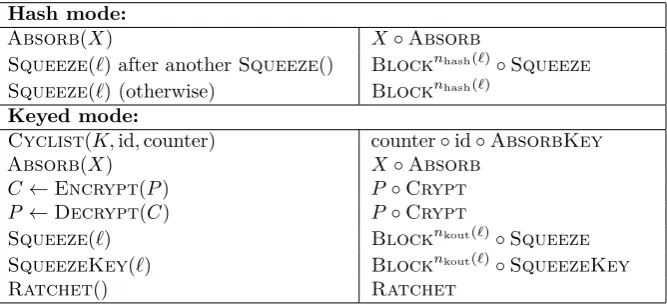
Table 4: Symbols and strings appended to the process history.
Hash mode:
Absorb(X) X◦Absorb
Squeeze(ℓ)after anotherSqueeze() Blocknhash(ℓ)◦Squeeze Squeeze(ℓ)(otherwise) Blocknhash(ℓ)
Keyed mode:
Cyclist(K,id,counter) counter◦id◦AbsorbKey
Absorb(X) X◦Absorb
C←Encrypt(P) P◦Crypt
P←Decrypt(C) P◦Crypt
Squeeze(ℓ) Blocknkout(ℓ)◦
Squeeze SqueezeKey(ℓ) Blocknkout(ℓ)◦SqueezeKey
Ratchet() Ratchet
design criteria, like minimizing the memory footprint. As a result, the state also depends on the number of blocks in the previous calls toSqueeze()and the previously processed plaintext blocks inEncrypt()orDecrypt().
Together, everything that influences the output of a Cyclist object, as returned by Squeeze(),SqueezeKey()or as keystream produced byEncrypt(), is captured by the
process history, see Definition9below. When in keyed mode, the output also depends on the secret key absorbed upon initialization, although the key is not part of the process history itself. This ensures the security claim can be properly expressed in an indistin-guishability setting where the adversary has full control on the process history but not on the secret key, see Claim 5.
Definition 9. The process history (or history for short) is a sequence of strings and symbols in (Z∗2∪ S)∗, with
S={Absorb,AbsorbKey,Crypt,Squeeze,SqueezeKey,Block,Ratchet}.
At initialization of the Cyclist object, the history is initialized to∅. Then, each call to the Cyclist object appends symbols and strings according to Table4, where
nhash(ℓ) = max (
0, ⌈
ℓ Rhash
⌉ −1
)
and nkout(ℓ) = max (
0, ⌈
ℓ Rkout
⌉ −1
) .
In addition, the process history is updated with theRkout-byte blocks of plaintext as they are processed byEncrypt()orDecrypt().
Algorithm 4Definition ofCyclist[f, Rhash, Rkin, Rkout, ℓratchet]
Instantiation: cyclist←Cyclist[f, Rhash, Rkin, Rkout, ℓratchet](K,id,counter) Phase and state: (phase, s)←(up,‘00‘f.b′)
Mode and absorb rate: (mode, Rabsorb, Rsqueeze)←(hash, Rhash, Rhash) if K not emptythenAbsorbKey(K,id,counter)
Interface: Absorb(X)
AbsorbAny(X, Rabsorb,‘03‘(absorb))
Interface: C←Encrypt(P), withmode=keyed return Crypt(P,false)
Interface: P ←Decrypt(C), withmode=keyed return Crypt(C,true)
Interface: Y ←Squeeze(ℓ)
return SqueezeAny(ℓ,‘40‘(squeeze))
Interface: Y ←SqueezeKey(ℓ), with mode=keyed return SqueezeAny(ℓ,‘20‘(key))
Interface: Ratchet(), withmode=keyed
Algorithm 5Internal interfaces ofCyclist[f, Rhash, Rkin, Rkout, ℓratchet] Internal interface: AbsorbAny(X, r, cD)
for allblocksXi in Split(X, r)do if phase̸= upthenUp(0,‘00‘)
Down(Xi, cD if first block else ‘00‘)
Internal interface: AbsorbKey(K,id,counter), with|K||id|8≤Rkin−1
(mode, Rabsorb, Rsqueeze)←(keyed, Rkin, Rkout) AbsorbAny(K||id||enc8(|id|8), Rabsorb,‘02‘(key)) if counternot emptythenAbsorbAny(counter,1,‘00‘)
Internal interface: O←Crypt(I,decrypt)
for allblocksIi inSplit(I, Rkout)do
Oi←Ii⊕Up(|Ii|8,‘80‘(crypt) if first block else ‘00‘) Pi←Oi if decryptelse Ii
Down(Pi,‘00‘) return ||iOi
Internal interface: Y ←SqueezeAny(ℓ, cU) Y ←Up(min(ℓ, Rsqueeze), cU)
while |Y|8< ℓdo Down(ϵ,‘00‘)
Y ←Y ||Up(min(ℓ− |Y|8, Rsqueeze),‘00‘) return Y
Internal interface: Down(Xi, cD)
(phase, s)←(down, s⊕(Xi||‘01‘||‘00‘∗||cD& ‘01‘ ifmode=hashelse cD))
Internal interface: Yi ←Up(|Yi|8, cU)
(phase, s)←(up, f(s if mode=hash else s⊕(‘00‘∗||cU))) return s[0]||s[1]|| . . . ||s[|Yi|8−1]
Internal interface: [Xi]←Split(X, n)
if X is emptythen return array with a single empty string[ϵ]
return array[Xi], withX =||iXi and|Xi|8=nexcept possibly the last block.
7.3
Xoodyak and its claimed security
We instantiateXoodyakin Definition10and attach to it security Claims4and 5.
Definition 10. XoodyakisCyclist[f, Rhash, Rkin, Rkout, ℓratchet]with • f =Xoodoo[12]of width48bytes (orb= 384bits)
• Rhash= 16bytes • Rkin= 44bytes • Rkout= 24bytes • ℓratchet= 16bytes
in calls to Xoodoo[12] or its inverse. We exclude from the claim weaknesses due to the mere fact that the function can be described compactly and can be efficiently executed, e.g., the so-called random oracle implementation impossibility [14], as well as properties that cannot be modeled as a single-stage game [18].
This means thatXoodyakhashing has essentially the same claimed security as, e.g., SHAKE128 [15].
Claim 5. Let K = (K0, . . . , Ku−1) be an array of u secret keys, each uniformly and
independently chosen from Zκ
2 with κ≤256 and κa multiple of 8. Then, the advantage
of distinguishing the array of Xoodyakobjects after initialization withCyclist(Ki,·,·)
with i∈Zu from an array of random oracles RO(i, h), where h∈(Z∗2∪ S)∗ is a process
history, is at most
qivN+ (u
2 )
2κ + N
2184 +
(L+ Ω)N+(L+Ω+12 ) 2192 +
M2
2382+
M q
2min(192+κ,384). (5)
Here we follow the notation of the generic security bound of the FSKD [9], namely:
• N is the computational complexity expressed in the (computationally equivalent) number of executions ofXoodoo[12].
• M is theonlineor data complexityexpressed in the total number of input and output blocks processed by Xoodyak.
• q≤M is the total number of initializations in keyed mode.
• Ω≤M is the number of blocks, in keyed mode, that overwrite the outer state and for which the adversary gets a subsequent output block. In particular, this counts the number of blocks processed by Decrypt(·) for which the adversary can also get the corresponding key stream value or other subsequent output (e.g., in the case of the release of unverified plaintext in authenticated encryption). And it also counts the number of calls to Ratchet()followed by Squeeze(ℓ)orSqueezeKey(ℓ)with
ℓ̸= 0.
• L≤M is the number of blocks, in keyed mode, for which the adversary knows the value of the outer state from a previous query and can choose the input block value (e.g., in the case of authentication without a nonce, or of authenticated encryption with nonce repetition). This includes the number of times a call toAbsorb()follows a call to Squeeze(ℓ)or toSqueezeKey(ℓ) withℓ̸= 0.
• qiv≤uis the maximum number of keys that are used with the sameid, i.e.,
qiv= max
id |{(i,id)| Cyclist(Ki,id,·)is called at least once}| .
Claims4and5ensureXoodyakhas128bits of security both in hash and keyed modes (assumingκ≥128). Regarding the data complexity, it depends on the values ofq,Ωand L, for which we will see concrete examples in Section 7.4. Given that they are bounded by M, Xoodyakresists to a data complexity of up to 264 blocks, as the probability in Eq. (5) is negligible as long asN≪2128andM ≪264. In the particular case ofL+Ω = 0, it resists even higher data complexities, as the probability remains negligible also when M ≪2160.
7.4
Using Xoodyak
Xoodyak, as a Cyclist object, can be started in hash mode and therefore used as a hash function. Alternatively, one can startXoodyak in keyed mode and, e.g., to use it as a deck function or for duplex-like session authenticated encryption. In this section, we cover use cases in this order, first in hash mode, then in keyed mode, then some combination of both.
7.5
Hash mode
As already mentioned,Xoodyakcan be used as a hash function. More generally, it can serve as an extendable output function (XOF), the generalization of a hash function with arbitrary output length. To get an-byte digest of some inputx, one can use Xoodyak as follows:
Cyclist(ϵ, ϵ, ϵ) Absorb(x) Squeeze(n)
This sequence is the nominal sequence for using Xoodyak as a XOF. Its security is summarized in the following Corollary.
Corollary 1. Assume that Xoodyaksatisfies Claim4. Then, this hash function has the following security strength levels, with nthe output size in bytes:
collision resistance min(8n/2,128) bits preimage and second preimage resistance min(8n,128) bits
m-target preimage resistance min(8n−logm,128) bits
Xoodyak can also naturally implement a dec function and process a sequence of strings. Here the output depends on the sequence as such and not just on the concatena-tion of the different strings and, in this sense it is similar to TupleHash [16]. To compute a n-byte digest over the sequencex3◦x2◦x1, one does:
Cyclist(ϵ, ϵ, ϵ) Absorb(x1) Absorb(x2) Absorb(x3) Squeeze(n)
A XOF can be implemented in a stateful manner and can come with an interface that allows for requesting more output bits. This is the so-called extendable output feature, and for Cyclist this is provided quite naturally by the Squeeze() function. Here, some care must be taken for interoperability: For supporting use cases such as the one in Section 7.6.4, Cyclist considers squeezing calls as being in distinct domains. This means a Cyclist objects with some given history, the n+m bytes returned by Squeeze(n)||Squeeze(m) and Squeeze(n+m) will be the same in the firstn bytes and differ in the last m bytes. If an extendable output is required without this feature, an interface can be built to allow incremental squeeze calls. For instance, an interface SqueezeMore()would behave such that callingSqueeze(n)followed bySqueezeMore(m)
7.6
Keyed mode
In keyed mode, Xoodyak can naturally implement a deck function, although we focus instead on duplex-based ways to perform authentication and (authenticated) encryption. To useXoodyakas a keyed object, one starts it withCyclist(K,id,counter)where K is a secret key with a fixed length of κ bits. We first show how to use the id and
counter parameters, to counteract multi-target attacks and to handle the nonce, then discuss various kinds of authenticated encryption use cases.
7.6.1 Two ways to counteract multi-target attacks
Theid is an optional key identifier. It offers one of two ways to counteract multi-target attacks.
In a multi-target attack, the adversary is not interested in breaking a specific device or key, but in breaking any device or key from a (possibly large) set. If there areukeys in a system, the security can degrade by up tolog2ubits in such a case [6]. Claim5reflects this in the term qivN
2κ ≤ N
2κ−log2u asqiv≤u.
Let us assume that we wish to target a security strength level of128 bits including multi-target attacks. Xoodyakcan achieve this in two ways.
• We extend the length of the secret key. By settingκ= 128 + log2u, then the term qivN
2κ becomes
qivN
2128+log2u ≤ N
2128 .
• We make the key identifieridglobally unique among theukeys and therefore ensure that qiv = 1. Then, there is no degradation for exhaustive key search in a multi-target setting, and the key size can be equal to the multi-target security strength level, so κ= 128 in this example.
7.6.2 Three ways to handle the nonce
Thecounterparameter ofCyclist()is a data element in the form of a byte string that can be incremented. It is absorbed in a trickled way, one digit at a time, so as to limit the number of power traces an attacker can take with distinct inputs [21]. At the upper level, the user or protocol designer fixes a basis2 ≤B ≤256 and assumes that the counter is a string in Z∗B. A possible way to go through all the possible strings in Z∗B is as follows. First, the counter is initialized to the empty string. Then, as the counter is incremented, it takes all the possible strings inZ1B, then all the possible strings inZ2B, and so on.
The counter shall be absorbed starting with the most significant digits. This allows caching the state after absorbing part of the counter as the first digits absorbed will change the least often. The smaller the value B, the smaller the number of possible inputs at each iteration of the permutation, so the better protection against power analysis attacks and variants.
This method of absorbing a nonce, as a counter absorbed in a trickled way, is desired in situations where protection against power analysis attacks matter. Otherwise, the nonce can be absorbed at once withAbsorb(nonce)just afterCyclist(K,id, ϵ).
Finally, a third method consists in integrating the nonce with theid parameter. Ifid
is a global nonce, i.e., it is unique among all the keys used in the system, this also ensures qiv= 1 as explained above.
7.6.3 Authenticated encryption
get a tag oft= 16bytes, we make the following sequence of calls:
Cyclist(K,id, ϵ)
Absorb(nonce)
Absorb(A)
C←Encrypt(P)
T ←Squeeze(t)
return (C, T)
To decrypt(C, T), we proceed similarly:
Cyclist(K,id, ϵ) Absorb(nonce) Absorb(A) P ←Decrypt(C)
T′←Squeeze(t)
if T =T′ then return P else
return ⊥
If the nonce is not repeated and if the decryption does not leak unverified decrypted ciphertexts, then we haveL= Ω = 0here, see Claim5. The resulting simplified security claim is given in the following corollary.
Corollary 2. Assume that (1)Xoodyakindeed satisfies Claim5; (2) this authenticated encryption scheme is fed with a single κ-bit key with κ ≤ 192; (3) it is implemented such that the nonce is not repeated and the decryption does not leak unverified decrypted ciphertexts. Then, it can be distinguished from an ideal scheme with an advantage whose dominating terms are:
N
2κ+ N
2184+ M2
2192+κ .
This translates into the following security strength levels assuming at-byte tag (the com-plexities are in bits):
computation data plaintext confidentiality min(184, κ,8t) 96 +κ/2
plaintext integrity min(184, κ,8t) 96 +κ/2
associated data integrity min(184, κ,8t) 96 +κ/2
7.6.4 Session authenticated encryption
Session authenticated encryption works on a sequence of messages and the tag authen-ticates the complete sequence of messages received so far. Starting from the sequence in Section 7.6.3, we add the support for messages (Ai, Pi), whereAi,Pi or both can be empty.
Cyclist(K,id, ϵ) Absorb(nonce) Absorb(A1) C1←Encrypt(P1) T1←Squeeze(t)
C2←Encrypt(P2) T2←Squeeze(t)
⇒output(C2, T2)and wait for next message Absorb(A3)
T3←Squeeze(t)
⇒outputT3and wait for next message C4←Encrypt(P4)
T4←Squeeze(t)
⇒output(C4, T4)and wait for next message T5←Squeeze(t)
⇒outputT5and wait for next message
In this example,T2 authenticates(A2, P2)◦(A1, P1). The third message has no plain-text, the fourth message has no associated data, and the fifth message is empty. In such a sequence, the convention is that the call toSqueeze()ends a message. Since it appears in the processing history, there is no ambiguity on the boundaries of the messages even if some of the elements (or both) are empty.
The use of empty messages may be clearer in the case of a session shared by two (or more) communicating devices, where each device takes a turn. A device may have nothing to say and so skips its turn by just producing a tag.
To relate to Claim5, we have to determineLby counting the number of invocations to Absorb()that follow Squeeze(). If the nonce is not repeated and if the decryption does not leak unverified decrypted ciphertexts, we haveL=T−q, withT the number of messages processed (or tags produced), and Ω = 0.
7.6.5 Ratchet
At any time in keyed mode, the user can callRatchet(). This causes part of the state to be overwritten with zeroes, thereby making it computationally infeasible to compute the state value before the call toRatchet().
In an authenticated encryption scheme, the call to Ratchet() can be typically in-serted either just before producing the tag or just after. The advantage of calling it just before the tag is that it is most efficient: It requires only one extra call to the permutation f. An advantage of calling it just after the tag is that its processing can be done asyn-chronously, while the ciphertext is being transmitted and it waits for the next message. UnlessRatchet()is the last call, the number of calls to it must be counted inΩ.
Cyclist(K,id, ϵ) Absorb(nonce) Absorb(A) C←Encrypt(P)
Ratchet(){either here . . . } T ←Squeeze(t)
Ratchet(){. . . or here}
7.6.6 Rolling subkeys
K1←K andi←1 while necessarydo
Initialize a newXoodyakinstance withCyclist(Ki, ϵ, ϵ) Ki+1←SqueezeKey(ℓsub){and storeKi+1 by overwritingKi} Ratchet(){optional}
Absorb(Ai) Ci←Encrypt(Pi) Ti←Squeeze(t)
⇒output(Ci, Ti)and wait for next message i←i+ 1
Hereℓsub should be chosen large enough to avoid collisions, sayℓsub = 32bytes (256 bits). Assuming that there are no collisions in the subkeys,L= 0andΩis the number of calls toRatchet().
Using Cyclist this way offers resilience against side channel attacks, as the long-term key is not exposed any more and can even be discarded as soon as the first subkey is derived. The key to attack becomes a moving target, just like the state in session authenticated encryption.
7.6.7 Nonce reuse and release of unverified decrypted ciphertext
The authenticated encryption schemes presented in this section assume that thenonce is unique per session, namely that the value is used only once per secret key. It also assumes that an implementation returns only an error when receiving an invalid cryptogram and in particular does not release the decrypted ciphertext if the tag is invalid. If these two assumptions are satisfied, we refer to this as the nominal case; otherwise, we call it the
misuse case.
In the misuse case security degrades and hence we strongly advise implementers and users to respect the nonce requirement at all times and never release unverified decrypted ciphertext. We detail security degradation in the following paragraphs.
A nonce violation in general breaks confidentiality of part of the plaintext. In partic-ular, two sessions that have the same key and the same process history (i.e., the sameK,
id,counterand the same sequence of associated data, plaintexts) will result in the same output (ciphertext, tag). We call such a pair of sessions in-sync. Clearly, in-sync sessions leak equality of inputs and hence also plaintexts. As soon as in-sync sessions get differ-ent input blocks, they lose synchronicity. If these input blocks are plaintext blocks, the corresponding ciphertext blocks leak the bitwise difference of the corresponding plaintext blocks (ofRkout= 24bytes). We call this thenonce-misuse leakage.
Release of unverified decrypted ciphertext also has an impact on confidentiality as it allows an adversary to harvest keystream that may be used in the future by legitimate parties. An adversary can harvest one key stream block at each attempt.
Nonce violation and release of unverified decrypted ciphertext have no consequences for integrity and do not put the key in danger forXoodyak. This is formalized in Corollary3.
Corollary 3. Assume that (1)Xoodyaksatisfies Claim5; (2) this authenticated encryp-tion scheme is fed with a single κ-bit key with κ≤192. Then, except for nonce-misuse leakage and keystream harvesting, it can be distinguished from an ideal scheme with an advantage whose dominating terms are:
N
2κ + N
2184 +
M N+M2
2192 .
computation data plaintext confidentiality (nominal case) min(128, κ,8t) 64
plaintext confidentiality (misuse case) - -plaintext integrity min(128, κ,8t) 64
associated data integrity min(128, κ,8t) 64
7.7
Authenticated encryption with a common secret
A key exchange protocol, such as Diffie-Hellman or variant, results in a common secret that usually requires further derivation before being used as a symmetric secret key. To do this with a Cyclist object, we can use an object in hash mode, process the common secret, and use the derived key in a new object that we start in keyed mode. For example:
Cyclist(ϵ, ϵ, ϵ)
Absorb(ID of the chosen protocol) Absorb(KA){Alice’s public key} Absorb(KB){Bob’s public key}
Absorb(KAB){Their common secret produced with Diffie-Hellman} KD←Squeeze(ℓ)
Cyclist(KD, ϵ, ϵ) Absorb(nonce)
Absorb(A)
C←Encrypt(P)
T ←Squeeze(t)
return (C, T)
Note that if ℓ ≤ Rhash, an implementation can efficiently chain KD ← Squeeze(ℓ) and the subsequent reinitialization Cyclist(KD, ϵ, ϵ). Since KD is located in the outer part of the state, it needs only to set the rest of the state to the appropriate value before calling f.
Note also that if one of the public key pairs is ephemeral, the common secretKAB is used only once and no nonce is needed.
Acknowledgement
We thank Bart Mennink and Guido Bertoni for useful discussion, Ted Krovetz for finding and reporting to us the flaw in Farfalle-SIV, as noted in Section5.1and Johan De Meulder for his contributions on the early stages of the definition of Xoodoo.
References
[1] D. J. Bernstein, S. Kölbl, S. Lucks, P. Maat Costa Massolino, F. Mendel, K. Nawaz, T. Schneider, P. Schwabe, F.-X. Standaert, Y. Todo, and B. Viguier,Gimli : A cross-platform permutation, Cryptographic Hardware and Embedded Systems - CHES 2017, Proceedings (W. Fischer and N. Homma, eds.), Lecture Notes in Computer Science, vol. 10529, Springer, 2017, pp. 299–320.
[2] G. Bertoni, J. Daemen, S. Hoffert, M. Peeters, G. Van Assche, and R. Van Keer,
[3] G. Bertoni, J. Daemen, M. Peeters, and G. Van Assche,Duplexing the sponge: Single-pass authenticated encryption and other applications, Selected Areas in Cryptography - SAC 2011, Revised Selected Papers (A. Miri and S. Vaudenay, eds.), Lecture Notes
in Computer Science, vol. 7118, Springer, 2011, pp. 320–337.
[4] G. Bertoni, J. Daemen, M. Peeters, G. Van Assche, and R. Van Keer, CAESAR submission: Ketje v2, September 2016,https://keccak.team/ketje.html.
[5] , CAESAR submission: Keyak v2, document version 2.2, September 2016, https://keccak.team/keyak.html.
[6] E. Biham, How to decrypt or even substitute des-encrypted messages in 228 steps, Inf. Process. Lett.84(2002), no. 3, 117–124.
[7] G. Brassard, P. Hoyer, M. Mosca, and A. Tapp, Quantum amplitude amplification and estimation, Contemporary Mathematics305(2002), 53–74.
[8] J. Daemen, S. Hoffert, G. Van Assche, and R. Van Keer,The design of Xoodoo and Xoofff, IACR Trans. Symmetric Cryptol.2018 (2018), no. 4, 1–38.
[9] J. Daemen, B. Mennink, and G. Van Assche, Full-state keyed duplex with built-in multi-user support, Advances in Cryptology - ASIACRYPT 2017, Proceedings, Part II (T. Takagi and T. Peyrin, eds.), Lecture Notes in Computer Science, vol. 10625, Springer, 2017, pp. 606–637.
[10] T. Dierks and E. Rescorla, The transport layer security (TLS) protocol version 1.2, Network Working Group of the IETF, RFC 5246, August 2008.
[11] L. K. Grover,A fast quantum mechanical algorithm for database search, Proceedings of the 28th Annual ACM Symposium on the Theory of Computing, May 1996 (Gary L. Miller, ed.), ACM, 1996, pp. 212–219.
[12] M. Hamburg, The STROBE protocol framework, Real World Crypto, 2017.
[13] S. Hoffert, Xoodoo reference code in C++, August 2018, https://github.com/ XoodooTeam/.
[14] U. Maurer, R. Renner, and C. Holenstein,Indifferentiability, impossibility results on reductions, and applications to the random oracle methodology, Theory of Cryptog-raphy - TCC 2004 (M. Naor, ed.), Lecture Notes in Computer Science, no. 2951, Springer-Verlag, 2004, pp. 21–39.
[15] NIST,Federal information processing standard 202, SHA-3 standard: Permutation-based hash and extendable-output functions, August 2015, http://dx.doi.org/10. 6028/NIST.FIPS.202.
[16] , NIST special publication 800-185, SHA-3 derived functions: cSHAKE, KMAC, TupleHash and ParallelHash, December 2016, https://doi.org/10.6028/ NIST.SP.800-185.
[17] T. Perrin, Stateful hash objects: API and constructions, https://github.com/ noiseprotocol/sho_spec/blob/master/output/sho.pdf, 2018.
[19] P. Rogaway and T. Shrimpton, A provable-security treatment of the key-wrap prob-lem, Advances in Cryptology - EUROCRYPT 2006, Proceedings (S. Vaudenay, ed.), Lecture Notes in Computer Science, vol. 4004, Springer, 2006, pp. 373–390.
[20] M.-J. O. Saarinen, Beyond modes: Building a secure record protocol from a cryp-tographic sponge permutation, Topics in Cryptology - CT-RSA 2014. Proceedings (J. Benaloh, ed.), Lecture Notes in Computer Science, vol. 8366, Springer, 2014,
pp. 270–285.
[21] M. M. I. Taha and P. Schaumont,Side-channel countermeasure for SHA-3 at almost-zero area overhead, 2014 IEEE International Symposium on Hardware-Oriented Se-curity and Trust, HOST 2014, IEEE Computer Society, 2014, pp. 93–96.
[22] G. Van Assche, On dec(k) functions, INDOCRYPT 2018, December 2018, https: //keccak.team/files/OnDecAndDeckFunctions-Indocrypt2018.pdf.
[23] G. Van Assche, R. Van Keer, and Contributors, Extended Keccak code package, August 2018,https://github.com/XKCP/XKCP.