Self-bilinear Map from One Way Encoding System
and Indistinguishability Obfuscation
Huang Zhang1,4, Fangguo Zhang1,4, Baodian Wei2,4, and Yusong Du3
1 School of Information Science and Technology, Sun Yat-sen University 2 School of Data and Computer Science, Sun Yat-sen University
3 School of Information Management, Sun Yat-sen University 4 Guangdong Key Laboratory of Information Security Technology
Guangzhou 510006, China
Abstract. The bilinear map whose domain and target sets are identical is called the self-bilinear map. Original self-bilinear maps are defined over cyclic groups. This brings a lot of limitations to construct secure self-bilinear schemes. Since the map itself reveals information about the underlying cyclic group, hardness assumptions on DDHP and CDHP may not hold any more. In this paper, we used iO to construct a self-bilinear map from generic sets. These sets should own several properties. A new notion, One Way Encoding System (OWES), is proposed to describe formally the properties those sets should hold. An Encoding Division Problem is defined to complete the security proof. As an instance of the generic construction, we propose a concrete scheme built on the GGH graded encoding system and state that any 1-graded encoding system may satisfy the requirements of OWES. Finally, we discuss the hardness of EDP in the GGH graded encoding system.
Keywords: self-bilinear map, multi-linear map, indistinguishability obfus-cation, one way encoding system.
1
Introduction
The bilinear map is a very useful cryptographic primitive. It provides solutions for many cryptographic applications such as identity-based encryptions [2], non-interactive zero-knowledge proof systems [16], attribute-based encryptions [21] and short signatures [3, 23], etc. The self-bilinear map is a special variant of bilinear maps. The target and preimage groups of self-bilinear maps are the same. Because of this exclusive property, the self-bilinear map may have more interesting potentials. A straightforward application of the self-bilinear map is constructing multilinear maps.
multilinear maps were proposed – the GGH scheme [11] on ideal lattices, the CLT scheme [9] over the integer and the GGH14 [15] on lattices. The multilinear map is a basic component of some cryptographic primitives such as witness encryption [14], indistinguishability obfuscation and functional encryption [12], etc.
Recently, multilinear maps met extremely strong challenges. CLT schcme was completely broken by “zerozing algorithm” [6]. Two patches [13, 5] were proposed very soon after the CLT was broken. But Coron et al. [10] stated that these two patches were still unsafe. Then, they described a new multilinear map over the inte-ger [8]. Not long after the CLT scheme was completely broken, the GGH scheme was also under attack. Hu and Jia constructed a modified encoding/decoding algorithm [17] and designed a weak-DL attack to break the MDDH assumption which is the security basis of many schemes. There isn’t any patch that can fix this weakness. To construct a secure and efficient multilinear map is still a worthwhile work. This also highlights the study of finding a wonderful self-bilinear map.
Lee [19] designed the first candidate self-bilinear map. But Cheon and Lee [7] remarked that Lee’s map is not essentially self-bilinear. They also proved the impos-sibility that the secure self-bilinear map can’t be constructed over cyclic group of known prime order. The computational Diffie-Hellman (CDH) assumption collapses because the map itself reveals much information about the underlying group. To avoid this, Yamakawa et al. [22] chose the signed quadratic residue groupQR+n of
Z∗
n to be the underlying group. The order ofQR+n is composite and unknown. The factoring assumption is a basic hardness assumption in their security proof.
Unlike other’s work, we prefer to build self-bilinear maps over generic sets instead of cyclic groups. A new concept OWES is defined to describe the generic sets that can be used to build self-bilinear maps. In order to complete the security proof, some hard problems are assumed to be hard in the OWES. We show that the graded encoding system (GES) is an instance of the OWES. Based on the GGH grade encoding system, a concrete construction of the self-bilinear map is proposed. We also discussed the security of the concrete scheme.
Through the work of self-bilinear maps fromiO, we find that multilinear maps can be built by making use ofiO. On the contrary, it’s like a paradox that the firstiO
was designed from multilinear maps. Coincidentally, some recent works try to study the relationship between the multilinear map and the obfuscation. Paneth et al. [20] defined a variant of secret sampling multilinear map. They named it the polynomial jigsaw puzzle. The polynomial jigsaw puzzle can be used to constructiO and iO
implies the polynomial jigsaw puzzle. Albrecht et al. [1] proposed a multilinear map scheme from obfuscation. These work are not similar to ours. Whether multilinear map and obfuscation are essentially the same conception is still an open problem to discuss.
2
Preliminaries
In this section, we describe notations used in this paper, review theiO, and propose the new concept of OWES. We also present the formal definition of the variant of self-bilinear maps and multilinear maps.
2.1 Notations
We useZto denote the set of all integer numbers,Fto denote a field.Z[x] to denote all polynomials with coefficients in Z. Let [n] be the set {x∈ Z|1 ≤x≤ n} and [0,n] be the set{x∈Z|0≤x≤n}.λis the secure parameter. We usee←DS,σ to denote thate is sampled from the discrete distribution with mean 0 and standard deviationσin setS.{xi}ni=1 represent the set{x1,· · ·, xn}. If ¯ais an element in a residue class ringR/I, thenais its representation inR.
2.2 Indistinguishability Obfuscation
Definition 1 (Indistinguishability Obfuscator).A uniform PPTmachineiO
is called an indistinguishability obfuscator for a circuit class Cλ if the following conditions are satisfied:
– For security parametersλ∈N, allC∈ Cλ, and all inputs x, we have that P r[C′(x) =C(x) :C′←iO(λ, C)] = 1
– For any (not necessarily uniform)PPTdistinguisher D, there exists a negligible functionαsuch that the following holds: For all security parametersλ∈N, and all pairs of circuitsC0, C1∈ Cλ, we have that ifC0(x) =C1(x)for all inputs x, then
|P r[D(iO(λ, C0)) = 1]−P r[D(iO(λ, C1)) = 1]| ≤α(λ)
Informally speaking,iOcan make two circuits or functions which have the same size and achieve the same goal be computationally indistinguishable.
3
Self-bilinear maps and One Way Encoding Systems
Below we define formally our notion of self-bilinear maps from OWES andiO. To make the analogy and differences from self-bilinear maps more explicit, we begin by recalling the definition of self-bilinear maps of Cheon and Lee [7].
Definition 2 (Self-bilinear map). For a cyclic group G of order p, a map e :
G×G→Gis self-bilinear, if it has the following properties.
– For allg1, g2∈Gand integer a∈Zp, it holds that e(g1a, g2) =e(g1, g2a) =e(g1, g2)a.
3.1 One Way Encoding Systems
We define the new concept of One Way Encoding Systems (OWES) to summarize all the necessary properties to build self-bilinear maps. These properties were refined from cryptographic cyclic groups. Firstly, we generalize the ag∈Gas an encoding of ring element ¯a∈Zord(n), whereais a representation of ¯a. The encoding algorithm is define asf(x) =xg. We’ll regard the ring as the plaintext space, and all possible encodings as the encoding space. Secondly, in order to simulate the cyclic group operationag+bg= (a+b)g, the encoding system have to be additive homomorphic. Thirdly, Observing the valid self-bilinear map operation e((a+b)g, γg) = (a+ b)γe(g, g), we find that the self-bilinear map system doesn’t need the plaintext space to be additively cyclic. So we extend the plaintext space to any finite ring with identity. The encodings space will not always be a cyclic group because of the change. Fourthly, since the represenctation of the element in plaintext space is not the integer anymore, we must define a new manipulation “⊗” between representations and encodings. Namely, ifxis a representation of an element in the plaintext space and his an encoding, thenx⊗gis a new encoding. Such manipulation is similar to the scalar multiplication in linear spaces. Finally, for cryptographical use, givenf and f(a), it should be hard to computex. Moreover, givenf,f(a),f(b), to distinguish f(ab) from a random encoding should be hard. As a conclusion of all discussed above, here comes the formal definition of OWES and its hardness assumptions.
Assume that (S0,+,·) is a finite ring with identity (‘·’ will be omitted for sim-plicity), S1 is a set with addition operation “⊕”,f : S0 →S1 is a surjection. (‘·’ will be omitted for simplicity))
Definition 3 (OWES). An One Way Encoding System consits ofS0, S1 and f,
with following properties hold:
1. f is additive homomorphic: fora, b∈S0,f(a+b) =f(a)⊗f(b).
2. Plaintext multiplication ‘⊗’: fora∈S0and f(b)∈S1,a⊗f(b) =f(a·b). 3. f is one way: givef(a), it’s hard to computea
Moreover, since the self-bilinear map reveal information about the underlying set, a new hard problem should be hard in the OWES.
Definition 4 (EDP). For OWES (S0, S1, f), the Encoding Division Problem is,
on input thef(ab)∈S1 and invertiblea∈S0, to compute f(b)∈S1.
The OWES has a property similar to the linear transformation in linear space. If we change the f by multiplying it with an element inb∈S0, (S0, b⊗S1, b⊗f) is also an OWES (Butb⊗S16=S1, ifbis a zero divisor inS0).
Theorem 1. If(S0, S1, f)is an OWESand the element b∈S0,(S0, b⊗S1, b⊗f) is also an OWES.
Proof. The Property 1 and Property 2 obviously hold in (S0, b⊗S1, b⊗f). We proof the Property 3 hold below. For simplicity, let f′ =b⊗f. Given f′(a), IfA
Assume that (S0, S1, f) and b ∈S0 are the public parameters. The challenger re-ceives a problem instancef(a). The simulator computesf′(a) =b⊗f(a) and sends
f′(a) toA.Areturnawith non-negligible probability. So if the Property 3 holds in
(S0, S1, f), it also holds in (S0, b⊗S1, b⊗f). Thus (S0, b⊗S1, b⊗f) is an OWES. ⊓⊔
Self-bilinear map from OWES. The self-bilinear map with auxiliary information
was first defined by Yamakawa et al [22]. We recall the definition with a little modifications. The Self-bilinear map with auxiliary information consists of efficient procedures for instance-generation, element-encoding, addition and negation, self-bilinear map, SBP =(InstGen, Enc, Add, Neg, Map). These procedures are described below.
Instance Generation. The randomizedInstGen(1λ) takes as input the
parame-terλ, and outputsparams, whereparamsis a description of the self-bilinear map e:S1×S1→S1.
Encoding. The Enc(params, a) takes params and a plaintext a ∈ S0, and
outputs the encodingf(a) and the auxiliary informationτf(a).
Addition. Given params, two encodings f(a), f(b) ∈ S1, τf(a), τf(b), we have
Add(params, f(a), f(b), τf(a), τf(b)) output the encodingf(a+b), and the auxiliary informationτf(a+b).
Self-bilinear Map. For f(a), f(b) ∈ S1, we have Map(params, f(a), f(b)) =
e(f(a), f(b)).
Hardness Assumptions.Our hardness assumptions are modeled after the
discrete-logarithm, BCDH assumptions in self-bilinear groups. For example, the analog of discrete-logarithm problem is trying to obtainafrom the encodingf(a).
The analog of BCDH in our case roughly says that it is hard to compute map when somebody is given three or more encodings and the auxiliary information. In other words, given encodingsf(a),f(b),f(c),τf(a),τf(b),τf(c), thec⊗e(f(a), f(b)) can’t be obtained efficiently by BCDH challenger. We formalize the hardness as-sumption as follows.
Definition 5 (EBCDHP). For a self-bilinear map e : S1×S1 → S1 and its
underlying OWES (S0, S1, f), theEBCDHPis, on inputf(a), f(b), f(c), τf(a), τf(b), τf(c), to compute c⊗e(f(a), f(b)).
The EBCDH assumption says that for any setting of parameters, the probability of solving EBCDHP is negligible.
4
Generic Construction from OWES and
i
O
In this section, we construct a self-bilinear map schemeSBP from OWES andiO.
4.1 Our Construction
In theSBP,iOcircuits act as the auxiliary information. We describe notations for circuits on OWES first.
Notation for Circuits on OWES. For the OWES (S0, S1, f) anda1 ∈S0, Ca1(x) denotes the circuit that takes x ∈S1 as input and computes a1⊗x. For circuits Ca1(x),Ca2(y) whose outputs can be parsed as elements inS1, Plus(Ca1(x), Ca2(y)) denotes a circuit that computes the sum of outputs ofCa1(x) andCa2(y).
Now we are ready to to introduce the procedures of of the generic constructing
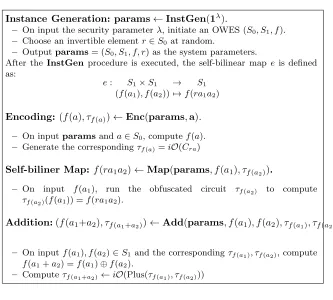
SBP. The generic construction of self-bilnear map is shown in Fig.1.
Instance Generation: params←InstGen(1λ).
– On input the security parameterλ, initiate an OWES (S0, S1, f).
– Choose an invertible elementr∈S0 at random.
– Outputparams= (S0, S1, f, r) as the system parameters.
After the InstGen procedure is executed, the self-bilinear map e is defined as:
e: S1×S1 → S1
(f(a1), f(a2))7→f(ra1a2)
Encoding:(f(a), τf(a))←Enc(params,a).
– On inputparamsanda∈S0, computef(a).
– Generate the correspondingτf(a)=iO(Cra)
Self-biliner Map: f(ra1a2)←Map(params, f(a1), τf(a2)).
– On input f(a1), run the obfuscated circuit τf(a2) to compute
τf(a2)(f(a1)) =f(ra1a2).
Addition:(f(a1+a2), τf(a1+a2))←Add(params, f(a1), f(a2), τf(a1), τf(a2)).
– On inputf(a1), f(a2)∈S1 and the correspondingτf(a1), τf(a2), compute
f(a1+a2) =f(a1)⊕f(a2).
– Computeτf(a1+a2)←iO(Plus(τf(a1), τf(a2)))
4.2 Security Analysis of SBP.
We give a polynomial reduction from the EDP to the EBCDHP. In Section 6, we’ll give an instance of EDP, and analyze its hardness.
Theorem 2. If there is a PPT algorithm A solving the EBCDHP with respect
to SBP efficiently, then there is an algorithm to solve the EDP in the OWES efficiently.
Proof. We assume that an algorithmAcan solve the EBCDHP inSBP. We design an algorithm C to solve the EDP with high probability by running A as the sub-routing.
Reduction Algorithm C:
1. Ooutputs an EDP instance (S′
0, S1′, f′), f′(rb), r. 2. Compute f′(r2b) = r⊗f′(rb). Then, set S0 = S′
0, f(x) = x⊗f′(r2b), S1 =
{f(x)|x ∈ S0}. Finally, output params = (S0, S1, f, r). params describes a
SBP. (note that (S0, S1, f) is also an OWES). 3. Choose a′
0, a′1, a′2∈S0 uniformly at random. 4. Compute ra′
i+ 1 and sets rai =ra′i+ 1. Thus, f(ai) = (ra′i+ 1)⊗f′(rb), for i= 0,1,2. (note thatris invertible in S0).
5. Generate the auxiliary information τf(ai) = iO(Crai) = iO(Cra′i+1), for i =
0,1,2.
6. Sendparams, {f(ai)}2i=0 and{τf(ai)}
2
i=0 toA.
7. IfAthinks he is playing with a SBP scheme, returnsU. Otherwise,Areturns nothing andC aborts.
8. Cchecks the value ofU, ifU 6=f(ra0a1a2), aborts. 9. Computeq=(ra′1+1)(ra′2+1)−1
r =ra′1a′2+a′1+a′2. 10. Computep=a′
0(ra′1+ 1)(ra′2+ 1), and output U′=U−[p+q]⊗f′(rb).
Correctness: If the reduction algorithmCcomplete its execution without aborting,
the outputU′ is the answer of EDP (f(rb), b).
U =f(ra0a1a2) =f′(ra
0a1a2r2b) =f′[a
0ra1ra2rb] =f′[(a′
0+1r)(ra′1+ 1)(ra′2+ 1)rb] =f′[(a′
0(ra′1+ 1)(ra′2+ 1) + (ra′
1+1)(ra′2+1)
r )rb]
=f′[(a′
0(ra′1+ 1)(ra′2+ 1) + (ra′
1+1)(ra′2+1)−1
r +
1 r)rb] U′=U⊖[p+q]⊗f′(rb)
=U⊖[a′
0(ra′1+ 1)(ra′2+ 1) + (ra′
1+1)(ra′2+1)−1
r ]⊗f′(rb) =U⊖f′[(a′
0(ra′1+ 1)(ra′2+ 1) + (ra′
1+1)(ra′2+1)−1
r )rb]
=f′[(1
Probability: We analyze the probability thatC aborts. In the step 7,A end this algorithm if the parameters he received is not come from aSBPscheme. According to the theorem 3.1, (S0, S1, f) is an OWES if (S0′, S1′, f′) is. The auxiliaryiOcircuits in SBP achieved the expected function. So, the probability that algorithm abort in step 7 is negligible. Since we have assumed that A can solve the EBCDHP in
SBP efficiently, the algorithmC through the step 8 with non-negligible probability. Thus, the algorithmC will not abort with a non-negligible probability.
Time complexity: We use T(·) to denote the time complexity. Besides the
sub-routing A, the times of manipulations in each step of C is a constant. Assume that the sum of these constant ist. The time complexity of each manipulation is a polynomial poly(λ), since they are efficiently computable (addition in a ring etc). Thus, the time complexity of the algorithmCis bounded byT(C) =t·poly(λ)+T(A). Since Ais assumed to be an efficient algorithm, T(A) is bounded bypoly(λ). So, T(C) =poly(λ) which meansC is efficiently computable.
In summary, the algorithmC is a polynomial reduction from EDP to EBCDHP. Since EDP is hard, the algorithm that can solve EBCDHP doesn’t exist.
Remark In the algorithm C, we compute ra′
1a′2 +a′1+a′2 instead of computing (ra′
1+1)(ra′2+1)−1
r in step 9. This is because of the uncovered division algorithm in S0. If S0 is the integer ring or polynomial ring (it has the division algorithm), the division algorithm may be used reduce the time complexity of the step 9. As the number of term increase, to compute
Qn
i=1(ra′i+i)−1
r is much easier.
5
Concrete Construction from GGH and
i
O
The OWES is not an unpractical concept. The GGH graded encoding system [11] is an instance of the OWES. We’ll introduce a concrete construction from the graded encoding system (GES) andiO.
5.1 An Instance of OWES
We can get an instance of the OWES out of the GGH graded encoding system, only considered the 1-GES. Let r, d, d′ denote the level-0 encodings, c(d) denotes the level-1 encoding of I+d, whereI is the ideal. The four properties of OWES hold in 1-GES.
1. additive homomorphic:c(d)+c(d′)
=c(d+d′)
2. plaintext multiplication: d⊗c(d)=c(dd′)
3. Given the level-1 encoding c(d), it is hard to compute the level-0 encodingd, wheredis a short element in I+d.
5.2 Construction
Depending on the security parameterλ, we choose the ringR=Z[x]/(xn+ 1) and Rq =R/qR, where q, n, m (mentioned below) are function ofλ. Elements in the underlying ring can be regarded as polynomials. The system encodes elements of a quotient ringQR=R/I, whereI=hgiand g∈R. We will use the symbolc(d) to denote the encodings of element d. Since 1-GES is an instance of the OWES, we assume that the notation for circuit on OWES defined in Section 4.1 is still worked here. The concrete self-bilinear map scheme is shown in Fig.2
Instance Generation: params←InstGen(1λ).
– Take as input the security parameterλ, generate the 1-GES. It is described by the following parameters.y= [a
z]q, the level-1 encoding ofI+ 1.xi=
[bi
z]q,i= [m], the re-randomization parameters.xiis the level-1 encoding
of I. The zero testing parameter Pzt = [hz/g]q, where h is “somewhat
small”.
– Choose a random elementα←DR,σ′.
– Choose a random elements←DZm,σ′, and computev=s·y. – Defineparams= (R/I, Rq, v,{xi}mi=1, α, Pzt) and makes them public.
Here,R/I acts asS0 in OWES,Rq plays a role ofS1, andv,{xi}mi=1are the
encoding algorithm f.Pzt helps to check whether an element equals to the
other. After the instance generation procedure is executed, the self-bilinear mapeis difined as
e: Rq×Rq → Rq
(c(d), c(d′))7→c(αdd′)
Encode: (c(d), τ
c(d))←Encode(params, d).
– Computec(d)= [dv+Pmi=1rixi]q, wherer←DZm,σ∗,σ∗= 2λ. – Generate the corresponding auxiliary information τc(d)=iO(Cαd).
Addition: (c(d+d′)
, τc(d+d′))←Add(params, c(d), c(d
′)
, τc(d), τc(d′)).
– Computec(d+d′)= [c(d)+c(d′)]q directly.
– Generate the auxiliary information asτc(d+d′)←iO(Plus(τc(d), τc(d′))).
Self-bilinear Map: c(αdd′)
←Map(param, c(d), τ
c(d′)). Run the circuit
τc(d′)(c(d)) to computec(αdd
′)
= [αd′c(d)] q.
isZero(params, c). Output 1 if||[Pztc(d)]q||< q3/4, otherwise output 0.
5.3 Setting the Parameters
GGH are noise encodings. The noise level should never be too large. The setting of parameters should satisfy the basic GGH requirements.
– To sample the g ←DZn,σ, set σ=
√
λn, σ should larger than the smoothing parameter (η2−λ(Zn)). As a result, the size ofg is bounded with||g|| ≤σ√n=
n√λ.
– To sampleai, bi and level-0 elements, set σ=λn3/2. Then, these elements are bounded byλn2. GGH states that numerator iny and thex
i are bounded by σn4.
– To sampler←DZn
,σ∗, setσ∗ = 2λ. As a result, the numeratorxi is bounded
by||c|| ≤2λ·poly(n).
– The value ofk-multilinear map ofkencodings is essentially the product of one level-1 encoding andk−1 plaintext. Hence the numerate of this final encoding is bounded by||c|| ≤2λ·poly(n)·(λn3/2)k−1=λ2λnO(k).
– To getλ-level security against lattice attacks, the dimensionnshould be roughly fixed so thatq <2n/λ, which means thatn >O(κλ˜ 2).
– Finally,mshould be larger thannlogq.m=O(n2) is enough.
5.4 Security Analysis of Concrete Self-bilinear Maps
Modified Encoding/Decoding Attack Hu et al. provided the modified
encod-ing/decoding to solve the MDDHP [17]. In fact, their algorithm analyzed the GGH-Lite scheme [18]. There is a little difference between the GGHGGH-Lite and GGH scheme in the re-randomization procedure. GGLite only contains two re-randomization pa-rameters x(1) and x(2). These parameters are also the level-1 encodings of I. The modified encoding/decoding algorithm almost totally solves the MDDHP. If we use κ-MDDHP to denote the problem corresponding toκ-multilinear maps,c(d)k to de-note the level-kencoding ofI+d,{c(di)
1 } κ+1
i=1 is theκ+ 1 level-1 encodings given by theκ-MDDHP oracle, then the attack procedure works as follows.
1. Use the weak-DL attack to generate the level-0 encodingd′
i of level-1 encoding c(di)
1 . Note thatd′ is not a short element.
2. Multiply these level-0 encodings together to get the level-0 encodingQκ+1i=1 di. 3. Use the modified encoding/decoding procedure to get a level-κdecodingpztc
(Qκ+1
i=1di)
κ .
4. Extract the high order bits of the result in the step 3.
If level-kencodings encode the same coset ofI, the most significant bits of their decodings are identical. So, these bits can help adversaries distinguish thec(
Qκ+1
i=1di)
κ and a random level-κencoding.
The attacking algorithm requires some intermediate parameters. These param-eters are called special decodings that are obtained as below.
Y =yκ−1x(1)p
X(i)=yκ−2x(i)x(1)p
zt(mod q) =h(1 +ag)κ−2(b(i)g)b(1), i= 1,2
wherex(i)= [b(i)g/z],i= 1,2. y=(1 +ag)/z. The exponent ofy brings a limitation to this procedure. If 0 ≤ κ ≤ 2, κ−1 or κ−2 will be smaller than 0. On one hand, since some elements in the ring Rq are not invertible,yκ−2 can not always be computed. On the other hand, ify2−κ is invertible inR
q, the invert operations can’t assure that the coefficient ofyκ−2 is smaller thanq. The “mod q” operation couldn’t be omitted on the right sides of the equations above. So, the attacking procedure can only solve theκ-MDDHP, forκ≥3.
Our self-bilinear map scheme adopts the 1-GES. The parameter κ= 1, which means “Modified Encoding/Decoding Attack” doesn’t threat our self-bilinear map.
6
Further Consideration to ED
The EDP is a very important hard problem in our scheme. Unfortunately, we don’t know how to give a reduction from classic hard problem to EDP. We attempted an extensive cryptanalysis of EDP instead.
6.1 Co-prime in Ring and its Residue Class
In the residue class ringZp, the element ¯ais invertible if and only ifais co-prime withpin Z. The modified Euclidean Algorithm can be used to check whether two elements inZare co-prime. Moreover the modified Euclidean Algorithm will output ¯
a−1 if ¯a.
In this section. we notice that if we have an algorithm to check the co-prime relation inR, all the co-prime relation in its residue class can be check. Moreover, the inversion of the element inRof its residue class ring can be computed by solving a equation with multiple variables.
At the first glance, we have an algorithm to check the co-prime relation only if we had the Euclidean algorithm in this ring. Unfortunately, even though we can check co-prime relation inZ[x] andQ[x], these case in residue class of them are more complicated so that we can’t do it in directly. But this topic is quite important since if we want to calculate the inverse of ¯a∈R/hgi, we usually finds, t∈R such that sa+tg= 1, and pick this (s mod g) as the inverse of ¯a∈R/hgi.
We obtained a simply and directly conclusion by exploring the procedure which find inverse of elements inZq. That is if calculating inverse in Zq, one take use of Euclidean algorithms inZ. So we have conclusion below.
Theorem 3. Let R/hgi be the residue class ring of R, where g ∈R. Then ¯a,¯b ∈
R/hgiare co-prime if and only if ∃s, t, p∈R such that∀a+lg∈¯aand∀b+ng∈¯b, s(a+kg) +t(b+ng) +pg= 1.
Proof. Assume that⊕and⊙denote the add and multiply inR/hgirespectively.
1. Sufficiency.if ¯a, ¯b∈R/hgiare co-prime, then∃s, ¯¯ t∈R/hgisuch that
¯
(s+kg)·(a+lg) + (t+mg)·(b+ng) = 1 +pg
(s+kg)·(a+lg) + (t+mg)·(b+ng)−pg= 1
wherek, l, m, n ∈R. So a+lg and b+ng can denote any element in ¯a and ¯b respectively, and∃(s+kg),(t+mg),(−p)∈Rto prove the result.
2. necessity.if∃s, t, p∈Rsuch thats(a+lg) +t(b+ng) +pg= 1. we have
sa+tb≡1mod g
¯
s⊙¯a⊕¯t⊙¯b= ¯1
this means ¯s, ¯b∈R/hgiare co-prime by the definition.
By using this theorem, if we want to compute inversion of ¯a∈R/hgi, we simply use the representation of coseta+hgiand finds, t, p∈Z[x] such thatsa+tg+pf = 1, then sis the a representation of coseta−1+hgi. But this is a function with three variants. We wonder how hard it is, especially we limited the norm of s.
6.2 Direct Attack
We discuss the difficulty of EDP in concrete OWES. The EDP in OWES is denoted as (a, v, c(ab)=abv+rX). Assume that a∈A,b ∈B, A, B are elements in R/I (here, we don’t use the coset form to denote them). All elements inR/Iis invertible, because that I =hgi is the prime element in R. Since a is public, the adversary have two direct idea to solve EDP to get c(b).
1. Dividec(ab)byausing the division algorithm inR. 2. Dividec(ab)byausing the division algorithm inR
q[x]. 3. Find short enough a′ ∈A−1, and computec′ = [a′c(ab)]
q. c′ is a valid level-1 encoding of element inB.
Case 1. All these elements are regarded as elements inR, or as polynomials with degree less thann. We will get
abv+rX
a =bv+ rX
a
rX is an element inI. It can be written as a polynomialrX =k(x)g(x) +l(x)f(x). Sincea(x) ia random polynomial with degree smaller thann,a(x)∤g(x) anda(x)∤
f(x) with high probability. Moreover, for n is a power of 2, f(x) = xn+ 1 is an irreducible polynomial in Q[X], so is in Z[X] and R. Thus, it doesn’t exist k′(x)
and l′(x) that makes rX
a = k′(x)g(x) +l′(x)f(x) with high probability. rX
a ∈/ I. abv+rX
a =bv+ rX
a is not a valid level-1 encoding ofB.
Case 3. If the shorta′ ∈A−1 is found, attack method 3 truly can solve EDP. We try to measure the difficulty of findinga′.
We use f to denote the polynomial f(x) for simplicity. The element inR can be written asp+kf, where p, k, f ∈ Z[x]. The element in R/I can be written as ¯
p+ ¯r¯g, where ¯q,r,¯ ¯g∈R. It can also be written as
(p+kf) + (r+k′f)(g+k′′f)
=p+rg+ (k′g+k′′f+rk′′)f
=p+rg+r′f
(1)
all elements in (1) are inZ[X].r′=k′g+k′′f +rk′′. This fact tell us, the element
¯ ¯
pinR/I can be written asp+rg+r′f, and p∈Z[X] is the representation of ¯p.¯
Thus, to find an elementa′ ∈A(−1), is to find polynomials a′, s, t∈Z[X] that
satisfy the equation below
a′a+sg+tf= 1 (2)
where f is a public parameter, g is a secret parameter, but GGH state that a not short representation g′ ∈ hgi > could be recovered. Equation (2) with three
variables. It seems hard to finda′, s, t that satisfy equation (2), anda′ is a short
polynomial. Since s, t don’t have to be short, adversaries can fix a shorta′ and
find anys,t that solve the equation. Sincea′ is a random element, the probability
P r[a′∈A(−1)] =|R/I|−1.|R/I|can be computed as|R/I|= det(g, gx,· · · , gxn−1). We do believe that |R/I| =O(2λ), because that the |R/I| is the plaintext space of GGH graded encoding system. If |R/I| is not large enough, the MDL problem in GGH is not hard any more. Thus, the probability that the short a′ ∈ A−1 is negligible.
7
Conclusion
We described a new notion called one way encoding system (OWES). By making use of the indistinguishability obfuscation, we construct a self-bilinear map over the OWES. The EBCDHP is proved to be hard if the EDP is hard. We also discussed that the graded encoding system like GGH can be used as an instance of OWES. After that, a concrete construction from GGH encoding system is proposed. To increase the confidence of security, we give a simple analysis about EDP in the polynomial ring and its residue class ring. We believe that the EDP in GGH is as hard as we need.
References
1. Albrecht, M.R., Farshim, P., Hofheinz, D., Larraia, E., Paterson, K.G.: Multilinear maps from obfuscation. Tech. rep., Cryptology ePrint Archive, Report 2015/780, 2015. http://eprint.iacr.org (2015)
3. Boneh, D., Lynn, B., Shacham, H.: Short signatures from the weil pairing. In: Advances in CryptologyASIACRYPT 2001, pp. 514–532. Springer (2001)
4. Boneh, D., Silverberg, A.: Applications of multilinear forms to cryptography. Contem-porary Mathematics 324(1), 71–90 (2003)
5. Boneh, D., Wu, D.J., Zimmerman, J.: Immunizing multilinear maps against ze-roizing attacks. Tech. rep., Cryptology ePrint Archive, Report 2014/930, 2014. http://eprint.iacr.org (2014)
6. Cheon, J.H., Han, K., Lee, C., Ryu, H., Stehl´e, D.: Cryptanalysis of the multilinear map over the integers. In: Advances in Cryptology–EUROCRYPT 2015, pp. 3–12. Springer (2015)
7. Cheon, J.H., Lee, D.H.: A note on self-bilinear maps. Korean Mathematical Society 46(2), 303–309 (2009)
8. Coron, J.S., Lepoint, T., Tibouchi, M.: New multilinear maps over the integers. Tech. rep., Cryptology ePrint Archive, Report 2015/162, 2015. http://eprint.iacr.org (2015) 9. Coron, J.S., Lepoint, T., Tibouchi, M.: Practical multilinear maps over the integers.
In: Advances in Cryptology–CRYPTO 2013, pp. 476–493. Springer (2013)
10. Coron, J.S., Lepoint, T., Tibouchi, M.: Cryptanalysis of two candidate fixes of multi-linear maps over the integers. Tech. rep., Cryptology ePrint Archive, Report 2014/975, 2014. http://eprint.iacr.org (2014)
11. Garg, S., Gentry, C., Halevi, S.: Candidate multilinear maps from ideal lattices. In: Advances in Cryptology–EUROCRYPT 2013. vol. 7881, pp. 1–17. Springer (2013) 12. Garg, S., Gentry, C., Halevi, S., Raykova, M., Sahai, A., Waters, B.: Candidate
indis-tinguishability obfuscation and functional encryption for all circuits. In: Foundations of Computer Science (FOCS), 2013 IEEE 54th Annual Symposium on. pp. 40–49. IEEE (2013)
13. Garg, S., Gentry, C., Halevi, S., Zhandry, M.: Fully secure functional encryption without obfuscation. Tech. rep., Cryptology ePrint Archive, Report 2014/666, 2014. http://eprint.iacr.org (2014)
14. Garg, S., Gentry, C., Sahai, A., Waters, B.: Witness encryption and its applications. In: Proceedings of the forty-fifth annual ACM symposium on Theory of computing. pp. 467–476. ACM (2013)
15. Gentry, C., Gorbunov, S., Halevi, S.: Graph-induced multilinear maps from lattices. In: Theory of Cryptography, pp. 498–527. Springer (2015)
16. Groth, J., Ostrovsky, R., Sahai, A.: Perfect non-interactive zero knowledge for np. In: Advances in Cryptology–EUROCRYPT 2006, pp. 339–358. Springer (2006)
17. Hu, Y., Jia, H.: Cryptanalysis of ggh map. Tech. rep., Cryptology ePrint Archive, Report 2015/301, 2015. http://eprint.iacr.org (2015)
18. Langlois, A., Stehl´e, D., Steinfeld, R.: Gghlite: More efficient multilinear maps from ideal lattices. In: Advances in Cryptology–EUROCRYPT 2014, pp. 239–256. Springer (2014)
19. Lee, H.S.: A self-pairing map and its applications to cryptography. Applied Mathe-matics and Computation 151(3), 671C678 (2004)
20. Paneth, O., Sahai, A.: On the equivalence of obfuscation and multilinear maps. Sub-mission to TCC 2015 (2015)
21. Sahai, A., Waters, B.: Fuzzy identity-based encryption. In: Advances in Cryptology– EUROCRYPT 2005, pp. 457–473. Springer (2005)