Fire Development
in Passenger Trains
A thesis submitted in fulfilment of the requirements
for the degree of
Master of Engineering
by
Nathan White
Centre for Environment Safety and Risk Engineering
Victoria University, Australia
This thesis presents research consisting of experiments and analysis of fire
development in a passenger train carriage. The aim of this research is to use experiments, particularly a full-scale passenger train fire experiment, to increase understanding of fire behaviour in passenger trains and evaluate existing design fire estimation methods applied to passenger trains.
A design fire represents a fire development scenario in terms of a heat release rate (HRR) vs time curve. The design fire is the most critical input affecting fire safety design of trains, tunnels and surrounding infrastructure. Large fires involving at least an entire carriage are rare but can result in severe consequences and require design consideration. Current understanding of fire development on passenger trains is limited. Very limited experimental research has been conducted, particularly
full-scale HRR measurement of entire carriages. As a result, existing methods for design fire estimation applied to trains are based on crude assumptions and appropriate design fires for passenger trains are uncertain.
A series of fire experiments have been conducted on an Australian metropolitan
passenger train, including one full-scale fully developed carriage fire, large-scale ignition experiments and cone calorimeter tests. The main focus of this thesis is the full-scale experiment. From these experiments it is concluded that an ignition source of 100-170 kW peak HRR is the minimum required to promote fire spread to the entire carriage. Ignition of upper wall and ceiling linings is critical for fire spread to
the entire carriage. Significant fire spread to upper wall and ceiling linings at the ignition location lead to flashover conditions resulting in fire spread to the entire carriage interior. Flashover occurred starting from the ignition area at 140 s. The carriage interior became rapidly untenable at the onset of flashover. The occurrence of flashover severely limits time available for driver response and passenger evacuation. The fully developed HRR was affected by ventilation conditions with significant
experiment based on experimental measurements and observation. Fully developed HRR was estimated to be 8 MW prior to window breakage, increasing to 11 MW after window breakage increased ventilation. It is expected the peak HRR and burn duration would be greater for a fully fitted carriage interior. This result does not represent an appropriate design fire due to the reduced fuel load but does provide a
basis for understanding train fire development and evaluating design fire estimation methods by comparison to both experimental observations and the conservation of energy model. Existing design fire estimation methods were found to inappropriately represent real fire behaviour resulting in poor estimation of fire growth and burn duration. Although the methods provided a rough order of magnitude estimate of peak
HRR for the full-scale experiment they do not realistically predict all aspects of design fires. These tools should only be used in conjunction with an experimental knowledge of train fire behaviour.
Application of the computational fluid dynamics (CFD) fire growth model Fire
Dynamics Simulator (FDS) to predict design fires for trains has been reviewed. Work by other’s applying FDS to estimate the HRR for the full-scale experiment is reviewed. An estimate of fire growth matching observations and measurements for the full-scale experiment was not achieved. It is concluded that FDS does not reliably predict realistic design fires for passenger trains due to simplifying assumptions in the FDS combustion and pyrolysis model and difficulty selecting appropriate input
parameters for combustible material and glazing
It is demonstrated that no ideal method for estimating design fires for passenger trains exists. However in order to engineer fire safety designs for rail infrastructure, existing
The author wishes to acknowledge:
• The vital support, patience and motivation from his family, especially his wife. • The principle supervision of Professor Ian Thomas and Dr. Ian Bennetts, and
also the assistance from all staff at the Centre for Environment Safety and Risk Engineering, Victoria University.
• CSIRO for providing both financial support and experimental resources. • CSIRO fire researchers for their technical assistance in conducting
experiments of a scale that required managed teamwork to succeed.
• Queensland Fire and Rescue Service for providing a location and fire service
support required to conduct the large-scale passenger train fire experiment. • WPI Fire engineering students and staff for undertaking CFD modelling of the
full-scale experiment.
DECLARATION
I, Nathan White, declare that the Master by Research thesis entitled “Fire Development in Passenger Trains” is no more than 60,000 words in length
including quotes and exclusive of tables, figures, appendices, bibliography, references and footnotes. This thesis contains no material that has been submitted previously, in whole or in part, for the award of any other academic degree or diploma. Except
where otherwise indicated, this thesis is my own work.
ABSTRACT ... I
ACKNOWLEDGEMENTS ...III
DECLARATION ...III
TABLE OF CONTENTS ... IV
LIST OF ABREVIATIONS... XII
CHAPTER 1 - INTRODUCTION... 1
1.1 BACKGROUND... 1
1.2 RESEARCH AIMS... 2
1.3 RESEARCH METHODOLOGY... 2
1.4 LIMITATIONS OF RESEARCH... 3
1.5 OVERVIEW OF THIS THESIS... 3
CHAPTER 2 - LITERATURE REVIEW... 5
2.1 THENEEDFORRESEARCHOFFIREDEVELOPMENTINPASSENGER TRAINS ... 5
2.1.1 FIRE ENGINEERING DESIGN OF PASSENGER TRAINS... 5
2.1.2 PASSENGER RAIL FIRE INCIDENTS... 8
2.1.3 TUNNEL FIRE INCIDENTS... 11
2.1.4 PASSENGER RAIL FIRE STATISTICS... 12
2.1.5 THE NEED FOR RESEARCH ON FIRE DEVELOPMENT IN PASSENGER TRAINS... 14
2.2 EXPERIMENTALRESEARCHONPASSENGERTRAINFIRES ... 15
2.2.1 CATEGORIES OF EXPERIMENTAL WORK... 15
2.2.2 JNRFIRE BEHAVIOUR ON A RUNNING TRAIN PROJECT (1974) ... 16
2.2.3 NBSAMTRACKPROJECT (1984)... 18
2.2.4 SPFIRES IN BUSES AND TRAINS PROJECT (1990) ... 20
2.2.5 EUREKAPROJECT (1995) ... 21
2.2.6 FIRESTARRPROJECT (2001)... 24
2.2.7 CSIROFIRE GROWTH ON PASSENGER RAIL INTERIORS (2000-2003)... 28
2.2.8 NIST-FIRE SAFETY OF PASSENGER TRAINS PROJECT (1999-2004) ... 32
2.2.9 SPMODEL SCALE RAILCAR FIRE TESTS (2005) ... 36
2.2.10 OTHER EXPERIMENTAL PROJECTS... 38
2.3 DESIGNSTANDARDSFORPASSENGERTRAINFIRESAFETY... 42
2.3.1 AUSTRALIAN FIRE SAFETY REQUIREMENT... 42
2.3.2 INTERNATIONAL STANDARDS... 43
2.4 DESIGNFIREESTIMATIONMETHODS ... 49
2.4.1 “T2”GROWTH RATES... 50
2.4.2 PREDICTING FLASHOVER... 52
2.4.3 AVERAGE HRRDESIGN FIRE ESTIMATION METHOD... 57
2.4.4 DUGGAN’S METHOD... 58
2.4.8 ASSUMED DESIGN FIRES FOR LARGE TRAIN FIRES... 68
2.5 LITERATUREREVIEWCONCLUSIONS... 71
CHAPTER 3 EXPERIMENTAL INVESTIGATION OF FIRE BEHAVIOUR ON A PASSENGER TRAIN CARRAIGE ... 74
3.1 EXPERIMENTALAPPROACH... 74
3.1.1 IMPORTANT FIRE BEHAVIOUR FACTORS FOR PASSENGER LIFE SAFETY... 74
3.1.2 OVERVIEW OF EXPERIMENTS CONDUCTED... 76
3.1.3 LIMITATIONS AND CONDITIONS AFFECTING EXPERIMENTS... 77
3.2 CARRIAGEANDMATERIALS ... 78
3.3 CONECALORIMETEREXPERIMENTS... 81
3.4 LARGE-SCALECORNERIGNITONEXPERIMENTS ... 85
3.4.1 INSTALLATION OF MATERIALS IN CARRIAGE... 85
3.4.2 INSTRUMENTATION AND APPARATUS... 86
3.4.3 IGNITION SOURCES AND PROCEDURE... 86
3.4.4 RESULTS... 87
3.5 FULL-SCALEEXPERIMENT ... 90
3.5.1 INSTALLATION OF MATERIALS IN CARRIAGE... 90
3.5.2 INSTRUMENTATION AND APPARATUS... 92
3.5.3 IGNITION SOURCE... 96
3.5.4 PROCEDURE... 96
3.5.5 RESULTS... 97
3.6 EXPERIMENTALCONCLUSIONS ... 117
CHAPTER 4 ANALYSIS OF FULL-SCALE EXPERIMENT ... 119
4.1 ANALYTICALAPPROACH ... 119
4.2 APPLICATIONOFEXISTINGDESIGNFIREESTIMATIONMETHODS... 119
4.2.1 APPLICATION OF AVERAGE HRR METHOD... 120
4.2.2 APPLICATION OF DUGGAN’S METHOD... 123
4.2.3 APPLICATION OF METHODS TO PREDICT FLASHOVER... 127
4.2.4 APPLICATION OF CORRELATION FOR VENTILATION CONTROLLED BURNING RATE. 128 4.2.5 PRELIMINARY ESTIMATE OF FULL-SCALE EXPERIMENT PEAK HRR ... 132
4.3 CONSERVATIONOFENERGYMODEL ... 133
4.3.1 CONSERVATION OF ENERGY MODEL FRAMEWORK... 133
4.3.2 ENERGY STORED... 134
4.3.3 HEAT TRANSFER THROUGH BOUNDING SURFACES... 136
4.3.4 VENT MASS FLOW ENERGY TRANSFER... 145
4.3.5 EXTERIOR FIRE HEAT RELEASE RATE... 156
4.3.6 TOTAL HEAT RELEASE RATE... 165
4.4 ANALYSISCONCLUSIONS ... 170
CHAPTER 5 FDS MODELLING TO ESTIMATE TRAIN FIRE HRR ... 172
5.1 INTRODUCTIONTOCFDANDFDS ... 172
5.2 GOVERNINGTHEORYANDASSUMPTIONSFORFDS... 174
5.2.1 HYDRODYNAMIC MODEL... 174
5.3 VALIDITY/LIMITATIONSOFHRRPREDICTIONBYFDS ... 187
5.3.1 CAUSES OF ERROR FOR HRRPREDICTION... 187
5.3.2 EXPERIMENTAL VALIDATION OF HRR PREDICTION... 190
5.4 MEASURMENTOFMATERIALPROPERTIESFORINPUTTOFDS... 193
5.5 APPLICATIONOFFDSTOPASSENGERTRAINFIRES ... 196
5.5.1 SIMULATION OF A SINGAPORE METRO TRAIN FIRE... 196
5.5.2 WPISIMULATIONS OF FULL-SCALE TRAIN FIRE EXPERIMENT... 200
5.6 FDSCONCLUSIONS ... 211
CHAPTER 6 CONCLUSIONS AND FURTHER RESEARCH RECOMMENDATIONS ... 212
6.1 CONCLUSIONS... 212
6.2 FURTHER RESEARCH RECOMMENDATIONS... 214
REFERENCES ... 216
APPENDIX A - STANDARD TEST METHODS ... 230
A.1 SMALL FLAME TESTS... 230
A.2 SMOKE TESTS... 231
A.3 TOXICITY TESTS... 232
A.4 FLAME SPREAD TESTS... 232
A.5 FIRE RESISTANCE TESTS... 234
A.6 HEAT RELEASE RATE TESTS... 234
A.7 OTHER TEST METHODS... 236
APPENDIX B – FIRE SAFETY STANDARD MATERIAL REQUIRMENTS ... 238
APPENDIX C – IGNITION SOURCES ... 242
APPENDIX D – FULL-SCALE EXPERIMENTAL DRAWINGS ... 246
APPENDIX E – FULL-SCALE EXPERIMENT PHOTOGRAPHS ... 258
APPENDIX F – FULL-SCALE EXPERIMENT RESULT GRAPHS ... 279
APPENDIX G – FULL-SCALE EXPERIMENT MEASURMENTS SCALED FROM VIDEO FOOTAGE ... 293
APPENDIX H – CONE CALORIMETER RESULT GRAPHS... 298
Symbol Description Unit
A Surface area m2
A Arrhenius pre exponential factor (Section FDS) m/s
Af Surface area of fuel m2
AO Area of opening m2
AT Total area of compartment enclosing surfaces
excluding floor area or vent areas.
m2
cp Specific heat kJ/kg⋅K
C Empirical constant -
Cd Flow coefficient -
D Diameter M
Di Diffusion coefficient m2/s
Ds Specific optical density -
E Arrhenius activation energy kJ/kmol
f External force vector including gravity (N)
Fs Flame spread factor -
g Gravitational acceleration m/s2
h Height M
h Enthalpy (section FDS) (J)
hconv-in Convective heat transfer coefficient of inside
surface
W/m2⋅K
hconv-out Convective heat transfer coefficient of outside
surface
W/m2⋅K
hk Effective heat transfer coefficient kW/m2⋅K
hrad-in Radiant heat transfer coefficient of inside surface W/m2⋅K
hrad-out Radiant heat transfer coefficient of outside
surface
W/m2⋅K
H Characteristic height M
HN Neutral plane height M
HO Height of opening M
i Small finite volume or time step number -
k Thermal conductivity W/m⋅K
ki Instantaneous smoke extinction coefficient m-1
L Length M
m Mass Kg
mfinal Final mass Kg
minitial Initial mass Kg
m& ′′′ Mass rate per unit volume kg/m3⋅s
a
m& Mass flow rate of air into opening kg/s
g
m& Mass flow rate of gas out of opening kg/s
f
m& Mass rate of burning kg/s
M Molecular mass kg/mol
n Total number finite volumes or time steps -
P Pressure Pa
q Radiant and convective heat flux vector W⋅m2
in conv
q& − Convective heat transfer rate to inside surface kW
out conv
q& − Convective heat transfer rate from outside surface kW
cond
q& Conductive heat transfer rate through a material kW
er HeatTransf
q& Rate of heat transferred out of the boundary of a control volume
kW
MassFlowIn
q& Rate of heat transferred by mass flow into an enclosure
kW
t MassFlowOu
q& Rate of heat transferred by mass flow out of an enclosure
kW
stored
q& Rate of heat stored within a control volume kW
in rad
q& − Radiant heat transfer rate to inside surface kW
out rad
q& − Radiant heat transfer rate from outside surface kW q&′′ Heat Release rate per unit surface area kW/m2
q&′′′ Heat Release rate per unit volume kW/m3
ave
Q& Average heat release rate kW
External
Q& Heat release rate due to combustion external to a train carriage
kW
FO
Q& Heat release rate required for the onset of flashover
kW
Internal
Q& Heat release rate due to combustion internal to a train carriage
kW
loss
Q& Net heat loss kW
d nControlle Ventilatio
Q& Ventilation controlled heat release rate kW
*
Q& Dimensionless energy release rate -
R Ideal gas constant (8.314) J/kmol
Rcond Conductive thermal resistance K/W
Rconv-in Convective thermal resistance at inside surface K/W
Rconv-out Convective thermal resistance at outside surface K/W
Rrad-in Radiant thermal resistance at inside surface K/W
Rrad-out Radiant thermal resistance at outside surface K/W
Rtot Total thermal resistance K/W
t Time S
tFO Time to onset of flashover S
tig Time to ignition S
tVL Time to loss of visibility S
T Temperature K
Ta Temperature of ambient air K
Tg Temperature of hot fire gas K
TL Fraction of light transmission -
Ts-in Temperature of inside surface K
Ts-out Temperature of outside surface K
u Velocity m/s
u Velocity vector m/s
vi Instantaneous volume flow rate m3/s
yco Carbon monoxide yield kg/kg
ys Soot yield kg/kg
Yi Mass fraction of individual species kg/kg
Z Mixture fraction -
∇
∂ ∂ ∂
∂ ∂
∂
z , y , x
-
Greek Symbol Description Unit
α Fire intensity coefficient -
δ Thickness M
δx Grid size M
∆Hc Gross Heat of combustion MJ/kg
∆Heff Effective Heat of combustion MJ/kg
∆Hnet Net Heat of combustion MJ/kg
∆HO Energy released per unit mass oxygen consumed MJ/kg
∆Hv Heat of vaporization MJ/kg
∆P Pressure difference Pa
∆t Time difference S
∆T Temperature difference K
ε Emissivity -
εg Emissivity of gas -
εs Emissivity of surface -
η Correction factor for ventilation controlled HRR -
Φ Φ Φ
Φ Kinetic energy dissipation vector -
κ Extinction coefficient m-1
κ Absorption coefficient
-ρ Density kg/m3
ρa Ambient air density kg/m
3
ρchar Density of char kg/m
3
ρg Density of hot fire gas kg/m3
σ Stefan-Boltzmann constant (5.67 × 10¹¹
τij Viscous stress tensor Pa
χ Combustion efficiency -
LIST OF ABREVIATIONS
Acronym Description
AFAC Australian Fire Authorities Council
ASET Available safe egress time
ASTM American Society for Testing and Materials
BRANZ Building Research Association of New Zealand
CFAST Consolidated Model of Fire and Smoke Transport
CFD Computational fluid dynamics
CRF Critical radiant heat flux
CSIRO Commonwealth Science and Industry Research Organisation
DNS Direct Numerical Simulation
ERRI European Rail Research Institute
FAA Federal Aviation Administration
FAR Federal aviation regulation
FCRC Fire Code Reform Centre
FDS Fire Dynamics Simulator
FED Fractional effective dose
FIRESTARR Fire Standardisation Research in Railways
FR Fire retarded
FRA Federal Railroad Administration
FRP Fibre reinforced polymer
GRP Glass reinforced polymer
HRR Heat release rate
HRRPUA Heat release rate per unit area
ISO International Organization for Standardization
JNR Japan National Rail
KRRI Korean Rail Research Institute
LES Large eddy simulation
LS-PCP Low smoke polychloroprene
NBS National Bureau of Standards
NFPA National Fire Protection Association
NIST National Institute of Standards and Technology
PTC Public Transport Corporation
PU Polyurethane
PVC Polyvinylchloride
RANS Reynolds Averaged Navier-Stokes equations
RSET Required safe egress time
ROA Railways of Australia
SEA Specific extinction area (m2/kg)
SGS Sub Grid Scale
SRA State Rail Authority
THR Total heat released
CHAPTER 1 - INTRODUCTION
1.1
Background
Effective fire safety design of rail infrastructure is underpinned by application of realistic design fires representing credible train fire incidents. Effective fire safety design achieves an acceptable level of life safety with acceptable reliability for the
least cost. A design fire represents a fire development scenario in terms of a heat release rate (HRR) vs time curve. This is the most critical input affecting design and prediction of performance for fire safety systems including, smoke management, detection and suppression, and stability of structures.[1] The design fire is also the most critical input affecting prediction of occupant tenability. This thesis focuses on
passenger train interior fire scenarios.
One of many objectives for passenger train designers is to minimise both the probability of a large interior fire occurring and the maximum fire size and duration. Small arson fires that do not spread beyond the ignition area are common.[2] Fully
developed fires involving at least an entire carriage interior are rare however the consequences of such a scenario can be severe and require design consideration.
Current understanding of fire development in passenger train interiors is limited. Previous experimental research in this field is limited and mostly focuses on the early stages of ignition and fire spread. Very little experimental research has involved large
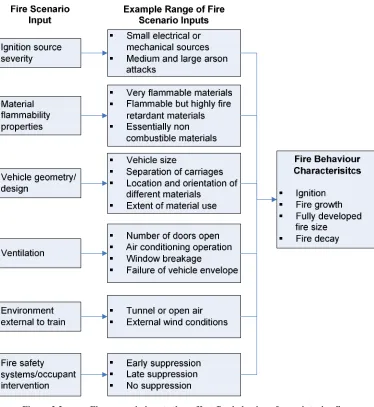
scale experiments to investigate fully developed train fire behaviour, particularly with measurement of HRR. Understanding of the affect of variables such as ignition source severity, material flammability properties, vehicle geometry and design, ventilation and window behaviour, and the environment external to the train on fire development in passenger trains is limited. As a result, existing methods for design fire estimation
1.2
Research Aims
The aims of this research are to:
• Identify and develop an understanding of factors affecting ignition and fire
growth on passenger trains.
• Experimentally investigate fully developed fire behaviour on a passenger train
carriage and provide an estimate of HRR based on experimental
measurements.
• Evaluate existing models used to estimate design fires for passenger trains.
1.3
Research Methodology
The methods adopted in this research are:
• Literature review.
• Experiments including:
Cone calorimeter tests on interior materials.
A series of large-scale ignition experiments in a train carriage
interior corner.
One full-scale fully developed train carriage experiment on a
carriage with half the interior fitted.
• Analysis of HRR for the full-scale experiment based on experimental
measurements and observations. Evaluation of existing design fire estimation
methods against the full-scale experiment.
• Review of a CFD model Fire Dynamics Simulator (FDS) applied to estimate
passenger train design fires. Particularly work by other fire engineering
1.4
Limitations of Research
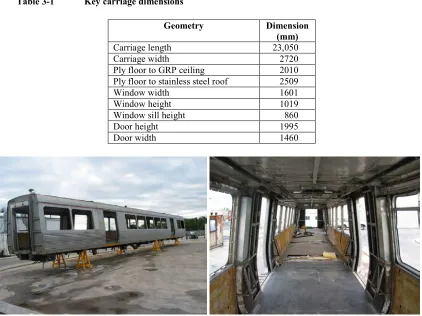
The carriage and test facility used for the experimental work was only available for a limited period. This restricted the time available for both planning and conducting the experiments.
HRR was not directly measured for the full-scale or large scale experiments as no facility capable of HRR measurement on this scale exist in Australia and it is beyond
the resources of this research to construct such a facility. Other instrumentation was used to enable HRR to be estimated.
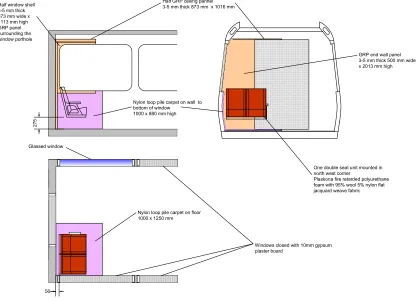
A limited amount of train interior materials was available. Only a 10 m length of the carriage was fully fitted with interior materials. It is likely the fire size and burn duration would have increased had more materials been fitted, thus estimated HRR
for the full-scale experiment is not representative of a fully fitted carriage.
Due to limited resources and time only one full-scale experiment, representing one fire scenario was conducted. Different fire scenarios involving different ventilation conditions, materials and the effects of a tunnel are not assessed.
Review of CFD modelling to estimate design fires only considers FDS V4. At the time of writing a new version (FDS V5) has been released but has not been significantly applied to train fires.
1.5
Overview of this Thesis
This thesis has been arranged in the following manner:
Chapter 2 presents a review of literature on subjects related to the current research. These include: review of fire engineering design of passenger trains and train fire incidents and statistics to demonstrate the need for research, prior experimental research on passenger train fires, design standards for fire safety of passenger trains
and design fire estimation methods.
tests. Details of the materials and carriage tested, instrumentation, ignition sources, procedure and results are presented. Conclusions are drawn regarding factors affecting ignition, fire growth and fully developed fire behaviour.
Chapter 4 presents the analysis. Existing design fire estimation methods are applied to, and evaluated against, the full-scale experiment. A conservation of energy model
is used to estimate the actual HRR for the full-scale experiment based on measurements and observations.
Chapter 5 presents a review of FDS modelling applied to estimate design fires for passenger trains. This includes: governing theory and assumptions for FDS which
affect HRR modelling, previous validation of the FDS HRR model and measurement of material properties for input to FDS. Two examples of application of FDS to predict passenger train design fire are reviewed. One application (carried out by others) was to estimate the HRR for the full-scale experiment.
Chapter 6 presents a final summary and conclusions.
CHAPTER 2 - LITERATURE REVIEW
2.1
THE NEED FOR RESEARCH OF FIRE DEVELOPMENT
IN PASSENGER TRAINS
In order to demonstrate the need for research of fire behaviour in passenger trains, the
process of fire engineering design of passenger trains and its dependence on estimated design fires is reviewed. Severe fire incidents and fire incident statistics on passenger trains will then be reviewed to understand the consequences and likelihood of these incidents providing further motivation for this research.
2.1.1
Fire Engineering Design of Passenger Trains
Whenever a new rail system is designed or an existing system significantly modified, designers and operators are required, both by regulation and by duty of care, to ensure
the fire safety of the resulting system is at a satisfactory level. Two approaches to ensure this are:
• Prescriptive approach applies specifications or standards to achieve life safety
objectives through detailed requirements such as small-scale tests but does not quantify the life safety of the system.
• Performance based approach applies fire engineering analysis of systems to
compare or quantify life safety ensuring that life safety objectives are met.
There are few prescriptive passenger rail fire safety standards (see Section 2.3).
Prescriptive standards provide little design flexibility and do not clearly quantify the life safety of the system. Performance based fire engineering has been adopted for design of both passenger trains and rail infrastructure where:
• Prescriptive standards failed to enable design or assessment of materials, fire
safety systems or operating procedures and their resulting affect on life safety. • Prescriptive requirements prohibited other design objectives to be met and
alternative designs requirements could be demonstrated to have equal or better efficacy.
for application on buildings however the framework for applying fire engineering summarised in Figure 2.1 has been applied with some alteration to many passenger rail system designs in Australia.
Fire Engineering Brief
Characterise System Define design objectives Define acceptance criteria Hazard identification Establish fire scenarios Establish trail concept design(s)
Establish evaluations methods
Analysis and Design Based on Established Fire Scenarios
Fire Initiation and development
Smoke development and management
Fire spread, reaction of structure to fire and management
Detection and suppression Occupant behaviour and tenability
Fire brigade response
Evaluation
Does design satisfy the acceptance
criteria?
Yes:
design accepted
No:
Modify design and repeat process
Fire Safety Design Incorporated
in Detailed System Design
Figure 2.1 Fire engineering design and analysis process
This framework identifies that the fire scenarios selected are a critical input to the design process.
Fire scenarios are characterised by design fires. Design fires are most easily and
commonly expressed in terms of a HRR versus time curve for the course of the fire.[4] Throughout this thesis a HRR vs time curve is referred to as a HRR curve and instantaneous HRR is referred to as HRR. A HRR curve is a simple approximation of real fire behaviour and is normally considered to consist of three stages as shown in Figure 2.2.
Fire growth is dependant on fuel and other conditions. For fires in enclosures an important fire growth concept is flashover. Flashover is the rapid transition from a localised fire to general conflagration involving all materials within an enclosed space. This concept is fully discussed in Section 2.4.2.
The importance of design fires for fire safety design is demonstrated by addressing
each point of analysis described in Figure 2.1 as follows:
• Fire initiation and development – This involves the characterisation of key fire scenarios in terms of a HRR curve. Key factors affecting a HRR curve are
the ignition source, material properties, material and enclosure arrangements and geometries, and ventilation conditions. Prediction of HRR curves based on these properties is extremely complex.[5]
• Smoke development and management -The rate of smoke production is related to HRR as well as material properties and ventilation conditions. All
empirical correlations commonly used to predict smoke production rate are dependent on HRR.[6]
• Fire spread, reaction of structure to fire and management – The occurrence and rate of fire spread within a carriage, between carriages and to
surrounding infrastructure is quantified by and dependent on the design fire HRR curve and vehicle design.[4] Surrounding infrastructure is also designed to maintain structural integrity when exposed to assumed design fires.[7]
• Detection and suppression – Detection and suppression systems are activated by hot gases or smoke which are related to HRR.[8] The effectiveness of
suppression systems once activated is heavily dependent on HRR.
• Occupant behaviour and tenability – Tenability criteria are usually based on quantities such as hot layer height, radiant heat, convective heat, toxic gases
and visibility/smoke obscuration. All of these quantities are strongly influenced by the HRR curve.[4]
• Fire brigade response –HRR directly affects the fire brigades actions and effectiveness.[9] For incidents such as the Mont Blanc Tunnel fire where
Thus the fires chosen as a basis for design affect both cost and effectiveness of material selection, the fire safety system and the surrounding infrastructure. Where prescriptive regulations or standards are applied for passenger train fire safety the design and construction cost is primarily governed by the regulations or standards and the design fire and resulting level of life safety is either implicitly assumed or not addressed at all. Where performance based design is adopted then the design fire has
a critical affect on the cost of fire protection systems (both active and passive), smoke management systems and facilities for occupant warning and egress. A significant cost may be associated with design and selection of train materials to achieve a required design fire. Significant cost of property and business continuity loss (as well as fatalities/injuries) may exist if a design fire is poorly chosen resulting in an
ineffective fire safety design.
Insufficient understanding of fire behaviour within rail vehicles limits designers ability to predict realistic design fires.[11] The National Institute of Standards and Technology (NIST), in a review of fire safety of passenger trains,[12] have identified
the ability to relate small scale test data to real scale burning behaviour through valid fire growth models as the major element lacking from fire safety design of passenger trains. They also recognize that real-scale tests of actual trains are required to develop and validate such models.
To produce a working design, current practise is to apply an assortment of
non-validated assumptions to develop design fires. These assumptions, discussed in Section 2.4, reflect the limits of existing understanding of fire behaviour on passenger trains. If these assumptions are much more severe than reality then the resulting design may be excessively safe and unnecessarily costly. If the assumptions are much
less severe than reality then the resulting design may not result in a suitable level of safety.
2.1.2
Passenger Rail Fire Incidents
2.1.2.1 International Incidents
1990-2005.[13] The majority of these involved derailments or collisions. Only five of these major accidents resulted from fire. There are some examples of passenger train fires resulting from collision such as the Ladbroke Grove incident [14] however such incidents usually involved liquid fuels and deaths and injuries may have resulted from the collision rather than the fire. Thus it is concluded that major passenger rail fires are not high frequency events. However review of the five incidents in Table 2-1
demonstrates they can have severe consequences. It is recognised that these incidents involve rail systems with significant cultural, design or operational differences to Australian railway systems.
Table 2-1 Rail fire incidents resulting in large fatalities 1990-2005
Location Date Description Fatalities
(Injuries)
Daegu, South Korea
18/02/2003 A arsonist ignited 4 l of petrol on train prior to stopping at Jungangno underground station. Approx. 4 min later a second train stopped opposite the burning train. At this time the fire had spread to other cars on the first train but most passengers had escaped. Electrical power to the second train was lost preventing it from moving. Doors failed to open trapping most of the passengers. The fire consumed all cars on both trains and spread to the platform, but did not spread to an adjoining shopping mall.[15-17]
192 (147)
Godhra, India
27/02/2002 Fire occurred on an intercity passenger train, the Sabarmati Express. The fire spread rapidly to multiple carriages. An investigation concluded that the fire started inside the train rather than externally.[18-20]
52 (-)
Al Ayatt, Egypt
19/02/2002 Fire on intercity commuter train. Fire started on the 4th carriage of an 11 carriage train. Source of the fire thought to be a gas stove used by a passenger. The train travelled for 7 km after ignition stopping at town of Al Ayatt. The fire spread rapidly to all carriages behind the carriage of fire origin. Seven carriages in total were consumed. Train was not air conditioned and most windows were open enabling rapid spread of the fire. The train was occupied beyond it’s designed capacity and bars were fitted to windows hampering evacuation.[21,22]
373 (-)
Kaprun, Austria
11/11/2000 Fire started at rear of underground cable drawn train travelling to Kaprun ski resort. The tunnel is 3200 m long with a maximum gradient of 50% connecting to an alpine centre at the top. The train came to a halt 530 m inside the tunnel. Twelve passengers escaped travelling down the tunnel past the fire at the rear. The fire grew rapidly, drawing air from the bottom of the tunnel and expelling combustion products out of the top of the tunnel. The remaining occupants were killed, the majority dying of asphyxiation attempting to travel up the tunnel. Smoke also affected people at alpine centre at the top of the tunnel.[23] The carriage was completely consumed. Ski equipment and clothes were thought to have fuelled the fire. The fire cause was a faulty heater and leakage of highly flammable hydraulic brake oil.[24]
155 (-)
Baku, Azerbaijan
28/10/1995 Fire occurred on an underground metro train. The metro system opened in 1967 and the carriages involved were nearly 30 years old. An investigation concluded that the fire was started accidentally by electrical sparks from wiring under one of the cars.[25]
2.1.2.2 Australian Incidents
A review of Australian railway disasters[26] and statistics reviewed in Section 2.1.4 indicate there have been no fires resulting in fatalities on modern Australian passenger trains however there are several cases of significant fire spread.
A large fire incident occurred on a NSW C-set double-deck train on the 22nd October 2006.[27] An arson fire was started in the corner of the upper deck of a carriage. Fire spread up to 4 m along upper wall and ceiling linings but did not reach flashover with no spread to seats, flooring or the lower deck. The carriage was filled with smoke. Approximately 30 passengers were evacuated with no injuries.
Two major fire incidents occurred on Melbourne trains during 2002. On April 9, 2002 an arson fire was lit using newspaper in the unoccupied end carriage of a three car set bound for the city. The train stopped a Merlynston station when the driver noticed the fire. The fire reached a flashover condition and consumed the entire carriage interior,
valued at $1.7 million. The fire did not spread to other cars and caused about $10,000 damage to the station building. A similar event occurred on an 11:32 pm train from the city on August 30 2002 at Hampton station. The arson fire was lit in the unoccupied last car resulting in the entire car being consumed.
Two similar incidents also occurred in NSW in the 1970’s.[28] These prompted some investigation by railway authorities into the performance of materials used in NSW trains at the time. In 1976 a fire was deliberately lit at the rear end of the lower deck on an unoccupied double deck carriage and rapidly spread to surrounding materials. It appears that flashover may have occurred when a passenger door was opened to allow fire fighting. Fire spread through the entire carriage. Another double deck carriage
was completely destroyed in a similar event in 1973.
In Queensland in 2001 an arson fire was lit in the driver’s cabin of a suburban train. The vehicle was stabled in the open at a rail yard. The fire brigade responded some 14
flame damage in the passenger saloon adjacent to the connecting door which had eventually burnt through.[29]
2.1.3
Tunnel Fire Incidents
The use of tunnels and underground or covered stations also provides a motivation for research of fire development on passenger trains.[30] Tunnels contain heat and smoke from fires, restrict escape and rescue possibilities and can affect fire ventilation. Many underground stations are connected to shopping centres and public spaces. Also a
fires growth rate and fully developed HRR can be significantly increased by both increased radiation effects due to tunnel geometry and forced ventilation. It is possible for these effects to increase the growth rate and fully developed HRR that would occur for an open fire load (such as an open hazardous good vehicle) in the open air by a factor ranging from 1-10 depending on the severity of the effects. [31]. This increase of HRR due to tunnel effects may not be as severe for a passenger train as for
an open fire load due to partial shielding of the trains body, however some limited increase in HRR could be expected. [32,33]
This containment of hazardous fire conditions and increase in fire growth and HRR leads to an increase in the consequences of a severe fire incident and requires cost
effective fire safety design. The first European rail tunnels were built more than 150 years ago and since then the use of tunnels and underground stations has been increasing to meet transport needs. For example Germany has approximately 600 km of tunnel for underground, rapid transit and urban railways with a total of approximately 500 subterranean stops.[34] Increased application of fire safety engineering for rail tunnels requires suitable design fires for cost effective design.
Recent tunnel fires have demonstrated that the occurrence of a fire incident within a tunnel is likely to escalate the incident consequences. In 1996 a fire occurred in the Channel Tunnel which provides a rail link between Britain and France where road vehicles are carried on special rail cars. The fire started in a truck carrying combustible goods resulting in 34 people being injured and severe damage to the
in 1999 a fire in Austria’s Tauern road tunnel resulted in 12 fatalities and 50 injuries.[10]
2.1.4
Passenger Rail Fire Statistics
The following review of passenger rail fire statistics demonstrates that small fire incidents, most often caused by arson, are common. However large fire incidents involving at least a large portion of a carriage are less common with six large fires reported in the literature in Australia over the past 30 years. Passenger train fire
related fatalities are very rare.
2.1.4.1 UK statistics
The Railway Safety Organisation has reported fire statistics for all rail (passenger and freight) on Railtrack controlled infrastructure in the UK from 1992 to 2000.[2] Only train fires where there was the presence of flame were included in the data and
‘smoke only’ incidents were excluded. During this period and on this basis over 2900 fires occurred with 78% of these occurring on passenger trains. Arson was the major fire cause with 56% of passenger train fires being attributed to arson. Mechanical and electrical causes each accounted for approximately 14% of the passenger train fires. Of the arson fires, 90% occurred in metropolitan areas and 10% occurred in
regional/intercity areas. Excluding 31 people who were killed in a major incident at Ladbroke Grove (1999) involving a collision and subsequent diesel fuel fire, only 1 fatality occurred due to fire during this period. Except for two arson fires which resulted in complete or severe damage to entire carriages and two fires involving collisions and/or fuel tanks rupturing, all other incidents did not result in severe damage to vehicles.
2.1.4.2 Australian Statistics
The rate of reported fire starts is very different for Melbourne (9-15 per year) compared to Sydney (80 per year). This significant difference is possibly due to differences in definition of a fire incident and thoroughness of reporting and record keeping.
Melbourne
fires were reported during the 9 year period. Of these 52 fires were interior fires. Arson was the cause for 52% of total fires and 79% of internal fires. This is similar to UK statistics
A risk assessment study for railway lines at Federation Square[37] has tabled fire incidents recorded by the Public Transport Corporation (PTC) for the Melbourne
suburban network from 1987 to 1997. Over this period there were 125 reported fires. Of these, 76 were deliberate and 49 were accidental. Another study[38] has tabled fire incidents recorded from 1998 to 2003 for about 60% of the Melbourne suburban network with 45 fires. Of these 20 are known to be arson fires including the 2 cases of arson resulting in spread to entire carriages discussed in section 2.1.2.2.
Sydney
Railcorp safety statistics published since January 2006[39,40] indicate an average of one reported fire incident every three days on NSW City and outer suburban trains. Details of the size and source of the fires is not provided.
The State Rail Authority (SRA) have provided fire incident reports in NSW rolling stock for the period 1991 to 2000.[41] The database contains approximately 690 fire incidents. However a substantial number of these incidents involved smoke being emitted from over heating of traction motors, brakes, cables/batteries, A/C units and the like and have been excluded from consideration below. For internal car fires most fires involved construction materials and fittings with ignition sources commonly
being newspapers, paper cups, lighter fluid etc. A limited statistical analysis conducted by Arup[41] of some 200 of the fires gives the following approximate figures:
41% started on seating.
2% started on walls.
11% started on floors.
12% started in light fittings.
20% were due to other electrical fittings.
2.1.5 The Need for Research on Fire Development in Passenger
Trains
Barnett has conducted a review of events motivating improved fire safety for sea, road and rail.[42] Through review of some major transport fire incidents the potential for catastrophic life loss and consequences is recognised. The review also recognises that
tunnels exacerbate the problem of rail fires. Barnett concludes that determination of appropriate design fires is critical to effective fire safety design leading to minimisation of such consequences.
Barnett’s conclusions are in agreement with the findings of this review of fire
engineering design, fire incidents and statistics which has demonstrated the following key points:
Although large passenger train fires are infrequent they may have extreme consequences.
Occurrence of such fires within tunnels or other underground infrastructure can escalate these consequences.
Arson is the most frequent interior fire cause and the most likely to result in significant fire sizes.
A suitable level of fire safety must be achieved via cost effective design. This
2.2
EXPERIMENTAL RESEARCH ON PASSENGER TRAIN
FIRES
2.2.1 Categories of Experimental Work
Experimental work previously carried out on passenger train interiors falls into the following three categories:
Small-scale - Experiments conducted on small, single or composite material specimens usually applying standard test methods. The actual conditions that occur in real fire scenarios are generally not well simulated. Small-scale
experiments are the least costly and are useful for comparison or screening of materials.
Large-scale - Experiments involving full sized specimens or which “mock-up” a small section of the interior of a train, usually involving a floor, seat,
wall and/or ceiling combination. These experiments are designed to simulate the localised material and geometry combinations that occur in a real fire
scenario without extending to include the full train carriage. Large-scale experiments simulate ignition and early fire growth in real scenarios. However such experiments do not simulate fire spread along a carriage or fully developed fire behaviour as the full carriage materials are not included and enclosure geometry and ventilation are usually different. Direct measurement
of HRR is often applied.
Full-scale - Experiments conducted on an actual or mocked up train carriage involving the complete, or a significant proportion of interior materials. These experiments are designed to provide data relating to fully developed fire behaviour and fire size. Full-scale experiments are generally extremely costly
and direct measurement of HRR on such a scale is difficult and not normally attempted.
Due to cost and resource requirements most passenger train fire behaviour experimental programs have involved a combination of small and large-scale
Table 2-2 Passenger train fire experimental research projects
Project Year Experiments
JNR – Fire
behaviour on a
running train[43,44]
1974 • Full-scale fire tests on moving trains
NBS
AMTRACK[45]
1984 • Small-scale tests
• Large-scale mock-up interior section tests
• Large-scale calorimeter tests on seats SP-Fires on buses
and trains[46]
1990 • Large-scale mock-up interior section tests
• Large-scale calorimeter tests on seats
EUREKA[47-49] 1995 • Full scale fully developed carriage fire tests conducted in tunnels with HRR measurement
FIRESTARR[50,51] 2001 • Small-scale tests
• Large-scale mock-up interior section tests
• Large-scale calorimeter tests on seats Previous CSIRO
research[52]
2000-2003
• Large-scale calorimeter tests on seats
• Large-scale mock-up interior section test
• ISO 9705 room fire test NIST-Fire safety of
passenger trains [53-55]
1999-2004
• Phase I Cone calorimeter compared with other standard small scale tests
• Phase II Large-scale mock-up interior section tests to support t2 growth rates for zone fire models
• Phase III Full scale tests on intercity coach SP – Model scale
railcar fire tests[56,57]
2005 • Small-scale tests on 1-10 scale model railcar investigating ventilation effects
Descriptions of standard fire tests applied to rail vehicles are provided in Appendix A. These research projects are discussed as follows.
2.2.2 JNR Fire Behaviour on a Running Train Project (1974)
A train fire in the Hokuriku tunnel, Japan, 1972, resulted in destruction of one carriage, 30 fatalities and 700 injured. In response to this event Japan National Rail
(JNR) refurbished its fleet with improved materials to increase fire safety and conducted full-scale experiments on moving multiple car trains to verify the improvement of fire safety and understand post-flashover fire behaviour on moving trains.[43,44]
Experiments were conducted both on an open air test track and in a 2.9 km tunnel.
via bellows but were separated by end doors. Experiments and results are summarised in Table 2-3.
Table 2-3 JNR Full-scale train fire experiments and results Test Location Carriage
details
Ignition source
Results
1 Open air Refurbished car. Vents windows and doors closed,
20 pages of newspaper and 200 ml alcohol
No significant fire growth
2 Open air
Non-refurbished car. Vents windows and doors closed
20 pages of newspaper and 200 ml alcohol
Significant fire growth on seat, wall and ceiling linings. At 9 minutes flashover was immanent so train set in motion. However carriage filled with smoke and fire growth was choked. Due to lack of ventilation
3 Open air
Non-refurbished car. Vents and side doors open
40 pages of newspaper and 400 ml alcohol
Carriage flashed over after 3 minutes. Train was then set in motion. Ignited carriage was completely burned out with damage heavier to the rear. Only two windows were broken. No significant fire spread to adjoining carriages. Conditions remained tenable in the adjoining carriages.
4 Tunnel Refurbished
car. Vents open, windows partly open, doors closed
20 pages of newspaper and 300 ml alcohol
Carriage flashed over and the train was set in motion. Ignition carriage was completely burnt out. Fire spread to exterior of carriage behind. No spread of fire to interior of adjoining carriages Tenability was reduced in carriage behind ignition carriage. Average tunnel temperature increased 10°C and conditions remained tenable.
5 Tunnel Refurbished
car. Vents open, windows and doors closed
20 pages of newspaper and 300 ml alcohol
Carriage fire grew appeared to be growing to flashover and the train was set in motion. Fire was less severe due to restricted ventilation. Only the middle part and ceiling of the Ignition carriage were burned. No fire spread to adjoining carriages. Conditions remained tenable in carriage behind. Average tunnel temperature increased by 5°C and conditions remained tenable.
The JNR scale train fire experiments are unique as they appear to be the only full-scale experiments investigating fire growth on moving vehicles and observing multiple flashover train fires under different ventilation conditions. Other important
points of these experiments are:
• Project literature states that “The fire initially develops on the ignition seat
until sufficient heat is produced to ignite the adjacent wall lining and luggage in racks directly above. This increased fire size then ignites the ceiling. By this
flashover occurs. Up to the onset of flashover there is sufficient air within the vehicle to provide all the oxygen required for combustion. However after flashover a sudden consumption of oxygen takes place, temporarily affecting the rate of combustion causing a temporary drop in temperature. Subsequent spread of fire depends on the ventilation conditions of the vehicle”. This observation matches well with the experimental observations in Section 3.2 of
this thesis.
• This project demonstrates fire will spread more aggressively in the opposite
direction to the vehicle motion for a flashover carriage fire on a moving train. • Improved fire performance of materials will reduce likelihood of flame spread
beyond the ignition area.
• Fire spread from carriage to carriage is enhanced and more likely to occur in a
tunnel. The effectiveness of carriage separation by use of end doors in
preventing carriage to carriage fire spread is demonstrated.
• Only a moving train fire in a tunnel is investigated and it is concluded that the
effects on the tunnel are not significant. However the effects both on tunnels and on vehicles are likely to be much greater if the fire is stationary.
• HRR was not measured for these experiments however the principal of oxygen
consumption calorimetry was not in common use at this time.
• Vehicles used in these experiments were 1970’s intercity coaches. The fuel
load and fire performance of materials for these vehicles compared with current metro passenger trains is unknown.
2.2.3 NBS AMTRACK Project (1984)
In 1984 the US National Bureau of Standards (NBS), was sponsored by the Federal Railroad Administration (FRA) to investigate fire behaviour of interior materials on an Amtrak intercity passenger coach.[45] The project investigated a range of alternative interior materials and was conducted in 3 parts:
• Small-scale tests – tests including smoke density chamber tests, flame spread tests, critical radiant flux tests and cone calorimeter tests were used to characterise the materials
ISO 9705 enclosure. Different types of floor, wall and ceiling linings, two double seat assemblies and in some cases a luggage rack were fitted. For all tests either 50 double sheets (1.06 kg) or 100 sheets (2.12 kg) of newspaper were placed on the rear window seat and ignited. Temperatures, heat fluxes, gas concentrations and HRR were measured. Tenability criteria for temperatures and gas concentrations were applied to these experiments. Two
of the tests applying 1.06 kg newspaper resulted in flashover. Both of these tests had carpet lined walls and ceilings. The larger ignition source was not applied to these linings.
• Large scale seating calorimeter tests – Four different full size, upholstered seat and squab cushions were mounted on a non-combustible seat frame directly under the calorimeter hood and ignited using 1.06 kg of newspaper to investigate fire behaviour of seating without interaction with other materials or surrounding geometry. Peak HRR for seating (with newspaper HRR subtracted) ranged from 30-140 kW.
The NBS Amtrack project assesses the viability of predicting large-scale behaviour from small scale tests. The research concludes that small-scale test results cannot be used to directly predict large scale behaviour; however they can be used to assess general improvement or deterioration in performance due to changes in materials
within the same geometry. Other comments regarding the NBS AMTRACK project are:
• Occurrence of two flashover fires for tests with the most flammable
combustible wall and ceiling linings demonstrates that material properties have a critical influence on fire spread beyond the area of ignition.
• Packing of newspaper ignition sources affects the severity of the ignition
source. Packing density of ignition sources was not characterised. The 1.06 kg newspaper achieved a peak HRR of 55 kW at 100 s. This was sufficient to promote fire spread on some of the materials.
• Based on comparison with later research on newer vehicles the older NBS
Decreased fuel load and material flammability decreases susceptibility to fire growth.
• The author’s conclude “a suitable interior evaluation protocol would be to
firstly conduct a small number of large-scale mock-up tests to determine a set
of acceptable materials for a given vehicle geometry and then use comparative small-scale tests to assess alternative materials”[45]. This would be more adequate but costly compared to design according to current prescriptive rail design standards.
2.2.4 SP Fires in Buses and Trains Project (1990)
In 1990 the SP National Testing and Research Institute of Sweden conducted a project on fire performance and test methods for buses and trains.[46] This research involved a
range of large-scale experiments to determine ignitability and HRR of a variety of interior materials from buses and trains. The research also reviewed suitable fire test methods and zone modelling for buses and trains. The SP fires in buses project is primarily focused on seating fire performance and only provides limited information on fire behaviour beyond the early stages of ignition relating to fully developed fire
behaviour. Other comments regarding this experimental work are:
• BS 5852 small ignition sources were applied to a range of seats. When
exposed to smouldering cigarettes, match flames and type 4 timber cribs the seats did not support fire growth. When slightly larger BS 5852 type 5 and 6
timber cribs were applied all seats ignited and produced peak HRR’s ranging from 160-250 kW.
• Cone calorimeter tests were performed on seat materials but the results were
not used for any purpose other than comparison of materials.
• Two large-scale experiments were conducted in a standard ISO 9705
enclosure. The enclosure was fitted with rows of seats, and floor, wall and ceiling linings from a bus. The exact details of the materials are not reported. A BS 5852 type 6 timber crib was applied to the middle seat. In both tests it was found that although the seat ignited and burnt with a peak HRR of 200kW
there was no spread beyond the ignited seat.
Surveys of typical litter on trains[58] demonstrate that much larger ignition sources are credible. Given that very small ignition sources were used the performance of the seats tested appears to be poor.
• The ceiling height for the large-scale experiments was higher at 2.4 m than
most typical trains or buses at approximately 2 m. This may have reduced flame impingement on ceiling linings. The project concluded that direct flame spread along wall and ceiling linings is unlikely and that fire is more likely to spread from seat to seat. This is contradictory to the findings of other research reviewed which highlight that wall and ceiling linings are critical for flame
spread.
2.2.5 EUREKA Project (1995)
Nine European nations cooperated in the EUREKA project EU 499 FIRETUN which primarily involved a series of full-scale fire experiments conducted in tunnels. The objective of this project was to investigate the effects of real transport fires on a tunnel environment and structure. Altogether 21 tests were conducted on a variety of transport vehicles and other materials such as timber between 1990 and 1992. Results
of the experiments were evaluated from 1992 through 1995. Key results of the EUREKA project were summarised in the main project report[47] and in a tunnel fire safety paper[48] and the calculation of experimental HRR was reported by SP.[49]
The tunnel used was 2.3 km long. It had a horseshoe shaped cross section with a width varying between 5.3 and 7 m and height between 4.8 and 5.5 m.The tunnel had a steady slope of 1° however gas flows due to buoyancy were observed due to this
small slope. Four rail cars were tested separately in these experiments including subway cars and intercity passenger cars. These had either steel or aluminium bodies. In addition to this two extra experiments, each involving half a passenger train with different wall and ceiling linings, were carried out to compare the fire performance of different linings. In these two experiments all other materials such as seats and
demonstration of the improve performance of phenolic GRP over polyester GRP. In all experiments trays of isopropanol were used as the ignition source. For most experiments 6 l isopropanol was used but if this did not induce significant fire growth then the quantity was increased to 12 l. Air velocities in the tunnel were varied for different experiments from 0 - 8 m/s.
The tunnel was instrumented to measure temperatures, air velocity, gas concentration and smoke density. The vehicles themselves were instrumented with a limited number of thermocouples. The vehicles could not easily be observed due to heat and smoke in the tunnel as the fire developed.
The method of estimating HRR by mass loss was rejected due to the heavy weight of the vehicles. Instead HRR measurement was attempted by two different methods. The first method was to measure the convective fraction of the HRR (typically 70%[5]) based on temperature and flow measurements alone. The second method of calculating HRR was the principle of Oxygen consumption calorimetry and/or CO2
production calorimetry. A gas flow and concentration profile was estimated for the tunnel cross section from measurements. This was then used to estimate the total
HRR. This method had a large error estimated to be of the order of ± 25%. The majority of this error may be due to instrumentation limitations. Gas velocity and O2
concentration was usually measured at 3 points for a given tunnel cross section on either side of the fire source. Accuracy of laboratory fire calorimeters rely upon high
Reynolds number flows producing well mixed, homogenous distribution of gas concentrations and temperature and a well defined velocity profile across an exhaust duct of much smaller diameter compared with the EUREKA test tunnel. For tunnels the ratio of velocity to cross sectional area is most likely lower, resulting in lower Reynolds number flows, poorer mixing, less homogenous distribution of gas
concentration and temperature, and flow profiles across the tunnel that change significantly with fire size. For this reason 3 measurement points is likely to provide only a coarse measurement of HRR.
Table 2-4 EUREKA train fire experiment results
Vehicle type Fuel load
(MJ)
Ignition source (kg isopropanol)
Result HRR*
± ±± ±25% (MW)
Subway car steel Body (F31)
32,670 0.7 Carriage burnt out
Fire duration 20 min
-
Rail car steel body
62,480 6.2 Carriage burnt out
Fire duration 70 min
20
Rail Car steel body
76,890 6.2 Carriage burnt out
Fire duration 100 min
14
Subway car Aluminium body
41,360 6.2 Carriage burnt out and roof
melted away Fire duration 20 min
35
Half railway car Polyester GRP
15,400 6.2 Carriage burnt out
Fire peak at 8 minutes
-
Half railway car phenolic GRP
12,100 12.3 No fire spread -
- = HRR not calculated or reported in EUREKA reports
* Quoted HRR are estimates recommended by EUREKA report, there was significant variance in
estimates
The EUREKA project full-scale measurement of HRR of complete train carriages in tunnels is unique. There is a large degree of variance of HRR calculated by different parties involved. This may be due to likely errors discussed above. Due to this
inaccuracy and variance the esulting HRR quoted should not be taken as definitive. Rail carriages were calculated to have peak HRR ranging from 14-35 MW with maximum gas temperatures inside the vehicles of 800-1200 °C This research
demonstrates the difficulties of full scale train fire HRR measurement. Other points regarding the EUREKA project are:
• The research was focused on tunnel fire performance and very little data was
gathered on the internal fire growth within passenger trains.
• After initial localised fire growth at the ignition source location, all rail car
fires exhibited a subsequent rapid fire development, during the first 10-15
minutes from ignition demonstrating that when an ignition source is large enough to promote fire spread beyond the ignition area then the fire is likely to rapidly grow to involve the entire carriage.
• Damage to the vehicle body integrity was observed to influence fire growth.
• The importance of wall and ceiling lining performance as a mechanism for
flame spread beyond the ignition area is demonstrated by the comparative wall and ceiling lining tests. The polyester GRP supported significant fire spread throughout the carriage. The phenolic resin GRP did not support significant
fire spread.
2.2.6
FIRESTARR Project (2001)
The Fire Standardisation Research in Railways (FIRESTARR) Project[50,51] was a 3
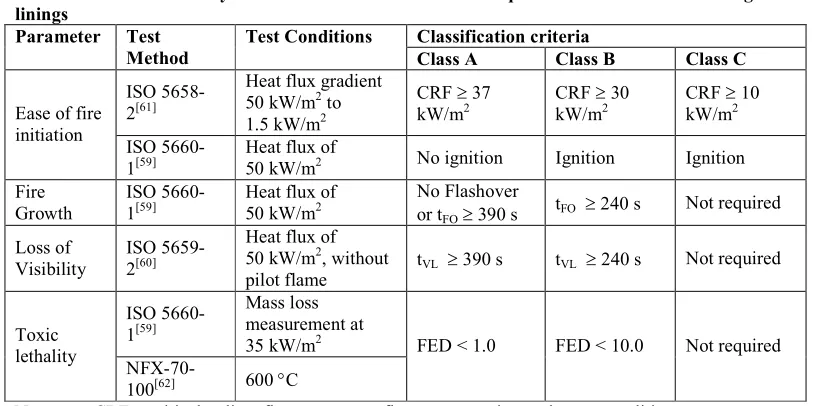
year project with the intention of assisting the development of a draft European Standard EN 45545 “Fire protection on railway vehicles”.[43] The project involved collaboration between 11 European research organisations. The objectives of the project were to select suitable test methods for assessment of the fire performance of materials and to propose a classification system for the materials. The project
involved the following experiments on a broad range of interior materials:
Small-scale tests – Standard small-scale tests including small flame exposure tests, lateral flame spread tests, flooring radiant panel tests, cone calorimeter and smoke tests were conducted. The complete results of these small-scale tests were not
provided in the final FIRESTARR report.
Large-scale wall and ceiling lining tests – Eleven different wall and ceiling linings were tested directly under an ISO 9705 hood, installed on a mock-up wall and ceiling corner section. The corner was open and well ventilated. A 75 kW gas burner was applied for 10 minutes. Heat release rate, smoke and toxic gas concentrations were
measured in the exhaust duct. Six materials produced peak heat release rates in the range of 80-100 kW but one material, a polyester GRP, produced a peak HRR greater than 1000 kW.
Twelve different wall and ceiling linings (same materials as for corner test plus one