Tradeoff Cryptanalysis of Memory-Hard Functions
Alex Biryukov and Dmitry Khovratovich
University of Luxembourg
[email protected], [email protected]
Abstract. We explore time-memory and other tradeoffs for memory-hard functions, which are sup-posed to impose significant computational and time penalties if less memory is used than intended. We analyze three finalists of the Password Hashing Competition: Catena, which was presented at Asiacrypt 2014,yescryptand Lyra2.
We demonstrate that Catena’s proof of tradeoff resilience is flawed, and attack it with a novel pre-computation tradeoff. We show that usingM4/5 memory instead ofM we have no time penalties and reduce the AT cost by the factor of 25. We further generalize our method for a wide class of schemes with predictable memory access. For a wide class of data-dependent schemes, which addresses memory unpredictably, we develop a novelranking tradeoff and show how to decrease the time-memory and the time-area product by significant factors. We then apply our method to yescrypt and Lyra2 also exploiting the iterative structure of their internal compression functions.
The designers confirmed our attacks and responded by adding a new mode for Catena and tweaking Lyra2.
Keywords:password hashing, memory-hard, Catena, tradeoff, cryptocurrency, proof-of-work.
1
Introduction
Memory-hard functions are a fast emerging trend which has become a popular remedy to the hardware-equipped adversaries in various applications: cryptocurrencies, password hashing, key derivation, and more generic Proof-of-Work constructions. It was motivated by the rise of various attack techniques, which can be commonly described as optimized exhaustive search. In cryptocurrencies, the hardware arms race made the Bitcoin mining [29] on regular desktops tremendously inefficient, as the best mining rigs spend 30,000 times less energy per hash than x86-desktops/laptops1. This causes major centralization of the mining
efforts which goes against the democratic philosophy behind the Bitcoin design. This in turn prevents wide adoption and use of such cryptocurrency in economy, limiting the current activities in this area to mining and hoarding, whith negative effects on the price. Restoring the ability of CPU or GPU mining by the use of memory-hard proof-of-work functions may have dramatic effect on cryptocurrency adoption and use in economy, for example as a form of decentralized micropayments [15]. In password hashing, numerous leaks of hash databases triggered the wide use of GPUs [3, 34], FPGAs [27] for password cracking with a dictionary. In this context, constructions that intensively use a lot of memory seem to be a countermeasure. The reasons are that memory operations have very high latency on GPU and that the memory chips are quite large and thus expensive on FPGA and ASIC environments compared to a logic core, which computes, e.g. a regular hash function.
Memory-intensive schemes, which bound the memory bandwidth only, were suggested earlier by Burrows et al. [8] and Dwork et al. [17] in the context of spam countermeasures. It was quickly realized that to be a real countermeasure, the amount of memory shall also be bounded [18], so that memory must not be easily traded for computations, time, or other resources that are cheaper on certain architecture. Schemes that are resilient to such tradeoffs are calledmemory-hard [21, 30]. In fact, the constructions in [18] are so strong that even tiny memory reduction results in a huge computational penalty.
Disadvantage of classical constructions and new schemes. The provably tradeoff-resilient superconcentra-tors [32] and their applications in [18, 19] have serious performance problems. They are terribly slow for modern memory sizes. A superconcentrator requiring N blocks of memory makes O(NlogN) calls to F. As a result, filling, e.g., 1 GB of RAM with 256-bit blocks would require dozens of calls to F per block (ClogN calls for some constant C). This would take several minutes even with lightweightF and is thus intolerable for most applications like web authentication or cryptocurrencies. Using less memory, e.g., several megabytes, does not effectively prohibit hardware adversaries.
This has been an open challenge to construct a reasonably fast and tradeoff-resilient scheme. Since the seminal paper by Dwork et al. [18] the first important step was made by Percival, who suggestedscrypt[30].
1
The idea of scryptwas quite simple: fill the memory by an iterative hash function and then make a pseudo-random walk on the blocks using the block value as an address for the next step. However, the entire design is somewhat sophisticated, as it employs a stack of subfunctions and a number of different crypto primitives. Under certain assumptions, Percival proved that the time-memory product is lower bounded by some constant. The scrypt function is used inside cryptocurrency Litecoin [4] with 128 KB memory parameter and is now adapted as an IETF standard for key-derivation [5]. scrypt is a notable example of data-dependent schemes where the memory access pattern depends on the input, and this property enabled Percival to prove some lower bound on adversary’s costs. However, the performance and/or the tradeoff resilience of scrypt are apparently not sufficient to discourage hardware mining: the Litecoin ASIC miners are more efficient than CPU miners by the factor of 100 [1].
The need for even faster, simpler, and possibly more tradeoff-resilient constructions was further empha-sized by the ongoing Password Hashing Competition [2], which has recently selected 9 finalists out of the 24 original submissions. Notable entries are Catena [20], just presented at Asiacrypt 2014 with a security proof based on [26], and yescrypt and Lyra2 [25], which both claim performance up to 1 GB/sec and which were quickly adapted within a cryptocurrency proof-of-work [7]. The tradeoff resilience of these constructions has not been challenged so far. It is also unclear how possible tradeoffs would translate to the cost
Our contributions. We present a rigorous approach and a reference model to estimate the amortized costs of password brute-force on special hardware using full-memory algorithms or time-space tradeoffs. We show how to evaluate the adversary’s gains in terms of area-time and time-memory products via computational complexity and latency of the algorithm.
Then we present our tradeoff attacks on the last versions of Catena and yescrypt, and the original version of Lyra2. Then we generalize them to wide classes of data-dependent and data-independent schemes. For Catena we analyze the faster Dragonfly mode and show that the original security proof for it is flawed and the computation-memory product can be kept constant while reducing the memory. For ASIC-equipped adversaries we show how to reduce the area-time product (abbreviated further by AT) by the factor of 25 under reasonable assumptions on the architecture. The attack algorithm is then generalized for a wide class of data-independent schemes as aprecomputation method.
Then we consider data-dependent schemes and present the first generic tradeoff strategy for them, which we call theranking method. Our method easily applies to yescrypt and then to the second phase of Lyra2, both taken with minimally secure time parameters. We further exploit the incomplete diffusion in the core primitives of these designs, which reduces the time-memory and time-area products for both designs.
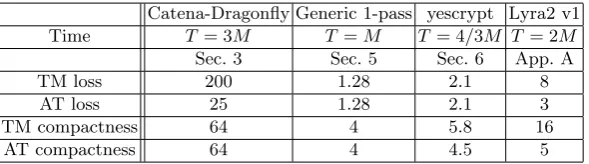
Altogether, we show how to decrease the time-memory product by the factor of 2 for yescrypt and the factor of 8 for Lyra2. Our results are summarized in Table 1. To the best of our knowledge, our methods are the first generic attacks so far on data-dependent or data-independent schemes2.
Catena-Dragonfly Generic 1-pass yescrypt Lyra2 v1 Time T = 3M T =M T = 4/3M T = 2M
Sec. 3 Sec. 5 Sec. 6 App. A
TM loss 200 1.28 2.1 8
AT loss 25 1.28 2.1 3
TM compactness 64 4 5.8 16
AT compactness 64 4 4.5 5
Table 1.Our tradeoff gains on Catena, yescrypt and Lyra2 with minimal secure parameters, 230 memory
bytes and reference hardware implementations (Section 2). TM loss is the maximal factor by which we can reduce the time-memory product compared to the full-memory implementation. AT loss is the maximal factor for time-area product reduction. Compactness of TM and AT is the maximal memory reduction factor which does not increase the TM or AT, resp., compared to the default implementation.
Related work. So far there have been only a few attempts to develop tradeoff attacks on memory-hard functions. A simple tradeoff forscrypthas been known in folklore and was recently formalized in [20]. Alwen and Serbinenko analyzed a simplified version of Catena in [9]. Designers of Lyra2 and Catena attempted to attack their own designs in the original submissions [20, 25]. Simple analysis of Catena has been made in [16].
Paper outline We introduce necessary definitions and metrics in Section 2. We attack Catena-Dragonfly in Section 3 and generalize this method in Section 4. Then we present a generic ranking algorithm for data-dependent schemes in Section 5 and attackyescryptwith this method in Section 6. The attack on Lyra2 is quite sophisticated and we leave it for Appendix A.
2
Preliminaries
2.1 Syntax
LetGbe a hash function that takes a fixed-length stringIas input and outputs tagH. We consider functions that iteratively fill and overwrite memory blocks X[1], X[2], . . . , X[M] using a compression functionF:
X[ij] =fj(I), 1≤j≤s; (1)
X[ij] =F(X[φ1(j)], X[φ2(j)], . . . , X[φk(j)]), s < j≤T, (2)
where φi are some indexing functions referring to some already filled blocks and fj are auxiliary hash
functions (similar toF) filling the initial sblocks for some positives.
We say that the functionmakes ppasses over the memory, if T =pM. Usually pand M are tunable parameters which are responsible for the total running time and the memory requirements, respectively.
2.2 Time-space tradeoff
Let Abe an algorithm that computes G. The computational complexity C(A) is the total number of calls toF andfi byA, averaged over all inputs toG. We do not consider possible complexity amortization over
successive calls toA. Thespace complexity S(A) is the peak number of blocks (or their equivalents) stored byA, again averaged over all inputs to G. Suppose thatA can be represented as a directed acyclic graph with vertices being calls toF. Then thelatency L(A) is the length of the longest chain the graph from the input to the output. Therefore,L(A) is the minimum time needed to runAassuming unlimited parallelism and instant memory access.
A straightforward implementation of the scheme (1) results in an algorithm with computational com-plexity T and latency L=T and space complexity M. However, it might be possible to computeG using less memory. According to [24], any function, that is described by Equation (1) and whose reference block indices φj(i) are known in advance, can be computed using cklogTT memory blocks for some constant ck
depending on the number k of input blocks for F. Therefore, any p-pass function can be computed using less than M =T /pmemory for sufficiently largeM.
Let us fix somedefault algorithm AofG with (C1, M1, L1) being computational and space complexities
and latency ofA, respectively. Suppose that there is atime-space tradeoff given by the family of algorithms3 B={Bq}that computeG using Mq1 space for differentq. The idea is to store only one ofq memory blocks
on average and recompute the missing blocks whenever they are needed. Then we define thecomputational penalty CB(q) as
CPB(q) =
C(Bq) C1
andlatency penalty LB(q).
LPB(q) =
L(Bq) L1
,
2.3 Attackers and cost estimates
We consider the following attack. Suppose that G with time and memory parameters (T, M) is used as a password hashing function withI= (P, S), whereP is a secret password andSis a public salt. An attacker getsH andS (e.g., from a database leak) and tries to recoverP. He attempts a dictionary attack: given a listLof most probable passwords, he runsG on everyP ∈Land checks the output.
Definition 1. Let Φbe a cost function defined over a space of algorithms. Let also GT ,M be a hash function
with fixed algorithm A0 (default algorithm). Then GT ,M is called (α, Φ)-secure if for every algorithm B for GT ,M
Φ(B)> αΦ(A).
In other words,GT ,M can not be computed cheaper than by the factor of α1.
The cost function is more difficult to determine. We suggest evaluating amortized computing costs for a single password trial. Depending on the architecture, the costs vary significantly for the same algorithmA. For the ASIC-equipped attackers, who can use parallel computing cores, it is widely suggested that the costs can be approximated by the time-area product AT [9, 11, 28, 35]. Here T is the time complexity of the used algorithm andAis the sum of areas needed to implement the memory cells and the area needed to implement the cores. Let the area needed to implement one block of memory be the unit of area measurement. Then in order to know the total area, we needcore-memory ratio Rc, which is how many memory blocks we can
place on the area taken by one core.
Suppose that the adversary runs algorithmBq usingM/q memory andl computing cores, thus having
computational complexity Cq =C(Bq). The running time is lower bounded by the latencyLq =L(Bq) of
the algorithm. IfLq < Cq/l, i.e. the computing cores can not finish the work in minimum time, then the
timeT can be approximated byCq/l, and the costs are estimated as follows:
ATBq(l) =
lRc+
M q
C
q
l =Cq(Rc+ M
ql)
We see that the costs drop as l increases. Therefore, the adversary would be motivated to push it to the maximum limit Cq/Lq. Thus we obtain the final approximation of costs:
ATBq =CqRc+Lq
M
q . (3)
Here we assume unlimited memory bandwidth. Taking the bandwidth restrictions into account is even more difficult, as they depends on the relative frequency of the computing core and the memory as well as on the architecture of the memory bus. Moreover, the memory bandwidth of the algorithm depends on the implementation and is not easy to evaluate. We leave rigorous memory bandwidth evaluation and restrictions for the future work.
We recall that the valueRc is depends on the architecture, the function F, and the block size. To give
a concrete example, suppose that the block is 64 bytes and F is the Blake-512 hash function. We use the following reference implementations4:
– The 50-nm DRAM [22], which takes 550 mm2 per GByte; – The 65-nm Blake-512 [23], which takes about 0.1 mm2.
Then the core-memory ratio is 224·0.1
550 ≈3000. For more lightweight hash functions this ratio will be smaller.
The actual functionsF in the designs that we attack are often ad-hoc and have not implemented yet in hardware. Moreover, the numbers may change when going to smaller feature size. To make our estimates of the attack costs architecture-independent, we introduce a simpler metric — thetime-memory product TM:
TMBq=Lq
M
q , (4)
which for not so high computational penalties gives a good approximation of AT.
In our tradeoff attacks, we are mainly interested to compare the AT and TM costs ofBq with that of
the default algorithmA. Thus we define theAT ratio ofBq as ATBq
ATA, and theTM ratio ofBq as
TMBq TMA
We note that for the same TM value the implementation with less memory is preferable, as its design and production will be cheaper. Thus we explore how much the memory can be reduced keeping the AT or TM costs below those of the default algorithm.
Definition 2. Tradeoff algorithms B have AT compactnessq if it is the maximal qsuch that
ATBq ≤ATA.
Tradeoff algorithms B have TM compactnessq if it is the maximalq such that
TMBq ≤TMA.
For the concrete schemes we take “minimally secure” values ofT, i.e. those that supposed to have (α, Φ )-security for reasonably highα. Unfortunately, no explicit security claim of this kind is present in the design documents of the functions we consider.
Data-dependent and data-independent schemes. The existing schemes can be categorized according to the way they access memory. The data-independent schemes Catena [20], Pomelo [36], Argon2i [13] computes
φ(j) independently of the actual password in order to avoid timing attacks like in [33]. Then the algorithm
Bthat uses less memory can recompute the missing blocks just by the time they are requested. Therefore, it has the same latency as the full-memory algorithm, i.e. L(B) =L0. For these algorithms the time-memory
product can be arbitrarily small, and the minimum AT value is determined by the core-memory ratio. Thedata-dependentschemes scrypt [30]yescrypt[31], Argon2d [13] computeφ(j) using the just computed block:φ(j) =φ(j, Xij−1). Then precomputation is impossible, and for each recomputing block the latency is increased by the latency of the recomputation algorithm, so Lq > L0. There exist hybrid schemes [25],
which first run a data-independent phase and then a data-dependent one.
3
Cryptanalysis of Catena-Dragonfly
3.1 Description
Short history. Catena was first published on ePrint [20] and then submitted to the Password Hashing Competition. Eventually the paper was accepted to Asiacrypt 2014 [21]. In the middle of the reviewing process, we discovered and communicated the first attack on Catena to the authors. The authors have introduced a new mode for Catena in the camera-ready version of the Asiacrypt paper, which is resistant to the first attack. The final version of Catena, which is the finalist of the Password Hashing Competition, contains two modes: Catena-Dragonfly (which we abbreviate to Catena-D), which is an extension to the original Catena, and Catena-Butterfly, which is a new mode advertised as tradeoff-resistant. In this paper we present the attack on Catena-Dragonfly, which is very similar to the first attack on Catena.
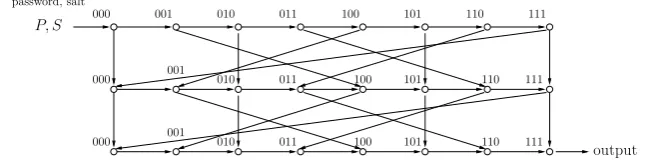
Specification. Catena-D is essentially a mode of operation over the hash functionF, which is be instantiated by Blake2b [10] in the full or reduced-round version. The functional graph of Catena-D is determined by the time parameterλ(valuesλ= 1,2 are recommended) and the memory parametern, and can be viewed as (λ+ 1)-layer graph with 2n vertices in each layer (denoted by Catena-D-λ). We denote the X-th vertex
in layerl (both count from 0) by [X]l. With each vertex we associate the corresponding output of the hash
functionF and denote it by [Xl] as well. The outputs are stored in the memory, and due to the memory
access pattern it is sufficient to store only 2n blocks at each moment. The hash function H has 512-bit
output, so the total memory requirements are 2n+6 bytes.
First layer is filled as follows
– [0]0=G
1(P, S), whereG1 invokes 3 calls toF; – [1]0=G
2(P, S), whereG2 invokes 3 calls toF – [i]0
←F([i−1]0,[i
−2]0), 2
≤i≤2n −1.
Then 23n/4nodes of the first layer are modified by functionΓ. The details ofΓ are irrelevant to our attack.
The memory access pattern at the next layers is determined by thebit-reversal permutation ν. Each index is viewed as an n-bit string and is transformed as follows:
ν(x1x2. . . xn) =xnxn−1. . . x1, wherexi∈ {0,1}.
The layers are then computed as
– [0]j =F([0]j−1 ||[2n
−1]j−1); – [i]j =F([i
−1]j
||[ν(i)]j−1).
Thus to compute [X]l we need [ν(X)l−1]. The latter can be then overwritten5. An example of Catena-D
withλ= 2 andn= 3 is shown at Figure 1.
The bit-reversal permutation is supposed to provide memory-hardness. The intuition is that it maps any segment to a set of blocks that are evenly distributed at the upper layer.
5 In terms of Equation (1) we could enumerate all blocks as [i]j=j|| i
|{z}
nbits
000 001 010 011 100 101 110 111
111
000 001 010 011 100 101 110
111
000 001 010 011 100 101 110
P, S
output
password, salt
Fig. 1.Catena-D-2 with n= 3. 3 layers, 8 vertices per layer.
Original tradeoff analysis. The authors of Catena-D originally provided two types of security bounds against tradeoff attacks. Recall that Catena-D-λcan be computed withλ2ncalls toF using 2nmemory blocks. The
Catena-D designers demonstrated that Catena-D-λ can be computed using λS memory blocks with time complexity6
T ≤2n+ 2n
2n
2S λ−1
+ 2n
2n
2S λ
Therefore, if we reduce the memory by the factor ofq, i.e. use only 2n
q blocks, we get the following penalty:
Pλ(q)≈ q
2
λ
. (5)
The second result is the lower bound for tradeoff attacks with memory reduction byq:
Pλ(q)≥Ω qλ. (6)
However the constant in Ω() is too small (2−18 forλ = 3) to be helpful in bounding tradeoff attacks for
smallq. More importantly, the proof is flawed: the result forλ= 1 is incorrectly generalized for largerλ. The reason seems to be that the authors assumed some independence between the layers, which is apparently not the case (and is somewhat exploited in our attack).
In the further text we demonstrate a tradeoff attack yielding much smaller penalties than Eq. (5) and thus asymptotically violating Eq. (6).
3.2 Our tradeoff attack on Catena-D
The idea of our method is based on the simple fact that
ν(ν(X)) =X,
whereX can be a single index or a set of indices. We exploit it as follows. We partition layers intosegments of length 2k for some integerk, and store the first block of every segment (first two blocks at layer 0). As
the index of such a block ends withkzeros, we denote the set of these blocks as [∗n−k0k]. We also store all
23n/4 blocks modified byΓ, which we denote by [Γ].
Consider a single segment [AB∗k], whereAis ak-bit constant,B is a n
−2k-bit constant. Then
ν([AB∗k]) = [
∗kν(B)ν(A)].
Blocks [∗kν(B)ν(A)] belong to 2k segments that haveν(B) in the middle of the index. Denote the union of
these segments by [∗kν(B)
∗k]. Now note that ν([∗k
ν(B)∗k
]) = [∗k B∗k
],
and
ν(ν([∗kB
∗k])) = [ ∗kB
∗k].
Therefore, when we iterate the permutation ν, we are always within some 2k segments. We suggest the
computing strategy in Algorithm 1. At layer twe recompute 2k full segments from layers 0 tot
−2 and 2k
subsegments of lengthν(A) (interpreted as a number in the binary form) at layert−1. Therefore, the total cost of computing layertis
C(t) =X
A X
B
((t−1)22k+ν(A)2k+ 2k) =
=X
A
((t−1)2n+ν(A)2n−k+ 2n−k) = (t
−1)2n+k+ 2n+k−1+ 2n= (t
−12)2n+k+ 2n. (7)
Algorithm 1Tradeoff for Catena-Dragonfly. 1. Compute layer 0 storing [∗n−k
0k]0 and [∗n−k
0k−11]0, i.e. the first two blocks of every segment. 2. ComputeΓ and store all the updated blocks [Γ] in the memory.
3. Compute layer 1 segmentwise: for each segment [AB∗k
]1 recompute blocks [∗k
ν(B)ν(A)]0 using stored blocks from layer 0 and [Γ]. Store blocks [∗n−k0k]1.
4. Compute layer 2 segmentwise: for each segment [AB∗k
]2 recompute 2k segments [∗k
Bk]0 using stored blocks from layer 0, then use them to recompute blocks [∗k
ν(B)ν(A)]1 using [Γ], then compute [AB∗k
]2. Store blocks [∗n−k0k]2.
5. Compute layer 3 segmentwise: for each segment [AB∗k
]3 recompute 2k segments [∗k
ν(B)k]0 using stored blocks from layer 0, then recompute 2k segments [∗kBk]1 using stored blocks from layer 1 and [Γ], then recompute blocks [∗k
ν(B)ν(A)]2, then compute [AB∗k
]3. Store blocks [∗n−k
0k]3. 6. Compute other layers in the similar fashion.
The total cost of computing Catena-D-λis
2n
λ2
2 2
k
+λ+ 1
.
We store (t+ 1)2n−k blocks as segment starting points, 23n/4 blocks [Γ] and 22k blocks for intermediate
computations. Fork= logq+ log(λ+ 1) andq <2n/4we store about 2n/qblocks, so the memory is reduced
by the factor of q. This value ofkyields the total computational complexity of
Cq = 2n
qλ2(λ+ 1)
2 +λ+ 1
(8)
Since the computational complexity of the memory-full algorithm is (λ+ 1)2n, our tradeoff method gives
the computational penalty
qλ2
2 + 1.
Since Catena is a data-independent scheme, the latency of our method does not increase. Therefore, the time-memory product (Equation (4)) can be reduced by the factor of 2n/4. We can estimate how AT costs
evolves assuming the reference implementation in Section 2.3:
ATBq= 2
n
qλ2(λ+ 1)
2 +λ+ 1
·3000 + (λ+ 1)2n2 n
q .
Forq= 2n/5 andλ= 2 we get
ATB
2n/5 = 2 n
6·2n/5·211.5+ 3·29n/5.
Forn= 24 (1GB of RAM) we get
ATB24.8 ≈2
24+2.5+4.8+11.5+ 243.2+1.5 ≈244.
whereas
ATB1 = 2 49.5.
Therefore, we expect the time-area product dropped by the factor of about 25 if the memory is reduced by the factor of 30. In the terms of Definition 1, Catena-D-2 is not (1/25,AT)-secure. Our tradeoff method also have AT and TM compactness at least 2n/5= 64.
On other architectures the AT may drop even further, and we expect that an adversary would choose the one that maximizes the tradeoff effect, so the actual impact of our attack can be even higher.
Violation of Catena-D lower bound Our method shows that the Catena-D lower bound is wrong. If
we summarize the computational costs for λlayers, we obtain the following computational penalty for the memory reduction by the factor ofq:
CPλ(q) =O(λ3q),
which is asymptotically smaller than the lower boundΩ(qλ) (Equation (6)) from the original Catena
3.3 Other results for Catena
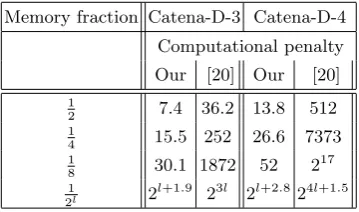
Our attack on Catena can be further scrutinized and generalized to non-even segments. More details are provided in [14] with the summary given in Table 2.
4
Generic precomputation tradeoff attack
Now we try to generalize the tradeoff method used in the attack on Catena for a class of data-independent schemes. We consider schemes G where each memory block is a function of the previous block and some earlier block:
X[i]←F(X[i−1], X[φ(i)]),0≤i < T
where φis a deterministic function such that φ(i)< i. A group of existing password hashing schemes falls into this category: Catena [20], Pomelo [36], Lyra2 [25] (first phase). Multiple iterations of such a scheme are equivalent to a single iteration with larger T and an additional restriction
x−M ≤φ(x),
so that the memory requirements areM blocks.
The crucial property of the data-independent attacks is that they can be tested and tuned offline, without hashing any real password. An attacker may spend significant time to search for an optimal tradeoff strategy, since it would then apply to the whole set of passwords hashed with this scheme.
Precomputation method. Our tradeoff method generalizes as follows. We divide memory into segments and store only the first block of each segment. For every segmentIwe calculate its imageφ(I). Letφ(I) be the union of segments that contain φ(I). We repeat this process until we get an invariant setUk =U(I):
I |{z}
U0
→φ(I)
| {z } U1
→φ(φ(I))
| {z }
U2
· · · →Uk.
The schemeG is then computed according to Algorithm 2.
Algorithm 2Precomputation method
– For all segments precompute the block indices in the union chainsI→U(I) – ComputeGby segment. For each segmentI:
1. Compute blocksU(I) =Uk;
2. Compute blocks inUk−1, then inUk−2, up toU0 =I. 3. Store the first block ofIin the memory.
The total amount of calls toF isP
i≥0|Ui|, and the penalty to computeI is
CP(I) =
P i≥0|Ui|
|I| .
How efficient the tradeoff is depends on the properties of φ and the segment partition, i.e. how fast Ui
expands. As we have seen, Catena uses a bit permutation for φ, whereas Lyra2 uses a simple arithmetic
Memory fraction Catena-D-3 Catena-D-4 Computational penalty Our [20] Our [20]
1
2 7.4 36.2 13.8 512 1
4 15.5 252 26.6 7373 1
8 30.1 1872 52 2 17
1
2l 2
l+1.9
23l 2l+2.824l+1.5
function or a bit permutation [20, 25]. In both casesUi stabilizes in size after two iterations. Ifφis a more
sophisticated function, the following heuristics (borrowed from our attacks on data-dependent schemes) might be helpful:
– Store the firstT1computed blocks and the lastT2computed blocks for someT1, T2(usually aboutN/q). – Keep the listLof the most expensive blocks to recompute and storeM[i] ifφ(i)∈ L.
I=U0
U1
U2
Fig. 2.Segment unions in the precomputation method.
5
Generic ranking tradeoff attack
Now we present a generic attack on a wide class of schemes with data-dependent memory addressing. Such schemes include scrypt [30] and the PHC finalists yescrypt[31], Argon2d [13], and Lyra2 [25]. We consider the schemes described by Equation (1) with k= 2 and the following addressing (cf. also Figure 3):
X[1] =f(I) for 1< i < T
ri=g(X[i−1]);
X[i] =F(X[i−1], X[ri]).
(9)
Here g is some indexing function. This construction and our tradeoff method can be easily generalized to multiple functions F, to stateful functions (like in Lyra2), to multiple inputs, outputs, and passes, etc. However, for the sake of simplicity we restrict to the construction above.
? M[0] M[1] M[2]
M[i]
M[ri] M[i−1]
F F F F F F
Fig. 3.Data-dependent schemes.
Our tradeoff strategy is following: we compute the blocks sequentially and for each blockX[i] decide if we store it or not. If we do not store it, we calculate itsaccess complexity A(i) – the number of calls needed to recompute it as a sum of access complexities ofX[i−1] andX[ri] plus one. If we storeX[i], its access
complexity is 0.
The storing heuristic rule is the crucial element of our strategy. The idea is to store the block ifA(ri) is
too high.
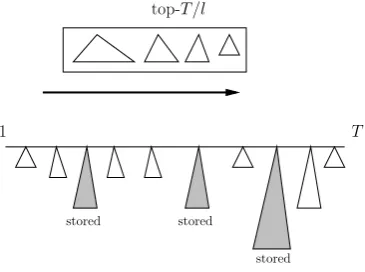
Ourranking tradeoff method works according to Algorithm 3 (Figure 4).
Herew, sandl are parameters, and we usually set l= 3s. The computational complexity is computed as
C=X
i A(ri).
We also compute the latency L(i) of each block asL(i) = max(L(ri), L(i−1)) + 1 if we do not storeX[i]
andL(i) = 0 if we store it. Then the total latency is
L=X
Algorithm 3Ranking method
1. Split the memory into segments ofsblocks;
2. Keep the sorted listLof theT /lhighest access complexities, initialize it with all zeros; 3. Temporarily store lastwblocks.
4. Compute blocks sequentially. For blockX[i], ifX[ri] is missing, recompute it.
5. IfX[i] is the starting block of the segment, we store it and setA(i) = 0;
6. IfX[i] is not the starting block of the segment, butA(ri)∈ L, we storeX[i] and setA(i) = 0;
7. If X[i] is not the starting block of the segment, andA(ri) ∈ L/ , we do not store X[i] and setA(i) =A(ri) +
A(i−1) + 1.
We implemented our attack and tested it on the class of functions described by Equation (9). For fixed
w and sthe total number of calls to F and the number of stored blocks is entirely determined by indices
{ri}. Thus we do not have to implement a real hash function, and it is sufficient to generateri according
to some distribution, model the computation as a directed acyclic graph, and compute C and L for this graph. We made a number of tests with uniformly randomri (within the segment [0;i] and T = 212) and
different values of wand s. Then we grouped C and L values by the memory complexity and figured the lowest complexities for each memory reduction factor. These values are given in Table 3.
1 T
top-T /l
stored stored
stored
Fig. 4. Outline of the ranking tradeoff method.
Memory fraction (1/q) 1 2
1 3
1 4
1 5
1 6
1 7
1 8
1 9
1 10 Computation penaltyCP(q) 1.59 2.98 7.3 16.6 57.5 180 635 3340 213.2
Latency penaltyLP(q) 1.56 2.55 4 5.8 8.7 11.6 15.4 21.1 24.8 AT ratio 0.78 0.85 1.02 1.16 1.45 1.69 2.04 2.97 4.24 TM ratio 0.78 0.85 1.02 1.16 1.45 1.65 1.9 2.34 2.48 Segment lengths 3 5 8 10 13 16 18 21 23
Window size w
M 0.06 0.01 0.01 0 0 0 0 0 0
Table 3. Computational, latency, AT (for Rc = 3000 and M = 224), and TM penalties for the ranking
tradeoff attack on generic data-dependent schemes.
6
Cryptanalysis of
yescrypt
6.1 Description
yescrypt[31] is another PHC finalist, which is built upon scrypt and is notable for its high memory filling rate (up to 2 GB/sec) and a number of features, which includes custom S-boxes to thwart exhaustive search on GPU, multiplicative chains to increase the ASIC latency, and some others.yescryptis essentially a family of functions, each member activated by a combination of flags. Due to the page limits, we consider only one function of the family.
Here we consider theyescryptsetting where flagyescryptRW is set, there is no parallelism, and no ROM (in the further text – just yescrypt). It operates on 1024-byte memory blocks X[1], X[2], . . . , X[M]. The scheme works as follows:
X[1]←F0(I);
X[i]←F(X[i−1]⊕X[φ(i)]), 1< i≤M;
Y ←X[M];
Y ←X[Y modM])←F(Y ⊕X[Y (mod M)]), M < i≤T.
Here F and F0 are compression functions (the details of F0 are irrelevant for the attack). Therefore, the
memory is filled in the firstM steps and then (T−M) blocks are updated using the state variableY. Here
φ(i) is the data-dependent indexing function: it takes 32 bits ofX[i−1] and interprets it as a random block index among the last 2k blocks, where 2k is the largest power of 2 that is smaller thani.
TransformationF operates on 1024-byte blocks as follows:
– Blocks are partitioned into 16 64-byte subblocksB0, B1, . . . , B15. – New blocks are produced sequentially:
Bnew 0 ←f(B
old 0 ⊕B
old 15); Bnew
i ←f(Binew−1 ⊕Biold), 0< i <16.
The details off are irrelevant to our attack.
6.2 Tradeoff attack on yescrypt
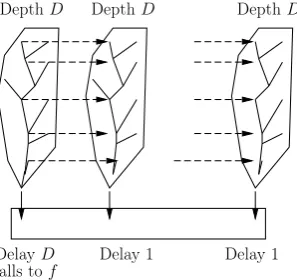
Our crucial observation is that there is no diffusion from the last subblocks to the first ones. Thus if we store allB0, we break the dependencies between consecutive blocks and the subblocks can be recomputed
from B1 toB15 with pipelining (Figure 5). Suppose that the blockX[i] is computed with latencyL(i), i.e.
its computation tree hasL(i) levels if measured inF. However, if we consider the tree off, then the actual latency ofX[i] isL(i) + 15 instead of expected 16L(i) if measured in calls tof.
The tradeoff strategy is given in Algorithm 4.
Algorithm 4Tradeoff attack onyescrypt.
1. Start the ranking tradeoff method with some parametersw, s; 2. StoreB0 of each block;
3. IfX[i] needs the missing blockX[ri]:
(a) ComputeB0 ofX[i] using one call tof, as all previousB0 are stored; (b) ComputeB1.
(c) WhileB1 is recomputed, start recomputing B2, as it needs exactly the same subblocks used in the recom-putation ofB1. This adds latency of one call tof.
(d) ComputeBi for all otheri.
If the missing block is recomputed by a tree of depthD, then the latency of the new block is D+ 16 measured in calls tof, or D
16+ 1 if measured in calls toF. This number should be compared to the latency D+ 1 if we had not exploited the iterative structure ofF. Thus if the ranking method gives the total latency
L(measured inF), the actual latency should be L+15 16 .
Memory 1 1 2
1 3
1 4
1 5
1 6
1 7
1 8 Computation penaltyCP(q) 1 2.9 26 1135 219 − − −
Latency penaltyLP(q) 1 1.1 1.4 2 3.5 6.3 11.1 17.5
TM ratio 1 0.55 0.47 0.5 0.75 1.05 1.59 2.19 AT ratio 1 0.55 0.46 0.7 95 − − −
Table 4. Computational, latency, AT (for Rc = 3000 and M = 224), and TM penalties for the ranking
tradeoff attack onyescryptmode of operation with 4/3 passes, using the iterative structure ofF.
DepthD DepthD
DelayD Delay 1
DepthD
Delay 1 calls tof
Fig. 5. Pipelining the block computation in yescrypt: only the first subblock is computed with delayD.
7
Future work
Our tradeoff methods apply to a wide class of memory-hard functions, so our research can be continued in the following directions:
– Application of our methods to other PHC candidates and finalists: Pomelo [36] and the modified Lyra2.
– Set of design criteria for the indexing functions that would withstand our attacks.
– New methods that directly target schemes that make multiple passes over memory or use parallel cores.
– Design a set of tools that helps to choose a proof-of-work instance in various applications: cryptocur-rencies, proofs of space, etc.
8
Conclusion
Tradeoff cryptanalysis of memory hard functions is a young, relatively unexplored and complex area of research combining cryptanalytic techniques with understanding of implementation aspects and hardware constraints. It has direct real-world impact since its results can be immediately used in the on-going arms race of mining hardware for the cryptocurrencies.
In this paper we have analyzed memory-hard functions Catena-Dragonfly andyescrypt. We show that Catena-Dragonfly is not memory-hard despite original claims and the security proof by the designers’, since a hardware-equipped adversary can reduce the attack costs significantly using our tradeoffs. We also show that yescryptis more tradeoff-resilient than Catena, though we can still exploit several design decisions to reduce the time-memory and the time-area product by the factor of 2.
We generalize our ideas to the generic precomputation method for data-independent schemes and the generic ranking method for the data-dependent schemes. Our techniques may be used to estimate the attack cost in various applications from the fast emerging area of memory-hard cryptocurrencies to the password-based key derivation.
9
Acknowledgement
A
Cryptanalysis of Lyra2 v1
A.1 Description of Lyra2 v1
Lyra2 [25] is a PHC finalist, notable for its high memory filling rate (up to 1 GB/sec). Very recently, Lyra2 has been significantly changed for the second round of the competition. This section describes the original submission to PHC [25], Lyra2 v1 (just Lyra2 in the further text).
Lyra2 is a hybrid hashing scheme, which uses independent addressing in the first phase and data-dependent addressing in the second phase. Lyra2 operates on blocks of 768 bits (96 bytes) each, and fills the memory with 2n
·C such blocks, where nandC are parameters, and C is by default set to 128 [25, p.39]. In this paper we useC = 128. The entire memory is represented as a (2n
×C)-matrixM, and we refer to its components as rows and columns. Rows are denoted by M[i].
Lyra2 has two main phases: the single-iteration Setup phase, where the memory is addressed data-independently, and the multiple-iterationWandering phase, where the memory is addressed data-dependently. The numberT of iterations in the Wandering phase can be as low as 1, and we take this value in our analysis.
Setup phase. The first phase fills rows sequentially from M[0] toM[2n
−1] as follows:
M[0], M[1]←f(Password,Salt); forifrom 2 to 2n
−1
M[i]←F(M[i−1], M[φ(i)]);
M[φ(i)]←M[φ(i)]⊕←−−M[i].
Here φ(i) = 2k
−i, where 2k is the smallest power of 2 that is not smaller thani,←−−M[] stands for the left
rotation of each 768-bit word by 32 bits, andGis a cryptographic hash function. The following details ofF are relevant to our attack:
– FunctionF is stateful: it operates on the 1024-bit stateS, which is preserved between rows.
– Function F(X, Y) processes columns Xi, Yi of X and Y sequentially. The internal state undergoes C
rounds (similarly to the duplex-sponge construction [12]), where in roundi columnZi of the outputZ
is produced as follows:
S ←S⊕Xi⊕Yi; S ←P(S);
Zi←768 least sign. bits of (S).
HerePis a single round of the Blake2b internal permutation [10]. We do not exploit any specific property ofP. ThusF can be seen as a duplex-sponge instantiated with a Blake2b round function.
We remind the reader that Z is used not only to produce a new row M[i] but also to overwrite the row
M[2k −i].
Wandering phase. The Wandering phase transforms the blocks produced in the Setup phase. First, it reverses the ordering. Then it operates similarly to the Setup phase, but the second input block to F is taken pseudo-randomly:
fori from 1 to 2n −1
ri←g(M[i−1], i−1);
M[i]←M[i]⊕F(M[i−1], M[ri]);
M[ri]←M[ri]⊕F←−−−−−−−−−−−−−(M[i−1], M[ri]).
Here gtruncates the first input to the least significant 32 bits and xores with the second input. All indices are computed modulo 2n.
A.2 Tradeoff attack on the Setup and Wandering phases of Lyra2
Let us denote a segment of rows{M[i], M[i+ 1], . . . , M[j]} byM[i:j]. Considera, bsuch that 2k−1< a < b <2k. Then
φ([a:b]) = [(2k
−b) : (2k −a)].
Thus to construct a single segment we need another segment of the same length. This suggests the following strategy for computing 2n rows in the Setup phase.
1. First 2n−l rowsM[0], . . . , M[2n−l
−1] for somel >0 (parameter of the attack). 2. We split rows fromM[2n−l] toM[2n
−1] into segments of length qfor some q <2n−l. Store the entire
stateS at the start of each segment.
Then to compute segmentM[a:a+q−1],2k−1< a <2kwe have to computeM[φ(a:a+q
−1)], which has been updated when computing segments between 2k−2 and 2k−1. Eventually we reach the stored 2n−l
rows. To computeM[a:a+q−1],2k−1< a <2k we need to compute a segment in the interval [2i: 2i+1]
for eachn−l < i < k(Figure 6).
Let us figure out the memory reduction and the computational overhead of this procedure. We store 2n−l
first rows and 2n
96q rows for starting state in each segment, then a segment of lengthqduring recomputation.
For segments between rowsM[2n−l] andM[2n−l+1] we need 1 call toFper row, as there is no recomputation.
For segments between rowsM[2n−l+1] andM[2n−l+2] we need 2 calls to F per row, and so on. In general,
we make
(k−n+l)q (10)
calls to F to compute a segment of lengthq between row indices 2k and 2k+1. For the entire Setup phase
we spend
2n−l | {z } M[0:2n−l−1]
+ 2n−l | {z } M[2n−l:2n−l+1−1]
+2·2n−l+1+ 3
·2n−l+2+
· · ·+l2n−1
≤(l−0.5)2n
calls toF. The memory requirements are 2n−l+q+ 2n
96q, which reaches the minimum of 2
n−l+ 2n/2−4.5 for q= 2n/2−5.5.
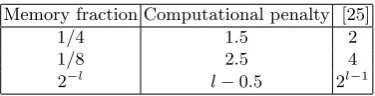
To summarize, our tradeoff algorithmB has computational penalty (l−0.5) if the memory is reduced by the factor of 2l (Table 5).
a 2k−b
2k−1 q
2n−l
updated blocks Indices of
Time
b 2k−a
Fig. 6.Computing segment of lengthq with precomputation method in the Setup phase of Lyra2.
Memory fraction Computational penalty [25]
1/4 1.5 2
1/8 2.5 4
2−l l−0.5 2l−1
Access complexity of a single row.In the next phase we will need to calculate the cost of recomputing a single row rather than a segment. To compute a single row, we need to recompute (l−0.5) segments on average, so the average recomputation complexity is:
A=q(l−0.5). (11)
Tradeoff attack on the Wandering phase of Lyra2 withT = 1.
We apply the ranking method to the Wandering phase of Lyra2. Since Lyra2 updates two rows at once, its penalties are higher than in generic data-dependent schemes and are given in Table 6.
Memory fraction 1 2
1 3
1 4
1 5
1 6
1 7
1 8
1 10
1 12
1 16 Computation penalty 2.7 10.4 75 1071 214 2n 2n2n 2n 2n Depth penalty 2.4 4.8 8.9 15.4 23.8 35.7 49 83 124 193
Table 6. Average computational and depth penalties for the ranking method on the Wandering phase of
Lyra2, without exploiting the row pipelining.
A.3 Tradeoff for the full Lyra2 withT = 1
Memory partition. To run the attack on the full Lyra2 with fraction 1/l of memory, we have to split the available memory between Setup and Wandering phases. Suppose that we allocate fractionαof memory for the Setup phase and fractionβof memory for the Wandering phase. LetPS(α) be the penalty of running the
Setup phase with fraction α, PR(α) be the average access complexity of a single row from the Setup phase
run with fractionα(Eq. (11)), andPW(β) be the penalty of running the Wandering phase with fractionβ
(Table 6). Then the total memory reduction will be α+β. To estimate the time penalty, we note that in our tradeoff for the Wandering phase, each recomputation requests as many rows from the Setup phase as many hash calls is made in the Wandering phase. Therefore, the total time penalty would be estimated as
P(α+β) = PS(α)2
n+P
R(α)PW(β)2n
2n+1 ,
as we construct 2·2n blocks in two phases.
Exploiting iterative compression function Similarly to the attack onyescrypt we can exploit the fact that Lyra2 produces blocks of a row columnwise. Therefore, we have to makeD calls toP to compute the first column of the block, whereas computation of other columns can be pipelined: the second column of the deepest tree level can be computed simultaneously with the first column of one level higher. To compute all 128 columns, we spend time needed to computeD+ 128 columns only, so the actual latency penalty is 1 +D/128. Therefore, the total latency penalty can be calculated as follows:
D(α+β) = DS(α) +
DR(α)+DW(β)
128 + 1
2 ,
where DS(α) = 1−(logα)/256 is the average latency penalty in the Setup phase, DR(α) =−logα−0.5
is the average latency penalty for accessing the row from the Setup phase, andDW(β) is the depth penalty
for the Wandering phase given in Table 6.
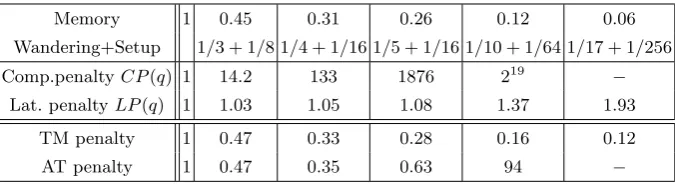
The results are given in Table 7. We conclude that Lyra2 is only (0.33, AT)-secure and (0.1, T M)-secure. The AT compactness is 4 and the TM compactness is 16.Thus Lyra2 v1 is more susceptible to tradeoff attacks compared toyescrypt.
References
1. Litecoin: Mining hardware comparison. https://litecoin.info/Mining_hardware_comparison. 2. Password Hashing Competition. https://password-hashing.net/.
Memory 1 0.45 0.31 0.26 0.12 0.06 Wandering+Setup 1/3 + 1/8 1/4 + 1/16 1/5 + 1/16 1/10 + 1/64 1/17 + 1/256 Comp.penaltyCP(q) 1 14.2 133 1876 219 −
Lat. penaltyLP(q) 1 1.03 1.05 1.08 1.37 1.93
TM penalty 1 0.47 0.33 0.28 0.16 0.12 AT penalty 1 0.47 0.35 0.63 94 −
Table 7. Computational, latency, AT (assuming Rc = 3000 and M = 224) and TM penalties for the
ranking tradeoff attack on Lyra2 v1 withT = 1. Memory fraction is given as a sum of Wandering and Setup allocations
5. IETF Draft: The scrypt Password-Based Key Derivation Function, 2012. https://tools.ietf.org/html/ draft-josefsson-scrypt-kdf-02.
6. Bitcoin: Mining hardware comparison, 2014. https://en.bitcoin.it/wiki/Mining_hardware_comparison. 7. Vertcoin: Lyra2RE reference guide, 2014. https://vertcoin.org/downloads/Vertcoin_Lyra2RE_Paper_
11292014.pdf.
8. Mart´ın Abadi, Michael Burrows, Mark S. Manasse, and Ted Wobber. Moderately hard, memory-bound functions. ACM Trans. Internet Techn., 5(2):299–327, 2005.
9. Jo¨el Alwen and Vladimir Serbinenko. High parallel complexity graphs and memory-hard functions. IACR Cryptology ePrint Archive 2014/238.
10. Jean-Philippe Aumasson, Samuel Neves, Zooko Wilcox-O’Hearn, and Christian Winnerlein. BLAKE2: simpler, smaller, fast as MD5. InACNS’13, volume 7954 ofLecture Notes in Computer Science, pages 119–135. Springer, 2013.
11. Daniel J. Bernstein and Tanja Lange. Non-uniform cracks in the concrete: The power of free precomputation. InASIACRYPT’13, volume 8270 ofLecture Notes in Computer Science, pages 321–340. Springer, 2013. 12. Guido Bertoni, Joan Daemen, Michael Peeters, and Gilles Van Assche. Duplexing the sponge: Single-pass
authenticated encryption and other applications. InSAC’11,.
13. Alex Biryukov, Daniel Dinu, and Dmitry Khovratovich. Argon and argon2: password hashing scheme. Technical report, 2015. https://password-hashing.net/submissions/specs/Argon-v2.pdf.
14. Alex Biryukov and Dmitry Khovratovich. Tradeoff cryptanalysis of memory-hard functions. Cryptology ePrint Archive, Report 2015/227, 2015. http://eprint.iacr.org/.
15. Alex Biryukov and Ivan Pustogarov. Proof-of-work as anonymous micropayment: Rewarding a Tor relay. IACR Cryptology ePrint Archive 2014/1011. to appear at Financial Cryptography 2015.
16. Donghoon Chang, Arpan Jati, Sweta Mishra, and Somitra Kumar Sanadhya. Time memory tradeoff analysis of graphs in password hashing constructions. InPreproceedings of PASSWORDS’14, pages 256–266, 2014. available athttp://passwords14.item.ntnu.no/Preproceedings_Passwords14.pdf.
17. Cynthia Dwork, Andrew Goldberg, and Moni Naor. On memory-bound functions for fighting spam. In CRYPTO’03, volume 2729 ofLecture Notes in Computer Science, pages 426–444. Springer, 2003.
18. Cynthia Dwork, Moni Naor, and Hoeteck Wee. Pebbling and proofs of work. In CRYPTO’05, volume 3621 of Lecture Notes in Computer Science, pages 37–54. Springer, 2005.
19. Stefan Dziembowski, Sebastian Faust, Vladimir Kolmogorov, and Krzysztof Pietrzak. Proofs of space. IACR Cryptology ePrint Archive 2013/796, to appear at Crypto 2015.
20. Christian Forler, Stefan Lucks, and Jakob Wenzel. Catena: A memory-consuming password scrambler. IACR Cryptology ePrint Archive, Report 2013/525. Version of 5 Jan 2014,https: // eprint. iacr. org/ eprint-bin/
getfile. pl? entry= 2013/ 525& version= 20140105: 194859& file= 525. pdf, 2014.
21. Christian Forler, Stefan Lucks, and Jakob Wenzel. Memory-demanding password scrambling. InASIACRYPT’14, volume 8874 ofLecture Notes in Computer Science, pages 289–305. Springer, 2014.
22. Bharan Giridhar, Michael Cieslak, Deepankar Duggal, Ronald G. Dreslinski, Hsing Min Chen, Robert Patti, Betina Hold, Chaitali Chakrabarti, Trevor N. Mudge, and David Blaauw. Exploring DRAM organizations for energy-efficient and resilient exascale memories. InInternational Conference for High Performance Computing, Networking, Storage and Analysis (SC 2013), pages 23–35. ACM, 2013.
23. Frank G¨urkaynak, Kris Gaj, Beat Muheim, Ekawat Homsirikamol, Christoph Keller, Marcin Rogawski, Hubert Kaeslin, and Jens-Peter Kaps. Lessons learned from designing a 65nm ASIC for evaluating third round SHA-3 candidates. InThird SHA-3 Candidate Conference, March 2012.
24. John E. Hopcroft, Wolfgang J. Paul, and Leslie G. Valiant. On time versus space. J. ACM, 24(2):332–337, 1977. 25. Marcos A. Simplicio Jr, Leonardo C. Almeida, Ewerton R. Andrade, Paulo C. F. dos Santos, and Paulo S. L. M.
Barreto. The Lyra2 reference guide, version 2.3.2. Technical report, april 2014.
26. Thomas Lengauer and Robert Endre Tarjan. Asymptotically tight bounds on time-space trade-offs in a pebble game. J. ACM, 29(4):1087–1130, 1982.
28. Sourav Mukhopadhyay and Palash Sarkar. On the effectiveness of TMTO and exhaustive search attacks. In IWSEC 2006, volume 4266 ofLecture Notes in Computer Science, pages 337–352. Springer, 2006.
29. Satoshi Nakamoto. Bitcoin: A peer-to-peer electronic cash system. 2009. http://www.bitcoin.org/bitcoin. pdf.
30. Colin Percival. Stronger key derivation via sequential memory-hard functions. 2009.http://www.tarsnap.com/ scrypt/scrypt.pdf.
31. Alexander Peslyak. Yescrypt - a password hashing competition submission. Technical report, 2014. available at https://password-hashing.net/submissions/specs/yescrypt-v0.pdf.
32. Nicholas Pippenger. Superconcentrators. SIAM J. Comput., 6(2):298–304, 1977.
33. Thomas Ristenpart, Eran Tromer, Hovav Shacham, and Stefan Savage. Hey, you, get off of my cloud: exploring information leakage in third-party compute clouds. In Proceedings of the 2009 ACM Conference on Computer and Communications Security, CCS 2009, Chicago, Illinois, USA, November 9-13, 2009, pages 199–212, 2009. 34. Martijn Sprengers and Lejla Batina. Speeding up GPU-based password cracking. InSHARCS’12, 2012. available
athttp://2012.sharcs.org/record.pdf.
35. Clark D. Thompson. Area-time complexity for VLSI. InSTOC’79, pages 81–88. ACM, 1979.