Secure Physical Computation using Disposable
Circuits
Ben A. Fisch1, Daniel Freund2, and Moni Naor?3 1
Cornell [email protected] 3 Weizmann Institute of Science
Abstract. In asecure physical computation, a set of parties each have physical inputs and jointly compute a function of their inputs in a way that reveals no information to any party except for the output of the function. Recent work in CRYPTO’14 presented examples of physical
zero-knowledge proofs of physical properties, a special case of secure physical two-party computation in which one party has a physical input and the second party verifies a boolean function of that input. While the work suggested a general framework for modeling and analyzing physi-cal zero-knowledge protocols, it did not provide a general theory of how to prove any physical property with zero-knowledge. This paper takes an orthogonal approach usingdisposable circuits(DC)—cheap hardware tokens that can be completely destroyed after a computation—an ex-tension of the familiar tamper-proof token model. In the DC model, we demonstrate that two parties can compute any function of their physical inputs in a way that leaks at most 1 bit of additional information to either party. Moreover, our result generalizes to any multi-party physical computation. Formally, our protocols achieve unconditional UC-security with input-dependent abort.
1
Introduction
In asecure two-party computation(2PC), parties A and B each have secret inputs
xAandxBrespectively, and they jointly compute a functionf(xA, xB) such that each party receives the output of the function, but no further information about the other party’s secret input. Asecure multi-party computation(MPC) extends 2PC to an arbitrary number of parties each with private inputs to a multi-party function. As early as the 1980s, various results demonstrated that any two-party or multi-party function can be securely computed under standard cryptographic assumptions [21, 9].
In the present work, we consider secure computation in a physical context where each party’s input is a physical entity. For example, suppose parties A
?
and B wish to securely compute a function of their DNA (e.g. whether they are both carriers of a certain recessive gene). Unless the parties trust each other to honestly supply their genetic information as digital inputs, they cannot use standard secure 2PC to solve this task. They also may not trust one another to directly measure each other’s genetic information and potentially learn more than the necessary information. To solve this task, the parties require asecure physical computation that is guaranteed to return to both parties the correct function output of the physical inputs and simultaneously prevent either party from learning more than the function output.
A special case of physical secure computation is a physical zero-knowledge proof, where a Prover must prove to a Verifier that a physical input object sat-isfies a physical property without revealing any further information about the input. Informal examples of physical zero-knowledge have appeared throughout the literature [19, 20]. Recent work of [4] introduced formal definitions and an analysis framework for physical zero-knowledge protocols, and gave examples of protocols for comparing DNA profiles and neutron radiographs of objects. Earlier work of [7, 8] used physical zero-knowledge techniques to demonstrate that two nuclear warheads have the same design without revealing further information on the design. The necessity for such a protocol arises in nuclear disengagement, where one country must prove to the other that it is destroying authentic nu-clear weapons without revealing sensitive information on that weapon’s design. Previous techniques relied oninformation barriers, or trusted devices that would measure the input objects and display only a red (reject) or green (accept) light. However, in absence of trust, information barriers are problematic as they may reveal too much information to the inspecting party, or may display false infor-mation. The protocols in [4] and [7] avoid information barriers and instead use techniques that physically manipulate the inputs and enable the inspecting party to verify physical properties without ever recording any sensitive information. Such protocols seem to be inherently problem-specific, and there is no general zero-knowledge protocol presented for proving any arbitrary physical property of any input.
Many previous works have explored the use of physical hardware and physical separation in cryptographic protocols. Ben-Or et. al. [1] introduced the multi-prover interactive proof system (MIP) model, and showed that with two physi-cally isolated provers it is possible to achieve unconditionally secure ZK proofs for NP. In addition, they showed similar results for bit commitment and Rabin-OT. Goldreich and Ostrovsky [10] demonstrated uses of tamper-proof hardware for the purpose of software protection. Katz [15] initiated a long line of works that used tamper-proof hardware to achieve universally composable (UC) secu-rity in multi-party computation protocols. In particular, Goyal et. al. [12] showed that tamper-proof hardware could be used to achieve unconditional UC-secure non-interactive multi-party computation.
Our model of disposable circuits is an extension of the standard stateful tamper-proof token model, which was first formalized by Katz [15]. The tokens in our model have the additional capability to measure physical inputs. In par-ticular, a party in our model has the ability to create a token that will directly probe a specific physical input held by another party. We assume that both parties can reference the same object by some uniquely identifiable physical in-formation even if all further physical characteristics of that object are secret. For example, the physical input might be a box held by the second party whose contents are secret, and yet both parties can identify the box by its exterior characteristics and physical location. The issuer of a token could certify that the token is investigating a specified object simply through physical observation. Al-ternatively, the token itself could be programmed to recognize the pre-specified characteristics used to reference the object. The motivation for this functionality is to remove any need for parties to trust each other to supply correct physi-cal inputs or honest descriptions of physiphysi-cal inputs to the tokens. Importantly, our model also assumes that any user of a token can destroy or memory-wipe the token. While this was not an explicit requirement of Katz’s original model, subsequent uses of tamper-proof tokens have required similar assumptions (e.g., theone-time memory(OTM) tokens of Goldwasser et. al. [11] and Goyal et. al. [12]).
on the physical input. Crucially, the device is destroyed or memory-wiped at the end of the protocol so that it cannot reveal any further information.
More generally, we show that it is possible for two parties to evaluate any function of their physical inputs in a way that leaks at most one bit of informa-tion about the inputs. Each party can issue a token to investigate the opposing party’s physical input and output a message authentication code (MAC) signa-ture on the input description to the opposing party. The two parties then invoke a secure 2PC functionality that verifies the MAC signatures and computes the desired function. Moreover, we show that this approach can be easily extended for physical multi-party computation (MPC). Each party creates multiple to-kens, one for each of the other parties. Each token investigates a single party’s input and outputs a MAC signature on the input description to that party. The parties each collect the MAC signatures they have received from the other parties’ tokens, and input these signatures along with their input descriptions to an MPC functionality that verifies the signatures and computes the desired function.
Building on the result that MPC can be unconditionally realized in the tamper-proof token model [12], our protocols are unconditionally secure (i.e. they do not rely on computational assumptions). We will analyze the security of our protocols using the notion ofsecurity with input-dependent abortintroduced in [14], which cleanly captures the idea that an adversary can learn at most 1 bit about another party’s input by causing the protocol to abort conditioned on that party’s input.
Lastly, we present in Section 5 a protocol calledisolated circuit secure com-munication that allows the two isolated disposable circuits to communicate se-cretly with each other without leaking any information toAorB. We conclude in Section 6 with a question left open by our work.
2
Preliminaries
In this section we provide further details and formal specifications of the un-derlying definitions and concepts we address in this paper. We provide formal specifications in terms of ideal functionalities (see Canetti [2]). The ideal func-tionality definition of a protocol or token describes its target behavior in anideal world using a trusted entity.
output. Additionally, the token Tρ may be partially isolated so that it cannot communicate with its creator and only interacts with a specified user. This is captured in FW RAP by having the creator party P specify a user party P0, whereafter FW RAP stores (P, P0, ρ) and only accepts subsequent “execution” commands fromP0 to runTρ.
We define the ideal functionality FDC (see Figure 1) as an extension of FW RAP. We model the ability of tokens to directly measure physical inputs in the environment following the paradigm in [4]. Every real world physical object x is assigned a unique identifier idx, which captures the public meta information that the parties in the real world system use to reference the same object. Upon receiving the identifier idx,FDC queries an ideal world oracle for a physical measurement M with idx, which returns the logical output of the real world physical measurementM(x). However, without loss of generality, we may assume thatMis an identity function (outputting a canonical description of x and all its physical characteristics), and hence we eliminate M from the formal description ofFDC for simplicity. Instead, upon receivingidxas input to a token implementing ρ, FDC directly computesρ(¯x) where ¯xis the canonical description ofx. We also model the capability of the token creator to certify that the token will be used only to investigate a specific object by optionally including
idx in the “creation” command. Additionally, we add a “destroy” command to FDC that deletes the tuple representing an active token and outputs⊥to the issuer of the command. This models the real world ability of users to destroy or memory-wipe hardware tokens at any point in time as well as certify that the device has been successfully destroyed.
Secure physical property verification (SPV). SPV involves two parties, a proverP and a verifierV. The prover holds a physical inputx, and will allow the verifier to verify a physical propertyπofx, i.e. certify thatπ(x) = 1. The ideal functionality for SPV is described below in Figure 2, and only slightly modifies the physical zero-knowledge ideal functionalityFΠ
ZK definition described in [4].
Secure physical two-party computation (2PC). Secure physical 2PC in-volves two parties, A and B, who each hold physical inputsxandyrespectively. A function of x and y has two components: a pair of physical measurements (M1,M2) and a mathematical functionf(M1(x),M2(y)). However, in defining the ideal functionalityFPhysical2P C, we may assume without loss of generality that M1andM2are “identity” measurements that each output a sufficiently detailed description of their physical inputs and relevant physical properties. Thus, our definition instead allowsFPhysical2P C to query an oracle Othat outputs canon-ical descriptions of physcanon-ical objects. The ideal functionality is formally defined in Figure 3.
FunctionalityFDC
FDC is parametrized by a polynomialp(·) and an implicit security parameterk.
“Creation”Upon receiving (create, sid, P, P0, idx, mid, ρ) from a partyP whereρ is the description of a deterministic program (e.g., an interactive Turing machine),
mid is a machine id, andidx either uniquely references a physical objectxor is set to⊥:
1. Send (create, sid, P, P0, idx, mid, ρ) toP0. 2. Store (P, P0, idx, mid, ρ,∅).
“Execution”Upon receiving (run, sid, P, mid, msg) from partyP0:
1. Find the unique tuple (P, P0, idx, mid, ρ, state). If no such tuple is stored, then do nothing.
2. Ifidx6=⊥andmsg6=idx, then do nothing.
3. Ifmsg=idx, setinput= ¯x, the canonical descriptionx. 4. Ifidx=⊥, then setinput=msg.
5. Runρ(input, state) for at mostp(k) steps. Let (out, state0) denote the result. Ifρdoes not terminate inp(k) steps, then setout=⊥andstate0=state. 6. Send (sid, P, mid, out) to P0, store (P, P0, idx, mid, ρ, state0) and erase
(P, P0, idx, mid, ρ, state).
“Destroy”Upon receiving (destroy, sid, mid, P) from partyP0, erase any tuple of the form (P, P0,∗, mid,∗,∗) and return⊥toP0.
Fig. 1.Ideal world disposable circuit functionality
inputsx1, ..., xN. The ideal functionalityFPhysicalM P C receives an input identifier
idxi from each ith party, it derives the canonical description O(idxi) = ¯xi for
eachi, computes a functionf(¯x1, ...,x¯N), and outputs this value to all parties.
Unconditional one-time MAC. We denote by (M AC, V F) an uncondi-tionally secure one-time message authentication code scheme. A message m is signed with a keykas (m, M ACk(m)). The verification algorithmV F computes
V Fk(m, σ) = 1 if and only ifσ is a correct signature of m with keyk. An ex-ample of an unconditional one-time MAC is the mapx7→a·x+bover a finite field, where the key k= (a, b) is used to signmasa·m+b.
FunctionalityFΠ SP V
The functionality is parametrized by a physical propertyΠ. We model the physical measurementMΠ
for verifyingΠ as an ideal functionality FΠ
M. We assume any
physical inputxhas a unique identifieridxin the ideal world.
– Upon receiving (idx,Prover,Verifier) from the partyProver,FSP VΠ queriesFMΠ
to compute Π(x), and sends (Π(x), idx, Π) toVerifier. Finally, ifVerifier re-ceivesΠ(x) = 1, it outputsaccept. Otherwise Verifier outputsreject.
Fig. 2.Ideal world Secure Property Verification
FunctionalityFPhysical2P C
Upon initiation, the functionality is supplied with a functionf:{0,1}∗×{0,1}∗→ {0,1}∗
and access to an oracleO, which on inputidxidentifying a physical object
xoutputs a canonical description including physical properties ofx.
– Upon receivingidx from the partyAandidy from the partyB, queryOand record ¯x=O(idx) and ¯y=O(idy). Outputf(¯x,y¯) to both partiesAandB.
Fig. 3.Ideal world physical 2PC
control of its communication. We define an environment Z that sets the par-ties’ inputs in both executions and observes their outputs. Additionally, Zmay communicate freely with the adversaryAin the real protocol andS in the ideal protocol. LetREALρ,A,Z denote the output ofZafter interacting with the real
protocol and letIDEALFρ,A,Zdenote its output after interacting with the ideal
process.
Definition 1. (Realizing an ideal functionality) A protocolρsecurely realizes the ideal functionality Fρ if for any real world adversaryAthere exists an ideal adversaryS such thatREALρ,A,Z ∼IDEALFρ,S,Z for every environment Z.
We will prove that our protocols satisfy a slightly relaxed definition of security called security with input-dependent abort [14], which allows an adversary to learn at most 1 bit of information by causing the protocol to abort dependent on another party’s inputs. Formally, given any multi-party functionality F, we define the functionalityFIDAas follows.FIDAreceives inputs from the parties and
runs an internal copy ofF. In addition, it receives the description of a predicate
φfrom the adversary. Before delivering any output fromF, it evaluatesφwith all the inputs. Ifφoutputs 1, thenFIDA replaces the outputs to the honest parties
withabort. Otherwise,FIDA delivers the correct outputs fromFto both parties.
on the canonical description ¯xof the object identified byidx(along with the other inputs).
Definition 2. (Security with input-dependent abort) A protocolρimplementing the ideal functionalityFρ issecure with input-dependent abort ifρsecurely realizesFIDA
ρ .
3
Secure Property Verification
In this section, we present a solution for SPV that is secure with input-dependent abort. The general setup is as follows. The input to the protocol is the physical objectxand a physical propertyΠ. We expressΠas a boolean function so that
Π(x) ∈ {0,1}. The verifier, denoted V, programs a DC token CV to examine
x, and computeΠ(x). In the formal description,CV is replaced with the ideal functionalityFDC, as described in Section 2. The tokenCV must then commu-nicateΠ(x) toV via an indirect channel through the prover, denotedP, who is mediating the communication. The prover’s task is to limit this communication to a single bit.
It is straightforward for CV to authenticate any message it sends to the verifier via the prover by signing the message using a MAC and a secret key it shares withV. In fact, since the message only consists of a single bit, it suffices forCV to either send the secret key itself or nothing. More precisely, letCV and
V share a secret stringskof lengthλ(a security parameter). After investigating
x, CV sends sk to P if and only if Π(x) = 1.P must demonstrate to V that it “knows” sk as “evidence” that Π(x) = 1. P could simply send sk to V, but would need to ensure thatV cannot learn any further information fromsk. Namely,P should be convinced that V already “knows”skas well.
Solutions from bit commitment. A natural way to convinceP that V al-ready knows sk is to use a commitment protocol in which V sends P a com-mitment toskthatCV can later de-commit (without involving or even commu-nicating with V). We discuss briefly a few solutions for this task that we can easily derive from existing protocols in the literature. One suitable protocol is the “commit and reveal” protocol of [1] for two isolated provers in the MIP model, whereV acts as one prover andCV as the second. The UC-secure commitment protocol of Moran and Segev [18] is also applicable, but their protocol usesV to send both the commitment and de-commitment while CV is used for a validity check. It is easy to modify the protocol so that the token CV de-commits the secret instead ofV, although to maintain UC-security we would need to involve a third isolated token for the validity check (the simulator can extract the commit-ted value by rewinding this token whereas it cannot rewindV). Another option is to adapt the standard construction of bit commitment from Rabin-OT [16]. In the generalized version of this construction using error-correcting codes (e.g., [6, 5]), the sender computes a randomized encodingenc(s) of the input strings
ofenc(s) via Rabin-OT. To de-commit, the sender revealss, and the receiver is able to check that enc(s) is consistent with the previously transmitted bits. In our setting, P would simply request fromV to see a random subset of the bits ofenc(s), andCV would de-commit by sendings.
All of the above solutions would be unconditionally secure in our model, and we imagine it would not be hard to obtain UC-security as well. However, it is simpler to present and prove our feasibility result by making black-box use of previously defined functionalities that are known to be unconditionally UC-secure in the tamper-proof token model (and the disposable-circuit model by extension). The above solutions could not use the standard ideal commitment functionality FCOM in a black-box way because FCOM does not separate the party that sends the commitment from the party (or token) that reveals the commitment, which seems crucial in our application.
Solution from 2PC. In an effort to present and prove our result in the sim-plest possible way, we offer a solution using general 2PC, which can be realized with unconditional UC-security in the tamper-proof token model [12].V andP
will run a secure 2PC functionality that takes inputs xand y from each party, and either outputs 1 if x=y and otherwise outputs abort. If both parties are honest, they will both supply the input sk. If the honest V receives the out-put 1, then it is convinced thatP knowssk, which constitutes a proof thatCV verified Π(x) = 1 (up to the negligible probability that P guessed sk). More formally, given any UC-secure protocol implementing this 2PC functionality, if the protocol execution outputs 1 when V suppliessk, then there exists an effi-cient simulator that can extract skfromP. Even ifV is dishonest, it can learn at most 1 bit from the protocol by causing the 2PC subprotocol to either abort or succeed dependent on the input that the honest P supplies. We formally describe the protocol in Figure 4 and prove that it securely realizes SPV with input-dependent abort.
Claim 1:Protocol 1 securely realizes FΠ
SP V with input-dependent abort (uncon-ditionally).
Proof. Let πdenote the real protocol according to the description of Protocol 1. We define the ideal world simulatorS given any real world adversary Aand consider separately the cases whereAcorrupts Prover andAcorrupts Verifier. We may assume without loss of generality that A is a proxy for Z. In other words,Z controlsA’s outgoing communication andAforwards all its incoming messages back to Z.
A corrupts V. S runs a simulated copy of A. S intercepts the command
(create, sid, V, P, idx, mid, ρ) that A sends to FDC as well as the value s that
Asubmits to EqualityChecker.S defines the unary predicate φson strings m∈ {0,1}∗so thatφ
Protocol 1 - SPV
Setup: Letλdenote a security parameter. The Verifier chooses a random password string sk in {0,1}λ. Let ¯x denote a canonical description of the physical input
x that the prover supplies. Let Π be a boolean function so thatΠ(¯x) ∈ {0,1}. Recall that FDC is able to derive ¯xgiven idx, a unique identifier for the object. The prover claims thatΠ(¯x) = 1.
1. (V initiates a token)Letρdefine a program that on input ¯xoutputsskif
Π(¯x) = 1 and outputs⊥otherwise.V sends (create, sid, V, P, idx, mid, ρ) to FDC.
2. (P queries the token)P submits (run, sid, V, mid, idx) toFDC and receives in responseρ(¯x).
3. (P destroys the token)P submits (destroy, sid, mid, V) to FDC and waits to receive⊥in response.
4. (2PC equality check) P inputsρ(¯x) andV inputs skto a protocol that unconditionally UC-realizes the following ideal functionality:
– EqualityChecker: On input (msg, sid, P, V) from party P and (msg0, sid, V, P) from partyV, output 1 to both parties if msg =msg0, and otherwise outputabort.
5. If V receives the output 1 from EqualityChecker, then it outputs Accept. If either party receivesabort, then it outputsabort.
Fig. 4.SPV from secure 2PC.
the output (Π(x), idx,1) fromFSP VIDA if and only if Awould receive the output 1 from EqualityChecker. In this case,S forwards 1 to Z and sets V’s output to
Accept. Likewise,S will receive the outputabort if and only ifAwould receive
abortfromEqualityChecker. In this case,S sendsaborttoZ and setsV’s output
to abort as well. In the former case, the honest P has no output in either the
ideal or real processes. In the latter case, the honest partyP also outputsabort
in both processes. Thus,Z has identical views in both processes.
A corrupts P. S runs a simulatedFDC with a simulatedA just as V would, except that it chooses its own random password string sk0 and defines ρ0 to output sk0 whenΠ(x) = 1. S records the value outthat A receives back from FDC, and the values0 that the simulatedAwould submit toEqualityChecker. If eitherout=⊥orout6=s0, thenS sends the constant predicateφ= 1 toFIDA
SP V, causing both P and V to output abort, and sends abort directly toZ as well. Otherwise, ifout=sk0 =s0, thenS sends (Π(x), idx,1) toFSP VIDA , causing V to outputAccept.
In the case that the simulatedAreceivesout=sk0, the realAwould receive
sk from FDC. Let s denote the value that the real A would send as input to
theEqualityChecker. Sinceskandsk0 are identically distributed random strings,
s6=sk, which both causeP andV to outputabortin the real and ideal processes respectively. In this case, the view ofZis distributed identically in the real and ideal processes.
In the case that the simulatedAreceivesout=⊥, the realAalso receives⊥. Here, S immediately causes an abort. The only way that Z might see different values in the real process is if A avoids an abort by guessing sk. This occurs with probability negligible inλoverV’s random choice of sk.
We conclude that in both cases,REALπ,A,Z∼IDEALFIDA SP V,S,Z.
4
Secure Physical Two-Party Computation
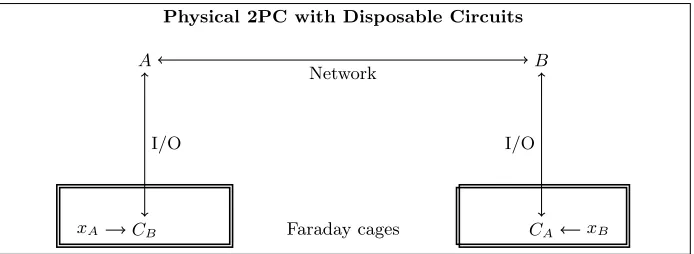
We now have two parties, PartyAand Party B, who respectively hold physical inputs xA and xB, and wish to evaluate a function of their inputs. Party A creates a DC tokenCAto investigatexB and partyBcreates a DC tokenCB to investigatexA. We assume that the function can be computed by measuringxA and xB separately in isolation, and then evaluating a logical function f of the measured values.4The parties exchange circuits so thatC
A is isolated withxB and only a communication channel toB whileCB is isolated with xA and only a communication channel to A. Figure 5 depicts a schematic of the setup after the circuits are exchanged.
Physical 2PC with Disposable Circuits
A B
CB Faraday cages CA
I/O Network
I/O
xB
xA
Fig. 5.Schematic of the physical setup for secure physical 2PC using disposable circuits (Protocol 2).
A high level description of the protocol is as follows. Each token computes a canonical description of the input it investigates, and outputs this description signed with an unconditional one time MAC to the opposing party. LetkA and
kBdenote secret keys thatAshares withCAandBshares withCBrespectively.
CA(investigatingxB) derives the description ¯xBand sends (¯xB, M ACkA(¯xB)) to
B.CB(investigatingxA) derives the description ¯xAand sends (¯xA, M ACkB(¯xA))
4
toA. PartiesAandBalso derive the canonical descriptions of their own inputs to check that the descriptions they receive from the tokens are correct. Next,A
andB execute a secure 2PC functionality that verifies the MAC signatures and computes the function f. A supplies the inputs (¯xA, M ACkB(¯xA), kA) and B
supplies the inputs (¯xB, M ACkA(¯xB), kB). The 2PC functionality outputsabort
to both parties if either MAC verification fails, and otherwise outputsf(¯xA,x¯B) to both parties. We describe the details of the protocol formally in Figure 6.
Alternatively, we could useCAandCB to locally compute the outputs first, send the outputs signed with a MAC to the opposing party. ThenAandBcould execute a 2PC functionality that both verifies the signatures and checks that the outputs are equal, outputting 1 if these checks pass. This should be a more ef-ficient method in general sincef could be an arbitrarily complex function and costly to evaluate inside the 2PC functionality. This modified protocol uses the same general technique as thedual-execution garbled circuits (DualEx) protocol for 2PC [17, 13], although the goal of DualEx was to achieve a tradeoff between security and efficiency in standard 2PC. Nonetheless, we find the former method simpler to present and prove secure.
Claim 2:Protocol 2 securely realizesFPhysical2P C with input-dependent abort. Proof. Let πdenote the real protocol according to the description of Protocol 1. We define the ideal world simulator S given any real world adversary A. It suffices to analyze the case whereAcorruptsA, as the case in whichAcorrupts
B is symmetrical. As before, we may assume without loss of generality thatA is a proxy forZ.
Sruns a simulated copy ofA.S interceptsidxB andρAfromA’screate
mes-sage toFDC. In addition,Sruns a simulatedFDC.Schooses a random secret key
r, defines ρS(y) = (y, M ACr(y)), and sends (create, sidS,S, A, idxB, midS, ρS)
to FDC. Next, S intercepts idxA from A’s run command to FDC. S sends
(run, sidS,S, midS, idxA) to the simulatedFDC, and forwards the resulting
out-put (¯xA, M ACr(¯xA)) to Aand toZ. S intercepts the input (m0, σ0, k0) thatA submits to VFChecker. If V Fr(m0, σ0)6= 1 thenS setsφ= 1. Otherwise,S sets the predicateφsuch thatφ(x, y) = 1 if and only ifV Fk0(ρA(y))6= 1. Finally,S
sendsidxA andφtoF
IDA
Physical2PC.S forwards the output it receives, whetherabort
orf(¯xA,x¯B), toZ and setsA’s output accordingly.
In the real protocol,Z sees (¯xA, M ACkB(¯xA)) and in the ideal world it sees
(¯xA, M ACr(¯xA)) wherekBis the random value chosen byAandris the random value chosen byS. These values are identically distributed. Thus, the probabil-ity Aresponds in the real world with (m, σ, k) such that the verification of the honest party’s MAC fails, i.e. V FkB(m, σ) 6= 1, is identical to the probability
that the simulatedAresponds with (m0, σ0, k0) such thatV Fr(m0, σ0)6= 1. Like-wise, the outcome of the verifying the adversary’s MAC in the real world, i.e.
V Fk0(ρA(¯xB)), is identically distributed toV Fk(ρA(¯xB)). Thus, the probability
Protocol 2 - Physical 2PC
Setup:Letλdenote a security parameter. Let (M AC, V F) denote an unconditional one-time message authentication scheme. PartyAhas physical inputxA identified byidxA and party B has physical inputxB identified byidxB. Let ¯xA denote a
canonical description ofxA and ¯xB a canonical description ofxB. PartiesA and
B share a functionf:{0,1}∗× {0,1}∗→ {0,1}∗.
1. (A initiates a token) Choose a random stringkA ∈ {0,1}λ. Let ρA define a program that on inputyoutputs (y, σA) whereσA =M ACkA(y).A sends
(create, sidA, A, B, idxB, midA, ρA) toFDC.
2. (B initiates a token)Choose a random string kB ∈ {0,1}λ. LetρB define a program that on inputy outputs (y, σB) whereσB =M ACkB(y).B sends
(create, sidB, B, A, idxA, midB, ρB) toFDC.
3. (AqueriesB’s token)Asubmits (run, sidB, B, midB, idxA) toFDC, receives
in response (outB, σB), and checks thatoutB= ¯xA.
4. (BqueriesA’s token)Asubmits (run, sidA, A, midA, idxB) toFDC, receives
in response (outA, σA), and checks thatoutA= ¯xB.
5. (The parties destroy the tokens)A submits (destroy, sidB, midB, B) to FDC and waits to receive ⊥in response. B submits (destroy, sidA, midA, A) toFDC and waits to receive⊥in response.
6. (2PC check signatures and compute f) A submits inputs (¯xA, σB, kA) and B submits inputs (¯xB, σA, kB) to a protocol that unconditionally UC-realizes the following ideal functionality:
– VFChecker: On input (m, σ, kA) from partyAand (m0, σ0, kB) from party
B, check thatV FkA(m 0
, σ0) = 1 and check thatV FkB(m, σ) = 1. If these
checks pass, compute and output f(m, m0) to both parties. Otherwise, outputabort.
7. If VFChecker outputs abort, then both A and B output abort. Otherwise, VFCheckeroutputsf(¯xA,x¯B) to bothA andB, who each locally output this value as well.
Fig. 6.Secure physical 2PC leaking at most 1 bit.
On the other hand, when both MAC verifications pass, in the ideal world the output is always the true output f(¯xA,x¯B), whereas in the real world the output is f(m,x¯B) possibly for m 6= ¯xA. Nonetheless, when m 6= ¯xA, the probability that verifying the honest party’s MAC passes, i.e. V FkB(m, σ) =
V FkB(m, M ACkA(¯xA)) = 1, is negligible by reduction to the security of (M AC, V F).
We conclude thatREALπ,A,Z∼IDEALFIDA
Physical2P C,S,Z
5
Secure Physical Multi-Party Computation
In the first phase of the protocol, each party Pi creates n−1 tokens{Tji}j6=i, and transfers the tokenTi
j to partyPj. The token Tji investigates the inputxj and outputs toPjthe canonical description ¯xjofxj and a MAC signature using
Pi’s keyki: (¯xj, M ACki(¯xj)). At the end of the first phase, each party Pi has
received n−1 MAC signed descriptions of its inputxi from the other parties’ tokens. Each Pi checks that the n−1 descriptions it has received are all the same, and also match the correct canonical description ¯xithat it has derived on its own. In the second phase, each partyPi inputs (¯xi, ki,{M ACkj(¯xi)}i6=j) to
a secure MPC protocol implementing a functionality that verifies all the MAC signatures and either outputs abort (when a signature is invalid) or otherwise returnsf(¯x1, ...,x¯n) to each party. The resulting protocol is secure with input-dependent abort, as an adversary and its tokens can at best cause the MPC protocol to either succeed or fail depending on the inputs they investigate and the adversary’s input. The MPC protocol can be unconditionally UC-securely realized in the DC model (as an extension of the tamper-proof token model) following the result of Goyal et. al. [12].
6
Isolated Circuit Secure Communication
In this section we show a simple protocol we callisolated circuit secure commu-nication (ICSC) that enables the two isolated circuitsCA andCB in the setup depicted in Figure 5 to send messages to each other in a way that keeps the messages hidden from both A and B. The protocol ismalleable, meaning that
AandBcan sabotage any message sent between the circuits without detection. However, all messages that A and B see during the protocol reveal no infor-mation (are uniformly distributed) even ifAcolludes maliciously withCA orB colludes maliciously withCB.
Protocol 3 - ICSC
CA andAshare secret keykA0 andk 1
A;CB andB share a secret keysk0B andk 1 B.
1. CA sends messagem0 toCB: – CA toB: sendu0=k0A⊕m0 – B toA: sendv0=k0B⊕u0 – A to CB: send w0 = kA0 ⊕v0 =
kB0 ⊕m0
– CB: outputm0=kB0 ⊕w0
2. CB sends messagem1 toCA: – CB toA: sendv1=kB1 ⊕m1 – AtoB: sendu1=kA1 ⊕v1 – B to CA: send w1 =k1B⊕u1 =
k1A⊕m1
– CA: outputm1=kA1 ⊕w1
Multiple rounds:Using a pseudorandom function or any KDF, on roundiparty
Auses a key pairKDF(k0
A;k1A;i), and partyB uses a key pairKDF(k0B;k1B;i).
Fig. 7.Isolated circuitsCAandCBexchange secret messages indirectly throughAand
Security (sketch). We do not precisely formalize the security of the ICSC protocol (e.g., in the UC-framework), but we sketch here the security intuition. First, it is easy to see the the output of the protocol toCA andCB respectively is correct when all parties are honest. Second, the views of A andB are indis-tinguishable from random. Consider the view of an adversary A corrupting A
(the case forB is symmetric). In the first round,Areceivesk0
B⊕mfor somem and in the second round it receivesk1
B⊕m0 for somem0. Given thatkB0 andk1B are independent uniformly distributed random strings, the simulator can replace both of A’s messages with independent random strings. The argument can be extended to prove computational security in the multi-round setting via a stan-dard hybrid argument, replacing the PRF generated keys with uniform random strings.
7
Further directions
Open question:Is there a protocol for physical SPV or 2PC/MPC in the DC model that is fully secure against malicious adversaries, or that provably does not leak any information?
Acknowledgements
We thank the anonymous reviewers of this paper for their many helpful com-ments and suggestions.
References
1. M. Ben-Or, S. Goldwasser, J. Kilian, and A. Wigderson. Multi-prover interactive proofs: How to remove intractability assumptions. In 20th ACM STOC, pages 113–131. ACM Press, May 1988.
2. R. Canetti. Security and composition of multiparty cryptographic protocols. Jour-nal of Cryptology, 13(1):143–202, 2000.
3. R. Canetti. Universally composable security: A new paradigm for cryptographic protocols. In42nd FOCS, pages 136–145. IEEE, Oct. 2001. Full version at Cryp-tology ePrint Archive, Report 2001/055, http://eprint.iacr.org/2001/055.
4. B. Fisch, D. Freund, and M. Naor. Physical zero-knowledge proofs of physical properties. In J. A. Garay and R. Gennaro, editors,CRYPTO 2014, volume 8617, pages 313–336. Springer, Aug. 17–21, 2014.
5. T. K. Frederiksen, T. P. Jakobsen, J. B. Nielsen, P. S. Nordholt, and C. Orlandi. MiniLEGO: Efficient secure two-party computation from general assumptions. In
Eurocrypt 2013, LNCS, pages 537–556. Springer, 2013.
7. A. Glaser, B. Barak, and R. J. Goldston. A new approach to nuclear warhead verification using a zero-knowledge protocol. Presented at 53rd Annual INMM (Institute of Nuclear Materials Management) meeting, 2012.
8. A. Glaser, B. Barak, and R. J. Goldston. A zero-knowledge protocol for nuclear warhead verification. Nature, 510:497–502, 2014.
9. O. Goldreich, S. Micali, and A. Wigderson. How to play any mental game, or a completeness theorem for protocols with honest majority. In A. Aho, editor,19th ACM STOC, pages 218–229. ACM Press, May 1987.
10. O. Goldreich and R. Ostrovsky. Software protection and simulation on oblivious RAMs. J. ACM, 43(3):431–473, 1996.
11. S. Goldwasser, Y. T. Kalai, and G. N. Rothblum. One-time programs. In D. Wag-ner, editor,Crypto 2008, volume 5157 ofLNCS, pages 39–56. Springer, Aug. 17–21, 2008.
12. V. Goyal, Y. Ishai, A. Sahai, R. Venkatesan, and A. Wadia. Founding cryptography on tamper-proof hardware tokens. In 2010, volume 5978 ofLNCS, pages 308–326. Springer, 2010.
13. Y. Huang, D. Evans, and J. Katz. Quid-Pro-Quo-tocols: Strengthening semi-honest protocols with dual execution. InIEEE Symposium on Security and Privacy, pages 272–284, 2012.
14. Y. Ishai, E. Kushilevitz, R. Ostrovsky, M. Prabhakaran, and A. Sahai. Efficient non-interactive secure computation. In K. G. Paterson, editor, Eurocrypt 2011, volume 6632 ofLNCS, pages 406–425, Tallinn, Estonia, May 15–19, 2011. Springer. 15. J. Katz. Universally composable multi-party computation using tamper-proof hardware. In M. Naor, editor, Eurocrypt 2007, volume 4515 of LNCS, pages 115–128. Springer, May 20–24, 2007.
16. J. Kilian. Founding cryptography on oblivious transfer. In20th ACM STOC, pages 20–31. ACM Press, May 1988.
17. P. Mohassel and M. Franklin. Efficiency tradeoffs for malicious two-party compu-tation. In M. Yung, Y. Dodis, A. Kiayias, and T. Malkin, editors,(PKC 2006), volume 3958 ofLNCS, pages 458–473. Springer, Apr. 2006.
18. T. Moran and G. Segev. David and Goliath commitments: UC computation for asymmetric parties using tamper-proof hardware. In N. P. Smart, editor,Eurocrypt 2008, volume 4965 ofLNCS, pages 527–544. Springer, Apr. 13–17, 2008.
19. M. Naor, Y. Naor, and O. Reingold. Applied kid cryptography or how to convince your children you are not cheating. Journal of Craptology, 0(1), April 1999. 20. J.-J. Quisquater, L. Guillou, M. Annick, and T. Berson. How to explain
zero-knowledge protocols to your children. In Proceedings on Advances in Cryptology, CRYPTO ’89, pages 628–631, New York, NY, USA, 1989. Springer-Verlag New York, Inc.