Analyzing Permutations for AES-like Ciphers:
Understanding ShiftRows
†Christof Beierle1, Philipp Jovanovic2, Martin M. Lauridsen3, Gregor Leander1?, and Christian Rechberger3
1 Horst G¨ortz Institute for IT Security, Ruhr-Universit¨at Bochum, Germany
{christof.beierle, gregor.leander}@rub.de
2 Fakult¨at f¨ur Informatik und Mathematik, Universit¨at Passau, Germany
3
DTU Compute, Technical University of Denmark, Denmark
{mmeh, crec}@rub.de
Abstract. Designing block ciphers and hash functions in a manner that resemble the AES in many aspects has been very popular since Rijndael was adopted as the Advanced Encryption
Standard. However, in sharp contrast to theMixColumns operation, the security implications of
the way the state is permuted by the operation resemblingShiftRowshas never been studied in
depth.
Here, we provide the first structured study of the influence ofShiftRows-like operations, or more
generally, word-wise permutations, in AES-like ciphers with respect to diffusion properties and resistance towards differential- and linear attacks. After formalizing the concept of guaranteed trail weights, we show a range of equivalence results for permutation layers in this context. We prove that the trail weight analysis when using arbitrary word-wise permutations, with rotations as a special case, reduces to a consideration of a specific normal form. Using a mixed-integer linear programming approach, we obtain optimal parameters for a wide range of AES-like ciphers, and show improvements on parameters for Rijndael-192, Rijndael-256, PRIMATEs-80 and Prøst-128. As a separate result, we show for specific cases of the state geometry that a seemingly optimal bound on the trail weight can be obtained using cyclic rotations only for the permutation layer, i.e. in a very implementation friendly way.
Keywords:AES, AES-like, differential cryptanalysis, linear cryptanalysis, diffusion, optimization, mixed-integer linear programming
1 Introduction
Since 2000 with the standardization of Rijndael [14] as the Advanced Encryption Standard (AES), an astonishing number of new primitives using components similar to the AES have seen the light of day. Examples of such include, but are not limited to, block ciphers 3D [22], ANUBIS [4], LED [19], mCrypton [24] and PRINCE [11], as well as hash functions like WHIRLPOOL [3], ECHO [7], Grøstl [17], LANE [21], PHOTON [18], Twister [16] and compo-nents of CAESAR candidates PAEQ [10], PRIMATEs [1], Prøst [23] and STRIBOB [28]. This can largely be attributed to the seminal wide-trail design strategy [15] which was introduced along with Rijndael and its predecessor SQUARE [12] for the first time.
The wide-trail strategy is an elegant way of ensuring good diffusion properties and at the same time allow designers to easily give bounds on the resistance towards differential- and linear cryptanalysis. Additionally, another advantage is that it decouples the choice of the non-linear layer and the linear layer to a large extent. In a nutshell, any good S-box combined with any good linear layer will result in a cipher resistant against linear- and differential attacks.
For AES-like ciphers, including all the above mentioned designs, the linear layer itself is composed of two parts: one resembles the AESMixColumnsoperation and the other resembles
?The work of Gregor Leander was funded by the BMBF UNIKOPS project
†
the AES ShiftRows operation. The MixColumns-like operation is a matrix multiplication of the columns of the state and the ShiftRows-like operation is a permutation of the words of the state.
For the former, the criteria are well understood. All that is required here is that this operation has a suitably high branch number. In short, the branch number corresponds to the minimal sum of the number of active S-boxes in an input/output column, provided an active input column (and the number of active S-boxes is the essential tool for bounding the success probability of linear- and differential attacks). In stark contrast, for the operation resembling ShiftRows, the situation is significantly less clear. Basically, the ShiftRows-like operation highly influences the number of active S-boxes when considering more than two rounds only. Understanding the bounds for more than two rounds is crucial for many good designs. With a well-chosenShiftRows-like operation it is usually possible to derive much stronger bounds for more rounds than the trivial bound one gets by multiplying the two-round bound by half the number of rounds.
In the case of the AES (and others including [7, 10, 11]) one uses a so-called superbox argument to prove strong bounds on four rounds of the cipher. For others, the problem is modelled as a mixed-integer linear programs like in [1, 23, 27] which allows the computation of bounds for an (in principle) arbitrary number of roundsfor a given choice of theShiftRows-like operation. However, no structured approach for analyzing the influence of theShiftRows-like operation on the security of the cipher has been undertaken previously. The results so far remain ad-hoc and specific to a given choice of parameters. Considering the large number of designs following this approach, this shortcoming is quite surprising and unsatisfactory from a scientific perspective. In particular, the choices made are often not optimal and not based on an adequate understanding of the implications.
Our Contribution. In this paper, we develop a structured approach to analyzing the permu-tation layer, i.e. the generalized ShiftRows-like operation, for AES-like ciphers with respect to diffusion and resistance towards differential- and linear cryptanalysis. For this, we start by defining a general framework for AES-like ciphers. Note that we do not restrict to the case where permutation is identical in all rounds but we allow for different choices of the permu-tation in different rounds. Moreover, we first consider arbitrary word-wise permupermu-tations and later restrict ourselves to word-wise rotations of the rows. The latter have the appeal of being efficiently implementable on many modern CPUs. Our following analysis consists of two parts. First, and as a core contribution to a structured approach, we simplify the problem by introducing the notion of equivalent permutation parameters. It is intuitively clear that many choices of the permutation will lead to the same behavior of the cipher. One such example is changing the order of the rotation constants for the ShiftRows operation in the AES, i.e. rotate the first row by 3, the second by 2, and so on. We will make this intuition precise and, as will be shown below, discover more involved examples of the above.
The notion of equivalence will imply the same lower bound on the number of guaranteed active S-boxes. This is interesting theoretically, as it allows to simplify the problem. For ex-ample, we prove that a general permutation can never yield better results than a permutation that operates on the rows individually. Furthermore, using this notion of equivalence, we derive a normalized representation of any word-wise rotation of the rows. This allows to significantly reduce the problem domain and thus the search space for a computational approach.
Finally, given our extensive experimental results, we conjecture an optimal lower bound on the number of active S-boxes possible for specific cases of the state geometry. Those parameters are such that they allow for an iterative version of the superbox argument mentioned above. We also provide a permutation which guarantees this conjectured optimal bound. In contrast to prior work, e.g. ECHO and PAEQ, this permutation layer is generic and, more importantly, realized withcyclic row rotations only. Thus, it allows for an easy and efficient implementation.
Outline. In Section 2 we give notation and define what we mean by AES-like ciphers. Then, in Section 3, we introduce, besides diffusion, the concept of guaranteed active S-boxes as a measure of the resistance against differential- and linear attacks. Section 4 provides reductions in order to identify equivalent permutation parameters for AES-like ciphers. We thereby also introduce the normal form of rotation matrices, considering only cyclic rotations of the state rows. Section 5 copes with modelling the problem using a mixed-integer linear programming approach in order to calculate optimal bounds for given state dimensions. In this context, some practical examples for rotation parameters are provided. Finally, Section 6 continues with a theoretic analysis of special cases of the state dimension and presents (conjectured) optimal solutions to the main criteria. We conclude the paper in Section 7.
2 Preliminaries
We use Fqr to denote the finite field of size qr with q prime. We use Zn to interchangeably denote the group of integers modulonand the set{0,1, . . . , n−1}. We refer to binary strings in Fm2 aswords. We refer toM×N matrices with word entries asstates. For a stateX we use Xi
to denote theith row ofX, andXi,j denotes word in thejth column ofXi. LetF be a function
operating on states and let ⊕be bitwise addition. For words x, x0 we use the term difference to denotex⊕x0, and let the notion extend to states where the differences are word-wise. For input statesx, x0 toF, we refer to x⊕x0 and F(x)⊕F(x0) as theinput difference and output difference, respectively. For anM×N differenceX, we use the symbol with a tilde on top, e.g.
˜
X, to denote the activity pattern of X, an M ×N matrix over F2 where ˜Xi,j = 1 if Xi,j 6= 0
and ˜Xi,j = 0 otherwise. For a, b∈Fm2 we let ha, bi= Lm−1
i=0 ai·bi denote the inner product of aand b, where subscript idenotes theith bit. We extend this inner product to states, s.t. for
X, Y ∈(Fm2 )M×N we havehX, Yi= L
i∈ZM,j∈ZNhXi,j, Yi,ji.
2.1 AES-like Ciphers
With the increasing popularity of the AES since its standardization, dozens of new ciphers that follow what we refer to as anAES-like design have seen the light of day. We describe formally our notion of AES-like ciphers in Definition 1.
Definition 1. An AES-like cipher is a block cipher EK which is parametrized by a fixed key K, the state dimension M×N, the word size m, the number of rounds T and a permutation parameter π = (π0, . . . , πT−1), where each πt is a permutation on ZM ×ZN. It is composed
of round functions Ri, s.t. EK = RT−1 ◦ · · · ◦ R0. Each round function is composed of the
following bijective transformations on states, s.t.∀t ∈ZT :Rt=AddRoundKeyt◦Permuteπt ◦ MixColumnst◦SubBytes:
1. SubBytes substitutes each word of the state according to one or several S-boxes S :Fm2 →
Fm2 .
2. MixColumnst applies, in round t, for all columns j ∈ZN left-multiplication by an M×M
matrix Mtj ∈(Fm2 )M×M:
MixColumnst: (Fm2 )M
×N →(
Fm2 )M
×N
where multiplication inFm2 is defined by an arbitrary irreducible polynomial overF2 of degree
m.
3. Permuteπt permutes, in round t, the words within the state due to a given permutation πt. We use the notation that for a position(i, j)∈ZM×ZN in the state, πt(i, j) gives the new
position of that word under the permutation πt:
Permuteπt : (F
m
2 )M
×N →(
Fm2 )M
×N
∀i∈ZM,∀j ∈ZN :Xi,j 7→Xπt(i,j).
4. AddRoundKeyt performs word-wise XOR to the state using the tth round key.
Subsequently, we omit the AddRoundKeyt operation of Definition 1 from consideration, as it does not affect diffusion properties nor resistance towards differential- and linear cryptanalysis of the AES-like cipher. Note also, that for generality we consider in Definition 1 an arbitrary word permutation Permuteπt, while later we will, for efficiency reasons, resrict ourselves to row-wise rotations of the words as in theShiftRows operations of the AES.
3 Diffusion and Resistance to Differential/Linear Cryptanalysis
In this paper, we are concerned with two security aspects of an AES-like cipher, namely diffusion on the one hand and resistance against differential- and linear attacks on the other hand. We formally define our notations for both criteria in the following.
3.1 Diffusion
The first definition of diffusion is attributed to Shannon [29]. Informally, diffusion is about complicating the relationship between the ciphertext bits and plaintext bits. When designing a cipher, it is desirable to obtain what we callfull diffusion after as few rounds as possible and indeed the number of rounds chosen for the cipher is often determined by exactly this number.
Definition 2 (Diffusion degree).For a functionF :F`2→Fn2, we define thediffusion degree
d(F)forF as the fraction of bits in the image underF that depend oneach bitof the pre-image, i.e.
d(F) = 1
n·]
n
j∈Zn| ∀i∈Z`:∃x∈F`2 :F(x(i))j 6=F(x)j
o
,
whereF(x)j denotes the jth bit of F(x) andx(i) denotes the element x with theith bit flipped.
We say that F obtains full diffusion when d(F) = 1.
Definition 3 (Diffusion-optimality).Fix the state dimensionsM×N. Consider a permu-tation sequence π for an AES-like cipher which obtains full diffusion after t rounds. We say that π is diffusion-optimal if there exists no π0 6= π which obtains full diffusion after t0 < t
rounds.
3.2 Differential/Linear Cryptanalysis
in a given trail if it has a non-zero input difference (resp. mask). In general, ifp is the largest probability (resp. correlation) for the S-box to satisfy a differential- or linear property, and any trail has at least k active S-boxes, then the trail property holds with probability (resp. corre-lation) at mostpk. This way of ensuring resistance against linear and differential attacks is the basis of the wide-trail-strategy as introduced by Daemen and Rijmen in [15]. The second im-portant merit of the wide-trail starategy is that it allows to treat the S-box and the linear-layer as black boxes as long as they fulfill certain conditions. In our work, we follow both aspects of this philosophy. The designer is interested in having the lightest trail as heavy as possible. Indeed, knowing this probability is essential when determining the number of rounds for the cipher in the design phase. We give definitions of trails and trail weights in the following.
Definition 4 (Trail and trail weight). For an AES-like cipher EK using m-bit words and
state dimension M ×N, a T-round trail is a (T + 1)-tuple (X0, . . . , XT) ∈ (Fm2 )
M×NT+1
and the weight of the trail is defined as
X
t∈ZT
X
i∈ZM
X
j∈ZN ˜
Xi,jt .
A pair of inputs x, x0 ∈(Fm2 )M×N is said to follow the differential trail (X0, . . . , XT) over T
rounds if and only ifX0=x⊕x0 and
∀t∈ {1, . . . , T}:Xt= (Rt−1◦ · · · ◦ R0)(x)⊕(Rt−1◦ · · · ◦ R0)(x0).
We say that a differential trail is validfor EK if and only if there exists at least one input pair
which follows the trail.
If (α0, . . . , αT) is a T-round linear trail, we say that the trail is valid if and only if its correlation is non-zero, i.e. if
Y
t∈ZT
CRt(α
t, αt+1)6= 0,
where, for t ∈ ZT, CRt(α
t, αt+1) is the correlation over round R
t using input mask αt and
output maskαt+1. This quantity is defined by
CRt(α
t, αt+1) = 2 Pr
x
hx, αti=hRt(x), αt+1i
−1.
Note from Definition 4 that the weight of a trail corresponds exactly to the number of active S-boxes over thoseT rounds. In the remainder of this work, we concentrate on the differential case. However, the results apply equally to linear trails as well.
Definition 5 (Branch number). For a linear automorphism θ : (Fm2 )M → (Fm2 )M, the
differential branch number Bθ is defined as
Bθ= min x,x0∈(Fm2 )M
x6=x0
X
i∈ZM ˜
Xi+ ˜Yi
, X=x⊕x0, Y =θ(x)⊕θ(x0).
In the context of an AES-like cipherEK, we say EK has branch numberBθ if and only if it is
the largest integer s.t. left multiplication by any of theMjt used in the MixColumnst operation
has branch number at leastBθ.
the specifc instance of S. Each of the Mtj matrices used in the MixColumns operation will be considered as black-box linear operations, under the requirement that the AES-like cipher has branch number Bθ. A formal definition of that idea is given in the following. For a T-round
permutation parameter π = (π0, . . . , πT−1), let ]AESM,N(π, Bθ) denote the set of all M ×N
AES-like ciphers over T rounds with branch number Bθ using π0, . . . , πT−2 in the first T−1
rounds. The reason for not includingπT−1 is that our proofs in the following use the fact that
for different permutation sequences we can re-model one AES-like cipher into another, up to the last round, and up to changingMixColumns operations (but maintaining the branch number).
Definition 6. We say that the sequence of permutationsπ = (π0, . . . , πT−1) tightly guarantees
k active S-boxes for branch number Bθ if and only if there is a valid trail of weight k for
some EK ∈ ]AESM,N(π, Bθ) and there is no valid trail of weight k0 < k, k0 > 0, for some EK0 ∈AES]M,N(π, Bθ). We denote this property by π
Bθ
−−→k.
Definition 7 (Trail-optimality).A sequence of permutationsπ= (π0, . . . , πT−1)withπ
Bθ
−−→
kis said to be trail-optimal if there exists no π0 = (π00, . . . , πT0 −1) s.t. π0−B−→θ k0 where k0 > k. Appendix A provides a proof that the number of tightly guaranteed active S-boxes is really independent of the specific S-box instantiations. From Definition 6, it follows that the number of guaranteed active S-boxes is always a lower bound for the actual minimum number of active S-boxes in any concrete instantiation of an AES-like cipher.
4 Equivalent Permutations: Simplifying the Problem
In this section, we present a range of results which simplifies the problem of identifying good permutation parametersπfor AES-like ciphers by showing when different permutation param-eters are equivalent w.r.t. resistance towards differential- and linear attacks. Obviously, for a fixed branch number, many different π will tightly guarantee the same number of active S-boxes. Thus, identifying conditions under which two different permutation sequences π 6= π0
tightly guarantee the same bound is significant: for a theoretical understanding, this approach simplifies the problem while for a computer-aided search for a good π parameter, this signifi-cantly reduces the search space. In Definition 8, we specify what it means for two permutation sequences to be equivalent.
Definition 8 (Equivalence of permutation sequences).Two permutation sequencesπ, π0, for a T-round cipher, are said to be equivalent, denoted π ∼π0, if and only if for all possible branch numbers Bθ, the equality AES]M,N(π, Bθ) = AES]M,N(π0, Bθ) holds. Intuitively, this
means that for all AES-like ciphers using π, there is an AES-like cipher using π0 which it is functionally identical to, up until the last round.
We remark that, using this notion of equivalence, one can transform each cipher EK using π
into a cipherEK0 usingπ0such thatEK =τ◦EK0 for a permutationτ on the state words. Thus,
equivalence will imply the same number of tightly guaranteed active S-boxes for all possible fixed branch numbersBθ.
4.1 Equivalences for Permutation Sequences π
In order to prove the reduction to a normalized form on the round permutations, we show a range of observations in the following. Firstly, Lemma 9 is a combinatorial result on permuta-tions on Cartesian products.
Lemma 9 (Representation of permutations on cartesian products). Every
permuta-tion πt on the words of an M×N state can be represented as πt =γ0 ◦φ◦γ where γ, γ0 are
Proof. LetTA, TB, TC, TD ∈(ZM×ZN)M×N s.t.TAi,j = (i, j) and letTB, TC andTD be defined by the following diagram:
TA TB TC TD.
γ φ γ0
To show the result, we letTD =πt(TA) and show how to construct the permutations such that TD = (γ0◦φ◦γ)(TA). We first observe the following two properties which must hold:
1. TB must be a matrix where, within each column j ∈ ZN, it holds that i) the second
coordinate of each point is equal to j, because γ only permutes within each column of
TA and ii) the set of first coordinates cover all of ZM, because TB is a permutation of
ZM ×ZN.
2. TC must be a matrix where, for each column j∈ ZN, the points in column j of TC are
the same as those in column j of TD. This is required because otherwise going between TC and TD using a permutation operating in each column, is impossible.
If we can determine a matrixTB with property (1) and a row permutation φs.t. TC =φ(TB)
has property (2), we are clearly done, becauseTAandTD can be obtained fromTB respectively TC by applying a permutation on the columns.
For a matrix A∈(ZM ×ZN)M×N, letQ(A) be anN ×N matrix for whichQ(A)i,j is the
number of occurences ofj∈ZN in the second coordinate of the points in columni∈ZN of A.
AsQ(TB) and Q(TC) are both magic squares of weight M, one can decompose Q(TC) into a
sum ofM permutation matrices by the Birkhoff-von Neumann Theorem (see e.g. [2, p. 164]), and thus
Q(TC) =P0+· · ·+PM−1.
Let φ be a permutation within each row, defined by applying Pi to row i ∈ ZM. Then Q(φ(TB)) =Q(TC).
What is left to show is that there exists a column permutation TB of TA s.t. the first
coordinates in each column j of TC is correct, given the fixed permutation φ. To see this,
consider the case whereTC requires a point (a, b) to be in columnj. Clearly, (a, b) is in column b of both TA and TB. Now, let Pi be such that it moves some point in position (a0, b) of TB
from column b to column j of TC. If (a0, b) = (a, b), then (a, b) does not need to be moved
within column b from TA to TB by γ, but if (a0, b) 6= (a, b), one can use γ to move (a, b) to
(a0, b) so it ends up in columnj ofTC. As each point (a, b) will only be present once in TC, it
can be moved once between TA and TB and never moved again. This procedure holds for all
points (a, b), and as such the result follows.1 ut
Lemma 10 (Equivalence under permutations within columns).Let π= (π0, . . . , πT−1)
be a permutation sequence for an AES-like cipher EK and let γ, γ0 be arbitrary permutations
on the words within the columns of a state. Then, ∀t∈ZT :π∼(π0, . . . , γ0◦πt◦γ, . . . , πT−1).
In particular, the number of tightly guaranteed active S-boxes is invariant under inserting per-mutations, before and after anyπt, which act on the columns of the state separately.
Proof. Fix the branch numberBθand letEK ∈AES]M,N(π, Bθ). We consider any roundt∈ZT.
We first show that π ∼ π0 = (π0, . . . , πt ◦γ, . . . , πT−1). Let EK0 be like EK but using
permutation sequence π0, with rounds denoted R0
t, t ∈ ZT. Thus, EK0 ∈ AES]M,N(π0, Bθ). It
holds that
R0t=Permuteπt ◦Permuteγ◦MixColumnst◦SubBytes. Sinceγ operates on the columns separately, one can define
MixColumns0t=Permuteγ◦MixColumnst,
which in turn is a linear layer for an AES-like cipher with the same branch number, and we have
R0t=Permuteπt◦MixColumns
0
t◦SubBytes.
Now, EK0 is a cipher which uses the permutation sequence π and thus EK0 ∈ ]AESM,N(π, Bθ).
The other inclusion follows the same way by applying γ−1. For showing the case of π0 = (π0, . . . , γ0◦πt, . . . , πT−1), the argument is parallel. By combining the two, the result follows.
u t
As an easy result, one obtains Theorem 11, which we state without proof. Note that a permu-tation sequence is called ρ-alternating, written π = (π0, . . . , πρ−1)T, if it repeats the same ρ
permutations alternatingly.
Theorem 11 (Reduction to permutations on the rows).Letπ = (π0, . . . , πρ−1)T be aρ
-alternating permutation sequence. Then one can construct a π0= (π00, . . . , πρ0−1)T withπ ∼π0,
s.t. for each t∈Zρ, it holds thatπt0 permutes only the words in each row of the state.
4.2 Equivalences for Rotation Matrices σ
While we have, until this point, focused on AES-like ciphers with arbitrary word-wise permu-tations Permuteπt as part of the round function, such general permutations are not suitable for designs of cryptographic primitives. To that end, we limit ourselves from this point on to AES-like ciphers where the permutation operation of the round functioncyclically rotates each row of the state from left-to-right using a rotation matrix as specified in Definition 12.
Definition 12 (Rotation matrix). Consider an AES-like cipher where the permutation op-eration in the round function consists of cyclic word-wise rotations of each state row. For such a cipher, we define a rotation matrixas a matrixσ ∈ZρN×M, whereρ is a positive integer, such that
1. Ifρ=T, then σt,i denotes the rotation amount for row i∈ZM in roundt, and
2. Ifρ < T, then we have the further requirement that the rotation constants alternate, such that σk,i denotes the rotation amount for row i∈ZM in roundst where t≡kmodρ,
where, without loss of generality, we let the rotation direction be left-to-right.
As rotation matrices are a special case of arbitrary permutations, we remark that the notion of equivalence includes these as well. We simplify our notion of an AES-like cipher to only use row-wise rotations in the permutation part of each Rt. In particular, we substitue the
Permuteπt operation by
ShiftRowsσt : (F
m
2 )M×N →(Fm2 )M×N
∀i∈ZM,∀j∈ZN :Xi,j7→Xi,j+σtmodρ,imodN.
Lemma 13 (Equivalence under re-ordering of row entries).Letσ∈ZρN×M be a rotation matrix and letϑ0, . . . , ϑρ−1 be arbitrary, independent permutations on the ρ rows of σ. Define
σ0 s.t. ∀t∈Zρ:σ0t=ϑt(σt). Then σ∼σ0.
Proof. This directly follows from Lemma 10, as using σt0 is equivalent to using γ0 ◦σt◦γ for
appropriate permutationsγ0 and γ on the state columns. ut
Proof. We split the proof into two cases: i)T ≤ρand ii)T > ρ. Consider firstT ≤ρ. IfT < ρ, one can add constants toσT, . . . , σρ−1, since these are never used anyway. Thus, let us consider
T =ρ. We give a proof by induction that one can add independent constants ct, . . . , cT−1 to
σt, . . . , σT−1 to obtain an equivalent rotation matrixσ0, and proceed by induction ont. Clearly,
one can add a constant toσT−1 to obtain an equivalentσ0, since the set AES]M,N(σ, Bθ) does
not cover the use ofσT−1. Assuming the statement holds for t, . . . , T −1, we now prove that
it is possible to add a constantct−1 toσt−1 as well. Using the notation thatSR=ShiftRows,
MC=MixColumns, SB=SubBytesand RSk is a rotation of the whole state byk positions, we
have
Rt◦ Rt−1 = (SRσt◦MCt◦SB)◦(RS−ct−1 ◦RSct−1)◦(SRσt−1 ◦MCt−1◦SB)
=SRσt◦RS−ct−1 ◦RSct−1 ◦MCt◦RS−ct−1 ◦SB◦(RSct−1 ◦SRσt−1 ◦MCt−1◦SB), sinceRS−ct−1 commutes withSB. Now, sinceRSct−1◦MCt◦RS−ct−1 =:MC
0
tdefines a (just rotated)
linear column mixing and sinceSRσt commutes withRS−ct−1, we have
Rt◦ Rt−1= (RS−ct−1◦SRσt ◦MC
0
t◦SB)◦(RSct−1◦SRσt−1 ◦MCt−1◦SB),
and we see that by addingct−1 toσt−1 and−ct−1 toσt we obtain an equivalentσ0. The result
now follows by induction, since the addition of −ct−1 to σt can be undone by the induction
assumption.
For the case T > ρ, let H be a T ×M matrix where Ht = σk when t ≡ kmodρ. For
a T-round AES-like cipher EK, H and σ are clearly equivalent rotation matrices. From the
above, it follows we can addctto rowtofH,t∈ZT, and obtain an equivalentH0. In particular,
adding the sameck to all rowstwheret≡kmodρ, we obtainH0 which is equivalent toσ, and
has the property that Hi0 =Hj0 if i≡jmodρ, and in particular the first ρ rows of H0 equals
σ0 and the result follows. ut
Theorem 15 (Equivalence for rotation matrices). Given a rotation matrix σ ∈ ZρN×M, one can obtain an equivalent matrixσ0 ∈ZρN×M for which the following holds simultaneously
1. Each rowσ0t, t∈Zρ, is lexicographically ordered,
2. For allt∈Zρ it holds that σ0t,0 = 0 and
3. For allt∈Zρ it holds that σ0t,1 ≤ N2.
Proof. Points (1) and (2) follow directly from Lemma 13 and 14, respectively. For point (3), let us assume w.l.o.g that (1) and (2) hold and consider the case whereM ≥2 and consider the element σt,1 from some row σt. Ifσt,1 > N2, we add −σt,1modN and the result follows from
Lemmas 13 and 14. ut
Besides Theorem 15, we heuristically suggest a search for optimal rotation matrices to restrict itself to matrices where all entries in a row are different, i.e.∀t∈Zρ:σt,j =σt,j0 ⇔ j=j0, as
equal entries in someσt are redundant w.r.t. the diffusion properties of the cipher. Moreover,
when N is even, we require that σ contains at least one odd entry, because otherwise even-numbered columns never mix with odd-even-numbered columns. We refer to a rotation matrix which satisfies these properties, plus properties (1) – (3) of Theorem 15, as the normal form of its equivalence class of rotation matrices.
5 Mixed-Integer Linear Programming and Experimental Results
5.1 The Problem as a Mixed Integer Linear Program
In the following, we describe the mixed-integer linear program which models the problem of determining the tightly guaranteed trail weight under a given rotation matrix σ ∈ZρN×M. We give the parameters, decision variables, the constraints and the target optimization as Model 1. This formulation is similar to that of Mouha et al. [27]. We note that Model 1 is specified for the case where eachMtj used in theMixColumnstoperation is an MDS matrix, as this is usually
what is applied in designs. If, on the other hand, non-MDS matrices are deployed, the model can be easily modified to cover these cases as well, at the cost of a slightly more complicated model. Theorem 16 formalizes how Model 1 provides us with the sought bound.
Theorem 16. The solution of Model 1 is always a lower bound on the number of tightly guar-anteed active S-boxes for an AES-like cipher with branch number Bθ and rotation matrix σ.
If the branch number is optimal for the given dimensions and a linear mixing layer with this branch number exists (and the word length m >log2(M+ 2)), this provides a tight bound. Proof. This follows from Corollary 27 in Appendix A. ut
Theorem 16 shows in particular that one can not hope to improve the bounds in a generic way for the case of AES-like ciphers using MDS matrices. That is to say that any argument to improve upon the bounds provided by the model will necessarily be a non-black box argument. Thus, in the spirit of the wide-trail strategy, one cannot improve upon those bounds.
Model 1: MILP model for determining the guaranteed trail weight using a fixed rotation matrix
Parameters
Name Domain Description
M Z+ Number of rows in state
N Z+ Number of columns in state
T Z+ Number of rounds
ρ Z+ Number of rows in rotation paramterσ
Bθ Z+ Branch number ofMixColumns
σ ZρN×M Rotation parameter
Decision variables
Name Domain Index domain Description
˜
Xt
i,j F2 i∈ZM, j∈ZN, t∈ZT∪ {T} Xi,j˜ = 1 if and only if the word in position
(i, j) is active before roundRt
atj F2 j∈ZN, t∈ZT Auxilliary variable;atj = 1 if and only if
col-umnjhas an active word before roundRt
Minimize
X
t∈ZT
X
i∈ZM
X
j∈ZN ˜
Xi,jt
subject to
X
i∈ZM
X
j∈ZN ˜
Xi,j0 ≥1 (1)
∀j∈ZN,∀t∈ZT :
X
i∈ZM
˜
Xi,jt + ˜X t+1
i,(j+σt modρ,i) modN≥Bθ·a
t j (2)
∀i∈ZM,∀j∈ZN,∀t∈ZT : atj≥X˜ t
5.2 Experimental Results
A part of our contribution is a wide range of optimal choices of rotation matrices for various state geometriesM×N,ρand number of roundsT. For all our experiments, we concentrated on the case of MDS MixColumnst layers, i.e. AES-like ciphers with optimal branch number.
Using the heuristic approach from Section 4.2, i.e. by brute-forcing the normal form of each equivalence class of rotation matrices, we provide optimal solutions for the analyzed cases as per Theorem 16. The full table of results is given in Appendix B.
We highlight in Table 1 results which suggest improvements for some existing AES-like primitives. We see that, in some cases, direct replacement ofσ yields better bounds, while in other cases, one must increaseρ to obtain better bounds.
Table 1.Improvements for existing AES-like primitives. An entry (ρP,BP)/(ρM,BM) givesρand the number of tightly
guaranteed S-boxes B in a T-round trail for the primitive (subscript P) and the modified primitive (subscript M), respectively. The†symbol indicates results where only diffusion-optimalσ were tested, which means actual obtainable bounds may be higher.
Primitive T = 5 T= 6 T = 7 T = 8 T = 10 T = 12
Rijndael-192 − (1,42)/(1,45) (1,46)/(1,48) (1,50)/(1,57) − (1,87)/(1,90)
Rijndael-256 − (1,50)/(2,55) − − (1,85)/(2,90) (1,105)/(2,111)
PRIMATEs-80 (1,54)/(2,56) − − − − −
Prøst-128 − (2,85)/(2,90)† (2,96)/(2,111)† − − −
Among our findings are tight bounds which are not a multiple of the branch number for an even number of rounds. This implies that there exists some MDS linear mixing layers such that the lightest valid trail contains a two-round subtrail of weight more thanBθ. Thus, some
optimal trails have non-optimal transitions locally.
6 Optimal Solutions
In this section we describe, for special cases of the state geometry, optimal solutions with respect to both our main criteria, i.e. with respect to diffusion properties on one hand and resistance towards differential/linear attacks on the other hand.
6.1 Diffusion-Optimal Rotation Matrices
Under the assumptions that each S-box S : Fm2 → Fm2 and each Mtj matrix has the property
that each output bit depends on each input bit, we describe in the following a way of tracking the diffusion properties for an AES-like cipherEK. Letz be an arbitrary fixed bit of an input
toEK. When, in the beginning of a round, a single bit in a column depends onz, then each
bit in the column will depend on z after applying MixColumns◦SubBytes. Thus, with fixed parameters M, N and σ, determining how many rounds t are required to obtain full diffusion reduces to answering how many rounds are required to have at least one bit depending on z
in each column: if this is obtained aftert0 rounds then full diffusion is obtained aftert=t0+ 1 rounds. This is formalized in the following.
Definition 17 (Sumset).LetGbe an additive group and letA, B ⊂G. We define the sumset written A+B as A+B ={a+b|a∈A, b∈B}, where the sum is over G. We write kA for the sumsetA+A+· · ·+A withk terms.
Theorem 18. Consider an AES-like cipher with fixed parameters M, N, ρand σ. Let w.l.o.g.
z denote a bit in the word X0,0 for an input X. Let α(T) = (α(T)0, . . . , α(T)ρ−1) be a vector
rounds of the cipher. Then, afterT rounds, the indices of columns which contain bits depending onz are given by the sumsetα(T)0σ0+α(T)1σ1+· · ·+α(T)ρ−1σρ−1, where addition is over
ZN.
Proof. Let S−1 = {0}. We recursively define St = {v+s |s ∈ St−1, v ∈ σtmodρ} for t ≥ 0,
where addition is inZN. Note that the setStcorresponds exactly to the sumsetα(t)0σ0+· · ·+
α(t)ρ−1σρ−1. Clearly, S0 = {v | v ∈ σ0} is the set of indices of columns that contain words
depending on z after round R0. Now, assume that St are the column indices which contain
some word depending onzafterRt. Then, after applyingMixColumnst+1,all words in columns
j ∈ St depend on z. Now, when we apply ShiftRowsσt+1 modρ, the words depending on z are moved exactly to the indices given inSt+1, and thus the result is obtained by induction. ut Corollary 19. Consider an AES-like cipher with fixed parameters M, N, ρ and σ. If t0 is the smallest positive integer s.t. the sumsetα(t0)0σ0+· · ·+α(t0)ρ−1σρ−1 over ZC generates all of
ZN, then the cipher obtains full diffusion aftert=t0+ 1rounds.
Proof. The proof follows from Theorem 18. Note that we chose the input bit zfrom the word
X0,0. If it would be chosen from an arbitrary word Xi,j, the corresponding sumset would be
just shifted by a constantc. However, these are the same sumsets for all possible c, since they
generate all ofZN. ut
Theorem 20. When N = Mρ, a diffusion-optimal rotation matrix is σ ∈
ZρN×M s.t. σt,i = i·Mt for (t, i) ∈ Zρ×ZM or any σ0 where the rows of σ are permuted. These obtain full
diffusion afterρ+ 1rounds.
Proof. The set of indices of columns containing a word depending onz afterρ rounds is given by the sumset σ0 +· · ·+σρ−1 over ZN. This sumset has Mρ = N sums, and thus equals
ZN if and only if no two sums in the sumset are equal. To see why this is the case, consider
constructingM-adic numbers using the sums in the sumset. We pick exactly one element from each row of σ and add them. As the elements in row t are σt = 0Mt 1Mt· · ·(M−1)Mt
, the choice for the sum fromσt is the tth least significant digit in the M-adic representation of
that number. In other words, the rows ofσform a base for theM-adic number system, and we can form any number up to Pρ−1
t=0(M−1)Mt =N −1 with it. Since Mρ elements cannot be
generated using less thanρ parameters in the sumset, the diffusion-optimaltiy ofσ follows. ut
6.2 Trail-Optimal Solutions
In this section, we first state Theorem 21, which is of particular interest because of the large number of AES-like ciphers with square geometry. Considering its statement, square states can be understood quite well. We also give a conjecture on the optimality of guaranteed trail weights forM×MnAES-like ciphers over 2n+1 rounds and give a construction which matches the conjectured bound.
Theorem 21 (Optimality for square geometries). Let σ be a rotation matrix in normal form operating on a square state of dimensionM×M. Then the number of tightly guaranteed active S-boxes is invariant under increasingρ. In particular, any σ has σ ∼ 0 1 · · · M−1. Furthermore, assuming the existence of at least one MDS linear layer and the word length
m >log2(M + 2), we haveσ −−−→M+1 k(M + 1)2 over 4k rounds for all k∈N.
Proof. As for any ρ > 1, each row σt of a rotation matrix σ in normal form will equal
for some EK using the specific parameters. Therefore, we first define a four-round trail X of
weight (M+ 1)2 as
X:=
1 0 · · · 0 0 0 · · · 0
..
. ... . .. ...
0 0 · · · 0
,
1 0 · · · 0 0 1 · · · 0
..
. ... . .. ...
0 0 · · · 1
,
1 1 · · · 1 1 1 · · · 1
..
. ... . .. ...
1 1 · · · 1
,
1 0 · · · 0 0 0 · · · 1
..
. ... . .. ...
0 1 · · · 0
,
1 0 · · · 0 0 0 · · · 0
..
. ... . .. ...
0 0 · · · 0
.
By repeating this structurek times, one can define a 4k-round trail of weightk(M+ 1)2. For the validity of this trail for someEK, one can see that it is obtainable by only using the identity
as the S-box and existing mixing steps, applying Corollary 27 in Appendix A. ut
Theorem 21 implies that a designer who wants to improve upon the bound for a square dimen-sion necessarily has to choose a rotation parameterσconsisting of at least oneσtwhich breaks
the normal form structure. Intuitively, this would not only provide a worse bound but also worse diffusion properties. However, giving an argument for the trail-optimality considering all possible rotation matrices (resp. permutations) seems to be quite difficult.
For the special case of a hypercubed geometry, we give Conjecture 22.
Conjecture 22. Given the state dimensionM×Mnfor an AES-like cipher, then a trail-optimal choice of the permutation sequenceπ over 2n+1 rounds yields π−−−→M+1 (M+ 1)n+1.
The Superbox Argument. The superbox argument is a commonly used proof technique to lower bound on the number of active S-boxes in an AES-like cipher over a certain number of rounds. It has been used for the AES but also for ECHO [7] and PAEQ [10].
One uses the fact that for a clever choice of the rotation matrix, the round operations can be commuted such that some part of the encryption first works locally, in parallel, on parts of the state which we callsuperboxes. Next the superboxes are combined using state-wide operations which effectively mix the superboxes together, only to split the state into superboxes again, working with the localized operations. Such a large structure is referred to as amegabox, and covers four rounds of the cipher.
One can show that if a superbox has active input, there are at least Bθ active S-boxes in
the first two rounds inside this superbox. Now, with the right choice of rotation matrix, the operation that combines the superboxes again imply that for the next two rounds, the total number of active superboxes is at least Bθ. From this, one obtains a four-round lower bound
ofB2θ.
This concept, which is the idea behind the Four-Round Propagation Theorem [15, Theorem 3], can be easily generalized by iteration for appropriate dimensions of state in the AES-like cipher, and with an appropriately chosen rotation matrix. We stress, however, that choosing the rotation matrix correctly for the given state dimension is of paramount importance to assuring the argument that one has e.g.Bθ active superboxes in a megabox (or equivalently for higher
dimensions).
As mentioned, in Theorem 23, we give a construction which achieves the bound given in the conjecture above. Note that (especially for a cubed state dimension) this approach is not new in itself. Our main point here is that, in clear distinction to prior work such as [10, 13], we present an efficient way of implementing this idea by using cyclic rotations only. For a better visualization, Example 24 illustrates this construction forM = 4 andn= 3.
Theorem 23 (2n+1-Round Propagation Theorem). There exists a rotation matrix σ ∈
Z2 n×M
Mn , such that every (non-zero) valid2n+1-round trail over all EK ∈ ]AESM,Mn(σ, Bθ) has a weight of at leastBθn+1. The rotations can be described as
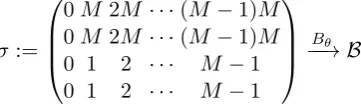
∀j∈Zn :σ2n−j−2 =σ2n−j−1 = 0 Mj 2Mj · · · (M−1)Mj
Proof. Forn= 1, the statement is precisely the Four-Round Propagation Theorem of the AES. Therefore, we first prove the theorem for the eight-round case, thus forn= 2. We need to show that
σ :=
0M 2M · · ·(M−1)M
0M 2M · · ·(M−1)M
0 1 2 · · · M −1 0 1 2 · · · M −1
Bθ
−−→ B
over eight rounds for aB ≥ Bθ3. For the proof, we rely on a straightforward generalization of the Four-Round Propagation Theorem to the dimension one higher than the standard AES, as described previously. In particular, if one can partition the M ×M2 state intoM sub-states of M columns each (i.e. consider them as M ×M sub-states), such that in four consecutive rounds, theShiftRowsoperating in the first and second rounds shifts each such sub-state as if using the vector (0 1 · · · M−1), with respect to considering that particularM×M sub-state, then the number of guaranteed active S-boxes in each such sub-state over four rounds it at leastBθ2 (assuming a non-zero input difference). Note that the rotations of the third and fourth round have no impact on the four-round trail weight.
Fig. 1.Positions of the 4 independent sets of columns in a 4×16 state
Using the σ specified, the first four rounds of EK satisfies this property when the M
sub-states of sizeM×M are taken to be every Mth column of the state, as indicated for a 4×16 state in Figure 1. The same thing holds when considering the last four rounds separately.
Now, due to the way the row shifting of the third round combines with the column mixing and row shifting of the fourth round, i.e. SRσ3◦MC◦SB◦SRσ2, each M ×M sub-state mixes completely with each of theM ×M sub-states. As such, like in the Four-Round Propagation Theorem, the sum of activeM×M sub-states from the third and fourth round is at leastBθ.
Combining this observation with the generalized Four-Round Propagation Theorem, the result ofBθ·Bθ2 follows.
The general case is now obtained by induction. In order to do the iteration to 2(n+1)+1
rounds, one has to apply the 2n+1-round propagation. ut
Example 24. LetM = 4,n= 3 andBθ= 5. Then the state has geometry 4×64. The guaranteed
trail weight of 625 over 16 rounds can be realized using the rotation matrix
σ=
0 16 32 48 0 16 32 48
0 4 8 12
0 4 8 12
0 16 32 48 0 16 32 48
0 1 2 3
0 1 2 3
.
We remark that especially for higher dimensions, a rotation matrix following this construc-tion is not of much practical interest as the diffusion properties are far from optimal. One open question is whether it is possible to obtain these bounds without using a rotation matrix which allows a proof using a superbox-like argument for general M. For the special case of M = 2 andN = 4, we found that
σ=
0 0 0 0 0 0 0 0 1 1 1 1 1 2 1 1
T
,
7 Conclusion
For AES-like ciphers, the linear mixing layer, often denoted MixColumns, is very well under-stood: one typically chooses mixing layers defined by MDS matrices to obtain optimal branch numbers. In sharp contrast to this, no systematic approach has been conducted to under-stand how the word-wise permutation layer in such ciphers affects the diffusion properties and resistance towards differential- and linear attacks. With this work, we close that gap.
Specifically, we consider arbitrary word-wise permutations, with special focus on rotations due to their elegant implementation characteristics. We formalized the concept of AES-like ciphers, guaranteed trail weights and equivalence of permutation parameters and, using these formalizations, proved a range of results which reduces the consideration to a special normalized form.
These results are employed in practice by connecting it with mixed-integer linear program-ming models for determining the guaranteed trail weights. To that end, we give a range of optimal word-wise rotations and improve on existing parameters for 192, Rijndael-256, PRIMATEs-80 and Prøst-128.
Using superbox-like arguments we are able, as a separate result, to show for specific state geometries that a seemingly optimal bound on the trail weight can be obtained using cyclic rotations only for the permutation layer, i.e. in a very implementation friendly way. Also coming out of our analysis is the observation that square state geometries are, in some sense, ideal when it comes to solving the problem of determining the best word-wise rotations, as there is just one solution which is optimal.
References
1. Elena Andreeva, Beg¨ul Bilgin, Andrey Bogdanov, Atul Luykx, Florian Mendel, Bart Mennink, Nicky Mouha,
Qingju Wang, and Kan Yasuda. PRIMATEs. CAESAR Proposal, 2014. http://competitions.cr.yp.to/
round1/primatesv1.pdf.
2. Armen S. Asratian, Tristan M. J. Denley, and Roland H¨aggkvist. Bipartite Graphs and Their Applications.
Cambridge Tracts in Mathematics. Cambridge University Press, 1998.
3. Paolo S.L.M. Barreto and Vincent Rijmen. The Whirlpool Hashing Function. NESSIE submission, 2000.
http://www.larc.usp.br/~pbarreto/WhirlpoolPage.html.
4. Paulo S.L.M. Barreto and Vincent Rijmen. The ANUBIS Block Cipher. NESSIE submission, 2000. http:
//www.larc.usp.br/~pbarreto/AnubisPage.html.
5. Christof Beierle, Philipp Jovanovic, Martin M. Lauridsen, Gregor Leander, and Christian Rechberger.
An-alyzing Permutations for AES-like Ciphers: Understanding ShiftRows. In Kaisa Nyberg, editor, Topics in
Cryptology - CT-RSA 2015, The Cryptographer’s Track at the RSA Conference 2015, San Francisco, CA, USA, April 20-24, 2015. Proceedings, volume 9048 of Lecture Notes in Computer Science, pages 37–58. Springer, 2015.
6. Christof Beierle, Philipp Jovanovic, Martin M. Lauridsen, Gregor Leander, and Christian Rechberger. Source code for experimental results, 2015. https://github.com/mmeh/understanding-shiftrows.
7. Ryad Benadjila, Olivier Billet, Henri Gilbert, Gilles Macario-Rat, Thomas Peyrin, Matt Robshaw, and
Yannick Seurin. SHA-3 Proposal: ECHO, 2010. http://crypto.rd.francetelecom.com/ECHO/.
8. Eli Biham and Adi Shamir. Differential Cryptanalysis of DES-like Cryptosystems. In Alfred Menezes and
Scott A. Vanstone, editors, Advances in Cryptology - CRYPTO ’90, 10th Annual International Cryptology
Conference, Santa Barbara, California, USA, August 11-15, 1990, Proceedings, volume 537 ofLecture Notes in Computer Science, pages 2–21. Springer, 1990.
9. Eli Biham and Adi Shamir. Differential Cryptanalysis of the Data Encryption Standard. Springer, 1993.
10. Alex Biryukov and Dmitry Khovratovich. PAEQ. CAESAR Proposal, 2014.http://competitions.cr.yp.
to/round1/paeqv1.pdf.
11. Julia Borghoff, Anne Canteaut, Tim G¨uneysu, Elif Bilge Kavun, Miroslav Knezevic, Lars R. Knudsen, Gregor
Leander, Ventzislav Nikov, Christof Paar, Christian Rechberger, Peter Rombouts, Søren S. Thomsen, and
Tolga Yal¸cin. PRINCE - A Low-Latency Block Cipher for Pervasive Computing Applications - Extended
Abstract. In Xiaoyun Wang and Kazue Sako, editors, Advances in Cryptology - ASIACRYPT 2012 - 18th
12. Joan Daemen, Lars R. Knudsen, and Vincent Rijmen. The Block Cipher Square. In Eli Biham, editor,Fast Software Encryption, 4th International Workshop, FSE ’97, Haifa, Israel, January 20-22, 1997, Proceedings,
volume 1267 ofLecture Notes in Computer Science, pages 149–165. Springer, 1997.
13. Joan Daemen, Lars R. Knudsen, and Vincent Rijmen. Linear Frameworks for Block Ciphers.Designs, Codes
and Cryptography, 22(1):65–87, 2001.
14. Joan Daemen and Vincent Rijmen. AES Proposal: Rjindael, 1998. http://csrc.nist.gov/archive/aes/
rijndael/Rijndael-ammended.pdf.
15. Joan Daemen and Vincent Rijmen. The Wide Trail Design Strategy. In Bahram Honary, editor,Cryptography
and Coding, 8th IMA International Conference, Cirencester, UK, December 17-19, 2001, Proceedings, volume
2260 ofLecture Notes in Computer Science, pages 222–238. Springer, 2001.
16. Ewan Fleischmann, Christian Forler, Michael Gorski, and Stefan Lucks. Twister - A Framework for Secure
and Fast Hash Functions. In Feng Bao, Hui Li, and Guilin Wang, editors,Information Security Practice
and Experience, 5th International Conference, ISPEC 2009, Xi’an, China, April 13-15, 2009, Proceedings,
volume 5451 ofLecture Notes in Computer Science, pages 257–273. Springer, 2009.
17. Praveen Gauravaram, Lars R. Knudsen, Krystian Matusiewicz, Florian Mendel, Christian Rechberger,
Mar-tin Schl¨affer, and Søren S. Thomsen. Grøstl – a SHA-3 Candidate, 2011. http://www.groestl.info/.
18. Jian Guo, Thomas Peyrin, and Axel Poschmann. The PHOTON Family of Lightweight Hash Functions.
In Phillip Rogaway, editor,Advances in Cryptology - CRYPTO 2011 - 31st Annual Cryptology Conference,
Santa Barbara, CA, USA, August 14-18, 2011. Proceedings, volume 6841 of Lecture Notes in Computer Science, pages 222–239. Springer, 2011.
19. Jian Guo, Thomas Peyrin, Axel Poschmann, and Matthew J. B. Robshaw. The LED Block Cipher. In Bart
Preneel and Tsuyoshi Takagi, editors,Cryptographic Hardware and Embedded Systems - CHES 2011 - 13th
International Workshop, Nara, Japan, September 28 - October 1, 2011. Proceedings, volume 6917 ofLecture Notes in Computer Science, pages 326–341. Springer, 2011.
20. IBM. ILOG CPLEX Optimizer, 1997-2014. http://www-01.ibm.com/software/commerce/optimization/
cplex-optimizer/.
21. Sebastiaan Indesteege, Elena Andreeva, Christophe De Canni`ere, Orr Dunkelman, Emilia K¨asper, Svetla
Nikova, Bart Preneel, and Elmar Tischhauser. The LANE hash function. Submission to NIST, 2008.
http://www.cosic.esat.kuleuven.be/publications/article-1181.pdf.
22. Jorge Nakahara Jr. 3D: A Three-Dimensional Block Cipher. In Matthew K. Franklin, Lucas Chi Kwong Hui,
and Duncan S. Wong, editors,Cryptology and Network Security, 7th International Conference, CANS 2008,
Hong-Kong, China, December 2-4, 2008. Proceedings, volume 5339 ofLecture Notes in Computer Science, pages 252–267. Springer, 2008.
23. Elif Bilge Kavun, Martin M. Lauridsen, Gregor Leander, Christian Rechberger, Peter Schwabe, and Tolga
Yal¸cın. Prøst. CAESAR Proposal, 2014. http://proest.compute.dtu.dk.
24. Chae Hoon Lim and Tymur Korkishko. mCrypton - A Lightweight Block Cipher for Security of Low-Cost
RFID Tags and Sensors. In JooSeok Song, Taekyoung Kwon, and Moti Yung, editors,Information Security
Applications, 6th International Workshop, WISA 2005, Jeju Island, Korea, August 22-24, 2005, Revised Selected Papers, volume 3786 ofLecture Notes in Computer Science, pages 243–258. Springer, 2005.
25. Florence J. MacWilliams and Neil J. A. Sloane. The Theory of Error-Correcting Codes. North-Holland
Publishing Company, 2nd edition, 1978.
26. Mitsuru Matsui. Linear Cryptoanalysis Method for DES Cipher. In Tor Helleseth, editor, Advances in
Cryptology - EUROCRYPT ’93, Workshop on the Theory and Application of of Cryptographic Techniques, Lofthus, Norway, May 23-27, 1993, Proceedings, volume 765 ofLecture Notes in Computer Science, pages 386–397. Springer, 1993.
27. Nicky Mouha, Qingju Wang, Dawu Gu, and Bart Preneel. Differential and Linear Cryptanalysis Using
Mixed-Integer Linear Programming. In Chuankun Wu, Moti Yung, and Dongdai Lin, editors,Information
Security and Cryptology 7th International Conference, Inscrypt 2011, Beijing, China, November 30 -December 3, 2011. Revised Selected Papers, volume 7537 ofLecture Notes in Computer Science, pages 57– 76. Springer, 2011.
28. Markku-Juhani O. Saarinen. STRIBOBr1. CAESAR Proposal, 2014. http://competitions.cr.yp.to/
round1/stribobr1.pdf.
29. Claude Shannon. Communication Theory of Secrecy Systems. Bell System Technical Journal, Vol 28, pp.
656–715, 1949.
30. Dominic J. A. Welsh. Codes and cryptography. Clarendon Press, 1988.
A Optimality of the Black-Box Model
One has to make sure that the definition of the tightly guaranteed active S-boxes is independent of the concrete S-box functions within the AES-like ciphers. This is shown in Lemma 25.
Lemma 25. Let θ : (Fm2 )M → (Fm2 )M be a linear automorphism with branch number Bθ.
a1, . . . , a2M ∈ Fm2 \ {0}, one can construct a linear automorphism θ0 with branch number Bθ
such thatθ0(a1v1, . . . , aMvM) = (aM+1w1, . . . , a2MwM).
Proof. Let G= [I |A] be the generator matrix in standard form of the linear [2M, M, Bθ]m
-codeCcorresponding toθ. Now one can construct an equivalent codeC0with the same minimal distance by multiplying every column of G by non-zero scalars a1, . . . , a2M [30, p. 54-55]. In
order to obtain a generator matrix G0 = [I |A0] of C0 in standard form, one scales the rows by the non-zero valuesa−11, . . . , a−M1. This does not change the generated code and defines the new mixingθ0(x) =A0x.
a1 . . . aM aM+1 . . . a2M
a−11 1
..
. . ..
A
0
a−M1 1
If the matrix A was invertible, then A0 is invertible as well since A0 is obtained from A by
scaling the rows and the columns. ut
In order to prove Theorem 16, one will make use of the following two results.
Lemma 26. Let log2(M + 2) < m and let C be a linear [2M, M]m-code which is MDS. For
every subsetS ⊆ {1, . . . ,2M}withM+1≤ |S| ≤2M, there exists a vectorv= (v1, . . . , v2M)∈ C such that vi6= 0 if and only if i∈S.
Proof. Define two subsets S1, S2 ⊆S such that |S1|= |S2| = M+ 1 and S1∪S2 = S. This
is possible since |S| ≥ M + 1. From [25, p. 319, Theorem 4] it follows that there exists two vectors v(1) = (v1(1), . . . , v2(1)M) and v(2) = (v1(2), . . . , v(2)2M) in C such that vi(j) 6= 0 if and only ifi ∈ Sj. Now, one can construct v as a linear combination v := v(1)+cv(2) with c ∈ Fm2 as
follows. Choosec6= 0 such that for all non-zero components v(1)i inv(1) the identity
c·vi(2)6=−vi(1)
holds. This is possible because of the field property ofFm2 and since 2m > M+ 2. ut
Thus, given a concrete MDS transformation (which has a sufficiently large dimension), every activity pattern which fulfils the branch number property can be be realized. By applying Lemma 25, one obtains as a corollary:
Corollary 27. Let log2(M + 2) < m and let A be an existing MDS matrix, A ∈ (Fm2 )M×M. Then for all v, w∈(Fm2 )M with weight(v) + weight(w)≥M+ 1, there exists an MDS matrix
A0 ∈(Fm2 )M×M such that w=A0v.
B Search Results
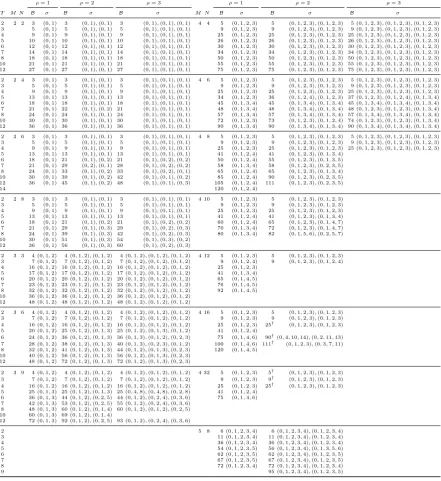
Table 2 provides the results from our search for optimal rotation matrices. Forρ∈ {1,2,3}and a wide range of dimensionsM×N, number of roundsT andsome trail-optimal choice ofσ, we give the number of active S-boxes it tightly guarantees, denotedB. Note that forρ= 2 with the 4×16 and 4×32 geometries, entries marked with† are results restricted to diffusion-optimal
Table 2.Results forM = 2,3,4,5
ρ= 1 ρ= 2 ρ= 3 ρ= 1 ρ= 2 ρ= 3
T M N B σ B σ B σ M N B σ B σ B σ
2 2 2 3 (0,1) 3 (0,1),(0,1) 3 (0,1),(0,1),(0,1) 4 4 5 (0,1,2,3) 5 (0,1,2,3),(0,1,2,3) 5 (0,1,2,3),(0,1,2,3),(0,1,2,3) 3 5 (0,1) 5 (0,1),(0,1) 5 (0,1),(0,1),(0,1) 9 (0,1,2,3) 9 (0,1,2,3),(0,1,2,3) 9 (0,1,2,3),(0,1,2,3),(0,1,2,3) 4 9 (0,1) 9 (0,1),(0,1) 9 (0,1),(0,1),(0,1) 25 (0,1,2,3) 25 (0,1,2,3),(0,1,2,3) 25 (0,1,2,3),(0,1,2,3),(0,1,2,3) 5 10 (0,1) 10 (0,1),(0,1) 10 (0,1),(0,1),(0,1) 26 (0,1,2,3) 26 (0,1,2,3),(0,1,2,3) 26 (0,1,2,3),(0,1,2,3),(0,1,2,3) 6 12 (0,1) 12 (0,1),(0,1) 12 (0,1),(0,1),(0,1) 30 (0,1,2,3) 30 (0,1,2,3),(0,1,2,3) 30 (0,1,2,3),(0,1,2,3),(0,1,2,3) 7 14 (0,1) 14 (0,1),(0,1) 14 (0,1),(0,1),(0,1) 34 (0,1,2,3) 34 (0,1,2,3),(0,1,2,3) 34 (0,1,2,3),(0,1,2,3),(0,1,2,3) 8 18 (0,1) 18 (0,1),(0,1) 18 (0,1),(0,1),(0,1) 50 (0,1,2,3) 50 (0,1,2,3),(0,1,2,3) 50 (0,1,2,3),(0,1,2,3),(0,1,2,3) 10 21 (0,1) 21 (0,1),(0,1) 21 (0,1),(0,1),(0,1) 55 (0,1,2,3) 55 (0,1,2,3),(0,1,2,3) 55 (0,1,2,3),(0,1,2,3),(0,1,2,3) 12 27 (0,1) 27 (0,1),(0,1) 27 (0,1),(0,1),(0,1) 75 (0,1,2,3) 75 (0,1,2,3),(0,1,2,3) 75 (0,1,2,3),(0,1,2,3),(0,1,2,3) 2 2 4 3 (0,1) 3 (0,1),(0,1) 3 (0,1),(0,1),(0,1) 4 6 5 (0,1,2,3) 5 (0,1,2,3),(0,1,2,3) 5 (0,1,2,3),(0,1,2,3),(0,1,2,3) 3 5 (0,1) 5 (0,1),(0,1) 5 (0,1),(0,1),(0,1) 9 (0,1,2,3) 9 (0,1,2,3),(0,1,2,3) 9 (0,1,2,3),(0,1,2,3),(0,1,2,3) 4 9 (0,1) 9 (0,1),(0,1) 9 (0,1),(0,1),(0,1) 25 (0,1,2,3) 25 (0,1,2,3),(0,1,2,3) 25 (0,1,2,3),(0,1,2,3),(0,1,2,3) 5 13 (0,1) 13 (0,1),(0,1) 13 (0,1),(0,1),(0,1) 34 (0,1,2,3) 36 (0,1,2,4),(0,1,2,3) 37 (0,1,2,3),(0,1,2,4),(0,1,3,4) 6 18 (0,1) 18 (0,1),(0,1) 18 (0,1),(0,1),(0,1) 45 (0,1,3,4) 45 (0,1,3,4),(0,1,3,4) 45 (0,1,3,4),(0,1,3,4),(0,1,3,4) 7 21 (0,1) 22 (0,1),(0,2) 21 (0,1),(0,1),(0,1) 48 (0,1,3,4) 48 (0,1,3,4),(0,1,3,4) 48 (0,1,2,3),(0,1,2,3),(0,1,3,4) 8 24 (0,1) 24 (0,1),(0,1) 24 (0,1),(0,1),(0,1) 57 (0,1,3,4) 57 (0,1,3,4),(0,1,3,4) 57 (0,1,3,4),(0,1,3,4),(0,1,3,4) 10 30 (0,1) 30 (0,1),(0,1) 30 (0,1),(0,1),(0,1) 72 (0,1,2,3) 73 (0,1,2,3),(0,1,2,4) 74 (0,1,2,3),(0,1,2,3),(0,1,3,4) 12 36 (0,1) 36 (0,1),(0,1) 36 (0,1),(0,1),(0,1) 90 (0,1,3,4) 90 (0,1,3,4),(0,1,3,4) 90 (0,1,3,4),(0,1,3,4),(0,1,3,4) 2 2 6 3 (0,1) 3 (0,1),(0,1) 3 (0,1),(0,1),(0,1) 4 8 5 (0,1,2,3) 5 (0,1,2,3),(0,1,2,3) 5 (0,1,2,3),(0,1,2,3),(0,1,2,3) 3 5 (0,1) 5 (0,1),(0,1) 5 (0,1),(0,1),(0,1) 9 (0,1,2,3) 9 (0,1,2,3),(0,1,2,3) 9 (0,1,2,3),(0,1,2,3),(0,1,2,3) 4 9 (0,1) 9 (0,1),(0,1) 9 (0,1),(0,1),(0,1) 25 (0,1,2,3) 25 (0,1,2,3),(0,1,2,3) 25 (0,1,2,3),(0,1,2,3),(0,1,2,3) 5 13 (0,1) 13 (0,1),(0,1) 13 (0,1),(0,1),(0,1) 41 (0,1,2,4) 41 (0,1,2,3),(0,1,3,4)
6 18 (0,1) 21 (0,1),(0,2) 21 (0,1),(0,2),(0,2) 50 (0,1,2,4) 55 (0,1,2,3),(0,1,3,5) 7 21 (0,1) 29 (0,2),(0,1) 28 (0,1),(0,2),(0,2) 58 (0,1,3,4) 58 (0,1,2,3),(0,2,3,5) 8 24 (0,1) 33 (0,1),(0,2) 33 (0,1),(0,2),(0,1) 65 (0,1,2,4) 65 (0,1,2,3),(0,1,3,4) 10 30 (0,1) 39 (0,1),(0,2) 42 (0,1),(0,1),(0,2) 85 (0,1,2,4) 90 (0,1,2,3),(0,2,3,5) 12 36 (0,1) 45 (0,1),(0,2) 48 (0,1),(0,1),(0,3) 105 (0,1,2,4) 111 (0,1,2,3),(0,2,3,5)
14 120 (0,1,2,4)
2 2 8 3 (0,1) 3 (0,1),(0,1) 3 (0,1),(0,1),(0,1) 4 10 5 (0,1,2,3) 5 (0,1,2,3),(0,1,2,3) 3 5 (0,1) 5 (0,1),(0,1) 5 (0,1),(0,1),(0,1) 9 (0,1,2,3) 9 (0,1,2,3),(0,1,2,3) 4 9 (0,1) 9 (0,1),(0,1) 9 (0,1),(0,1),(0,1) 25 (0,1,2,3) 25 (0,1,2,3),(0,1,2,3) 5 13 (0,1) 13 (0,1),(0,1) 13 (0,1),(0,1),(0,1) 41 (0,1,2,4) 41 (0,1,2,3),(0,1,3,4) 6 18 (0,1) 21 (0,1),(0,2) 21 (0,1),(0,2),(0,2) 60 (0,1,2,4) 65 (0,1,2,3),(0,1,4,7) 7 21 (0,1) 29 (0,1),(0,3) 29 (0,1),(0,2),(0,3) 70 (0,1,3,4) 72 (0,1,2,3),(0,1,4,7) 8 24 (0,1) 39 (0,1),(0,3) 42 (0,1),(0,2),(0,3) 80 (0,1,3,4) 82 (0,1,5,6),(0,2,5,7) 10 30 (0,1) 51 (0,1),(0,3) 54 (0,1),(0,3),(0,2)
12 36 (0,1) 56 (0,1),(0,3) 60 (0,1),(0,2),(0,3)
2 3 3 4 (0,1,2) 4 (0,1,2),(0,1,2) 4 (0,1,2),(0,1,2),(0,1,2) 4 12 5 (0,1,2,3) 5 (0,1,2,3),(0,1,2,3) 3 7 (0,1,2) 7 (0,1,2),(0,1,2) 7 (0,1,2),(0,1,2),(0,1,2) 9 (0,1,2,4) 9 (0,1,2,3),(0,1,2,4) 4 16 (0,1,2) 16 (0,1,2),(0,1,2) 16 (0,1,2),(0,1,2),(0,1,2) 25 (0,1,2,3)
5 17 (0,1,2) 17 (0,1,2),(0,1,2) 17 (0,1,2),(0,1,2),(0,1,2) 41 (0,1,3,4) 6 20 (0,1,2) 20 (0,1,2),(0,1,2) 20 (0,1,2),(0,1,2),(0,1,2) 65 (0,1,4,5) 7 23 (0,1,2) 23 (0,1,2),(0,1,2) 23 (0,1,2),(0,1,2),(0,1,2) 76 (0,1,4,5) 8 32 (0,1,2) 32 (0,1,2),(0,1,2) 32 (0,1,2),(0,1,2),(0,1,2) 92 (0,1,4,5) 10 36 (0,1,2) 36 (0,1,2),(0,1,2) 36 (0,1,2),(0,1,2),(0,1,2)
12 48 (0,1,2) 48 (0,1,2),(0,1,2) 48 (0,1,2),(0,1,2),(0,1,2)
2 3 6 4 (0,1,2) 4 (0,1,2),(0,1,2) 4 (0,1,2),(0,1,2),(0,1,2) 4 16 5 (0,1,2,3) 5 (0,1,2,3),(0,1,2,3) 3 7 (0,1,2) 7 (0,1,2),(0,1,2) 7 (0,1,2),(0,1,2),(0,1,2) 9 (0,1,2,3) 9 (0,1,2,3),(0,1,2,3) 4 16 (0,1,2) 16 (0,1,2),(0,1,2) 16 (0,1,2),(0,1,2),(0,1,2) 25 (0,1,2,3) 25† (0,1,2,3),(0,1,2,3) 5 20 (0,1,2) 25 (0,1,2),(0,1,3) 25 (0,1,2),(0,1,3),(0,1,2) 41 (0,1,2,4)
6 24 (0,1,2) 36 (0,1,2),(0,1,3) 36 (0,1,3),(0,1,2),(0,2,3) 75 (0,1,4,6) 90†(0,4,10,14),(0,2,11,13) 7 28 (0,1,2) 38 (0,1,2),(0,1,3) 40 (0,1,3),(0,2,3),(0,1,2) 100 (0,1,4,6) 111† (0,1,2,3),(0,3,7,11) 8 32 (0,1,2) 41 (0,1,2),(0,1,3) 44 (0,1,2),(0,1,3),(0,2,3) 120 (0,1,4,5)
10 40 (0,1,2) 56 (0,1,2),(0,1,3) 56 (0,1,2),(0,1,3),(0,2,3) 12 48 (0,1,2) 72 (0,1,2),(0,1,3) 72 (0,1,2),(0,1,3),(0,2,3)
2 3 9 4 (0,1,2) 4 (0,1,2),(0,1,2) 4 (0,1,2),(0,1,2),(0,1,2) 4 32 5 (0,1,2,3) 5† (0,1,2,3),(0,1,2,3) 3 7 (0,1,2) 7 (0,1,2),(0,1,2) 7 (0,1,2),(0,1,2),(0,1,2) 9 (0,1,2,3) 9† (0,1,2,3),(0,1,2,3) 4 16 (0,1,2) 16 (0,1,2),(0,1,2) 16 (0,1,2),(0,1,2),(0,1,2) 25 (0,1,2,3) 25† (0,1,2,3),(0,1,2,3) 5 25 (0,1,3) 25 (0,1,2),(0,1,3) 25 (0,4,8),(0,4,8),(0,2,8) 41 (0,1,2,4)
6 36 (0,1,3) 44 (0,1,2),(0,2,5) 44 (0,1,2),(0,2,4),(0,3,6) 75 (0,1,4,6) 7 42 (0,1,3) 53 (0,1,2),(0,2,5) 55 (0,1,2),(0,2,4),(0,3,6)
8 48 (0,1,3) 60 (0,1,2),(0,1,4) 60 (0,1,2),(0,1,2),(0,2,5) 10 60 (0,1,3) 69 (0,1,2),(0,1,4)
12 72 (0,1,3) 92 (0,1,2),(0,2,5) 93 (0,1,2),(0,2,4),(0,3,6)