CONJUGACY SEPARATION PROBLEM IN BRAIDS: AN ATTACK ON THE ORIGINAL COLORED BURAU KEY
AGREEMENT PROTOCOL
MATVEI KOTOV, ANTON MENSHOV, ALEXEY MYASNIKOV, DMITRY PANTELEEV, AND ALEXANDER USHAKOV
Abstract. In this paper, we consider the conjugacy separation search problem in braid groups. We deeply redesign the algorithm presented in [18] and provide an experimental evidence that the problem can be solved for 100% of very long randomly generated instances. The lengths of tested randomly generated instances is increased by the factor of two compared to the lengths suggested in the original proposal for 120 bits of security.
An implementation of our attack is freely available in CRAG, [6]. In particular, the implementation contains all challenging instances we had to deal with on a way to 100% success. We hope it will be useful to braid-group cryptography community.
Keywords. Algebraic eraser, braid group, colored Burau presentation, conjugacy problem, conjugacy separation, key agreement, cryptography.
2010 Mathematics Subject Classification. 03D15, 20F65, 20F10.
1. Introduction
The Anshel–Anshel–Goldfeld–Lemieux key agreement protocol (or col-ored Burau KAP, CBKAP, see [2]) was proposed to be used on low-cost platforms that constraint the use of computational resources. The core of the protocol is the concept of an Algebraic EraserTM(abbreviated AE) which was claimed to be a suitable primitive for use within lightweight cryptogra-phy. The AE primitive is based on an idea of using an action of a semidirect product of groups on a (semi)group to obscure involved algebraic structures. The underlying motivation for CBKAP is the need to secure networks that deploy Radio Frequency Identification (RFID) tags used for identification, authentication, tracing and point-of-sale applications.
1.1. Previous attacks. There are three attacks on CBKAP. The attack described in [18] was designed to solve the conjugacy separation problem for public data generated by the third trusted party (TTP) for Alice and Bob. Breaking the data generated by TTP allows to use a linear algebra attack to find the shared key as described in [2, Section 6]. The attack worked for
Date: May 22, 2018.
The second author was supported by Russian Science Foundation (project N16-11-10002).
relatively short keys and failed for the parameters suggested for practical use.
KTT attack [11] used linear algebra and attempted to determine a part of the private key data. According to [10] KTT just described a class of weak keys, that would not be used and by choosing the private key data in a specific way, this attack can be defeated.
Recently, the paper [5] improved the KTT attack. The new attack recon-structs the shared secret using all of the public information and performing a large precomputation. It is claimed in [3] that time complexity necessary for the attack to complete grows very fast for appropriately chosen parameters.
1.2. Our contribution. In this paper we deeply revise the attack proposed in [18] that operated based on geodesic-braid approximation only. We use ideas of geometric and computational group theory to defeat the TTP algo-rithm and solve the related conjugacy separation problem with 100% success rate for instances twice as long as originally proposed instances. Our algo-rithm does not use any specific assumptions on the given input except those described in the original paper [2].
2. Preliminaries: group of braids
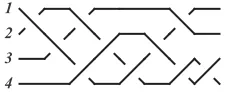
In this section we follow the exposition of [17, Section 5.1]. A braid is obtained by laying down a number of parallel pieces of strands and inter-twining then, without loosing track of the fact that they run essentially in the same direction. In our pictures the direction is horizontal. We number strands at each horizontal position from the top down. See Figure 1 for example.
1 2 3 4
Figure 1. A 4-strand braid.
x
1x
2x
3x
1x
2x
3 -1-1 -1
Figure 2. Generators of B4 and their inverses.
~
~
~
~
x
1x
3x
3x
1x
1x
2x
1x
2x
1x
2Figure 3. Typical relations in braids.
Each braid is uniquely defined by a sequence of strand crossings. A cross-ing is called positive if the front strand has a positive slope, otherwise it is called negative. There are exactly n−1 crossing types forn-strand braids, we denote them by x1, . . . , xn−1, wherexi is a positive crossing of ith and
i+ 1st strands. See Figure 2 for an example forB4. Since, as we mentioned above, any braid is a sequence of crossings, the set{x1, . . . , xn−1}generates
Bn. It is easy to see that crossings x1, . . . , xn−1 are subject to the relations [xi, xj] = 1
for everyi,j such that|i−j|>1 and
xixi+1xi =xi+1xixi+1
for everyisuch that 1≤i≤n−2. The corresponding braid configurations are shown in Figure 3. It is more difficult to prove that these two types of relations actually describe the equivalence on braids, i.e., the braid group
Bn has the following (Artin) presentation:
Bn=
x1, . . . , xn−1
xixjxi =xjxixj if|i−j|= 1
xixj =xjxi if|i−j|>1
.
A word w = w(x1, . . . , xn−1) in the generators of Bn and their inverses is
called a braid word. Length |w| of a braid wordw is the number of letters inw.
From this description, one easily sees that there are many pairs of com-muting subgroups in Bn, which makes it possible to useBn as the platform group for protocols. For example, Ko, Lee et al. [14] used the following two commuting subgroups: Ln=hx1, . . . , xdn
2e−1i and Un=hxd n
2e+1, . . . , xn−1i.
2.1. Dehornoy handle-free form. Let w be a word in generators of Bn. An xi-handle is a subword of wof the form
x−i εw(x1, . . . , xi−2, xi+1, . . . , xn)xεi,
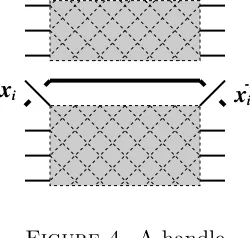
where ε = ±1. Schematically, an xi-handle can be shown as in Figure 4. An xi-handle x−i εwxεi where w = w(x1, . . . , xi−2, xi+1, . . . , xn) is called
x
ix
-1iFigure 4. A handle.
permitted if w does not containxi+1-handles. We say that the braid word
v0 is obtained from the braid wordv by aone step handle reduction if some subword ofv is a permitted xi-handlex−i εwxεi and v0 is obtained fromv by applying the following substitutions for all letters in a handlex−i εwxεi:
x±j1→
1 ifj=i, xεi+1x±i 1xεi+1 ifj=i+ 1,
x±j1 ifj < iorj > i+ 1.
Schematically, a reduction of anxi-handle can be shown as in Figure 5. We
Figure 5. Removing a permitted xi-handle.
say that the braid wordv0is obtained from the braid wordvbymstep handle reduction if there exists a sequence of m+ 1 words v = v0, v1, . . . , vm = v0 each of which is obtained from the previous one by a one step handle reduction. A braid word is calledhandle-free if it contains no handles. The next theorem describes the main properties of handle reduction.
• Any sequence of handle reductions applied toveventually stops and produces a handle-free braid wordv0 (which in general depends on a particular sequence of reductions) representing the same element of the braid group asv.
• The word v represents identity of a braid group if and only if any sequence of handle reductions applied tovproduces the trivial word.
Remark 2.1 (Complexity estimates). Even though the handle reduction procedure in practice is very efficient and most of the time works in linear time in terms of the length of a braid word, there is no good theoretical complexity estimate. For more on strategies for handle reduction and the the related discussion on complexity issues see [8, Section 3.3].
2.2. Garside normal form. The group Bn has a cyclic center generated by the element ∆2, where ∆ is the element called the half twist and can be expressed in the generators of Bn as follows:
∆ = (x1. . . xn−1)·(x1. . . xn−2)·. . .·(x1). Any elementg∈Bn can be uniquely represented in the form
∆pξ1. . . ξp
whereξ1, . . . , ξp arepermutation braids satisfying certain conditions, called the left Garside normal form. For more detail see [9, Chapter 9].
2.3. Geodesic braid approximation. Let w be a word in generators of
Bn. The problem of computing a geodesic word for words inB∞ is known
to be NP-complete (see [19]). It is known however (see e.g. [20, 12, 13]) that many NP-complete problems have polynomial time generic- or average-case solutions or have good approximate solutions.
The following algorithm tries to minimize the given braid word. It exploits the property of Dehornoys form that for a “generic” braid word w one has
|D(w)|<|w|.
Algorithm 2.2 (Braid Minimization).
Input. A word w=w(x1, . . . , xn−1) in generators of the braid group Bn. Output. A word w0 such that |w0| ≤ |w| and w0 =w in Bn.
Initialization. Put w0 =w and i= 0.
Computations.
(1) Increment i. (2) Put wi =D(wi−1).
(3) If |wi|<|wi−1|then: (a) Put wi =w∆i
(b) Goto (1).
(4) If iis even then output w0 =w∆i+1. (5) If iis odd then output w0 =wi+1.
The method was introduced in paper [15, 16] where it was successfully used to break protocols [1, 14].
2.4. Colored Burau group. Fix a primep and denote byRn be the ring of Laurent polynomials innvariables{t1, . . . , tn}with coefficients inFp. Let
GLn(Rn) be the group of invertible matrices overRn. The symmetric group Snnaturally acts onGLn(Rn) by permuting the variables{t1, . . . , tn}. The result of action of σ∈Sn on M ∈GLn(Rn) is denoted by Mσ. Recall that
a semidirect product ofGLn(Rn) andSn is a group
GLn(Rn)oSn={(M, π)|M ∈GLn(Rn) andπ ∈Sn},
equipped with the operation
(M1, σ1)·(M2, σ2) = (M1M2σ1, σ1σ2).
Define n−1n×n-matrices over polynomials in variablest={t1, . . . , tn}:
C1(t1) =
−t1 1 0 0 1 0 0 0 In−2
and Ci(ti) =
Ii−2 0 0 0 0
0 1 0 0 0
0 ti −ti 1 0
0 0 0 1 0
0 0 0 0 In−i−1
for 2≤i≤n−1.
Lemma. A mapϕon the generators x1, . . . , xn−1 of Bn: xi7→ϕ (Ci(ti), πi),
whereπi= (i, i+ 1)∈Sn, extends into a group homomorphism.
The group h(C1(t1), π1), . . . ,(Cn−1(tn−1), πn−1)i is called thecolored
Bu-rau representation ofBn and is denoted byCBn.
2.5. Action of CBn on a certain finite set. Fix n nontrivial elements
τ1, . . . , τn∈Fp termedt-values and define a group homomorphism :GLn(Rn)→GLn(Fp),
that for eachireplacesti with the valueτi. For (m, σ)∈GLn(Fp)×Sn and
(C, ρ)∈CBn define
(m, σ)?(C, ρ) = (m·(Cσ), σρ),
which defines an action of CBn on GLn(Fp)×Sn and, hence, an action of Bn onGLn(Fp)×Sn. We say that (m1, t1) and (m2, t2) in CBn?-commute if the equality
3. The protocol
Before the parties perform actual transmissions the following data is being prepared by the Third Trusted Party (TTP).
• A matrix m0 ∈ GLn(Fp) which has an irreducible characteristic
polynomial overFp. The choice ofm0is not relevant for the purposes of this paper, we refer the reader to [2] for more information on how
m0 can be generated randomly.
• ?-commuting subgroups A = hw1, . . . , wγi and B = hu1, . . . , uγi of the group CBn. We want to point out that the elements wi and vj are given to us as products of generators of CBn and there in-verses, i.e., as formal words in group alphabet {g1, . . . , gn−1}. We prefer this form because it allows us to avoid time consuming matrix multiplication inGLn(Rn).
Both the matrixm0 and subgroupsAandB can be chosen only once. Now, the public and private keys are chosen as follows:
Alice’s Private Key: is a pair which consists of a matrix of the form
na=l1mα01 +l2mα02+. . .+lrmα0r ∈GLn(Fp)
(where l1, . . . , lr ∈ Fp and r, α1, . . . , αr ∈ Z+) and a random sequence
wε1
i1, . . . , w
εm
im of generators of Aand their inverses.
Alice’s Public Key: is an element
Apublic= (na, id)? wε1
i1 ? . . . ? w
εm
im ∈GLn(Fp)×Sn.
Recall that eachwik is given as a formal product of the generators ofG. To
perform the?-operation efficiently one should not directly computewik, but
consequently apply the factors ofwik to the argument.
Bob’s Private Key: is a pair which consists of a matrix of the form
nb=l10m
β1
0 +l
0
2m
β2
0 +. . .+l
0
r0m
βr0
0 ∈GLn(Fp)
(where l01, . . . , lr00 ∈ Fp and r0, β1, . . . , βr0 ∈ Z+) and a random sequence
vδ1
j1, . . . , v
δl
jl of generators of B and their inverses.
Bob’s Public Key: is a pair
Bpublic = (nb, id)? vjδ1i? . . . ? v
δl
jl ∈GLn(Fp)×Sn.
Again, each vjk is given as a formal product of the generators ofCBn. To
perform the?-operation efficiently one should not directly computevjk, but
consequently apply the factors ofvjk to the argument.
The shared key: is an element ofGLn(Fp)×Sn obtained by Alice in the
form
[(na, id)·Bpublic]? wεi11? . . . ? w
εm im
and by Bob in the form
[(nb, id)·Apublic]? vjδ1i ? . . . ? v
δl jl.
It requires a little work to prove that the obtained elements are indeed equal inGLn(Fp). We omit the proof.
3.1. TTP algorithm. The cornerstone part of the proposed key exchange is the choice of ?-commuting subgroups of the group CBn. For that one
can generate commuting subgroupsAandB inBnand map them intoCBn
using the epimorphism ϕdefined in Section 2.4. The subgroups ϕ(A) and
ϕ(B) commute. Moreover, for any choice ofthe subgroupsϕ(A) andϕ(B)
?-commute.
Since ∆2 is a central element, it follows that elements u, w commute in
Bn if and only u∆2p and w∆2r do (for any p, r ∈ Z). Hence, we may always assume that the normal forms of the generators {w1, . . . , wγ} and {v1, . . . , vγ} have the exponent on ∆ equal to 0 or −1. When we say that we reduce a braid modulo ∆2 we mean changing the ∆-power of its Garside normal form to−1 or 0 depending on parity. The algorithm below (originally proposed in [2]) generates two commuting subgroups inBn.
Algorithm 3.1. (TTP algorithm)
(1) Choose two secret subsetsBL={xl1, . . . , xlα},BR={xr1, . . . , xrβ}
of the set of generators of Bn, where|li−rj| ≥ 2 for all 1≤i≤lα
and1≤j ≤rβ.
(2) Choose a secret elementz∈Bn.
(3) Choose words {w1, . . . , wγ} of bounded length over the generators
BL.
(4) Choose words{v1, . . . , vγ}of bounded length over the generatorsBR. (5) For each i= 1, . . . , γ:
(a) calculate the left normal form of zwiz−1 and reduce the result modulo ∆2;
(b) putwi0 to be a braid word corresponding to the element calculated in (a);
(c) calculate the left normal form of zviz−1 and reduce the result
modulo ∆2;
(d) putv0i to be a braid word corresponding to the element calculated in (c).
(6) Publish the sets{v01, . . . , v0γ} and {w01, . . . , w0γ}.
TTP algorithm produces generators of two commuting subgroups in Bn. Alice and Bob apply epimorphism ϕ (defined in Section 2.4) to obtain ? -commuting subgroups.
3.2. Security assumptions. It was noticed in [2] that if the conjugator
equations
(1)
w01 = ∆2p1zw
1z−1
. . .
w0γ= ∆2pγzwγz−1 v10 = ∆2r1zv
1z−1
. . .
vγ0 = ∆2rγzvγz−1
which has too many unknowns, since only left hand sides (i.e., elements
w01, . . . , w0γ, v10, . . . , v0γ) are known. Hence, it might be difficult to find the originalz.
It was noticed in [18] that one does need to use exactly the same z to apply the linear attack [2, Section 6]. In fact, any solutionz0 of the problem stated below plays a role of a conjugator z.
Simultaneous conjugacy separation search problem inBn(SCSSP). For tuples {v01, . . . , vγ0} and {w10, . . . , w0γ}find any z0 ∈Bn and
p1, . . . , pγ, r1, . . . , rγ ∈Z such that the words
{∆2p1z0−1v0
1z
0, . . . ,∆2pγz0−1v0 γz
0}
and
{∆2r1z0−1w0
1z0, . . . ,∆2rγz0−1wγ0z0}
can be expressed as words over two disjoint commuting subsets of generators of Bn.
SCSSP has little in common with thesimultaneous conjugacy search prob-lem often referenced in the papers on the braid group cryptography. The main difference is that in the conjugacy search problem both conjugate ele-ments are available and the goal is to recover the secret conjugator. In case of SCSSP, only the left hand side of the equation is known. The problem was analyzed in [18] with some limited success.
4. The attack
In this paper we improve the results of [18]. The original form of the attack is deeply revised to work for very long keys. We updated all key components to achieve 100% success rate on the tested instances of the protocol. We also introduced several new components. The new attack works as follows for the given instance{v10, . . . , v0γ},{w01, . . . , w0γ}of the separation problem: (1) Multiply each word in the tuples {v01, . . . , vγ0},{w10, . . . , wγ0} by an
anticipated ∆2-power. See Section 4.2 for more detail.
(2) Enumerate conjugates of the instance{v10, . . . , v0γ},{w10, . . . , wγ0} us-ing length-based heuristic:
(a) On each iteration pick an unchecked instance of the least total length.
(b) Conjugate the instance by all generators x±i 1 of Bn and save new instances (see Sections 4.3 and 4.4).
(c) Termination condition (see Section 4.1):
• Claim success if separated tuples are found.
• Accept failure when can not find separated tuples in an allocated time (set to 12 hours in our experiments). (d) If stuck (20 iterations with no length decrease):
• Apply ∆-fix if it is applicable. (see Section 4.5).
• If not, then restart enumeration of conjugates (see Section 4.6).
Below we describe each component of the attack in detail.
4.1. Termination condition. We say that tuples{v1, . . . , vγ}and{w1, . . . , wγ}
areseparated if the letters involved in v1, . . . , vγ and the letters involved in w1, . . . , wγ commute. One can compute the number of occurrences of each letter in each words and output the result as a table (with the total length on the right), below is an example forB8 withγ = 3:
v1: [ 34. 52. 34. 0. 0. 0. 0.] -> 120 v2: [ 33. 70. 33. 0. 0. 0. 0.] -> 136 v3: [ 36. 46. 46. 0. 0. 0. 0.] -> 128
w1: [ 0. 0. 0. 0. 28. 53. 39.] -> 120 w2: [ 0. 0. 0. 0. 21. 43. 36.] -> 100 w3: [ 0. 0. 0. 0. 36. 52. 28.] -> 116
It is clear that the tuples with a table as above are separated. Clearly, the program can declare success and stop when it gets an instance with two separated tuples.
Unfortunately, this condition turned out to be weak for tuples of long braid words. We apply braid-minimization to each word that often fails to remove some letters even when those letter can be removed. The original attack often was stuck with tuples of the following form:
v1: [ 0. 0. 0. 0.150.241.157.] -> 548 v2: [ 0. 0. 0. 0.168.199.125.] -> 492 v3: [ 0. 0. 0. 0.147.230.153.] -> 530
w1: [139.226.133. 0. 0. 0. 0.] -> 498 w2: [120.245.160. 3. 0. 0. 0.] -> 528 w3: [133.212.151. 0. 0. 0. 0.] -> 496
where the words appear to be “almost separated” with an exception of a single braid word w2. But, experimenting with braid-minimization we noticed the following:
• Dehornoy handle-free form ∆D(∆−1w∆)∆−1 “favors” cancellations of higher-indexed letters inw.
Our new termination condition uses this observation and checks if the fol-lowing two conditions hold:
• {D(v1), . . . , D(vγ)}and{∆D(∆−1w1∆)∆−1, . . . ,∆D(∆−1wγ∆)∆−1}
are separated;
• {D(w1), . . . , D(wγ)}and{∆D(∆−1v1∆)∆−1, . . . ,∆D(∆−1vγ∆)∆−1}
are separated.
4.2. Initial ∆2-power guess. Each word vi0 = ∆2pizviz−1 [and wi’ resp.]
is obtained from zviz−1 [zwiz−1’ resp.] by multiplying it by a ∆2-power. The initial step in our attack is an attempt to reconstruct the original values
pi and ri.
There are several tools available for this task. The original paper [18] used a length-aided heuristic to find the value of the dropped ∆2-power in
vi’s and wi’s. Our new attack uses abelianization of Bn instead. Abelian-ization can be computed in linear time which is a huge advantage over braid-minimization. Recall that abelianization of Bn is a homomorphism
α:Bn→Bn/Bn0 =hx1, . . . , xn−1 |x1 =. . .=xn−1i 'Z,
that in a given braid-word w counts the number of positive letters minus the number of negative letters. Observe that:
• α(∆2) =n(n−1).
• α(∆2pzwz−1) =pn(n−1) +α(w).
• The expected value of the abelianization value is:
E(|α(w)|)≈ p
|w|,
for a randomly uniformly generated braid-wordw.
For instance, ifn= 16 and|w|= 1000 we getE(|α(w)|)≈33 andα(∆2pzwz−1) = 240·p+α(w), which is a sum of the value α(w) (expected to be relatively small) and a multiple of 240.
Using the observation above, it is natural to define an anticipated ∆2 -power forw0i (and, similarly, forvi0) to be the numberp0i that minimizes the value of the abelianization|pn(n+ 1) +α(w0i)|. Hence, the initial step of the attack performs the following:
• Compute p0i ∈ Zthat minimizes the value |p0in(n+ 1) +α(w0i)| and
multiplyw0i by ∆2p0i.
• Compute r0i ∈ Z that minimizes the value |r0in(n+ 1) +α(vi0)| and multiplyv0i by ∆2r0i.
This procedure works as expected when |α(wi0)|,|α(vi0)| ≤ 1
2n(n−1). Oth-erwise it produces a slightly incorrect value (fixed as described in Section 4.5). The chance that the above inequality holds is higher for large values of the rank n.
4.3. Producing new instances. On each iteration the program chooses an unchecked instance {w1, . . . , wγ} and {v1, . . . , vγ} of the least total length.
The instance is conjugated by generators and their inverses x±11, . . . , x±n−11:
{x±i 1w1x∓i 1, . . . , x
±1
i wγx∓i 1},{x
±1
i v1x∓i 1, . . . , x
±1
i vγx∓i 1},
to produce new equivalent instances of the conjugacy separation problem. The obtained words are minimized using braid-minimization and new in-stances are saved as unchecked.
4.4. Fast descend for long conjugatorsz. Each iteration applies braid-minimization to 2γ·2(n−1) braid words (number of words in an instance times the number of generators and their inverses). For instance, if γ = 10,
n = 16, and |vi| = |wi| = |z| ≈ 1000, then each iteration applies
braid-minimization to 600 words of length at least 1000 which is very time con-suming. A heuristic search procedure that conjugates an instance by a single generator is expected to take at least|z| ≈1000 steps to reach the answer.
To make search more efficient we use the following trick. For an instance
{w1, . . . , wγ}and{v1, . . . , vγ}we take the terminal segmentxofw1of length
|w1|/10, conjugate byxand add a new instance{xw1x−1, . . . , xwγx−1}and {xv1x−1, . . . , xvγx−1}to the set of unchecked instances. This approach often
decreases the total length of the instance by as much as 10–20% on several iterations in the beginning of heuristic descend.
4.5. Fixing wrong∆2-powers. As we mentioned in Section 4.2, the initial ∆2-power guess can produce an incorrect value and we do not have any tools to immediately recognize the mistake. Fortunately, we can recognize the problem deep inside our enumeration of conjugate instances. But first we need to introduce concepts of a crossing number and tuples separated modulo ∆2.
Recall that thecrossing number cij ofith andjth strands in a braidwis
the algebraic number of positive crossings ofith andjth strands minus the negative number of crossings of the same strands. The next lemma allows to find the value pin a braid of the form w∆2p, where w∈ hx1, . . . , xki, by observing the crossing numbers. Its proof is trivial.
Lemma 4.1. If w∈ hx1, . . . , xki, then for w∆2p we have:
(2) cij = 2p for every1≤i≤n and every j≥k+ 2.
We say that tuples {v1, . . . , vγ} and {w1, . . . , wγ} are separated modulo
∆2 if
vi = ∆2piv∗
i and wi= ∆2riw
∗
i,
This behavior is not surprising since ∆2 is a central element. Multipli-cation of a word in an instance by ∆2 and conjugating the instance by a generator are commuting actions, which means that recovery of ∆2-powers and finding a secret conjugator can be performed in any order.
4.6. Restarting enumeration of conjugates. Testing the program we found several special instances with correct ∆2-powers that could not be minimized any further and did not produce separated tuples. Letter-distribution for those examples looked as in the example below:
[ 8. 8.192.291.186. 9. 4.] -> 698 [ 6. 7.194.262.193. 9. 5.] -> 676 [ 0. 0.196.290.168. 0. 0.] -> 654
[ 4. 7.173.280.192. 15. 5.] -> 676 [ 4. 7. 10. 10.163.283.219.] -> 696 [ 4. 7. 10. 10.173.252.204.] -> 660
Letters in the first tuple concentrate in the middle instead of being concen-trated on the left or on the right. (Also, we have wrong values of ∆2-powers in the example above.) This type of distribution could be obtained by con-jugating the instance byδ (the fundamental braid in Birman-Ko-Lee form). To solve those instances our current implementation aborts computation, conjugates the best obtained instance by a random word of length 500, and starts enumeration of conjugates again.
4.7. Parallel computations. The attack described above operates on tu-ples of braids. Most stages of the attack can be easily parallelized using basic tools of the standard C++ library. For instance, the attack per-forms numerous conjugations of tuples by generators the of Bn followed
by braid-minimization. In our implementation braid-minimization for each wordw1, . . . , wγ, v1, . . . , vγ is run in parallel using std::thread. Using paral-lel computations we achieved eight-twelve times improved running time for some stages of the algorithm. See section 5 for effective CPU usage numbers.
5. Experimental results
To test success of our attack we performed series of experiments for ran-domly generated instances with |vi|=|wi|=|z| ≈20,50,100,200,500,1000 in braid groups B8, B12, B16, B20 with γ = 10. The program was 100% successful for each parameter set, see Table 1.
All braids were generated uniformly randomly as braid-words on standard generatorsx1...xn−1and their inverses. (We do not use any particular prop-erties of braids, such as order of corresponding permutation, hence uniform approach is fair.) Using an appropriate conjugator, we may always assume that the sets BLandBRsplit the set of standard generators in two halves. Experiments were performed on a machine with two 8-core 3.1 GHz Intel Xeon CPU E5-2687W and 64GB RAM. On average our implementation was
using 3 to 5 cores, with up to 12 cores at its peak. Memory usage was less than 2 GB for parameters|vi|=|wi|=|z| ≈1000 in B20.
B8 B12 B16 B20
|vi|=|wi|=|z| ≈20 100% 100% 100% 100% |vi|=|wi|=|z| ≈50 100% 100% 100% 100% |vi|=|wi|=|z| ≈100 100% 100% 100% 100% |vi|=|wi|=|z| ≈200 100% 100% 100% 100% |vi|=|wi|=|z| ≈500 100% 100% 100% 100% |vi|=|wi|=|z| ≈1000 100% 100% 100% 100%
Table 1. Success rate.
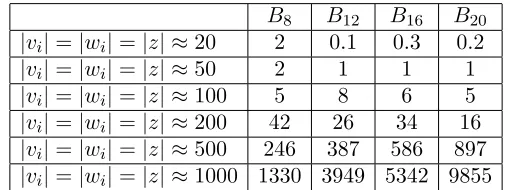
Table 2 shows time (in minutes) our program spent on 100 randomly generated instance of the problem.
Remark 5.1. Numbers in Table 2 require some explanation. In the row for |vi| = |wi| = |z| ≈ 200 the value for B8 is greater than the values for
B12, B16, B20. It happens because the chance of a wrong ∆2-power guess is higher for smaller values of the rankn. On the other hand, for|vi|=|wi|=
|z| ≈ 500 complexity of applying braid-minimization overwhelms the time the program spends to fix wrong ∆2-powers. We observe increasing values in the corresponding row.
B8 B12 B16 B20
|vi|=|wi|=|z| ≈20 2 0.1 0.3 0.2 |vi|=|wi|=|z| ≈50 2 1 1 1 |vi|=|wi|=|z| ≈100 5 8 6 5 |vi|=|wi|=|z| ≈200 42 26 34 16 |vi|=|wi|=|z| ≈500 246 387 586 897 |vi|=|wi|=|z| ≈1000 1330 3949 5342 9855 Table 2. Time required to solve 100 random instances of
the problem (in minutes). See Remark 5.1 for discussion.
B8 B12 B16 B20
B8 B12 B16 B20
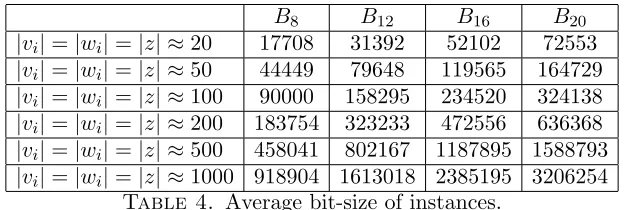
|vi|=|wi|=|z| ≈20 17708 31392 52102 72553
|vi|=|wi|=|z| ≈50 44449 79648 119565 164729
|vi|=|wi|=|z| ≈100 90000 158295 234520 324138 |vi|=|wi|=|z| ≈200 183754 323233 472556 636368 |vi|=|wi|=|z| ≈500 458041 802167 1187895 1588793 |vi|=|wi|=|z| ≈1000 918904 1613018 2385195 3206254
Table 4. Average bit-size of instances.
Table 3 shows average total length of the public tuples after length reduc-tion: |v1|+. . .+|vγ|+|w1|+. . .+|wγ|. Table 4 shows average total length
of the public tuples after length reduction: (|v1|+. . .+|vγ|+|w1|+. . .+
|wγ|)·(log2(n) + 1).
6. Conclusion
We showed that 100% of randomly generated instances of the conjugacy separation problem of length twice as long as originally proposed can be broken in less than two hours by a heuristic algorithm that operates based on “geometric tools” such as geodesic-length approximation, abelianization, and cross-numbers for braids. Our tools are not perfect (especially geodesic-length approximation that often gives far from optimal results), yet, they are sufficient for the task. We believe our algorithm has a lot of potential and can work for much longer instances of conjugacy separation problem (of course, some sufficient time should allocated to accommodate the increase). Our algorithm does not use any special assumptions on the given inputs except those described in the original paper [2]. This shows that the original protocol described in [2] cannot provide a significant level of security.
Our attack gives a very important tool. Most group-theoretic protocols (even those that use non-abelian platform groups) require a choice of com-muting elements (that’s the case for the “ancient” Ko-Lee protocol, for CBKAP, and for very recent protocols such as Kayawood [4]. Typically, choice of commuting elements is done by picking two “naturally commuting” subgroups (LnandUnin braids) and then conjugating them with some
mix-ing conjugator. “Naturally commutmix-ing” subgroups are typically bad as they nontrivially act on some disjoint spaces and the action of the shared key can be reconstructed based on public keys (that’s the case for E-multiplication). Our paper shows that using a mixing conjugator does not help: given two conjugated (braid-)tuples we can always conjugate them back to “naturally commuting” subgroups and recover the shared key.
References
[1] I. Anshel, M. Anshel, and D. Goldfeld. An algebraic method for public-key cryptog-raphy.Math. Res. Lett., 6(3-4):287–291, 1999.
[2] I. Anshel, M. Anshel, D. Goldfeld, and S. Lemieux. Key agreement, the algebraic eraserT M, and lightweight cryptography. InAlgebraic Methods in Cryptography,
vol-ume 418 ofContemporary Mathematics, pages 1–34. American Mathematical Society, 2006.
[3] I. Anshel, D. Atkins, D. Goldfeld, and P. Gunnells. Defeating the Ben-Zvi, Blackburn, and Tsaban Attack on the Algebraic Eraser. preprint. Available at arXiv:1601.04780v1 [cs.CR], 20126.
[4] I. Anshel, D. Atkins, and P. Goldfeld, D. Gunnels. Kayawood, a Key Agreement Protocol. Preprint. Available athttps://eprint.iacr.org/2017/1162(version: 30-Nov-2017), 2017.
[5] A. Ben-Zvi, S. Blackburn, and B. Tsaban. A practical cryptanalysis of the algebraic eraser. In Advances in Cryptology – CRYPTO 2016, volume 9814 ofLecture Notes Comp. Sc., pages 179–189, Berlin, 2016. Springer.
[6] CRyptography And Groups (CRAG) C++ Library. Available athttps://github. com/stevens-crag/crag.
[7] P. Dehornoy. A fast method for comparing braids.Adv. Math., 125:200–235, 1997. [8] P. Dehornoy, I. Dynnikov, D. Rolfsen, and B. Wiest. Why are braids orderable?
Societe Mathematique De France, 2002.
[9] D. B. A. Epstein, J. W. Cannon, D. F. Holt, S. V. F. Levy, M. S. Paterson, and W. P. Thurston.Word processing in groups. Jones and Bartlett Publishers, 1992. [10] D. Goldfeld and P. Gunnells. Defeating the Kalka-Teicher-Tsaban linear algebra
at-tack on the Algebraic Eraser. preprint. Available at eprint 1202.0598, 2012.
[11] A. Kalka, M. Teicher, and B. Tsaban. Short expressions of permutations as products and cryptanalysis of the algebraic eraser.Adv. Appl. Math., 49:57–76, 2012.
[12] I. Kapovich, A. G. Miasnikov, P. Schupp, and V. Shpilrain. Generic-case complexity, decision problems in group theory and random walks.J. Algebra, 264:665–694, 2003. [13] I. Kapovich, A. Myasnikov, P. Schupp, and V. Shpilrain. Average-case complexity
and decision problems in group theory.Adv. Math., 190:343–359, 2005.
[14] K. H. Ko, S. J. Lee, J. H. Cheon, J. W. Han, J. Kang, and C. Park. New public-key cryptosystem using braid groups. InAdvances in Cryptology – CRYPTO 2000, volume 1880 ofLecture Notes Comp. Sc., pages 166–183, Berlin, 2000. Springer. [15] A. G. Miasnikov, V. Shpilrain, and A. Ushakov. A practical attack on some braid
group based cryptographic protocols. InAdvances in Cryptology – CRYPTO 2005, volume 3621 ofLecture Notes Comp. Sc., pages 86–96, Berlin, 2005. Springer. [16] A. G. Miasnikov, V. Shpilrain, and A. Ushakov. Random subgroups of braid groups:
an approach to cryptanalysis of a braid group based cryptographic protocol. In Ad-vances in Cryptology – PKC 2006, volume 3958 ofLecture Notes Comp. Sc., pages 302–314, Berlin, 2006. Springer.
[17] A. G. Miasnikov, V. Shpilrain, and A. Ushakov.Non-Commutative Cryptography and Complexity of Group-Theoretic Problems. Mathematical Surveys and Monographs. AMS, 2011.
[18] A. D. Myasnikov and A. Ushakov. Cryptanalysis of Anshel-Anshel-Goldfeld-Lemieux key agreement protocol.Groups Complex. Cryptol., 1:263–275, 2009.
[19] M. Paterson and A. Razborov. The set of minimal braids is co-NP-complete.J. Al-gorithms, 12:393–408, 1991.
Department of Mathematics, Stevens Institute of Technology, Hoboken, NJ, USA
E-mail address: [email protected]
Department of Mathematics, Stevens Institute of Technology, Hoboken, NJ, USA, Institute of Mathematics and Information Technologies, Dosto-evskii Omsk State University, Omsk, Russia
E-mail address: [email protected]
Department of Mathematics, Stevens Institute of Technology, Hoboken, NJ, USA
E-mail address: [email protected]
Department of Mathematics, Stevens Institute of Technology, Hoboken, NJ, USA
E-mail address: [email protected]
Department of Mathematics, Stevens Institute of Technology, Hoboken, NJ, USA
E-mail address: [email protected]